
Research article · 2024 · Full text
International Journal of Veterinary Sciences and Animal HusbandryTANUVAS KPM gold pig: A source of livelihood and nutritional security to farmers of North Eastern part of Tamil Nadu
Volume 9(6) · Pages 23–25 · DOI: 10.22271/veterinary.2024.v9.i6a.1826 ↗
Research areasAgricultural Economics and PracticesLivestock Management and Performance ImprovementAgricultural Systems and Practices
Abstract
Author-writtenA study was undertaken with the objective to popularize TANUVAS KPM Gold pig among rural farmers for their nutritional security and livelihood status improvement in North Eastern parts of Tamil Nadu. A total number of 30 pigs were distributed to five Scheduled Caste farmers along with feed. The findings of the study revealed that the average body weight at 6 months, 8 months, feed conversion ratio, benefit cost ratio were 55.5 kg, 72.4 kg, 3.61 and 1.72 respectively when compared to the desi pig parameters of 35.2 kg, 56.8 kg, 5.42 and 1.23 respectively. The improved gross income of 27.64% positively impacted the farmers livelihood status and pork obtained assured their nutritional security. The benefit cost ratio obtained as a result of TANUVAS KPM Gold pig rearing was 39.83% more than the desi rearing.
Summary
Source-checkedPlain-language reading of the full paper, prepared with AI and checked against the text. Each point links to the authors' own words.
Why it matters
- Pig farming in India helps meet the protein needs of a growing population and improves the livelihoods of people in rural areas. View evidence ↗
- The pig population in Tamil Nadu has seen a significant decline, dropping from 183,983 in the 19th census to 66,772 in the 20th census. View evidence ↗
- Factors contributing to the decline of the pig population include a lack of quality germplasm, insufficient training in scientific farming, and marketing challenges. View evidence ↗
The question
- The study aimed to popularize the TANUVAS KPM Gold pig among rural farmers in North Eastern Tamil Nadu to improve their livelihood and nutritional security. View evidence ↗
What they did
- The researchers distributed a total of 30 pigs and accompanying feed to five Scheduled Caste farmers. View evidence ↗
- Each participating farmer received 6 pigs (3 male and 3 female) and 60 kg of free pig grower feed. View evidence ↗
- The study used 4-month-old pigs from the Post Graduate Research Institute in Animal Sciences and feed from the Central Feed Technology Unit, both located in Kattupakkam. View evidence ↗
- Researchers periodically measured body weight at 6 and 8 months, mortality, and feed efficiency for both the TANUVAS KPM Gold and local desi pigs. View evidence ↗
What they found
- TANUVAS KPM Gold pigs showed superior performance over desi pigs, with average weights of 55.5 kg at 6 months and 72.4 kg at 8 months, compared to 35.2 kg and 56.8 kg for desi pigs. View evidence ↗
- The feed conversion ratio for TANUVAS KPM Gold pigs was 3.61, which is more efficient than the 5.42 ratio observed in desi pigs. View evidence ↗
- Rearing TANUVAS KPM Gold pigs increased gross income by 27.64%, improving the farmers' livelihoods and providing nutritional security through pork. View evidence ↗
- The benefit-cost ratio for the TANUVAS KPM Gold pig was 39.83% higher than that of desi pig rearing. View evidence ↗
- The use of scientific feeding and balanced feed resulted in a feed conversion ratio that was 33.39% better than traditional farmer practices. View evidence ↗
What it means
- The authors conclude that rearing TANUVAS KPM Gold pigs improves rural livelihoods, achieving a benefit-cost ratio of 1.72. View evidence ↗
- The study did not examine reproduction parameters, which are necessary to determine the impact of establishing pig breeding units by farmers. View evidence ↗
Visual summary
3 visualsIllustrations explain the paper; charts are replotted from the paper's own table values.
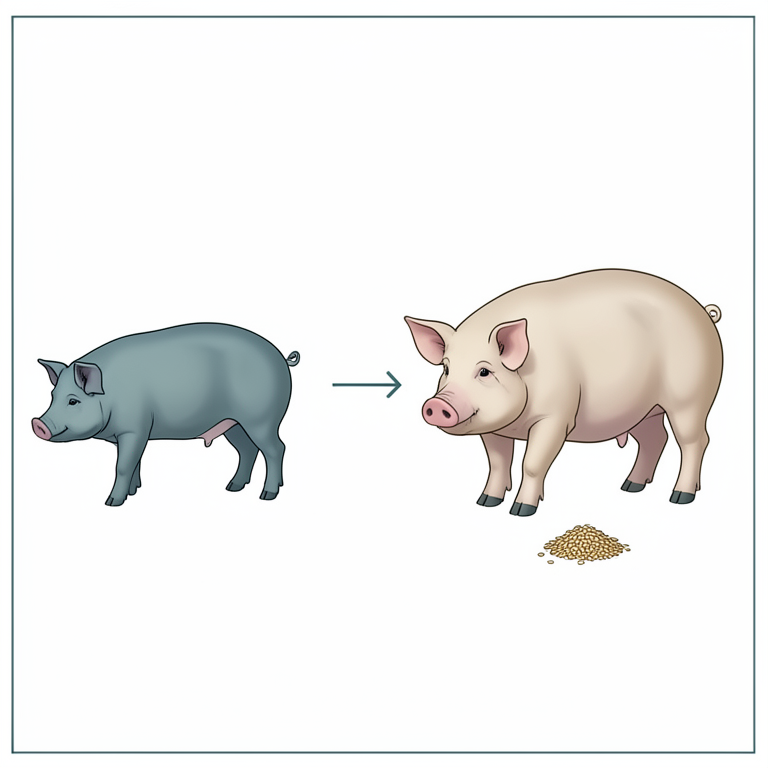
Growth and Efficiency Comparison
AI-generated conceptual illustration (TANUVAS KPM gold pigs and desi pigs). It explains the idea and does not show study data.
View source evidence ↗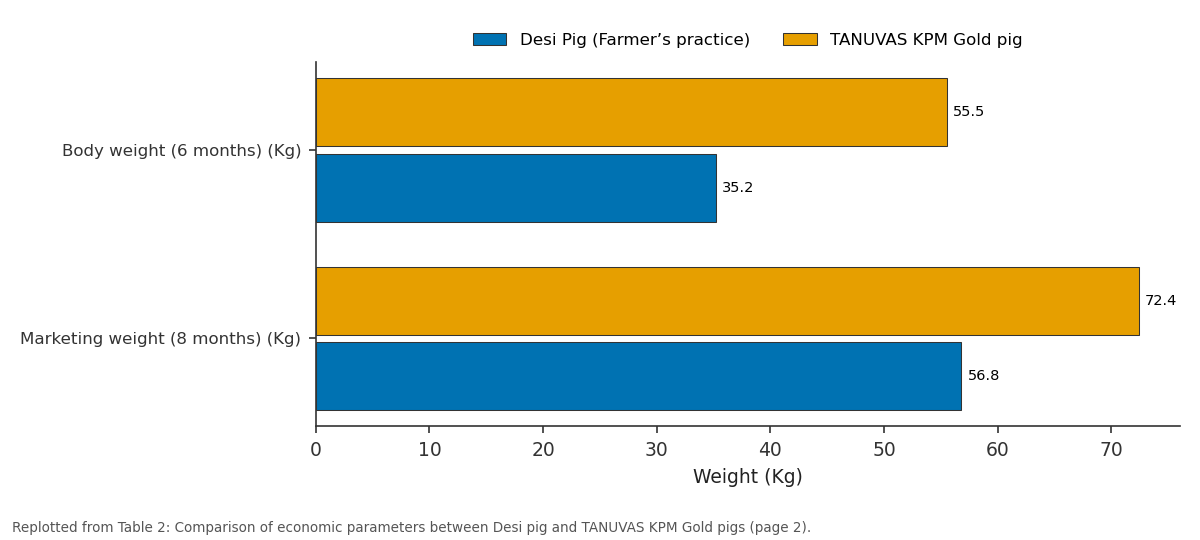
Desi Pig (Farmer’s practice) and TANUVAS KPM Gold pig: Body weight (6 months)... vs Marketing weight (8...
Replotted from Table 2 (page 2) of the original paper. Every bar is the paper's own table value.
View source evidence ↗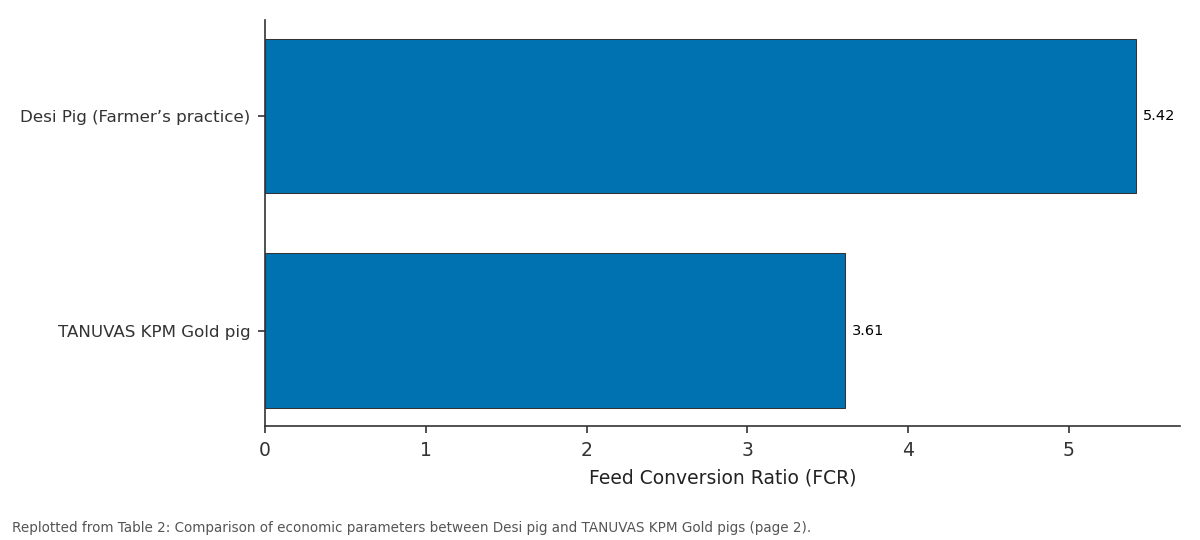
Feed Conversion Ratio (FCR): Desi Pig (Farmer’s... vs TANUVAS KPM Gold pig
Replotted from Table 2 (page 2) of the original paper. Every bar is the paper's own table value.
View source evidence ↗Figures & tables
From the original paper Table 1
 Table 2
Introduction
Pig farming is one of the component of livestock farming in India which is contributing to the protein demand of increasing population as well as improving the livelihood of rural population (Thomas et al., 2021) [10] . As per 20 th Livestock census pig population in India was 1.69% of the whole livestock population. In Tamil Nadu the pig population as per 20 th livestock census was 66772 when compared to 19 th census with 183983 population (Statistical Hand Book of Tamil Nadu-2021-22) [9] . This decline in pig population owes to many factors including lack of quality germplasm, proper training regarding scientific pig farming, marketing issues among many. In the era of ever growing demand for sustainable nutrition globally the improved pork production will play an important role in ensuring a continuous supply of protein. TANUVAS KPM Gold pig is a crossbred variety developed (AICRP on Pig) at PGRIAS, TANUVAS by crossing Large White Yorkshire (75%) with desi pig (25%) of Tamil Nadu (Srikanth et al. 2023) [8] . The rural farmers could have an increase in their income by 2.8 times by using this improved variety instead of the local variety breed (AICRP on Pig). Keeping these things in mind this study was done to popularize quality germplasm of TANUVAS KPM Gold pig among the farmers of North Eastern part of Tamil Nadu to find out the impact the pig farming has on their livelihood.
Methodology
The constraints faced by the pig farmers in Chengalpattu and Kancheepuram districts of Tamil Nadu were collected during on-campus and off-campus training programmes conducted at Krishi Vigyan Kendra (KVK) Kattupakkam and also during farm and field visit to pig farms. Some of the main constraints identified were lack of good quality germplasm, improper feeding management, mortality due to diseases, lack of training and best farming practices in pig farming. To overcome these constraints it was proposed to distribute TANUVAS KPM Gold pigs to Scheduled caste farmers under SCSP plan 2023-24. Five farmers who rear only desi pigs belonging to Chengalpattu and Kancheepuram districts of North Eastern Tamil Nadu were randomly selected from the list of famers collected during training programmes.
Each farmer was provided with 6 pigs (3 male and 3 female) and also supplied with 60 kg of pig grower feed free of cost. The pigs of 4 months age were purchased from Post Graduate Research Institute in Animal Sciences, Kattupakkam and pig grower feed was purchased from Central Feed Technology Unit, Kattupakkam. The farmers were trained on housing, disease and feeding management. The date were collected periodically to record the body weight at 6 months, 8 months, mortality if any, feed efficiency for both TANUVAS KPM Gold pigs and desi pigs. The data were collected from the beneficiaries using semi structured interview schedule and analyzed statistically (Snedecor and Cochran, 1994) [7] .
Results and Discussion
The production parameters of TANUVAS KPM Gold pigs by selected beneficiaries are given in Table 1. Comparison of economic parameters between Desi pig and TANUVAS KPM Gold pigs is given in Table 2. The data collected from the farmers showed that the farmers were able to get marketing weight of 72.4 kg at 8 months. This is similar to what Srikanth et al., 2023 [8] found out in their work. The gross income obtained from seeling pigs at market weight was found to be 27.64% more than the desi pigs income. This is 1.28 times more than the farmer's practice. As found out through success stories on improved varieties of pig (AICRP on Pig) it was possible to obtain 75 kg salughter weight compared to 45 kg from desi pig rearing which contributed to 1.67 times more income than the farmer's practice. As per Priyanka et al., 2022 [6] the extra income will be helpful in household and farming expenses especially that of women as in most of the rural household the women are taking care of the livestock. The farmers were able to get a better feed conversion ration compared to the desi pig rearing mainly due to the training given to them as found out in their study Haldar et al., 2017 [4] , also shown that providing proper training regarding shelter management and veterinary care resulted in improved and better production among small holder pig farmers in North Eastern India. Similar to the present study Haldar et al., 2017 [4] , distributed 4 months piglets among tribal farmers resulting in them adopting piglet production farming system. Hence supply of quality germplasm can ensure quality piglets to be supplied to other needy farmers. In the present study the reproduction parameters are yet to be studied for their impact in establishing Pig breeding unit by farmers. Doley et al., 2024 [3] in their study on constraints faced by the rural farmes in pig farming found out that the improper feeding with imbalanced feed was one of the constraints. In this study compared to scavenging technique followed for desi pigs farmers were advised to follow the scientific feeding by providing them with balanced feed. As a result it was found out that the fedd conversion ratio was 33.39% more than the farmer's practice. According to Anuj et al., 2016 [2] , the pork is of the animal protein which can be a source of both nutritional security and livelihood source for rural farmers which was established throught the present study.
| Parameters | Desi Pig (Farmer’s practice) | TANUVAS KPM Gold pig | Percentage over farmer’s practice |
|---|---|---|---|
| Body weight (6 months) (Kg) | 35.2 | 55.5 | 57.67 ↑ |
| Marketing weight (8 months) (Kg) | 56.8 | 72.4 | 27.64 ↑ |
| Feed Conversion Ratio (FCR) | 5.42 | 3.61 | 33.39 ↓ |
| Gross Income from sale of pigs (Slaughter purpose at Rs.90/kg live weight/pig) (Rs.) | 5112 | 6525 | 27.64 ↑ |
| Benefit Cost Ratio (BCR) | 1.23 | 1.72 | 39.83 ↑ |
Table text extracted from the original PDF; superscript letters are shown inline. The original table image is below.
View original table image
| S. No | Details of farmers | Body weight (6 months) (Kg) | Marketing weight (8 months) (Kg) | Feed Conversion Ratio (FCR) | Benefit Cost Ratio (BCR) |
|---|---|---|---|---|---|
| 1 | Farmer-1 | 55.5±1.52 (n=6) | 72.5±1.20 | 3.53±0.05 | 1.77±0.03 |
| 2 | Farmer-2 | 56.2±2.26 (n=6) | 75.2±1.70 | 3.60±0.14 | 1.72±0.04 |
| 3 | Farmer-3 | 52.2±1.19 (n=6) | 67.2±1.45 | 4.00±0.10 | 1.53±0.02 |
| 4 | Farmer-4 | 55.5±1.38 (n=6) | 73.2±0.95 | 3.42±0.06 | 1.77±0.03 |
| 5 | Farmer-5 | 58.0±1.39 (n=6) | 73.0±1.21 | 3.53±0.11 | 1.78±0.03 |
| Overall average | 55.5±0.75 (n=30) | 72.4±0.70 | 3.61±0.05 | 1.72±0.02 |
Table text extracted from the original PDF; superscript letters are shown inline. The original table image is below.
View original table image
Conclusion
From this study it can be established that the TANUVAS KPM Gold pigs rearing can improve the livelihood of rural families by resulting in a benefit cost ratio of 1.72 which is 39.83 percent more than the farmer's practice of rearing desi pigs and also provide nutritional security through consumption of pork. The additional gross income from a pig upto 27.64% more than the desi pig rearing ensure livelihood enhancement for the beneficiary families.
Acknowledgement
AcknowledgementThe authors are thankful to Tamil Nadu Veterinary and Animal Sciences University, Chennai and ATARI, Hyderabad for sanction and approval of Scheduled Caste Sub Plan 2023-2024 at KVK, Kattupakkam.
References
6 in the original paper- Anuj C, Patel BHM, Rajveer M, Sushil K, Sanjeev S, Subodh K. Pig production system as a source of livelihood in the Indian scenario: An overview. Int J Sci Environ Technol. 2016;5(4):2089-2096.
- Doley MK, Laskar SA, Neog M, Neog BK, Kazarika R, Chadipiralla K, et al. Rural backyard pig farming constraints faced by tribal farmers. Res J Agric Sci. 2024;15(1):172-176.
- Haldar A, Dhrubojoyti D, Biswarup S, Prasenjit P, Sandwip D, Anup D, et al. Smallholder pig farming for rural livelihoods and food security in North East India. J Anim Res. 2017;7(3):471-481.
- Srikanth V, Ajoy D, Bed S, Shrilla E, Mir MR, Salam PKS, et al. Improved varieties of swine suitable for Indian climate. Indian Farmer. 2023;10(09):401-406.
- Statistical Hand Book of Tamil Nadu-2021-22. Available from: https://www.tn.gov.in/depst/animalhusbandry.pdf
- Thomas R, Singh V, Gupta VK. Current status and development prospects of India's pig industry. Indian J Anim Sci. 2021;91(4):255-268.