
Research article · 2024 · Full text
International Journal of Biology SciencesSingle-celled parasites and epidemiological causes of the spread of Ambia disease in south Baghdad areas
Volume 6(2) · Pages 38–41 · DOI: 10.33545/26649926.2024.v6.i2a.231 ↗
Research areasLivestock and Poultry ManagementParasite Biology and Host InteractionsBird parasitology and diseases
Abstract
Author-writtenThe current study procedures were based on investigating the spread of the single-celled parasitic amoeba epidemic that causes ambia in the southern regions of the capital Baghdad during the years 2022-2023, where the features of the study, depending on the average degree of infection, showed that the infection, which was most severe in June of both years, as the average total number of infected people was (30.800) from 2022 and (44.800) from 2023, while the infection was the lowest possible in January, as the average The number of injured (11.50) from 2023. In May 2023, the average number of infected people was 5,800. In the case of relying on the rates of infection between the two years, it was in the months of April and December of 2022, reaching (4.6607) and (3.8777). In March 2023, the infection rate reached (2.2073). It was concluded from this study that the percentage of injury was the best in indicating the reality of the injury compared to the averages of the injury among the sample members for areas south of the capital, Baghdad. The infection was determined by age group, as the study showed that the average infection was high in the age group (6-10) years, as it reached (37.583) from 2022, the age group (46) years and over, as it reached (8.833) from 2022 and (6.917) from 2023, the highest rate of infection in January of 2022, reaching (46.2963). In April 2023, the infection rate reached (526,016), while the lowest rate was in addition, no significant relationship was shown on the basis of gender. It also appeared that the percentage of the number of senders for examination among the auditors was high in July of 2022, in October and December of 2023, and the percentage was low in January of 2022 and April of 2023.
Summary
Source-checkedPlain-language reading of the full paper, prepared with AI and checked against the text. Each point links to the authors' own words.
Why it matters
- Single-celled parasites can cause a wide variety of diseases in humans and animals, and in the case of Entamoeba histolytica, systemic injury can lead to death. View evidence ↗
- Amoeba infections can range from being asymptomatic to causing severe acute diarrhea, dysentery, or extra-intestinal complications, particularly affecting the liver. View evidence ↗
- The infective stage of the amoeba (cysts) is transmitted to humans via contaminated food, water, flies, or hands. View evidence ↗
The question
- The primary objective of the research was to identify the prevalence of ambia among the study sample. View evidence ↗
- The study aimed to determine if there was a relationship between infection and the age or sex of the sample groups. View evidence ↗
What they did
- The study sample consisted of infected individuals from health centers located in the southern regions of Baghdad. View evidence ↗
- The study period spanned two years, from January 2022 to December 2023. View evidence ↗
- Data were analyzed using a Complete Random Design (CRD) and Duncan's Multiple Range Test via SPSS software to examine significant variations between averages. View evidence ↗
What they found
- The average number of infected individuals increased from 30,800 in 2022 to 44,800 in 2023, indicating a worsening epidemic. View evidence ↗
- Infection peaked in June for both years, with averages of 50,800 in 2022 and 45,700 in 2023. View evidence ↗
- The lowest average infection numbers were recorded in January 2022 (12.50) and May 2023 (6,800). View evidence ↗
- The highest average infection rates occurred in children aged 4-8 years, with values of 37.6 in 2022 and 34.6 in 2023. View evidence ↗
- There were no significant differences in infection rates between males and females. View evidence ↗
What it means
- The authors conclude that increased infection rates are strongly correlated with poor hygiene, inadequate sanitation, and favorable environmental conditions for amoeba proliferation. View evidence ↗
- The authors recommend enhancing public health initiatives through education, improved sanitation, and timely medical interventions. View evidence ↗
- The authors suggest a future study to evaluate the predictive accuracy of physicians in diagnosing single-cell ambia parasites. View evidence ↗
- The authors state that precise understanding of temperature effects on amoebic growth and cyst formation requires further experimental laboratory studies. View evidence ↗
Visual summary
3 visualsIllustrations explain the paper; charts are replotted from the paper's own table values.
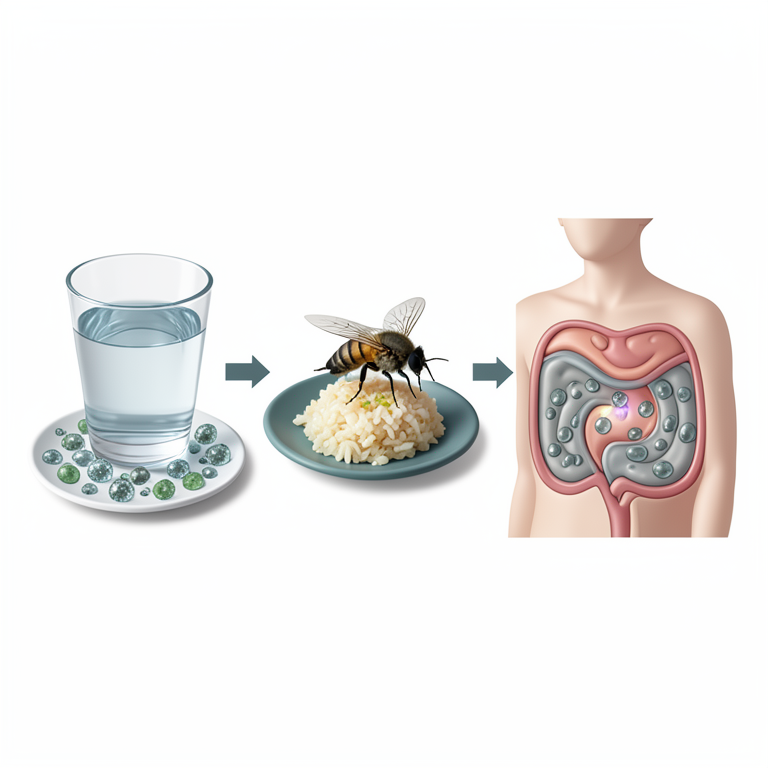
Transmission Cycle of Amoebic Cysts
AI-generated conceptual illustration (Entamoeba histolytica cysts, contaminated water, food, and houseflies). It explains the idea and does not show study data.
View source evidence ↗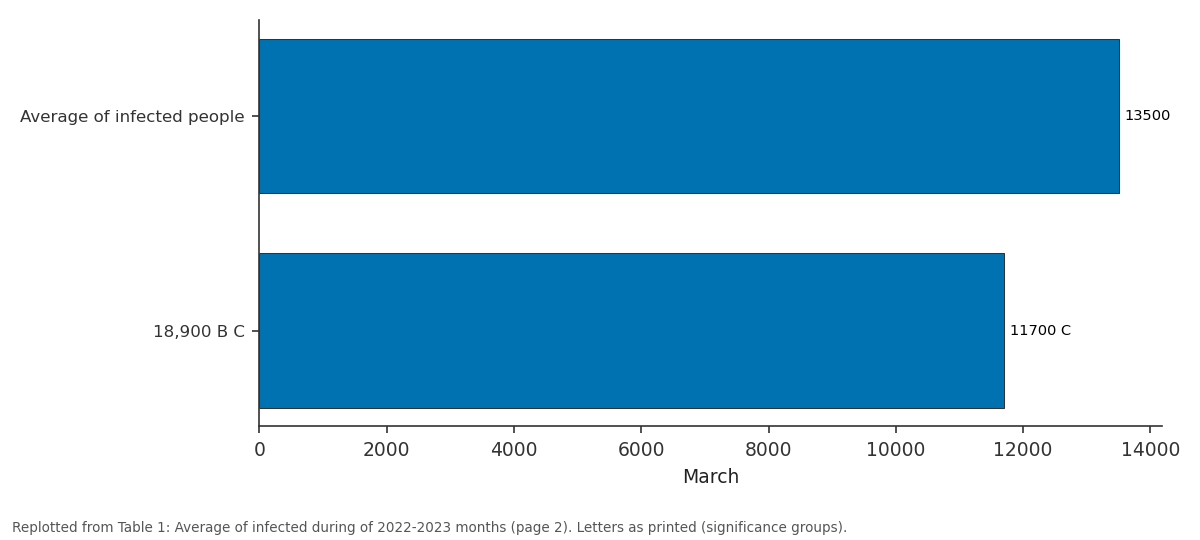
March: Average of infected... vs 18,900 B C
Replotted from Table 1 (page 2) of the original paper. Every bar is the paper's own table value.
View source evidence ↗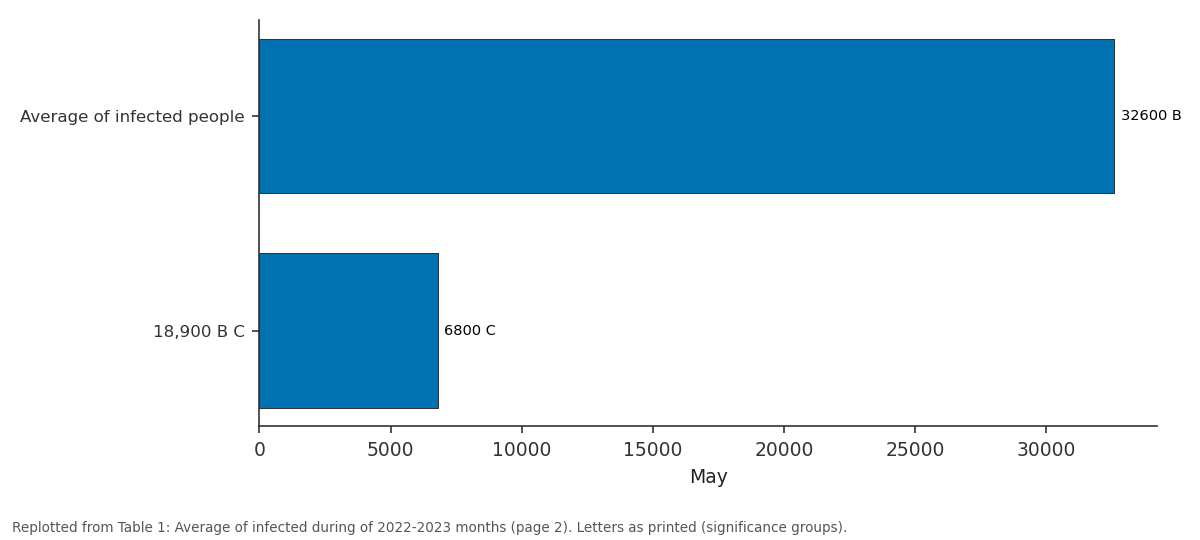
May: Average of infected... vs 18,900 B C
Replotted from Table 1 (page 2) of the original paper. Every bar is the paper's own table value.
View source evidence ↗Figures & tables
From the original paper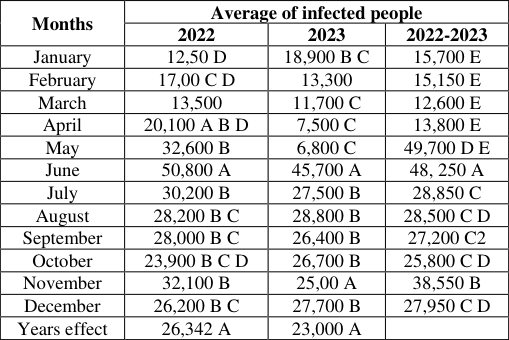 Table 1
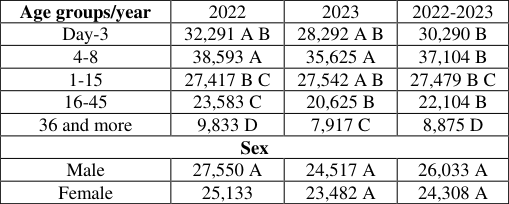 Table 2
Introduction
The findings of several studies in this regard according to the data of the case and what reached the type of infection and its degree, whether it is specialized in seasons, months or days of the year and according to the requirements of the climate for the seasons of the year,
Materials and Methods
According to records of Baghdad Health Department that the division of communicable diseases will be operational for a two-year period beginning in January 2022 and ending in December 2023. The same elements (Years, months of the year, and the overlap between them) were experimented with statistically using Complete Random Design (CRD), and the significance of the variations between the averages was examined using Duncan's Multiple using Duncan's Multiple Rang Test (Al-Rawi, 1984) [14] , where it was analyzed statistically using the SPSS program for statistical analysis.
Results
The results of (Table 1) showed the incidence was highly severe during month of June. In total years (depending on the average of the infection), as the rang of average injured number in the mentioned month was (50) in 2022, it was distinguished morally from rest of other months, and the results also showed that the infection was the lowest possible during the month of January, as the average number of injured reached (12.5), while the rest of the months the average number of injured ranged among (17) in February, (12.5) in March and (17.0) in April, after which it increased in May (32.6), then decreased again during the months of July (30), August (28.2), September (28.0) and October (23.9), then increased in November (32.1), then decreased in December (26.2), and infection was highly severe during month of June 2022, as the average number of injured reached (45.7), and it was distinguished morally from rest of other months, the injury was the lowest possible, as the average number of injured reached (6.8) in a month May, The rest of the months ranged from (18.9) in January to (7.5) in April, where they decreased in this month and then rose again during the remaining months. After calculating the averages for both years together, they were highest in June and lowest in March in both years at a level of significance (p< 0.05 It also noted of table (2) there is no significant difference in the incidence between males and females, and in both consecutive years as well, it is clear the number of reviewers for the year 2022 and the number of those sent to the examination in the laboratory, and it seems that there is a difference between the reviewers in each year with the number of those sent for examination in laboratories, and the highest percentage of referral for examination in laboratories for the year 2022 was in July, reaching (8.9), while the lowest referral for the same year was in January, as it reached (0.6), and for the year 2023 table (1), the highest referral rate to the examination was in October and December. It reached (9.9) and (10.0), while the lowest rate of referral to laboratories was in April, reaching (0.3), and it is clear from table (2) the percentage of the number of infected among the examined for two consecutive years (2022 and 2023), so the highest percentage of infection among the examined was in January 2022, and it reached (46, 2963) and the lowest in April, which amounted to (3.8807), while in the year (2023), the highest percentage of infected among the examined was in April, which amounted to (62.9016), and the lowest in March It reached (2.2073).
| Months | Average of infected people | — | — |
|---|---|---|---|
| 2022 | 2023 | 2022-2023 | |
| January | 12,50 D | 18,900 B C | 15,700 E |
| February | 17,00 C D | 13,300 | 15,150 E |
| March | 13,500 | 11,700 C | 12,600 E |
| April | 20,100 A B D | 7,500 C | 13,800 E |
| May | 32,600 B | 6,800 C | 49,700 D E |
| June | 50,800 A | 45,700 A | 48, 250 A |
| July | 30,200 B | 27,500 B | 28,850 C |
| August | 28,200 B C | 28,800 B | 28,500 C D |
| September | 28,000 B C | 26,400 B | 27,200 C2 |
| October | 23,900 B C D | 26,700 B | 25,800 C D |
| November | 32,100 B | 25,00 A | 38,550 B |
| December | 26,200 B C | 27,700 B | 27,950 C D |
| Years effect | 26,342 A | 23,000 A |
Table text extracted from the original PDF; superscript letters are shown inline. The original table image is below.
View original table image
Discussion
The tissue amoeba epidemic is spreading globally, especially in hot and subtropical tropics (Belding, 1965), where there are usually no clean sources of drinking water, and there is no efficient sewage drainage system, which causes environmental pollution with waste, which leads to the creation of conditions for the permanence of diseasecausing parasites that may cause death to many individuals, especially in childhood. (WHO, 1980) [11] . Based on this, the current study's findings demonstrated that the single-celled ambia parasitic disease infection increased and peaked in June of both years, with an average of 50,800 and 45,700 infected individuals in June of 2022 and 2023, respectively. After that, the infection declined in the remaining months and reached its lowest point in January of 2022, with an average of 12.50 infected individuals. In May 2023, it reached its lowest point ever with an average of 6,800 injuries. The results differed when compared to infection rates, but the latter provided a more accurate interpretation of the injury than the actual number in the case studied in this study.
The variations in occurrence between the months of the year could be attributed to variations in the weather, with summer temperatures rising and falling gradually as autumn and winter approach. The growth and development of primary cysts may be impacted by this temperature variation in two ways: on the one hand, it may have an impact on the relationship between the infection and the modes of transmission of single-celled parasitic diseases, the most significant of which are flies, the well-known mechanical carrier of primary cyst cysts that are common during the hot months.
The study also revealed that injuries were more prevalent among children under the age of 8 in both years, compared to those older than 8. It was found that the incidence of injury was lowest, and nearly negligible, for individuals aged 44 and above in both years. The higher rate of injury in children under 8 years old may be attributed to their lower awareness of personal and general hygiene practices. Additionally, they are more active, frequently play, and come into direct contact with dust and each other, both indoors, outdoors, and at school. Social customs common among children further contribute to the increased risk of infection in this age group. The prevalence of infection is notably higher among children under the age of 8 in general. These findings are somewhat consistent with those of Mouloud et al., (1997) [17] , who studied areas south of the capital Baghdad, such as Mahmoudiya, Nahrawan, and Salman Pak, in Baghdad Governorate. Similarly, a study by Ciragil et al., (2003) [5] in Turkey found that the age group of 1-14 years exhibited a higher rate of infection compared to other age groups. When comparing infection rates with other Arab Middle Eastern countries, the results were in line with those of Khan et al., (1989) [7] in Saudi Arabia, and the observed decrease in incidence with age mirrors the findings of Nimri (1994) [9] , who studied the prevalence of this disease among the Jordanian population. Through an extensive study conducted in Turkey on (948) schoolchildren, it was found that the incidence of monocellular lambia parasitoids has no relationship with the body mass index, but there is a significant relationship between the infection and the number of people living in the same house and the number of brothers and sisters who live and live in the same house or apartment. (Zeyrek et al., 2003) and holds Demirci et al., (2003) [18] that intestinal infection of parasitic ambia has to do with the way health facilities are used and the accompanying habits related to public health, (2001). The course of the study also showed that the number of examined among the auditors was high during the months of July and April of 2022 and in December and October of the year 2023, this may indicate the efficiency of diagnosis among doctors who expect an amoebic infection and send patients for examination in laboratories, and the increase in the number of infected examined, which indicates the validity of their expectations, this phenomenon cannot be explained, as doctors change in their positions, and for more accuracy it is proposed to conduct a study that works on Highlight this phenomenon itself to determine how well it is predicted for single-cell ambia parasites in a selected group of physicians so that this process can be evaluated. This study also revealed a high rate of infection with a singlecelled parasite that causes the performance of the tissuedissolving epidemic ambia during January of the year 2022, contrary to the previous results based on the average infection, and this is consistent with what was observed by Mouloud et al., (1997) [17] in Diyala, as they recorded the highest infection rate in January and the percentage is close to the study of Al-Daoudi (1998) [13] , who noted that the highest infection rate was in December. It was also found that the infection rate was high during the months of April and November of the year 2023, and the lowest infection rate appeared in April and December of 2022. In March 2023, the variation in infection rates throughout the year may be attributed to lower temperatures during winter, as colder weather can inhibit the growth and development of parasitic amoebic stages, as suggested by Abdel-Hafez et al., (1986) [1] . However, the spike in infections observed in January could be due to the accumulation and maturation of amoebic parasites that began in the autumn, fueled by the consumption of sugarrich fruits and the increased presence of flies. The effects of the disease became apparent only after the infection worsened at the onset of winter. These differences can only be known precisely after conducting an experimental study in the events of laboratory amoebic injury and designing an experiment aimed at studying the effect of temperature on the growth of the amoebic organism, the formation of cysts, the optimal temperature for its recovery and its interactions with other factors. It is worth mentioning that autumn provides optimal conditions, with favorable temperatures and weather for the growth of the parasitic stages of amoeba. During this time, fresh vegetables and fruits, such as grapes, figs, and other sugar-rich fruits, become abundant, attracting flies that serve as carriers of parasitic amoeba cysts. In contrast, the high infection rates observed during the summer months in the study could be attributed to the hot weather, which prompts people to consume refreshments and ice cream, often purchased from street vendors. Additionally, the consumption of fruits, which are frequently contaminated with intestinal parasites such as amoebic dysentery, along with the increase in flies and dust particles during transport and marketing, facilitates the spread of pathogens and the causes of amoebic epidemics. When comparing the incidence rate during 2022 and 2023, it became clear that the incidence of parasitic ambia was higher in 2023 compared to 2022The high incidence rate in 2023 may be attributed to several factors, including the direct transmission of the parasitic amoebic disease through contaminated food and water, inadequate hygiene practices, and the low cultural and social awareness of those affected. Additionally, the quality of the environment plays a crucial role in the transmission of intestinal parasites and the development of their stages, as noted by Patz (2000) [10] and Niazi et al., (1976) [8] . Unfavorable environmental conditions can also contribute significantly to the spread of amoebic parasites, as waste residues may come into contact with food or be transmitted directly from person to person. as well as the presence of serious problems in the level of sanitation and deterioration of infrastructure due to the recent conditions that passed on the country, which coincided with living conditions. The difficult health that Iraqis were living in and the conditions that the country suffered in light of wars, political and social problems and the incomplete infrastructure, especially health infrastructure.
Conclusion
This study highlights the concerning trends in the spread of the single-celled parasitic amoebic disease, ambia, in southern Baghdad between 2022 and 2023. The data indicates a significant seasonal fluctuation in infection rates, with peak incidences occurring in June of both years and the lowest rates observed in January. The average number of infected individuals rose notably from 30,800 in 2022 to 44,800 in 2023, underscoring a worsening epidemic that warrants urgent public health attention. The analysis reveals that children aged 6-10 years are particularly vulnerable, exhibiting the highest infection rates, likely due to their limited hygiene awareness and higher social interactions. Conversely, the infection rates in older age groups were considerably lower, indicating that preventive measures may need to be specifically targeted at younger populations. Interestingly, no significant gender differences were observed in infection rates, suggesting that environmental factors and social behaviors are more critical in influencing infection dynamics. The findings point to a strong correlation between increased infection rates and factors such as inadequate sanitation, poor hygiene practices, and the environmental conditions that favor the proliferation of the amoeba. The results also imply that the percentage of infections provides a more reliable indicator of the situation than mere averages, as it accounts for population size and variations across different demographics. The study's outcomes reinforce the necessity for enhanced public health initiatives, focusing on education, sanitation improvements, and timely medical interventions to curb the spread of this parasitic disease. Given the upward trend in infections, it is crucial for health authorities to implement effective monitoring systems and targeted public health campaigns to address the underlying causes and prevent further outbreaks.
Figures and tables from the paper
| Age groups/year | 2022 | 2023 | 2022-2023 |
|---|---|---|---|
| Day-3 | 32,291 A B | 28,292 A B | 30,290 B |
| 4-8 | 38,593 A | 35,625 A | 37,104 B |
| 1-15 | 27,417 B C | 27,542 A B | 27,479 B C |
| 16-45 | 23,583 C | 20,625 B | 22,104 B |
| 36 and more | 9,833 D | 7,917 C | 8,875 D |
| Sex | |||
| Male | 27,550 A | 24,517 A | 26,033 A |
| Female | 25,133 | 23,482 A | 24,308 A |
Table text extracted from the original PDF; superscript letters are shown inline. The original table image is below.
View original table image
References
11 in the original paper- Abdel-Hafez MMA, El-Kady N, Bolbol AS, Baknina MH. Prevalence of intestinal parasitic infections in Riyadh district, Saudi Arabia. Ann Trop Med Parasitol. 1986;80(6):631-634.
- Ciragil P, Aral M, Ekerbicer C, Gül M. The distribution of intestinal parasites in patients applying to the microbiology laboratory of the Sutcu Imam University Medical Faculty. Turkiye Parazitoloji Dergisi. 2003;27(2):136-138.
- Haque R, Huston C, Hughes M, Houpt E, Petri WA. Amoebiasis: review article. N Engl. J Med. 2003;348:1565-1573.
- Khan MV, Amir SE, Eid OM, Aggrewal S. Prevalence of intestinal parasites among patients in the Abha region. Ann Saudi Med. 1989;9(5):230-231.
- Niazi AD, Al-Essa TB, Khamis F. Studies on the prevalence of Entamoeba histolytica in Iraq. Bull Endem Dis. 1976;17(1-4):127-141.
- Nimri LF. Prevalence of giardiasis among primary school children. Child Care Health Dev. 1994;20(4):131-137.
- Patz JA. Global climate change and infectious diseases. Acta Parasitol. 2000;45(3):211.
- WHO. Scientific Working Group. Parasite-related diarrhoeas. Bull World Health Organ. 1980;58:819-830.
- Brown H. Clinical Parasitology. Mosul: Mosul University Press; 1980. Translated by Dr. Wijdan Muhammad Saleh, Dr. Qusai Abdul Qader Chalabi, Mrs. Walaa Ahmed Saleh.
- Mawloud NAQ, Nasrallah BA, Jassim BAA. Detection of gut parasites in the population of some areas of Diyala Governorate in Iraq. J Mustansiriya Sci. 1997;8(1):33-37.
- Demirci M. Foundations of fuzzy functions and vague algebra based on many-valued equivalence relations, Part I: Fuzzy functions and their applications. International Journal of General Systems. 2003 Apr 1;32(2):123-155.