
Research article · 2024 · Full text
International Journal of Veterinary Sciences and Animal HusbandryEffect of turmeric powder on decontamination of broiler chicken carcass
Volume 9(5) · Pages 350–353 · DOI: 10.22271/veterinary.2024.v9.i5sf.1772 ↗
Research areasCurcumin's Biomedical Applications
Abstract
Author-writtenMeat-born zoonotic disease is always considered inscrutable for human beings mostly transmitted through the consumption of meat obtained from infected animals or contaminated meat handling or processing. Broiler carcasses can be contaminated during the slaughter process, and along with traditional water washing, decontamination techniques must be adopted to preserve meat safely and maintain quality. The present study aimed to evaluate the effect of turmeric powder on microbial counts in broiler chicken carcasses. The freshly slaughtered broiler carcasses were divided into three groups: Group A (control), Group B and Group C. The group A (control) samples were kept without any preservatives, the group B samples were treated with turmeric powder (1.5%) for 1 minute and group C samples were treated with turmeric powder (1.5%) for 5 minutes. The total plate count, coliform count, Salmonella, E. coli, yeast, and mould counts were assessed in all groups. The results of the study showed a significant reduction in bacterial counts in the turmeric-treated broiler carcasses, with the reduction being higher in Group C than in Group B. Furthermore, sensory analysis revealed a significant increase in flavor scores for Groups B and C compared to the control group. However, the appearance/colour, juiciness, tenderness, and overall acceptability scores were not influenced by the treatment. To reduce microbial contamination in broiler chicken carcasses, turmeric (Curcuma longa) powder (1.5%) with a minimum contact time of 5 minutes was found to be effective.
Summary
Source-checkedPlain-language reading of the full paper, prepared with AI and checked against the text. Each point links to the authors' own words.
Why it matters
- Meat-borne zoonotic diseases are a significant concern for humans, often spreading through the consumption of meat from infected animals or via contamination during handling and processing. View evidence ↗
- Broiler chicken carcasses are susceptible to contamination during slaughter, which can lead to outbreaks of diseases caused by pathogens like Salmonella, Listeria, and Campylobacter spp. View evidence ↗
- Common chemical preservatives used to control microorganisms in meat can leave residues that contribute to antimicrobial resistance in humans. View evidence ↗
The question
- The study aimed to evaluate how the application of turmeric powder affects the microbial counts found on broiler chicken carcasses. View evidence ↗
What they did
- Freshly slaughtered broiler carcasses were split into three groups: a control group and two treatment groups receiving a surface application of 1.5% turmeric powder for either 1 minute or 5 minutes. View evidence ↗
- The sample size for the experimental groups was 6. View evidence ↗
- The researchers measured microbial quality using total plate, coliform, Salmonella, E. coli, and yeast/mould counts, and also performed a sensory analysis of the samples. View evidence ↗
What they found
- The mean total plate count decreased from 4.28±0.04 in the control group to 3.89±0.02 after 1 minute of turmeric treatment and further to 3.15±0.10 after 5 minutes. View evidence ↗
- Coliform counts were reduced from a mean of 2.20±0.06 in the control group to 1.85±0.09 (1 minute treatment) and 1.55±0.04 (5 minute treatment). View evidence ↗
- Yeast and mould counts decreased from 2.60±0.09 in the control group to 1.46±0.06 after 1 minute and 1.26±0.06 after 5 minutes of turmeric treatment. View evidence ↗
- No Salmonella or E. coli were detected in any of the tested samples across all groups. View evidence ↗
- Sensory analysis showed that turmeric-treated samples had significantly higher flavor scores than the control samples. View evidence ↗
- The treatment did not significantly change the tenderness, juiciness, appearance/color, or overall acceptability of the meat. View evidence ↗
What it means
- The authors conclude that applying 1.5% turmeric powder for at least 5 minutes is an effective way to reduce microbial contamination and avoid chemical residues in broiler chicken meat. View evidence ↗
- The authors suggest that these findings would be useful for retail broiler chicken shops. View evidence ↗
Visual summary
1 visualsIllustrations explain the paper; they do not show study data.
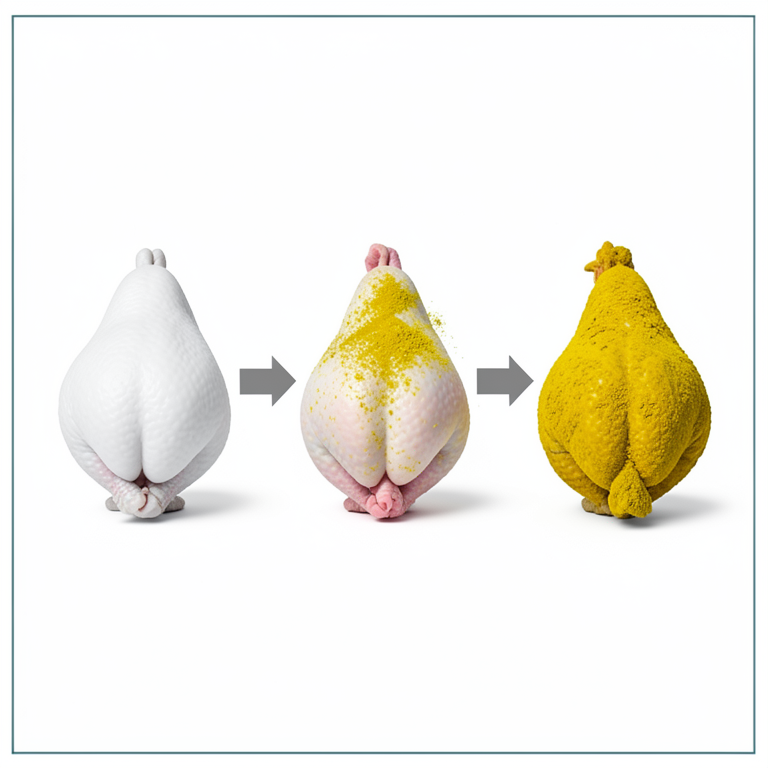
Turmeric Treatment Comparison
AI-generated conceptual illustration (broiler chicken carcasses). It explains the idea and does not show study data.
View source evidence ↗Figures & tables
From the original paper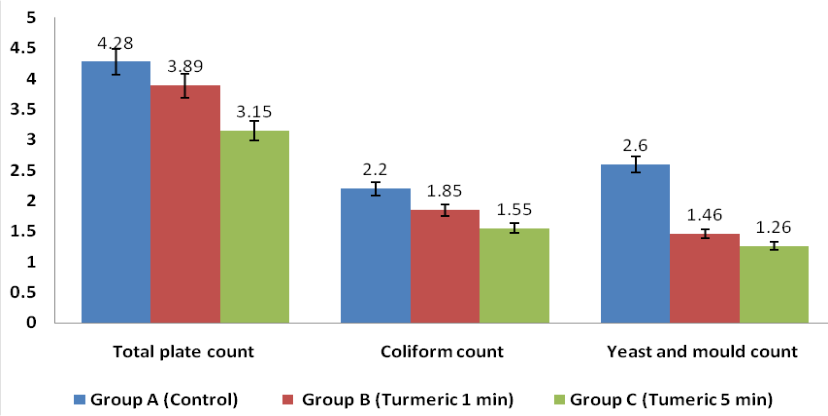 Figure 1
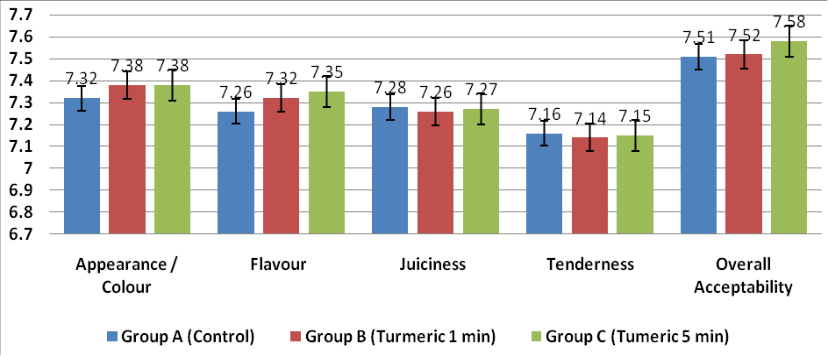 Figure 2
Introduction
Poultry production is one of the fastest-growing livestock subsectors, and poultry is among the world’s primary sources of animal protein. Broiler chicken meat is highly digestible (71.26%), has more biological value (79.00%) and is very well recognized nutritious food due to its essential amino acid content, B - complex vitamins and important minerals but low in fat (<2%) and calories (141kcal/g) (Muthulakshmi, 2022) [17]. In most small-scale poultry processing in India, slaughter is carried out manually using simple tools. After being killed, birds are scalded in hot water and then plucked and eviscerated, mostly by hand.
The meat may then be sold dressed (slaughtered, bled and plucked); eviscerated and ready to cook; in poultry parts (legs, wings, etc.); or deboned (muscle, fat and skin only). Broiler carcasses can become contaminated during the slaughter process. Consumption of contaminated meat can lead to human disease outbreaks caused by zoonotic pathogens such as Salmonella, Campylobacter spp., and Listeria. Meatborne zoonotic diseases may arise from meat obtained from infected animals or from meat contaminated during handling or processing.
Decontamination is the technique or process of removing, inactivating or killing pathogens to make an environment clean and safe (Fraise et al., 2008; Godbey, 2014; McDonnell, 2017) [9,11,16 ]. Washing with water is routinely used in meat processing plants and has been shown to be effective in removing visible contaminants such as soil, feathers, and other debris. The decontamination of meat and poultry carcasses can help to reduce human foodborne infections. However, process hygiene to prevent contamination should never be neglected.
Many studies have been conducted on decontamination practices at different stages M Muthulakshmi Assistant Professor, Department of LPT (Meat Science), Veterinary College and Research Institute, Namakkal, Tamil Nadu Veterinary and Animal Sciences University, Tamil Nadu, India https://www.veterinarypaper.com of slaughterhouse processes to extend the shelf life of poultry meat and to inactivate pathogenic microorganisms such as Salmonella spp. and C. jejuni [Del Río 2007; Bolder 1997; Dinçer and Baysal 2004; Northcutt 2007; Smulders and Greer, 1998 and Loretz 2010] [6, 5, 7, 18, 20, 13]. Decontaminants like chlorinated water, lactic acid, etc. employed to minimize the microbial load. Consequently, routine chemical preservatives (sodium benzoate, potassium nitrite, sodium nitrite, sulphur dioxide, erythorbic acid, calcium sorbate) used to control microorganisms leave drug residues that lead to antimicrobial resistance in humans. In recent years, the market trend has changed dramatically as per the consumer’s perception and acceptance of natural alternatives over synthetic ones.
Turmeric is extensively used as a preservative in food (Shahidi and Ambigaipala, 2015) [19]. The active principle in turmeric powder is Curcuminoids, Curcumin, Demethoxycurcumin etc., and acts as Antimicrobial, Antioxidant and Anti carcinogenic. (Gupta and Sadhana, 2005 and Mansouri et al. 2020) [12, 15]. This study aimed to assess the effect of turmeric powder on reducing microbial counts in broiler chicken carcasses.
Materials And Methods
Freshly slaughtered broiler carcasses were divided into three groups. The treatment groups were subjected to surface application of 1.5% turmeric powder, with contact times of either 1 minute or 5 minutes. Microbial quality was evaluated by assessing total plate count, coliform count, Salmonella, E. coli and yeast and mould counts. Additionally, the sensory qualities of the treated samples were analyzed.
Experimental Design
Group Treatments Group - A Broiler chicken carcass was collected and kept without any preservatives. (Control) Group - B Broiler chicken carcass treated with turmeric powder (1.5%) for 1 minute Group - C Broiler chicken carcass treated with turmeric powder (1.5%) for 5 minutes (Sample size, n = 6)
Results And Discussion
The microbial quality of control and treated broiler chicken carcasses is shown in Figure 1. There was a significant reduction in microbial counts in the decontaminated samples, with Group C showing the highest reduction. The mean total plate count for Group A (Control), Group B (1 minute) and Group C (5 minutes) was 4.28±0.04, 3.89±0.02 and 3.15±0.10, respectively. The mean coliform count for Group A (Control), Group B (1 minute) and Group C (5 minutes) was 2.20±0.06, 1.85±0.09 and 1.55±0.04, respectively.
The mean yeast and mould count for Group A (Control), Group B (1 minute) and Group C (5 minutes) was 2.60±0.09, 1.46±0.06 and 1.26±0.06, respectively. Salmonella and E. coli were not detected in any of the samples. The results of the present study are in agreement with Arshad et al. (2019) [3], who reported that decontaminating chicken meat with 3% turmeric powder significantly reduced microbial counts. However, their study indicated that complete decontamination of coliforms was achieved with a dose of 1 kGy + TP and 2 kGy + TP during all storage intervals (0, 7, and 14 days) in both aerobic and vacuum packaging.
Similar results were reported by Febrianta et al. (2021) [8], who stated that chicken breast marinated with 7.5% microencapsulated turmeric extract could extend the shelf life to 9 days at refrigeration temperatures. Madushanka et al. (2018) [14] concluded that natural compounds (nutmeg, mace, and cardamom) and organic acids (acetic, citric, and lactic) have antibacterial effects on S. typhimurium, making them suitable for poultry meat decontamination. These natural compounds were found to be more effective at destroying S. typhimurium compared to chemical compounds. Another study by Ayari et al. (2016) [4] demonstrated that combined treatments using bioactive compounds (cinnamaldehyde + ascorbic acid (0.5%, w/w), cinnamaldehyde (1.47%, w/w), or cinnamaldehyde + sodium pyrophosphate decahydrate (0.1%, w/w)) and irradiation significantly reduced the microbial load in meat samples compared to untreated control samples.
Present results also agree with those of Aksoy et al. (2009)[1], who reported that sumac and hibiscus infusions, as well as thyme and clove hydrodistillates, were effective natural herbal sources for decontamination and extending the shelf life of poultry meat, serving as alternatives to chemical agents. https://www.veterinarypaper.com Fig 1: Effect of turmeric powder (1.5%) on the microbial quality of broiler chicken carcass (CFU/cm2) marinated with 7.5% microencapsulated turmeric extract exhibited better physico-chemical, antioxidant, microbiological, and sensory properties. Jumayi et al. (2022) [2] investigated the potential radical scavenging and antioxidant activities (DPPH and ABTS) of several plant aqueous extracts (Curcuma longa, CL; Myristica fragrans, MF; Zingiber officinale, ZO; Cymbopogon citratus, CC; and Thymus vulgaris, TV) as well as their mixtures. The results indicated that these plant extracts may be effective against rancidity and could serve as natural antioxidants to prolong the shelf life of cold-stored rabbit meat. The sensory qualities of control and treated broiler chicken carcasses are shown in Figure 1.
The sensory analysis revealed a significant increase in the flavor scores of treated samples compared to the control samples. However, the appearance/colour, juiciness, tenderness, and overall acceptability scores were not significantly affected by the treatment in any of the groups. The findings of this study correlate with Arshad et al. (2019) [3], who reported that in decontamination, overall acceptability scores were higher for turmeric-treated samples than for samples treated with a combination of gamma irradiation and turmeric. Furthermore, Febrianta et al. (2021) [8] concluded that chicken breast Fig 2: Effect of turmeric powder (1.5%) on the sensory quality of broiler chicken carcass Reference 1.
Aksoy A, Güven A, Gulmez M. Decontamination and shelf-life potential of some herbal infusions and hydrodistillates on chicken meat. Kafkas Üniv Vet Fak Derg. 2011; 17:137-43. doi: 10.9775/kvfd.2011.4074. 2. Al Jumayi HA, Allam AY, El-Beltagy AE, Algarni EH, Mahmoud SF, El Halim Kandil AA.
Bioactive compound, antioxidant, and radical scavenging activity of some plant aqueous extracts for enhancing shelf life of cold-stored rabbit meat. Antioxidants (Basel). 2022; 11(6):1056. doi: 10.3390/antiox11061056. 3. Arshad MS, Amjad Z, Yasin M, Saeed F, Imran A, Sohaib M, Anjum FM, Hussain S. Quality and stability evaluation of chicken meat treated with gamma
Conclusion
In order to reduce microbial contamination as well as chemical residues due to chemical decontamination in broiler chicken meat, the application of turmeric (Curcuma longa) powder (1.5%) with a minimum contact time of 5 minutes was found to be effective. Lower microbial counts were observed on decontaminated samples. Present research findings will be usefull for retail broiler chicken shop. Conflict of Interest Not available Financial Support Not available https://www.veterinarypaper.com health effects.
J Funct Foods. 2015; 18(Part B):820-97. doi: 10.1016/j.jff.2015.06.018. 20. Smulders FJ, Greer GG. Integrating microbial decontamination with organic acids in HACCP programs for muscle foods: prospects and controversies. Int J Food Microbiol. 1998; 44(3):149-69. doi: 10.1016/S0168- 1605(98)00123-8.
How to Cite This Article Muthulakshmi M, Rajkumar R, Chandirasekaran V, Vasanthi C, Irshad A. Effect of turmeric powder on decontamination of broiler chicken carcass. International Journal of Veterinary Sciences and Animal Husbandry 2024; SP-9(5): 350-353. Creative Commons (CC) License This is an open access journal, and articles are distributed under the terms of the Creative Commons Attribution-NonCommercial- ShareAlike 4.0 International (CC BY-NC-SA 4.0) License, which allows others to remix, tweak, and build upon the work non- commercially, as long as appropriate credit is given and the new creations are licensed under the identical terms. irradiation and turmeric powder.
Int J Food Prop. 2019; 22(1):154-72. doi: 10.1080/10942912.2019.1575395. 4. Ayari S, Han J, Vu KD, Lacroix M. Effects of gamma radiation, individually and in combination with bioactive agents, on microbiological and physicochemical properties of ground beef. Food Control. 2016; 64:173- 80. doi: 10.1016/j.foodcont.2015.12.034. 5.
Bolder NM. Decontamination of meat and poultry carcasses. Trends Food Sci Technol. 1997; 8(7):221-7. doi: 10.1016/S0924-2244(97)01040-6. 6. Del Río E, Panio-Morán M, Prieto M, Alonso-Calleja C, Capita R.
Effect of various chemical decontamination treatments on natural microflora and sensory characteristics of poultry. Int J Food Microbiol. 2007; 115(3):268-80. doi: 10.1016/j.ijfoodmicro.2006.10.048. 7. Dinçer AH, Baysal T. Decontamination techniques of pathogen in meat and poultry.
Crit Rev Microbiol. 2004; 30(3):197-204. doi: 10.1080/10408410490468803. 8. Febrianta H, Yunianto VD, Nurwantoro N, Bintoro V. Quality evaluation of chicken breast marinated with encapsulation of turmeric extract. Food Res. 2021; 5:366- 73. doi: 10.26656/fr.2017.5(4).066. 9.
Fraise AP, Maillard JY, Sattar S. Principles and practice of disinfection, preservation and sterilization. 4th ed. Hoboken: Wiley-Blackwell; 2008. 10. Gelderblom HR.
Structure and classification of viruses. In: Baron S, editor. Medical microbiology. 4th ed. Galveston: University of Texas Medical Branch; 1996. 11.
Godbey WT. Microbial killing. In: An introduction to biotechnology. 2014. p. 143-64. 12. Gupta S, Sadhana R.
A comparison of the antimicrobial activity of garlic, ginger, carrot, and turmeric pastes against Escherichia coli O157 in laboratory buffer and ground beef. Foodborne Pathog Dis. 2005; 2(4):330-40. doi: 10.1089/fpd.2005.2.330. 13. Loretz M, Stephan R, Zweifel C. Antimicrobial activity of decontamination treatments for poultry carcasses: a literature survey.
Food Control. 2010; 21:791-804. doi: 10.1016/j.foodcont.2009.11.007. 14. Madushanka DNN, Jayaweera TSP, Jayasinghe JMCS, Yasawathie DG, Ruwandeepika HAD. Decontaminating effect of organic acids and natural compounds on broiler chicken meat contaminated with Salmonella typhimurium. Asian Food Sci J. 2018; 3(1):1-9. doi: 10.9734/AFSJ/2018/41802. 15.
Mansouri K, Rasoulpoor S, Daneshkhah A, Abolfathi S, Salari N, Mohammadi M, et al. Clinical effects of curcumin in enhancing cancer therapy: a systematic review. BMC Cancer. 2020; 20(1):791. doi: 10.1186/s12885-020-07256-8. 16. McDonnell GE.
Antisepsis, disinfection, and sterilization: types, action, and resistance. 2nd ed. Washington, DC: ASM Press; 2017. 17. Muthulakshmi M. Impact of different cooking methods on the quality and nutritive value of chicken meat.
PhD thesis, Tamil Nadu Veterinary and Animal Sciences University, Chennai, India; 2022. 18. Northcutt J, Smith D, Ingram KD, Hinton AJ, Musgrove M. Recovery of bacteria from broiler carcasses after spray washing with acidified electrolyzed water or sodium hypochlorite solutions. Poult Sci. 2007; 86:2239- 44. doi: 10.1093/ps/86.10.2239. 19.
Shahidi F, Ambigaipala P. Phenolics and polyphenolics in foods, beverages, and spices: antioxidant activity and