
Research article · 2024 · Full text
International Journal of Veterinary Sciences and Animal HusbandryEnhancing broiler chicken growth: The impact of dietary black soldier fly larvae [Hermetia illucens] on weight gain
Volume 9(5) · Pages 563–566 · DOI: 10.22271/veterinary.2024.v9.i5i.1766 ↗
Research areasInsect Utilization and EffectsAnimal and Plant Science Education
Abstract
Author-writtenThis study investigated the effect of dietary Black Soldier Fly Larvae (Hermetia illucens) on the growth performance of broiler chickens at Dr. Sharadchandra Pawar College of Agriculture, Baramati from January to February 2024. A total of 160, day-old Vancobb 430Y broilers were randomly assigned to four treatment groups for 42 days: T0 (basal diet), T1 (96% basal diet + 4% insect meal), T2 (94% basal diet + 6% insect meal), and T3 (92% basal diet + 8% insect meal). Results showed that T3 had the highest body weight (2652.08g) and weight gain (665.00g) at week six, indicating potential immunity benefits. These findings highlight the positive impact of Black Soldier Fly Larvae (Hermetia illucens) as a nutrient-dense alternative protein source for broiler diets.
Summary
Source-checkedPlain-language reading of the full paper, prepared with AI and checked against the text. Each point links to the authors' own words.
Why it matters
- Rising global demand for animal protein is putting pressure on livestock feed resources, creating an urgent need for alternative protein sources. View evidence ↗
- Black Soldier Fly (Hermetia illucens) is considered a viable replacement for traditional poultry feed ingredients like soybean meal because of its favorable amino acid profile and high protein content. View evidence ↗
The question
- The study aimed to investigate how incorporating Black Soldier Fly Larvae into the diet affects the growth performance of broiler chickens. View evidence ↗
What they did
- The experiment used 160 day-old Vancobb 430Y broiler chickens, which were randomly divided into four groups and monitored for 42 days. View evidence ↗
- The four treatment groups consisted of a control group (T0) on a basal diet, and three experimental groups receiving insect meal at 4% (T1), 6% (T2), and 8% (T3) inclusion levels. View evidence ↗
- The research was conducted from January to February 2024 at the Dr. Sharadchandra Pawar College of Agriculture in Baramati. View evidence ↗
- The study employed a Completely Randomized Design (CRD) and was replicated four times. View evidence ↗
What they found
- In the first week, the T3 group showed the highest mean body weight gain at 113.50 g, while the T0 group had the lowest at 73.63 g. View evidence ↗
- By the sixth week, the T3 group continued to lead in mean body weight gain at 665.00 g, compared to 576.25 g for the T0 group. View evidence ↗
- Statistical analysis confirmed a significant correlation between the inclusion of Black Soldier Fly larvae and improved growth performance across the treatment groups. View evidence ↗
- The T3 group's consistent superiority in body weight over the six-week period was attributed to increased feed consumption. View evidence ↗
What it means
- The authors conclude that adding Black Soldier Fly larvae to broiler diets significantly improves growth, with an 8% inclusion rate being the most effective among those tested. View evidence ↗
- The authors recommend the use of Black Soldier Fly larvae as a promising strategy for sustainable poultry production to enhance feed efficiency and growth. View evidence ↗
- The study was limited to inclusion levels of 4%, 6%, and 8%, meaning the absolute optimal inclusion level has not yet been determined. View evidence ↗
- The authors state that future research is needed to explore higher inclusion rates and their long-term impacts on gut health and growth. View evidence ↗
Visual summary
2 visualsIllustrations explain the paper; charts are replotted from the paper's own table values.
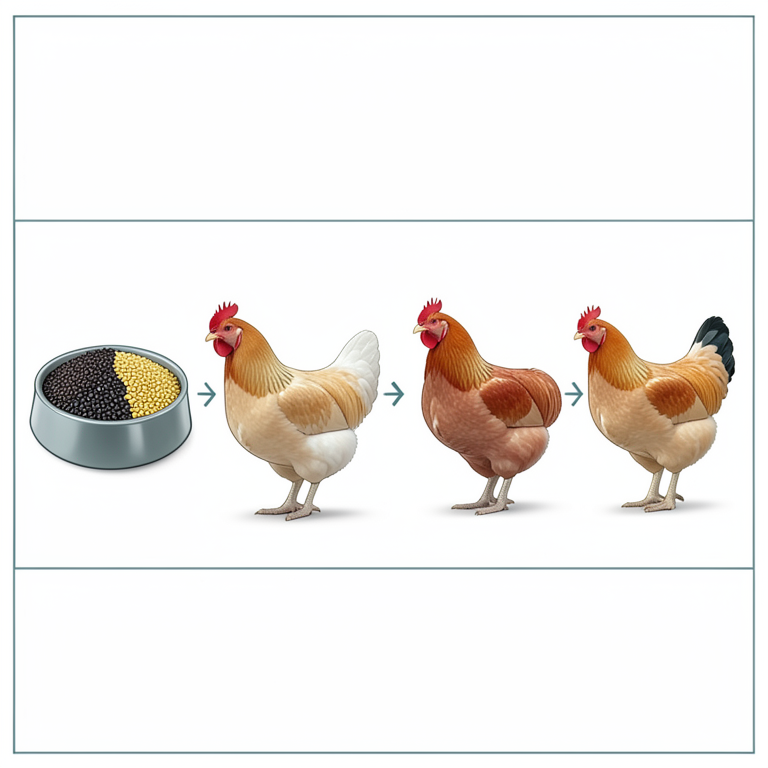
Dietary Inclusion vs. Weight Gain
AI-generated conceptual illustration (broiler chickens and black soldier fly larvae meal). It explains the idea and does not show study data.
View source evidence ↗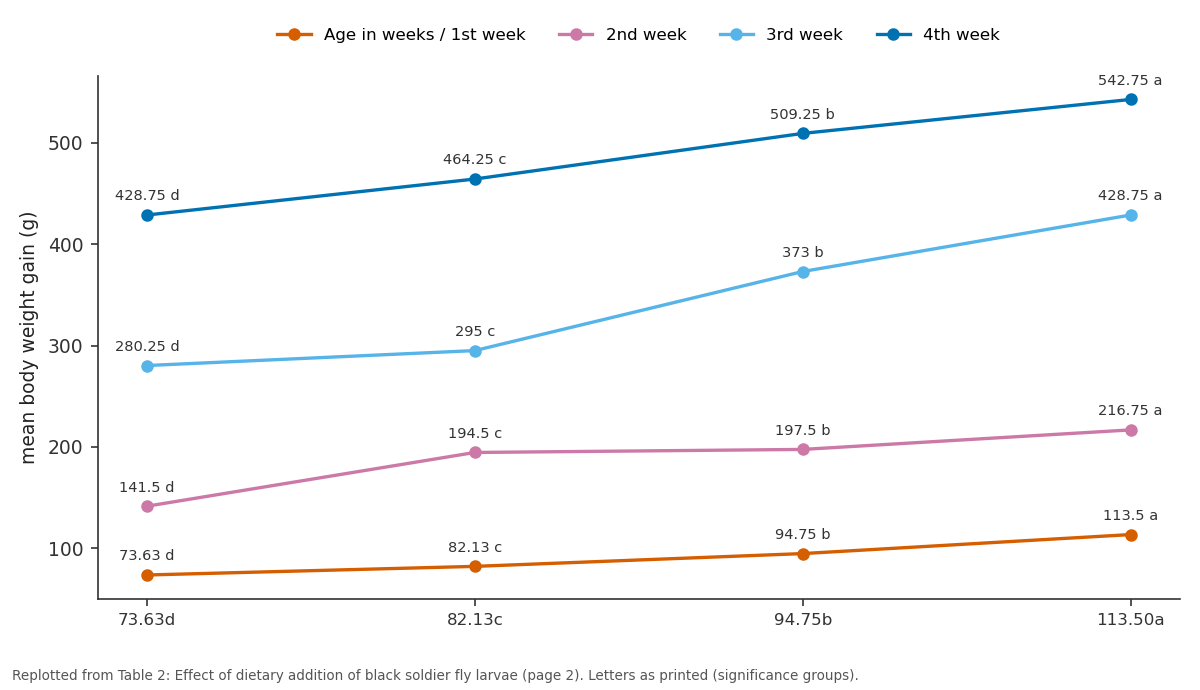
Age in weeks / 1st week and 2nd week and more: 73.63d vs 82.13c vs 94.75b vs 113.50a
Replotted from Table 2 (page 2) of the original paper. Every bar is the paper's own table value.
View source evidence ↗Figures & tables
From the original paper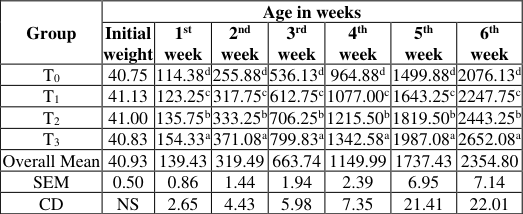 Table 1
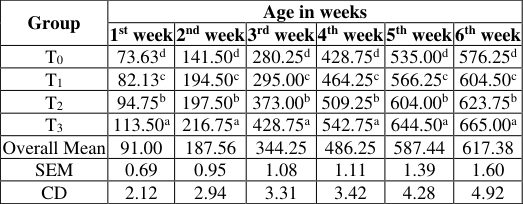 Table 2
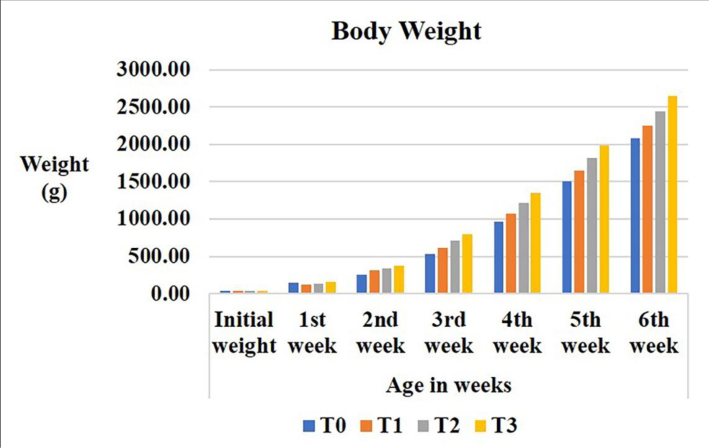 Figure 1
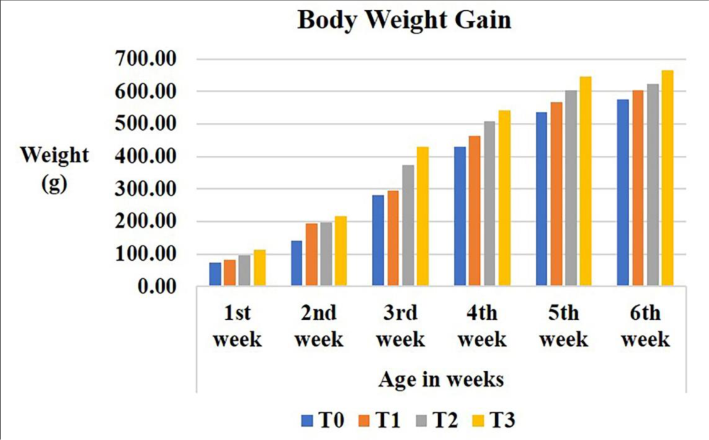 Figure 2
Introduction
The increasing global population is driving a heightened demand for food, particularly animal protein, which strains livestock feed resources. This scenario underscores the urgent need to identify alternative protein sources for animal husbandry. Insects, as highlighted by Makkar et al., (2014) [7] , are emerging as viable options due to their nutritional advantages and low resource requirements. Recent regulatory changes by the European Commission now permit the use of insect proteins in aquafeeds, with plans to extend this to poultry feeds. Among insects, the Black Soldier Fly (Hermetia illucens) stands out as a suitable replacement for conventional poultry feed ingredients, like soybean meal, due to its rich protein content and favorable amino acid profile. The larvae also have higher lipid levels, useful for biodiesel production, but their chitin content raises digestibility concerns for monogastric animals. Research on defatted Black Soldier Fly (Hermetia illucens) meal has yielded mixed results; for instance, Marono et al., (2017) [8] observed potential drawbacks in feed intake and egg production in laying hens. Conversely, Cullere et al., (2018) [1] reported comparable performance in growing quails fed diets incorporating 10-15% defatted Black Soldier Fly meal. Black Soldier Fly larvae (Hermetia illucens) can consume significant amounts of organic matter and thrive on diverse substrates, including decaying fruits and animal waste. The larvae's life cycle lasts about two months but can extend under limited feeding conditions. Adult flies, which do not feed, rely on energy reserves from their larval stage (Diclaro et al., 2009) [6] . As interest in sustainable protein sources continues to rise, Black Soldier Fly presents a promising solution for the future of animal feed production.
Materials and methodology
The experiment was conducted at the poultry farm of Dr. Sharadchandra Pawar College of Agriculture in Baramati. A total of 160 day-old broiler chicks (Vancobb 430Y) were sourced from a local hatchery. Upon arrival, the chicks were weighed and then randomly assigned to one of four treatment groups, with each group comprising 40 chicks. A standard basal diet was formulated using locally available feed ingredients, designed for three growth phases: pre-starter (0-10 days), starter (11-21 days), and finisher (22-42 days). The broilers were raised in a floor pen system for six weeks, during which feed and water were provided ad libitum. Individual weights of the chicks were recorded at arrival and subsequently on a weekly basis. In total, the study involved four treatments, with 160 birds distributed evenly across the treatments, resulting in 40 birds per group. The experiment was replicated four times and utilized a Completely Randomized Design (CRD). The treatment groups included a control group receiving only the basal diet, and three experimental groups receiving varying percentages of insect meal derived from Black Soldier Fly larvae (Hermetia illucens) mixed into the basal diet at 4%, 6%, and 8%, respectively.
Result and discussion
Result and discussion
Body weight
The mean initial body weights (g) of day-old broiler chicks for treatments T0, T1, T2, and T3 were 40. 75, 41.13, 41.00, and 40.83, respectively. At the end of the first week, the average cumulative body weights were 114.38 (T0), 123.25 (T1), 135.75 (T2), and 154.33 (T3), with T3 showing the highest weight and being significantly different (P≤0.01) from the other treatments. By the second week, cumulative body weights increased to 255.88 (T0), 317.75 (T1), 333.25 (T2), and 371.08 (T3), again with T3 leading and significantly different from the others. In the third week, weights reached 536.13 (T0), 612.75 (T1), 706.25 (T2), and 799.83 (T3), maintaining T3's superiority. The fourth week saw weights of 964.88 (T0), 1077.00 (T1), 1215.50 (T2), and 1342.58 (T3), with T3 still significantly ahead. By the fifth week, weights were 1499.88 (T0), 1643.25 (T1), 1819.50 (T2), and 1987.08 (T3). Finally, at six weeks, weights were 2076.13 (T0), 2247.75 (T1), 2443.25 (T2), and 2652.08 (T3), confirming T3's significant advantage throughout. (see Table 1) The analysis of growth performance in broiler chickens revealed that the highest body weight was achieved by the group fed an 8% inclusion of Black Soldier Fly larvae (Hermetia illucens) combined with a 92% basal diet (T3), reaching a total weight of 2652.08 g. This group was closely followed by those receiving a 6% inclusion (T2), with a body weight of 2443.25 g, and the 4% inclusion group (T1), which reached 2247.75 g. The control group (T0) recorded the lowest weight at 2076 g. These results highlight the positive impact of incorporating Black Soldier Fly larvae (Hermetia illucens) in broiler diets, suggesting that higher inclusion levels may enhance growth performance. However, it is crucial to recognize that the study focused only on 4%, 6%, and 8% inclusion levels, leaving the optimal level open for further research. (See Fig 1). Significant differences in body weight gains were noted across all treatment groups from the first week until the end of the experiment. The T3 group consistently demonstrated the highest mean body weight throughout the six-week period, attributable to increased feed consumption. Dabbou et al., (2018) [5] similarly reported enhanced growth metrics in broilers fed diets containing Black Soldier Fly (Hermetia illucens) larvae, noting improved body weight and average daily gain during the starter phase. However, they cautioned that higher inclusion rates might negatively impact average daily gain in the finisher phase, potentially due to adverse effects on gut morphology.
| Group | Age in weeks | — | — | — | — | — | — |
|---|---|---|---|---|---|---|---|
| Initial weight | 1st week | 2nd week | 3rd week | 4th week | 5th week | 6th week | |
| T0 | 40.75 | 114.38d | 255.88d | 536.13d | 964.88d | 1499.88d | 2076.13d |
| T1 | 41.13 | 123.25c | 317.75c | 612.75c | 1077.00c | 1643.25c | 2247.75c |
| T2 | 41.00 | 135.75b | 333.25b | 706.25b | 1215.50b | 1819.50b | 2443.25b |
| T3 | 40.83 | 154.33a | 371.08a | 799.83a | 1342.58a | 1987.08a | 2652.08a |
| Overall Mean | 40.93 | 139.43 | 319.49 | 663.74 | 1149.99 | 1737.43 | 2354.80 |
| SEM | 0.50 | 0.86 | 1.44 | 1.94 | 2.39 | 6.95 | 7.14 |
| CD | NS | 2.65 | 4.43 | 5.98 | 7.35 | 21.41 | 22.01 |
Table text extracted from the original PDF; superscript letters are shown inline. The original table image is below.
View original table image
Body weight gain
By the end of the first week, mean body weight gains were recorded at 73.63 g for T0, 82.13 g for T1, 94.75 g for T2, and 113.50 g for T3, with T3 achieving the highest gain. This trend continued into the second week, with gains of 141.50 g for T0, 194.50 g for T1, 197.50 g for T2, and 216.75 g for T3. Analysis of variance confirmed statistically significant differences among the treatment groups, indicating a clear correlation between Black Soldier Fly larvae (Hermetia illucens) inclusion and growth performance. In the third week, mean gains were 280.25 g for T0, 295.00 g for T1, 373.00 g for T2, and 428.75 g for T3, reinforcing the pattern of increased weight gains associated with higher inclusion levels. This trend persisted in the fourth week, where gains were 428.75 g for T0, 464.25 g for T1, 509.25 g for T2, and 542.75 g for T3. The fifth week showed gains of 535.00 g for T0, 566.00 g for T1, 604.00 g for T2, and 644.50 g for T3. By the end of the sixth week, results remained consistent, with mean body weight gains recorded at 576.25 g for T0, 604.50 g for T1, 623.75 g for T2, and 665.00 g for T3. In all cases, analysis confirmed the statistical significance of these differences. (see Table 2). Additionally, research by Cutrignelli et al., (2018) [4] indicated that feeding Black Soldier Fly larvae (Hermetia illucens) could enhance intestinal morphology, such as increased villi height in the duodenum. This suggests similar physiological improvements in broiler chickens, potentially contributing to enhanced weight gain. Overall, these findings underscore the benefits of integrating Black Soldier Fly larvae into poultry diets, especially in promoting growth and improving feed efficiency. Further studies are needed to determine optimal inclusion rates and their long-term impacts on growth performance and gut health in poultry. (See Fig 2). Different superscripts (a, b, c, d) within the same column show significant differences (p<0.05) (a, b, c, d) within the same column show significant differences (p<0.05)
| Group | Age in weeks | — | — | — | — | — |
|---|---|---|---|---|---|---|
| 1st week | 2nd week | 3rd week | 4th week | 5th week | 6th week | |
| T0 | 73.63d | 141.50d | 280.25d | 428.75d | 535.00d | 576.25d |
| T1 | 82.13c | 194.50c | 295.00c | 464.25c | 566.25c | 604.50c |
| T2 | 94.75b | 197.50b | 373.00b | 509.25b | 604.00b | 623.75b |
| T3 | 113.50a | 216.75a | 428.75a | 542.75a | 644.50a | 665.00a |
| Overall Mean | 91.00 | 187.56 | 344.25 | 486.25 | 587.44 | 617.38 |
| SEM | 0.69 | 0.95 | 1.08 | 1.11 | 1.39 | 1.60 |
| CD | 2.12 | 2.94 | 3.31 | 3.42 | 4.28 | 4.92 |
Table text extracted from the original PDF; superscript letters are shown inline. The original table image is below.
View original table image
Conclusion
The results of the study clearly indicate that the inclusion of Black Soldier Fly larvae (Hermetia illucens) in broiler chicken diets significantly enhances growth performance, with the highest body weight observed in the group receiving an 8% inclusion. The consistent superiority of the T3 treatment group throughout the experimental period underscores the potential benefits of integrating this insectbased protein source into poultry nutrition. The progressive weight gains across all treatment groups highlight the positive correlation between the level of Black Soldier Fly larvae (Hermetia illucens) and overall growth metrics. The significant differences observed at each evaluation point suggest that higher inclusion rates not only promote weight gain but may also improve feed efficiency. Furthermore, the findings align with previous research by Dabbou et al., (2018) [5] , which similarly reported enhanced growth performance in broilers fed diets containing Black Soldier Fly larvae. Moreover, the potential physiological benefits, such as improved gut morphology, as indicated by Cutrignelli et al., (2018) [4] , further support the inclusion of Black Soldier Fly larvae as a valuable dietary component. However, while the study suggests that an 8% inclusion level is effective, the question of optimal levels remains open for further investigation. Future research should explore higher inclusion rates and assess their long-term effects on growth performance, feed efficiency, and gut health in broiler chickens. Incorporating Black Soldier Fly larvae into broiler diets appears to be a promising strategy for enhancing growth and feed efficiency, presenting an opportunity for sustainable poultry production. As the industry increasingly seeks alternative protein sources, further studies are warranted to optimize dietary formulations that can leverage the benefits of this innovative ingredient.
Acknowledgement
I would like to thank my parents for all the life lessons.
Conflict of Interest
Conflict of Interest
Financial Support
Financial Support
References
0 in the original paperCited by 1
From OpenAlex, OpenCitations and reference lists read by Scinovex
- Impacts of Tenebrio molitor Larval Meal on Zootechnical Performance, Biochemical Indices, and Intestinal Morphometry in Broiler Chickens ↗
Nassi Guidi Hoeness Inaudi, Agboka Komi, Komi Attivi, Kodjo Gnatepe MLAGA, Guénnolé Vinakpon, Kokou Tona · World s Veterinary Journal · 2025
Protein resources availability is a major challenge for poultry farming in Sub-Saharan Africa. Insects such as Tenebrio molitor (T. molitor), known as yellow mealworm, which are rich in high-quality protein, offer a promising solution. The present study aimed to evaluate the effects of T. molitor larvae meal as an alternative protein source in broiler chicken diets. A total of 375…
❝ 0PDF