
Research article · 2024 · Full text
International Journal of Agriculture and Food ScienceLand suitability assessment to achieve optimal field rice yield
Volume 6(2) · Pages 47–51 · DOI: 10.33545/2664844x.2024.v6.i2a.204 ↗
Research areasAgricultural Systems and PracticesSoil and Land Suitability AnalysisRice Cultivation and Yield Improvement
Abstract
Author-writtenShifting cultivation of dryland rice is still practiced by indigenous Kalimantan people to fulfill their own needs for rice. The selected locations are mainly young secondary forest land cover with a fallow period of 10-15 years for easier work and higher biomass. The stage of shifting cultivation that most determines the ease of subsequent activities, growth and yield is the amount of biomass burned (>70%) to ash, except for parts of trees >15cm in diameter. Ash contains available macro and micro nutrients that can increase nutrient retention (nr), namely CEC, base saturation and pH and available nutrients (na) N, P and K. Assessment of land suitability to the requirements of growing field rice with the matching method, that the minimum land characteristics are the heaviest constraints that determine the class and sub-class land suitability. The evaluation results obtained actual land suitability sub-class S3nr,na, the heaviest limiting factors of nutrient retention and nutrient availability. Improvement of biomass ash after land burning occurs naturally starting with rain. Improvement of limiting factors is naturally limited, farmers must add N and P nutrients from Urea and Super Phosphate-36 (SP-36) fertilizers at doses of N 25-40 kg.ha-1 and P 30-50 kg.ha-1. Fertilizers are applied by sowing at 21 days of age and 45 days of age at a dose of 50% each. After the improvement efforts were made, the growth of field rice was better so that production increased. The sub-class of suitability increased one level to S2eh,nr, the limiting factors are slope class (eh) and nr.
Summary
Source-checkedPlain-language reading of the full paper, prepared with AI and checked against the text. Each point links to the authors' own words.
Why it matters
- Indigenous people in Kalimantan continue to use shifting cultivation systems, known as gilir balik, to produce rice for their own consumption. View evidence ↗
- Farmers typically select forest land with a fallow period of 10 to 15 years to ensure that soil fertility has recovered. View evidence ↗
- Burning more than 70% of biomass into ash is believed to improve soil by increasing available nutrients and reducing acidity. View evidence ↗
The question
- The study aims to apply scientific land evaluation methods to shifting cultivation for dryland rice, as such assessments have previously been limited to wet rice. View evidence ↗
What they did
- Field activities and soil sampling were conducted in April 2024 in Hambau Village, East Kalimantan Province. View evidence ↗
- Composite soil samples were collected from a depth of 0 to 20 cm. View evidence ↗
- The researchers matched climatic, physico-chemical, and environmental land characteristics against the specific requirements for growing field rice. View evidence ↗
- Land suitability was classified as S1 (highly suitable), S2 (moderately suitable), or S3 (marginally suitable) based on the severity of constraints and required inputs. View evidence ↗
What they found
- The soil was found to be acidic with a pH of 4.82 and a very low base saturation of 19.45%. View evidence ↗
- The actual land suitability assessment identified nutrient retention (nr) as the heaviest limiting factor due to soil acidity, low organic matter, and low base saturation. View evidence ↗
- The actual land suitability class for the studied area was determined to be marginally suitable (S3), specifically sub-class S3nr,na. View evidence ↗
- To improve productivity, the study suggests applying Urea (N) at 25-40 kg/ha and SP-36 (P) at 30-50 kg/ha. View evidence ↗
What it means
- The authors conclude that additional nitrogen (N) and phosphorus (P) fertilization is necessary to achieve optimal grain yields for field rice. View evidence ↗
- The authors state that biomass burning indirectly improves nutrient retention, allowing the suitability class to rise from S3 to S2. View evidence ↗
- The authors note that slope is a limiting factor that is difficult to change and contributes to mild to moderate erosion. View evidence ↗
Visual summary
1 visualsIllustrations explain the paper; they do not show study data.
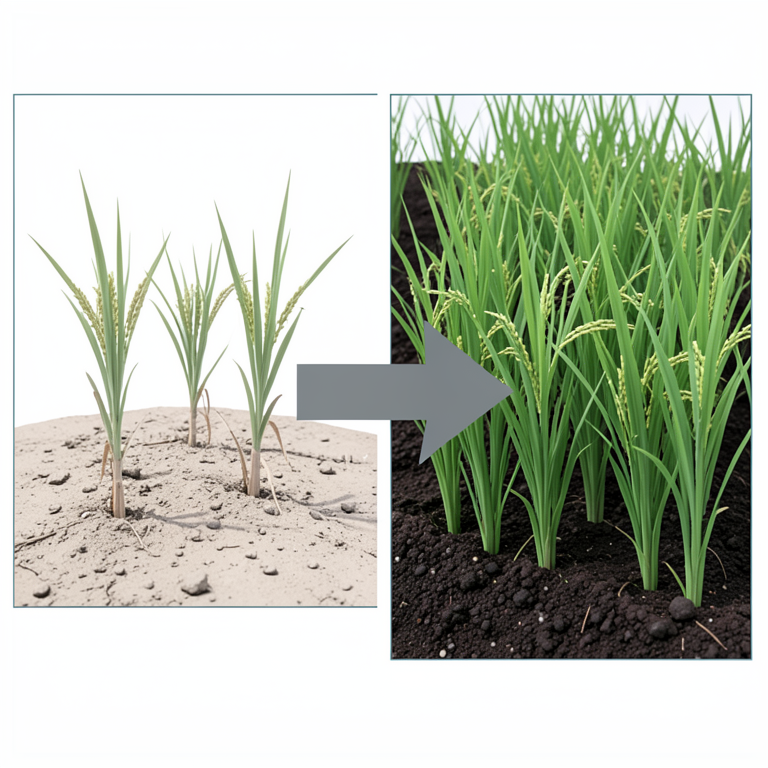
Suitability Transition
AI-generated conceptual illustration (Oryza sativa (rice plants) in a paddy field). It explains the idea and does not show study data.
View source evidence ↗Figures & tables
From the original paper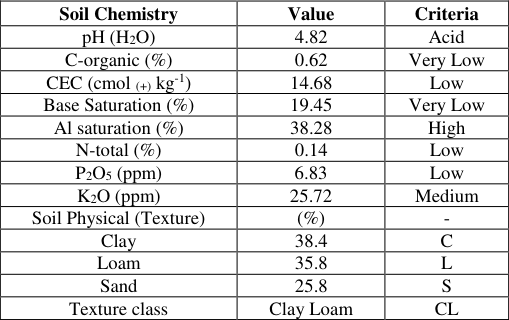 Table 1
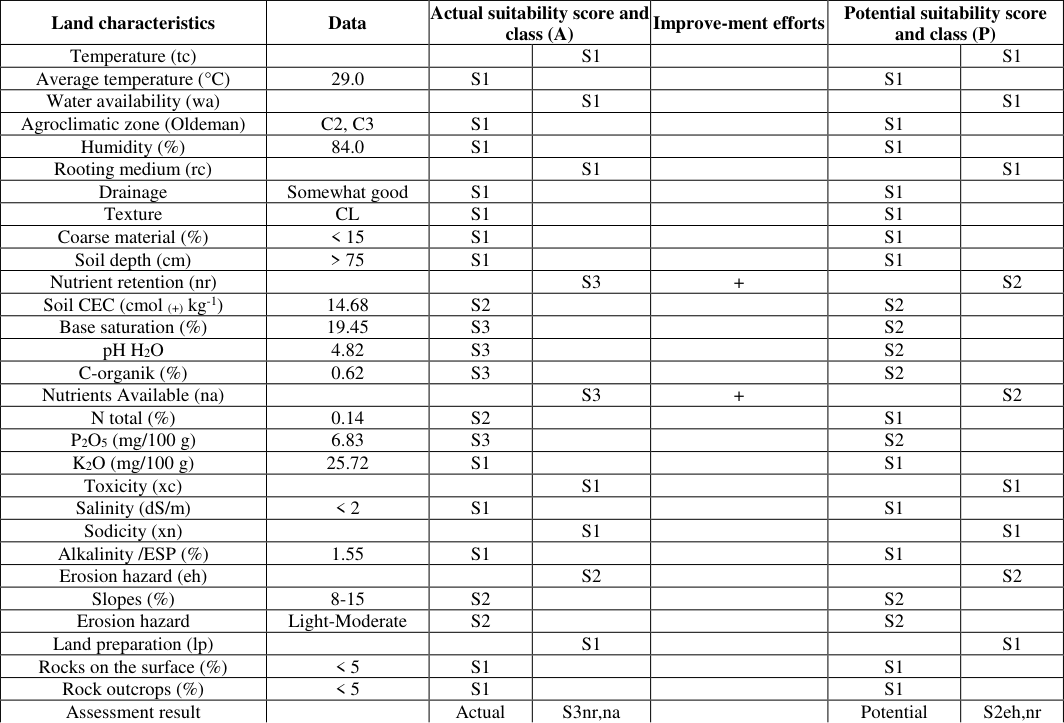 Table 2
Introduction
Dryland rice cultivation in shifting cultivation systems, also known as gilir balik, is still practiced by indigenous Kalimantan people to meet their own needs for rice (Palupi et al., 2023) [1] . The location chosen is mainly forest land cover with a fallow period of 10-15 years with consideration of soil fertility has recovered. In addition to the fallow period, location selection considerations are mainly relatively close to the place of residence and easy to reach. The main factor of the longer fallow period was chosen due to hereditary experience, namely easier to work, lighter management, more fertile if biomass burning is high so that crop yields increase. A more objective assessment for shifting cultivation activities based on scientific methods needs to be applied with the land evaluation method, which has only been used for wet rice activities. The application of land evaluation to assess the suitability class of land characteristics for paddy fields resulted in the identification of the actual suitability class and the heaviest limiting factor of land characteristics. Optimizing the results, improvements are made to the lowest scale limiting factors that are possible and can be done by traditional farmers with technological inputs such as fertilization (Darma et al., 2023; Palupi et al., 2024) [2,3] . In the process and stages of activities, some limiting factors may naturally change to become lighter or no longer the heaviest limiting factor. High levels of biomass burning (>70%) to ash will improve by increasing available macro and micro nutrients and reducing surface soil acidity (Darma and Fahrunsyah, 2022) [4] . Land characteristics that can be improved naturally by the presence of burnt ash are nutrient retention and available nutrients. The application of granular inorganic fertilizers such as urea and SP-36 by sowing needs to be done to increase soil fertility so that productivity increases from usual, the ultimate goal of their main food sufficiency of rice is met.
Data analysis
Land characteristics such as climate, physico-chemical and environment are matched with the requirements of growing field rice to obtain the level of suitability. Land suitability class is divided into S1 (highly suitable) land with mild constraints without additional input, S2 (moderately suitable) land with moderate constraints require moderate additional input and S3 (marginally suitable) land with severe constraints require additional input more than S2 (Food and Agriculture Organization, 1976) [11] . Determination of land suitability classes by matching between land characteristic data obtained against specific land use requirements (Djaenudin et al., 2011; Ritung et al., 2011) [12,13] . Land characteristic requirements and land suitability classes for field rice (Ritung et al., 2011) [13] . This results in the actual suitability class (A) and its limiting factors. Improvement with low and medium levels of management so as to obtain a potential suitability class (P).
Results and Discussion
Results and Discussion
Land characteristics
Climatic characteristics that affect the growth and production of field rice are temperature, rainfall and air humidity, the three factors that cannot be changed in the field. Based on data for 10 years, the average daily temperature is 29.0 °C with variations between the lowest and highest temperatures between 6-7 °C and 84.0% air humidity. Wet months (>200 mm/month) 5 months a year, classification (Madani and Wahid, 2022) [14] . From field observations the land surface is flat to undulating with slopes of 8-15%. Drainage includes a class of slightly good to good which is characterized by homogeneous soil color, no mottling (Rust) is found which indicates smooth groundwater movement (Ritung et al., 2007) [15] . Clayey loam (CL) soil texture is classified as a rather fine class, deep soil depth (>75 cm) and little coarse material (<15%) consisting of gravel or gravel. The findings of chemical analysis of composite soil samples in Table 1. +3 . P nutrient availability will increase if soil acidity is reduced. The limit of Al solubility and maximum P binding is around pH 5.5 then Al begins to precipitate and P begins to be released until the maximum available around pH 6.5-7 (Penn and Camberato, 2019) [16] . On the other hand, the binding of P by Fe occurs at pH <4.5 due to the high solubility of (Li and Jhonson, 2016) [17] .
| Soil Chemistry | Value | Criteria |
|---|---|---|
| pH (H2O) | 4.82 | Acid |
| C-organic (%) | 0.62 | Very Low |
| CEC (cmol (+) kg-1) | 14.68 | Low |
| Base Saturation (%) | 19.45 | Very Low |
| Al saturation (%) | 38.28 | High |
| N-total (%) | 0.14 | Low |
| P2O5 (ppm) | 6.83 | Low |
| K2O (ppm) | 25.72 | Medium |
| Soil Physical (Texture) | (%) | - |
| Clay | 38.4 | C |
| Loam | 35.8 | L |
| Sand | 25.8 | S |
| Texture class | Clay Loam | CL |
Table text extracted from the original PDF; superscript letters are shown inline. The original table image is below.
View original table image
Land suitability assessment
Actual land suitability is the level of natural suitability of a land for the use of certain agricultural commodities without human intervention on its land characteristics (see Table 2). The identification of actual land suitability (A) that the location of the fields for growing rice actually has the main or heaviest limiting factor is nutrient retention (nr), namely acidity of acidic planting (pH 4.82), low organic matter content and base saturation which indicates a general lack of metal-type nutrients such as Ca, Mg, K and Na. The factor of low nutrient retention or the minimum determines the land suitability class S3 sub-class S3nr. Based on Liebig's law (1840) in Mustaqim (2018) [18] , if connected to agriculture that the most determining factor is the minimum amount that determines the growth and yield of plants. The heaviest limiting factor is the main concern for land management of field rice plants for better growth so that productivity can be increased. Efforts to increase productivity with improvements to the heaviest limiting factor of nutrient retention results in potential suitability (P). Improvements that can be made by farmers indirectly and directly. Indirectly, dry slash and cut biomass will be burned. Good biomass burning up to the level of incineration Ismail (2005) [19] will produce maximum ash and charcoal, the ash from combustion is the unburned part of the biomass, almost completely metal macro-nutrients (Ca, Mg, K, and Na) and micro-nutrients and macro-nutrient P (Symanowicz et al., 2018) [20] . If there is rain it produces a strong base, the alkaline nature will reduce the acidity of the soil. Metal nutrients from ash and hydroxyl ions (OH -) will enter the soil solution through soil pores with rainwater media as metal ions that are exchanged with soil colids to increase base saturation and soil CEC, while hydroxyl ions interact with hydrogen ions (H + ) to reduce soil acidity so that the soil pH value rises. The increase in soil pH above the original 4.82 decreases the solubility of Al thereby increasing the availability of P in the form of H2PO4 -and HPO4 -2 for plants. Phosphate ions are absorbed by plant roots from the soil solution (Singh and Schulze, 2015) [21] . Nutrient P is a major part of Adenosine Triphosphate (ATP) as a store and transfer of energy in plants used for photosynthesis, protein synthesis, translocation and absorption of nutrients and respiration (Plaxton and Tran, 2011) [22] . The role of P nutrients is related to flower formation and seed development, so if fulfilled, it increases the quantity and quality of fruit (Khan et al., 2023; Osman et al., 2014) [23,24] . Changes in soil chemical properties were mainly in the rhizosphere area of field rice plants up to about 20 cm deep (Thepbandit and Athinuwa, 2024; Ferrarezi et al., 2022) [25,26] . Clayey loam (CL) soil texture has predominantly medium and fine pores (Feiza et al., 2015) [27] . A small portion of unburned and incompletely burned biomass will become soil organic matter, thus increasing organic matter content. Indirectly, land burning increases nutrient retention so that it is no longer a major limitation that can increase the original suitability class S3 to S2 sub-class S2eh,nr. The main limiting factor that is difficult to change the slope affects the erosion caused by the mild to moderate class, especially after burning biomass until the field rice is about 3 months old (Deng et al., 2020) [28] . A direct remedy is to sprinkle soil acidity-reducing materials such as agricultural lime to reduce soil acidity and increase base saturation. The type of agricultural lime used contains the main nutrient Ca (Calcite) or which contains the main nutrient Mg (Dolomite). Addition of organic matter in the form of compost to increase organic carbon levels in the soil. The practice of planting field rice of indigenous Kalimantan tribes does not recognize the addition of soil conditioners with liming and organic matter, improving the nutrient retention of field soil is done indirectly, namely the effect of the results of burning biomass that has dried (Gaydes-Combes et al., 2017) [29] . The Indonesian government has issued a policy as a solution to the problem that has been going on for about fifty years by legalizing communities to clear land by burning for shifting cultivation activities on their own land of 2 ha per family head by making firebreaks around the land to be burned as an effort to prevent forest and land fires (Rambe et al., 2024) [30] . This middle way is so that indigenous peoples can meet their basic needs but the International Journal of Agriculture and Food Science https://www.agriculturaljournals.com preservation of nature and the environment is maintained, in practice the fallow period affects the recovery of macro nutrients and soil organic matter as a determinant of soil fertility (Mukul et al., 2022) [31] . Nutrients play a major role in the growth of the vegetative and generative periods of rice plants, including field rice (Effendi et al., 2023; Winarso et al., 2022) [32,33] . Available nutrients (na) need to be added, especially macro-nutrients N and P because the low status will be a limiter when other factors are increased although the potential land suitability class (P) is not changed by the heaviest limiting factor, but can improve growth and yield. The application of N fertilizers to low N soils reacts quickly to spur better vegetative growth of rice plants, while the application of slower reacting P fertilizers is more intended to spur further growth of the vegetative phase that previously absorbed the diminishing natural soil P nutrients to be sufficient and ensure a better generative phase (Fernandus, 2023) [34] . Application of granular N and P fertilizers is the best choice in a practical way, namely spread evenly while walking when the rice is three weeks old or about 21 [35,36,37] . As an illustration, the dose of N is 25-40 kg. ha -1 and P is 30-50 kg. ha -1 , the source of fertilizer includes N from urea fertilizer and P from SP-36 fertilizer. The first and second application of N and P fertilizers are each 50% of the dose. Providing additional fertilizer will affect good growth in the vegetative and generative phases so that productivity increases from usual.
| Land characteristics | Data | Actual suitability score and class (A) | — | Improve-ment efforts | Potential suitability score and class (P) | — |
|---|---|---|---|---|---|---|
| Temperature (tc) | S1 | S1 | ||||
| Average temperature (°C) | 29.0 | S1 | S1 | |||
| Water availability (wa) | S1 | S1 | ||||
| Agroclimatic zone (Oldeman) | C2, C3 | S1 | S1 | |||
| Humidity (%) | 84.0 | S1 | S1 | |||
| Rooting medium (rc) | S1 | S1 | ||||
| Drainage | Somewhat good | S1 | S1 | |||
| Texture | CL | S1 | S1 | |||
| Coarse material (%) | < 15 | S1 | S1 | |||
| Soil depth (cm) | > 75 | S1 | S1 | |||
| Nutrient retention (nr) | S3 | + | S2 | |||
| Soil CEC (cmol (+) kg-1) | 14.68 | S2 | S2 | |||
| Base saturation (%) | 19.45 | S3 | S2 | |||
| pH H2O | 4.82 | S3 | S2 | |||
| C-organik (%) | 0.62 | S3 | S2 | |||
| Nutrients Available (na) | S3 | + | S2 | |||
| N total (%) | 0.14 | S2 | S1 | |||
| P2O5 (mg/100 g) | 6.83 | S3 | S2 | |||
| K2O (mg/100 g) | 25.72 | S1 | S1 | |||
| Toxicity (xc) | S1 | S1 | ||||
| Salinity (dS/m) | < 2 | S1 | S1 | |||
| Sodicity (xn) | S1 | S1 | ||||
| Alkalinity /ESP (%) | 1.55 | S1 | S1 | |||
| Erosion hazard (eh) | S2 | S2 | ||||
| Slopes (%) | 8-15 | S2 | S2 | |||
| Erosion hazard | Light-Moderate | S2 | S2 | |||
| Land preparation (lp) | S1 | S1 | ||||
| Rocks on the surface (%) | < 5 | S1 | S1 | |||
| Rock outcrops (%) | < 5 | S1 | S1 | |||
| Assessment result | Actual | S3nr,na | Potential | S2eh,nr |
Table text extracted from the original PDF; superscript letters are shown inline. The original table image is below.
View original table image
Conclusion
The actual land suitability class for field rice studied is marginally suitable (S3), the heaviest limiting factors are nutrient retention (nr) and nutrient availability (na) sub suitability class S3nr,na. The growth of field rice is less than optimal due to the heaviest limiting factor of nutrient retention (nr), namely low base saturation, acid soil and very low organic matter. Another limiting factor is nutrient availability (na), especially low available P nutrients. Biomass combustibility is high to the extent that incineration produces maximum ash. The ash consists of macro-nutrients especially base metals (Ca, Mg, K, Na) and P as well as micro-nutrients, which are available for field rice. It naturally ameliorates limiting factors, increasing nutrient retention and nutrient availability. Ash nutrient supply is uncertain, affected by biomass dryness during burning. Additional N and P nutrient fertilization is required to achieve optimum grain yield of field rice.
References
31 in the original paper- Murhaini S, Achmadi A. The farming management of Dayak people's community based on local wisdom ecosystem in Kalimantan Indonesia. Heliyon. 2023;7(12):e08578. DOI: 10.1016/j.heliyon.2021.e08578.
- Darma S, Nurhartanto N, Asrori MA. Analisis daya dukung lahan di Kabupaten Kutai Kartanegara. J Agroekotek Tro Lem. 2023;6(1):36-43. DOI: 10.30872/jatl.6.1.2023.11684.36-43.
- Palupi NP, Hardi EH, Fahrunsyah F, Rahayu DE, Nugroho RA, Darma S, et al. Rice straw compost and husk biochar as growth starters and in vitro heavy metal biosorbents. Nong Jix Xue/Trans Chin Soc Agri Machinery. 2024;5(1):1-12.
- Darma S, Fahrunsyah F. Effect of soil damage on carrying capacity of biomass production: A lesson from Tanjung Selor District-Tanjung Redeb, Indonesia. Univ J Agri Res. 2022;10(6):682-690. DOI: 10.13189/ujar.2022.100609.
- Wahyunto H, Suryani E, Tafakresnanto S, Ritung A, Mulyani M, Sukarman K, et al. Petunjuk teknis pedoman survei dan pemetaan tanah tingkat semi detail skala 1:50.000. Balai Besar Penelitian dan Pengembangan Sumberdaya Lahan Pertanian - Kementerian Pertanian RI, Bogor, 2016.
- Darma S. Channeling information and reviewing FFB productivity disruptions residents' palm oil gardens in Saliki Village (Muara Badak District, Kutai Kartanegara Regency). PengabdianMu: J Ilmiah Pengab Kepada Masy. 2022;7(6):814-821. DOI: 10.33084/pengabdianmu.v7i6.3787.
- BPS-Statistics Kutai Kartanegara. Kutai Kartanegara in Figures 2024, 22, 2024. https://kukarkab.bps.go.id/id/publication/2024/02/28/1f 87a0280eff09a873ecaba0/kabupaten-kutai-kartanegaradalam-angka-2024.html.
- Food and Agriculture Organization. A framework for land evaluation. FAO Soils Bulletin, No: 32. FAO: Rome, Italy. 1976;ISBN:92-5-1001 11-1.
- Madani I, Wahid KA. Pemetaan zona agroklimat oldeman di Provinsi Jawa Tengah menggunakan data climate hazards group infrared precipitation with station (CHIRPS). J Geo Rem Sen. 2022;3(2):95-102. DOI: 10.23960/jgrs.2022.v3i2.99.
- Penn CJ, Camberato JJ. A critical review on soil chemical processes that control how soil pH affects phosphorus availability to plants. Agri. 2019;9(6):120. DOI: 10.3390/agriculture9060120.
- Li W, Jhonson, CE. Relationships among pH, aluminum solubility and aluminum complexation with organic matter in acid forest soils of the Northeastern United States. Geoderma. 2016;271(1):234-242. DOI: 1016/j.geoderma.2016.02.03.
- Mustaqim W. Hukum minimum Liebig -Sebuah ulasan dan aplikasi dalam biologi kontemporer. Bumi Les J Env. 2018;18(1):28-32. DOI: 10.24843/blje.2018.v18.i01.p04.
- Ismail AY. Dampak kebakaran hutan terhadap potensi kandungan karbon pada tanaman Acacia Mangium willd di hutan tanaman industri. Thesis. Sekolah Pascasarjana, Institut Pertanian Bogor, Bogor. 2005.
- Symanowicz B, Becher M, Jaremko D, Skwarek K. Possibilities for the use of wood ashes in agriculture. J Ecol Eng. 2018;19(3):191-196. DOI: 10.12911/22998993/86156.
- Singh B, Schulze DG. Soil minerals and plant nutrition. Nat Edu Know. 2015;6(1):1.
- Plaxton WC, Tran HT. Metabolic adaptations of phosphate-starved plants. Plant Phy. 2011;156(3):10061015. DOI: 10.1104/pp.111.175281.
- Khan F, Siddique AB, Shabala S, Zhou M, Zhao C. Phosphorus plays key roles in regulating plants' physiological responses to abiotic stresses. Plants. 2023;12(15):2861. DOI: 10.3390/plants12152861.
- Osman EAM, Fatma II, Grah A, Ismaiel A. Influence of phosphorus fertilizer on growth, fruiting parameters and fruit quality of peach trees irrigated by acidic water. J Soil Sci Agri Eng. 2014;5(4):529-542. DOI: 10.21608/jssae.2014.49301.
- Thepbandit W, Athinuwa D. Rhizosphere microorganisms supply availability of soil nutrients and induce plant defense. Microorganisms. 2024;12(3):558. DOI: 10.3390/microorganisms12030558.
- Ferrarezi RS, Lin X, Neira ACG, Zambon FT, Hu H, Wang X, et al. Substrate pH Influences the nutrient absorption and rhizosphere microbiome of huanglongbing-affected grapefruit plants. Fron Plant Sci. 2022;13:856937. DOI: 10.3389/fpls.2022.856937.
- Feiza V, Feizienė D, Sinkevičienė A, Bogužas V, Putramentaitė A, Lazauskas S, et al. Soil water capacity, pore-size distribution and CO2 e-flux in different soils after long-term no-till management. Zemdirbyste. 2015;102(1):3-14. DOI: 10.13080/za.2015.102.001.
- Deng L, Sun T, Fei K, Zhang L, Fan X, Wu Y, et al. Effects of erosion degree, rainfall intensity and slope gradient on runoff and sediment yield for the bare soils from the weathered granite slopes of SE China. Geomorphology. 2020;352:106997. DOI: 10.1016/j.geomorph.2019.106997.
- Gay-des-Combes JM, Carrillo CS, Robroek BJM, Jassey VEJ, Mills RTE, Arif MS, et al. Tropical soils degraded by slash-and-burn cultivation can be recultivated when amended with ashes and compost. Ecol Evo. 2017;7(14):5378-5388. DOI: 10.1002/ece3.3104.
- Rambe HSJ, Romlih RN, Virriantaka V, Chrisdinata Y, Hitiyahubessy J. Implementation of Republic of Indonesia government regulation number 22 of 2021 in overcoming river water pollution cases. Aurelia: J Pen Peng Masy Indo. 2024;3(1):448-454. DOI: 10.57235/aurelia.v3i1.1648.
- Mukul SA, Herbohn J, Ferraren A, Congdon R. Limited role of shifting cultivation in soil carbon and nutrients recovery in regenerating tropical secondary forests. Front Env Sci. 2022;10:1076506. DOI: 10.3389/fenvs.2022.1076506.
- Effendi A, Gusmawartati G, Rosnia R. Growth and production of upland rice (Oryza sativa L.) in ultisol using liquid organic fertilizer and NPK. Indo J Agro. 2023;51(3):433-441. DOI: 10.24831/jai.v51i3.47352.
- Winarso S, Anggriawan R, Subiksa IGM, Ganestri RG, Intansari SR, Budianta D et al. Macronutrients (NPK) balance in rice field and dryland Maize cropping systems. J Deg Min Lands Manag. 2022;10(1):39453951. DOI: 10.15243/jdmlm.2022.101.3945.
- Fernandus N. Response of growth and production of upland rice plants (Oryza sativa L.) to application of vedagro fertilizer and green Manure. Cont Cent Res Institute Agri. 2023;17(2):31-43. DOI: 10.59651/cceria.v17i2.78.
- Meilani FS, Hindersah R, Setiawati MR, Wicaksono FY, Suryatmana P. Pengaruh pupuk hayati dengan bahan pembawa dan NPK tunggal terhadap tinggi tanaman dan berat gabah bernas padi gogo inceptisols Jatinangor. Soilrens. 2023;21(1):1-8. DOI: 10.24198/soilrens.v21i1.49316.
- Mulyaningsih ES, Sukiman H, Ermayanti TM, Lekatompessy S, Indrayani S, Seri AR, et al. Respon padi gogo terhadap pupuk hayati di lahan kering Kabupaten Konawe Selatan, Sulawesi Tenggara. J Pengk Peng Tek Pert. 2015;18(3):251-261.
- Prabukesuma MA, Hamim H, Nurmauli N. Pengaruh waktu aplikasi dan dosis pupuk NPK terhadap pertumbuhan dan hasil padi gogo (Oryza sativa L.). J Agro Trop. 2015;3(1):106-112. DOI: 10.23960/jat.v3i1.1970.
Cited by 1
From OpenAlex, OpenCitations and reference lists read by Scinovex
- OPTIMASI PERENCANAAN PENGGUNAAN LAHAN SAWAH BARU DALAM MENDUKUNG KETAHANAN PANGAN DI KABUPATEN MAROS, SULAWESI SELATAN ↗
Munawir, Nurhikmah Wahab · Jurnal Tanah dan Sumberdaya Lahan · 2026
Paddy field conversion in Maros Regency during the 2013–2023 period reached 1,946 hectares, equivalent to approximately 0.7% per year, and has led to a food balance deficit since 2023. This study aims to optimize the planning of new paddy fields to support food security in Maros Regency through: (1) identification of land availability, (2) land suitability analysis, (3) determining priority…
❝ 0PDF