
Research article · 2024 · Full text
International Journal of Veterinary Sciences and Animal HusbandryAssessing the effect of tamarind seed powder on growth performance of Osmanabadi male kids
Volume 9(5) · Pages 558–562 · DOI: 10.22271/veterinary.2024.v9.i5i.1765 ↗
Research areasDiverse scientific research topicsAdvances in Cucurbitaceae Research
Abstract
Author-writtenThe research work was carried out to assess the effect of feeding tamarind seed powder on growth performance of Osmanabadi male kids. For this purpose, twenty Osmanabadi male kids of about 3 months of age were randomly assigned to four treatment groups in equal number, namely T0 (Basal diet), T1 (Basal diet + Tamarind seed powder 5% of concentrates), T2 (Basal diet + Tamarind seed powder 10% of concentrates), T3 (Basal diet + Tamarind seed powder 15% of concentrates). Feeding trial continued for 90 days. Body weight and DMI of all the kids was recorded at weekly intervals. All the kids exhibited a growth rate ranging from 0.053 to 0.069 kg per day, with significant differences. The body weight gain was highest in the T3 treatment group. Overall, the experimental results indicated that the T3 treatment showed better and more desirable outcomes compared to the T2, T1 and T0 treatments. The daily dry matter (DM) intake varied significantly across the treatments. Goat kids in the T3 group consumed more DM compared to those in the T2, T1 and T0 groups. The average daily dry matter intake was 0.358, 0.389, 0.412 and 0.430 kg/day/kid for the T0, T1, T2 and T3 groups, respectively. This trend indicates an increase in daily dry matter intake with the incorporation of tamarind seed powder as a concentrate in the rations. However, T2 and T3 were at par to each other.
Summary
Source-checkedPlain-language reading of the full paper, prepared with AI and checked against the text. Each point links to the authors' own words.
Why it matters
- Livestock are essential for the economies and livelihoods of people in developing nations, offering both employment and income. View evidence ↗
- Tropical and subtropical regions often face feed shortages because they rely on low-quality native grasses and crop residues that are high in fiber but low in nitrogen. View evidence ↗
- Tamarind seed husk, a byproduct of seed extraction, is rich in condensed tannins and can potentially improve production efficiency by modulating rumen fermentation. View evidence ↗
The question
- The study aimed to evaluate how feeding tamarind seed powder affects the growth performance of male Osmanabadi kids. View evidence ↗
What they did
- Twenty 3-month-old male Osmanabadi kids were divided into four equal groups: a basal diet (T0), and basal diets supplemented with tamarind seed powder at 5% (T1), 10% (T2), and 15% (T3) of concentrates. View evidence ↗
- The feeding trial lasted for 90 days, with body weight and dry matter intake (DMI) recorded every week. View evidence ↗
- The experiment was conducted at the Goat farm of the Dr. Sharadchandra Pawar College of Agriculture in Baramati, using facilities that allowed for individual feeding and watering. View evidence ↗
- Data were analyzed using Microsoft Excel following a Randomized Block Design (RBD) to test for significant differences. View evidence ↗
What they found
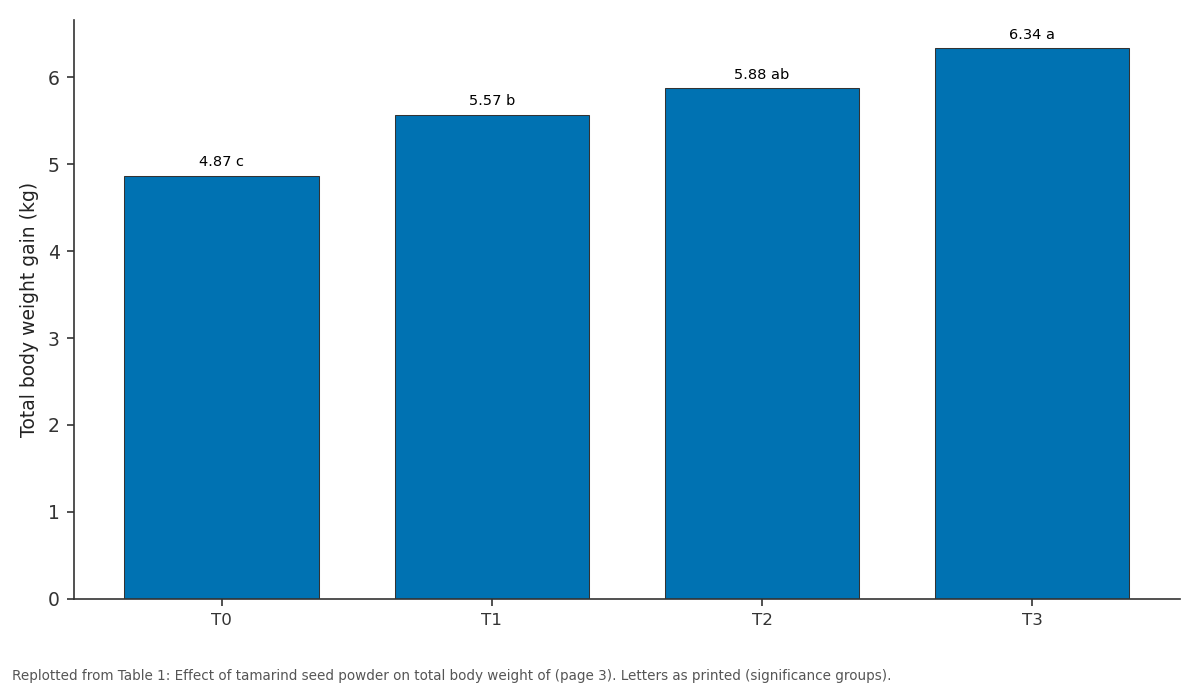
- After 90 days, the total body weight gain was highest in the T3 group (6.34 kg) and lowest in the T0 group (4.87 kg), with T1 and T2 gaining 5.57 kg and 5.88 kg respectively. View evidence ↗
- The average daily weight gain increased with higher levels of tamarind seed powder, ranging from 53.46 g/day in T0 to 69.60 g/day in T3. View evidence ↗
- Weekly body weight gains were highest for the T3 group at 487.20 g, compared to 374.19 g for T0, 430.59 g for T1, and 452.57 g for T2. View evidence ↗
- Average daily dry matter intake (DMI) increased as more tamarind seed powder was added, with T0 at 0.358 kg/d and T3 reaching 0.430 kg/d. View evidence ↗
- Kids in the T3 group achieved a significantly higher average body weight (P<0.05) than those in the T0, T1, and T2 groups. View evidence ↗
What it means
- The authors conclude that replacing 15% of the concentrate with tamarind seed powder increases the body weight of Osmanabadi male kids. View evidence ↗
- The authors suggest that using tamarind seed powder is an economically beneficial and sustainable way for farmers to utilize agricultural by-products. View evidence ↗
Visual summary
2 visualsIllustrations explain the paper; charts are replotted from the paper's own table values.
Total body weight gain (kg): T0 vs T1 vs T2 vs T3
Replotted from Table 1 (page 3) of the original paper. Every bar is the paper's own table value.
View source evidence ↗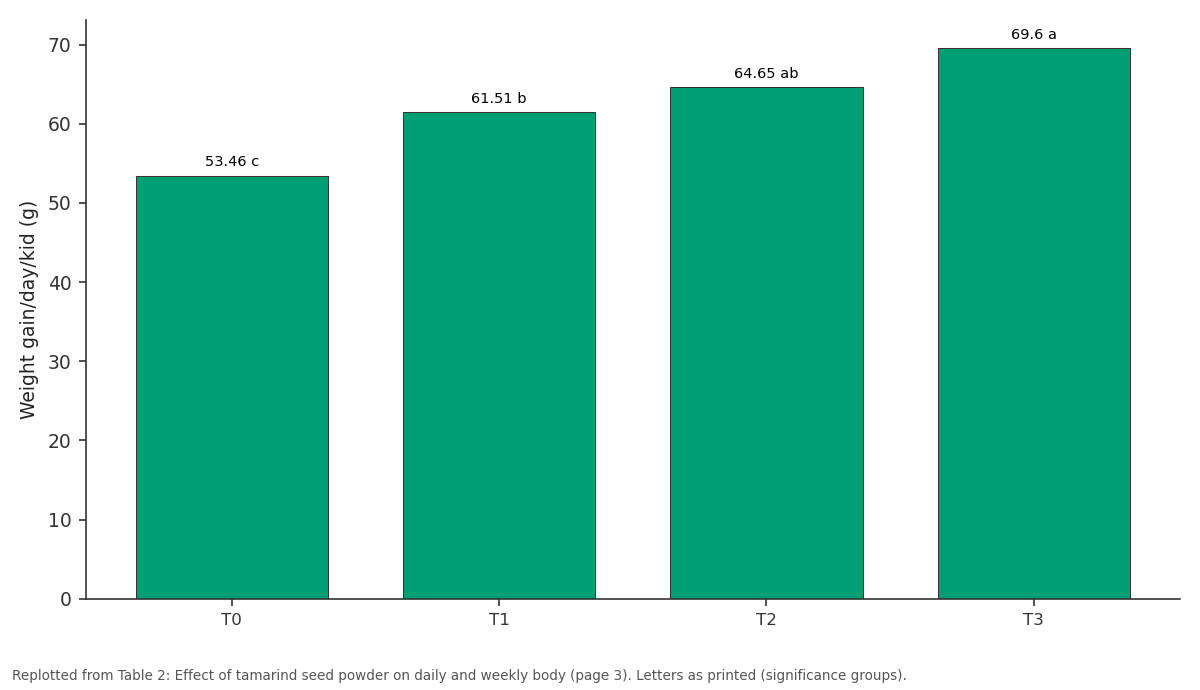
Weight gain/day/kid (g): T0 vs T1 vs T2 vs T3
Replotted from Table 2 (page 3) of the original paper. Every bar is the paper's own table value.
View source evidence ↗Figures & tables
From the original paper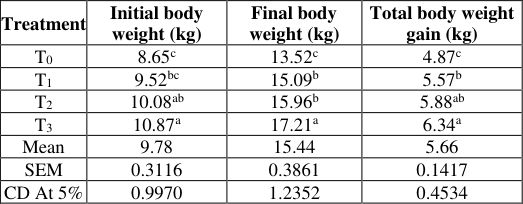 Table 1
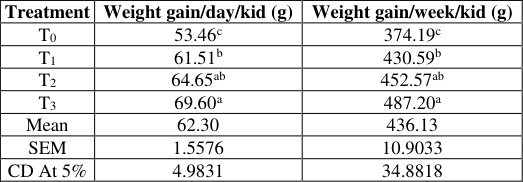 Table 2
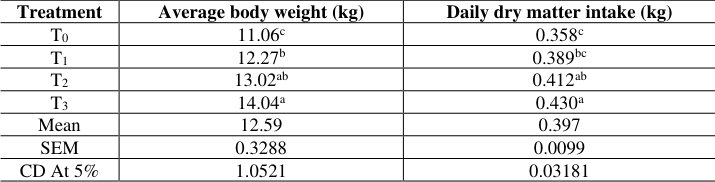 Table 3
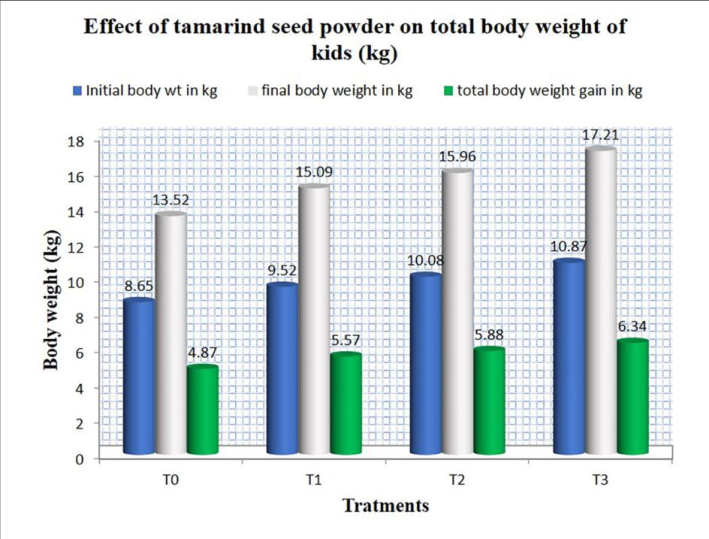 Figure 1
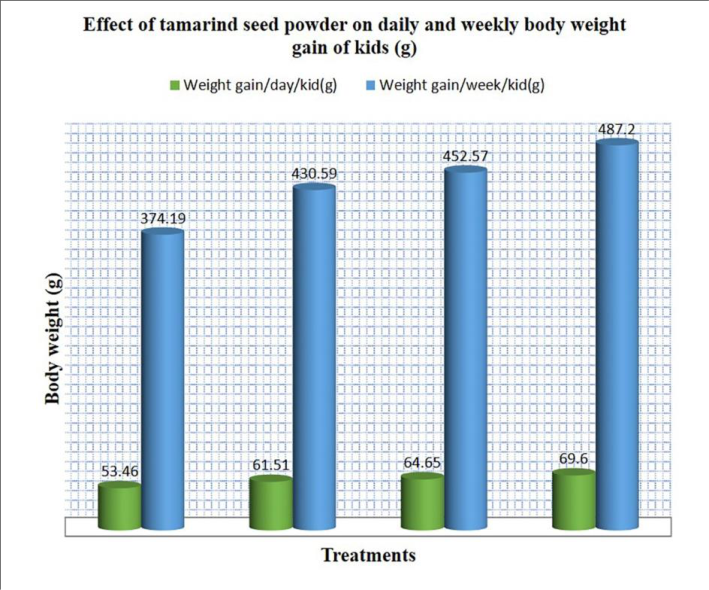 Figure 2
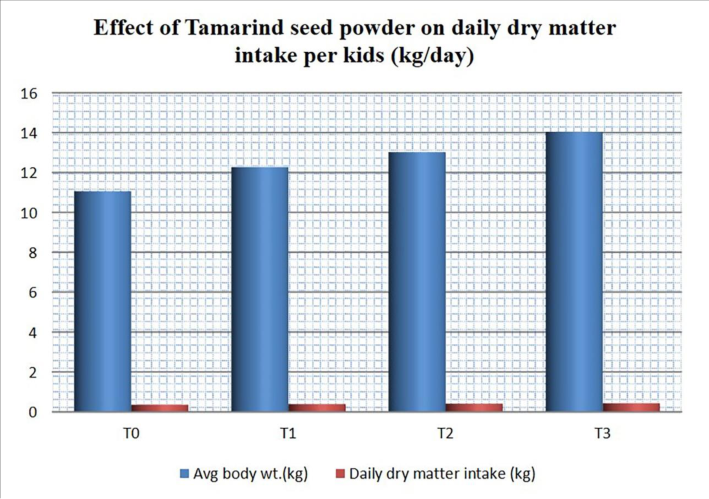 Figure 3
Introduction
Livestock are crucial to rural livelihoods and the economies of developing nations, providing income and employment for producers and others involved in often complex value chains. Goats, in particular, are highly adaptable animals that significantly contribute to economically disadvantaged regions. The relationship between goats and human dates back 10,000 years (Muigai et al., 2018) [5] . They are essential sources of both food and income, especially in resource-scarce environments (Moyo et al., 2013) [4] . Beyond their substantial contributions to meat, milk, and fiber production, goats play a vital role in maintaining ecological balance within specific farming systems. They can thrive on available shrubs and trees in harsh environments with low fertility, where no other crops can grow. Utilizing forages, browses and agro-industrial by-products alongside suitable supplementation for low-quality forages and crop residues seems to be a positive approach in addressing the feeding challenges faced by goats in the country. Compared to other ruminants, goats have demonstrated superior ability in utilizing forages high in fiber and low in protein to maintain their bodies and productivity. Alih et al., (2021) [1] suggest that this potential could be further enhanced through supplementation to improve productivity. Goat productive potential relies on their efficiency, influenced by factors such as age at puberty, age at first service, age at first kidding, litter size, number of double and triple kidding and birth weight (Simon et al., 2021) [9] . In developing countries, where poor farmers have limited access to external inputs and there is high demand for food, the production of animal feed often becomes a low priority. Consequently, feed shortages persist in tropical as well as subtropical regions, where the primary feed supply relies on crop residues and low-quality native grasses with low nitrogen and high fiber content. Several leguminous fodder trees and shrubs contain high protein and energy levels in their various edible parts, making them potentially valuable supplements for addressing nutrient deficiencies in animals (Tolera et al., 2001) [10] .
By utilizing these feed resources, livestock not only brings economic benefits to farmers but also contributes to improved soil fertility and erosion control. One of them is Tamarindus indica commonly known as Tamarind. Tamarind belongs to the dicotyledonous family Leguminosae. It grows in over 50 countries worldwide, with major production areas located in countries of Asia such as Bangladesh, India, Sri Lanka, Indonesia, Thailand as well as America and Africa. Pattern of its availability across the world differs. Due to their nitrogen-fixing ability and resilience to prolonged droughts, tamarind trees can flourish in nutrient-poor soils, making them perfect for lowmaintenance, high-yield farming. Additionally, tamarind trees are multipurpose, providing valuable fruits, timber and medicinal properties. The tamarind fruit comprises approximately seed (34%), shell (11%), pulp (55%) and fiber within the pod. The pulp is rich in organic acids such as acetic, citric, tartaric, succinic acids formic and malic. It also contains amino acids like alanine, leucine, phenylalanine, proline and serine, along with invert sugar (25-30%), pectin, protein (87.9 g/kg) and fat (19.1 g/kg). The byproduct of the seed extraction units is the tamarind seed husk, is a rich source of condensed tannin and can be used as a dietary ingredient to modulate rumen fermentation and enhance production efficiencies. Despite its potential, tamarind seed husk remains largely unexplored, with only two studies investigating its use in animal feed. These studies found no adverse effects from including tamarind seed husk (2.5% and 7.5%) in the diet on intake of nutrient and digestibility coefficient of this nutrient. Tamarind seed serve as the raw material for producing tamarind seed kernel powder (TKP), polysaccharides (jellose), adhesive and tannin. Tannins exhibit both advantageous and detrimental effects. Incorporating tannins into diets at levels below 4% (on a dry matter basis) is beneficial for safeguarding dietary proteins against excessive rumen degradation. Additionally, it enhances amino acid absorption and utilization by ruminants, reduce occurrence of pasture bloat, reduce methane production in goats. However, when tannins exceed 4% in the diet, they can adversely impact feed utilization by reducing palatability and intake (Priolo et al., 2002) [7] .
Materials and Methodology
Present experiment was conducted on Osmanabadi male kids to study the effect of dietary addition of tamarind (Tamarindus indica) seed powder on their growth performance.
Animals: Selection and Grouping
Twenty healthy male young goats (kids) of about 3 months of age were procured from the local market. These animals were maintained for 1 month on a standard diet comprised of concentrate mixture and Soybean husk, before the start of the proper experiment. The kids were housed in Goat farm, Division of Animal Husbandry and Dairy Science, Dr. Sharadchandra Pawar College of Agriculture, Baramati, having facilities for individual feeding and watering. The kids were vaccinated against peste des petits of ruminants (PPR), Black Quarter (BQ) and Haemorrhagic septicaemia (HS) adopting standard protocol. After adapting the kids for one month, these were divided into four groups of five animals in each on the basis of their body weights following randomized block design (RBD).
Housing and Management
All the experimental kids were housed in a well-ventilated shed with provision of individual tying and feeding. Strict management and hygienic practices were adopted throughout the experimental period. All the kids were dewormed against ecto and endo parasites before the start of experiment and subsequently at regular intervals. Clean drinking water was provided ad libitum twice a day at about 10 a.m. and 3 p.m. daily.
Feeds and Feeding
To fulfill their nutritional needs according to NRC (2007) guidelines for a target body weight gain of 50g/day, the kids were given a diet of concentrate mixture, Soybean husk and Maize silage. Each morning at 9:30 AM, they received a measured amount of concentrate mixture to satisfy their crude protein (CP) and most of their total digestible nutrients (TDN) requirements. Following the consumption of the concentrate, Soybean husk and Maize silage was made available to them ad libitum. The amount of concentrate mixture required by each kid was adjusted at every fifteen days interval based on their body weights. This feeding protocol was followed for 90 days.
Recording of body weights and DM Intake
Body weights of all the animals were recorded using electronic weighing balance at weekly intervals during morning time before offering them any feed and water. Animals were offered weighed amount of concentrate mixture, soyabean straw and maize silage. Residue, if any was weighed after 24 hr. of offering. Samples of concentrate mixture, soyabean straw and maize silage were subjected to DM analysis once in a week, to know their DM intake.
Statistical analysis
The data obtained was subjected to the statistical analysis by following the Randomized Block Design (RBD) for testing their difference as per procedure described by Amble (1975). Analysis was done with the help of Microsoft excel software.
Results and Discussion
The goal of the current study "Assessing the effect of tamarind seed powder on growth performance of Osmanabadi male kids" was undertaken at Goat Farm, Division of Animal Husbandry and Dairy Science, Dr. Sharadchandra Pawar College of Agriculture, Baramati. during the period of 2023 -2024 for 90 days to know the growth performance and dry matter intake of Osmanabadi male kids. The result of the present investigation is depicted and discussed in the chapter with the following subheads.
Growth performance 4.1.1 Dry matter intake 4.1.2 Growth performance 4.1.3 Body weight
The high protein content in tamarind seeds aids in muscle development and promotes weight gain. Additionally, tamarind seeds are indeed a valuable addition to the diet due to their richness in essential amino acids. These amino acids play a crucial role in supporting overall growth and enhancing the diet's nutritional quality. Their antioxidant properties also help in reducing oxidative stress, contributing to better health and performance in livestock. The Initial body weight (kg) and Final body weight (kg) and Total body weight gain (kg) of experimental goats under different treatments for different treatment groups viz. T0, T1, T2 and T3 was compiled and presented in Table 1. The initial weights 8.65, 9.52, 10.08 and 10.87 were increased to 13.52, 15.09, 15.96 and 17.21 kg after 90 days of feeding in treatments respectively. The goat kids raised in the T3 treatment group exhibited significantly higher total body weight compared to the T0, T1 and T2 groups. Conversely, the T0 group had the lowest final body weight among all the treatment groups. The total gain in goat's body weight provided with experimental ration T0, T1, T2 and T3 upon completion of 90 days trial was 4.87, 5.57, 5.88 and 6.34 kg, respectively. The variation among different treatment groups was significantly higher in Osmanabadi male kids from T3 followed by T2, T1 and T0. Additionally, the total body weight gain of the Osmanabadi male kids was significantly affected by the incorporation of tamarind seed powder in their diet. While the kids from the T0 group exhibited the lowest total body weight gain, significant differences in total body weight gain were observed among the T0, T1, T2 and T3 treatment groups. The following researchers collaborated on the current research work: Dongare (2018) [3] found that the body weight gain (in kilograms) during 60 days of experimental trial was 2.50, 3.00, 3.60 and 3.28 kg in treatment groups T1, T2, T3 and T4, respectively. Group T3 exhibited the maximum body weight gain, accompanied by groups T4, T2 and T1. The Daily body weight gain (g) and weekly body weight gain (g) of experimental goats under different treatments for different treatment groups viz. T0, T1, T2 and T3 was compiled and presented in Table 2. The values of weekly gain in body weight were 374.19, 430.59, 452.57 and 487.20 g in treatment T0, T1, T2 and T3, respectively. Highest value was observed for T3 and treatment T2 was at par with it. The average body weight gains per goat per day were 53.46, 61.51, 64.65 and 69.60 in treatment groups T0, T1, T2 and T3 respectively. Highest value was observed for T3 and treatment T2 was at par with it. The total body weight gain (kg), daily weight gain (g) and weekly weight gain (kg) of 15 percent replacement of concentrate mixture with tamarind seed powder significantly (P<0.05) higher as compared to T0, T1 and T2. T2 was statistically at par with T3. The highest weight gain in goat fed replace with 15 percent tamarind seed powder might be became better intake and utilization of tamarind seed powder over other treatment. The increase in ADG with T3 ration might be due to better (P<0.05) nutrient utilization and plane of nutrition compared to other rations (Table 1&2). The improved weight gain observed in lambs fed barley sprouts may be linked to enhanced microbial activity in the rumen, as reported by Tudor et al., (2003). This observation may also be due to the highest nitrogen retention and digestibility of DM, OM, CP, NDF and ADF of the ration. The following researchers collaborated on the current research work: Dongare (2018) [3] found that feeding tamarind seed powder to Osmanabadi male kids resulted in average daily weight gains of 44.00 g, 53.00 g, 64.10 g, and 58.50 g in treatment groups T1, T2, T3 and T4, respectively. Additionally, the weekly weight gains per kid were 313.00 g, 374.80 g, 447.40 g and 410.20 g in treatment groups T1, T2, T3 and T4, respectively.
| Treatment | Weight gain/day/kid (g) | Weight gain/week/kid (g) |
|---|---|---|
| T0 | 53.46c | 374.19c |
| T1 | 61.51b | 430.59b |
| T2 | 64.65ab | 452.57ab |
| T3 | 69.60a | 487.20a |
| Mean | 62.30 | 436.13 |
| SEM | 1.5576 | 10.9033 |
| CD At 5% | 4.9831 | 34.8818 |
Table text extracted from the original PDF; superscript letters are shown inline. The original table image is below.
View original table image
| Treatment | Initial body weight (kg) | Final body weight (kg) | Total body weight gain (kg) |
|---|---|---|---|
| T0 | 8.65c | 13.52c | 4.87c |
| T1 | 9.52bc | 15.09b | 5.57b |
| T2 | 10.08ab | 15.96b | 5.88ab |
| T3 | 10.87a | 17.21a | 6.34a |
| Mean | 9.78 | 15.44 | 5.66 |
| SEM | 0.3116 | 0.3861 | 0.1417 |
| CD At 5% | 0.9970 | 1.2352 | 0.4534 |
Table text extracted from the original PDF; superscript letters are shown inline. The original table image is below.
View original table image
Dry matter intake:
The crucial factor in feeds and fodder is dry matter, which excludes the moisture content. The dry matter (DM) content of the food directly influences the amount of feed required by the animal. Given their elevated metabolic rate compared to larger animals, goats necessitate a higher intake of dry matter relative to their body weight. The voluntary consumption of feed acts as a crucial measure of its acceptability, palatability and quality for the animal. Tamarind seed powder taste and texture influence palatability, making it acceptable to goat kids and leading to increased consumption. This improved palatability positively impacts dry matter intake (DMI). The mean daily DMI (kg) and body weight (kg) for different groups viz. T0, T1, T2 and T3 were compiled and present in table 3. Table 3 presents the average body weight (kg) of the kids. Among the treatment groups, the kids in the Treatment T3 group had a significantly higher average body weight (P<0.05) compared to those in the T2, T1 and T0 groups. However, the average body weight of the kids in the T2 group was statistically at par with those in the T3 group. Table 3 also presents the mean daily average dry matter intake of the kids fed four experimental rations. Specifically, the average daily DMI (in kg/d) for kids fed rations T0, T1, T2 and T3 were 0.358, 0.389, 0.412 and 0.430 respectively. Among the treatment groups, Treatment T3 exhibited a significantly higher average daily dry matter intake (DMI) for kids (P<0.05) compared to T2, T1 and T0 rations. Notably, T0 had a significantly lower intake (P<0.05). The highest dry matter intake (DMI) was observed in the T3 ration compared to T0, T1 and T2 rations. It could be because the rumen is urged to expel feed more quickly, which results in increased consumption. Shital et al., (2011) [8] observed an increase in the average daily dry matter intake (DMI) of Osmanabadi kids when their diet comprised 15 percent azolla meal along with concentrate and it was not any harmful effect on body of the kids. 1.0521 0.03181 Different superscripts (a, b, c) within the same column show significant differences (p<0.05)
| Treatment | Average body weight (kg) | Daily dry matter intake (kg) |
|---|---|---|
| T0 | 11.06c | 0.358c |
| T1 | 12.27b | 0.389bc |
| T2 | 13.02ab | 0.412ab |
| T3 | 14.04a | 0.430a |
| Mean | 12.59 | 0.397 |
| SEM | 0.3288 | 0.0099 |
| CD At 5% | 1.0521 | 0.03181 |
Table text extracted from the original PDF; superscript letters are shown inline. The original table image is below.
View original table image
Conclusion
Feeding tamarind seed powder, replacing 15% of the concentrate on a dry matter basis, to Osmanabadi male kids along with a basal diet resulted in an increase in their body weight. The Osmanabadi male kids in the T3 group achieved a total body weight gain of 6.35 kg. Similarly, incorporating crushed tamarind seeds into the concentrate mixture has been shown to improve the dry matter intake of the experimental goat kids. This practice can be economically beneficial for farmers and contribute to more sustainable livestock management by utilizing agricultural by-products effectively.
Acknowledgments
I sincerely thank my co-authors for her constant versatile inspiring guidance, constructive suggestions, constant support throughout the course of this study and preparation of manuscript. I am also grateful to all the respondents in the study area whose direct and indirect assistance was instrumental to the success of this research.
Conflict of Interest
Conflict of Interest
Financial Support
Financial Support
Figures and tables from the paper
References
8 in the original paper- Alih PA, Ajagbe AD, Effienokwu JN, Odiba J, Apeh UJ, Abalaka EO, et al. Carcass yield and wholesale cuts of West African dwarf goats fed Panicum maximum supplemented with Bambara Nut Offal and cereal spent grains-based supplement diets. Nig J Anim Sci Tech. 2021;4(2):93-98.
- Dongare V. Effect of feeding tamarind crushed seed on growth performance of Osmanabadi growing kids. Journal of Animal Nutrition and Feed Technology. 2018;8(2):123-130.
- Moyo S, Swanepoel FJC, Moyo B, Masika PJ. The role of livestock in developing communities: Enhancing multifunctionality. Tropical Animal Health and Production. 2013;45(3):501-508.
- Muigai AW, Hanotte O, Jianlin H, Rege JEO. Genetic diversity and domestication history of goats. Animal Genetics. 2018;49(6):579-590.
- Priolo A, Ben Salem HB, Atti N, Aefzaoni A. Polyethylene glycol in concentrate feed blocks to deactivate condensed tannins in Acacia cyanophilla foliage. 1. Effect on intake, digestion, and growth by Barbarine lambs. British Society of Animal Science. 2002;75:127-135.
- Shital SG, Fernandes AP, Darade RV, Zagade BG. Effect of feeding different levels of Azolla meal on growth performance of Osmanabadi goat kids. Research Journal of Animal Husbandry and Dairy Science. 2011;3(1):1316.
- Simon PB, Joseph JO, Ochieng JW, Tiambo CK, Tarekegn GM, Machuka EM, et al. Typology, management, and smallholder farmer-preferred traits for selection of indigenous goats (Capra hircus) in three agro-ecological zones in the Democratic Republic of Congo. J Appl Anim Res. 2021;49(1):423-430.
- Tolera A, Merkel RC, Goetsch AL, Sahlu T, Negesse T. Nutritional potential of fodder trees and shrubs as protein and energy sources in mixed diets for ruminants. Animal Feed Science and Technology. 2001;91(1-2):1-21.
Cited by 1
From OpenAlex, OpenCitations and reference lists read by Scinovex
- Waste to Wealth: Tamarind Seed Dietary Fiber as a Potent Prebiotic Feed Additive ↗
Balaji Arumugam, Ranjita S. Das, Shweta M. Deotale, Ipsita Chakravarty, Yogesh Ninawe, Praful S. Dadhe et al. · Biotechnology and Applied Biochemistry · 2026
ABSTRACT Tamarind ( Tamarindus indica ) seeds, often discarded as agro‐industrial waste, are a rich source of bioactive compounds and dietary fibers. In this study, tamarind seed powder (TSP) was enzymatically treated for 4 h (e 4 TSP), 6 h (e 6 TSP), and 8 h (e 8 TSP) to decipher its nutritional, functional, and bioactive properties. The e 6…
❝ 0