
Research article · 2024 · Full text
International Journal of Veterinary Sciences and Animal HusbandryA comprehensive review of iodine deficiency in goats
Volume 9(5) · Pages 317–320 · DOI: 10.22271/veterinary.2024.v9.i5e.1723 ↗
Research areasAnimal health and immunology
Abstract
Author-writtenIodine deficiency indeed poses a significant concern for both humans and livestock worldwide, and goats are particularly susceptible due to their browsing habits and potential lack of access to iodine-rich sources. Additionally, certain plants (Cabbage, Kale, Broccoli, Cauliflower and Turnips) consumed by goats may contain goitrogens, compounds that interfere with iodine utilization, exacerbating the problem. Clinical iodine deficiency in goats typically manifests as goitre, characterized by an enlargement of the thyroid gland. However, subclinical deficiency, where clinical signs are not readily apparent, can be more challenging to diagnose and have adverse effects on goat health and productivity. Clinical signs of iodine deficiency, such as goitre formation, are often more prevalent in kids (young goats) compared to adults. This heightened vulnerability in kids can be attributed to their rapid growth and development, which increases their demand for iodine. Diagnosis relies on clinical observations of goitre and the evaluation of thyroid hormone levels, along with assessing plasma organic iodine levels. Milk and urine iodine levels serve as reliable indicators of iodine deficiency. Deficiency can be prevented by daily supplementation of iodine. Additionally, it's crucial to avoid feeding goats diets high in goitrogens, substances that can interfere with iodine utilization and exacerbate deficiency symptoms.
Summary
Source-checkedPlain-language reading of the full paper, prepared with AI and checked against the text. Each point links to the authors' own words.
Why it matters
- Iodine is an essential trace mineral required to synthesize thyroid hormones, which regulate critical functions like growth, reproduction, and energy generation. View evidence ↗
- Goats are especially prone to iodine deficiency because of their specific browsing habits and limited access to iodine-rich food sources. View evidence ↗
- Iodine deficiency has significant economic impacts because it often leads to the death of both the fetus and the doe. View evidence ↗
The question
- The objective of this paper is to provide a comprehensive review of iodine deficiency in goats, covering its causes, diagnosis, and prevention. View evidence ↗
What they did
- Diagnosis of the condition is based on clinical observation of goitre, measurement of thyroid hormone levels, and analysis of organic iodine in plasma, milk, and urine. View evidence ↗
- Primary iodine deficiency is caused by environmental factors, specifically low iodine levels in the soil, water, and available feed. View evidence ↗
- Secondary iodine deficiency results from consuming goitrogenic compounds (like brassica plants) or high levels of calcium and nitrates that interfere with hormone production. View evidence ↗
What they found
- Young kids are more susceptible to clinical iodine deficiency and goitre than adults due to the higher iodine demands of rapid growth. View evidence ↗
- Normal serum thyroxine levels in goats are typically between 5.9 and 10.2 µg/dL, with triiodothyronine (T3) levels ranging from 124 to 151 ng/dL. View evidence ↗
- A plasma protein-bound iodine level of less than 8.1 μg/dL is an indicator of potential iodine deficiency. View evidence ↗
- In small ruminants, deficiency is suggested by milk iodine levels below 8 μg/L (compared to a normal 80 μg/L) and urine iodine levels below 50 μg/L. View evidence ↗
- Drinking groundwater with iodine concentrations below 2 μg/L is a contributing factor to deficiency in animals. View evidence ↗
- The standard dietary iodine requirement is 0.8 mg/kg dry matter for lactating goats and 0.5 mg/kg dry matter for non-lactating goats. View evidence ↗
- When fed cruciferous plants, iodine requirements increase to 2 mg/kg dry matter for lactating goats and 1.3 mg/kg dry matter for others. View evidence ↗
What it means
- Prophylactic injections of 375 mg of iodized oil before servicing are recommended to prevent congenital goitre and stillbirths. View evidence ↗
Visual summary
1 visualsIllustrations explain the paper; they do not show study data.
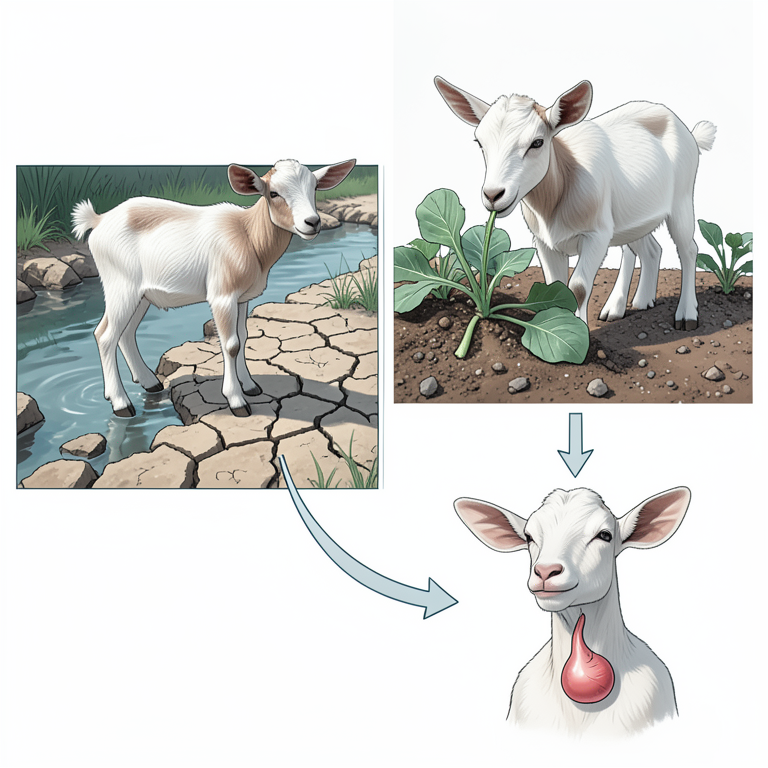
Causes of Iodine Deficiency
AI-generated conceptual illustration (goat kids). It explains the idea and does not show study data.
View source evidence ↗Introduction
Iodine, a crucial trace mineral, plays a fundamental role in the synthesis of thyroid hormones such as triiodothyronine and thyroxine. These hormones play a pivotal role in multiple physiological processes including thermoregulation, boosting cellular respiration and energy generation and exerting wide spread effects on intermediary metabolism, growth, development, reproduction, muscle function, immune response and circulation (Bhardwaj et al., 2018) [6] . Iodine availability is reduced by substances such as methylthiouracil, nitrates, perchlorates, soybean meal, and thiocyanates. Additionally, certain minerals like rubidium, arsenic, fluorine, calcium, and potassium interfere with iodine absorption. Iodine tends to be more readily utilized by the body during the winter months and lactation periods. The chemical form of iodine in feed also affects its absorption and iodates are more easily absorbed than iodides (Rankins and Pugh, 2012) [20] . Iodine deficiency is a spectrum of disorders that can occur from the foetal stage to puberty and is a widespread cause of diseases from goitre to neurological and metabolic disorders (Davoodi et al., 2022) [10] . Goitre is an Iodine deficiency disorder and common in newborns and younger animals characterized by non-inflammatory and non-neoplastic enlargement of the thyroid gland (Lafta et al., 2023) [15] . It has a major economic importance because the affected foetus seldom survives and the doe often perishes (Constable et al., 2017; Tufani et al., 2017) [9,27] .
Classification of iodine deficiency
Iodine deficiency primarily classified as primary and secondary iodine deficiency.
a. Primary iodine deficiency
Primary goitre refers to the enlargement of the thyroid gland due to dietary iodine deficiency. Deficiency of iodine in animals is primarily attributed to environmental factors, stemming from low levels of iodine in soil, water, feed, and fodder. The insufficient presence of iodine in soil, particularly in fodder crops, serves as a primary driver of iodine deficiency among animals. This deficiency in soil can occur due to including the leaching of iodine from surface soil and inadequate replenishment from airborne sources. Additionally, drinking groundwater with iodine levels below 2 μg/L contributes to iodine deficiency in animals (Hetzel and Wellby, 1997) [13] . Sandy soils generally have low iodine levels. The presence of high clay content and elevated soil pH can hinder the uptake of iodine by plants growing in such soils. The iodine content of plants varies depending on factors such as species, strains, climatic conditions, seasonal variations, and the use of chemical fertilizers. Cereals, wheat bran, and oil cakes typically have low iodine levels, whereas straws and green fodders contain iodine levels that are marginally adequate for livestock requirements. The stage of maturity and timing of harvesting significantly influence the iodine content of fodder, with iodine levels decreasing as environmental temperatures drop and vice versa. Excessive use of chemical fertilizers like diammonium phosphate and potash can decrease iodine uptake from the soil. Conversely, supplementing soil with seaweeds can increase soil iodine content (Bharadwaj et al., 2018) [6] .
b. Secondary iodine deficiency
Secondary iodine deficiency occurs due to the ingestion of goitrogenic compounds such as brassica plants, soybean byproducts, and water with high calcium and nitrate content, which interfere with thyroxinogenesis. In rare instances, excessive dietary iodine intake or genetically determined inherited enzyme defects responsible for thyroid hormone biosynthesis can also contribute to goitre formation (Radostits et al., 2010) [19] . An excessive intake of calcium reduces the absorption of iodine from the gastrointestinal tract. Additionally, high fluoride consumption is considered a significant factor in the development of goitre in animals. A deficiency of cobalt, and consequently vitamin B12, has been associated with elevated thyroxine levels, leading to pronounced hypertrophy and hyperplasia of the thyroid gland (Abdel et al., 1999) [1] .
Pathogenesis
Ruminants efficiently store iodine in their thyroid glands, maintaining thyroid hormone levels even when iodine intake is low over extended periods. However, unlike ruminants, developing foetuses lack this thyroid hormone reserve, impacting their growth and development when iodine intake is insufficient (Lafta et al., 2023) [15] . In circumstances of iodine deficiency, there is a consequential rise in the secretion of thyroid-stimulating hormone (TSH) as a compensatory mechanism due to the diminished levels of circulating thyroid hormones, prompting a notable enlargement of the thyroid glands known as goitre (Hassan et al., 2013) [12] . The increased size of the thyroid gland is a physiological response aimed at capturing more iodine from the bloodstream to support thyroid hormone synthesis.
Clinical signs
The most important clinical manifestations of goitre in young kids involve noticeable enlargement of the thyroid lobes, which are generally at least twice their normal size. These enlarged lobes feel soft to the touch and may exhibit a dark red coloration. Goitre arises from the hypertrophy and hyperplasia of the thyroid gland, primarily due to iodine deficiency in the body. This deficiency triggers an overproduction of thyroid-stimulating hormone (TSH) by the pituitary gland, as the thyroid attempts to compensate for the shortfall in thyroid hormones (Singh et al., 2002) [23,24] . However, in more severe cases, signs of hypotrichosis or alopecia may manifest, alongside pronounced enlargement of the neck. This enlargement is characterized by thickened, flaccid skin that appears swollen and edematous (Constable et al., 2017) [9] . Kids which survive the initial critical period after birth may generally recover, although they might still exhibit partial persistence of goitre. The thyroid gland may exhibit pulsations synchronized with the normal arterial pulse and may extend further down a significant portion of the neck, potentially causing localized swelling. When auscultated and palpated along the jugular furrow, a murmur and thrill (referred to as the thyroid thrill) may be detected due to increased arterial blood supply to the glands (Radostits et al., 2010) [19] . Most cases of congenital hypothyroidism are associated with multiple late-term abortions, stillbirths or early postnatal deaths (Jones et al., 1997) [14] . Of the animals born alive, some are weak and partly hairless with subcutaneous oedema of head and neck.
Diagnosis
The diagnosis of iodine deficiency relies on assessing the history of mineral mixture and iodine supplementation in the animal's diet, as well as observing clinical signs such as stillbirths, abortions, and the birth of weak or dead kids with congenital goitre. Clinical iodine deficiency is relatively straightforward to diagnose. However, subclinical deficiency is more concerning as it is challenging to identify and often overlooked. Animals with subclinical iodine deficiency may exhibit minimal or no obvious clinical symptoms, yet their production, growth rate, and fertility can be negatively impacted. Several methods have been employed to diagnose iodine deficiency, including thyroid weight, thyroid to body weight ratio in newborns, histological evaluation of the gland and T4 concentration in the serum of the animals (Clark et al., 1998) [8] . Assaying thyroid hormone levels, including triiodothyronine and thyroxine, is utilized to confirm iodine deficiency or hypothyroidism in goats. In goats, normal serum thyroxine concentrations have been reported in various studies. According to Capen (2002) [7] , the range is 38.6 to 54.4 nmol/L, while Bath et al. (1979) [5] and Reap et al. (1978) [21] reported a wider range of 64 to 107 nmol/L. According to Smith and Sherman (2023) [26] , serum thyroxine levels in goats typically fall within the range of 5.9 to 10.2 µg/dL, while normal levels of triiodothyronine (T3) typically range from 124 to 151 ng/dL. Furthermore, according to Davoodi et al. (2022) [10] , normal values for thyroxine (T4) in does range from 4.96 to 6.16 µg/dL, and for triiodothyronine (T3) from 144.00 to 162.00 ng/dL. In kids, these values are reported as an average of 8.65 ± 1.86 µg/dL for T4 and 282 ± 1.01 ng/dL for T3. These findings offer additional insights into thyroid hormone levels in both does and kids, aiding in the understanding of thyroid function in goats across different age groups. In small ruminants, the normal mean values for plasma T3 level are reported to range from 0.74 to 1.12 nmol/L, while for T4 level, the range is between 56.8 and 73.35 nmol/L, as documented by Almeida et al. (2002) [2] and Atessahin et al. (2001) [4] . Additionally, Atessahin et al. (2001) [4] documented normal levels for free T3 (FT3) ranging from 3.67 to 5.11 pmol/L and for free T4 (FT4) ranging from 13.38 to 18.53 pmol/L. According to, a thyroxine concentration of less than 50 nmol/L is considered a significant indicator of goitre (Andrewartha et al., 1980) [3] . Triiodothyronine, the active form of thyroid hormone at the cellular level, requires conversion from thyroxine through the action of the selenium-containing enzyme deiodinase. Insufficient selenium levels can hinder this conversion process, leading to elevated thyroxine levels, reduced triiodothyronine levels, and increased plasma cholesterol. The assessment of protein-bound (organic) iodine levels in the blood proves to be highly sensitive in diagnosing iodine deficiency. A protein-bound iodine level below 8.1 μg/dL indicates a potential deficiency in iodine. Assessing the rate of iodine excretion in milk and urine serves as valuable diagnostic criteria for simple iodine deficiency, as iodine intake typically correlates positively with urinary iodine excretion. In sheep, a milk iodine level of 80 μg/L is considered normal, while levels below 8 μg/L suggest deficiency. Similarly, the lower normal limit of iodine in urine is reported to be 50 μg/L according to Bharadwaj et al. (2018) [6] . These measurements offer important insights into iodine status and aid in diagnosing iodine deficiency. Earlier investigations into soil iodine concentration have demonstrated a broad spectrum, ranging from less than 0.1 to 150 mg/kg across different geographic regions. Notably, the iodine content in soil surpasses that found in rocks. Atmospheric iodine, sourced from marine environments, primarily contributes to soil iodine levels. Consequently, regions near seas exhibit higher concentrations of iodine in their soil (Fuge, 2013) [11] . In a normal thyroid gland, acini are lined by low cuboidal epithelium and filled with colloid. However, in cases of goitre, this normal architecture is replaced by tall columnar epithelium, with papillary infolding and reduced colloid content. A hyperplastic goitre presents as an enlarged gland with abundant colloid, also termed colloid goitre, particularly when dietary iodine supplementation is provided to goats (Roy et al., 1964) [22] . In such cases, the iodine content of the thyroid gland is diminished. Histopathologically, subclinical iodine deficiency can be identified by hyperplasia of the thyroid epithelium despite the gland maintaining a grossly normal size (Smith and Sherman, 2023) [26] .
Treatment and prevention
The actual dietary iodine requirement is 0.8 mg/kg dry matter for lactating goats and 0.5 mg/kg dry matter for the rest of the flock (Lamand, 1978; NRC, 2007) [16,18] . When goats are fed cruciferous plants, iodine requirement is approximately 2 mg/kg dry matter for lactating animals and 1.3 mg/kg dry matter for other animals (Smith and Sherman, 2023) [26] . To address or prevent iodine deficiency goitre in goats, especially in pregnant does, iodine supplementation in the form of iodized salts is recommended. The ideal iodine content of salt is typically around 0.0190%. It should be supplemented to livestock at a concentration of 2% in concentrates or at 0.5% of the total dry matter intake. For goats, the daily requirement of iodized salt is approximately 4.5 grams for adults and 2-2.5 grams for kids. Ensuring proper supplementation helps maintain adequate iodine levels, promoting thyroid health and preventing iodine deficiencyrelated conditions (NRC, 2005; Bharadwaj et al., 2018) [17,6] . Synthetic sodium thyroxine administered orally at a dosage of 0.2 mg/day to goats weighing between 16-20 kg has been shown to effectively alleviate many clinical signs of deficiency, as reported by Singh et al. (2006) [25] . However, it's important to note that this supplementation should ideally not be required once the diet is corrected to provide adequate levels of essential nutrients. It serves as a temporary measure to address immediate deficiencies, with the ultimate goal being the correction of dietary imbalances to maintain optimal health without the need for supplementation. Goat kids suffering from goitre can potentially benefit from the topical application of iodine, similar to the method used for navel dips in newborns. Additionally, in certain regions, injectable iodized poppy seed oil is available as a supplement. This injectable form of iodine provides supplementation that can last for up to two years (Wichtel et al., 1996) [28] . These interventions offer alternative methods of iodine supplementation for effectively managing goitre and iodine deficiency-related conditions in goat kids. Oral daily supplementation of potassium iodide (130mg) or weekly application of 1ml of tincture of iodine to the back throughout gestation was successful in preventing goitre (Smith and Sherman, 2023) [26] . The prophylactic injection of 375 mg of iodized oil administered before servicing of goats has been shown to prevent the relapse of stillbirth and congenital goitre in goats. Indeed, preventing goitre in goats typically involves several measures. One key approach is to avoid goitrogenic diets and forages, particularly during the gestation period. Goitrogens are substances that interfere with thyroid function and can contribute to the development of goitre. Additionally, regular supplementation of iodine in the diet of goats is essential. Ensuring adequate iodine intake helps maintain thyroid health and reduces the risk of goitre formation. By implementing these strategies, goat owners can effectively minimize the occurrence of goitre in their herds.
References
17 in the original paper- Gadir WSA, Adam SEI. Development of goitre and enterohepatonephropathy in Nubian goats fed with pearl millet (Pennisetum typhoides). Vet J. 1999;157(2):178185.
- Almeida AM, Schwalbach LM, de Wall HO, Greyling JP, Cardosa LA. Plasma insulin concentrations and thyroid hormone in fed and underfed Boer goat bucks. Israel Vet Med Assoc. 2002;57:1-4.
- Andrewartha KA, Caple IW, Davies WD, McDonald JW. Observations on serum thyroxine concentrations in lambs and ewes to assess iodine nutrition. Aust Vet J. 1980;56(1):18-21.
- Atessahin A, Pirincci I, Gursu F, Cikim G. Effects of selenium on thyroid hormone levels in sheep. Turk J Vet Anim Sci. 2002;26(6):1401-1404.
- Bath GF, Wentzel D, van Tonder E. Cretinism in Angora goats. J S Afr Vet Assoc. 1979;50:237-239.
- Clark R, Sargison N, West D, Littlejohn R. Recent information on iodine deficiency in New Zealand sheep flocks. N Z Vet J. 1998;46(6):216-222.
- Constable PD, Hinchcliff KW, Done SH, Grünberg W. Perinatal diseases. In: Veterinary Medicine: A Textbook of the Diseases of Cattle, Horses, Sheep, Pigs, and Goats. 11 th ed. St. Louis, MO: Elsevier; c2017. p. 1830-903.
- Davoodi F, Zakian A, Rocky A, Raisi A. Incidence of iodine deficiency and congenital goitre in goats and kids of Darreh Garm region, Khorramabad, Iran. Vet Med Sci. 2022;8(1):336-342.
- Hassan N, Randhawa C, Hussian S. Treatment of congenital bilateral goitre in a kid: a case report. Indian J Sci Technol. 2013;1(3):19-20.
- Lafta MH, Jarad A, Al Saad KM. Goiter in crossbreed goat kids at Basrah Province, Iraq. Arch Razi Inst. 2023;78(2):531-538.
- Reap M, Cass C, Hightower D. Thyroxine and triiodothyronine levels in 10 species of animals. Southwest Vet. 1978;31:31-34.
- Roy S, Deo MG, Ramalingaswami V. Pathologic features of Himalayan endemic goiter. Am J Pathol. 1964;44:839851.
- Singh JL, Sharma MC, Shiv Prasad SP, Mahesh Kumar MK, Gupta GC, Patnaik AK. Prevalence of endemic goitre in goats in relation to iodine status of the soil, water and fodder. Indian Vet J. 2002;79:657-60.
- Singh J, Sharma M, Kumar M, Rastogi S, Gupta GC, Singh SP, et al. Assessment of therapy in goitrous goats through some cardiac function tests. Small Rumin Res. 2002;44(2):119-122.
- Singh JL, Sharma MC, Kumar M, Gupta GC, Kumar S. Immune status of goats in endemic goitre and its therapeutic management. Small Rumin Res. 2006;63(3):249-255.
- Tufani NA, Athar H, Gugjoo MB, Ahmad RA, Fazili MR. Successful therapeutic management of congenital goitre in goat kids. Rumin Sci. 2017;6(2):391-392.
- Wichtel JJ, Thompson KG, Craigie AL, Williamson NB. Effects of selenium and iodine supplementation on the growth rate, mohair production, and thyroid status of Angora goat kids. N Z J Agric Res. 1996;39(1):111-115.
Cited by 5
From OpenAlex, OpenCitations and reference lists read by Scinovex
- Nutrient Utilization and Requirements in Sheep and Goats Raised Under Different Systems and Fed Low Nutritional Novel Feeds for Meat Production ↗
Osman Mahgoub, Nur El Huda I. E. Osman, Christopher D. Lu · Animals · 2025
Sheep and goats are essential in many parts of the world, providing meat, milk, and fiber while also aiding rural and low-income communities. The cost of feeding is a major factor in the overall expenses of animal production. Therefore, it is crucial to improve nutrient utilization and accurately assess nutrient needs. Sheep and goats in different parts of the world…
❝ 15PDF - Effects of dietary supplementation with selenium in organic form and iodine in dairy goats and their transfer to milk and dairy products ↗
Irene Azorín, Josefa Madrid, S. Martínez-Miró, M.B. López, Miguel José López, Fuensanta Hernández · Veterinary and Animal Science · 2025
• High-dose organic selenium plus iodine in goats enriched milk • With high dietary iodine, milk, cheese, and yogurt qualified as “high in iodine” • High organic selenium made fresh cheese eligible as a “selenium source” • Lower iodine doses may still deliver meaningful mineral enrichment This study evaluated the effects of dietary supplementation with selenium in organic form and…
❝ 4PDF - Potassium iodide oral therapy and serum thyroxine recovery in goats from iodine-depleted highland rangelands ↗
Tesfaye Wolde · Journal of Entomology and Zoology Studies · 2026
Highland goat herds in Ethiopia frequently exhibit iodine deficiency due to leached volcanic soils at elevations above 2,500 meters. This research assessed the therapeutic efficacy of oral potassium iodide (KI) at three dose levels (0.5, 1.0, and 1.5 mg/kg body weight) on serum thyroxine recovery, clinical symptom resolution, and urinary iodine excretion in 60 indigenous Arsi-Bale goats with confirmed iodine
- Effects of iodized salt lick blocks on reproductive efficiency and neonatal outcomes in iodine-deficient caprine herds ↗
Joseph Kariuki, Grace Njoroge · International Journal of Fauna and Biological Studies · 2026
Reproductive failure in iodine-deficient goat herds constitutes a major economic constraint in East African pastoral systems. This research investigated the impact of iodized salt lick blocks at two iodine concentrations (50 and 100 mg I/kg salt) on reproductive performance and neonatal outcomes in 90 indigenous Kenya Alpine dairy goats with documented iodine deficiency over a complete reproductive cycle during 2025-2026
- Comparative efficacy of lugol's solution versus organic iodine formulations on thyroid morphology in sub clinically iodine-deficient goats ↗
Selin Arslan · Journal of Pharmacognosy and Phytochemistry · 2026
The choice between inorganic and organic iodine sources for treating subclinical iodine deficiency in goats has lacked rigorous comparative evaluation regarding thyroid tissue-level responses. This research compared Lugol's solution (5% iodine/10% KI) and an organic iodine preparation (ethylenediamine dihydroiodide, EDDI) on thyroid gland morphology, follicular architecture, and serum hormone profiles in 45 Angora goats with documented subclinical iodine deficiency over