
Research article · 2024 · Full text
International Journal of Veterinary Sciences and Animal HusbandryEffect of multiple insulin injections on estrus expression in cross bred cows
Volume 9(5) · Pages 321–323 · DOI: 10.22271/veterinary.2024.v9.i5e.1724 ↗
Research areasReproductive Physiology in LivestockGenetic and phenotypic traits in livestock
Abstract
Author-writtenThe present study was conducted on 12 cross bred cows divided into two groups (n=6 each with 6) Group I and Group II. Both groups on day 10 post estrum received an injection of PGF2α. In addition group I received insulin @ 0.25 IU/Kg B.Wt, SC every 24 hours until estrus expression while cows in group II received every 12 hours on the day of induced estrus (at 0 hr, 12 hr and 24 hr). The results showed a 100% estrus induction rate in both groups. The mean time taken for estrus induction was 71.00 ± 4.97 hrs in Group I and 65.33 ± 5.17 hrs in Group II, with no statistically significant difference between the groups (P > .05). The duration of estrus was found to be 25 ± 0.85 hrs in Group I and 23.83 ± 1.32 hrs in Group II (P > 0.05). The mean estrus intensity score was 16.16 ± 1.10 in group I and 14.00 ± 1.18 in group II, respectively (P > .05). Among the total number of cows in the present study, most of the cows expressed intense (58.33%) to normal estrus (41.66%). A higher proportion of cows exhibited intense estrus (66.66%) in group I compared to group II (50.00%). The present study could be concluded that the administration of multiple insulin injections have a positive impact on parameters of estrus expression. However, the influence may be subtle or variable and influenced by a range of factors.
Summary
Source-checkedPlain-language reading of the full paper, prepared with AI and checked against the text. Each point links to the authors' own words.
Why it matters
- Improving the reproductive management of infertile animals is considered essential for increasing overall animal production. View evidence ↗
- Metabolic hormones and growth factors, including insulin and Insulin-like growth factor (IGF), are being studied for their role in regulating ovarian functions. View evidence ↗
- Insulin is viewed as a practical tool for improving reproductive performance in buffaloes and cattle because it is affordable and accessible. View evidence ↗
The question
- The study aimed to evaluate how multiple insulin injections affect the expression of estrus in crossbred cows. View evidence ↗
What they did
- The study used 12 healthy crossbred cows weighing between 250 and 350 kg with a body score of 2.5-3.5, all of whom had at least one normal delivery and no uterine infections. View evidence ↗
- Cows were split into two groups, and all animals received a PGF2α injection on day 10 post estrus. View evidence ↗
- Group I received subcutaneous insulin (0.25 IU/Kg B.Wt) every 24 hours until estrus appeared, while Group II received the same dose every 12 hours specifically on the day of induced estrus (at 0, 12, and 24 hours). View evidence ↗
- Estrus intensity was categorized as weak, normal, or intense using a modified score card based on Rao and Rao (1981). View evidence ↗
What they found
- Both Group I and Group II achieved a 100% estrus induction rate. View evidence ↗
- The duration of estrus was 25 ± 0.85 hours in Group I and 23.83 ± 1.32 hours in Group II, with no statistically significant difference. View evidence ↗
- Group I had a mean estrus intensity score of 16.16 ± 1.10 and Group II had 14.00 ± 1.18, which was not a statistically significant difference. View evidence ↗
- A higher percentage of cows in Group I exhibited intense estrus (66.66%) compared to Group II (50.00%). View evidence ↗
What it means
- The authors concluded that administering multiple insulin injections positively impacts the parameters of estrus expression. View evidence ↗
- The authors noted that the influence of insulin may be subtle or variable and could be affected by various factors. View evidence ↗
Visual summary
2 visualsIllustrations explain the paper; charts are replotted from the paper's own table values.
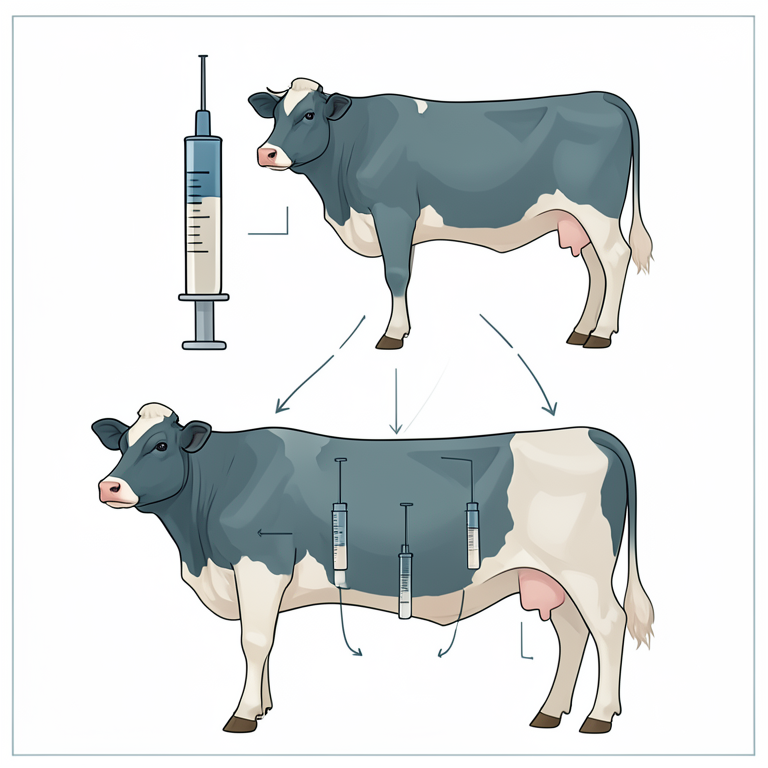
Insulin Administration Protocol
AI-generated conceptual illustration (crossbred cows). It explains the idea and does not show study data.
View source evidence ↗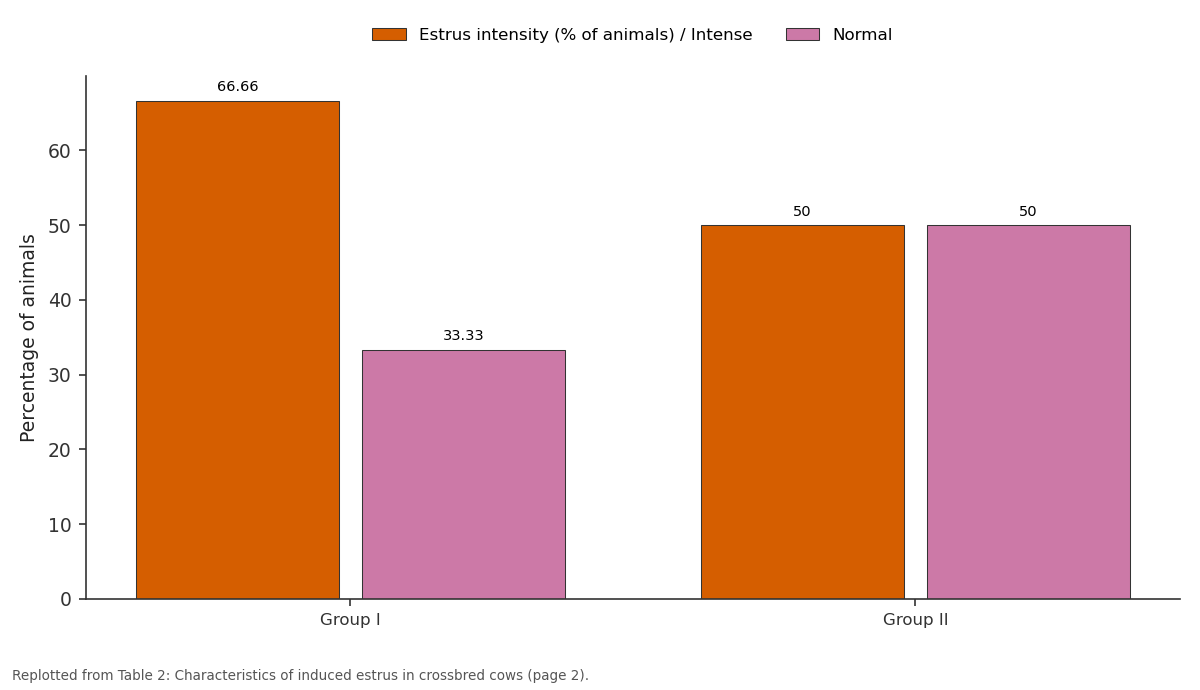
Estrus intensity (% of animals) / Intense and Normal: Group I vs Group II
Replotted from Table 2 (page 2) of the original paper. Every bar is the paper's own table value.
View source evidence ↗Figures & tables
From the original paper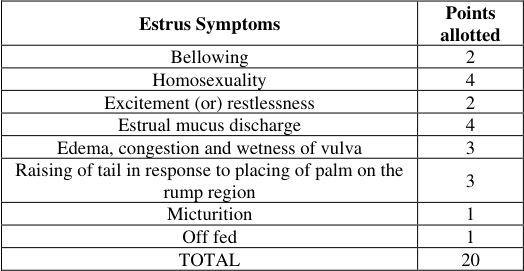 Table 1
 Table 2
Introduction
Reproductive management of infertile animals had been identified as a key area for enhancing the animal production. Metabolic hormones and growth factors like insulin, somatotrophin, and Insulin-like growth factor (IGF) are receiving significant attention in regulating ovarian functions. Application of metabolic hormones like insulin to regulate reproductive functions in livestock is a recent advancement. Administration of exogenous insulin in cattle raises intrafollicular and peripheral IGF-I levels (Simpson et al, 1994) [1] . Elevated plasma IGF-I concentrations during follicular phase following insulin administration may affect follicle development and the function of corpus luteum (Leeuwenberg et al., 1996) [2] . Insulin is affordable, readily available and appears to be useful to improve the reproductive performance in cattle and buffaloes. Continued exploration of nuanced effects of insulin administration on follicular development and overall reproductive performance will pave the way for targeted interventions aimed at optimizing fertility and addressing reproductive challenges in cows. Hence, the present investigation has been undertaken to evaluate the effect of multiple insulin injections on estrous expression in cross bred cows.
Materials and Methods
For the present study 12 apparently healthy cows, calved at least once through normal delivery and free from uterine infections were enrolled. Cross bred cows weighing approximately 250 to 350 kg and 2.5-3.5 body score condition were selected. The cows were divided into two groups viz., Group I and Group II. On day 10 post estrus all the cows in both the groups received an injection of PGF2α. In addition cows in group I received insulin @ 0.25 IU/Kg B.Wt, SC every 24 hours until estrus expression while cows in group II received insulin @ 0.25 IU/Kg B.Wt, SC every 12 hours on the day of induced estrus (at 0 hr, 12 hr and 24 hr). The animals were observed twice daily for behaviuoral signs of estrus like bellowing, discharge through vulva, vulval oedema and hyperemia of vestibular mucosa after PGF2α injection. The estrus induction rate was calculated from the number of animals responded to PGF2α injection expressed in percentage. The estrus induction interval was calculated from the time of administration of PGF2α to the time of the first expression of estrus signs and it is calculated in hours. Duration of estrus was recorded in hours as the interval between the onset and cessation of estrus signs. The intensity of the estrus was measured according to the score card designed by Rao and Rao (1981) [3] with marginal modifications (Table .1). The intensity of estrus was classified as weak, normal and intense estrus.
Results and Discussion
In this study, all the animals in both the groups exhibited estrus signs accounting to a 100 per cent estrus induction rate (Table 2). This aligns with previous studies by Selvaraju et al. (2002) [4] and Mani et al. (2021) [5] , who also reported 100% estrus induction rates following PGF2α administration. The mean estrus induction interval following PGF2α injection in both the groups was 71.00 ± 4.97 hours in group I and 65.33 ± 5.17 hours in group II. The difference was not statistically significant (P > .05). The results of this study are comparable to those reported by other researchers. Mujic et al. (2012) [6] reported that the mean interval of estrus induction was 3.92 ± 0.49 to 4.69 ± 0.68 days from treatment with single PGF2α injection. Selvaraju et al. (2002) [4] reported a longer time for estrus onset in insulin-treated cows (84.5 ± 6.6 hours) compared to control cows (72.3 ± 5.9 hours). Conversely, Shukla et al. (2005) [7] found a shorter time for estrus onset in cows treated with insulin and GnRH combined. The mean duration of estrus in group I and group II were 25 ± 0.85 hours and 23.83 ± 1.32 hours, respectively. The observed difference was not significant statistically (P > .05). These findings were consistent with the results reported by Velladurai et al. (2015) [8] , Nayana et al. (2020) [9] , and Ratnaparkhi et al. (2019) [10] , who documented similar durations of induced estrum in cows, with mean durations of 28.50 ± 0.56 hours, 28.13 ± 1.06 hours, 29.38 ± 0.74 hours, and 23.80 ± 0.55 hours, respectively. In group I, 66.66% and 33.33% cows exhibited intense and normal estrus, respectively. While in group II cows intense and normal estrus was expressed 50.00 per cent each. There was no significant difference (P > .05) in the instensity of estrus between the groups. The mean estrus intensity score was 16.16 ± 1.10 in group I and 14.00 ± 1.18 in group II with no statistically significant difference (P > .05) between the groups. The mean estrus intensity scores indicate that both groups exhibited relatively high levels of estrus behavior, though the difference between the groups was not significant. The results in the present study showed higher percentage of animals with intense estrus contrary to earlier studies (Velladurai et al., 2015 and Ratnaparkhi et al., 2019) [8,10] . However, Mani et al. (2021) [5] reported that 87.50 per centage cows exhibited very good estrus after double PGF2α injection. Role of insulin in promoting follicular growth and steroidogenesis through the IGF system suggested a mechanism by which it might affect estrus behavior (Lucy, 2000 and Butler, 2003) [11,12] .
Conclusion
Critical analysis of results indicated that administration of multiple insulin injections have a positive impact on parameters of estrus expression. However, the influence may be subtle or variable and influenced by a range of factors.
Conflict of Interest
Conflict of Interest
Financial Support
Financial Support
Figures and tables from the paper
| Estrus Symptoms | Points allotted |
|---|---|
| Bellowing | 2 |
| Homosexuality | 4 |
| Excitement (or) restlessness | 2 |
| Estrual mucus discharge | 4 |
| Edema, congestion and wetness of vulva | 3 |
| Raising of tail in response to placing of palm on the rump region | 3 |
| Micturition | 1 |
| Off fed | 1 |
| TOTAL | 20 |
Table text extracted from the original PDF; superscript letters are shown inline. The original table image is below.
View original table image
References
12 in the original paper- Simpson RB, Chase CC, Spicer LJ Jr, Vernon RK, Hammond AC, Rae DO. Effect of exogenous insulin on plasma and follicular insulin-like growth factor-I, insulinlike growth factor binding protein activity, follicular estradiol and progesterone, and follicular growth in superovulated Angus and Brahman cows. J Reprod Fertil. 1994;102:483-492.
- Leeuwenberg BR, Hudson NL, Moore LG, Hurst PR, McNatty KP. Peripheral and ovarian IGF-I concentrations during the ovine oestrous cycle. J Endocrinol. 1996;148(2):281-289.
- Rao AVN, Rao VH. A simple method for recording the intensity of estrus in crossbred cows. IVJ. 1981;58:24-28.
- Selvaraju S, Agarwal SK, Karche SD, Srivastava SK, Majumdar AC, Shanker U. Fertility responses and hormonal profiles in repeat breeding cows treated with insulin. Anim Reprod Sci. 2002;73(3-4):141-149.
- Mani R, Mohanty TK, Layek SS, Kumaresan A, Dubey P. Estrus response and conception rate in repeat breeding cows treated with PGF2α-based protocols. Theriogenology. 2021;170:25-31.
- Mujić E, Jotanović S, Nedić D, Tešić M, Šahinović R, Vekić M, et al. Induction and synchronization of estrus in dairy cows using a single injection of PGF2α and GnRH. Acta Vet. 2012;62(5-6):591-598.
- Shukla SN, Agarwal SK, Shanker U, Varshey VP, Majumdar AC. Modulation of ovarian response in anestrus cattle treated with insulin alone and in combination with gonadotropin-releasing hormone. IJAR. 2005;26(2):159-64.
- Velladurai C, Ezakial Napolean R, Selvaraju M, Doraisamy KA. Ovsynch protocol for improving estrus and conception rate in retained fetal membrane-affected cows. Intas Polivet. 2015;16(1):59-61.
- Nayana MP, Abdul Azeez CP, Promod K, Chacko L, John L. Characteristics of oestrus and conception rate in postpartum dairy cows induced ovulation by using 3000 IU of HCG in 5-day and 7-day CIDR-based oestrus synchronisation protocols. J Vet Anim Sci. 2020;51(1):19-24.
- Ratnaparkhi AR, Deshmukh SG, Pawshe CH, Kale VB, Chepte SD, et al. Comparative efficacy of synchronization protocols for improving fertility in postpartum crossbred dairy cows. J Entomol Zool Stud. 2018;7(5):961-964.
- Lucy MC. Regulation of ovarian follicular growth by insulin-like growth factors and their binding proteins. J Dairy Sci. 2000;83(7):1635-1647.
- Butler WR. Energy balance relationships with follicular development, ovulation, and fertility in postpartum dairy cows. Livest Prod Sci. 2003;83(2-3):211-218.