
Research article · 2024 · Full text
International Journal of Veterinary Sciences and Animal HusbandryBreeds of small ruminants: An update
Volume 9(5S) · Pages 220–234 · DOI: 10.22271/veterinary.2024.v9.i5sd.1714 ↗
Research areasGenetic and phenotypic traits in livestock
Abstract
Author-writtenGlobally and particularly in emerging nations, the production of small ruminants constitutes a substantial portion of the livestock industry. Among all livestock species, small ruminant husbandry has enormous socioeconomic benefits for impoverished farmers. Over the past few decades, small ruminants have steadily gained importance in the rural economy, especially in arid and semi-arid areas. In arid and semiarid rain-fed areas, small ruminants are crucial to the food and nutritional security of millions of rural people, particularly the landless, marginal, and small farmers. Small ruminants are prized for their meat, milk, wool, and hair. In India, sheep and goats are the most common meat-producing animals. The meat is widely favoured by people of all castes and religions. Recently, there has been growth in the total livestock population, including small ruminants. The total livestock population in India is 535.78 million, which increased by 4.6%, with goats contributing 148.88 million and sheep contributing 74.26 million. There is also a rise in the population of goats and sheep, i.e., 10.1% and 14.1%, respectively. The consistent rise in the number of sheep and goats over the past 20 years is a notable trend in the global livestock population. The biodiversity of small ruminants is considerable in India. 39 goat breeds and 45 sheep breeds have been notified and registered by the ICAR-National Bureau of Animal Genetic Resources. Among goat breeds, Jamunapari is the most famous for its milk production, whereas the Black Bengal breed (eastern region) is highly valued for its skin, meat production, and prolificacy, and Chegu and Changthangi breeds from the temperate Himalayan region produce high-quality fibre known as Pashmina. Some other breeds of goat also have better milk-producing abilities, including Surti, Osmanabadi, Zalawadi, Sirohi, etc. In the case of sheep, breeds from the southern region (Mandya, Nellore) are mostly mutton type; Himalayan breeds (Gaddi, Gurez) are known for the production of wool (carpet type), whereas breeds of the north-western arid and semiarid regions have greater diversity in terms of production, including Chokla (Indian Merino) which has potential for wool production; Sonadi is known for its milk-producing ability; and Marwari is a triple-purpose breed (milk, meat, and wool) along with disease-resistant capacity.
Summary
Source-checkedPlain-language reading of the full paper, prepared with AI and checked against the text. Each point links to the authors' own words.
Why it matters
- Small ruminant husbandry provides significant socioeconomic advantages, particularly for farmers living in poverty. View evidence ↗
- In arid and semi-arid rain-fed regions, these animals are essential for the food and nutritional security of millions of rural people, including small and landless farmers. View evidence ↗
- India's total livestock population is 535.78 million (a 4.6% increase), with goats and sheep numbering 148.88 million and 74.26 million, respectively. View evidence ↗
The question
- The aim of this paper is to provide an updated overview of the various breeds of small ruminants. View evidence ↗
What they did
- The review focuses on the 39 goat and 45 sheep breeds registered by the ICAR-National Bureau of Animal Genetic Resources. View evidence ↗
- Indigenous goat breeds are classified based on their respective agro-climatic regions. View evidence ↗
- Indigenous sheep breeds are classified based on their utility, such as apparel wool, carpet wool, mutton, or a combination. View evidence ↗
What they found
- The Jamunapari goat is a dual-purpose breed producing meat and milk with a fat content of 3.5%. View evidence ↗
- The Barbari goat is a prolific breeder, with a twinning rate of 64% and a triplet rate of 13%. View evidence ↗
- The Surti goat is noted as a good milk producer, yielding approximately 2.25 to 2.50 kg per day. View evidence ↗
- The exotic Sannen goat produces 2-5 kg of milk per day over a lactation period of 8-10 months, with 3-4% fat. View evidence ↗
- The Mecheri sheep breed is characterized by a high dressing percentage of approximately 53.4%. View evidence ↗
- The Kashmir Merino crossbreed produces fine wool, with an annual yield of 2-8 kg. View evidence ↗
- In the Karakul breed, pelts are primarily obtained by slaughtering lambs within 24 to 28 hours of birth. View evidence ↗
What it means
- The authors conclude that sheep and goats are vital for the livelihoods of rural communities, particularly those in arid and semi-arid regions. View evidence ↗
Figures & tables
From the original paper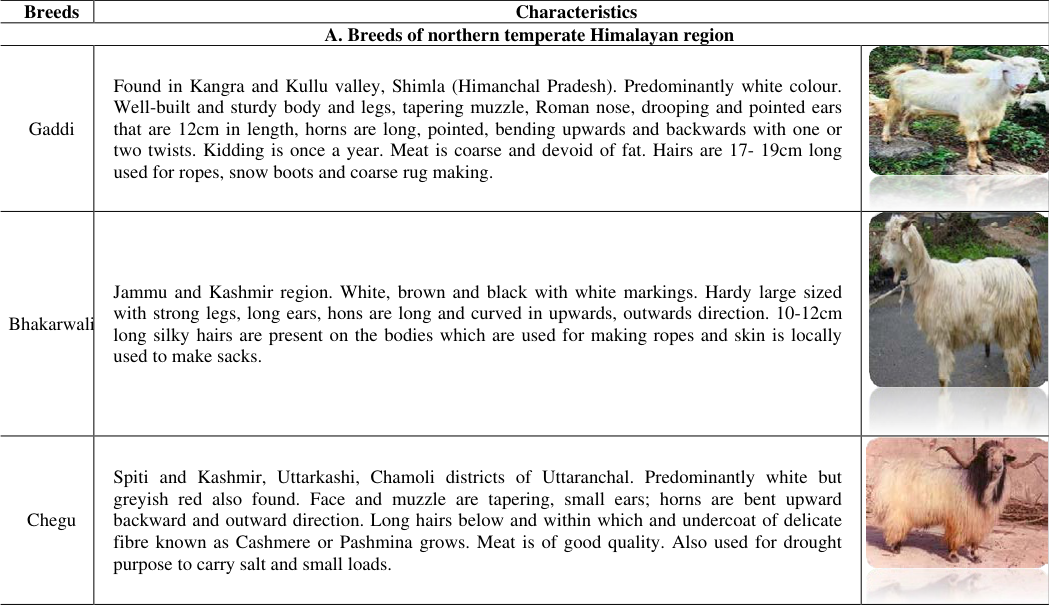 Table 1
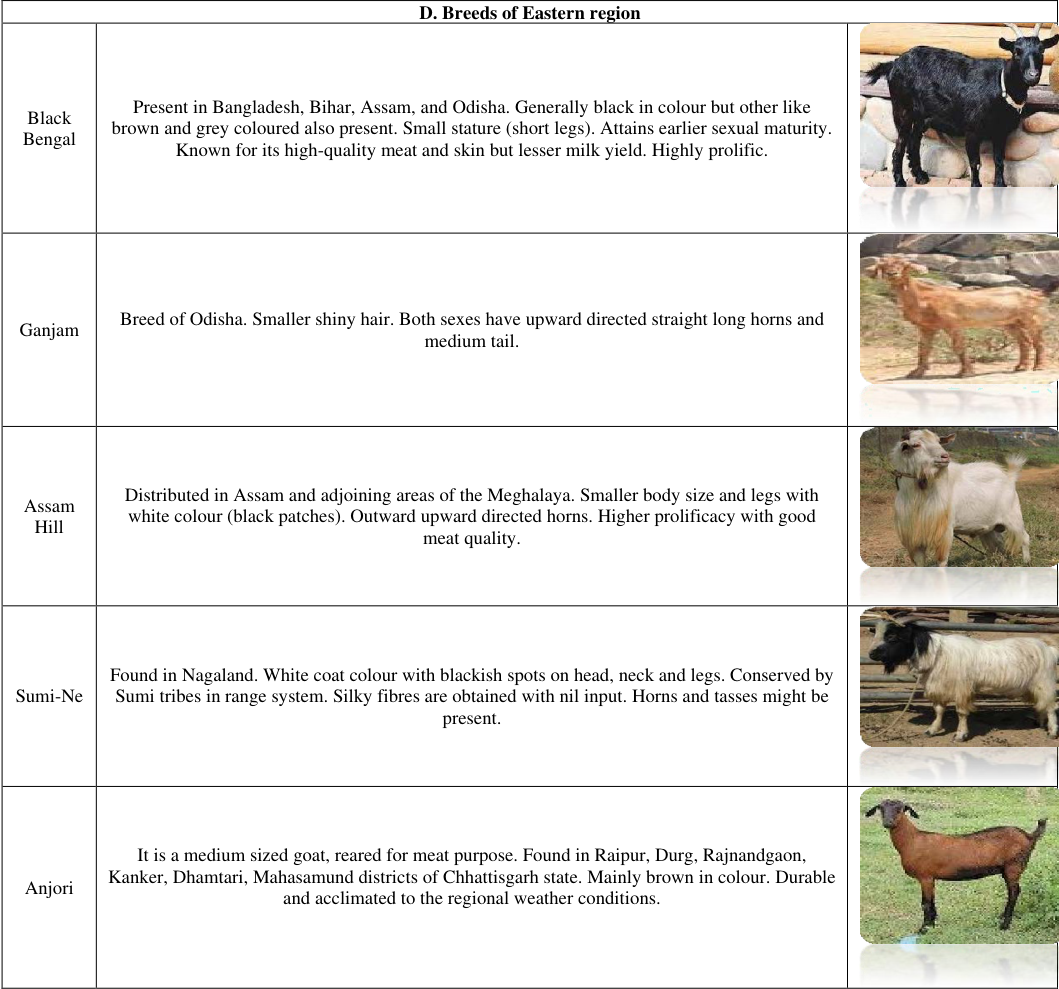 Table 2
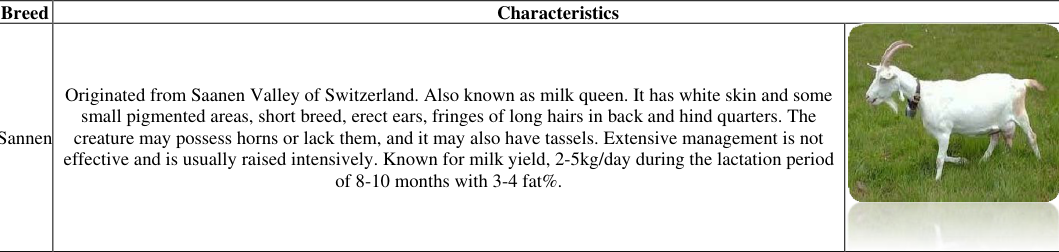 Table 2
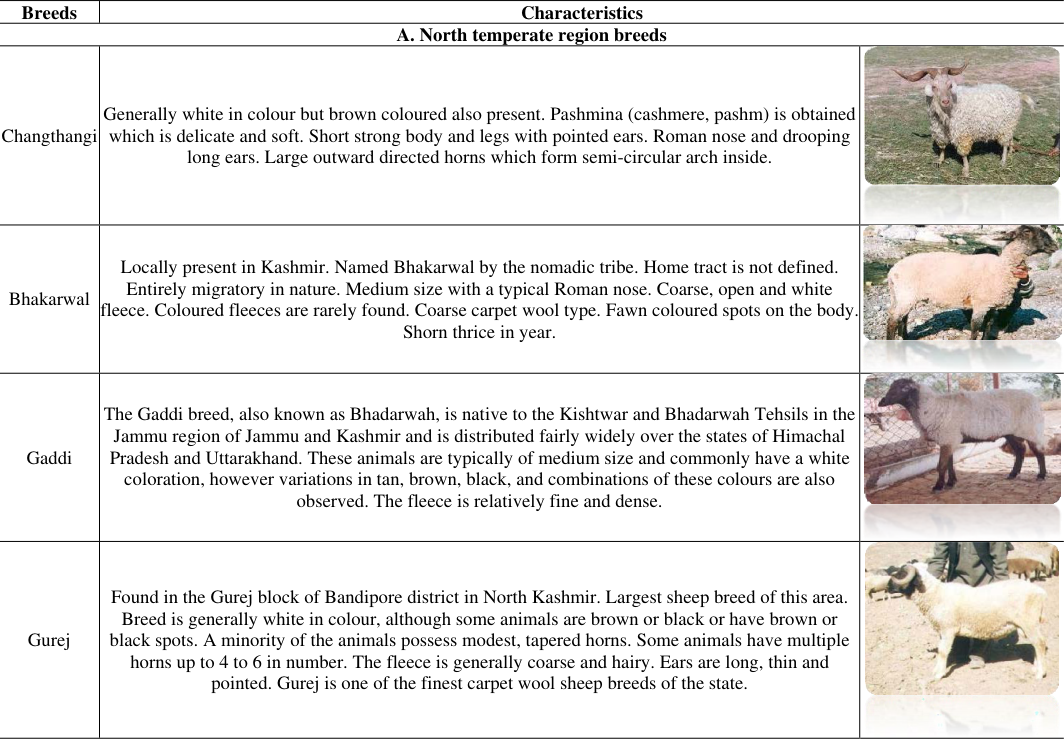 Table 3
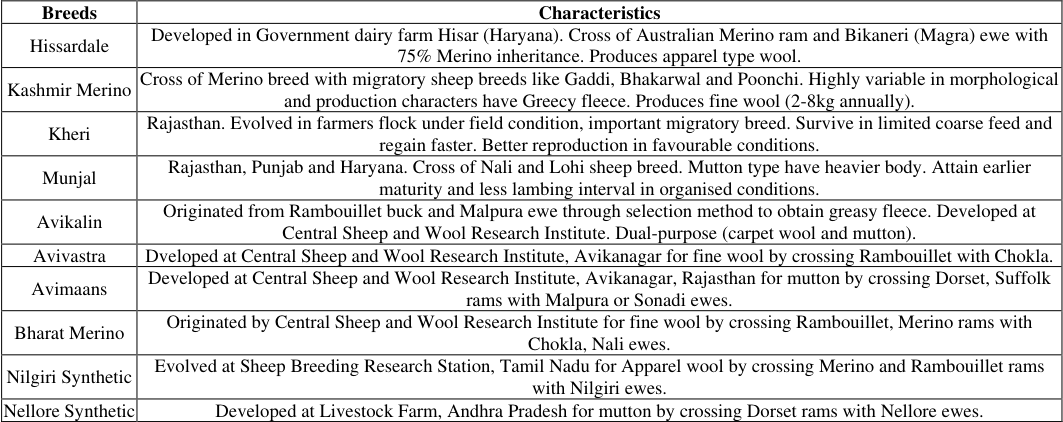 Table 4
 Table 5
 Table 5
Introduction
Breed is defined as the group of animals that have common ancestor, possess similar morphological, physiological and economical characters. Breeds are developed by the efforts of breeders and farmers. It occurs mainly by the continuous selection and breeding activities. Our indigenous or native breeds are most valuable animal germplasm that is highly suitable for our agro ecological and rearing conditions. Generally, breeds are named according to their native place. There are 39 goat and 45 sheep breeds registered in India. Various crossbreds of sheep are also developed in different research Centre.
Indigenous Breeds of Goat: Classification on the basis of Agro climatic regions.
Northern temperate Himalayan region: Goats are mainly reared for fibre and Pashmina production. Gaddi (Hair), Chegu and Changthangi (Pashmina breeds).
North western arid and semiarid region: Mainly dual-purpose (meat and milk) breeds Jamunapari, Beetal, Barbari, Jakhrana, Marwari, Kutchi, Mehsana, Sirohi, Zalawadi, Gohilwadi, Surti, Rohilkhandi, Pantja, Kahmi.
B. Breeds of north western arid and semi-arid region
B. Breeds of north western arid and semi-arid region
Jamunapari
Etawah, Agra, Mathura districts of Uttar Pradesh and Morena district Madhya Pradesh. Word 'Jamunapari' is attained from 'Jamuna River'. It is biggest, majestic and most beautiful breed of India. Large size tall and leggy, convex face line with Roman nose, ears are very long (27cm), flat and drooping. Body is mainly white and cream colour and thick growths of hairs are found in buttock region known as Feathers. Hair coat is glossy. Dual purpose breed yield both meat and milk of good quality (3.5 fat %). Selected bucks are 127cm tall and nannies are 102cm in height. Pasteur condition required for better performance.
Barbari (City breed)
Breed is originated from Barbera city of East Africa. Found in Etawah, Agra, Aligarh, Rajasthan, Delhi, Gurgaon, Karnal and Rohtak district of Haryana. Small size breed with white colour having small brown patches, eyes have bulging appearance. Small, tubate and slit (outward) ears Twisted horns present in both sexes. Dwarf breed and highly suitable for stall feeding.
C. Breeds of southern peninsular region
C. Breeds of southern peninsular region
Malabari
Native to North Kerala (Callikut, Kannur and Tellicherry districts). Also known as 'Tellicherry'.
Breed is mixture of Surti blood. Medium sized, horns are slightly twisted directed outward and upwards. Coat colour is not uniform varies from completely white to complete black. Meat is of good quality and skin is popular in tanning industry.
Osmanabadi (Deccania)
Breed of Osmanabad, Maharashtra, Karnataka, Telangana, Andhra Pradesh. Large body size and long legged, ears are long and pendulous. Predominantly black colour with white, brown spot. Two types based on presence of short and long hairs on thigh region and hindquarter. Breed is popular to attain early maturity and prolific in nature having good reproductive performance (twinning is common).
Breed have good dressing percentage and resistant to many diseases.
Attapaddy
Native to Kerala known as ''Black Gem of Kerala''. Medium sized, lean and slender body, mainly black in colour, bronze coloured eye, pendulous ears, bunchy tail. This breed is highly resistant to diseases like FMD, enteritis, pneumonia and enterotoxaemia. In this region goat rearing is primary source of income. Well suited for dry hot condition and poor quality roughages. This breed is considered as endangered and mainly reared by tribal community for meat. Milk yield is low.
D. Breeds of Eastern region
D. Breeds of Eastern region
Black Bengal
Present in Bangladesh, Bihar, Assam, and Odisha. Generally black in colour but other like brown and grey coloured also present. Small stature (short legs). Attains earlier sexual maturity.
Known for its high-quality meat and skin but lesser milk yield. Highly prolific.
Ganjam
Breed of Odisha. Smaller shiny hair. Both sexes have upward directed straight long horns and medium tail.
Assam Hill
Distributed in Assam and adjoining areas of the Meghalaya. Smaller body size and legs with white colour (black patches). Outward upward directed horns. Higher prolificacy with good meat quality.
Sumi-Ne
Found in Nagaland. White coat colour with blackish spots on head, neck and legs. Conserved by Sumi tribes in range system. Silky fibres are obtained with nil input. Horns and tasses might be present.
Anjori
It is a medium sized goat, reared for meat purpose. Found in Raipur, Durg, Rajnandgaon, Kanker, Dhamtari, Mahasamund districts of Chhattisgarh state. Mainly brown in colour. Durable and acclimated to the regional weather conditions.
Table 2: Important exotic breeds of Goat
Table 2: Important exotic breeds of Goat
Breed Characteristics
Breed Characteristics
Sannen
Originated from Saanen Valley of Switzerland. Also known as milk queen. It has white skin and some small pigmented areas, short breed, erect ears, fringes of long hairs in back and hind quarters. The creature may possess horns or lack them, and it may also have tassels. Extensive management is not effective and is usually raised intensively. Known for milk yield, 2-5kg/day during the lactation period of 8-10 months with 3-4 fat%. Shorn thrice in year.
Gaddi
The Gaddi breed, also known as Bhadarwah, is native to the Kishtwar and Bhadarwah Tehsils in the Jammu region of Jammu and Kashmir and is distributed fairly widely over the states of Himachal Pradesh and Uttarakhand. These animals are typically of medium size and commonly have a white coloration, however variations in tan, brown, black, and combinations of these colours are also observed. The fleece is relatively fine and dense.
Gurej
Found in the Gurej block of Bandipore district in North Kashmir. Largest sheep breed of this area.
Breed is generally white in colour, although some animals are brown or black or have brown or black spots. A minority of the animals possess modest, tapered horns. Some animals have multiple horns up to 4 to 6 in number. The fleece is generally coarse and hairy. Ears are long, thin and pointed. Gurej is one of the finest carpet wool sheep breeds of the state.
Karnah
The Karnah breed is primarily found in Karnah, a mountainous tehsil of Kupwara district in North Kashmir. Large body size with curved horns and prominent nose line. Fleece colour is white. Shorn twice in a year.
Poonchi
Breed is native to the Poonch and Rajouri districts of the Jammu region of Jammu and Kashmir. Breed is similar to Gaddi but lighter than the Gaddi. Predominantly white in colour, including the face and brown colour is also seen, short legs. Sheep are shorn three times a year.
Rampur Bushair
Breed is distributed in Shimla, Lahul and Spiti districts of Himachal Pradesh. Medium sized animals, fleece colour is predominantly white, but brown, black and tan colour are also seen on the fleece in varying proportions, ears are long and drooping, face line is convex, giving a typical Roman nose. The fleece is of medium quality and dense. Absence of wool face, belly and leg area. Jodhipi; white with black spots particularly around the lips, eyes and lower Jaw but also on belly and legs and Dora; pure brown. Horned male and polled ewe.
B. Breeds of north western arid and semi-arid region
B. Breeds of north western arid and semi-arid region
Figures and tables from the paper
| Breeds | Characteristics |
|---|---|
| Hissardale | Developed in Government dairy farm Hisar (Haryana). Cross of Australian Merino ram and Bikaneri (Magra) ewe with 75% Merino inheritance. Produces apparel type wool. |
| Kashmir Merino | Cross of Merino breed with migratory sheep breeds like Gaddi, Bhakarwal and Poonchi. Highly variable in morphological and production characters have Greecy fleece. Produces fine wool (2-8kg annually). |
| Kheri | Rajasthan. Evolved in farmers flock under field condition, important migratory breed. Survive in limited coarse feed and regain faster. Better reproduction in favourable conditions. |
| Munjal | Rajasthan, Punjab and Haryana. Cross of Nali and Lohi sheep breed. Mutton type have heavier body. Attain earlier maturity and less lambing interval in organised conditions. |
| Avikalin | Originated from Rambouillet buck and Malpura ewe through selection method to obtain greasy fleece. Developed at Central Sheep and Wool Research Institute. Dual-purpose (carpet wool and mutton). |
| Avivastra | Dveloped at Central Sheep and Wool Research Institute, Avikanagar for fine wool by crossing Rambouillet with Chokla. |
| Avimaans | Developed at Central Sheep and Wool Research Institute, Avikanagar, Rajasthan for mutton by crossing Dorset, Suffolk rams with Malpura or Sonadi ewes. |
| Bharat Merino | Originated by Central Sheep and Wool Research Institute for fine wool by crossing Rambouillet, Merino rams with Chokla, Nali ewes. |
| Nilgiri Synthetic | Evolved at Sheep Breeding Research Station, Tamil Nadu for Apparel wool by crossing Merino and Rambouillet rams with Nilgiri ewes. |
| Nellore Synthetic | Developed at Livestock Farm, Andhra Pradesh for mutton by crossing Dorset rams with Nellore ewes. |
Table text extracted from the original PDF; superscript letters are shown inline. The original table image is below.
View original table image
References
7 in the original paper- Kumar S, Pant KP. Development perspective of goat rearing in India: status, issues and strategies. Indian J Agric Econ. 2003;58(4):752-767.
- Mishra SP, Mishra C, Sahoo SS. Crossbreeding experiments in India-lessons to learn and voyage to future. Pharma Innov. 2017;6:32-35.
- Singh MK, Rai B, Singh P, Singh PK, Singh NP. Goat production status in different agro-climatic regions of India: An overview. Indian J Small Ruminants. 2008;14(1):48-70.
- Singh NJ, Jain G, Aslam CP, Shukla AK. Valuable role of meat, milk, & fiber production of goat farming in Indian economy. Indian J Livest Vet Res. 2023;1:2-4.
- Tantia MS, Vij PK. Population estimates of sheep and goat breeds of India. Indian J Anim Res. 2000;34(1):6063.
- Yadav AK, Singh J. Characteristics of registered indigenous goat breeds of India: an overview. Indian Farmer. 2016;3(1):1-14.
- Yadav AK, Singh J, Yadav SK. Characteristic features of registered indigenous sheep breeds of India: A review. Int. J Pure Appl. Biosci. 2017;5(2):332-353.
Cited by 2
From OpenAlex, OpenCitations and reference lists read by Scinovex
- Nutritional and phytogenic modulation of caprine physiology: a systematic review of Moringa oleifera effects on metabolism, reproductive function, and lactation performance ↗
Raza Mohai Ud Din, Nasir A. Ibrahim, Salwa Eman, Ahmed A. Saleh, Rahmat Ali, Mukesh Kumar et al. · Frontiers in Nutrition · 2026
Introduction Moringa oleifera ( M. oleifera ) is highlighted as a diverse-purpose feed in the nutrition of small ruminants. This is a systematic review that compared its effects on goats based on a predetermined PICO model (Population: goats in different physiological phases; Intervention: dietary M. oleifera in the forms of leaf meal, extract, or silage; Comparison: no interventions; Outcomes: growth…
❝ 1PDF - Prevalence of bluetongue in sheep and goats across different climatic regions and zones in India: a meta–analysis ↗
Paramanadham Krishnamoorthy, Vidyashree Lakshmipura Krishnappa, Katkar Madhuri Deepak, Kuralayanapalya Puttahonnappa Suresh · Veterinary Research Communications · 2026
❝ 0