
Research article · 2024 · Full text
International Journal of Advanced Chemistry ResearchA review of biodegradable lubricants 3. Caracterization, current status, and future improvement trends
Volume 6(2) · Pages 66–68 · DOI: 10.33545/26646781.2024.v6.i2a.230 ↗
Research areasLubricants and Their AdditivesTribology and Wear Analysis
Abstract
Author-writtenThe history of biodegradable lubricants has been presented in a series of articles, works and patents. Biodegradable lubricants are used to improve the properties of mineral oils or vegetable oils. To improve the properties of the oils, a wide range of biodegradable lubricants based on polymers were synthesized. A series of researches are related to the production of biodegradable lubricating oils that also possess a food-type non-toxic character.
Summary
Source-checkedPlain-language reading of the full paper, prepared with AI and checked against the text. Each point links to the authors' own words.
Why it matters
- In the field of tribology, there is an increasing demand for lubricants that meet higher performance criteria while being biodegradable. View evidence ↗
- Research is focused on reducing or eliminating the harmful environmental effects caused by traditional lubricants. View evidence ↗
The question
- The paper aims to review the characterization, current status, and future improvement trends of biodegradable lubricants. View evidence ↗
What they did
- The authors conducted a review of existing literature, including articles, academic works, and patents. View evidence ↗
What they found
- Polymer-based biodegradable lubricants have been synthesized to enhance the properties of vegetable or mineral oils. View evidence ↗
- The synthesis of these lubricants can be achieved using homogeneous or heterogeneous catalysts, including Lewis catalysts like FeCl3 and AlBr3. View evidence ↗
- A specific composition consisting of 70% trimethylol propane trioleate, 15% sulfurized animal fat, 8% phosphate, and 7% calcium sulfonate performed excellently in polymer processing. View evidence ↗
- Esterifying polyhydric alcohols with butyric, valeric, and capric acids produces oils in the ISO VG 10 and VG 22 viscosity classes with properties similar to commercial biodegradable oils. View evidence ↗
- Non-toxic automotive base oils are composed of neopolyol esters with C8-C36 fatty acids, characterized by a pour point below -20 °C and Noack volatility under 7%. View evidence ↗
- Synthetic esters produced via electrophilic addition of carboxylic acids to unsaturated fatty acids exhibit lower toxicity and higher oxidation resistance. View evidence ↗
- For marine use, biodegradable lubricants with a specific gravity over 1.0 at 15.6 °C are designed to sink in water and biodegrade while submerged. View evidence ↗
What it means
- The development of next-generation lubricants is driven by the necessity to significantly reduce or eliminate toxic chemical components. View evidence ↗
- Vegetable oils are ideal as dispersion phases in lubricating greases because they combine high biodegradability with effective lubricating properties. View evidence ↗
Visual summary
1 visualsIllustrations explain the paper; they do not show study data.
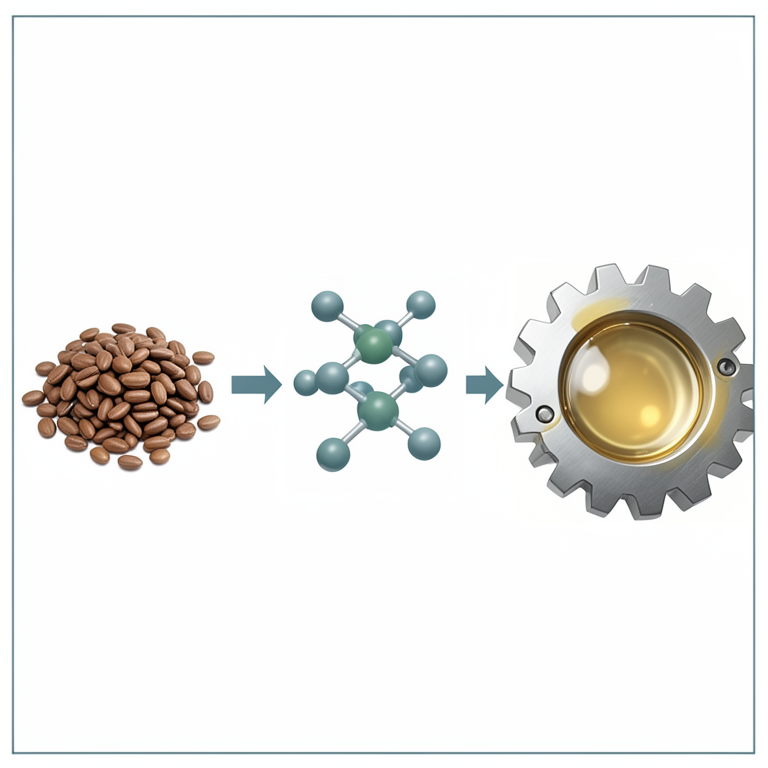
Study overview
AI-generated conceptual illustration (biodegradable lubricants (vegetable oils and synthetic esters) in industrial machinery gears). It explains the idea and does not show study data.
View source evidence ↗Introduction
The literature of recent years offers a wide range of articles, works and patents in the field of tribology, a field in which the performance criteria are becoming higher and higher, and the condition of biodegradability has become practically self-evident. Thus, a series of studies have been carried out regarding the influence of lubricants on the environment and how their harmful effect can be eliminated or at least reduced [1] . The reaction is catalyzed homogeneously or heterogeneously, by acids and Lewis catalysts, such as: Nafion-silica composites, Amberlist 15, AlBr3, FeCl3, etc. [2] . The synthesis and biodegradability capacity of some adipic and sebacic esters was studied by a Polish research team [3] . Thus, ester oligomers with different ranges of molecular masses were synthesized from dimethyl adipate, dimethyl sebacate and neopentylglycol. The transesterification reactions were catalyzed by calcium methoxide [3] . The problem of the biodegradability of lubricants is not limited to the basic material the lubricating oil but the contribution of thickeners and the package of additives, important in the case of lubricating greases, must be taken into account [4] . Although it is somewhat divergent to the field of tribology, the issue of biodegradability is also important in the case of lubricants for the processing of plastic materials, mainly oils and fats. Thus, a composition containing 70% by weight of trimethylol propane trioleate, 7% by weight of calcium sulfonate, 15% by weight of sulfurized animal fat and 8% by weight of phosphate, showed excellent qualities in the processing of polymers [4] . It is proposed to use carboxylic acids, secondary products of the catalytic oxidation of cyclohexane, as substances for obtaining biodegradable lubricants [5] . The mixture of monocarboxylic acids (butyric, valeric and capric) separated from the mixture resulting from the catalytic oxidation of cyclohexane to cyclohexanone, was used to esterify polyhydric alcohols (pentaerythritol or trimethylol propane) resulting in ester oils within the ISO VG 10 and VG 22 viscosity classes which have properties comparable to those of commercial biodegradable ester oils. Modification of the commercial assortments of polyalkylene glycols (PAGs) by esterification of hydroxyl groups with a mixture of monocarboxylic acids from the C4-C6 series, changed some properties of PAGs, increasing their importance as a base oil for the production of lubricants [5] . Fatty acid neoalkyl glycol esters are considered non-toxic and biodegradable base oils for functional automotive fluids [6] . These fluids consist of esters of neopentyl glycol, trimethylol propane, pentaerythritol and dipentaerythritol with fatty acids having a chain length of C8-C36, an iodine index of less than 10 (preferably less than 1), a Noack volatility (DIN 51581) less than 7% (preferably less than 4%), and a pour point less than -20 °C (preferably below -40 °C).
Biodegradable or non-biodegradable additives can also be present in order to ensure the increase of the performance of the fluid. Such fluids can be used as engine oils, gear oils, automatic transmission fluids, traction fluids or hydraulic fluids (for example for shock absorbers), brake fluids and refrigeration units [7] . Synthetic lubricants and hydraulic fluids can be obtained by the electrophilic addition of carboxylic acids (their anhydrides, acyl halides, or neocarboxylic acids) to unsaturated fatty acids or their esters [8] : oleic, linoleic, linolenic, palmitoleic, eicosenoic, erucic acids or their methyl esters, glycerin-trioleate, pentaerythritol-tetraoleate, or mixtures of rapeseed, sunflower, palm, coconut or olive oils. The addition reaction is carried out in heterogeneous acid catalysis (zeolites, solid phosphoric acid, metal phosphates, acid oxides for example B2O3GeO2, ion exchange resins) or homogeneous (H2SO4, H3BO3, HNO3, HCl, AlCl3 and other halogenated acids and Lewis acids ). The synthetic esters thus obtained are characterized by an increased resistance to oxidation and reduced toxicity [9] . Complex polyol esters show biodegradability characteristics, and lubricating compositions containing a polyfunctional alcohol ester and a saturated or unsaturated dicarboxylic acid residue having from about 9 to about 22 carbon atoms are also biodegradable [10] . Lubricants based on fully hydrogenated vegetable oils have a series of properties (lubrication capacity, rheology, optimal electrical insulation values and microbial biodegradability capacity) that give them a special position among the fluids that ensure the proper functioning of mechanical devices [11] . Biodegradable lubricants involve the use of lubricating compositions that are based on a biodegradable base oil, such as a polyol or polyalkylene glycol ester, a thickener based on calcium sulfonate and a phospholipid of natural origin as an antiwear additive (such as lecithin) and having a specific gravity greater than 1.0 at 15.6 °C (60 °F) for marine applications. The thickening agent may be a linear alkyl benzene sulfonic acid, acetic acid and 12-hydroxy stearic acid, and calcium carbonate as a solid film lubricant. The lubricant sinks when dispersed in water avoiding the formation of a glossy surface and biodegrades when submerged which means that it is established as an environmentally friendly lubricant [12] . As an observation we can say that this patent presents to some extent a composition claimed in another patent of the same authors, cited at position [13] .
A biodegradable penetrating lubricant is composed of the following components At least one triglyceride An organic solvent chosen from:
(3) Combination of (1) and (2); An antioxidant; A corrosion inhibitor.
Optionally, the lubricant can be added further with other substances chosen from Viscosity modifier. Wear inhibitor. An emulsifier [14][15][16][17][18][19][20][21][22][23][24] .
Conclusions
Obtaining a new generation of lubricants was the understanding of the need to eliminate or considerably reduce the content of toxic chemical compounds. The good lubricating properties as well as the high degree of biodegradability were the decisive criteria in the use of vegetable oils as a dispersion phase in lubricating greases.
References
15 in the original paper- Hoelderich W, Rios LA, Weckes P, Schuster H. Lubricant and pressure transfer agent comprises oleo chemicals with the double bonds epoxidized and then reacted with aliphatic alcohols. DE10200971 (A1). 24 July 2003.
- Kolwzan B, Gryglewicz S. Synthesis and biodegradability of some adipic and sebacic esters. J Synth Lubr. 2003;20(2):99-107.
- Liu W, Zhang T. Tianjin Univ of Sci and Technol., Tianjin, China. Hecheng Runhua Cailiao. 2004;31(3):17-19.
- Ikeda M, Okahara H. Lubricant for plastic working of magnesium alloy or aluminum alloy and working method using the lubricant. JP2003105364 (A). 09 April 2003.
- Beran E. Inst. of Chem and Technol of Petroleum and Coal, Wroclaw Univ of Technol., Poland. Prace Naukawe Instytutu Chemii I Technol. Nafty I Wegla, Polit. Wroclawskiej. 2002;57:385-390.
- Woydt M, Criqui B, Desplanches G, Linnemann T. Non-toxic and biodegradable fluids for multi-functional applications in automobiles are based on ethylene oxide/propylene oxide copolymers or esters of neopolyols. FR2792325 (A1). 20 October 2000.
- Hoelderich W, Keller U, Fischer J, Weckes P, Mang T, Luther R, et al. Novel compositions of material, especially lubricants and pressure transmitting means, the production and use thereof. WO0153438 (A1). 26 July 2001.
- Zehler E, Costello C. Complex polyol esters with improved performance. WO2005019395 (A1). 03 March 2005.
- Garmier WW. Vegetable oil lubricant comprising allhydroprocessed synthetic oils. WO2005026300 (A1). 24 March 2005.
- Kurosky JM, Tahir ZA. Biodegradable lubricants. WO2004106474 (A1). 09 December 2004.
- Stanciu I. Some methods for determining the viscosity index of hydraulic oil. Indian J Sci Technol. 2023;16(4):254-258.
- Stanciu I. Rheological behavior of corn oil at different viscosity and shear rate. Orient J Chem. 2023;39(2):335-339.
- Stanciu I. Rheological characteristics of corn oil used in biodegradable lubricant. Orient J Chem. 2023;39(3):592-595.
- Stanciu I. Effect of temperature on rheology of corn (Zea mays) oil. Orient J Chem. 2023;39(4):1068-1070. International Journal of Advanced Chemistry Research https://www.chemistryjournals.net
- Rashid U, Anwar F, Knothe G. Fuel Process Technol. 2009;90(9):1157-1163.