
Research article · 2024 · Full text
International Journal of Advanced Chemistry ResearchMechanistic studies of transition metal-catalyzed cross-coupling reactions
Volume 6(2) · Pages 56–59 · DOI: 10.33545/26646781.2024.v6.i2a.228 ↗
Research areasAsymmetric Hydrogenation and CatalysisCatalytic Cross-Coupling Reactions
Abstract
Author-writtenTransition metal-catalyzed cross-coupling reactions have become indispensable tools in modern organic synthesis, enabling the efficient formation of Carbon-Carbon (C-C) and carbon-heteroatom (C-X) bonds. This research provides a comprehensive mechanistic analysis of three pivotal cross-coupling reactions: the palladium-catalyzed Suzuki-Miyaura coupling, the nickel-catalyzed Kumada coupling, and the iron-catalyzed Stille coupling. These reactions are critically evaluated in terms of their catalytic cycles, including key steps such as oxidative addition, transmetalation, and reductive elimination. The mechanistic insights discussed are supported by recent computational advances, particularly in density functional theory (DFT), which have provided significant predictive power in optimizing reaction conditions and designing novel catalysts. By integrating experimental and computational studies, this work contributes to a deeper understanding of the catalytic mechanisms involved in transition metal-catalyzed cross-coupling reactions, offering valuable insights for the development of more effective and sustainable synthetic methodologies. This study underscores the continued evolution of cross-coupling reactions as a cornerstone of organic synthesis.
Summary
Source-checkedPlain-language reading of the full paper, prepared with AI and checked against the text. Each point links to the authors' own words.
Why it matters
- Transition metal-catalyzed cross-coupling reactions are essential in modern organic synthesis for building complex molecular structures. View evidence ↗
- These reactions are fundamental for creating C-C and C-X bonds used in the production of advanced materials, agrochemicals, and pharmaceuticals. View evidence ↗
- There is an increasing focus on using abundant first-row transition metals like iron and nickel to create more sustainable and cheaper processes than those using precious metals like palladium. View evidence ↗
The question
- The paper aims to provide a detailed mechanistic overview of key cross-coupling reactions and discuss recent advancements and their future implications. View evidence ↗
What they did
- The analysis focuses on three specific reactions: the Suzuki-Miyaura (palladium-catalyzed), Kumada (nickel-catalyzed), and Stille (iron-catalyzed) couplings. View evidence ↗
- The evaluation centers on the catalytic cycles, specifically the steps of reductive elimination, transmetalation, and oxidative addition. View evidence ↗
- The mechanistic discussions are supported by computational advances, specifically Density Functional Theory (DFT). View evidence ↗
What they found
- In Suzuki-Miyaura coupling, the first step is oxidative addition where Pd^0 reacts with an aryl halide to form a palladium (II) complex. View evidence ↗
- The transmetalation step of the Suzuki-Miyaura coupling involves an organoboron compound transferring an organic group to the palladium complex, creating an Ar-Pd^II-R complex. View evidence ↗
- The Suzuki-Miyaura cycle concludes with reductive elimination, which forms the C-C bond and regenerates the Pd^0 catalyst. View evidence ↗
- The Kumada coupling begins with oxidative addition, where Ni^0 reacts with an aryl or alkyl halide to form a nickel (II) complex. View evidence ↗
- The Kumada coupling ends with reductive elimination, producing the C-C bond and regenerating the Ni^0 catalyst. View evidence ↗
- Iron-catalyzed Stille coupling starts with the reduction of an iron (III) catalyst to iron (II) via reaction with an organostannane. View evidence ↗
- The second step of the iron-catalyzed Stille coupling is oxidative addition, where the iron (II) complex reacts with an aryl halide to form an iron (III) complex. View evidence ↗
- The iron-catalyzed Stille coupling concludes with reductive elimination, forming the C-C bond and regenerating the iron (II) catalyst. View evidence ↗
What it means
- The authors conclude that the future of the field depends on developing more sustainable methodologies and continued innovation. View evidence ↗
- A remaining challenge in the field is the economic and environmental cost associated with the reliance on precious metals like palladium. View evidence ↗
Visual summary
1 visualsIllustrations explain the paper; they do not show study data.
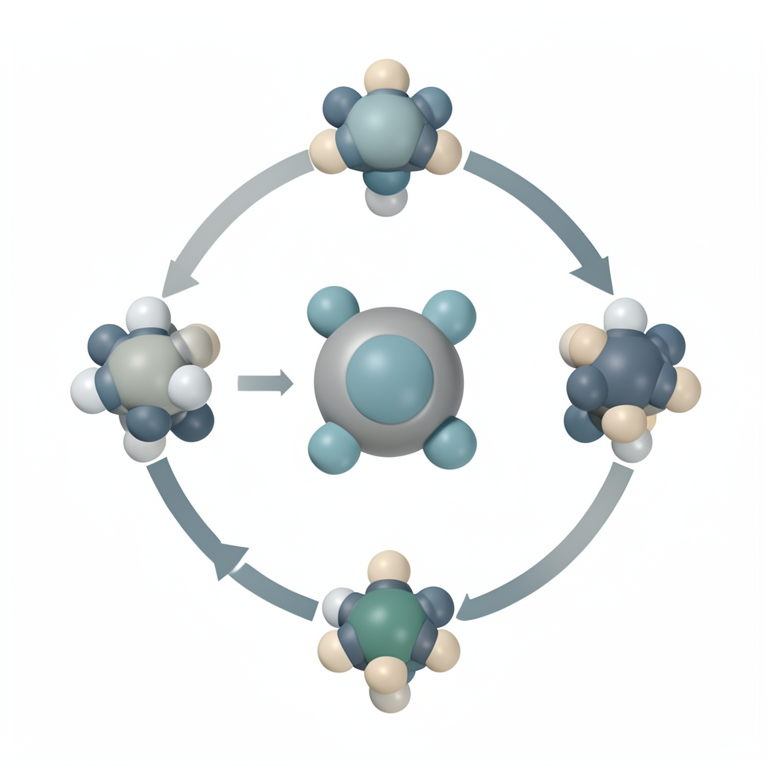
General Catalytic Cycle
AI-generated conceptual illustration (transition metal complex and organic molecules). It explains the idea and does not show study data.
View source evidence ↗Introduction
Transition metal-catalyzed cross-coupling reactions have emerged as a cornerstone of modern organic synthesis, playing a crucial role in the construction of complex molecular architectures. These reactions facilitate the formation of carbon-carbon (C-C) and carbonheteroatom (C-X) bonds, which are fundamental to the synthesis of pharmaceuticals, agrochemicals, and advanced materials. Among the various metals employed in these catalytic processes, palladium, nickel, and iron are particularly noteworthy due to their unique electronic properties and versatility in catalyzing a broad range of coupling reactions (Nijamudheen & Datta, 2020) [1] . The development of cross-coupling reactions such as the Suzuki-Miyaura, Kumada, and Stille couplings has revolutionized synthetic strategies, enabling chemists to achieve high levels of selectivity and functional group tolerance under mild conditions (Beletskaya & Ananikov, 2022) [2] . These reactions typically proceed through well-defined catalytic cycles involving oxidative addition, transmetalation, and reductive elimination, with each step being finely tuned by the nature of the metal catalyst and the reaction conditions. Recent advances in computational chemistry, particularly Density Functional Theory (DFT), have provided deeper mechanistic insights into these processes, revealing subtle details about transition states and intermediate species that are often elusive in experimental studies (Duan et al., 2022) [3] . These insights have not only enhanced our theoretical understanding but also guided the design of more efficient catalysts and optimized reaction conditions (Palkowitz et al., 2023) [4] . As the demand for more sustainable and cost-effective catalytic processes grows, the role of first-row transition metals, such as nickel and iron, has gained significant attention due to their abundance and lower environmental impact compared to precious metals like palladium (Mako & Byers, 2016) [5] . This paper aims to provide a comprehensive mechanistic overview of these critical cross-coupling reactions, highlighting recent advancements and their implications for the future of synthetic chemistry.
Historical background of transition metal-catalyzed cross-coupling reactions
The development of transition metal-catalyzed crosscoupling reactions represents a significant milestone in the field of organic synthesis. This transformative chemistry began in the late 1960s and early 1970s, spearheaded by the groundbreaking work of Richard F. Heck, Ei-ichi Negishi, and Akira Suzuki, who were later awarded the Nobel Prize in Chemistry in 2010 for their contributions. These early studies focused on the use of palladium as a catalyst to form carbon-carbon (C-C) bonds under relatively mild conditions, revolutionizing synthetic methodologies for constructing complex organic molecules. Heck's initial work on arylation of olefins using palladium catalysts demonstrated the potential of these reactions to facilitate C-C bond formation with high efficiency and selectivity. This discovery was followed by Negishi's development of organozinc reagents in cross-coupling reactions, which allowed for even greater versatility in the types of bonds that could be formed (Negishi, 2011) [6] . Akira Suzuki further expanded the utility of these reactions by introducing organoboron compounds, leading to the widely adopted Suzuki-Miyaura coupling, known for its functional group tolerance and ease of use (Chirik & Morris, 2015) [7] . Over the decades, the scope of cross-coupling chemistry has expanded beyond palladium, incorporating first-row transition metals like nickel and iron, which offer cost-effective and sustainable alternatives. Nickel, for example, has proven effective in catalyzing challenging C-C and C-heteroatom (C-X) bond formations, particularly with less reactive alkyl halides. Similarly, iron catalysis has gained attention due to its abundance and environmental friendliness, facilitating a range of crosscoupling reactions that are both economically viable and sustainable.
The evolution of catalytic systems
The evolution of catalytic systems in transition metalcatalyzed cross-coupling reactions has been driven by the need for more sustainable and cost-effective alternatives to palladium, a traditionally used but expensive metal. Nickel (Ni) has emerged as a cost-effective alternative, particularly in the Suzuki-Miyaura reaction. Nickel's ability to catalyze challenging couplings involving alkyl halides, which are less reactive in palladium-catalyzed processes, has been a significant advancement. Mechanistic studies reveal that nickel's versatility stems from its ability to access multiple oxidation states (Ni^0, Ni^I, Ni^II, and Ni^III), enabling it to participate in both two-electron and single-electron transfer mechanisms (Cheung et al., 2021) [8] . Iron (Fe), another abundant metal, has also gained attention for its environmental friendliness and effectiveness in crosscoupling reactions.
Mechanistic insights and reaction pathways
Mechanistic insights into transition metal-catalyzed crosscoupling reactions are crucial for optimizing these processes and developing innovative catalytic strategies. These reactions generally proceed through three main steps: oxidative addition, transmetalation, and reductive elimination. The efficiency and selectivity of each step are highly dependent on the nature of the metal catalyst, ligands, and reaction conditions. Advances in computational chemistry, particularly density functional theory (DFT), have provided detailed insights into these reaction pathways.
For instance, DFT studies have revealed critical intermediates and transition states that are challenging to detect experimentally. These insights have been instrumental in the rational design of new catalysts. For example, recent DFT studies on nickel-catalyzed crosscouplings have identified key Ni (I) intermediates that are vital for catalytic efficiency (Hou & Yu, 2020) [9] . Similarly, DFT has been used to optimize ligands in palladiumcatalyzed reactions to enhance selectivity.
Mechanistic insights Palladium-catalyzed Suzuki-Miyaura coupling
The Suzuki-Miyaura coupling is one of the most widely used reactions in organic synthesis for forming carboncarbon (C-C) bonds. This reaction involves the coupling of aryl halides with organoboron compounds, catalyzed by palladium, and is particularly valued for its mild reaction conditions and broad functional group tolerance (Nijamudheen & Datta, 2020) [1] .
Reaction mechanism 1. Oxidative addition
The first step in the Suzuki-Miyaura coupling is oxidative addition, where the palladium catalyst in its zero oxidation state (Pd^0) reacts with the aryl halide (Ar-X). This process results in the formation of a palladium (II) complex (Ar-Pd^II-X). This step is crucial as it activates the aryl halide, making it susceptible to further reactions. Pd 0 + Ar-X → Ar-Pd II -X
Transmetalation
In the transmetalation step, the organoboron compound (R-B(OH)_2) transfers its organic group (R) to the palladium complex, displacing the halide. This step forms the Ar-Pd^II-R complex and produces a boron byproduct (B(OH)_2X). This transmetalation step is highly dependent on the base used in the reaction, which activates the boron reagent for the transfer.
Ar-Pd
Ar-Pd
Reductive elimination
The final step is reductive elimination, where the palladium (II) complex undergoes a reductive process to form the desired C-C bond, regenerating the palladium (0) catalyst. The Ar-R product is released, and the palladium catalyst is now available to enter another catalytic cycle. This step is crucial for the overall efficiency of the reaction and is typically very fast, making the Suzuki-Miyaura coupling highly efficient [10] .
Nickel-catalyzed kumada coupling
The Kumada coupling, catalyzed by nickel, is a highly efficient reaction for forming carbon-carbon (C-C) bonds between aryl or alkyl halides and Grignard reagents [11] . This reaction is particularly valued for its ability to form sp2-sp3 and sp3-sp3 carbon bonds, making it a critical tool in organic synthesis [12] . The use of nickel as a catalyst in this reaction is advantageous due to its relatively low cost, abundance, and versatility across various substrates. Nickel's ability to operate under mild conditions further enhances the utility of the Kumada coupling, especially when working with sensitive or complex molecules.
Reaction mechanism 1. Oxidative addition
The first step in the Kumada coupling reaction is oxidative addition, where the nickel catalyst in its zero oxidation state (Ni^0) reacts with an aryl or alkyl halide (R-X). This step results in the formation of a nickel (II) complex (R-Ni^II-X). The oxidative addition is a critical step that activates the halide for subsequent reactions, and nickel's unique electronic properties facilitate this process even with challenging substrates [13] .
Transmetalation
In the transmetalation step, the nickel (II) complex formed in the oxidative addition reacts with a Grignard reagent (R'-MgX). This step transfers the organic group from the Grignard reagent to the nickel complex, forming a new nickel (II) complex (R-Ni^II-R') and a magnesium halide byproduct (MgX_2). This step is crucial for coupling the organic moieties to form the C-C bond [14] .
R-Ni
R-Ni
Reductive elimination
The final step is reductive elimination, where the nickel (II) complex undergoes a reductive process to form the desired C-C bond (R-R') and regenerate the nickel (0) catalyst. This regeneration allows the catalyst to participate in another catalytic cycle, making the reaction highly efficient [15] .
R-Ni
Nickel's ability to catalyze these couplings under mild conditions and its effectiveness with a variety of substrates make it a versatile catalyst.
Iron-catalyzed stille coupling
The Stille coupling reaction, traditionally catalyzed by palladium, involves the formation of carbon-carbon (C-C) bonds between organostannanes (R-SnR'_3) and organic electrophiles such as aryl halides (Ar-X) [16] . However, the use of iron as a catalyst in this reaction has gained significant attention due to iron's low cost, abundance, and environmental friendliness compared to precious metals like palladium [17] . Iron-catalyzed Stille coupling is particularly appealing because iron is a less toxic alternative, making the process more sustainable and eco-friendly.
Reaction mechanism:
The iron-catalyzed Stille coupling proceeds through a multi-step mechanism, involving the reduction of the iron catalyst, oxidative addition, and reductive elimination.
Reduction of Fe catalyst
The first step involves the reduction of the iron (III) catalyst to iron (II). This occurs when the iron (III) catalyst reacts with the organostannane (R-SnR'_3), leading to the formation of an iron (II) complex (R-Fe^II) and a tin (IV) by product (R'_3Sn^IV). This step is crucial for activating the iron catalyst, enabling it to participate in the subsequent steps of the catalytic cycle [18] .
Oxidative addition
In the oxidative addition step, the iron (II) complex reacts with an organic electrophile, typically an aryl halide (Ar-X). This reaction forms an iron (III) complex (Ar-Fe^III-R) by inserting the iron into the carbon-halogen bond of the aryl halide. The oxidative addition is a key step that enables the coupling of the organic fragments [19] . R-Fe II + Ar-X → Ar-Fe III -R + X
Reductive elimination
The final step is reductive elimination, where the iron (III) complex undergoes a reductive process to form the desired C-C bond (Ar-R) and regenerate the iron (II) catalyst. This step is crucial for the overall efficiency of the reaction as it completes the catalytic cycle, allowing the iron catalyst to be reused in subsequent cycles.
Ar-Fe III -R → Ar-R + Fe II
Advantages and applications
Iron-catalyzed Stille coupling offers several advantages over traditional palladium-catalyzed versions. Iron is significantly less expensive and more abundant than palladium, making the process more cost-effective, especially for large-scale industrial applications. Additionally, iron's lower toxicity and reduced environmental impact make it a preferable choice for greener chemistry applications. The ability of iron catalysts to effectively couple a wide range of organostannanes with aryl halides under mild conditions further enhances the utility of this reaction in the synthesis of complex organic molecules, such as pharmaceuticals and advanced materials.
Advances in mechanistic understanding through computational studies
Recent advances in computational studies, particularly through Density Functional Theory (DFT), have significantly deepened our mechanistic understanding of transition metal-catalyzed cross-coupling reactions. Computational methods have elucidated critical intermediates, transition states, and reaction pathways that are often challenging to observe experimentally. For example, DFT has revealed the role of low-valent nickel species in cross-coupling reactions, providing insights into their reactivity and selectivity. These insights have enabled the rational design of new catalysts and optimization of reaction conditions, leading to more efficient and selective synthetic processes. As computational power continues to grow, these studies will likely play an increasingly important role in guiding experimental research and expanding the capabilities of cross-coupling reactions.
Challenges and future directions
Despite significant advancements, challenges remain in transition metal-catalyzed cross-coupling reactions, particularly concerning sustainability and cost. The reliance on precious metals like palladium presents economic and environmental concerns. As a result, the future of cross-coupling research is focused on developing catalysts based on more abundant and less toxic metals, such as nickel and iron. Additionally, there is a growing emphasis on performing these reactions under milder, greener conditions, such as in aqueous media or at lower temperatures, to reduce their environmental impact. Advances in computational chemistry and machine learning are also expected to drive the discovery of novel catalysts and reaction conditions, pushing the boundaries of what can be achieved in synthetic chemistry.
Conclusion
This research paper highlights the pivotal role of transition metal-catalyzed cross-coupling reactions in modern organic synthesis, emphasizing their versatility, efficiency, and broad applicability. Through detailed mechanistic insights, particularly enhanced by computational studies, we have seen how reactions like the Suzuki-Miyaura, Kumada, and Stille couplings have revolutionized the synthesis of complex molecules, including pharmaceuticals and advanced materials. While challenges remain, particularly regarding sustainability and cost, ongoing research into alternative catalysts like nickel and iron, along with the integration of greener reaction conditions, promises to expand the scope and reduce the environmental impact of these essential reactions. The future of cross-coupling chemistry lies in continued innovation and the development of more sustainable methodologies.
References
16 in the original paper- Beletskaya I, Ananikov V. Transition-metal-catalyzed C-S, C-Se, and C-Te bond formations via crosscoupling and atom-economic addition reactions. Achievements and challenges. Chem Rev. 2022;122(6):4705-4732. Available from: https://doi.org/10.1021/acs.chemrev.1c00836
- Duan A, Xiao F, Lan Y, Niu L. Mechanistic views and computational studies on transition-metal-catalyzed reductive coupling reactions. Chem Soc. Rev. 2022;51(8):2833-2863. Available from: https://doi.org/10.1039/d2cs00371f
- Palkowitz M, Emmanuel M, Oderinde M. A paradigm shift in catalysis: Electro-and photomediated nickelcatalyzed cross-coupling reactions. Acc Chem Res. 2023;56(8):963-975. Available from: https://doi.org/10.1021/acs.accounts.3c00479
- Mako T, Byers J. Recent advances in iron-catalysed cross coupling reactions and their mechanistic underpinning. Inorg Chem Front. 2016;3(6):766-790. Available from: https://doi.org/10.1039/C5QI00295H
- Negishi E-i. Magical power of transition metals: past, present, and future (Nobel Lecture). Angew Chem Int. Ed. 2011;50(30):6738-6764.
- Chirik PJ, Morris RH. Getting down to earth: The renaissance of catalysis with abundant metals. J Am Chem Soc. 2015;137(25):7634-7645.
- Cheung CW, Hu X, Stahl SS. Mechanistic insights into selective transition metal-catalyzed oxidation reactions. Nat Rev Chem. 2021;5(6):374-387.
- Hou X, Yu Z-X. Computational studies on mechanistic aspects of nickel-catalyzed reactions. J Am Chem Soc. 2020;142(45):19448-19464.
- Swift E, Jarvo E. Asymmetric transition metalcatalyzed cross-coupling reactions for the construction of tertiary stereocenters. Tetrahedron. 2013;69(29):5799-5817. Available from: https://doi.org/10.1016/J.TET.2013.05.001
- Sellars J, Steel P. Transition metal-catalysed crosscoupling reactions of P-activated enols. Chem Soc Rev. 2011;40(10):5170-5180. Available from: https://doi.org/10.1039/c1cs15100b
- Tappe F, Trepohl V, Oestreich M. Transition-metalcatalyzed C-P cross-coupling reactions. Synthesis. 2010;3037-3062. Available from: https://doi.org/10.1055/S-0030-1257960
- Shao Z, Zhang H. N-tosylhydrazones: versatile reagents for metal-catalyzed and metal-free cross-coupling reactions. Chem. Soc. Rev. 2012;41(2):560-572. Available from: https://doi.org/10.1039/c1cs15127d
- Kaga A, Chiba S. Engaging radicals in transition metalcatalyzed cross-coupling with alkyl electrophiles: recent advances. ACS Catal. 2017;7(7):4697-4706. Available from: https://doi.org/10.1021/ACSCATAL.7B01405
- Gutierrez O, Tellis J, Primer D, Molander G, Kozlowski M. Nickel-catalyzed cross-coupling of photoredox-generated radicals: uncovering a general manifold for stereoconvergence in nickel-catalyzed cross-couplings. J Am Chem Soc. 2015;137(15):48964899. Available from: https://doi.org/10.1021/ja513079r
- Hazari N, Melvin P, Beromi M. Well-defined nickel and palladium precatalysts for cross-coupling. Nat Rev Chem. 2017;1:44. Available from: https://doi.org/10.1038/s41570-017-0025
- Xia Y, Qiu D, Wang J. Transition-metal-catalyzed cross-couplings through carbene migratory insertion. Chem. Rev. 2017;117(23):13810-13889. Available from: https://doi.org/10.1021/acs.chemrev.7b00382
Cited by 1
From OpenAlex, OpenCitations and reference lists read by Scinovex
- Synthetic Approaches to Organoselenium Compounds ↗
Gulay Dilek · Özgür Yayınları eBooks · 2026
Organoselenium chemistry is an important field of organic chemistry that encompasses a variety of reagents, reaction pathways, and synthetic methods for the construction of carbon–selenium bonds. The structural diversity of organoselenium compounds and their utility in various synthetic transformations have stimulated considerable interest in the development of new and efficient methods for their preparation. This book has been prepared to…
❝ 0PDF