
Research article · 2024 · Full text
International Journal of Veterinary Sciences and Animal HusbandryToxic metals and essential microelements level in brown shrimp Crangon crangon (Linnaeus, 1758) from Bulgarian Black Sea coast as a biomonitor Southern and Northern
Volume 9(5) · Pages 106–108 · DOI: 10.22271/veterinary.2024.v9.i5b.1665 ↗
Research areasMarine and environmental studiesEnvironmental Toxicology and EcotoxicologyEnvironmental and Biological Research in Conflict Zones
Abstract
Author-writtenIn the current study, the concentration of trace elements (Zn, Mn) and toxic metals (As, Pb, Cd, Hg, Al) were determined in the tissues of the brown shrimp Crangon crangon (Linnaeus, 1758). The samples were collected during the summer and autumn seasons from the Bulgarian Black Sea (Varna and Burgas areas) in 2020 and 2021. Variations of chemical element concentrations with seasons and regions are compared. In all samples, Cd and Hg levels were under the legal limit for human consumption as indicated by European Regulation. The concentration of Pb exceeds the permissible limit in the tissues of shrimps caught from the Southern Black Sea (summer season 2021). Higher values of Zn and lower values of Mn were observed in the samples from the North. The Black Sea shrimp could be used as a biomonitoring species to assess seasonal changes in marine chemical pollution in Bulgaria.
Summary
Source-checkedPlain-language reading of the full paper, prepared with AI and checked against the text. Each point links to the authors' own words.
Why it matters
- Heavy metal pollution in aquatic environments is considered a serious global environmental issue. View evidence ↗
- Organisms living in water (hydrobionts) can accumulate toxic substances, making them useful indicators for monitoring coastal water pollution. View evidence ↗
- The brown shrimp, Crangon crangon, is recognized by researchers as a suitable bioindicator species for this purpose. View evidence ↗
What they did
- Brown shrimp samples were collected from the Varna and Burgas areas of the Bulgarian Black Sea during the summer and autumn of 2020 and 2021. View evidence ↗
- Summer sampling occurred in August 2020 and July 2021 for both regions, while autumn sampling was conducted only in Varna in November 2021. View evidence ↗
- Chemical elements were determined using inductively coupled plasma mass spectrometry (ICP-MS) following nitric acid treatment. View evidence ↗
- Data were reported as mean values in mg/kg fresh weight ± standard deviation, with significance tested using Student's t-test (p < 0.05). View evidence ↗
What they found
- Cadmium (Cd) and mercury (Hg) levels remained below the legal limits for human consumption across all tested samples. View evidence ↗
- Manganese (Mn) levels were significantly higher in shrimp samples from the Southern Black Sea coast compared to the Northern coast. View evidence ↗
- Samples from the Northern region exhibited higher zinc (Zn) values and lower manganese (Mn) values. View evidence ↗
- Among all tested toxic elements, aluminium (Al) and arsenic (As) showed the highest concentrations across both seasons and both regions. View evidence ↗
What it means
- The authors conclude that Crangon crangon is a viable species for use as a bioindicator to monitor chemical pollution in the Black Sea. View evidence ↗
- The study concludes that most investigated chemical elements showed distinct regional and seasonal variations in their accumulation. View evidence ↗
Visual summary
3 visualsIllustrations explain the paper; charts are replotted from the paper's own table values.
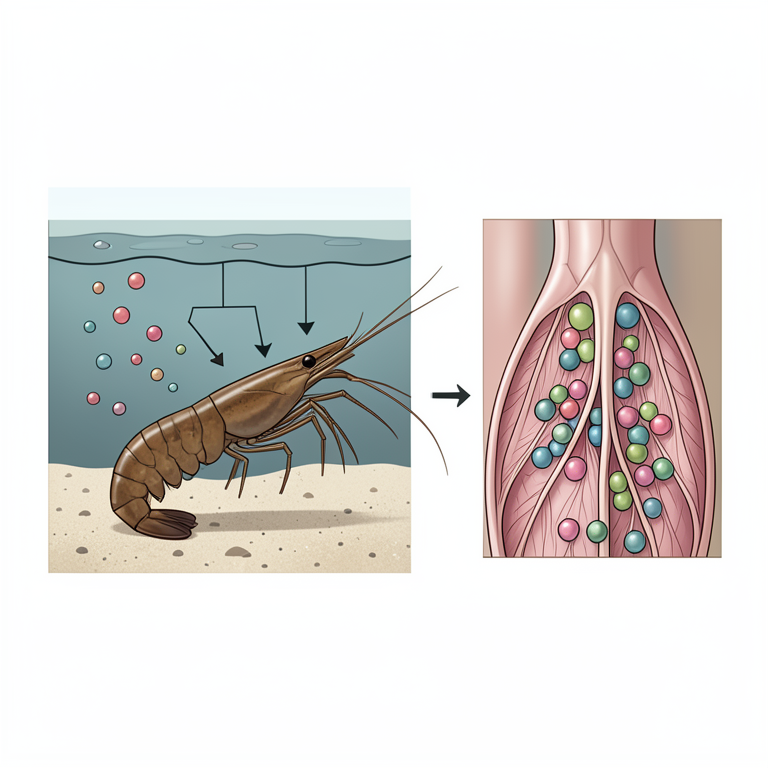
Bioindicator Concept
AI-generated conceptual illustration (brown shrimp (Crangon crangon)). It explains the idea and does not show study data.
View source evidence ↗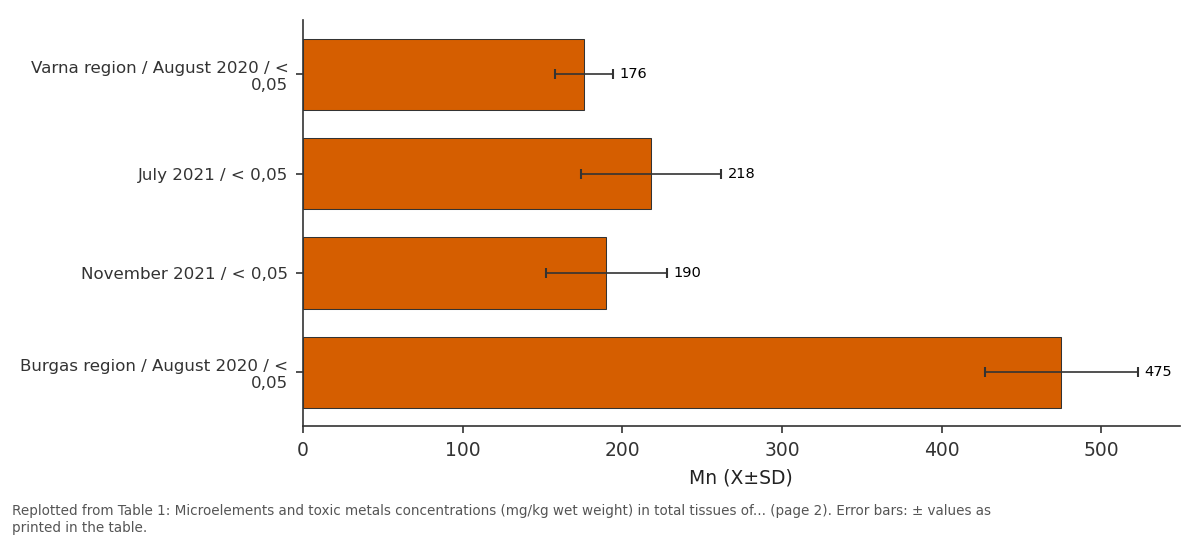
Mn (X±SD): Varna region / August... vs July 2021 / < 0,05 vs November 2021 / < 0,05 vs Burgas region / August...
Replotted from Table 1 (page 2) of the original paper. Every bar is the paper's own table value.
View source evidence ↗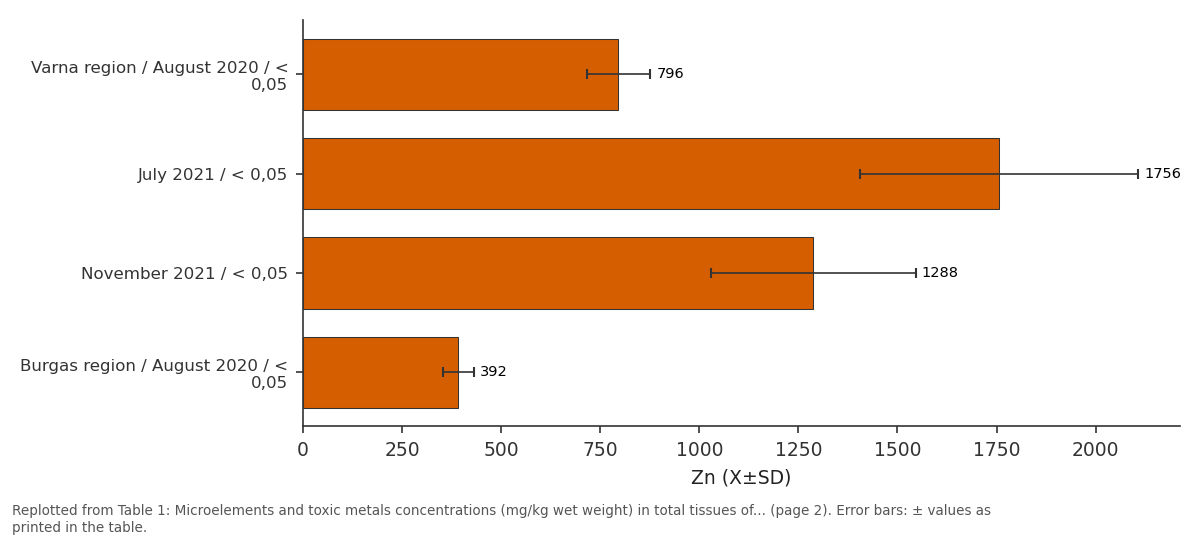
Zn (X±SD): Varna region / August... vs July 2021 / < 0,05 vs November 2021 / < 0,05 vs Burgas region / August...
Replotted from Table 1 (page 2) of the original paper. Every bar is the paper's own table value.
View source evidence ↗Figures & tables
From the original paper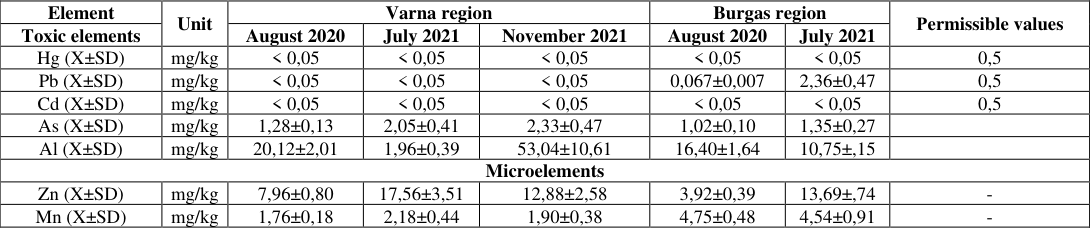 Table 1
Introduction
Heavy metal pollution of aquatic biomes is a serious environmental problem of global significance (Bat and Ozturk 1997; Khoshnood 2017; Bachvarova et al. 2022) [3,18,1] . Hydrobionts accumulate a wide variety of toxic substances, which could be used as an indicator of coastal water pollution (Baki et al. 2018; Fazio et al. 2020) [2,11] . Just as such a bioindicator species, many authors point to the decapod crustaceans Crangon crangon (Culshaw et al. 2002; Junk and Zauke 2008) [9,16] . The brown shrimp Crangon crangon (Linnaeus, 1758) also known as the common shrimp, is a widespread epibenthic species (Campos and Veer 2008; Devriese et al. 2015) [6,10] . Its habitat is the waters of the Atlantic Ocean, the White Sea, the Baltic Sea, the Mediterranean Sea, the North Sea and the Black Sea (Chak and Thiel 2015) [7] .
Materials and Methods
Whole bodies of the brown shrimps C. crangon from the summer and autumn catch were sampled at the Bulgarian North and South Sea coast. The collective samples from the summer catch from Varna and Burgas were taken in August 2020 and July 2021. The shrimps from the autumn catch were taken only from Varna in November 2021. Samples were stored under refrigeration conditions of -20ºC before processing. A variety of shrimp sizes were used, which were washed with clean water. Samples were analyzed after preliminary homogenization with a Vortex homogenizer, then acid digestion was performed by microwaves (ETHOS UP High-performance Microwave digestion system, Milestone Inc). After nitric acid treatment, spectroscopic determination was performed by inductively coupled plasma mass spectrometry (ICP-MS, Thermo Fisher TM). The obtained data were presented as mean (X) values (mg/kg) fresh weight±standard deviation (SD) and were processed with Student's t-test to assess the significance of the values (p< 0.05).
Results and Discussion
The present study aimed to determine the concentrations of some chemical elements in the tissues of C. Crangon and evaluate seasonal and regional differences in their accumulation. The obtained data on chemical element concentration in the tissues of brown shrimp are presented in Table 1.
| Element | Unit | Varna region | — | — | Burgas region | — | Рermissible values |
|---|---|---|---|---|---|---|---|
| Toxic elements | August 2020 | July 2021 | November 2021 | August 2020 | July 2021 | ||
| Hg (X±SD) | mg/kg | < 0,05 | < 0,05 | < 0,05 | < 0,05 | < 0,05 | 0,5 |
| Pb (X±SD) | mg/kg | < 0,05 | < 0,05 | < 0,05 | 0,067±0,007 | 2,36±0,47 | 0,5 |
| Cd (X±SD) | mg/kg | < 0,05 | < 0,05 | < 0,05 | < 0,05 | < 0,05 | 0,5 |
| As (X±SD) | mg/kg | 1,28±0,13 | 2,05±0,41 | 2,33±0,47 | 1,02±0,10 | 1,35±0,27 | |
| Al (X±SD) | mg/kg | 20,12±2,01 | 1,96±0,39 | 53,04±10,61 | 16,40±1,64 | 10,75±,15 | |
| Microelements | |||||||
| Zn (X±SD) | mg/kg | 7,96±0,80 | 17,56±3,51 | 12,88±2,58 | 3,92±0,39 | 13,69±,74 | - |
| Mn (X±SD) | mg/kg | 1,76±0,18 | 2,18±0,44 | 1,90±0,38 | 4,75±0,48 | 4,54±0,91 | - |
Table text extracted from the original PDF; superscript letters are shown inline. The original table image is below.
View original table image
Microelements
Essential microelements (Zn, Fe, Mn, Cu, Mo, etc.) have an important physiological role for animals and humans, as in small quantities they participate in the synthesis of vital chemical compounds such as enzymes and hormones, stimulate growth, development, improve immunity, etc. However, their high concentrations can have a toxic effect on living organisms (Gundogdu et al. 2020) [13] . All crustaceans like C. crangon, require essential microelements for their biological functions (Bat et al. 2013) [4] . In the present study, the levels of Zn and Mn were determined. Their concentration were in the range of 3,92-17,56 mg/kg for Zn and 1,76-4,75 mg/kg for Mn. As the manganese values of the shrimps samples taken from the South were significantly higher compared to those from the North Black Sea coast.
Toxic elements
Other chemical elements such as Cadmium (Cd), Mercury (Hg), Lead (Pb) and Arsenic (As) can have a toxic effect, entering the body (Laly et al. 2021). In connection with this, the European legislation lays down maximum permitted levels for Cd, Hg and Pb in food (Regulation No 1881/2006). Pb and Cd are highly toxic, can cause multiple organ damage and have a carcinogenic impact (Mendil et al. 2009; Hosseini et al. 2015) [19,15] . Mercury is a highly toxic substance that poses a serious global risk to human health and the environment (Gomes et al. 2021) [12] . Marine organisms accumulate substantial concentrations of Hg in their tissues. (Biton-Porsmoguer et al. 2021) [5] . Methyl Hg (the organic form of Hg) is much more toxic than the inorganic forms, and it is organic mercury that hydrobionts accumulate (Pandey et al., 2012) [21] .
In the present study it was showed that expect for Pb, Cd and Hg in all samples of shrimp (Crangon crangon) were lower amounts than the permissible limit levels. Erdem et al. 2015 reported the same results for the analysed brown shrimps caught from the Black Sea coast (Turkey) in 2015. In the shrimps' samples taken in the summer of 2021 from Burgas was observed very high lead concentration of 2,36±0,47 mg/kg. Тhese values exceed 7.8 times the maximum permissible limits of 0,3mg/kg specified in Regulation (EC) No 1881/2006. Like mercury, arsenic (As) is a heavy metal with a highly toxic effect, which is found in organic and inorganic forms, and the main source of arsenic for humans is seafood consumption (Taylor et. al 2017) [22] . Aluminium (Al) is a neurotoxic metal that tends to accumulate in the body tissues. Marine animals especially representatives of the cephalopods (Such as shrimps) are inclined to accumulate high levels of Al from the polluted seas. Non-essential elements such as Al and As showed the highest values of all tested toxic elements for both two seasons and Varna and Burgas. As for both chemical elements, the highest concentrations were recorded in the autumn season (Al -53,04±10,61 mg/kg and As -2,33±0,47 mg/kg). Habte et al. 2015 [14] also reported for High levels of aluminium and arsenic in other species of shrimps.
Conclusions
The contamination of the Black Sea with chemical elements represents a serious ecological threat to humanity. The bioaccumulation of toxic substances in hydrobionts is a major problem arising from these pollutions. Our results showed that the heavy metals (Cd and Hg) laid down in the European legislation do not exceed the maximum permissible limits. Except for lead, its values are very high during the second summer sampling period from Burgas. High levels of aluminium were reported in all samples, especially those from the autumn season. The obtained data showed seasonal and regional differences for most of the investigated chemical elements. In general, based on the obtained results, we can summarize that the species Crangon crangon could be used as a bioindicator in monitoring the Black Sea chemical pollution.
Conflict of Interest Not available
Conflict of Interest Not available
Financial Support
Financial Support
References
17 in the original paper- Bachvarova D, Stancheva M, Ignatova-Ivanova T, Ibryamova S, Chipev N, Alexandrova A. Trace metal accumulation in tissues of wedge clams from sandy habitats of the Bulgarian Black Sea coast. In: editors. Current Trends of Ecology. BioRisk 2022;17:73-81. https://doi.org/10.3897/biorisk.17.77290
- Baki MA, Hossain MM, Akter J, Quraishi SB, Haque SMF, Atique UAKM, Khan MF. Concentration of heavy metals in seafood (Fishes, shrimp, lobster and crabs) and human health assessment in Saint Martin Island, Bangladesh. Ecotoxicology and Environmental Safety. 2018 Sep 15;159:153-163.
- Bat L, Ozturk M. Heavy metal levels in some organisms from the Sinop Peninsula of the Black Sea. Turkish Journal of Engineering and Environmental Sciences. 1997;21(1):29-33.
- Bat L, Sahin F, Sezgin M, Ustun F, Gokkurt-Baki O, Oztekin HC. Heavy metals in edible tissues of the brown shrimp Crangon crangon (Linnaeus, 1758) from the Southern Black Sea (Turkey). Journal of the Black Sea/Mediterranean Environment. 2013;19(1):70-81.
- Commission Regulation (EC) No 1881/2006 of 19 December 2006 setting maximum levels for certain contaminants in foodstuffs.
- Culshaw C, Newton LC, Weir I, Bird DJ. Concentrations of Cd, Zn and Cu in sediments and brown shrimp (Crangon crangon L.) from the Severn Estuary and Bristol Channel, UK. Marine Environmental Research. 2002;54:331-334.
- Devriese LI, van der Meulen MD, Maes T, Bekaert K, Paul-Pont I, Frère L. Microplastic contamination in brown shrimp (Crangon crangon, Linnaeus 1758) from coastal waters of the Southern North Sea and Channel area. Marine Pollution Bulletin. 2015 Sep 15;98(12):179-187. DOI: 10.1016/j.marpolbul.2015.06.051. Epub 2015 Jul 2. PMID: 26456303.
- Fazio F, D'Iglio C, Capillo G, Saoca C, Peycheva K, Piccione G. Environmental investigations and tissue bioaccumulation of heavy metals in grey mullet from the Black Sea (Bulgaria) and the Ionian Sea (Italy). Animals. 2020;10(10):1739. https://doi.org/10.3390/ani10101739
- Gomes M, Garcia C, Sato Y, Mendes E, de Miranda M, da Costa S. Determination and evaluation of mercury concentration in fish in the São Francisco River Watershed, Brazil. Ambiente & Água-An Interdisciplinary Journal of Applied Science; c2021. DOI: 10.4136/1980-993X
- Gundogdu A, Culha ST, Kocbas F. Trace elements concentrations and human health risk evaluation for four common fish species in Sinop coasts (Black Sea). Turkish Journal of Agriculture -Food Science and Technology. 2020;8(9):1854-1862. https://doi.org/10.24925/turjaf.v8i9.1854-1862.3470
- Habte G, Choi JY, Nho EY, Khan N, Choi H, Park SK. Determination of toxic heavy metal levels in commonly consumed species of shrimp and shellfish using ICPMS/OES. Food Science and Biotechnology. 2015;24:373-378. https://doi.org/10.1007/s10068-0150049-4
- Hosseini SV, Sobhanardakani S, Miandare HK, Harsij M, Regenstein JM. Determination of toxic (Pb, Cd) and essential (Zn, Mn) metals in canned tuna fish produced in Iran. Journal of Environmental Health Science and Engineering. 2015 Aug 11;13:59. DOI: 10.1186/s40201015-0215-x. PMID: 26266037; PMCID: PMC4531440.
- Jung K, Zauke GP. Bioaccumulation of trace metals in the brown shrimp Crangon crangon (Linnaeus, 1758) from the German Wadden Sea. Aquatic Toxicology. 2008;88:243-249.
- Khoshnood Z. Effects of environmental pollution on fish: A short review. Transylvanian Review of Systematical and Ecological Research. 2017;19:1-10. https://doi.org/10.1515/trser-2017-0005
- Mendil D, Uluozlu OD, Tuzen M, Soylak M. Investigation of the levels of some elements in edible oil samples produced in Turkey by atomic absorption spectrometry. Journal of Hazardous Materials. 2009;15:724-728.
- Pandey G, Madhuri S, Shrivastav AB. Contamination of mercury in fish and its toxicity to both fish and humans: An overview. International Research Journal of Pharmacy. 2012;3(11):44-47.
- Taylor V, Goodale B, Raab A, Schwerdtle T, Reimer K, Conklin S, Margaret R, Kevin K, Francesconi A. Human exposure to organic arsenic species from seafood. Science of the Total Environment. 2017;580:266-282. DOI: 10.1016/j.scitotenv.2016.12.113.