
Research article · 2024 · Full text
International Journal of Agriculture Extension and Social DevelopmentKnowledge of farmers towards improved Foxnut (Thangjing) cultivation practices in Bishnupur District of Manipur
Volume 7(9) · Pages 241–243 · DOI: 10.33545/26180723.2024.v7.i9d.1039 ↗
Research areasAgricultural Economics and PracticesLivestock Management and Performance Improvement
Abstract
Author-writtenThe study was on Adoption behaviour of farmers towards improved Foxnut (Thangjing) cultivation practices in Bishnupur District of Manipur, conducted in the session 2023-2024. A total number of 120 respondents were taken randomly from Bishnupur District under Nambol Block. The primary data was collected using pre-structured interview schedule and appropriate statistical analysis to obtain the results. The study’s finding shows that 45 per cent of the respondents are of old age group and 24.16 per cent of the respondents were educated up-to graduate. It was revealed that majority (54.17%) of the respondents are engaged in farming only. It was found that majority (55%) of the respondents have 1-2 acres of land and 35 per cent of the respondents have 10-20 years of farming experience with 43.33 per cent of the respondents’ annual income as 50,001 to 1,00,000 rupees. It shows that majority (58.33%) of the respondents have medium level category knowledge towards improved foxnut cultivation practices. It revealed that out of ten independent variables, i.e. age, education, occupation, farming experience, annual income, mass media exposure, risk bearing capacity, land holding, extension contact and scientific orientation positively and significantly correlated with knowledge of farmers towards improved Foxnut cultivation practices.
Summary
Source-checkedPlain-language reading of the full paper, prepared with AI and checked against the text. Each point links to the authors' own words.
Why it matters
- Foxnut, known locally as Thangjing, is a significant cash crop in Manipur. View evidence ↗
- Cultivating foxnut serves as a primary income source for low-income families and a supplementary profit source for higher-income families in the region. View evidence ↗
- The crop is valued in traditional oriental medicine for treating conditions such as diarrhea and kidney problems. View evidence ↗
What they did
- The researchers randomly selected 120 farmers engaged in foxnut cultivation for the study. View evidence ↗
- The study took place in the Nambol block of Bishnupur district, Manipur, specifically within the villages of Nambol Naorem and Nambol Oinam. View evidence ↗
- Data was gathered through pre-structured interview schedules and analyzed using statistical methods. View evidence ↗
What they found
- Among the respondents, 45% belonged to the old age group and 24.16% had an education level up to graduate. View evidence ↗
- A majority of the farmers (54.17%) were exclusively engaged in farming. View evidence ↗
- Most respondents (55%) held 1-2 acres of land, 35% had 10-20 years of experience, and 43.33% earned an annual income between 50,001 and 100,000 rupees. View evidence ↗
- The majority of farmers (58.33%) possessed a medium level of knowledge regarding improved cultivation practices, while 29.17% had high knowledge and 12.5% had low knowledge. View evidence ↗
- Ten variables, including age, education, income, and mass media exposure, were found to be positively and significantly correlated with the farmers' knowledge of improved cultivation. View evidence ↗
What it means
- The authors recommend that the Department of Agriculture provide training on farm management and plant protection to improve productivity. View evidence ↗
Visual summary
3 visualsIllustrations explain the paper; charts are replotted from the paper's own table values.
Factors Influencing Knowledge
AI-generated conceptual illustration (Foxnut (Euryale ferox) plants in a wetland pond). It explains the idea and does not show study data.
View source evidence ↗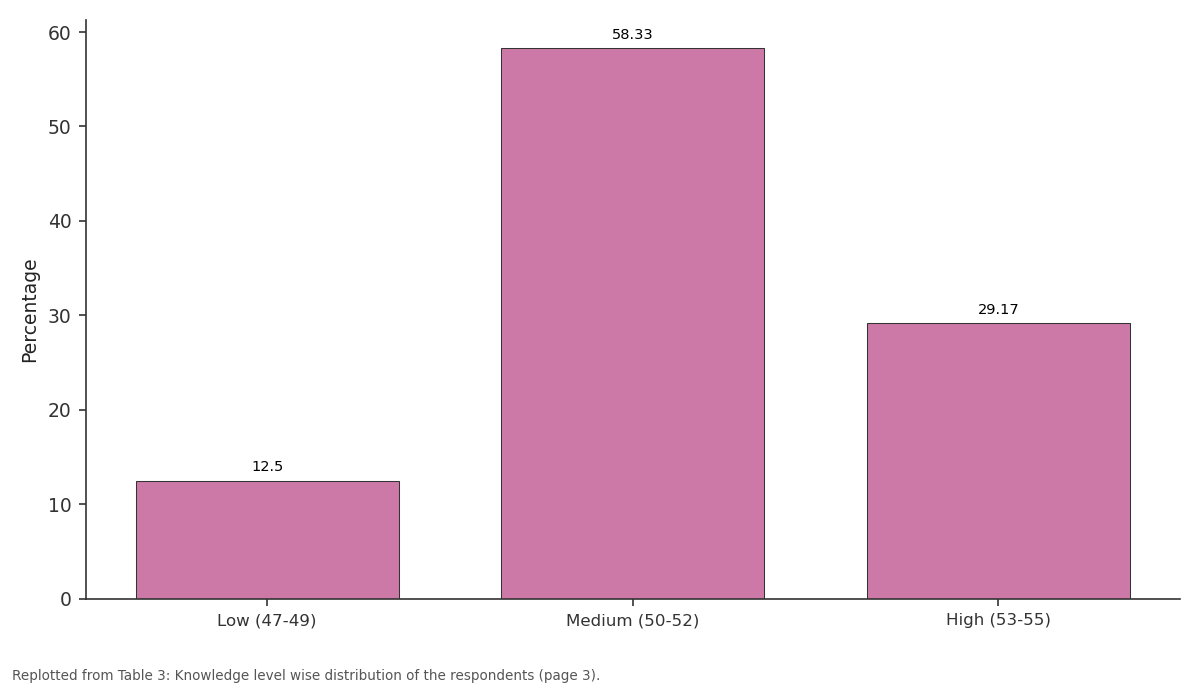
Percentage: Low (47-49) vs Medium (50-52) vs High (53-55)
Replotted from Table 3 (page 3) of the original paper. Every bar is the paper's own table value.
View source evidence ↗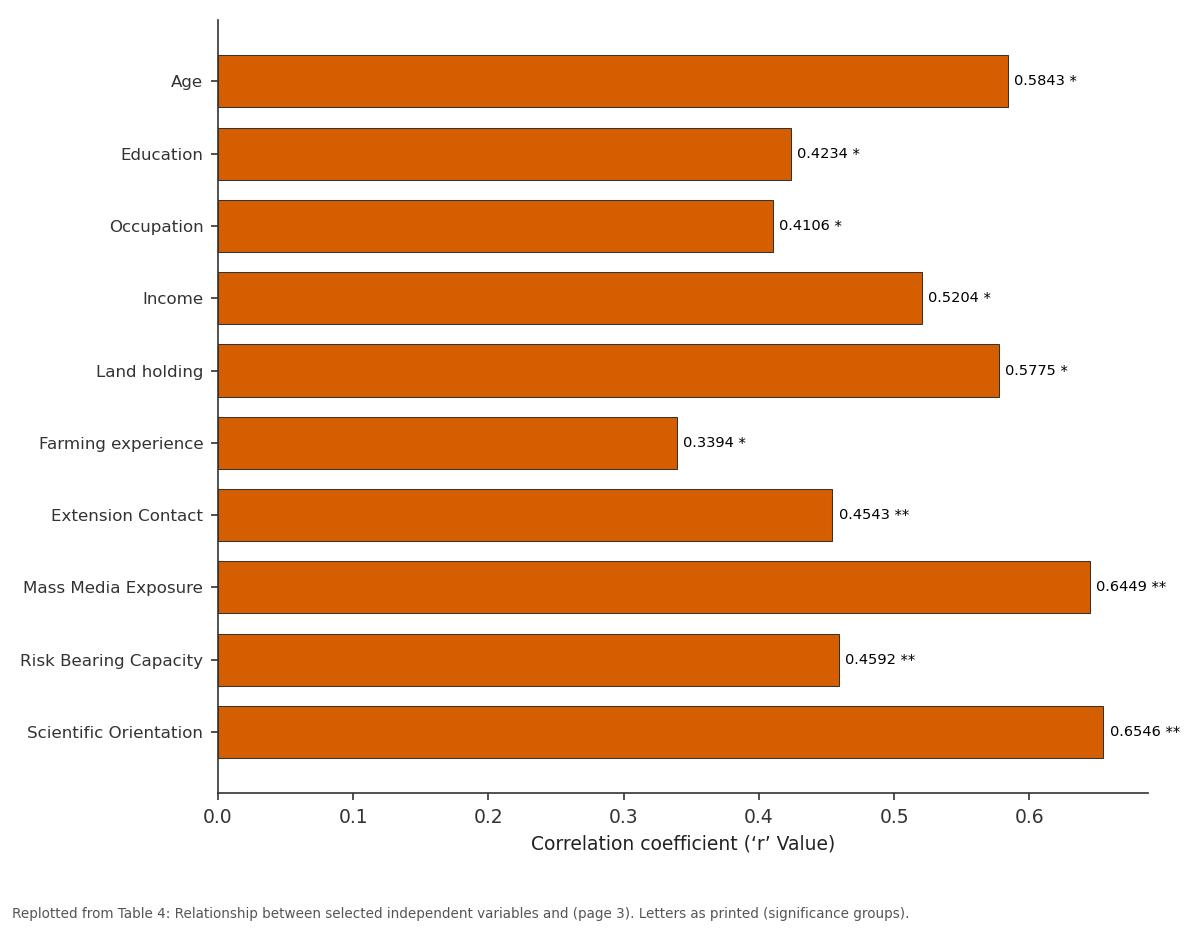
Correlation coefficient (‘r’ Value): Age vs Education vs Occupation vs Income vs Land holding
Replotted from Table 4 (page 3) of the original paper. Every bar is the paper's own table value.
View source evidence ↗Figures & tables
From the original paper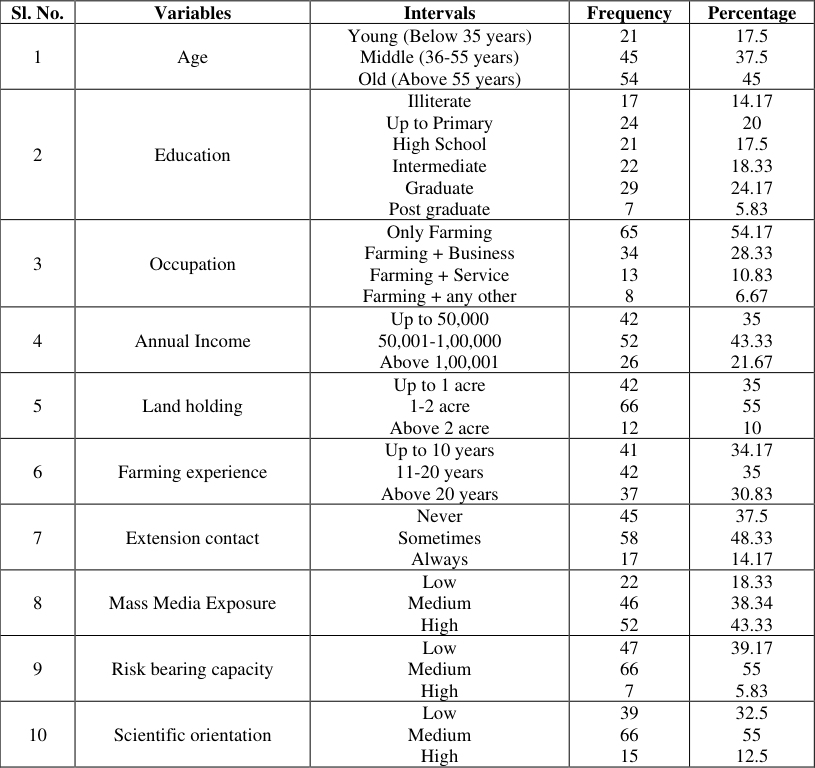 Table 1
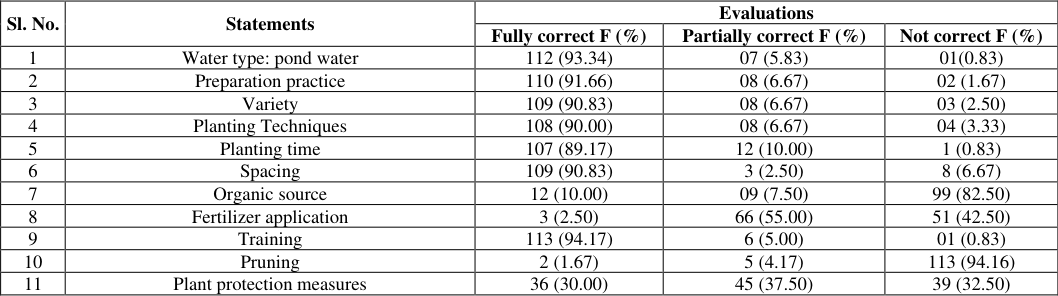 Table 2
 Table 3
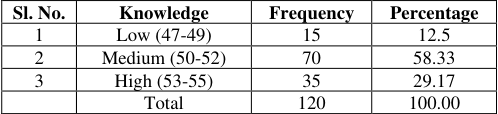 Table 3
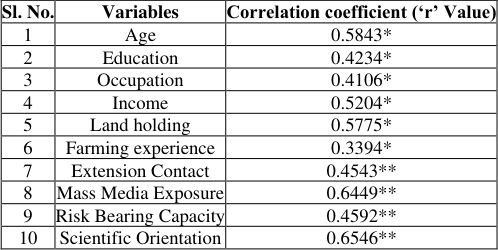 Table 4
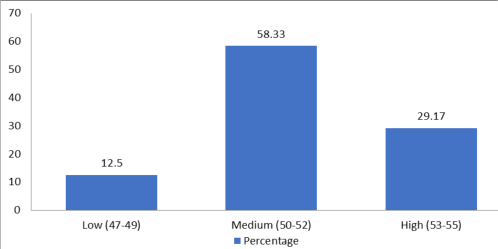 Figure 1
Results
The study’s finding shows that 45 per cent of the respondents are of old age group and 24.16 per cent of the respondents were educated up-to graduate. It was revealed that majority (54.17%) of the respondents are engaged in farming only. It was found that majority (55%) of the respondents have 1-2 acres of land and 35 per cent of the respondents have 10-20 years of farming experience with 43.33 per cent of the respondents’ annual income as 50,001 to 1,00,000 rupees. It shows that majority (58.33%) of the respondents have medium level category knowledge towards improved foxnut cultivation practices.
It revealed that out of ten independent variables, i.e. age, education, occupation, farming experience, annual income, mass media exposure, risk bearing capacity, land holding, extension contact and scientific orientation positively and significantly correlated with knowledge of farmers towards improved Foxnut cultivation practices. Keywords: Foxnut (Thangjing), knowledge, improved cultivation practices Objectives • To understand the socio-economic profile of the respondents. • To understand the knowledge of the respondents towards improved foxnut cultivation practices. Research Methodology Descriptive research design was followed for the present study. This design was followed as it is used to describe characteristics of a population or phenomenon being studied.
It is a scientific method which involves observing and describing the behaviour of the subject without influencing any way.The study was conducted at Bishnupur district of Manipur.There are 3 blocks in Bishnupur district of Manipur, out of which Nambol block was selected purposively based on maximum area under foxnut cultivation.There are 14 villages in Nambol block, out of which two villages namely Nambol Naorem and Nambol Oinam were selected for the present study on the basis of maximum area under foxnut cultivation. A total number of 120 respondents who were engaged in foxnut cultivation were selected randomly for the present study.
Introduction
Foxnut (Euryale ferox Salisb.) is one of the major cash crops in Manipur. It is commonly known as Thangjing in Manipur. It is cultivated mainly in the valley districts of Manipur namely Bishnupur, Thoubal, Imphal East and Imphal West districts. It is an aquatic cash crop grown in perennial water bodies like ponds and lakes.
In Manipur, foxnut cultivation can be a potential source of income for lower-income families. In some higher-income families, Foxnut cultivation is practised as a side-income business to earn more profit. Farmers in the Bishnupur District of Manipur practice traditional methods of foxnut cultivation. They use a local variety “Chakhao-nambi” sometimes.
They can get four to five times harvest once they cultivate. They didn’t use any organic fertilizer. They had hardly used NPK. Most of the farmers rely on their livelihood in Foxnut cultivation.
Foxnut plays an important role in the treatment of various diseases and is often sold in the local market thereby providing livelihood to a large number of rural people. It is widely been used in traditional oriental medicine to cure several diseases including kidney problems, diarrhoea, etc. in Manipur. 241 https://www.extensionjournal.com
Results And Discussion
Socio-economic Profile of the respondents Table 1: Profile characteristics of the respondents Sl. No. Variables Intervals Frequency Percentage Young (Below 35 years) 1 Age 17.5 37.5 Middle (36-55 years) Old (Above 55 years) 21 45 54 45 14.17 Illiterate Up to Primary 2 Education High School Intermediate 17 24 21 22 29 20 17.5 18.33 24.17 Graduate Post graduate 7 5.83 Only Farming Farming + Business 3 Occupation 65 34 13 54.17 28.33 10.83 Farming + Service Farming + any other 8 6.67 4 Annual Income Up to 50,000 50,001-1,00,000 Above 1,00,001 42 52 26 35 43.33 21.67 Up to 1 acre 5 Land holding 1-2 acre Above 2 acre 42 66 12 35 55 10 Up to 10 years 34.17 6 Farming experience 11-20 years Above 20 years 41 42 37 35 30.83 7 Extension contact Never Sometimes Always 45 58 17 37.5 48.33 14.17 8 Mass Media Exposure Low Medium High 22 46 52 18.33 38.34 43.33 39.17 9 Risk bearing capacity Low Medium 47 66 High 7 55 5.83 32.5 10 Scientific orientation Low Medium High 39 66 15 55 12.5 From the above table, it was reveals that 45 per cent of the respondents are of old age group and 24.16 per cent of the respondents were educated up-to graduate. It was revealed that majority (54.17%) of the respondents are engaged in farming only.
It was found that majority (55%) of the respondents have 1-2 acres of land and 35 per cent of the respondents have 10-20 years of farming experience with 43.33 per cent of the respondents’ annual income as 50,001 to 100,000 rupees. It stated that 48.33 of the respondents have their contact with extension worker sometimes. It found that 43.33 per cent of the respondents have high level towards mass media exposure. It reveals that majority (55%) of the respondents have medium level category towards risk bearing capacity and again majority (55%) of the respondents have medium level category towards scientific orientation.
Similar results were also reported by Ahmad et al., (2020) [1]. Knowledge of the respondents towards improved foxnut cultivation practices Table 2: Knowledge level of the respondents towards improved foxnut cultivation practices Sl. No. Statements Evaluations Fully correct F (%) Partially correct F (%) Not correct F (%) 1 Water type: pond water 112 (93.34) 07 (5.83) 01(0.83) 2 Preparation practice 110 (91.66) 08 (6.67) 02 (1.67) 3 Variety 109 (90.83) 08 (6.67) 03 (2.50) 4 Planting Techniques 108 (90.00) 08 (6.67) 04 (3.33) 5 Planting time 107 (89.17) 12 (10.00) 1 (0.83) 6 Spacing 109 (90.83) 3 (2.50) 8 (6.67) 7 Organic source 12 (10.00) 09 (7.50) 99 (82.50) 8 Fertilizer application 3 (2.50) 66 (55.00) 51 (42.50) 9 Training 113 (94.17) 6 (5.00) 01 (0.83) 10 Pruning 2 (1.67) 5 (4.17) 113 (94.16) 11 Plant protection measures 36 (30.00) 45 (37.50) 39 (32.50) 242 https://www.extensionjournal.com 12 Thinning 09 (7.50) 12 (10.00) 99 (82.50) 13 Method of harvesting 4 (3.33) 85 (70.83) 31 (25.84) 14 Time of harvesting 117 (97.50) 02 (1.67) 1 (0.83) 15 Yield More than/about 1200-1500 kg/ha/year 65 (54.17) 4 (3.33) 51 (42.5) Less than 1200-1500 kg/ha/year 45 (37.5) 7 (5.83) 68 (56.67) F= Frequency %= Percentage Table 3: Knowledge level wise distribution of the respondents Sl.
| Sl. No. | Knowledge | Frequency | Percentage |
|---|---|---|---|
| 1 | Low (47-49) | 15 | 12.5 |
| 2 | Medium (50-52) | 70 | 58.33 |
| 3 | High (53-55) | 35 | 29.17 |
| Total | 120 | 100.00 |
Table text extracted from the original PDF; superscript letters are shown inline. The original table image is below.
View original table image
| 12 | Thinning | 09 (7.50) | 12 (10.00) | 99 (82.50) |
|---|---|---|---|---|
| 13 | Method of harvesting | 4 (3.33) | 85 (70.83) | 31 (25.84) |
| 14 | Time of harvesting | 117 (97.50) | 02 (1.67) | 1 (0.83) |
| 15 | Yield More than/about 1200-1500 kg/ha/year | 65 (54.17) | 4 (3.33) | 51 (42.5) |
| Less than 1200-1500 kg/ha/year | 45 (37.5) | 7 (5.83) | 68 (56.67) |
Table text extracted from the original PDF; superscript letters are shown inline. The original table image is below.
View original table image
| Sl. No. | Statements | Evaluations | — | — |
|---|---|---|---|---|
| Fully correct F (%) | Partially correct F (%) | Not correct F (%) | ||
| 1 | Water type: pond water | 112 (93.34) | 07 (5.83) | 01(0.83) |
| 2 | Preparation practice | 110 (91.66) | 08 (6.67) | 02 (1.67) |
| 3 | Variety | 109 (90.83) | 08 (6.67) | 03 (2.50) |
| 4 | Planting Techniques | 108 (90.00) | 08 (6.67) | 04 (3.33) |
| 5 | Planting time | 107 (89.17) | 12 (10.00) | 1 (0.83) |
| 6 | Spacing | 109 (90.83) | 3 (2.50) | 8 (6.67) |
| 7 | Organic source | 12 (10.00) | 09 (7.50) | 99 (82.50) |
| 8 | Fertilizer application | 3 (2.50) | 66 (55.00) | 51 (42.50) |
| 9 | Training | 113 (94.17) | 6 (5.00) | 01 (0.83) |
| 10 | Pruning | 2 (1.67) | 5 (4.17) | 113 (94.16) |
| 11 | Plant protection measures | 36 (30.00) | 45 (37.50) | 39 (32.50) |
Table text extracted from the original PDF; superscript letters are shown inline. The original table image is below.
View original table image
No. Knowledge Frequency Percentage 1 Low (47-49) 15 12.5 2 Medium (50-52) 70 58.33 3 High (53-55) 35 29.17 Total 120 100.00 It found out that majority (58.33%) of the respondents have medium knowledge level towards improved foxnut cultivation followed by 29.17 per cent of the respondents have high level of knowledge and 12.5 per cent of the respondents have low level of knowledge towards improved foxnut cultivation practices. Similar results was also reported by Jana et al.,(2017) [2].
Conclusion
It is concluded that most of the respondents are old age group (above 55 years), most of the respondents are educated up to graduate, majority of the respondents are engaged in farming only, most of the respondents’ annual income was in between 50,001-100,000 rupees, majority of the respondents’ land holding was in between 1-2 acre with farming of most of the respondents was up to 11-20 years. Majority of the respondents move medium level knowledge level followed by high and low level in respective to the recommended practices. The factors influencing the knowledge towards improved foxnut cultivation practices were. age, education, occupation, income, land holding, farming experience, extension contact, mass media exposure, risk bearing capacity and scientific orientation are positively and significantly correlated with knowledge towards improved foxnut cultivation practices. Farmers should be trained for better productivity, proper education on plant protection measures, and farm management practices should be ensure by Department of Agriculture.
Figures and tables from the paper
| Sl. No. | Variables | Correlation coefficient (‘r’ Value) |
|---|---|---|
| 1 | Age | 0.5843* |
| 2 | Education | 0.4234* |
| 3 | Occupation | 0.4106* |
| 4 | Income | 0.5204* |
| 5 | Land holding | 0.5775* |
| 6 | Farming experience | 0.3394* |
| 7 | Extension Contact | 0.4543** |
| 8 | Mass Media Exposure | 0.6449** |
| 9 | Risk Bearing Capacity | 0.4592** |
| 10 | Scientific Orientation | 0.6546** |
Table text extracted from the original PDF; superscript letters are shown inline. The original table image is below.
View original table image
References
9 in the original paper- Ahmad A, Kumar B. A study on socio-economic condition of farmers cultivating makhana in Darbhanga District of Bihar, India. Int J Curr Microbiol Appl Sci. 2020;9(2):1318-1325.
- Jana B. Organic cultivation of makhana in low land Fig 1: Distribution of respondents based on the knowledge level of during rainy season for enhancing farm profitability. Int J Ecosyst Ecol Sci. 2017;7(3):419-424.
- Khadatkar A, Mehta CR, Gite LP. Makhana (Euryale foxnut cultivation Relationship between selected independent variables with the knowledge of the respondents towards improved foxnut cultivation practices ferox Salisb.): A high-valued aquatic food crop with emphasis on its agronomic management - A review. Scientia Hortic; c2020. p. 261.
- Kumar A, Singh AK, Kumar B, Kumari S. A study of Table 4: Relationship between selected independent variables and knowledge knowledge and traditional wisdom of makhana cultivation in Bihar. Indian J Tradit Knowl. 2021;20(2):532-536.
- Kumar A, Singh AK, Kumari S, Kumar B. Socio- economic characteristics of makhana growers in relation to livelihood and earning. Indian J Ext Edu. 2019;55(4):226-228.
- Kumari P, Kumar A, Kumar A, Bhadauria P, Kumari P. Improved agro-technique for makhana cultivation. Indian Farming. 2024;74(03):40-43.
- Shashi S, Vasantha R, Babu KM, Chary DS. Profile characteristics of cultivators of two major makhana ecosystems in Katihar District of Bihar State. Int J Stat Appl Math. 2023;8(6):104-109.
- Singh DK, Singh IS, Kumar U, Kumar A, Bhatt BP. Traditional wisdom of Mallah community regarding makhana production in North Bihar. Indian J Ext Edu. 2018;54(2):76-82.
- Soibam H, Ayam VS. Cultivation and economics of Euryale ferox Salisb. for subsistence and commercialization. Int J Agricult Stat Sci. 2018;14(1):163-167. Sl. No. Variables Correlation coefficient (‘r’ Value) 1 Age 0.5843* 2 Education 0.4234* 3 Occupation 0.4106* 4 Income 0.5204* 5 Land holding 0.5775* 6 Farming experience 0.3394* 7 Extension Contact 0.4543** 8 Mass Media Exposure 0.6449** 9 Risk Bearing Capacity 0.4592** 10 Scientific Orientation 0.6546** ** = Significant at 0.01 level of probability * = Significant at 0.05 level of probability NS = Not Significant The data presented in table 4 stated that all the independent variables i.e. age, education, occupation, income, land holding, farming experience, extension contact, mass media exposure, risk bearing capacity and scientific orientation are positively and significantly correlated with knowledge towards improved foxnut cultivation practices. 243