
Research article · 2024 · Full text
International Journal of Agriculture Extension and Social DevelopmentAdoption behaviour of farmers towards improved watermelon cutivation practices in Bishnupur district of Manipur
Volume 7(9) · Pages 249–253 · DOI: 10.33545/26180723.2024.v7.i9d.1041 ↗
Research areasAgricultural Economics and PracticesLivestock Management and Performance ImprovementAgricultural Systems and Practices
Abstract
Author-writtenThe main purpose of the study was on Adoption Behaviour of Farmers Towards Improved Watermelon cultivation practices in Bishnupur District of Manipur, conducted in the session 2023-2024. A total number of 120 respondents were taken randomly from Bishnupur District under Moirang Block. Pre-structured interview schedule was used for collecting primary data and appropriate statistical analysis to obtain the results. The detailed analysis of the study shows that 55.83 per cent of the respondent are young age group and 45.83 per cent were educated up-to primary school. It was revealed that 40.83 per cent of the respondents are engaged in only farming. It found that the majority 61.66 per cent of the respondents have 1-2 acre of land and majority 47.5 per cent of the respondent have >5 years of farming experience with 48.33 per cent of the respondent annual income as up-to 50,000 rupees. It shows that majority 60.83 per cent have medium level category knowledge level, 68.34 per cent of the respondent have the medium level category adoption level towards improved watermelon cultivation practices. It revealed that all twelve independent variables i.e; age, education, family size, annual income, land holding, occupation, farmer experience, extension contacts, risk bearing capacity, mass media exposure, scientific orientation and progressiveness are positively and significantly correlated with knowledge and adoption of farmers towards improved watermelon cultivation practices. The top rank constraints faced by the farmer during watermelon adoption is lack of government concerns (97.5%).
Summary
Source-checkedPlain-language reading of the full paper, prepared with AI and checked against the text. Each point links to the authors' own words.
Why it matters
- Watermelon is a globally significant vegetable crop from the Cucurbitaceae family. View evidence ↗
- In the Bishnupur District of Manipur, watermelon productivity is limited by the use of traditional cultivation methods and medium-yielding cultivars. View evidence ↗
The question
- The study aimed to analyze the adoption behavior of farmers regarding improved watermelon cultivation practices in the Bishnupur District of Manipur during 2023-2024. View evidence ↗
What they did
- The researchers randomly selected 120 farmers engaged in watermelon cultivation for the study. View evidence ↗
- The research was conducted in the Moirang Block of Bishnupur district, specifically within the villages of Naransena, Phubala, and Thinungei. View evidence ↗
- Data was collected using a pre-tested, structured interview schedule. View evidence ↗
- The analysis employed mean, frequency, percentage, and correlation to evaluate data and relationships between variables. View evidence ↗
What they found
- The majority of the respondents (55.83%) were in the young age group, defined as below 35 years. View evidence ↗
- Most of the farmers (61.66%) held land areas of up to 1 acre. View evidence ↗
- A high percentage of farmers (93.33%) fully adopted the practice of planting watermelon in suitable climatic conditions. View evidence ↗
- Over half of the respondents (52.5%) did not use the recommended seed rate. View evidence ↗
- The overall adoption level of improved watermelon cultivation practices was medium for 68.34% of the respondents. View evidence ↗
- Factors including age, education, income, and extension contact were all positively and significantly correlated with the adoption of improved practices. View evidence ↗
What it means
- The authors recommend that the department of agriculture provide farmer training for productivity, ensure the timely availability of organic fertilizers, and provide education on plant protection. View evidence ↗
Visual summary
2 visualsIllustrations explain the paper; charts are replotted from the paper's own table values.
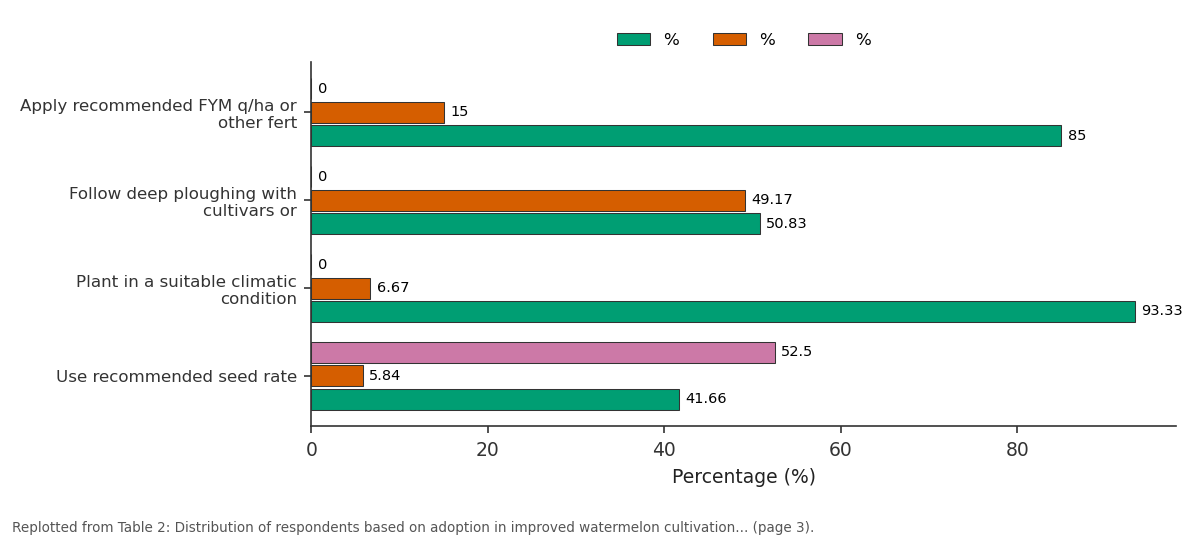
% and % and more: Apply recommended FYM... vs Follow deep ploughing... vs Plant in a suitable... vs Use recommended seed...
Replotted from Table 2 (page 3) of the original paper. Every bar is the paper's own table value.
View source evidence ↗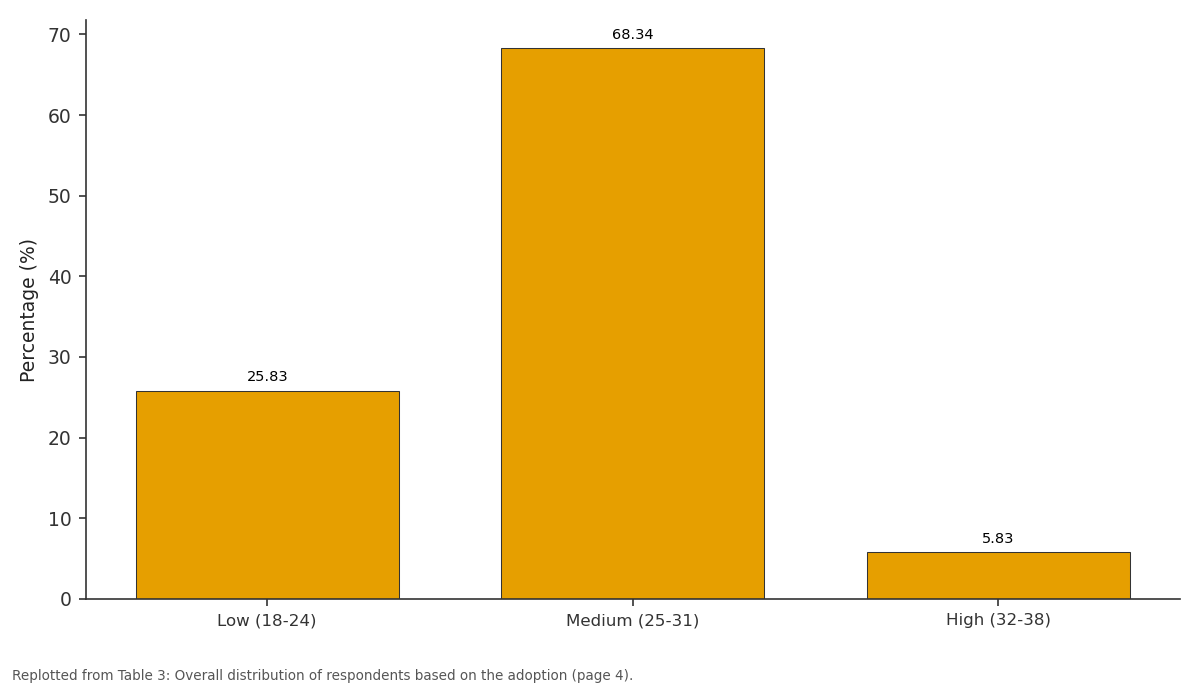
Percentage: Low (18-24) vs Medium (25-31) vs High (32-38)
Replotted from Table 3 (page 4) of the original paper. Every bar is the paper's own table value.
View source evidence ↗Figures & tables
From the original paper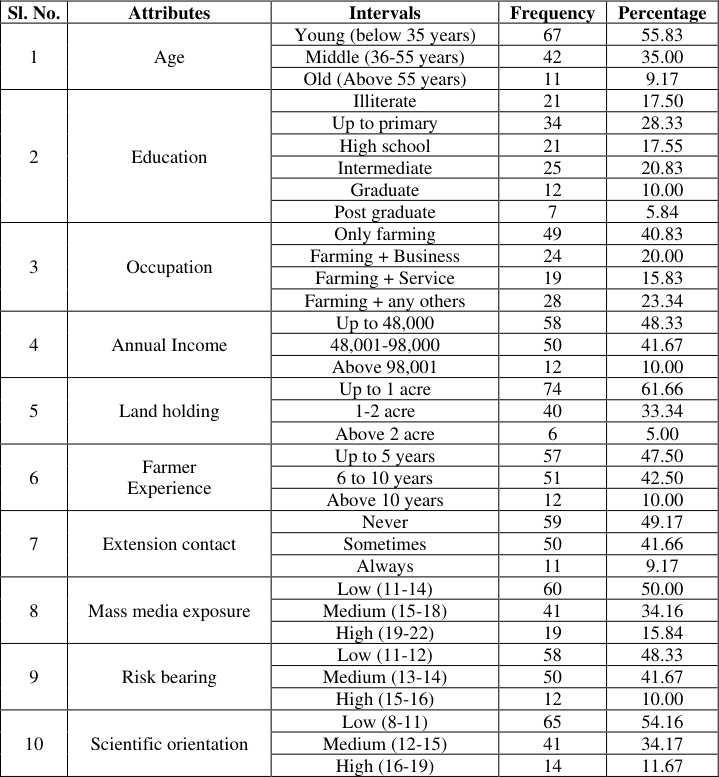 Table 1
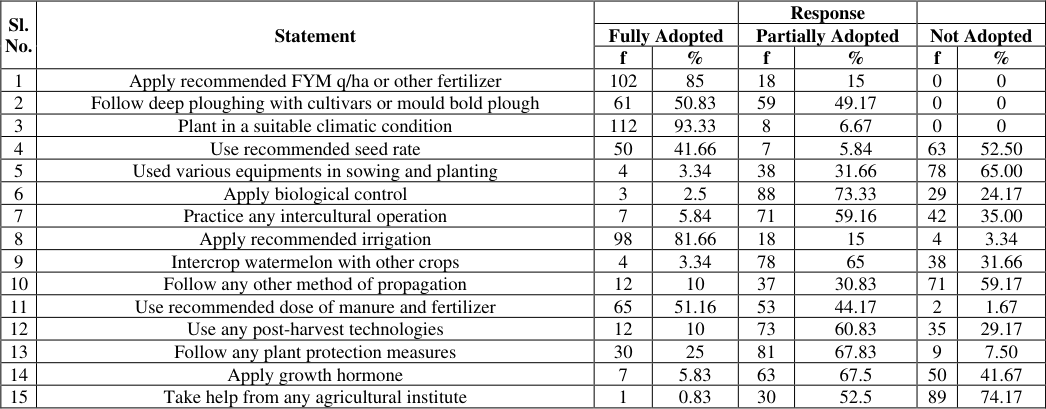 Table 2
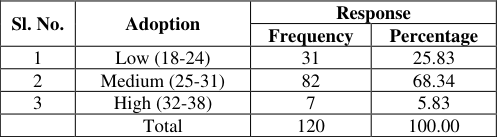 Table 3
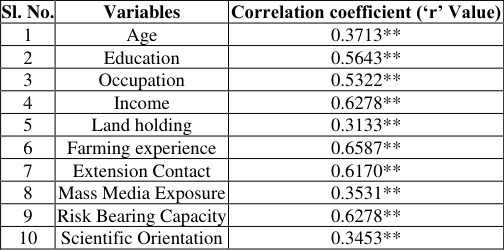 Table 4
Introduction
Watermelon (Citrullus lanatus) is a tropical fruit, belongs to family Cucurbitaceace is a flowering plant originally from south Africa. Watermelon contains vitamin C, potassium and magnesium and its 92% water and 8% sugar. They can grow with or without seeds. Watermelons are the same gourd family as squash and cucumbers. Watermelon is a large oblong or roundish fruit with a hard green or white rind often striped or variegated a sweet watery pink, yellowish, or red pulp and usually many seeds. Watermelon is an important vegetable crop of the world belonging to the family of Cucurbitaceae. Watermelon contains about 6% sugar and 92% water by weight. As with many other fruits, it is a good source of vitamin C. Watermelon is native to dry areas in tropical and subtropical Africa, south of the equator. The crop prefers hot, dry climate with mean daily temperatures of 22 C to 30 C. The optimum soil temperature for root growth is in the range of 20 C to 35 C. Fruits grown under hot, dry conditions have a high sugar content of 11% in comparison to 8% under cool, humid conditions. The crop is very sensitive to frost. Total length of the growing period ranges 80-110 days, depending on climate. The crop prefers a sandy loam soil texture with pH of 5.8 to 7.2. For high -1 production, fertilizer requirements are 80100 kg ha N, 25--1 -1 60 kg ha P and 35-80 kg ha K. The crop is moderately sensitive to salinity.
World production of watermelon is about 77.5 M t fruit from 3.1 M ha. In India, it is grown over an area of 81000 ha with total production of about 1789 thousand metric tons and average -1 yield of 22.08 t ha. In Maharashtra, it is grown over an area -1 of 660 ha with average yield in the range of 25-30 t ha. Cucurbits share about 5.6% of total vegetables production of India. In India, adoption of sustainable technology is rapidly reshaping agriculture, uplifting rural areas, and achieving food security. Watermelon is important vegetables crop having good prospects in Maharashtra state as well as country. It is an important vegetables crop grown in Solapur district due to its hardy nature and prolific bearing even in marginal lands. Its cultivation requires little care and inputs. It has nutritional value, as well as, good selling price in market and can kept for long time (Bhajipale et al., 2019) [4] . There have been significant advancements in adoption of agricultural technology, however the gaps in technology adoption in the agricultural sector still considered as a major concerned. Effective adoption of sustainable practices has become very essential to agricultural policy and practice, which can help with the restoration and management of the natural environment. It ensures a regenerative and sustainable agriculture system (Thangjam et al., 2024) [8] . Manipur is a state in Northeast India known for its rich agricultural heritage. Watermelon is one of the crops grown in Manipur, and its cultivation has potential to improve www.extensionjournal.com farmers livelihoods. Here are some points related to adoption behavior of farmers and improved practices in Manipur. In Manipur, the cultivation of watermelons is suitable for soil and climate. Watermelon productivity in Bishnupur District is constrained by use of medium-yielding cultivars. It improved cultivars were reported to be susceptible to insect disease depending on the season. The cultivation of watermelon in Bishnupur District of Manipur is mainly used by the traditional method of cultivation.
Justification of the study
The findings of the present study will help to provide scientific information on the necessary social and psychological factors that would influence the acceptability of the watermelon cultivation in large scale. It is assumed that the main objective of the farmers is to provide a steady source of cultivation of watermelon will be helpful.
Objectives
• To understand the socio-economic status of the respondents. • To understand the adoption of improved watermelon cultivation practices.
Research Methodology
Descriptive research design was used for the study. This design was followed as it is used to describe characteristics of a population or phenomenon being studied. It is a scientific method which involves observing and describing the behavior of the subject without influencing anyway. The study was conducted under Moirang Block of Bishnupur district of Manipur. There are 3 blocks in Bishnupur District of Manipur, out of which Moirang Block was selected purposively based on maximum cultivation area covered under Watermelon cultivation. There are 111 villages in Bishnupur block, out of which three villages namely Naransena, Phubala and Thinungei were selected from Moirang Block for the present study. A total number of 120 respondents who were engaged in watermelon cultivation were selected randomly for the present study.
Methods used for data collection
A pre-tested structured interview schedule focused towards the objectives of the study was developed for data collection. Survey method of data collection with the help of a pre-structured interview schedule was used. The collected data were classified, tabulated and analyzed in light of the objectives.
Data statistical analysis
The data collected from the respondents was converted to 3 point score (Likert Scale) and tabulated. The evaluation of the data and the relationship between the independent and dependent variables was done using Mean, Frequency, Percentage and Correlation. .33 per cent had their annual income of less than or up to 48,000, 41.67 per cent of the respondents had their annual income in between 48.001-98,000 and remaining 10 per cent of the respondents had their annual income more than 98,001 rupees. It was revealed that majority (61.66%) of the respondents land holding was up to 1 acre, 33.34 per cent of the respondents land holding was in between 1-2 acres and remaining 5 per cent of the respondents land holding was above 2 acres. It was found that most 47.5 per cent of the respondents had their farming experience below 5 years followed by 42.5 per cent with 6-10 years experience and remaining 10 per cent of respondents had their farming experience of more than 10 years. It was revealed that most 49.17 per cent of the respondents never contact with the extension workers, 41.66 per cent of the respondents had contact with extension worker sometimes and 9.17 per cent of the respondents had always contact with extension workers. It was revealed that majority (50%) of respondents had overall low level mass media exposure, 34.16 per cent of the respondents had medium level mass media exposure and 15.84 per cent of the respondents had high level mass media exposure. It was revealed that most 48.33 per cent of the respondents had low level risk bearing capacity followed by 41.67 per cent with medium level and 10 per cent of respondents had high level risk bearing capacity. It was found that majority (54.16%) of the respondents have low level scientific orientation followed by 34.17 per cent of the respondents with medium level and 11.67 per cent of the respondents with high level scientific orientation. Similar result is also reported by (Ahmad et. al., 2017) [1] . From the above table reveals that majority (85%) of the respondents had fully adopted the recommended FYM q/ha or other fertilizer and 15 per cent of the respondents had partially adopted on this. It was reveals that majority (50.83%) of the respondents fully followed deep ploughing with cultivars or mold bold plough and 49.17 per cent of respondents partially adopt to this. It was stated that majority (93.33%) of respondents plant their watermelon in a suitable climatic condition and 6.67 per cent of respondents partially adopt this. It founded that majority (52.5%) of the respondents do not used recommended seed rate, 41.66 per cent of the respondents fully used and 5.84 per cent of the respondents partially used on this. It stated that majority (65%) of the respondents do not used various equipments in sowing and planting, 31.66 per cent of the respondents partially used and 3.34 per cent of the respondents fully used this. It reveals that majority (73.33%) of respondents partially applied biological control, 24.17 per cent of respondents do not apply and 2.5 per cent of respondents fully apply biological control. It stated that majority (59.16%) of respondents partially practiced intercultural operation, 35 per cent of respondents do not practice and 5.84 per cent of respondents fully practiced intercultural operation. It was reveals that majority (81.66%) of the respondent fully apply recommended irrigation, 15 per cent of respondents partially apply and 3.34 per cent of respondents do not apply recommended irrigation. It found that majority (65%) of the respondents partially intercrop watermelon with other crops, 31.66 per cent of respondents do not intercrop and 3.34 per cent of respondents fully intercrop watermelon with other crops. It stated that majority (59.17%) of respondents does not follow any other method of propagation, 30.83 per cent of respondents partially follow and 10 per cent of respondents fully followed this. It reveals that majority (51.16%) of respondents fully used recommended dose of manure and www.extensionjournal.com fertilizer, 44.17 per cent of respondents partially used and 1.67 per cent of respondents do not used this. It stated that majority (60.83%) of respondents partially used post-harvest technologies, 29.17 per cent of respondents does not used and 10 per cent of respondents fully used post-harvest technologies. It found that majority (67.5%) of respondents partially follow plant protection measures, 25 per cent of respondents fully followed and 7.5 per cent of respondents do not follow on this. It reveals that majority (52.5%) of respondents partially apply growth hormones, 41.67 per cent of respondents does not apply and 5.83 per cent of respondents fully apply growth hormone. It found that majority (74.17%) of respondents does not take help from agricultural institute, 25 per cent of respondents partially took help and 0.83 per cent of respondents fully taken help from agricultural institute. [7] .
Results and Discussion Socio Economic Profile of the respondents
Results and Discussion Socio Economic Profile of the respondents
Adoption of improved watermelon cultivation practices
Adoption of improved watermelon cultivation practices
Association between Selected Independent Variables with adoption level of the respondents in improved watermelon cultivation practices:
Association between Selected Independent Variables with adoption level of the respondents in improved watermelon cultivation practices:
Fig Correlation between selected dependent variable with adoption towards improved watermelon cultivation practices
From the above table revealed that all the independent variables i.e. age, education, occupation, income, land holding, farming experience, extension contact, mass media exposure, risk bearing capacity and scientific orientation are positively and significantly correlated with adoption towards improved watermelon cultivation practice.
Conclusion
It was concluded that majority of the respondents was young age (below 35 years), most of the respondents are educated up to primary, most of the respondents' main occupation was farming, most of the respondents' had their annual income of less than or up to 48,000, majority of the respondents land holding was up to 1 acre, most of the respondents had their farming experience below 5 years and majority of respondents had overall low level mass media exposure. Majority of the respondents have medium level category of overall knowledge and adoption towards improved watermelon cultivation practices. The factors influencing the knowledge and adoption towards improved watermelon cultivation were age, education, occupation, income, land holding, farming experience, extension contact, mass media exposure, risk bearing capacity and scientific orientation are positively and significantly correlated with knowledge and adoption towards improved
Acknowledgement
www.extensionjournal.com watermelon cultivation practices. Farmers should be trained for better productivity, timely availability of organic fertilizers and proper education on plant protection measures should be ensured by the department of agriculture.
Figures and tables from the paper
| Sl. No. | Attributes | Intervals | Frequency | Percentage |
|---|---|---|---|---|
| 1 | Age | Young (below 35 years) | 67 | 55.83 |
| Middle (36-55 years) | 42 | 35.00 | ||
| Old (Above 55 years) | 11 | 9.17 | ||
| 2 | Education | Illiterate | 21 | 17.50 |
| Up to primary | 34 | 28.33 | ||
| High school | 21 | 17.55 | ||
| Intermediate | 25 | 20.83 | ||
| Graduate | 12 | 10.00 | ||
| Post graduate | 7 | 5.84 | ||
| 3 | Occupation | Only farming | 49 | 40.83 |
| Farming + Business | 24 | 20.00 | ||
| Farming + Service | 19 | 15.83 | ||
| Farming + any others | 28 | 23.34 | ||
| 4 | Annual Income | Up to 48,000 | 58 | 48.33 |
| 48,001-98,000 | 50 | 41.67 | ||
| Above 98,001 | 12 | 10.00 | ||
| 5 | Land holding | Up to 1 acre | 74 | 61.66 |
| 1-2 acre | 40 | 33.34 | ||
| Above 2 acre | 6 | 5.00 | ||
| 6 | Farmer Experience | Up to 5 years | 57 | 47.50 |
| 6 to 10 years | 51 | 42.50 | ||
| Above 10 years | 12 | 10.00 | ||
| 7 | Extension contact | Never | 59 | 49.17 |
| Sometimes | 50 | 41.66 | ||
| Always | 11 | 9.17 | ||
| 8 | Mass media exposure | Low (11-14) | 60 | 50.00 |
| Medium (15-18) | 41 | 34.16 | ||
| High (19-22) | 19 | 15.84 | ||
| 9 | Risk bearing | Low (11-12) | 58 | 48.33 |
| Medium (13-14) | 50 | 41.67 | ||
| High (15-16) | 12 | 10.00 | ||
| 10 | Scientific orientation | Low (8-11) | 65 | 54.16 |
| Medium (12-15) | 41 | 34.17 | ||
| High (16-19) | 14 | 11.67 |
Table text extracted from the original PDF; superscript letters are shown inline. The original table image is below.
View original table image
| Sl. No. | Statement | — | — | Response | — | — | — |
|---|---|---|---|---|---|---|---|
| Fully Adopted | Partially Adopted | Not Adopted | |||||
| f | % | f | % | f | % | ||
| 1 | Apply recommended FYM q/ha or other fertilizer | 102 | 85 | 18 | 15 | 0 | 0 |
| 2 | Follow deep ploughing with cultivars or mould bold plough | 61 | 50.83 | 59 | 49.17 | 0 | 0 |
| 3 | Plant in a suitable climatic condition | 112 | 93.33 | 8 | 6.67 | 0 | 0 |
| 4 | Use recommended seed rate | 50 | 41.66 | 7 | 5.84 | 63 | 52.50 |
| 5 | Used various equipments in sowing and planting | 4 | 3.34 | 38 | 31.66 | 78 | 65.00 |
| 6 | Apply biological control | 3 | 2.5 | 88 | 73.33 | 29 | 24.17 |
| 7 | Practice any intercultural operation | 7 | 5.84 | 71 | 59.16 | 42 | 35.00 |
| 8 | Apply recommended irrigation | 98 | 81.66 | 18 | 15 | 4 | 3.34 |
| 9 | Intercrop watermelon with other crops | 4 | 3.34 | 78 | 65 | 38 | 31.66 |
| 10 | Follow any other method of propagation | 12 | 10 | 37 | 30.83 | 71 | 59.17 |
| 11 | Use recommended dose of manure and fertilizer | 65 | 51.16 | 53 | 44.17 | 2 | 1.67 |
| 12 | Use any post-harvest technologies | 12 | 10 | 73 | 60.83 | 35 | 29.17 |
| 13 | Follow any plant protection measures | 30 | 25 | 81 | 67.83 | 9 | 7.50 |
| 14 | Apply growth hormone | 7 | 5.83 | 63 | 67.5 | 50 | 41.67 |
| 15 | Take help from any agricultural institute | 1 | 0.83 | 30 | 52.5 | 89 | 74.17 |
Table text extracted from the original PDF; superscript letters are shown inline. The original table image is below.
View original table image
| Sl. No. | Adoption | Response | — |
|---|---|---|---|
| Frequency | Percentage | ||
| 1 | Low (18-24) | 31 | 25.83 |
| 2 | Medium (25-31) | 82 | 68.34 |
| 3 | High (32-38) | 7 | 5.83 |
| Total | 120 | 100.00 |
Table text extracted from the original PDF; superscript letters are shown inline. The original table image is below.
View original table image
| Sl. No. | Variables | Correlation coefficient (‘r’ Value) |
|---|---|---|
| 1 | Age | 0.3713** |
| 2 | Education | 0.5643** |
| 3 | Occupation | 0.5322** |
| 4 | Income | 0.6278** |
| 5 | Land holding | 0.3133** |
| 6 | Farming experience | 0.6587** |
| 7 | Extension Contact | 0.6170** |
| 8 | Mass Media Exposure | 0.3531** |
| 9 | Risk Bearing Capacity | 0.6278** |
| 10 | Scientific Orientation | 0.3453** |
Table text extracted from the original PDF; superscript letters are shown inline. The original table image is below.
View original table image
References
7 in the original paper- Ahmad A, Prasad RL, Kumar D, Singh N, VM Prasad, Paul A. An economic analysis of production of watermelon in Allahabad District, Uttar Pradesh, India. Int J Adv Educ Res. 2017;2(4):206-210.
- Begum MEA, Hossain MI, Mainuddin M. Climate change perceptions, determinants, and impact of adaptation strategies on watermelon farmers in the saline coastal areas of Bangladesh. Lett Spat Resource Sci. 2023;16(19).
- Bhajipale DD, Kharde PB, Karangami RS. Knowledge of improved cultivation practices of watermelon by the respondents. Int J Chem Stud. 2020;8(1):1157-1160.
- Kavinilavan R, Ramchandra. Economic analysis of cost of production and profitability of watermelon in Thiruvananthapuram District of Tamil Nadu, India. J Exp Agric Int. 2023;45(8):54-58.
- Lothungbeni J, Bose DK, Syed HM. Adoption behavior of farmers towards off-season improved cucumber cultivation practices in Wokha District of Nagaland. Int J Adv Agric Sci Technol. 2021;8(10):84-93.
- Sarker B, Shankar M, Sayem SM. Resource-use efficiency in watermelon production in the Patuakhali District, Bangladesh. Asian J Agric Hort Res. 2018;1(3):1-8.
- Thangjam B, Jha KK, Sharma S, Singh H. Factors affecting the adoption of sustainable agricultural practices in Manipur. Indian J Ext Edu. 2024;60(2):6670.