
Research article · 2024 · Full text
International Journal of Biology SciencesExploring genetic traits among residents of Bharatpur, district Akola, Maharashtra
Volume 6(2) · Pages 30–32 · DOI: 10.33545/26649926.2024.v6.i2a.228 ↗
Research areasLivestock Management and Performance Improvement
Abstract
Author-writtenGenetic traits are characteristics or features that, can be determined by an individual's genetic makeup (genotype) and are passed down from parents to offspring through inheritance. Genetic traits play a pivotal role in shaping the physical characteristics of individuals. These traits are determined by the inheritance of alleles from parents to offspring. Through genetic recombination and assortment, unique combinations of alleles are generated, contributing to the vast diversity observed within populations. These traits are encoded in an individual's DNA and can be inherited in different ways, including through dominant, recessive, or polygenic inheritance. This study delves into the diversity of genetic traits among residents of Bharatpur Village, located in Dist. Akola, Maharashtra, aims to understand the diversity among its people. A total of 300 individuals from Bharatpur Village participated in this cross-sectional study, representing diverse age groups. Traits such as eye color, hair texture, and other heritable characteristics were assessed. The study reveals patterns of inheritance, including dominant, recessive, and polygenic traits, shedding light on the genetic diversity present among the individuals.
Summary
Source-checkedPlain-language reading of the full paper, prepared with AI and checked against the text. Each point links to the authors' own words.
Why it matters
- Genetic traits are features determined by an individual's genotype and are inherited from parents to offspring. View evidence ↗
- Indian populations are of significant scientific interest due to their high level of genetic complexity. View evidence ↗
- Patterns of genetic diversity in a community can provide insights into its population history and the impact of demographic events. View evidence ↗
The question
- The study aimed to explore and understand the genetic diversity and traits among residents of Bharatpur Village in the Akola district of Maharashtra. View evidence ↗
- The researchers also sought to determine how specific genetic traits are distributed and how prevalent they are within the village population. View evidence ↗
What they did
- The study involved a survey of 300 individuals from Bharatpur village, with ages ranging from 1 to 75 years. View evidence ↗
- Data on 28 different genetic traits were collected using a questionnaire format. View evidence ↗
- The researchers used PTC paper for tasting tests, observed physical traits like earlobe shape and eye color, and asked participants to perform activities such as tongue rolling and ear wiggling. View evidence ↗
What they found
- Brown eyes were more common than black eyes, with 213 individuals having brown eyes compared to 87 with black eyes. View evidence ↗
- Right-handedness was dominant in the population, with 286 individuals being right-handed and only 14 being left-handed. View evidence ↗
- More individuals were unable to taste PTC (168) than those who could (132). View evidence ↗
- Hypertrichosis and red/green color blindness were not found in the population, while traits like polydactyly and cleft chin were very rare. View evidence ↗
What it means
- The authors conclude that the prevalence of these traits in Bharatpur village is likely influenced by specific genetic or environmental factors. View evidence ↗
- The authors state that further research is needed to explore the specific genetic, cultural, or environmental factors that contribute to the observed traits. View evidence ↗
Visual summary
2 visualsIllustrations explain the paper; charts are replotted from the paper's own table values.
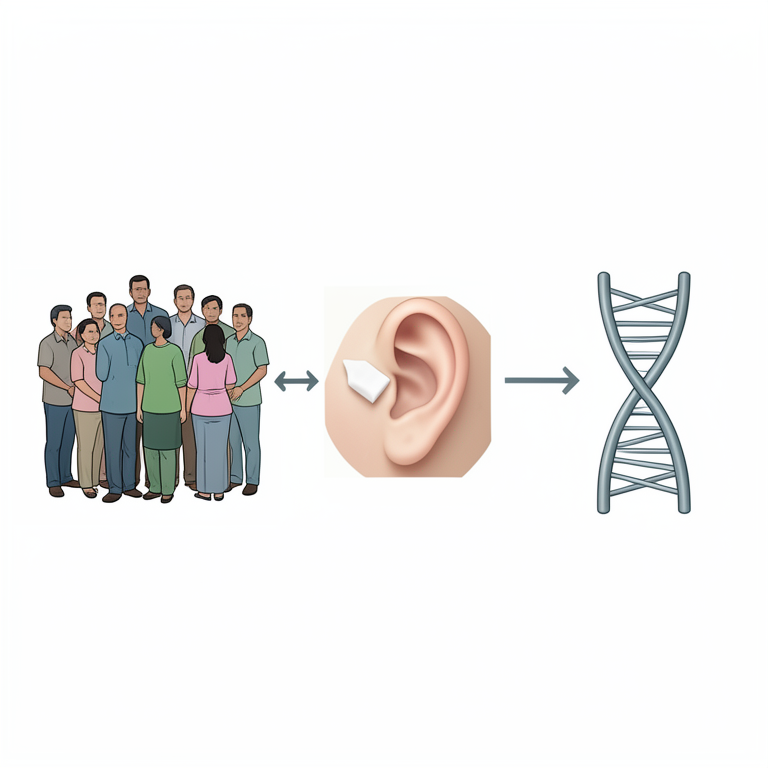
Study Workflow
AI-generated conceptual illustration (Residents of Bharatpur village, Maharashtra). It explains the idea and does not show study data.
View source evidence ↗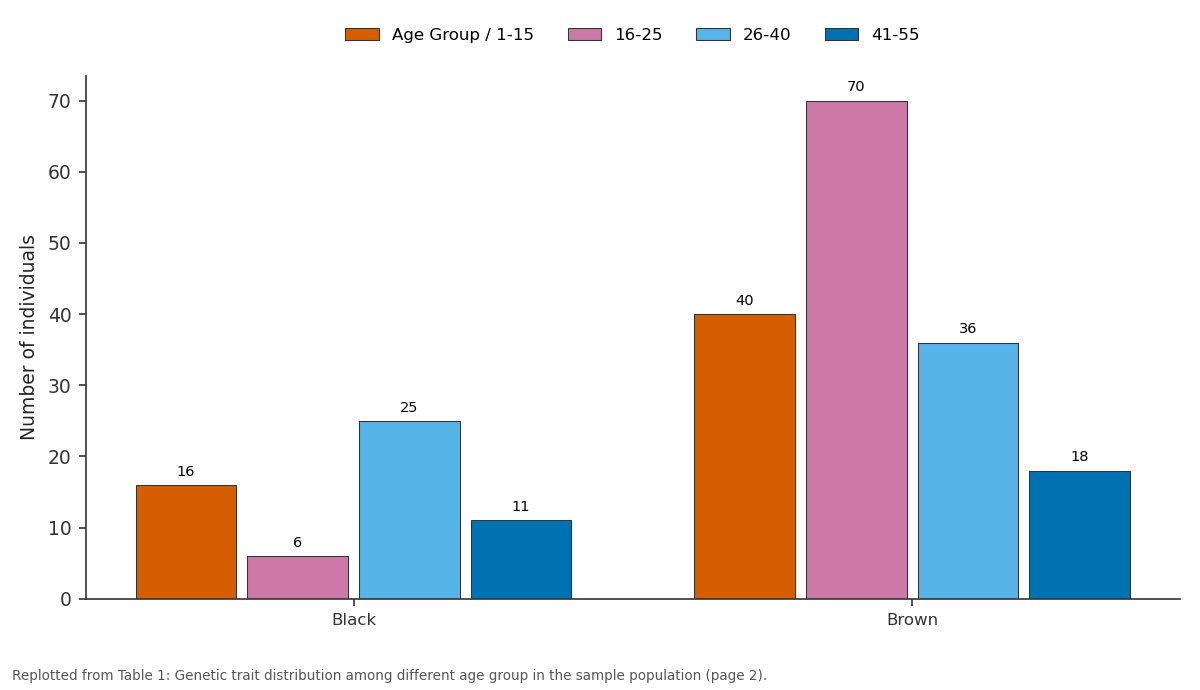
Age Group / 1-15 and 16-25 and more: Black vs Brown
Replotted from Table 1 (page 2) of the original paper. Every bar is the paper's own table value.
View source evidence ↗Figures & tables
From the original paper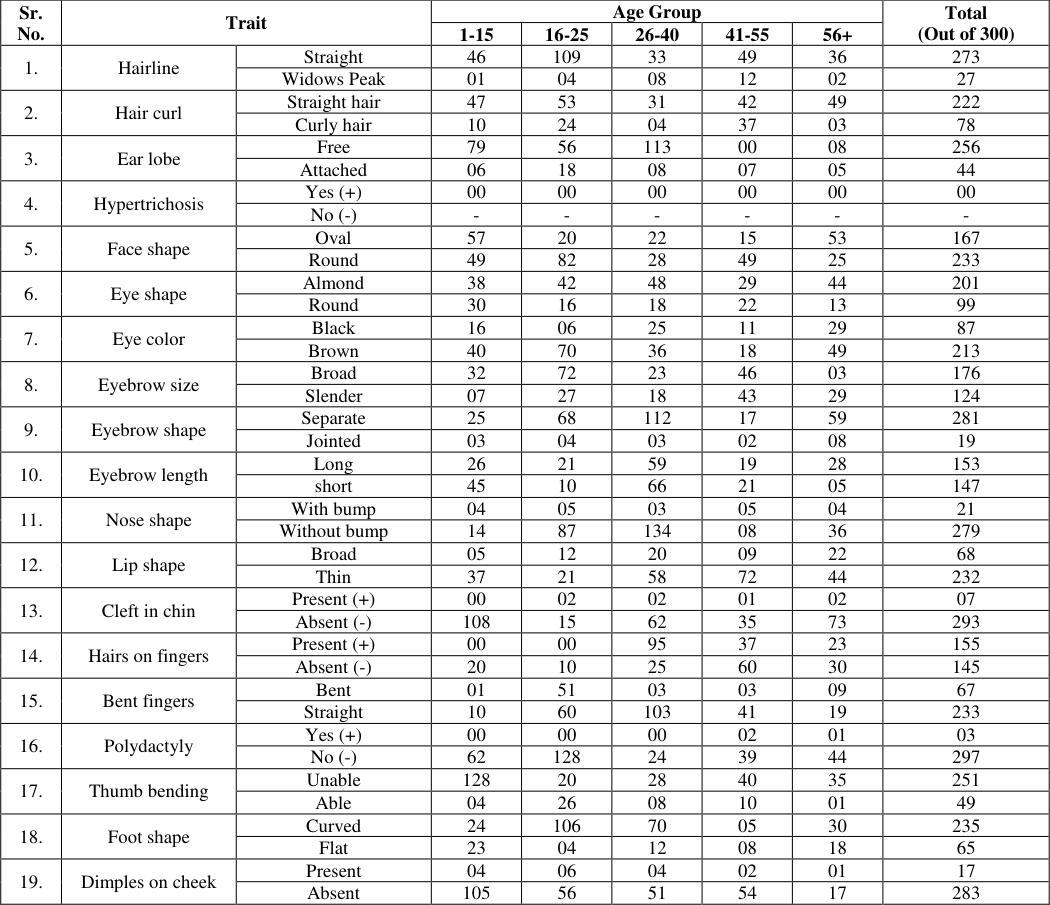 Table 1
Introduction
Population genetics is a field within genetics that investigates genetic variance in populations (Noreen and Mardon, 2021) [2] . Population genetic studies leverage observable traits to explore genetic diversity and evolutionary processes. Indian populations endowed with unparalleled genetic complexity have received a great deal of attention from scientists the world over (Kashyap V.K. et al., 2006) [3] . Genetic traits play a crucial role in the diversity of life on Earth and are the basis for evolution through natural selection. Genetic traits are characteristics or features of an organism that are determined by the genetic information inherited from its parents. These traits are encoded in the organism's DNA, which is composed of genes. Genes are sequences of DNA that contain instructions for building proteins, which in turn play various roles in the structure, function, and development of an organism. According to Rostand J. and Tetry A. (1964) [9] , the human population offers a unique chance to investigate the morphogenetic variance among endogamous populations residing in various ecological and geographical conditions. In genetics, alleles are different forms of a gene that can produce distinct variations in a particular trait. Dominant alleles "override" the expression of recessive alleles, meaning they determine the phenotype (observable trait) even in the presence of a recessive allele. Recessive alleles are expressed only when there is no dominant allele present to mask their expression. The frequency of a character in a population is related to whether its phenotypic effect is favourable or unfavourable. The aggregate genomic variety of a community is influenced by significant demographic events, and patterns of genetic diversity provide information about population history. (Lynn B. Jorde, 2003) [6] . According to Fred Gifford (1990) [1] , for any trait, there will be both genetic and environmental factors whose alteration would affect the trait. Genetic traits can be either inherited or acquired through mutations. Inherited traits are passed down from parent to offspring through the process of reproduction. Acquired genetic traits result from mutations that occur in an individual's DNA during their lifetime. These mutations can be caused by various factors such as exposure to radiation, chemicals, or viruses.
Acquired genetic traits may or may not be passed down to future generations, depending on whether they occur in cells that give rise to gametes (sperm or eggs). The main aim of the present study was to explore the genetic traits present among the residents of Bharatpur Village, Dist. Akola, Maharashtra, and understand the genetic diversity within this population. Also to analyze the genetic data to determine the prevalence and distribution of specific genetic traits within the population of Bharatpur village.
Materials and Methods
A comprehensive survey of 300 individuals was conducted in Bharatpur village to study various genetic traits in humans. Participants ranging from 1 year to 75 years old were enrolled, including children and babies, for comparison across different age groups. The survey utilized a questionnaire format, collecting data on 28 traits while also capturing information such as name, age, qualification, contact number, and signatures. Traits examined encompassed a wide range, including eye color, size, shape, ear shape, nose shape, lip shape, and tasting ability using PTC paper. Additionally, participants were queried about inherited traits in their families. Various materials were employed, including PTC paper for tasting ability and activities like hand clasping, rolling tongue, wiggling ears, and bending thumb to compare traits. External observations were made on traits such as earlobe shape, eye color, and foot shape. The data collected from each survey were analysed to understand the severity of traits across different age groups, providing valuable insights into the genetic makeup of the Bharatpur village population.
The following 28 genetic traits were included in the study Hair line, hair curl, ear lobe, hypertrichosis, face shape, eye shape, eye color, eyebrow size, eyebrow shape, eyebrow length, nose shape, lip shape, cleft in the chin, hairs on fingers, bent finger, polydactyly (extra fingers or toes), thumb bending, foot shape, presence of dimple, ability to roll tongue, ear wiggle capability, handedness, presence of freckles, hand clasping pattern, color blindness, PTC tasting ability, pattern baldness, eyelash length. [8] while studies in anthropology and evolutionary biology have highlighted that certain physical characteristics may have evolved in response to environmental pressures or as signals of mate quality, such as nose shape and lip shape. (Shepherd, 2010; Lieberman, 2013) [11,5] . 300 individuals from different age groups among random populations were observed for morphogenetic traits. The observations from the study of 300 individuals in Bharatpur village indicate a notable absence or low prevalence of certain morphogenetic characteristics within the population. Hypertrichosis and red/green color blindness were completely absent; while cleft in the chin, polydactyly, freckles, and dimples were reported to be very rare. A few traits such as widow's peak, curly hair, attached earlobe, and wiggling ears were found and compared to what might be expected in a random population sample. These observations suggest potential genetic or environmental factors at play within the population of Bharatpur village that influence the prevalence of these morphogenetic traits.
Observation and Result
Observation and Result
Conclusion
The present research served as a valuable resource for exploring the multifaceted nature of human physical traits and their variations across different age groups. By considering the contributions of genetics, environment, and culture, we can gain deeper insights into the rich tapestry of human diversity and the dynamic processes that shape our outward appearance. However Further research could explore the underlying genetic, cultural, or environmental factors contributing to these observations.
Figures and tables from the paper
| Sr. No. | Trait | — | Age Group | — | — | — | — | Total (Out of 300) |
|---|---|---|---|---|---|---|---|---|
| 1-15 | 16-25 | 26-40 | 41-55 | 56+ | ||||
| 1. | Hairline | Straight | 46 | 109 | 33 | 49 | 36 | 273 |
| Widows Peak | 01 | 04 | 08 | 12 | 02 | 27 | ||
| 2. | Hair curl | Straight hair | 47 | 53 | 31 | 42 | 49 | 222 |
| Curly hair | 10 | 24 | 04 | 37 | 03 | 78 | ||
| 3. | Ear lobe | Free | 79 | 56 | 113 | 00 | 08 | 256 |
| Attached | 06 | 18 | 08 | 07 | 05 | 44 | ||
| 4. | Hypertrichosis | Yes (+) | 00 | 00 | 00 | 00 | 00 | 00 |
| No (-) | - | - | - | - | - | - | ||
| 5. | Face shape | Oval | 57 | 20 | 22 | 15 | 53 | 167 |
| Round | 49 | 82 | 28 | 49 | 25 | 233 | ||
| 6. | Eye shape | Almond | 38 | 42 | 48 | 29 | 44 | 201 |
| Round | 30 | 16 | 18 | 22 | 13 | 99 | ||
| 7. | Eye color | Black | 16 | 06 | 25 | 11 | 29 | 87 |
| Brown | 40 | 70 | 36 | 18 | 49 | 213 | ||
| 8. | Eyebrow size | Broad | 32 | 72 | 23 | 46 | 03 | 176 |
| Slender | 07 | 27 | 18 | 43 | 29 | 124 | ||
| 9. | Eyebrow shape | Separate | 25 | 68 | 112 | 17 | 59 | 281 |
| Jointed | 03 | 04 | 03 | 02 | 08 | 19 | ||
| 10. | Eyebrow length | Long | 26 | 21 | 59 | 19 | 28 | 153 |
| short | 45 | 10 | 66 | 21 | 05 | 147 | ||
| 11. | Nose shape | With bump | 04 | 05 | 03 | 05 | 04 | 21 |
| Without bump | 14 | 87 | 134 | 08 | 36 | 279 | ||
| 12. | Lip shape | Broad | 05 | 12 | 20 | 09 | 22 | 68 |
| Thin | 37 | 21 | 58 | 72 | 44 | 232 | ||
| 13. | Cleft in chin | Present (+) | 00 | 02 | 02 | 01 | 02 | 07 |
| Absent (-) | 108 | 15 | 62 | 35 | 73 | 293 | ||
| 14. | Hairs on fingers | Present (+) | 00 | 00 | 95 | 37 | 23 | 155 |
| Absent (-) | 20 | 10 | 25 | 60 | 30 | 145 | ||
| 15. | Bent fingers | Bent | 01 | 51 | 03 | 03 | 09 | 67 |
| Straight | 10 | 60 | 103 | 41 | 19 | 233 | ||
| 16. | Polydactyly | Yes (+) | 00 | 00 | 00 | 02 | 01 | 03 |
| No (-) | 62 | 128 | 24 | 39 | 44 | 297 | ||
| 17. | Thumb bending | Unable | 128 | 20 | 28 | 40 | 35 | 251 |
| Able | 04 | 26 | 08 | 10 | 01 | 49 | ||
| 18. | Foot shape | Curved | 24 | 106 | 70 | 05 | 30 | 235 |
| Flat | 23 | 04 | 12 | 08 | 18 | 65 | ||
| 19. | Dimples on cheek | Present | 04 | 06 | 04 | 02 | 01 | 17 |
| Absent | 105 | 56 | 51 | 54 | 17 | 283 |
Table text extracted from the original PDF; superscript letters are shown inline. The original table image is below.
View original table image
References
7 in the original paper- Gifford F. Genetic traits. Biol Philos. 1990;5:327-347. Netherlands: Kluwer Academic Publishers.
- Noreen K, Mardon AA. The inheritance of traits: From genetics to heredity. Canada: Golden Meteorite Press; 2021. ISBN: 978-1-77369-260-269.
- Kashyap VK, Gujral R, Sitalaximi T. Tracing the genetic imprints of caste origins in India. Hum Genet. 2006;118(6):694-703. DOI:10.1007/s00439-005-0079-5
- Kulkarni SS, Chaudhari R. Genetic diversity and population structure of Maharashtra (India) populations based on 15 autosomal STR markers. Int J Legal Med. 2017;131(3):609-610. DOI:10.1007/s00414-016-1507-5
- Polderman TJC, Benyamin B, De Leeuw CA, Sullivan PF, Van Bochoven A, Visscher PM, et al. Metaanalysis of the heritability of human traits based on fifty years of twin studies. Nat Genet. 2015;47(7):702-709.
- Kadam SS, Gade MB. Survey of dominant and recessive character in Sonai College. J Emerg Technol Innov Res. 2021;8(12).
- Shepherd J. The origins of facial diversity. Sci Am. 2010;302(2):76-81.