
Research article · 2024 · Full text
International Journal of Advanced Chemistry ResearchMathematical kinetic and thermodynamic study of adsorption of chloride I by alkaline soil using batch method
Volume 6(2) · Pages 35–39 · DOI: 10.33545/26646781.2024.v6.i2a.225 ↗
Research areasAdsorption and biosorption for pollutant removal
Abstract
Author-writtenIn alkaline soil chloride ion may be as counter ion of calcium and sodium while may be in excess because of water logging and because of input intentionally and having high anion exchange capacity in most of study area. It may be high or low leached or not in order to affect the quality of soil, surface water and ground water. In this way the aim of this work was to study the adsorption of on to the soil sample [ss] with different amount of adsorbate in the temperature range of 293K to 313K by using batch process method. Rate of adsorption was found nearest to Ist order reaction. Adsorption and desorption process run as complementary process gave equilibrium constant which tends to give approach of thermodynamics parameters like enthalpy change, Gibbs free energy change, entropy changes respectively with the help of mathematical modeling the kinetics and thermodynamic parameter were interpreted to make ease to understood with clear predictions, distribution classification and assumptions of the entire data's mutual relation.
Summary
Source-checkedPlain-language reading of the full paper, prepared with AI and checked against the text. Each point links to the authors' own words.
Why it matters
- In alkaline soils, chloride ions can act as counter ions for sodium and calcium, and may accumulate due to intentional input or water logging. View evidence ↗
- Chloride ions are small and easily leached, which can impact the quality of surface water, ground water, and soil. View evidence ↗
- In regions with low rainfall, evapotranspiration can concentrate salts because leaching is insufficient to remove them from soil profiles. View evidence ↗
What they did
- The experimental setup involved a glass column 60cm long and 3cm in diameter, packed with 60g of soil. View evidence ↗
What they found
- The rate of chloride adsorption was found to be closest to a first-order reaction. View evidence ↗
- Positive entropy changes were observed, suggesting increased randomness of the unadsorbed portion and a slight increase in the adsorbed part ratio. View evidence ↗
What it means
- The authors conclude that these kinetic and thermodynamic studies help determine the efficiency of ion adsorption and leaching, which clarifies the soil's capacity to retain or release metals and their contamination limits. View evidence ↗
Visual summary
2 visualsIllustrations explain the paper; charts are replotted from the paper's own table values.
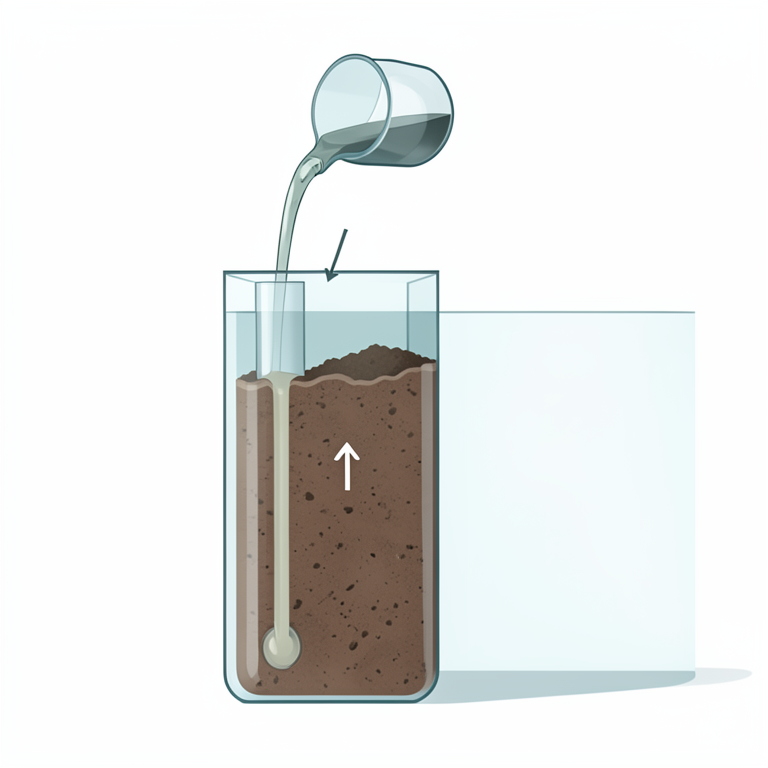
Experimental Setup Diagram
AI-generated conceptual illustration (alkaline soil in a glass column). It explains the idea and does not show study data.
View source evidence ↗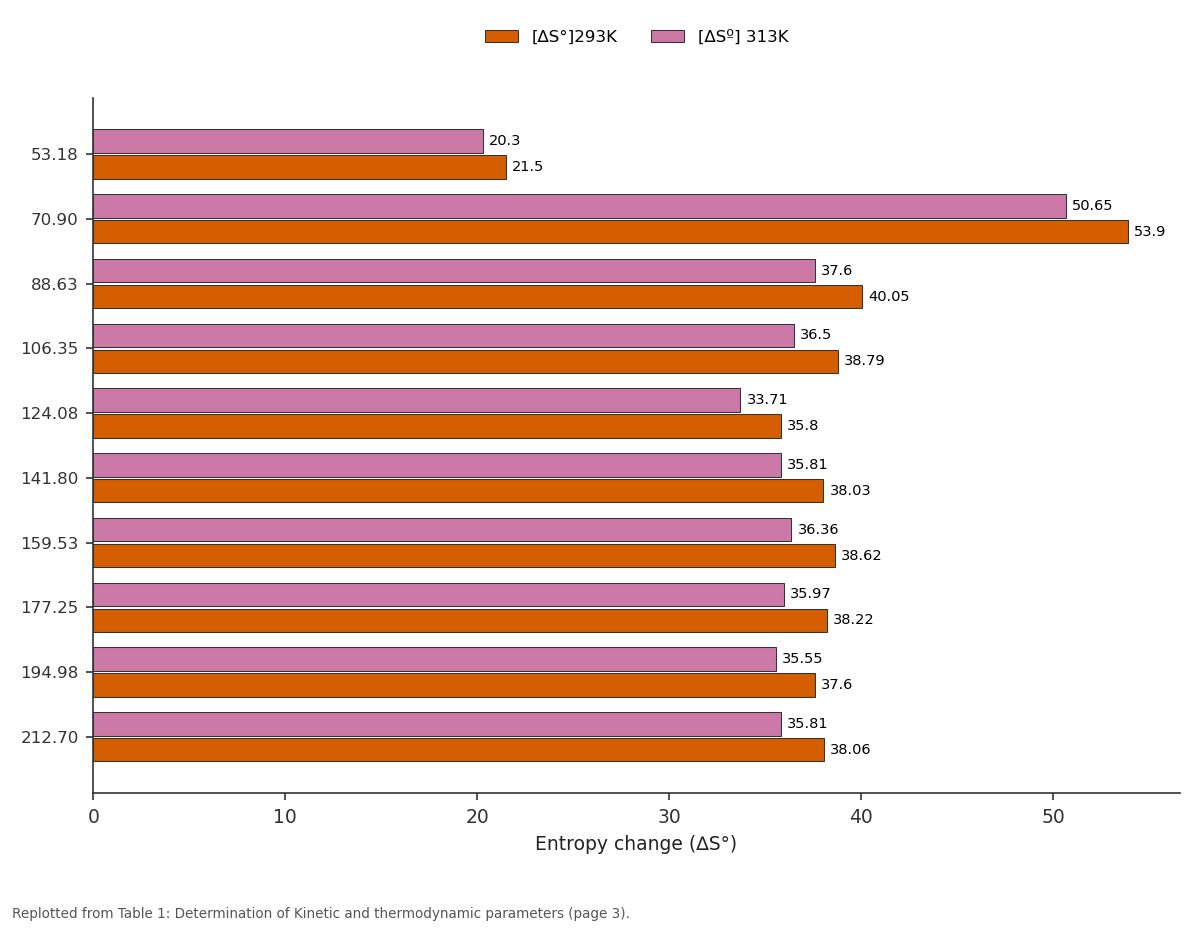
[∆S°]293K and [∆Sº] 313K: 53.18 vs 70.90 vs 88.63 vs 106.35 vs 124.08
Replotted from Table 1 (page 3) of the original paper. Every bar is the paper's own table value.
View source evidence ↗Figures & tables
From the original paper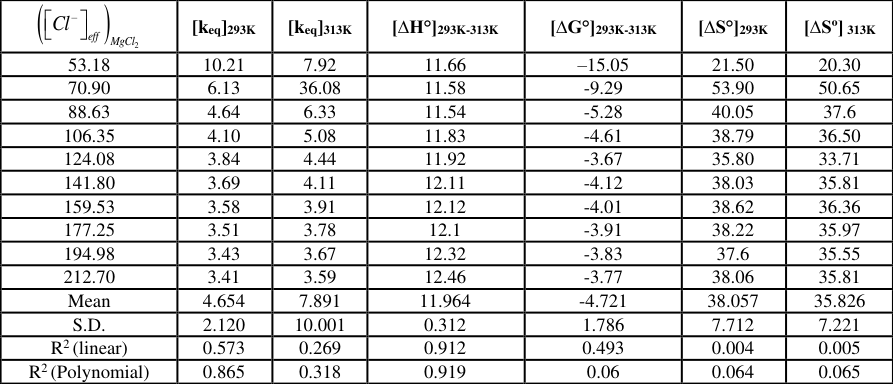 Table 1
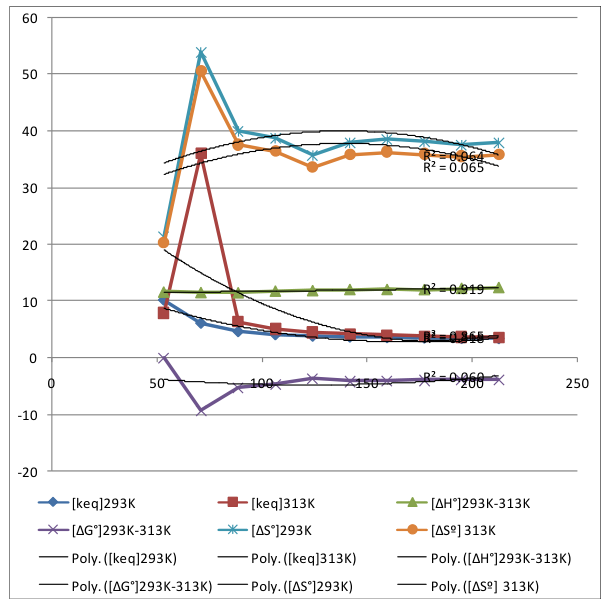 Figure 1
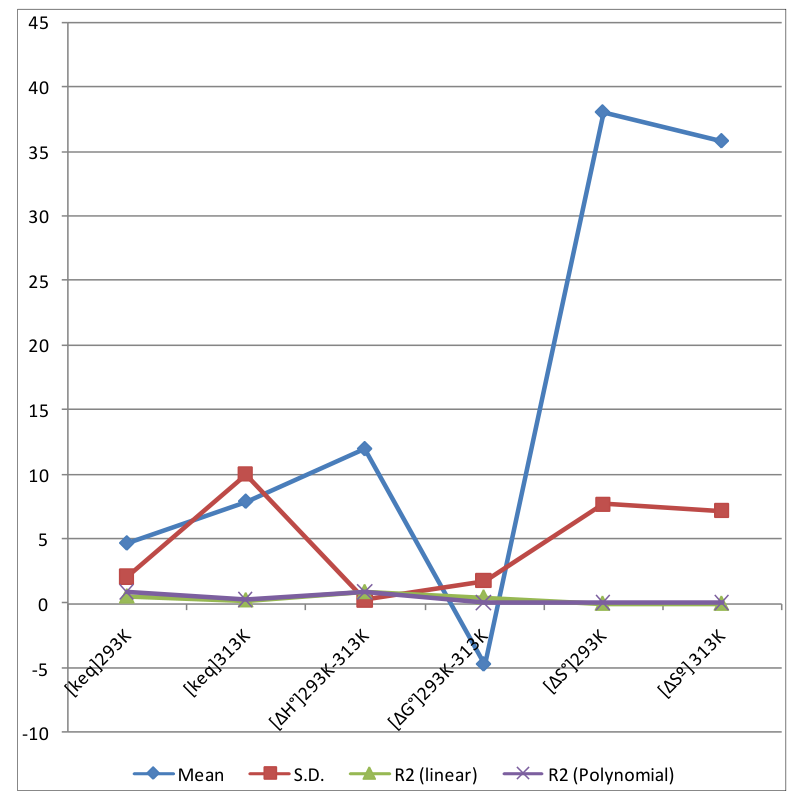 Figure 2
Introduction
Although study area is affected with alkalinity but the salinity buildup also vary with soil type [1][2][3][4] . Besides excess of chloride ion input can be leached down easily [5][6] . In area where rainfall is low, soil leaching is usually insufficient to completely remove salts from soil profiles and may be concentrated more by evapotranspiration processes [7][8] . Alkali soils owe their unfavorable physico-chemical properties mainly to the dominating presence of particular salt which causes the soil to swell and difficult to clarify or settle [9][10] . Although chloride plays important role in anion exchange capacity and because of its small size it is easily leached consequently affecting the quality of soil and ground water even surface water [11, 12] . So it was keened to study the chloride leaching kinetics and thermodynamics factors to clarify the adsorption or desorption of ion having relation with cofactors like other counter ions, competitor ions, climatic or seasonally changes or temperature changes [5,6] . A very abundant salt MgCl 2 was selected to study the adsorption or desorption process through the glass column method and using by batch process method. Using by batch process method various parameters studied in a range of temperature 293 313
by adding various amount of salt. In order to understand adsorption efficiency of sodium adsorption kinetic studies were done which describe residential or uptake time of solute on solvent at the solid solution interface [3,4] . The kinetical parameters can scale up studies of soil remediation process connecting optimum operational conditions of chloride predicting by important directional or non-directional operations of the ion adsorption and remedial operations [4][5][6] .
As temperature can make two types effects on the adsorption process as physical adsorption and chemical adsorption process which are opposite qualities in the reference of increasing temperature. So only temperature changes are not sufficient parameter to determine the type of adsorption. (9) Thus enthalpy
were too observed and calculated of each experiment to know whether the reactions are spontaneous or non spontaneous or feasible. º G was found negative (10) while º H was distinct positive (11) .
Materials and Methods
For the estimation of chloride -Cl amount or concentration during adsorption or desorption process on the soil sample [SS], the soil sample were collected, dried and sieved for removing unwanted particles, from study region. Length 60cm and diameter of 3cm of glass column prepared and gently packed or filled with 60gm soil. A fixed amount of salt as effluent
Gibbs energy by the following equations
were calculated consequently in order to know reaction feasibility or spontaneity. The treatment of calculation of obtained data is based on the some parameter as defined below.
JK mol
with the addition of various amount of salt
with the addition of various amount of salt indicate reaction during chloride ions adsorption is how much spontaneous process. With increasing temperature adsorption was too found in increasing order as particles potential energy too increases thus enthalpy changes were too noticed increasing because of endothermic reaction entropy changes were observed positive which indicate the randomness of unadsorbed part and slighlty increasing of adsorbed part ratio. It is well known absolute. Entropy is not inversely proportional to absolute temperature which increases with temperature because of increasing atomic vibration and the disorder of system but change in entropy in a constant temperature heat transfer does make it seems like entropy is inversely proportional to temperature based on the equation, but it actually only means that the amount of entropy change is less at higher temperature for a given heat transfer according to formulae º
Figures and tables from the paper
| Cl– eff MgCl2 | [keq]293K | [keq]313K | [∆H°]293K-313K | [∆G°]293K-313K | [∆S°]293K | [∆Sº] 313K |
|---|---|---|---|---|---|---|
| 53.18 | 10.21 | 7.92 | 11.66 | –15.05 | 21.50 | 20.30 |
| 70.90 | 6.13 | 36.08 | 11.58 | -9.29 | 53.90 | 50.65 |
| 88.63 | 4.64 | 6.33 | 11.54 | -5.28 | 40.05 | 37.6 |
| 106.35 | 4.10 | 5.08 | 11.83 | -4.61 | 38.79 | 36.50 |
| 124.08 | 3.84 | 4.44 | 11.92 | -3.67 | 35.80 | 33.71 |
| 141.80 | 3.69 | 4.11 | 12.11 | -4.12 | 38.03 | 35.81 |
| 159.53 | 3.58 | 3.91 | 12.12 | -4.01 | 38.62 | 36.36 |
| 177.25 | 3.51 | 3.78 | 12.1 | -3.91 | 38.22 | 35.97 |
| 194.98 | 3.43 | 3.67 | 12.32 | -3.83 | 37.6 | 35.55 |
| 212.70 | 3.41 | 3.59 | 12.46 | -3.77 | 38.06 | 35.81 |
| Mean | 4.654 | 7.891 | 11.964 | -4.721 | 38.057 | 35.826 |
| S.D. | 2.120 | 10.001 | 0.312 | 1.786 | 7.712 | 7.221 |
| R2 (linear) | 0.573 | 0.269 | 0.912 | 0.493 | 0.004 | 0.005 |
| R2 (Polynomial) | 0.865 | 0.318 | 0.919 | 0.06 | 0.064 | 0.065 |
Table text extracted from the original PDF; superscript letters are shown inline. The original table image is below.
View original table image
References
11 in the original paper- Barman S, Kar S, Mukhopadhyay A, Das S, Ghosh S. A study on leaching behavior of Na, Ca and K using column batch test. World Academy of Science, Engineering and Technology. 2012;70:1-6.
- Cai H, Guo D. Phytotoxicity of salt in composted sewage and correlation with NaCl, calcium nitrate and magnesium nitrate. J Plant Nutr. 2011;34(12):1788-1796.
- Dahiya IS, Khera KL, Leaching of soluble salt during infiltration and redistribution. Irrig Sci. 1984;5:15-24.
- Hussain K, Ahsan S, Aziz S, Hussain N. Irradiation of water with electron beam as a key to sustainable smart/green cities -A review. Appl Water Sci. 2018;8(1):6.
- Larsen D, Smith R, Wilson G. Low level soluble chloride extraction in soil. Method X. 2020;7(6):100967.
- Muneer M, Oades JM. The role of Ca-organic interaction in soil aggregate stability -two field studies with C-14 labelled straw, CaCO 3 , and CaSO 4 •2H 2 O. Aust J Soil Res. 1989;27(2):401-409.
- Shahrukh M, Ali A, Babar M, Farooq S, Ahmed A. Evaluating non-equilibrium solute transport through four soils of Pakistan using a Hydrus model and nonparametric indices. Soil Sci Soc Am J. 2018;82(5):1071-1084.
- Tazeh S, Rahmanian R, Yazdani M, Jahangiri M. Effects of two organic amendments on EC, SAR and soluble ion concentration in a saline-sodic soil. Int. J Biosci. 2013;3(9):55-68.
- Wright IC, Foster S, Whiteley G. A review of radioactive isotopes and other residence time tracers in understanding groundwater recharge: Possibilities, challenges, and limitations. J Hydrol. 2017;5(5):797-811.
- Yihdego Y, Webb JA. Use of a conceptual hydrogeological model and a time-variant water budget analysis to determine controls on salinity in Lake Burrumbeet in Southeast Australia. Environ Earth Sci. 2015;73(4):1587-1600.
- Zhou Z, Zhang X, Zhao Y. Simulation of the properties of MgO-MgCl2-H2O system by thermodynamic method. Cem Concr Res. 2015;68:105-111.