
Research article · 2024 · Full text
International Journal of Agriculture Extension and Social DevelopmentA study on problems and suggestions in organic turmeric production in west Jaintia Hills district of Meghalaya
Volume 7(9) · Pages 73–76 · DOI: 10.33545/26180723.2024.v7.i9b.1016 ↗
Research areasAgricultural Economics and PracticesIndian History and Philosophy
Abstract
Author-writtenThe study investigates the problems faced by organic turmeric farmers and provides recommendations for improving production. Turmeric (Curcuma longa L.) is a significant spice crop in India, particularly in the North-Eastern region. Despite its importance, organic turmeric farmers in Meghalaya face numerous challenges. The research adopts an Ex-post facto design, analyzing input, financial, labor, technical, marketing and general constraints among 122 farmers. The findings reveal that major constraints include the unavailability and high cost of bio-fertilizers and bio-pesticides, reliance on private money lenders, high labor costs and lack of technical knowledge on seed treatment, fertilizer and pest management. Additionally, farmers struggle with market fluctuations, inadequate market information, and personal issues like family health and education. To address these issues, farmers suggested that extension agents should educate and demonstrate organic turmeric production processes and that government support in terms of financial assistance and the development of village-level industries is crucial. The establishment of Self-Help Groups (SHGs) to reduce production costs and increase profits was also highly recommended. These findings underline the need for focused research, effective extension services and infrastructure development to support organic turmeric farming in the region. The study's insights can help policymakers and agricultural stakeholders devise strategies to enhance the productivity and profitability of organic turmeric farming in Meghalaya.
Summary
Source-checkedPlain-language reading of the full paper, prepared with AI and checked against the text. Each point links to the authors' own words.
Why it matters
- India is the global leader in turmeric production, accounting for approximately 78% of the world's total. View evidence ↗
- Turmeric is valued for its high dietary fiber and potential therapeutic uses in treating conditions like diabetes, cancer, and obesity. View evidence ↗
- In the North Eastern region of India, turmeric productivity is hindered by soil nutrient leaching and fixation caused by a high-rainfall, fragile ecosystem. View evidence ↗
The question
- The research aims to identify the specific challenges organic turmeric farmers face and suggest ways to improve production. View evidence ↗
What they did
- The study used an Ex-post facto research design conducted in the West Jaintia Hills district of Meghalaya. View evidence ↗
- Villages were purposively selected from the Laskein and Thadlaskein blocks, as these areas have the highest concentration of organic turmeric cultivation. View evidence ↗
- A sample of 122 farmers was selected using Probability Proportional to Size Sampling. View evidence ↗
- Data collection was carried out through an interview schedule administered to the respondents. View evidence ↗
What they found
- The primary input problem identified was the lack of availability of bio-fertilizers and bio-pesticides, which ranked first with a Garrett Mean Score of 52.77. View evidence ↗
- The most significant financial constraint was a heavy dependence on private money lenders for credit. View evidence ↗
- High labor costs were ranked as the top labor-related problem, with a Garrett Mean Score of 54.40. View evidence ↗
- The leading technical problem was a lack of knowledge regarding disease and pest management. View evidence ↗
- The most critical marketing constraint was high fluctuations in the price of turmeric. View evidence ↗
- Personal issues, such as family health and children's education, were ranked as the top general constraint. View evidence ↗
- The highest-ranked suggestion for improvement (80.32%) was for extension agents to provide education and demonstrations on production, certification, and marketing. View evidence ↗
- Developing Self-Help Groups (SHGs) was the second most prioritized suggestion (76.22%) to reduce costs and increase profits. View evidence ↗
What it means
- The authors conclude that improving organic turmeric farming in Meghalaya requires a collaborative effort between the government, extension services, and farmers. View evidence ↗
- The authors state that implementing the suggested measures can enhance the productivity, profitability, and sustainability of the region's organic turmeric farming. View evidence ↗
Visual summary
2 visualsIllustrations explain the paper; charts are replotted from the paper's own table values.
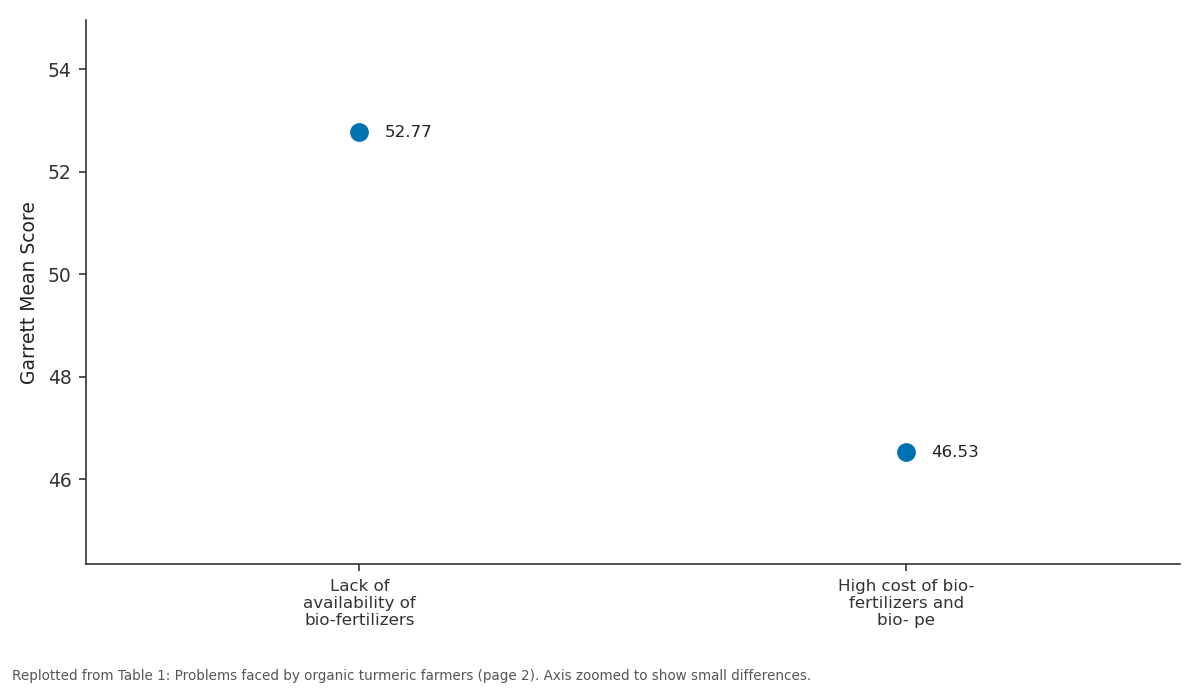
Garrett Mean Score: Lack of availability of... vs High cost of...
Replotted from Table 1 (page 2) of the original paper. Every bar is the paper's own table value.
View source evidence ↗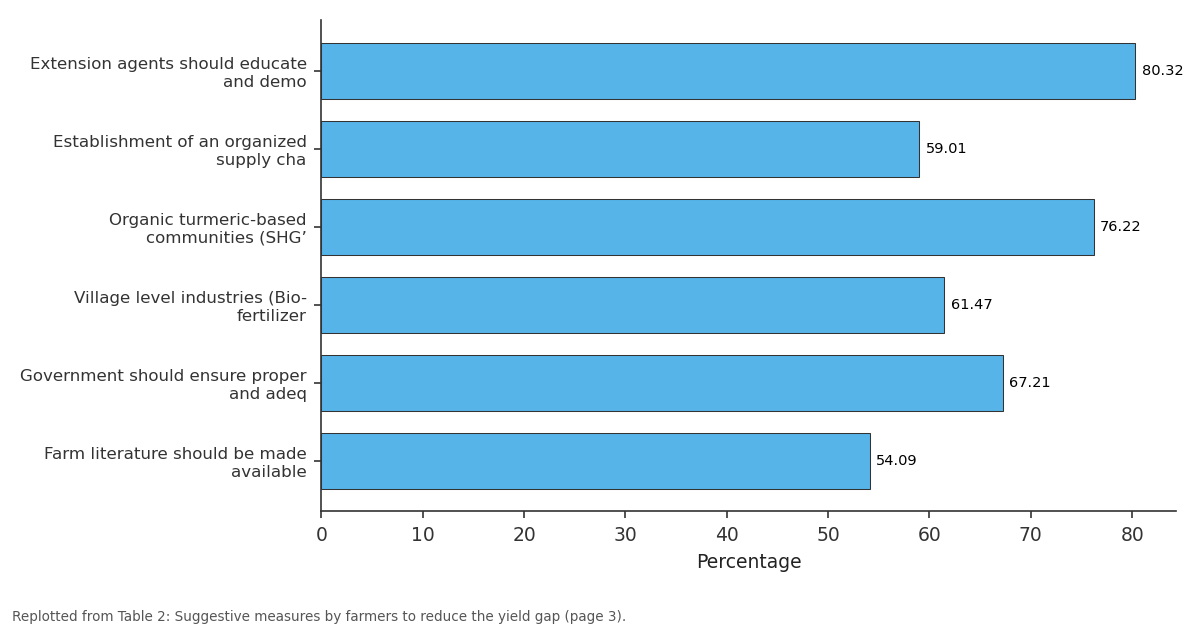
Percentage: Extension agents should... vs Establishment of an... vs Organic turmeric-based... vs Village level... vs Government should...
Replotted from Table 2 (page 3) of the original paper. Every bar is the paper's own table value.
View source evidence ↗Figures & tables
From the original paper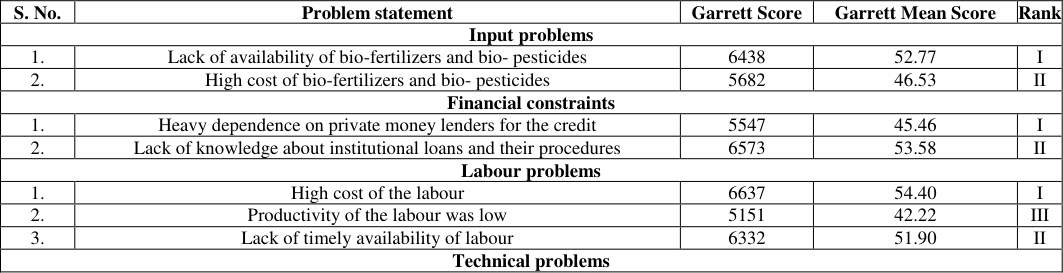 Table 1
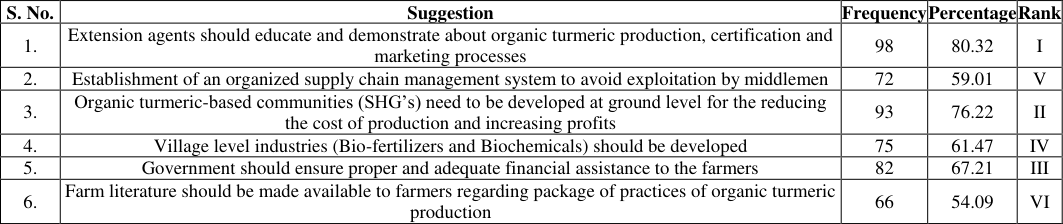 Table 2
Introduction
Turmeric (Curcuma longa L.) is one of the important commercial spice crops grown in India. It is believed to have originated in India, perhaps in Eastern India or Malaysia (Sturlevant, 1919) [9] . India is the top producer of turmeric (Curcuma longa L.) contributing about 78% of the world's production (Viraja et al., 2018) [11] . The Northeastern (NE) region of India is considered as a major hub of spices, with a share of 9.38% of total production in 2016-17 and 6.51% of the country's land area under cultivation (Singh et al., 2020) [8] . Out of all the spice crops, turmeric is an important cash crop in the NEH region and shares about 8.3% of the total production in the country. Mizoram, with a total production of 27.82 thousand MT is the leading state in the region followed by Meghalaya (16.63 thousand MT) and Manipur (15.40 thousand MT). The agro-climatic conditions of the region are characterised by warm and humid summers with abundant rainfall and cool winters, which are favourable for turmeric cultivation (SFAC, 2012) [7] . Like other food crops grown in the NE region, turmeric is cultivated using the traditional knowledge of the inhabitants which are generally eco-friendly, less expensive and organic inputs. Turmeric is widely grown in all the districts of Meghalaya. In Meghalaya for the year 2017-18, the area covered under turmeric was 2649 hectares (GOM, 2017) [3] . The Khasi-Jaintia Hills districts contribute 72% and the Garo Hills district contributes 28% of the state's production (GOM, 2020) [4] . Turmeric varieties commonly grown in Meghalaya are Lakadong, Lashien, Ladaw, Lakachain, Yangau, and Megha-1 (Ashraf et al., 2012) [1] . All parts of the turmeric plant including rhizome, is edible and contains abundant starch (Bose et al., 2012) [2] . The volatile oil content in dry turmeric varies between 3.6-4.8%. The crop is also very rich in dietary fibre thus, it could be employed in the treatment of diseases such as obesity, diabetes, cancer and gastrointestinal disorders (Mukherjee et al., 2016) [6] . Apart from being used as a part of daily cooking, turmeric is believed to have many curative values that work differently on the organs of the body. It exhibits intense antihepatotoxic, anti-cancerous, antidiabetic, antiseptic, antibacterial, anti-asthmatic, anti-ulcer, insect repellents, blood purifier, carminative and healing properties. Turmeric being a native crop, has wider variability and was www.extensionjournal.com observed for the yield and quality attributes. Lakadang a local landrace identified from Jaintia hills has been found rich in curcumin (7.5%) content (Jha et al., 2018) [5] . Despite regional advantages, productivity is low, which may be due to poor fertility of soil by leaching and fixation of nutrients in the high rainfall fragile ecosystem. Therefore, scientific organic production technology is very important for economically sustainable production in this highly fragile ecosystem of north eastern region of India. Organic production of turmeric has significant and positive effect on growth, yield and quality attributes over traditional practices (Verma et al., 2019) [10] . However, despite having good demand, farmers have not, till date, been able to realize the full economic potential of this crop primarily because of the preponderance of small and marginal farmers, absence of focussed research, low individual volumes exacerbated by lack of organised aggregation, weak post-harvest management and market facilities, lack of universal access to information, skills and technology, unreliable price discovery, dominance of middleman, trader cartelization, weak extension, lack of assured irrigation, inaccessible to finance and most importantly insufficient planting materials of the crop. Since the study was taken up on problems and suggestions in the production of organic turmeric.
Methodology
An Ex-post facto research design was adopted for the study. The research study will be taken up in West Jaintia Hills district of Meghalaya, which comprises of the highest area under organic turmeric cultivation in the state and contributes more than half of the turmeric production in the state. Two villages are selected purposively from each of the selected blocks (Laskein and Thadlaskein) which comprises of the highest area under organic turmeric cultivation in the district of West Jaintia Hills. The farmers from each village of selected blocks who are indulged in organic turmeric farming are identified. This selection is done by implying the technique of Probability Proportional to Size Sampling. Thereby, 122 respondents had been determined and pinpointed as sample of the study. The data from the respondents was collected with the help of an interview schedule. The data collected was analysed and interpretations were drawn based on results. The suitable statistical techniques were used for analysis of data.
Results and Discussion
Results and Discussion
Problems faced by the farmers in organic turmeric cultivation:
At the time of data collection, the respondents were solicited to put forward the problems encountered by them during the organic turmeric cultivation. Results collected were displayed in Table 1. under the following heads.
| S. No. | Problem statement | Garrett Score | Garrett Mean Score | Rank |
|---|---|---|---|---|
| Input problems | ||||
| 1. | Lack of availability of bio-fertilizers and bio- pesticides | 6438 | 52.77 | I |
| 2. | High cost of bio-fertilizers and bio- pesticides | 5682 | 46.53 | II |
| Financial constraints | ||||
| 1. | Heavy dependence on private money lenders for the credit | 5547 | 45.46 | I |
| 2. | Lack of knowledge about institutional loans and their procedures | 6573 | 53.58 | II |
| Labour problems | ||||
| 1. | High cost of the labour | 6637 | 54.40 | I |
| 2. | Productivity of the labour was low | 5151 | 42.22 | III |
| 3. | Lack of timely availability of labour | 6332 | 51.90 | II |
| Technical problems |
Table text extracted from the original PDF; superscript letters are shown inline. The original table image is below.
View original table image
Input problems
Data presented in table 1. showed that 'lack of availability of bio-fertilizers and bio-pesticides' was the major constraint followed by 'high cost of bio-fertilizers and biopesticides'
Financial constraints
From Table 1. it was clearly observed that the most important constraint conveyed by the respondents were 'heavy dependence on private money lenders for the credit' and followed by 'lack of knowledge about institutional loans and their procedures'
Labour problems
The data from Table 1. revealed that 'high cost of the labour' accounted as the major problem according to the respondents which was followed by 'productivity of the labour was low' and 'lack of timely availability of labour'
Technical problems
Results furnished from Table 1. indicated that the prime problem for the respondents was 'lack of knowledge on seed treatment' succeeded by 'lack of knowledge on fertilizers management' and 'lack of knowledge on disease and pest management'
Marketing problems
It could be noticed from Table 1. that major portion of the respondents were having 'high fluctuations in the price of turmeric' as the major constraint, followed by 'inadequate information on the markets and product prices' and 'distant location of markets'
General problems
An observation from Table 1. indicated that the first constraint was 'Influenced by the personal problems like family health, children education etc.,' the second constraint was 'Insect and pest incidence' and followed by the 'frequency of contact between farmer and extension worker is low' and 'lack of training programmes on production, protection, post harvesting and marketing aspects of organic turmeric' From the present, it was pretty obvious that 'lack of availability of bio-fertilizers and bio-pesticides', 'heavy dependence on private money lenders for the credit', 'high cost of the labour', 'lack of knowledge on disease and pest management', 'high fluctuations in the price of turmeric', and 'Influenced by the personal problems like family health, children education etc.,' were the important constraints faced by the respondents under input, financial, labour, technical, marketing and general constraints respectively. Thus, it can be concluded that the respondents were experiencing a number of problems during the organic turmeric cultivation. 2. ranked six key suggestions for improving organic turmeric production based on their perceived importance. The highest-ranked suggestion was that extension agents should educate and demonstrate organic turmeric production, certification, and marketing processes (Rank I). This indicated that respondents believed knowledge transfer and hands-on demonstrations were critical for the success of organic turmeric farming. The development of organic turmeric-based communities, such as Self-Help Groups (SHGs), was also highly prioritized (Rank II), as these groups could reduce production costs and increase profits for farmers. Ensuring proper and adequate financial assistance from the government was ranked third (Rank III), emphasizing the need for financial support to empower farmers in their organic endeavors.
Other suggestions included the establishment of villagelevel industries for bio-fertilizers and biochemicals (Rank IV), which highlighted the importance of local industry development to support organic farming. The creation of an organized supply chain to prevent exploitation by middlemen was ranked fifth (Rank V), showing a moderate concern for fair trade practices. Lastly, making farm literature available on organic turmeric production practices was given the lowest priority (Rank VI), suggesting that while important, it was considered less urgent compared to the other recommendations.
Conclusion
The study provides a comprehensive analysis of the challenges and potential solutions for organic turmeric production in West Jaintia Hills, Meghalaya. The research reveals that farmers face significant barriers in accessing bio-fertilizers and bio-pesticides, financial credit, and skilled labor, all of which are essential for successful organic farming. Additionally, the lack of technical knowledge and market access further complicates the situation for these farmers, leading to lower productivity and income. The high fluctuation in turmeric prices and the distant location of markets add to the financial uncertainty faced by these farmers. The suggestions provided by the farmers highlight the need for a multi-faceted approach to improving organic turmeric production. Prioritizing education and demonstrations by extension agents can empower farmers with the knowledge required for better crop management. The formation of SHGs and the development of local industries for biofertilizers and biochemicals can reduce costs and improve the economic sustainability of organic turmeric farming. Government intervention in providing financial assistance and establishing an organized supply chain can further support the farmers in overcoming the challenges they face.
In conclusion, addressing the constraints in organic turmeric farming in Meghalaya requires a concerted effort from various stakeholders, including government agencies, extension services, and the farming community. By implementing the suggested measures, there is potential to enhance the productivity, profitability, and sustainability of organic turmeric farming in the region, ultimately contributing to the overall agricultural development of Meghalaya.
Figures and tables from the paper
| S. No. | Suggestion | Frequency | Percentage | Rank |
|---|---|---|---|---|
| 1. | Extension agents should educate and demonstrate about organic turmeric production, certification and marketing processes | 98 | 80.32 | I |
| 2. | Establishment of an organized supply chain management system to avoid exploitation by middlemen | 72 | 59.01 | V |
| 3. | Organic turmeric-based communities (SHG’s) need to be developed at ground level for the reducing the cost of production and increasing profits | 93 | 76.22 | II |
| 4. | Village level industries (Bio-fertilizers and Biochemicals) should be developed | 75 | 61.47 | IV |
| 5. | Government should ensure proper and adequate financial assistance to the farmers | 82 | 67.21 | III |
| 6. | Farm literature should be made available to farmers regarding package of practices of organic turmeric production | 66 | 54.09 | VI |
Table text extracted from the original PDF; superscript letters are shown inline. The original table image is below.
View original table image
References
10 in the original paper- Ashraf K, Mujeeb M, Ahmad A, Amir M, Mallick MN, Sharma D. Validated HPTLC analysis method for quantification of variability in content of curcumin in Curcuma longa L (turmeric) collected from different geographical regions of India. Asian Pac J Trop Biomed. 2012;2(2):5384-5588.
- Government of Meghalaya (GoM). Directorate of Agriculture and Farmers' Welfare -Organic agriculture; c2017. Available from: http://megagriculture.gov.in/public/crops_spices.aspx. Accessed 22nd October 2021.
- Government of Meghalaya (GoM). Directorate of Agriculture and Farmers' Welfare -Organic agriculture; c2020. Available from: http://www.megagriculture.gov.in/PUBLIC/organic_ag riculture_Default.aspx. Accessed 21 October 2021.
- Jha AK, Rymbai H, Verma VK, Deshmukh NA, Assumi SR, Devi MB, et al. Quality spices production-the way forward to farmers' prosperity in NEH Region. Souvenir and Abstracts of National Conference cum Kisan Unnati Mela-2018: Approaches for Doubling the Farmers Income-the Road Ahead for Farmers Prosperity; c2018. p. 33-52.
- Mukherjee D, Roquib MA, Das ND, Mukherjee S. A study on genetic variability, character association and path coefficient analysis on morphological and yield attributing characters (Casia esculanta var. antiquorum L.Scott). Am J Plant Sci. 2016;7:479-488.
- Small Farmers Agribusiness Consortium (SFAC). Value Chain Analysis of Selected Crops in North Eastern State; c2012. Available from: http://sfacindia.com/PDFs/SFAC_Value-ChainAnalysis.pdf. Accessed 22nd July 2022.
- Singh R, Dympep A, Passah S, Feroze SM, Choudhury A, Kumar S, Jhajharia A. Value chain analysis of Lakadong turmeric in Meghalaya: A micro-level study. Agric Econ Res Rev. 2020;33(2):239-249.
- Sturlevant EL. Note on edible plants. Res NY Agric Expt Stn. 1919;69(70):185-186.
- Verma VK, Patel RK, Deshmukh NA, Jha AK, Ngachan SV, Singha AK, et al. Response of ginger and turmeric to organic versus traditional production practices at different elevations under humid subtropics of north-eastern India. Ind Crops Prod. 2019;136:21-27.
- Viraja CV, Thumar VM, Singh N, Thanki PM, Tandel VB. Resource use efficiency in turmeric cultivation in Navsari district of Gujarat. Int J Agric Sci. 2018;10(15):6779-6780.