
Research article · 2024 · Full text
International Journal of Agriculture Extension and Social DevelopmentThe challenges faced by FPO members in access to finance and markets in Kurnool district of Andhra Pradesh
Volume 7(8) · Pages 624–630 · DOI: 10.33545/26180723.2024.v7.i8i.997 ↗
Research areasMicrofinance and Financial Inclusion
Abstract
Author-writtenThe study examines the socio-economic challenges faced by Farmer Producer Organization (FPO) members in accessing finance and markets in Kurnool District, Andhra Pradesh. The agriculture sector in India, where 83 percent of farmers are smallholders, is fragmented, leading to low productivity and poor access to affordable credit. This research highlights those younger farmers, particularly those aged 25-35 years, are more actively involved in FPOs (34%) compared to non-FPOs (24%). FPO members generally have smaller landholdings, with 42 percent owning between 2.5 to 5 acres, whereas non-FPO members more commonly have medium-sized holdings (40% owning 5-10 acres). Additionally, FPO members show higher educational attainment, with only 32 percent being illiterate compared to 42 percent among non-FPO members. Annual income levels also vary, with 36 percent of FPO members earning between ?50,000 to ?1,00,000, compared to 16 percent of non-FPO members. The study identifies inadequate credit, high interest rates, and difficulties in documentation as major financial constraints. In market access, challenges include exploitation by middlemen, improper weighment, and poor transport facilities. The findings emphasize the need for targeted interventions to improve the financial and market access conditions for FPO members, thereby enhancing their socio-economic status.
Summary
Source-checkedPlain-language reading of the full paper, prepared with AI and checked against the text. Each point links to the authors' own words.
Why it matters
- The Indian agricultural sector is highly fragmented, with approximately 83% of farmers being smallholders who struggle with low productivity and limited access to affordable credit. View evidence ↗
- Farmer Producer Organizations (FPOs) are intended to act as catalysts for rural advancement and poverty eradication by enabling small farmers to collectively access production and marketing information. View evidence ↗
- Agricultural finance is essential for rural households to make productive investments and manage economic risks. View evidence ↗
The question
- The study aims to examine the socio-economic challenges that FPO members in the Kurnool District of Andhra Pradesh face when trying to access finance and markets. View evidence ↗
What they did
- The researchers used a multistage stratified random sampling technique in the Kurnool district, which has 61 active FPOs. View evidence ↗
- The Garrett Ranking technique was used to determine the relative importance of various financial and market constraints based on respondent perspectives. View evidence ↗
What they found
- Younger farmers (aged 25-35) are more likely to be involved in FPOs (34%) than non-FPOs (24%). View evidence ↗
- FPO members typically have smaller landholdings (42% owning 2.5 to 5 acres) compared to non-FPO members, who more commonly have medium-sized holdings (40% owning 5-10 acres). View evidence ↗
- Illiteracy is higher among non-FPO members (42%) than among FPO members (32%). View evidence ↗
- A higher percentage of FPO members (36%) earn an annual income between ₹50,000 and ₹1,00,000 compared to non-FPO members (16%). View evidence ↗
- Inadequate credit for cultivation operations was the top-ranked financial constraint for both FPO (score 60.26) and non-FPO (score 68.35) members. View evidence ↗
- The primary market constraint for FPO members is the distance to market locations (score 67.34), whereas this is the least significant constraint for non-FPO members (score 32.32). View evidence ↗
- Exploitation by middlemen is the top market constraint for non-FPO members (score 61.75), while it is ranked sixth for FPO members (score 41.15) because FPOs allow direct access to processors. View evidence ↗
What it means
- The authors conclude that FPOs are crucial for improving the socio-economic status of small and marginal farmers in the Kurnool District by enhancing their access to markets and finance. View evidence ↗
- The authors recommend implementing enhanced support systems, specifically better market infrastructure, easier credit access, and stronger collective bargaining. View evidence ↗
- The authors state that future research should focus on strategies to improve market integration and financial access for FPOs in the Kurnool District. View evidence ↗
Visual summary
2 visualsIllustrations explain the paper; charts are replotted from the paper's own table values.
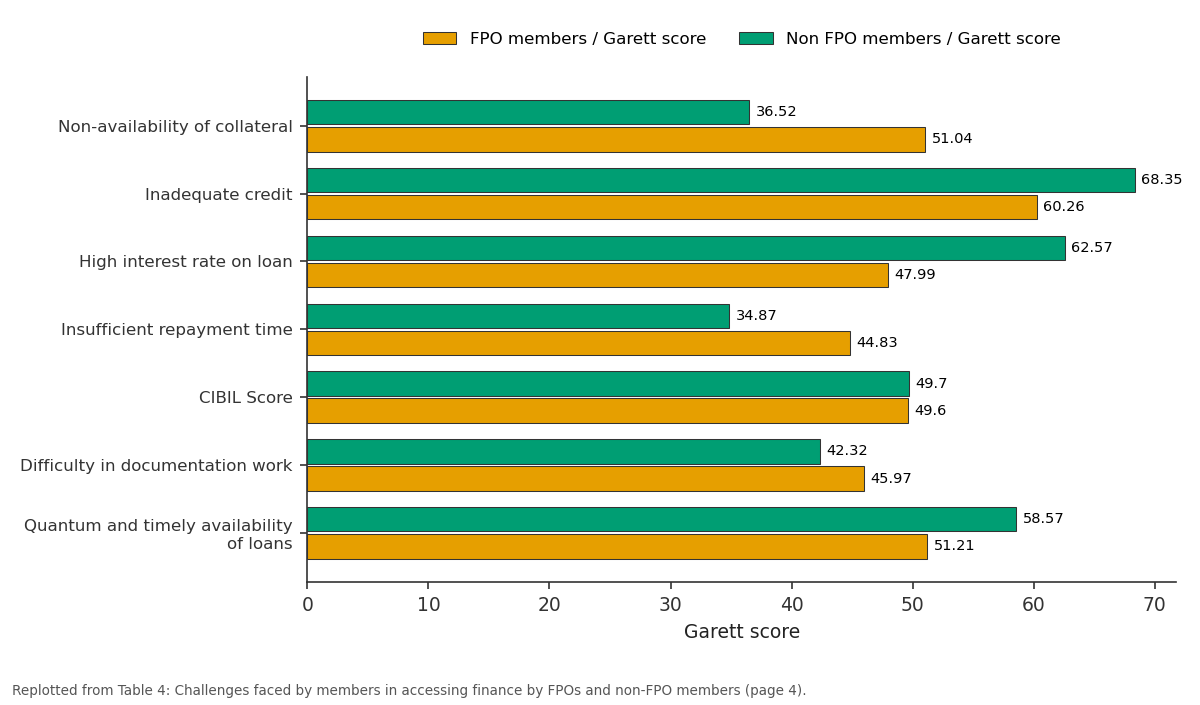
FPO members / Garett score and Non FPO members / Garett score: Non-availability of... vs Inadequate credit vs High interest rate on... vs Insufficient repayment... vs CIBIL Score
Replotted from Table 4 (page 4) of the original paper. Every bar is the paper's own table value.
View source evidence ↗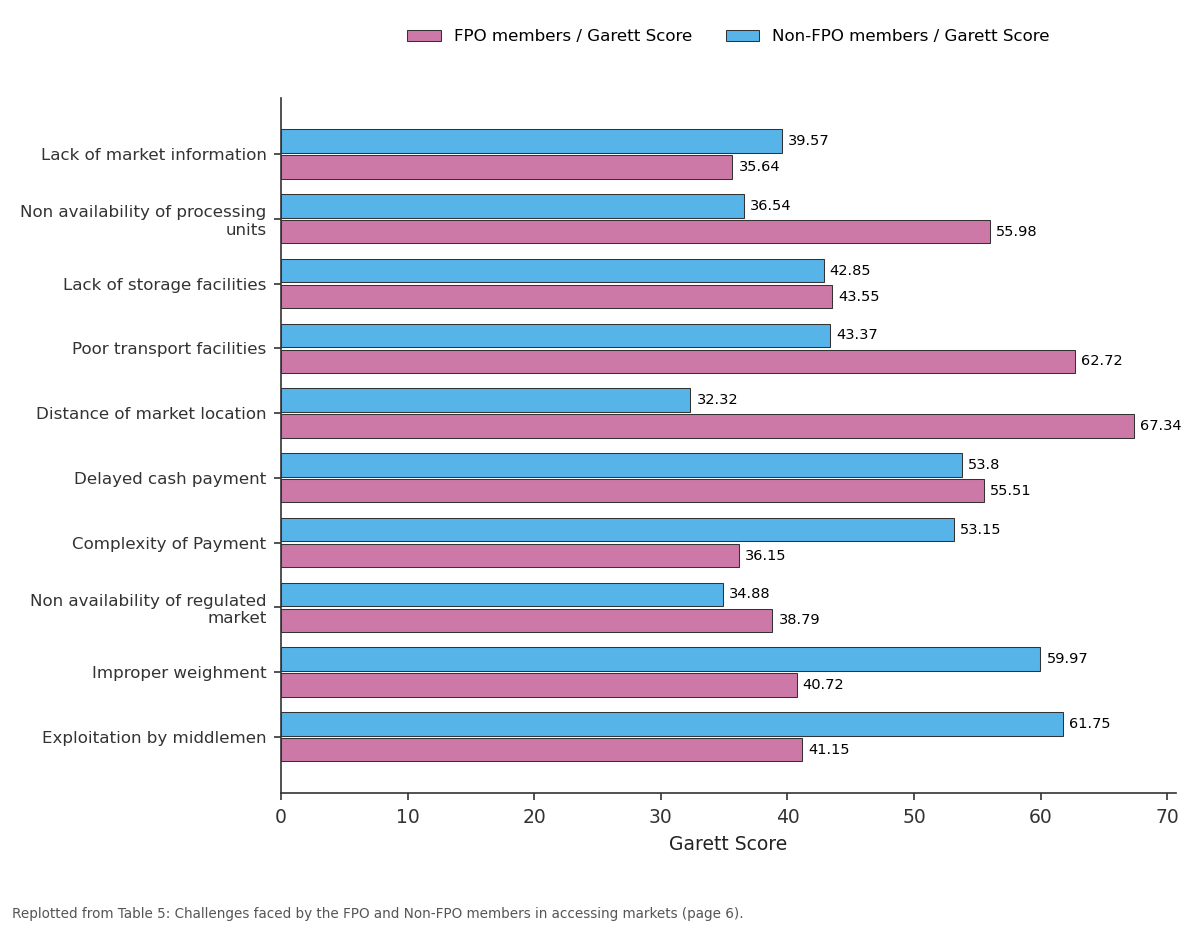
FPO members / Garett Score and Non-FPO members / Garett Score: Lack of market... vs Non availability of... vs Lack of storage... vs Poor transport... vs Distance of market...
Replotted from Table 5 (page 6) of the original paper. Every bar is the paper's own table value.
View source evidence ↗Figures & tables
From the original paper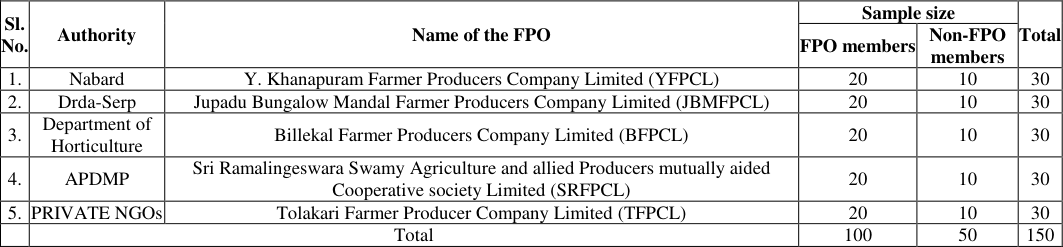 Table 1
 Table 2
 Table 3
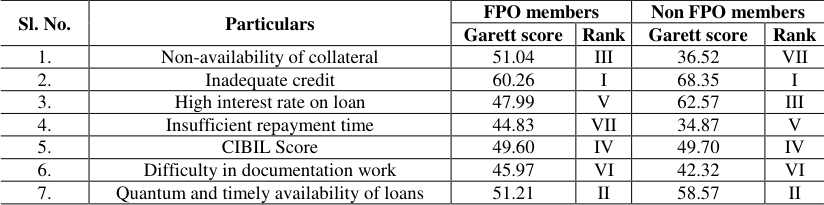 Table 4
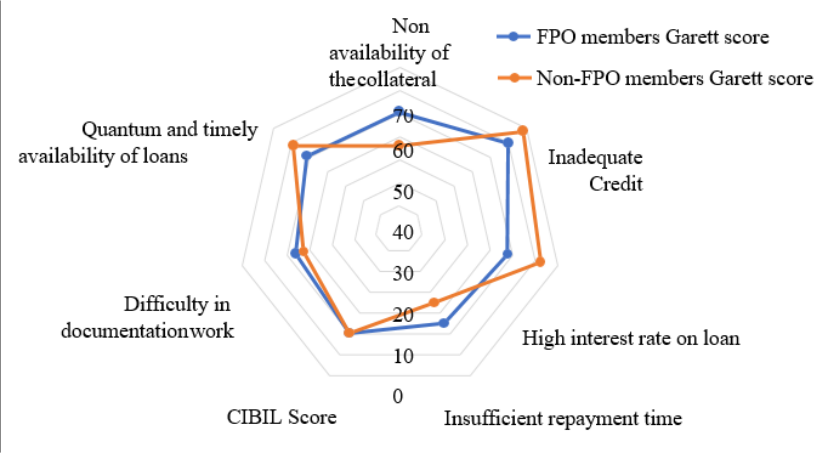 Figure 1
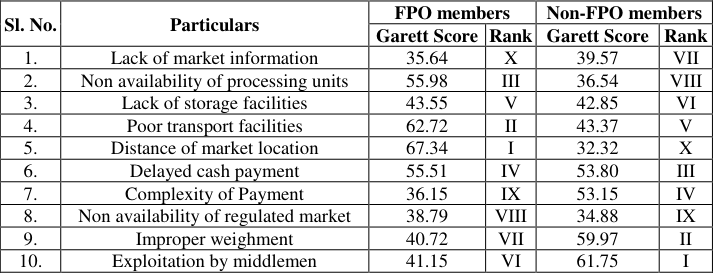 Table 5
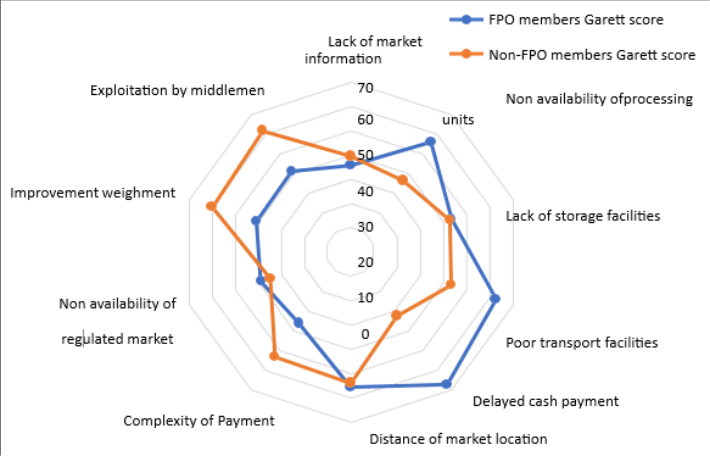 Figure 2
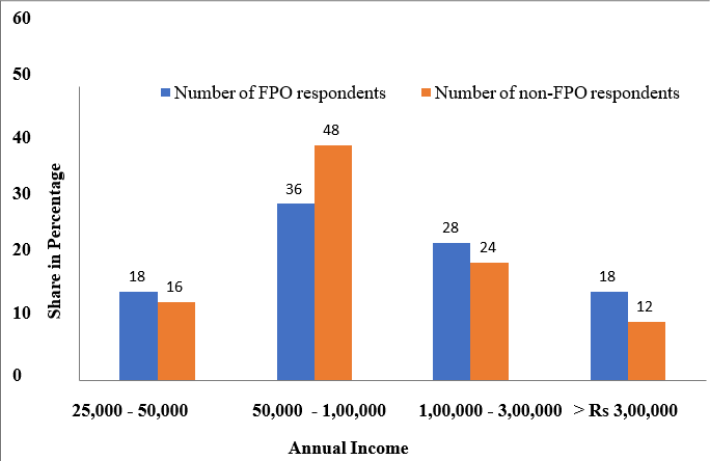 Figure 3
Introduction
The agriculture sector in India, despite its significant contributions, is alarmingly fragmented, necessitating higher efficiency to improve the socio-economic conditions of farmers. With about 83 percent of Indian farmers being smallholders, constituting roughly 50 percent of operational land holdings, the challenges of low productivity and poor access to affordable credit continue to trap them in poverty. As agricultural assets undergo further fragmentation, the need for collectivization becomes paramount. Farmer Producer Organizations (FPOs) play a crucial role in this context, acting as catalysts for poverty eradication and the advancement of rural farmers. FPOs offer a platform for small and marginal farmers to collectively access the information necessary for production, value addition, and commodity marketing. By maintaining productive linkages with input agencies, such as credit service providers and alternative markets, FPOs enhance farmers' ability to navigate the complexities of modern agriculture. Market-oriented FPOs assist members in purchasing inputs and machinery, meeting high-quality standards, and managing post-harvest activities to minimize losses. Through these activities, FPOs establish themselves as reliable suppliers, enabling their members to secure better prices for their produce. The collective bargaining power of FPO members surpasses that of individual farmers, allowing them to negotiate more effectively with major market players, thereby ensuring that profits are retained by farmers rather than lost to middlemen. Finance is crucial in this process, as it supports rural households and enterprises in making productive investments, managing risks, and coping with economic shocks. Given the rural sector's priority for economic growth and poverty reduction, agricultural finance is increasingly recognized as a key component of financial system development. Small farmers require credit not only for agricultural activities but also for other household needs, savings, payment systems, and insurance. In this context, rural cooperatives and FPOs in India serve as essential mechanisms for pooling resources and providing access to a range of financial services. In recent times, FPOs, in partnership with state governments, have increasingly involved small and marginal farmers, facilitating easier access to credit, marketing facilities, technical advisory services, and collective bargaining opportunities. To significantly enhance small farmers' market access and strengthen their position within the agricultural value chain, the concept of crop-specific FPOs has gained prominence. These organizations focus on the aggregation of crop-specific input procurement and output sourcing, ensuring their longterm sustainability. Such an approach holds great promise for breaking farmers' dependency on intermediaries and improving their access to technology, finance, markets, and www.extensionjournal.com government schemes. A Farmer Producer Organization is a legally recognized company established under the Farmer Producer Company (FPC) Act, passed by the Indian Parliament in 2002. This legal form was created to address the shortcomings of cooperative societies while retaining their strengths and incorporating the best practices of corporate companies. According to the FPC Act, only farmer producers can be members of an FPO, and they are responsible for managing the organization. Paid staff may be employed to assist in the administration of the FPO, but the organization remains farmer-driven, with any surplus gained over the years being shared among the members. The Ministry of Agriculture, Government of India, through its "Policy and Procedural Guidelines 2013," has recognized Producer Companies under Part IX A of the Companies Act as the most appropriate and legally sound form of FPOs. To harness the collective bargaining power of FPOs, it is essential to work directly with small and marginal farmers and their institutions, as well as with FPOs and their promoting organizations, to create an enabling environment that facilitates their smooth functioning and helps overcome daily challenges (Alagh, 2007) [1] . FPOs present a valuable opportunity for small and marginal farmers, offering a means of aggregation that transcends individual land rights. By leveraging the strength of collective planning for crop production, procurement, and marketing, FPOs add value to farmers' yields and help them move up the agricultural value chain. The global success of FPOs underscores the need for policy support to empower these member-based farmer bodies, reduce risk, and enhance their market presence. To further this agenda, the Indian government has launched a central scheme aimed at forming and promoting 10,000 FPOs by 2027-28, with a budgetary allocation of ₹6,865 crores. In Andhra Pradesh, 852 FPOs were promoted by 2020. The Small Farmers Agri-Business Consortium (SFAC) supports FPOs through various resource institutions, providing training, capacity building, financial grants, and links to input suppliers, service providers, and market players. This initiative represents a significant step toward improving access to finance and markets for FPO members, particularly in districts like Kurnool, where small and marginal farmers face considerable challenges (Singh, 2017) [4] .
Methodology
This chapter outlines the methodology employed in selecting the sample, data collection, and analytical techniques used to achieve the objectives of the study. The methodology is detailed under the following sections: Sampling Design: A multistage stratified random sampling technique was utilized for selecting the sample in this study. Kurnool district, where 61 actively performing Farmer Producer Organizations (FPOs) operate under various departments, was purposively selected. This district was chosen due to its diverse crop cultivation across different mandals and its potential for establishing multi-commodity FPOs.
Selection of FPOs
Among actively functioning FPOs, 5 FPOs were selected for the study. One FPO from each of NABARD, SERP, APDMP, Department of Horticulture and NGOs based on the maximum number of members.
Selection of Respondents
All the farmers registered under the selected FPOs were listed out and 20 farmers from each of the FPO were selected randomly, thus constituting a representative sample of 100 farmers from 5 FPOs in the study area. A sample of 50 non-FPO farmers were also selected randomly for comparison in the study area as detailed in Table 1. Analytical Tools: The Garrett Ranking technique was employed to identify and rank the major constraints faced by FPO members in accessing finance and markets. This method converts the rankings of constraints into numerical scores, allowing for the determination of their relative importance from the respondents' perspectives. The formula for converting ranks into percentages is:
| Sl. No. | Authority | Name of the FPO | Sample size | — | Total |
|---|---|---|---|---|---|
| FPO members | Non-FPO members | ||||
| 1. | Nabard | Y. Khanapuram Farmer Producers Company Limited (YFPCL) | 20 | 10 | 30 |
| 2. | Drda-Serp | Jupadu Bungalow Mandal Farmer Producers Company Limited (JBMFPCL) | 20 | 10 | 30 |
| 3. | Department of Horticulture | Billekal Farmer Producers Company Limited (BFPCL) | 20 | 10 | 30 |
| 4. | APDMP | Sri Ramalingeswara Swamy Agriculture and allied Producers mutually aided Cooperative society Limited (SRFPCL) | 20 | 10 | 30 |
| 5. | PRIVATE NGOs | Tolakari Farmer Producer Company Limited (TFPCL) | 20 | 10 | 30 |
| Total | 100 | 50 | 150 |
Table text extracted from the original PDF; superscript letters are shown inline. The original table image is below.
View original table image
Percentage position = 100(Rij -0.50)/Nj
Where, Rij = Rank given for the i th item by the j th individual, Nj= Number of items ranked by the j th individual.
Results and Discussion
Results and Discussion
Socio-economic profile of respondents
The socio-economic profile of respondents in Kurnool District, Andhra Pradesh, highlights the differences between members of Farmer Producer Organizations (FPOs) and non-FPO members in terms of age, landholding, literacy levels, and income, which are crucial factors influencing farming practices and economic activities.
Age is a critical demographic factor that shapes the ability to adopt modern farming practices. The study reveals that younger farmers, particularly those aged 25-35 years, are more actively involved in FPOs, representing 34 percent of FPO respondents, compared to just 24 percent in the non-FPO group. This suggests that younger farmers are more inclined towards collective farming efforts. In contrast, older farmers aged 45-55 years are more prevalent among non-FPO members, making up 36 percent of this group, indicating a preference for traditional farming methods among the older generation.
Landholding size is a key determinant of a farming family's economic well-being. The majority of FPO members (42%) possess landholdings between 2.5 to 5 acres, making it the most common range among them. On the other hand, non-FPO members are more likely to have medium-sized landholdings (5-10 acres), with 40% falling into this category. Interestingly, a higher proportion of non-FPO members (24%) have large landholdings (>10 acres) compared to FPO members (8%), potentially providing them with better access to resources and markets. Education plays a pivotal role in adopting modern and scientific farming practices that enhance economic viability.
The study shows that illiteracy is more prevalent among non-FPO members, with 42 percent being illiterate, compared to 32 percent among FPO members. FPO members generally have higher educational attainment, with more individuals having completed primary, high school, or www.extensionjournal.com intermediate education. Additionally, 10 percent of FPO respondents have graduated or attained higher education, compared to 8 percent of non-FPO respondents, reflecting a slight educational advantage among FPO members.
The FPO members tend to be younger, better educated, and possess smaller landholdings compared to non-FPO members. These socio-economic factors significantly influence their participation in FPOs and their ability to access finance and markets, shaping the challenges faced by FPO members in Kurnool District, Andhra Pradesh.
Annual Income level of FPO and Non FPO members
Annual income is the net income of the farmers which reflects the practice of cultivation operations by the farmers which directly influences production that ultimately increases the annual income.
In the study area, the annual income range of FPO and Non-FPO respondents is depicted in the Table 3. Among the FPO respondents, major annual income of the respondents is in the range of Rs. 50,000 to Rs. 1,00,000 which constitutes about 36 percent of the FPO respondents and 16 percent of the Non FPO respondents followed by the range of Rs1,00,000 to Rs. 3,00,000 which was the annual income of 28 percent of the FPO respondents and 24 percent of Non FPO respondents. Above 3,00,000 annual income was earned by 18 percent of the FPO respondents and 6 percent of the Non FPO respondents in the study area. Many challenges were faced by the FPO and Non-FPO members in accessing finance and markets in the study area and these are analysed with help of Garrett Ranking Score which was obtained based on the opinion of the respondents through pretested interview schedule and are presented below. Here the results presented are in line with the findings of Suneesha et al 2017.
| Sl. No. | Annual income range of respondents (Rs) | Number of respondents | — |
|---|---|---|---|
| FPO members | Non FPO members | ||
| 1. | 25,000 - 50,000 | 18 (18.00) | 8 (16.00) |
| 2. | 50,000 - 1,00,000 | 36 (36.00) | 24 (48.00) |
| 3. | 1,00,000-3,00,000 | 28 (28.00) | 12 (24.00) |
| 4. | > 3,00,000 | 18 (18.00) | 6 (12.00) |
Table text extracted from the original PDF; superscript letters are shown inline. The original table image is below.
View original table image
Challenges faced by members in accessing finance through FPOs
The constraints faced by the FPO and Non-FPO in accessing finance are presented in Table 4. Inadequate credit to perform the cultivation operations effectively which enhances the yields was major constraint faced by both FPO and Non-FPO members in the study area which was ranked first with the Garrett score of 60.26 and 68.35 respectively. Quantum and timely availability of loan to carry out their operations was the next major constraint faced by both FPO and Non-FPO which was ranked second with the Garrett Score of 51.21 and 58.27 respectively.
| Sl. No. | Particulars | FPO members | — | Non FPO members | — |
|---|---|---|---|---|---|
| Garett score | Rank | Garett score | Rank | ||
| 1. | Non-availability of collateral | 51.04 | III | 36.52 | VII |
| 2. | Inadequate credit | 60.26 | I | 68.35 | I |
| 3. | High interest rate on loan | 47.99 | V | 62.57 | III |
| 4. | Insufficient repayment time | 44.83 | VII | 34.87 | V |
| 5. | CIBIL Score | 49.60 | IV | 49.70 | IV |
| 6. | Difficulty in documentation work | 45.97 | VI | 42.32 | VI |
| 7. | Quantum and timely availability of loans | 51.21 | II | 58.57 | II |
Table text extracted from the original PDF; superscript letters are shown inline. The original table image is below.
View original table image
High interest rate on loan was another major constraint faced which was ranked third and fifth with the Garrett Ranking Score of 62.57 and 47.99 of Non-FPO and FPO members respectively. CIBIL score of an individual farmer to generate further loans was the financial constraint which was ranked fourth by both FPO and Non-FPO members with the Garrett Score of 49.60 and 49.70, respectively. Non availability of the collateral to avail loans was ranked third and seventh by FPO and Non FPO with a Garrett Score of 51.04 and 49.07, respectively. Insufficient repayment time to repay the availed loans was another constraint which was ranked seventh and fifth by FPO and Non FPO members with Garrett Ranking Score of 44.83 and 34.87, respectively. Difficulty in documentation work to access credit was one of constraints faced by the FPO and Non-FPO members which was ranked sixth by both FPO and Non-FPO members with Garrett Score of 45.97 and 43.32 respectively similar results were found with Kumar (2004) [7] . In the study area, it has been observed that non-FPO members face comparatively more challenges than the FPO members due to lack collectivization of their produce and less bargaining power. The constraints which are faced by FPO and Non FPO members are listed and are ranked with the help of Garrett Score by considering the opinions of the respondents through pre-scheduled interview. The Table 5 represents the constraints faced by both the FPO and Non FPO members in access to markets. The first constraint faced by the non-FPO members was exploitation by middlemen where the farmer approached the village merchants and local commission agents to reach the processor and incurred the additional marketing costs and marketing margins to these middle men whereas, the FPO members reach the processors directly through FPOs so this constraint is ranked first and sixth with Garett Score of 61.75 and 41.15 respectively of both Non-FPO and FPO members respectively similar findings were found with Camanzi et al. (2011) [2] . The major constraint faced by the FPO members in access to market was distance of market location as these FPO members reach the processors directly without involvement of local traders and they are located in faraway places and this was ranked first by the FPO members and tenth by non-FPO members with the Garret Ranking Score of 67.34 and 32.32, respectively. The second constraint faced by the Non-FPO members was improper weighment as these members sell their produce to the local village traders individually, they were subjected to the improper weighment of their produce by them and this constraint was ranked second and seventh by the Non-FPO and FPO members with the Garret Ranking Score of 59.97 and 40.72, respectively. The second constraint faced by the FPO members was poor transport facilities due to lack of transportation vehicles which could be purchased collectively once these FPOs reach optimum financial status through subsidies as the FPOs in district are still in the nascent stage this was one of the major constraints faced by the members which was ranked second and fifth by FPO and Non-FPO with the Garrett score of 62.72 and 43.37, respectively analogues results were found with Sukhpal (2008) [9] . The third constraint was faced by the non-FPO members was delayed cash payment due to their linking with the local merchants and this was ranked fourth and third by FPO and Non-FPO members, respectively with Garret Score of 62.72 and 55.51. The next major constraint faced by FPO members was Non availability of the processing units for which they need to depend upon the other member causing the increase in the length of the market chain and this was ranked third and eighth by the FPO and Non-FPO members respectively with Garett Score of 55.98 and 36.54. Delayed cash payment was another major constraint which was putforth by the FPO and Non-FPO and ranked as fourth and third with the garrett score of 55.15 and 53.80, respectively similar finding was observed in Chopade et al.
| Sl. No. | Particulars | FPO members | — | Non-FPO members | — |
|---|---|---|---|---|---|
| Garett Score | Rank | Garett Score | Rank | ||
| 1. | Lack of market information | 35.64 | X | 39.57 | VII |
| 2. | Non availability of processing units | 55.98 | III | 36.54 | VIII |
| 3. | Lack of storage facilities | 43.55 | V | 42.85 | VI |
| 4. | Poor transport facilities | 62.72 | II | 43.37 | V |
| 5. | Distance of market location | 67.34 | I | 32.32 | X |
| 6. | Delayed cash payment | 55.51 | IV | 53.80 | III |
| 7. | Complexity of Payment | 36.15 | IX | 53.15 | IV |
| 8. | Non availability of regulated market | 38.79 | VIII | 34.88 | IX |
| 9. | Improper weighment | 40.72 | VII | 59.97 | II |
| 10. | Exploitation by middlemen | 41.15 | VI | 61.75 | I |
Table text extracted from the original PDF; superscript letters are shown inline. The original table image is below.
View original table image
(2019) [3] . Adequate storage facilities weren't available to both FPO and Non-FPO members which was ranked fifth and sixth with the Garrett Score of 43.55 and 42.85, respectively. Non availability of the regulated market was the constraint which was least faced by the both FPO and Non-FPO members which was ranked eighth and ninth with Garrett Score of 38.79 and 34.88, respectively. Market information was available to both FPO and Non-FPO members adequately so this was ranked tenth and seventh with Garrett Score of 35.64 and 39.57, respectively similar results were found with Braham and Chitemi (2009) [6] . www.extensionjournal.com
Conclusion
The research concludes that FPOs play a crucial role in improving the socio-economic conditions of small and marginal farmers in Kurnool District by providing better access to finance and markets. The study reveals that younger farmers are more inclined towards FPO participation, leveraging collective efforts to overcome the challenges posed by fragmented agricultural holdings. FPO members benefit from smaller but more manageable landholdings and higher educational attainment, which www.extensionjournal.com contribute to better adoption of modern farming practices. However, significant challenges remain in accessing finance, with inadequate credit and high interest rates being the primary concerns. Furthermore, FPO members face difficulties in accessing markets, primarily due to exploitation by middlemen, improper weighment, and inadequate transport facilities. These issues highlight the need for enhanced support systems, including easier access to credit, better market infrastructure, and strengthened collective bargaining mechanisms. Addressing these challenges is essential to ensure that FPOs can effectively uplift the socio-economic status of their members and contribute to the broader goal of rural development.
Future Focus
Future research should explore strategies to further enhance the effectiveness of FPOs in Kurnool District, focusing on improving financial access and market integration. One area of focus could be the development of innovative financial products tailored to the needs of small and marginal farmers, ensuring timely and adequate credit availability at lower interest rates. Additionally, the potential of digital platforms for streamlining market access should be explored, which could reduce reliance on middlemen and improve transparency in pricing and weighment processes. Another critical area for future research is the enhancement of transportation and storage infrastructure to facilitate smoother market integration for FPO members. Finally, examining the impact of policy interventions on the sustainability of FPOs, particularly in promoting cropspecific FPOs that can leverage economies of scale, would provide valuable insights for scaling up successful models. By addressing these areas, future studies can contribute to the development of more resilient and economically viable FPOs, ultimately leading to improved livelihoods for smallholder farmers in the region.
Figures and tables from the paper
| SI. No. | Name of FPO | Year of Registration | Financial turnover for the year 2021 | Total membership | Promoting Institution | Crops cultivated grown |
|---|---|---|---|---|---|---|
| 1 | YKFPCL | 31.05.2016 | 82,00,000 | 701 | NABARD | Cotton, groundnut, and vegetables |
| 2 | JBMFPCL | 11-04-2017 | 79,00,000 | 1780 | DRDA SERP | redgram, cotton, maize |
| 3 | SRLFPCL | 03-09-2020 | 60,00,000 | 515 | APDMP | cotton, groundnut, onion |
| 4 | BFPCL | 14-07-2018 | 83,00,000 | 620 | Department of horticulture | Groundnut, redgram, jowar |
| 5 | TFPCL | 27-12-2017 | 3,50,00,000 | 2307 | Reliance NGO | Cotton, groundnut, chilli and jowar |
Table text extracted from the original PDF; superscript letters are shown inline. The original table image is below.
View original table image
References
6 in the original paper- Camanzi L, Malorgio G, García Azcárate T. The role of producer organizations in supply concentration and marketing: A comparison between European countries in the fruit and vegetables sector. J Food Prod Mark. 2011;17(3):327-354.
- Chopade SL, Kapse PS, Dulgand VJ. Constraints faced by the members of farmer Producer Company. Int J Curr Microbiol Appl. Sci. 2019;8(8):2358-2361.
- Singh G, Budhiraja P, Vatta K. Sustainability of farmer producer organizations under agricultural value networks in India. Indian J Agric Econ. 2017;73(3):370-385.
- Barham J, Chitemi C. Collective action initiatives to improve marketing performance: lessons from farmer groups in Tanzania. Food Policy. 2009;34(1):53-59.
- Singh G, Vatta K. Assessing the economic impacts of farmer producer organizations: A case study in Gujarat, India. Agric Econ Res Rev. 2019;3(1):139-148.
- Singh S. Producer companies as new generation cooperatives. Econ Polit. Wkly. 2008;43(20):22-24.