
Research article · 2024 · Full text
International Journal of Agriculture Extension and Social DevelopmentKnowledge of beneficiaries about key features and eligibility criteria of Ayushman Bharat Yojana
Volume 7(9) · Pages 01–05 · DOI: 10.33545/26180723.2024.v7.i9a.1000 ↗
Research areasAgricultural Economics and Practices
Abstract
Author-writtenThe study was conducted in Hisar district of Haryana. Two blocks from Hisar district i.e. Hisar-I and Hansi-I were randomly selected. Thus, a total of 180 beneficiaries of Ayushman Bharat Yojana were selected by simple random sampling technique from six randomly selected villages (30 from each village). Data was collected with the help of a well-structured interview schedule. Most respondents were male, married, and between 38-59 years old, belonging to small nuclear families. Agriculture was the primary source of income, with many being landless or having marginal land holdings. The study revealed significant knowledge gaps among beneficiaries. 36.1 percent had a low level of knowledge about the scheme's key features, while 45.6 percent had a low level of knowledge about eligibility criteria. These findings highlight the need for increased awareness and education efforts to ensure beneficiaries can effectively access and utilize the scheme benefits.
Summary
Source-checkedPlain-language reading of the full paper, prepared with AI and checked against the text. Each point links to the authors' own words.
Why it matters
- The Ayushman Bharat scheme is a government health insurance program designed to provide up to INR 5 lakh per family annually for secondary and tertiary hospitalization to approximately 500 million poor and vulnerable Indian families. View evidence ↗
- The program aims to reduce the financial burden on families and ensure they have timely access to quality healthcare. View evidence ↗
- Because the scheme is entitlement-based and does not require advance enrollment, beneficiary awareness is considered the most critical factor for its success. View evidence ↗
What they did
- The research was conducted in six randomly selected villages across the Hisar-I and Hansi-I blocks of the Hisar district in Haryana. View evidence ↗
- A total of 180 beneficiaries were selected using a proportionate sampling method, with 90 participants from each of the two blocks. View evidence ↗
- Data was collected using a well-structured interview schedule that included both independent and dependent variables. View evidence ↗
- Knowledge was measured across two components (key features and eligibility criteria), with correct responses scored as 1 and incorrect as 0. View evidence ↗
What they found
- Most beneficiaries were aware that the scheme targets BPL households (96.7%) and provides coverage of Rs. 5 lakhs per family per year (94.4%). View evidence ↗
- Knowledge was very low regarding the specific number of procedures covered, with only 11.1% of respondents aware that 1592 procedures are included. View evidence ↗
- Regarding key features, 36.1% of respondents had a low level of knowledge, 28.3% had medium knowledge, and 35.6% had high knowledge. View evidence ↗
- High awareness was found for basic eligibility, such as BPL status (98.9%) and not owning excessive agricultural land (93.9%). View evidence ↗
- Knowledge of eligibility criteria related to disabled members or the absence of adult members was low, ranging between 1.1% and 18.9%. View evidence ↗
- When evaluating eligibility criteria, 45.6% of respondents had a low level of knowledge, 41.1% had medium knowledge, and only 13.3% had high knowledge. View evidence ↗
What it means
- The authors conclude that while basic understanding exists, significant knowledge gaps remain that must be addressed to improve the overall effectiveness of the scheme. View evidence ↗
- The authors recommend implementing targeted awareness campaigns to improve the understanding of healthcare schemes within rural communities. View evidence ↗
Figures & tables
From the original paper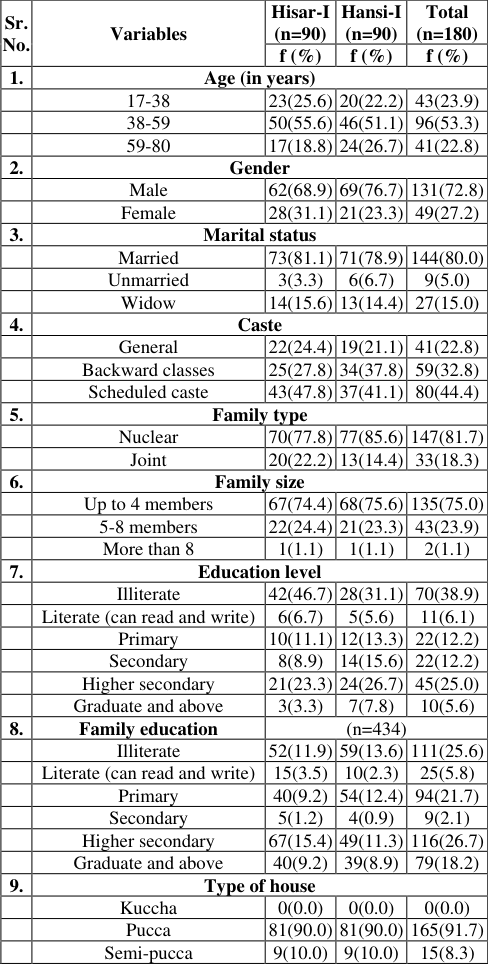 Table 1
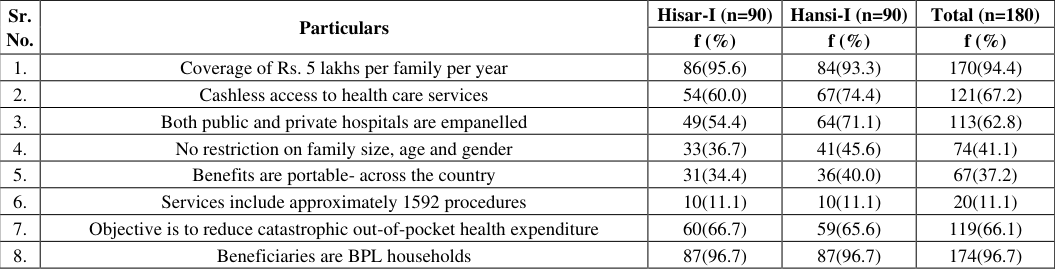 Table 2
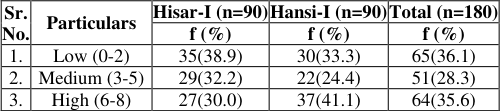 Table 3
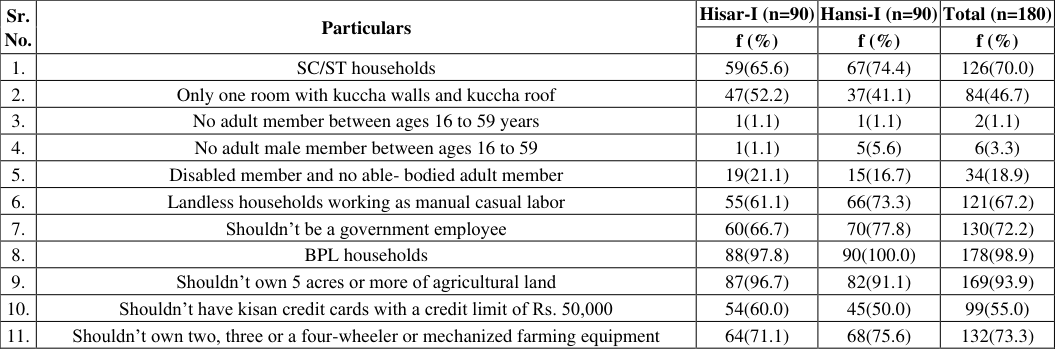 Table 4
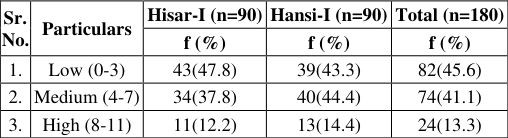 Table 5
Introduction
The Ayushman Bharat (Hindi for "India blessed with a long life") scheme is a government health insurance program that will cover about 500 million poor and vulnerable families in India providing up to INR 5 lakh per family per year for secondary and tertiary care hospitalization services. (Gopichandran, 2019) [2] . Under PM-JAY, all pre-existing conditions are covered from day one and there are no restrictions based on family size, age, gender. Moreover, the benefits are portable across the nation, allowing beneficiaries to seek treatment at any empaneled public or private hospital. With a comprehensive coverage spanning medical consultations, diagnostics, treatments and posthospitalization care, PM-JAY aims to alleviate the financial strain on families and facilitate timely access to quality health care services. Haryana Government is making great effort for the upliftment of poorest of poor through various schemes. In this line the state Government has started a new scheme called CHIRAYU Haryana scheme on 21st November 2022, to help Antyodaya families living in the state. CHIRAYU stands for "Comprehensive Health Insurance of Antyodaya Units". It is an extension of Ayushman Bharat benefits in state with the vision to provide quality health services to poor and vulnerable groups in the society, as expenses on health makes such families even more weak. According to some studies knowledge of beneficiaries varied about different aspects of the scheme. Bidari et al. (2021) [1] observed that the majority (62%) of the samples exhibited poor knowledge, while 22 percent had average knowledge and 16 percent demonstrated good knowledge. The study concluded that a significant portion of the population lacked adequate understanding of the AB PMJAY policy. Vinay et al. (2021) [11] revealed that out of the 100 participants examined, 83 percent possessed knowledge that their entire family was insured under AB-NMPM for an annual amount of 5 lakhs. However, only 52 percent had knowledge that out-patient department (OPD) services in private empaneled hospitals were not covered under the scheme. Parisi et al. (2023) [5] found that approximately 62 percent of respondents were aware of PM-JAY, with 78 percent of them acknowledging their eligibility for the scheme. Sharma et al. (2023) [8] highlighted that among the 383 households surveyed, 10.18 percent, 47.26 percent and 27.40 percent of households from the lower, middle and upper economic strata, respectively, possessed knowledge about AB-PMJAY. Verma and Faridi (2023) [10] concluded that the majority of individuals, comprising 38.67 percent, possessed moderately adequate knowledge, whereas 32.67 percent had inadequate knowledge and only 28.67 percent had adequate knowledge regarding the PMJAY-AB scheme. Kanwal et al. (2024) [4] stated that nearly half of the respondents (49.40%) were aware of the coverage of services, 38 percent knew about services available in other states, 35 percent were knowledgeable about the types of services and 11 percent were informed about the availability of services at private hospitals. www.extensionjournal.com Saikia et al. (2024) [7] observed a mean knowledge level of 11.7±4.16 regarding the Ayushman Bharat Yojana. Haque and Choudhary (2019) [3] showed that 84 percent of rural residents exhibited insufficient knowledge, 14 percent demonstrated moderate knowledge and a mere 2 percent displayed adequate knowledge with no significant correlation with selected demographic variables. Since PM-JAY is an entitlement-based scheme where there is no advance enrolment process, making beneficiaries aware of the scheme is the most critical aspect. Keeping the above facts in view, the study was planned with the following objectives: 1. To study the knowledge about key features of Ayushman Bharat Yojana among beneficiaries. 2. To study the knowledge about eligibility criteria for Ayushman Bharat Yojana among beneficiaries.
Materials and Methods
Materials and Methods
Locale of the study
The study was carried out randomly in village Ramayan, Dhandheri and Depal from Hansi Block-I and village Mayar, Bhagana and Ladwa from Hisar Block-I, Hisar district of Haryana state because of the convenience, easy accessibility and familiarity of the researcher with this area. A list of beneficiaries enrolled in the scheme was obtained from the Community Health Centres serving the respective villages. From this list, a proportionate sample of 180 beneficiaries was selected for the current study, consisting of 90 beneficiaries from Hisar-I block (30 from each of the three villages i.e. Bhagana, Mayar and Ladwa) and 90 beneficiaries from Hansi-I block (30 from each of the three villages i.e. Ramayan, Dhandheri and Depal). A wellstructured interview schedule was prepared with inclusion of all independent and dependent variables of the study for collection of data. The data was collected from the beneficiaries of each selected village of both blocks. The collected data was quantified and interpreted by using statistical tools such as frequency and percentage. A list of knowledge items was prepared and framed in a statement form to obtain the response from respondents. The responses to the statements were quantified by giving 1 to correct response and 0 score to incorrect response. The knowledge part was made up of 2 components i.e. key features and eligibility criteria for scheme. Each part had a varied number of statements and overall knowledge level was calculated by making categories i.e. low, medium and high-level knowledge based on maximum and minimum score can be attained by respondents.
Results
Results
Profile of respondents
Profile of respondents presented a brief account of the socio-personal and economic and economic background of respondents which includes the independent variables of respondents i.e., age, marital status, place of residence, education, family occupation, land holding and annual income of respondents. percent respondents were married, whereas 15 percent were widow and rest of them i.e. 5 percent were found to be unmarried in pooled sample of both blocks. 44.4 percent belonged to Scheduled Caste, 32.8 percent were from Backward Class followed by 22.8 percent from General category. 81.7 percent respondents in the total sample belonged to the nuclear family and the remaining 18.3 percent belonged to joint family. Three-fourths of respondents (75%) in the both selected blocks had family size up to 4 members, whereas 23.9 percent had 5-8 members in their family followed by only few (1.1%) had family size more than 8 members. 38.9 percent of the respondents from total sample were illiterate, one-fourth (25%) were higher secondary pass outs, 12.2 percent were secondary pass outs, 12.2 percent were primary pass outs, 6.1 percent were literate (can read and write), while only 5.6 percent were graduate and above. Out of total sample, one-fourth of respondents (25.6%) had no formal education and were illiterate. A further, 5.8 percent had some basic literacy skills, being able to read and write. Meanwhile, 21.7 percent had completed primary education, 2.1 percent had finished secondary education and 26.7 percent had completed higher secondary education. Additionally, 18.2 percent had graduated with a degree or higher. Majority of the respondents (91.7%) of the total sample had pucca house, while very few respondents (8.3%) had semi-pucca house. None of the respondents had a kuccha house in both blocks.
Data presented in
Data presented in
Knowledge regarding key features of ABY
Data in Table-2 regarding knowledge of respondents regarding key features of ABY pointed that majority of the respondents (96.7%) of pooled sample had the knowledge that the beneficiaries of scheme are BPL households, followed by 94.4 percent knew about the coverage of Rs. 5 lakhs per year per family, 67.2 knew about cashless access to health care services under scheme, 66.1 percent knew scheme objective to reduce catastrophic out-of-pocket health expenditure, 62.8 percent knew that both public and private hospitals are empaneled under the scheme, 41.1 percent knew that there is no restriction on family size, age and gender for treatment under scheme, 37.2 percent knew that benefits of scheme are portable across the country and remaining 11.1 percent knew about 1592 procedures included under services of scheme.
Overall knowledge of respondents regarding key features of ABY
The critical evaluation of results depicted that 36.1 percent respondents had a low level of knowledge of key features of scheme which was followed by high knowledge (35.6%) and medium knowledge (28.3%), respectively.
Knowledge regarding eligibility criteria for ABY
Table-2 revealed that the majority of respondents (98.9%) were aware that BPL households were eligible for the scheme, followed by knowledge of other eligibility criteria: no ownership of excessive agricultural land (93.9%), no ownership of certain vehicles or farming equipment (73.3%), no government employment (72.2%), SC/ST household eligibility (70%), landless laborer eligibility (67.2%) and eligibility based on housing conditions (46.7%). However, knowledge of eligibility criteria related to disabled members, adult male absence and adult member absence was relatively low, ranging from 1.1 percent to 18.9 percent.
Overall knowledge level of respondents regarding eligibility criteria for ABY
The critical evaluation of results depicted that 45.6 percent respondents had a low level of knowledge of key features of scheme which was followed by medium knowledge (41.1%) and high knowledge (13.3%), respectively.
Discussion
The findings of this study reveal varying levels of knowledge among respondents regarding the scheme. Knowledge about key features (36.1%) and IT system (45.6%) fell in the low category, suggesting a need for improved awareness campaigns to enhance understanding of these aspects. Documentation (45.6%) and benefit cover (35.6%) knowledge levels were also medium. These findings suggest that while respondents have a fair understanding of the scheme's basics, there are areas that require attention to enhance their knowledge and awareness, ultimately improving the scheme's effectiveness.
The findings of the current study align with those of Kanwal et al. (2024) [4] who reported that almost all participants (99.1%) had heard about the AB-PMJAY scheme from their local village-level body (approximately 92.0%). Similarly, the current study found that a majority of respondents (65.6%) had a medium level of knowledge about the scheme's basic details, while 49.4% of Kanwal et al.'s (2024) [4] respondents were aware of the coverage of services. Additionally, the current study found that 36.1 percent of respondents had low knowledge about key features, compared to 38 percent of Kanwal et al.'s (2024) [4] respondents who knew about services available in other states. The consistency in findings highlights the need for improved awareness campaigns to enhance knowledge and understanding of health care schemes among rural communities. Specifically, Prasad et al. (2023) [6] found that 65.1 percent of their respondents had a medium level of knowledge about the scheme's basic details, 58.2 percent had a medium level of knowledge about key features. Similarly, Thomas et al.
(2023) [9] reported that 60.2 percent of their respondents had a medium level of knowledge about the scheme's benefits, 56.5 percent had a medium level of knowledge about the enrollment process and 54.1 percent had a medium level of knowledge about the scheme objectives. The consistency in findings across studies highlights the need for effective awareness campaigns to improve knowledge and understanding of health care schemes among rural communities.
Conclusion
This study highlights significant knowledge gaps among beneficiaries of the Ayushman Bharat Yojana scheme in Hisar district, Haryana. The findings reveal varying levels of knowledge regarding key features, eligibility criteria, documentation, benefit cover, and the IT system. Notably, a substantial proportion of respondents had low levels of knowledge about the scheme's key features and eligibility criteria. These findings suggest that while beneficiaries have a fair understanding of the scheme's basics, there are areas that require attention to enhance their knowledge and awareness, ultimately improving the scheme's effectiveness. The study's results align with previous research, emphasizing the need for targeted awareness campaigns to improve knowledge and understanding of health care schemes among rural communities. By addressing these knowledge gaps, policymakers and healthcare providers can work towards ensuring that beneficiaries can effectively access and utilize the scheme's benefits, ultimately reducing financial strain and improving health outcomes.
Figures and tables from the paper
| Sr. No. | Variables | Hisar-I (n=90) | Hansi-I (n=90) | Total (n=180) |
|---|---|---|---|---|
| f (%) | f (%) | f (%) | ||
| 1. | Age (in years) | |||
| 17-38 | 23(25.6) | 20(22.2) | 43(23.9) | |
| 38-59 | 50(55.6) | 46(51.1) | 96(53.3) | |
| 59-80 | 17(18.8) | 24(26.7) | 41(22.8) | |
| 2. | Gender | |||
| Male | 62(68.9) | 69(76.7) | 131(72.8) | |
| Female | 28(31.1) | 21(23.3) | 49(27.2) | |
| 3. | Marital status | |||
| Married | 73(81.1) | 71(78.9) | 144(80.0) | |
| Unmarried | 3(3.3) | 6(6.7) | 9(5.0) | |
| Widow | 14(15.6) | 13(14.4) | 27(15.0) | |
| 4. | Caste | |||
| General | 22(24.4) | 19(21.1) | 41(22.8) | |
| Backward classes | 25(27.8) | 34(37.8) | 59(32.8) | |
| Scheduled caste | 43(47.8) | 37(41.1) | 80(44.4) | |
| 5. | Family type | |||
| Nuclear | 70(77.8) | 77(85.6) | 147(81.7) | |
| Joint | 20(22.2) | 13(14.4) | 33(18.3) | |
| 6. | Family size | |||
| Up to 4 members | 67(74.4) | 68(75.6) | 135(75.0) | |
| 5-8 members | 22(24.4) | 21(23.3) | 43(23.9) | |
| More than 8 | 1(1.1) | 1(1.1) | 2(1.1) | |
| 7. | Education level | |||
| Illiterate | 42(46.7) | 28(31.1) | 70(38.9) | |
| Literate (can read and write) | 6(6.7) | 5(5.6) | 11(6.1) | |
| Primary | 10(11.1) | 12(13.3) | 22(12.2) | |
| Secondary | 8(8.9) | 14(15.6) | 22(12.2) | |
| Higher secondary | 21(23.3) | 24(26.7) | 45(25.0) | |
| Graduate and above | 3(3.3) | 7(7.8) | 10(5.6) | |
| 8. | Family education | (n=434) | ||
| Illiterate | 52(11.9) | 59(13.6) | 111(25.6) | |
| Literate (can read and write) | 15(3.5) | 10(2.3) | 25(5.8) | |
| Primary | 40(9.2) | 54(12.4) | 94(21.7) | |
| Secondary | 5(1.2) | 4(0.9) | 9(2.1) | |
| Higher secondary | 67(15.4) | 49(11.3) | 116(26.7) | |
| Graduate and above | 40(9.2) | 39(8.9) | 79(18.2) | |
| 9. | Type of house | |||
| Kuccha | 0(0.0) | 0(0.0) | 0(0.0) | |
| Pucca | 81(90.0) | 81(90.0) | 165(91.7) | |
| Semi-pucca | 9(10.0) | 9(10.0) | 15(8.3) |
Table text extracted from the original PDF; superscript letters are shown inline. The original table image is below.
View original table image
| Sr. No. | Particulars | Hisar-I (n=90) | Hansi-I (n=90) | Total (n=180) |
|---|---|---|---|---|
| f (%) | f (%) | f (%) | ||
| 1. | Coverage of Rs. 5 lakhs per family per year | 86(95.6) | 84(93.3) | 170(94.4) |
| 2. | Cashless access to health care services | 54(60.0) | 67(74.4) | 121(67.2) |
| 3. | Both public and private hospitals are empanelled | 49(54.4) | 64(71.1) | 113(62.8) |
| 4. | No restriction on family size, age and gender | 33(36.7) | 41(45.6) | 74(41.1) |
| 5. | Benefits are portable- across the country | 31(34.4) | 36(40.0) | 67(37.2) |
| 6. | Services include approximately 1592 procedures | 10(11.1) | 10(11.1) | 20(11.1) |
| 7. | Objective is to reduce catastrophic out-of-pocket health expenditure | 60(66.7) | 59(65.6) | 119(66.1) |
| 8. | Beneficiaries are BPL households | 87(96.7) | 87(96.7) | 174(96.7) |
Table text extracted from the original PDF; superscript letters are shown inline. The original table image is below.
View original table image
| Sr. No. | Particulars | Hisar-I (n=90) | Hansi-I (n=90) | Total (n=180) |
|---|---|---|---|---|
| f (%) | f (%) | f (%) | ||
| 1. | Low (0-2) | 35(38.9) | 30(33.3) | 65(36.1) |
| 2. | Medium (3-5) | 29(32.2) | 22(24.4) | 51(28.3) |
| 3. | High (6-8) | 27(30.0) | 37(41.1) | 64(35.6) |
Table text extracted from the original PDF; superscript letters are shown inline. The original table image is below.
View original table image
| Sr. No. | Particulars | Hisar-I (n=90) | Hansi-I (n=90) | Total (n=180) |
|---|---|---|---|---|
| f (%) | f (%) | f (%) | ||
| 1. | SC/ST households | 59(65.6) | 67(74.4) | 126(70.0) |
| 2. | Only one room with kuccha walls and kuccha roof | 47(52.2) | 37(41.1) | 84(46.7) |
| 3. | No adult member between ages 16 to 59 years | 1(1.1) | 1(1.1) | 2(1.1) |
| 4. | No adult male member between ages 16 to 59 | 1(1.1) | 5(5.6) | 6(3.3) |
| 5. | Disabled member and no able- bodied adult member | 19(21.1) | 15(16.7) | 34(18.9) |
| 6. | Landless households working as manual casual labor | 55(61.1) | 66(73.3) | 121(67.2) |
| 7. | Shouldn’t be a government employee | 60(66.7) | 70(77.8) | 130(72.2) |
| 8. | BPL households | 88(97.8) | 90(100.0) | 178(98.9) |
| 9. | Shouldn’t own 5 acres or more of agricultural land | 87(96.7) | 82(91.1) | 169(93.9) |
| 10. | Shouldn’t have kisan credit cards with a credit limit of Rs. 50,000 | 54(60.0) | 45(50.0) | 99(55.0) |
| 11. | Shouldn’t own two, three or a four-wheeler or mechanized farming equipment | 64(71.1) | 68(75.6) | 132(73.3) |
Table text extracted from the original PDF; superscript letters are shown inline. The original table image is below.
View original table image
| Sr. No. | Particulars | Hisar-I (n=90) | Hansi-I (n=90) | Total (n=180) |
|---|---|---|---|---|
| f (%) | f (%) | f (%) | ||
| 1. | Low (0-3) | 43(47.8) | 39(43.3) | 82(45.6) |
| 2. | Medium (4-7) | 34(37.8) | 40(44.4) | 74(41.1) |
| 3. | High (8-11) | 11(12.2) | 13(14.4) | 24(13.3) |
Table text extracted from the original PDF; superscript letters are shown inline. The original table image is below.
View original table image
References
11 in the original paper- Bidari MR, Saji AM, John AB, Bhagat T, Anjitha PR, Bhumbe D. A study to assess the level of knowledge regarding Ayushman Bharat Pradhan Mantri Jan Arogya Yojana (ABPMJAY) among people residing in urban areas. Drugs Cell Ther Hematol. 2021;10(1):1071-1076.
- Gopichandran V. Ayushman Bharat National Health Protection Scheme: an ethical analysis. Asian Bioeth Rev. 2019;11(1):69-80.
- Haque J, Choudhary S. An exploratory study to assess the knowledge of the people regarding Ayushman Bharat Yojna in the selected rural area of the Balia district UP. Int J Multidiscip. 2019;5(4):2575-2577.
- Kanwal S, Kumar D, Chauhan R, Raina SK. Measuring the effect of Ayushman Bharat-Pradhan Mantri Jan Aarogya Yojna (AB-PMJAY) on health expenditure among poor admitted in a tertiary care hospital in the northern state of India. Indian J Community Med. 2024;49(2):342-348.
- Parisi D, Srivastava S, Parmar D, Strupat C, Brenner S, Walsh C, Allegri M. Awareness of India's National Health Insurance Scheme (PM-JAY): a cross-sectional study across six states. Health Policy Plan. 2023;38(3):289-300.
- Prasad SSV, Singh C, Naik BN, Pandey S, Rao R. Awareness of the Ayushman Bharat-Pradhan Mantri Jan Arogya Yojana in the rural community: A crosssectional study in eastern India. Cureus. 2023;15(3):111.
- Saikia B, Pal M, Ringkangmai W, Krishnan S. A quasiexperimental study to assess the effectiveness of a planned teaching program on knowledge regarding Ayushman Bharat Yojana among community people in Panchayatan village, Greater Noida, Uttar Pradesh. Int J Community Med Public Health. 2024;11(1):157-164.
- Sharma M, Tilekar SD, Shelgaonkar MV. To assess the knowledge, awareness, and utilization of people regarding PMJAY -Ayushman Bharat Yojana and Mahatma Jyotiba Phule Jan Arogya Yojana in rural areas of Rahata Taluka, Maharashtra. Biol Forum. 2023;15(5):62-68.
- Thomas B, Raykundaliya D, Bhatt S, Vadhel K. Study of awareness, enrolment, and utilization of Ayushman Bharat Pradhan Mantri Jan Arogya Yojana in Gujarat, India. Int J Community Med Public Health. 2023;10(8):2741-2747.
- Verma A, Faridi SB. Knowledge and utilization of "Pradhan Mantri Jan Arogya Yojana-Ayushman Bharat" (PMJAY-AB) scheme among the eligible families in the selected rural community of Lucknow. Era J Med Res. 2023;10(1):77-83.
- Vinay V, Sachdeva A, Kumar T. Awareness and perception of beneficiaries regarding Ayushmann Bharat scheme in urban Rohtak, Haryana. Glob J Res Anal. 2021;10(4):61-62.