
Research article · 2024 · Full text
International Journal of Agriculture Extension and Social DevelopmentAssociation between profile characteristics and entrepreneurial behaviour of women entrepreneurs producing value-added products of millets
Volume 7(8S) · Pages 231–234 · DOI: 10.33545/26180723.2024.v7.i8sd.986 ↗
Research areasAgricultural Economics and PracticesLivestock Management and Performance Improvement
Abstract
Author-writtenThe study was conducted in Bengaluru rural and Bengaluru urban districts of Karnataka state during 2020-21 to analyze the association between profile characteristics and entrepreneurial behaviour of women entrepreneurs actively involved in producing value-added products of millets. From each district, thirty women entrepreneurs were randomly selected constituting a sample of 60 respondents for the study. Chi-square test was employed to find out the association between the profile characteristics of women entrepreneurs with their entrepreneurial behavior. The variable annual income, mass media exposure and financial support was found to have significant association with the entrepreneurial behaviour of women entrepreneurs at five Percent level of significance. Whereas, education and extension participation were found to be significant at one Percent level of significance. The remaining variables such as age, marital status, family type, family size, organization participation, cosmopoliteness, economic motivation, deferred gratification, experience in enterprise, employment generation were found to have non-significant association with entrepreneurial behaviour of women entrepreneurs.
Summary
Source-checkedPlain-language reading of the full paper, prepared with AI and checked against the text. Each point links to the authors' own words.
Why it matters
- Entrepreneurship is considered a critical component for economic growth and activity. View evidence ↗
- Entrepreneurial behavior is defined as a combination of personality traits and environmental factors that allow an individual to transform resources into production possibilities. View evidence ↗
The question
- The study aimed to analyze the association between the profile characteristics of women entrepreneurs producing value-added millet products and their entrepreneurial behavior in Bengaluru's rural and urban districts. View evidence ↗
What they did
- The research was carried out in the rural and urban districts of Bengaluru, Karnataka, during the 2020-21 period. View evidence ↗
- A Chi-square test was used to determine if there was a significant association between the entrepreneurs' profile characteristics and their entrepreneurial behavior. View evidence ↗
What they found
- The majority of the sampled women entrepreneurs were middle-aged (76.67%), married (90%), lived in joint families (55.00%), had medium-sized families (65%), and were educated up to graduation (36.67%). View evidence ↗
- Factors including age, marital status, family size, family type, organization participation, cosmopoliteness, economic motivation, deferred gratification, enterprise experience, and employment generation did not have a significant association with entrepreneurial behavior. View evidence ↗
- Most of the women entrepreneurs (66.67%) possessed a moderate level of experience in their enterprise. View evidence ↗
- The majority of entrepreneurs showed a medium level of employment generation (88.33%), while the most common level of financial support was low (45.00%). View evidence ↗
What it means
- The authors conclude that variables significantly associated with entrepreneurial behavior should be strengthened to improve the production, management, and marketing of value-added millet products. View evidence ↗
- The study rejected the null hypothesis that there is no difference in entrepreneurial behavior among women entrepreneurs, confirming that differences do exist. View evidence ↗
Visual summary
2 visualsIllustrations explain the paper; charts are replotted from the paper's own table values.
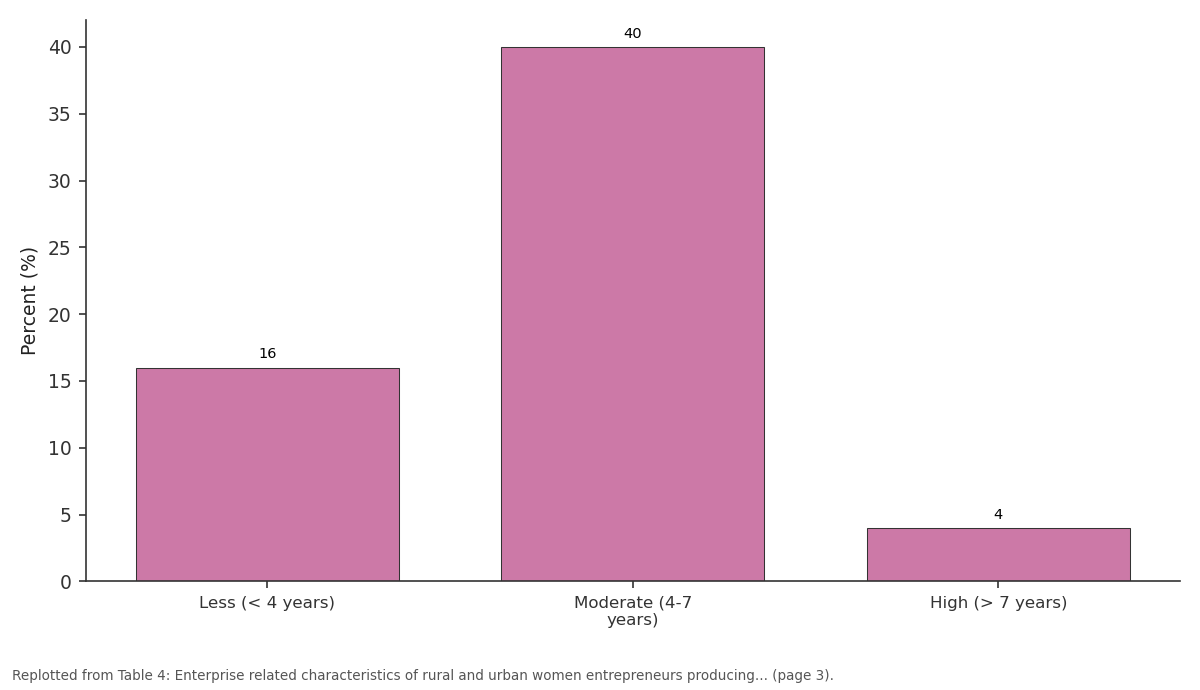
Total (n=60) / No (f): Less (< 4 years) vs Moderate (4-7 years) vs High (> 7 years)
Replotted from Table 4 (page 3) of the original paper. Every bar is the paper's own table value.
View source evidence ↗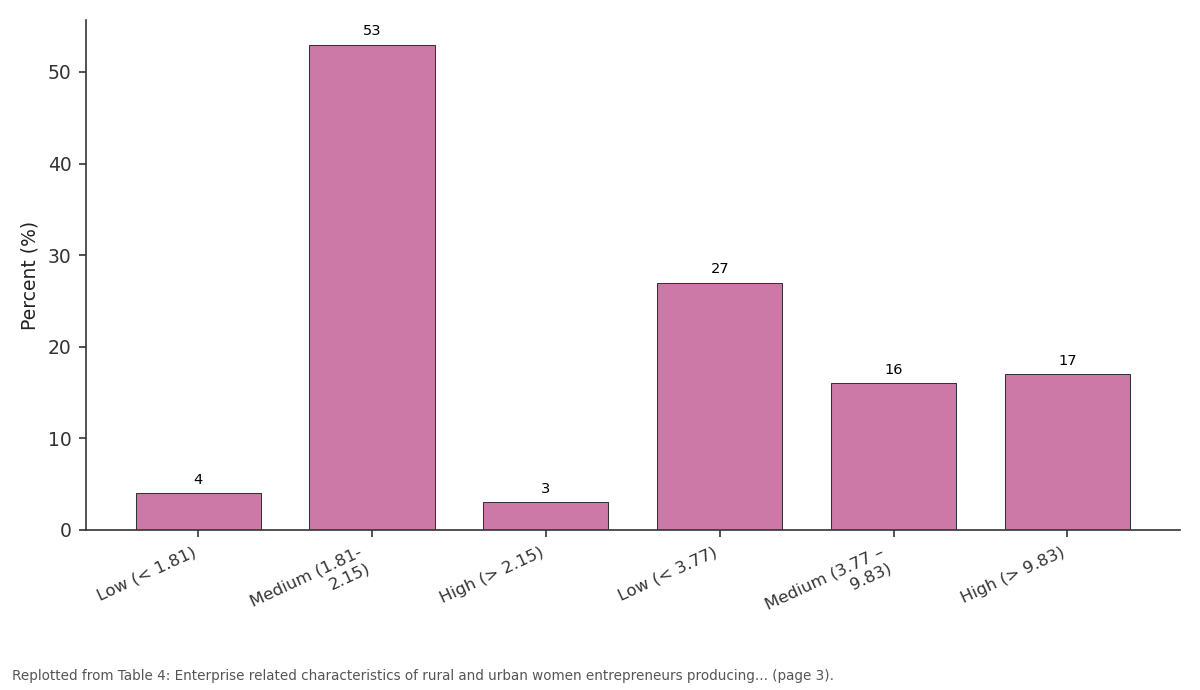
Total (n=60) / No (f): Low (< 1.81) vs Medium (1.81- 2.15) vs High (> 2.15) vs Low (< 3.77) vs Medium (3.77 – 9.83)
Replotted from Table 4 (page 3) of the original paper. Every bar is the paper's own table value.
View source evidence ↗Figures & tables
From the original paper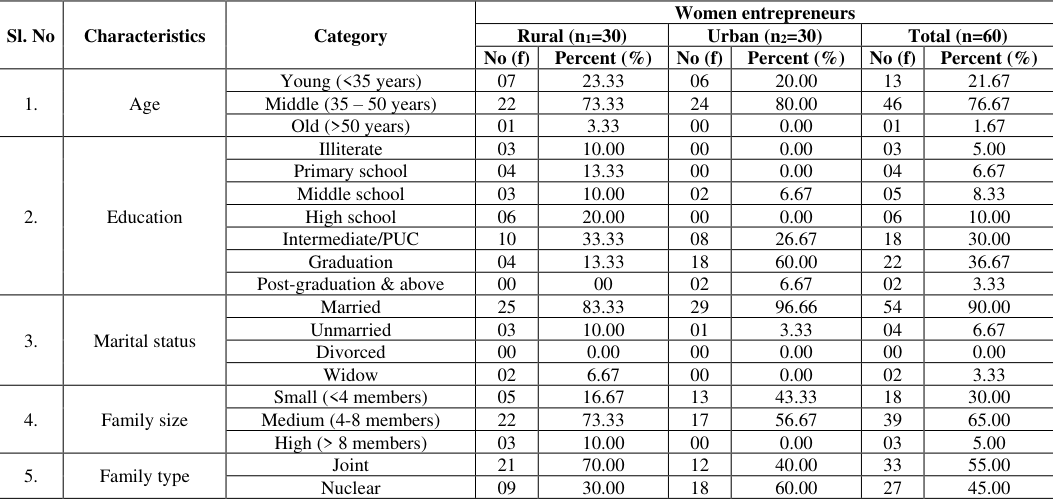 Table 1
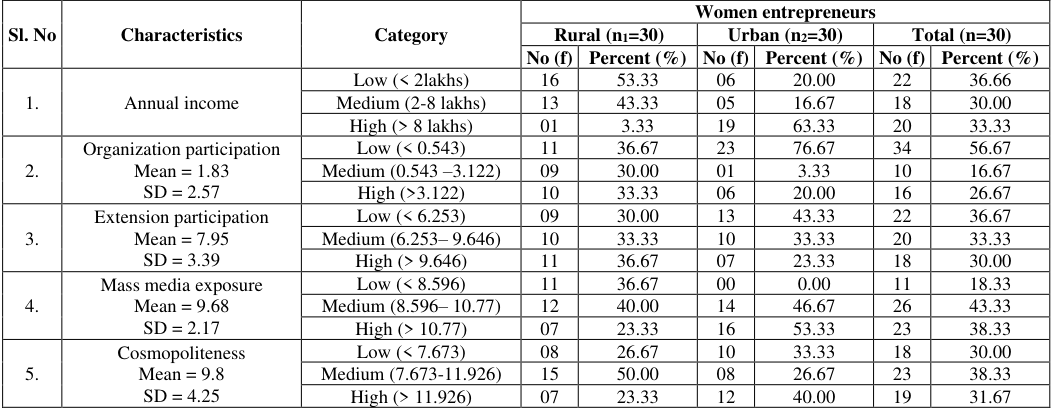 Table 2
 Table 3
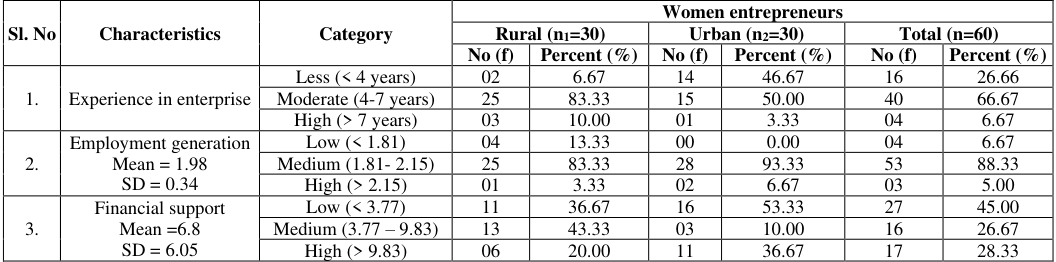 Table 4
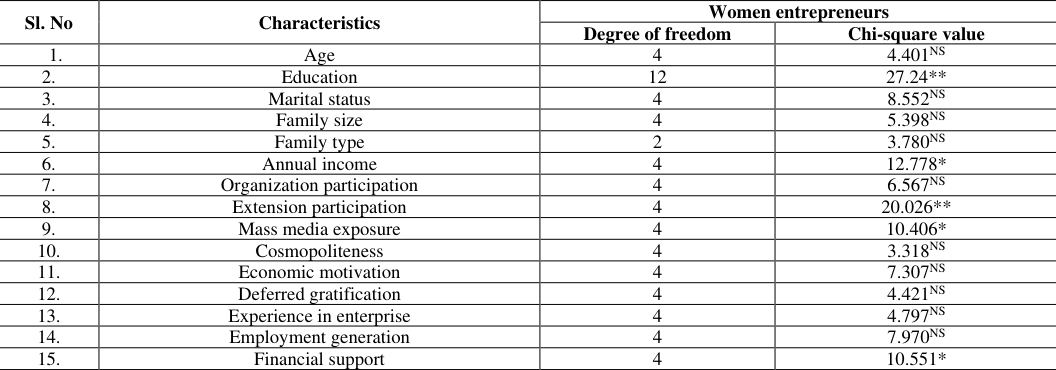 Table 5
Introduction
Entrepreneurship is the driving force behind economic activity and a critical component for growth. Entrepreneurship is responsible for activating, utilizing and coordinating various elements that contribute to economic growth and development. Entrepreneurship is the attitude of mind in taking measured risks with confidence in order to attain a defined business goal. It's about looking forward and spotting opportunities, forming a vision for the future of the company, innovating and taking risks. The concept of entrepreneurship is acknowledged as a function of several factors. Entrepreneurship is considered to be a composite variable meaning that people with entrepreneurial behavior may possess some specialized characteristics. Entrepreneurial behaviour has been defined as package of personality characteristics and environmental factors related to dynamic agent of change for transforming physical, natural and human resources into corresponding production possibilities (De.2010) [1] . Hence, considering the increasing importance of women entrepreneurship association of profile characteristics of women entreprenurs with their entrepreneurial behaviour was taken as one of the objective in the study entitled "Entrepreneurial behaviour of women producing value added products of millets in Bengaluru rural and urban districts".
Methodology
The study was conducted in Bengaluru rural and Bengaluru urban districts of Karnataka. Women entrepreneurs who were actively involved in the preparation of value-added products of millets and generating income majorly from this enterprise were selected. From each district, thirty women entrepreneurs were randomly selected constituting a sample of 60 women entrepreneurs for the study. Chi-square test (χ 2 test) was employed to find out the association between the profile characteristics of women entrepreneurs with their entrepreneurial behavior.
Hypothesis of the study
The study was conducted with the following null hypothesis ▪ There is no significance difference between entrepreneurial behaviour of women entrepreneurs. ▪ There is no association between personal, socioeconomic and psychological characteristics of women entrepreneurs with their entrepreneurial behaviour.
Results and Discussion
It is apparent from The association of 17 profile characteristics of women entrepreneurs with their entrepreneurial behaviour is presented in Table 5. Chi square test was applied to find out the association between the profile characteristics of both rural and urban women entrepreneurs with their entrepreneurial behaviour. The variable annual income, mass media exposure and financial support was found to have significant association with the entrepreneurial behaviour of women entrepreneurs at five Percent level of significance. Whereas, education and extension participation were found to be significant at one Percent level of significance. The remaining variables such as age, marital status, family type, family size, organization participation, cosmopoliteness, economic motivation, deferred gratification, experience in enterprise, employment generation were found to have non-significant association with entrepreneurial behaviour of women entrepreneurs. Financial support 4 10.551* ** Significant at 1% level of significance * Significant at 5% level of significance NS Non-significant www.extensionjournal.com
| Sl. No | Characteristics | Women entrepreneurs | — |
|---|---|---|---|
| Degree of freedom | Chi-square value | ||
| 1. | Age | 4 | 4.401NS |
| 2. | Education | 12 | 27.24** |
| 3. | Marital status | 4 | 8.552NS |
| 4. | Family size | 4 | 5.398NS |
| 5. | Family type | 2 | 3.780NS |
| 6. | Annual income | 4 | 12.778* |
| 7. | Organization participation | 4 | 6.567NS |
| 8. | Extension participation | 4 | 20.026** |
| 9. | Mass media exposure | 4 | 10.406* |
| 10. | Cosmopoliteness | 4 | 3.318NS |
| 11. | Economic motivation | 4 | 7.307NS |
| 12. | Deferred gratification | 4 | 4.421NS |
| 13. | Experience in enterprise | 4 | 4.797NS |
| 14. | Employment generation | 4 | 7.970NS |
| 15. | Financial support | 4 | 10.551* |
Table text extracted from the original PDF; superscript letters are shown inline. The original table image is below.
View original table image
The explanation for the profile characteristics of women entrepreneurs having significance to high significant association with the entrepreneurial behaviour is presented in the ensuring paragraphs.
Education and entrepreneurial behvaiour
Chi-square test indicates a significant association at one Percent level of significance between education and entrepreneurial behaviour of women entrepreneurs. The probable reason might be the advantages that an individual gets from education through knowledge acquisition, motivation towards higher accomplishment and broadening of the vision. Literate women entrepreneurs have the ability to gather, interpret and use information in an appropriate manner. Education helps an individual in proper planning, precise decision making and managing the production and marketing activities.
Annual income and entrepreneurial behvaiour
The chi-square analysis was showed significant association between annual income and entrepreneurial behaviour at five Percent level of significance. The reason might be that respondents with more annual income would have more opportunities and potentialities to try and adopt variety of technological innovations. As a result, it is quite possible that women entrepreneurs with more annual income show keen interest in investing in the enterprise.
Extension participation and entrepreneurial behvaiour
The chi square test revealed a significant association between extension participation and entrepreneurial behaviour of women entrepreneurs at one Percent level of significance. Extension participation exposes women entreprneurs to new practices and methods with a quest to gain knowledge and develop entrepreneurial ability to obtain higher returns and profit in the enterprise. Because, greater participation in extension activities helps the respondents to gather information from different sources.
Mass media exposure and entrepreneurial behvaiour
Chi-square test revealed a significant association at five Percent level between mass media exposure and entrepreneurial behaviour of women entrepreneurs. The mass media play a vital role in diffusion of information. The mass media participation develops modern orientation among women entrepreneurs, making them more efficient in acquiring knowledge, awareness, retaining and evaluating the effectiveness of an entrepreneur. Women entrepreneurs with high mass media exposure are able to get acquainted with knowledge of improved technologies and marketing aspects which help them for proper planning and decision making in taking up farm operations.
Financial support and entrepreneurial behvaiour
The chi-square analysis was found to have significant association between financial support and entrepreneurial behaviour of women entrepreneurs at five Percent level. Financial support allows entrepreneurs to estimate the quantity and the timing of money needed to start their venture and keep it running and also securing funds for longer-term investments. It also makes sure that there are enough funds to operate and that the respondents are spending and investing wisely.
Conclusion
The study reveals that middle-aged, married women with moderate entrepreneurial experience dominate both rural and urban entrepreneurship in millet value-added products, with urban women generally better educated and earning higher incomes. Key factors such as education, annual income, extension participation, mass media exposure, and financial support significantly influence entrepreneurial behavior, with education and extension participation being particularly impactful. There is difference among the women entrepreneurs with respect to the entrepreneurial behaviour, hence the set forth hypothesis i.e., There is no difference among the women entrepreneurs with respect to the entrepreneurial behaviour is rejected. The variables which are significant with entrepreneurial behaviour of women entrepreneurs need to be focused and strengthened in order to increase the efficiency in production, management and marketing of millets value-added products of millets.
Figures and tables from the paper
| Sl. No | Characteristics | Category | Women entrepreneurs | — | — | — | — | — |
|---|---|---|---|---|---|---|---|---|
| Rural (n1=30) | Urban (n2=30) | Total (n=60) | ||||||
| No (f) | Percent (%) | No (f) | Percent (%) | No (f) | Percent (%) | |||
| 1. | Age | Young (<35 years) | 07 | 23.33 | 06 | 20.00 | 13 | 21.67 |
| Middle (35 – 50 years) | 22 | 73.33 | 24 | 80.00 | 46 | 76.67 | ||
| Old (>50 years) | 01 | 3.33 | 00 | 0.00 | 01 | 1.67 | ||
| 2. | Education | Illiterate | 03 | 10.00 | 00 | 0.00 | 03 | 5.00 |
| Primary school | 04 | 13.33 | 00 | 0.00 | 04 | 6.67 | ||
| Middle school | 03 | 10.00 | 02 | 6.67 | 05 | 8.33 | ||
| High school | 06 | 20.00 | 00 | 0.00 | 06 | 10.00 | ||
| Intermediate/PUC | 10 | 33.33 | 08 | 26.67 | 18 | 30.00 | ||
| Graduation | 04 | 13.33 | 18 | 60.00 | 22 | 36.67 | ||
| Post-graduation & above | 00 | 00 | 02 | 6.67 | 02 | 3.33 | ||
| 3. | Marital status | Married | 25 | 83.33 | 29 | 96.66 | 54 | 90.00 |
| Unmarried | 03 | 10.00 | 01 | 3.33 | 04 | 6.67 | ||
| Divorced | 00 | 0.00 | 00 | 0.00 | 00 | 0.00 | ||
| Widow | 02 | 6.67 | 00 | 0.00 | 02 | 3.33 | ||
| 4. | Family size | Small (<4 members) | 05 | 16.67 | 13 | 43.33 | 18 | 30.00 |
| Medium (4-8 members) | 22 | 73.33 | 17 | 56.67 | 39 | 65.00 | ||
| High (> 8 members) | 03 | 10.00 | 00 | 0.00 | 03 | 5.00 | ||
| 5. | Family type | Joint | 21 | 70.00 | 12 | 40.00 | 33 | 55.00 |
| Nuclear | 09 | 30.00 | 18 | 60.00 | 27 | 45.00 |
Table text extracted from the original PDF; superscript letters are shown inline. The original table image is below.
View original table image
| Sl. No | Characteristics | Category | Women entrepreneurs | — | — | — | — | — |
|---|---|---|---|---|---|---|---|---|
| Rural (n1=30) | Urban (n2=30) | Total (n=30) | ||||||
| No (f) | Percent (%) | No (f) | Percent (%) | No (f) | Percent (%) | |||
| 1. | Annual income | Low (< 2lakhs) | 16 | 53.33 | 06 | 20.00 | 22 | 36.66 |
| Medium (2-8 lakhs) | 13 | 43.33 | 05 | 16.67 | 18 | 30.00 | ||
| High (> 8 lakhs) | 01 | 3.33 | 19 | 63.33 | 20 | 33.33 | ||
| 2. | Organization participation Mean = 1.83 SD = 2.57 | Low (< 0.543) | 11 | 36.67 | 23 | 76.67 | 34 | 56.67 |
| Medium (0.543 –3.122) | 09 | 30.00 | 01 | 3.33 | 10 | 16.67 | ||
| High (>3.122) | 10 | 33.33 | 06 | 20.00 | 16 | 26.67 | ||
| 3. | Extension participation Mean = 7.95 SD = 3.39 | Low (< 6.253) | 09 | 30.00 | 13 | 43.33 | 22 | 36.67 |
| Medium (6.253– 9.646) | 10 | 33.33 | 10 | 33.33 | 20 | 33.33 | ||
| High (> 9.646) | 11 | 36.67 | 07 | 23.33 | 18 | 30.00 | ||
| 4. | Mass media exposure Mean = 9.68 SD = 2.17 | Low (< 8.596) | 11 | 36.67 | 00 | 0.00 | 11 | 18.33 |
| Medium (8.596– 10.77) | 12 | 40.00 | 14 | 46.67 | 26 | 43.33 | ||
| High (> 10.77) | 07 | 23.33 | 16 | 53.33 | 23 | 38.33 | ||
| 5. | Cosmopoliteness Mean = 9.8 SD = 4.25 | Low (< 7.673) | 08 | 26.67 | 10 | 33.33 | 18 | 30.00 |
| Medium (7.673-11.926) | 15 | 50.00 | 08 | 26.67 | 23 | 38.33 | ||
| High (> 11.926) | 07 | 23.33 | 12 | 40.00 | 19 | 31.67 |
Table text extracted from the original PDF; superscript letters are shown inline. The original table image is below.
View original table image
| Sl. No | Characteristics | Category | Women entrepreneurs | — | — | — | — | — |
|---|---|---|---|---|---|---|---|---|
| Rural (n1=30) | Urban (n2=30) | Total (n=60) | ||||||
| No (f) | Percent (%) | No (f) | Percent (%) | No (f) | Percent (%) | |||
| 1. | Economic motivation Mean = 21.11 SD = 1.16 | Low (< 20.53) | 04 | 13.33 | 00 | 0.00 | 04 | 6.67 |
| Medium (20.53 – 21.69) | 08 | 26.67 | 10 | 33.33 | 18 | 30.00 | ||
| High (> 21.69) | 18 | 60.00 | 20 | 66.67 | 38 | 63.33 | ||
| 2. | Deferred gratification Mean = 33.61 SD = 2.83 | Low (< 32.19) | 07 | 23.33 | 13 | 43.33 | 20 | 33.33 |
| Medium (32.19 – 35.03) | 13 | 43.33 | 10 | 33.33 | 23 | 38.33 | ||
| High (> 35.03) | 10 | 33.33 | 07 | 23.33 | 17 | 28.33 |
Table text extracted from the original PDF; superscript letters are shown inline. The original table image is below.
View original table image
| Sl. No | Characteristics | Category | Women entrepreneurs | — | — | — | — | — |
|---|---|---|---|---|---|---|---|---|
| Rural (n1=30) | Urban (n2=30) | Total (n=60) | ||||||
| No (f) | Percent (%) | No (f) | Percent (%) | No (f) | Percent (%) | |||
| 1. | Experience in enterprise | Less (< 4 years) | 02 | 6.67 | 14 | 46.67 | 16 | 26.66 |
| Moderate (4-7 years) | 25 | 83.33 | 15 | 50.00 | 40 | 66.67 | ||
| High (> 7 years) | 03 | 10.00 | 01 | 3.33 | 04 | 6.67 | ||
| 2. | Employment generation Mean = 1.98 SD = 0.34 | Low (< 1.81) | 04 | 13.33 | 00 | 0.00 | 04 | 6.67 |
| Medium (1.81- 2.15) | 25 | 83.33 | 28 | 93.33 | 53 | 88.33 | ||
| High (> 2.15) | 01 | 3.33 | 02 | 6.67 | 03 | 5.00 | ||
| 3. | Financial support Mean =6.8 SD = 6.05 | Low (< 3.77) | 11 | 36.67 | 16 | 53.33 | 27 | 45.00 |
| Medium (3.77 – 9.83) | 13 | 43.33 | 03 | 10.00 | 16 | 26.67 | ||
| High (> 9.83) | 06 | 20.00 | 11 | 36.67 | 17 | 28.33 |
Table text extracted from the original PDF; superscript letters are shown inline. The original table image is below.
View original table image
References
3 in the original paper- Nishu Kanwar Bhati, Rajshree Upadhyay. Association of entrepreneurial behaviour with personal and socioeconomic characteristics of rural women in dairying. International Journal of Science, Environment and Technology. 2016;5(4):2010-2615.
- Patel MM, Sanoria YC. Correlation of entrepreneurial behaviour of sugarcane growers. Maharashtra Journal of Extension Education. 1997;16:344-346.
- Siddeshwari GK, Sathya Gopal PV, Sailaja V, Ravindra Reddy B. Association between entrepreneurial behaviour and current entrepreneurial status of the women entrepreneurs of self-help groups in Andhra Pradesh. Current Journal of Applied Science and Technology. 2020;39(4):73-77.