
Research article · 2024 · Full text
International Journal of Agriculture Extension and Social DevelopmentAn Assessment of challenges faced by farmers in receiving agro services from input dealers: A comprehensive study
Volume 7(8) · Pages 465–468 · DOI: 10.33545/26180723.2024.v7.i8g.970 ↗
Research areasAgricultural Economics and Practices
Abstract
Author-writtenThe present study was carried out in Nagar Kurnool and Wanaparthy districts of Telangana state to find out the problems being faced by the farmers in receiving agro services from the input dealers. Garett ranking was employed to study the problems which were categorised into technical, market related, financial and social problems. The findings of the study revealed that staff working in the input shops do not have proper knowledge of the products being sold ranked first among various technical problems faced by the farmers while purchasing the inputs (Garett Mean Score - 68). Among market related problems, unavailability of the required inputs during offseason was the first and foremost problem faced by farmers while purchasing inputs from the input dealers (Garett Mean Score - 66.71). Obtaining crop loans from banks was a tiresome process and input dealers are biased towards large farmers were ranked first among financial problems and social problems respectively. These findings underscore the need for targeted interventions to improve the knowledge and skills of input dealers, enhance supply chain management, simplify financial processes, and address social inequities in the provision of agro services.
Summary
Source-checkedPlain-language reading of the full paper, prepared with AI and checked against the text. Each point links to the authors' own words.
Why it matters
- Input dealers are essential intermediaries that provide farmers with necessary agricultural products and guidance. View evidence ↗
- Farmers have reported issues like misinformation and high costs when dealing with input dealers, which reduces trust in these services. View evidence ↗
- Challenges in receiving agro services can prevent farmers from adopting modern practices and make it harder to sustain their farming activities. View evidence ↗
The question
- The study aims to identify the specific problems farmers face when receiving agro services from input dealers. View evidence ↗
What they did
- The research used an Ex-Post facto design and was conducted in 2023 within the Wanaparthy and Nagar Kurnool districts of Telangana state. View evidence ↗
- The study sampled 120 farmers in total, with 60 farmers randomly selected from three mandals in each of the two districts. View evidence ↗
- Data was gathered via personal interviews using a specific schedule and analyzed using the Garrett ranking method. View evidence ↗
What they found
- The most significant technical problem was the lack of product knowledge among shop staff, which had a Garrett Mean Score of 68. View evidence ↗
- The primary market-related challenge was the unavailability of required inputs during the offseason, with a Garrett Mean Score of 66.71. View evidence ↗
- The top financial problem was the tiresome process of obtaining bank crop loans, and the top social problem was dealer bias toward large farmers. View evidence ↗
What it means
- The authors conclude that resolving these multi-dimensional challenges is essential for creating a more efficient and equitable input delivery system to improve farmer livelihoods. View evidence ↗
Visual summary
3 visualsIllustrations explain the paper; charts are replotted from the paper's own table values.
Categorization of Farmer Challenges
AI-generated conceptual illustration (small-scale farmers and agricultural input shops). It explains the idea and does not show study data.
View source evidence ↗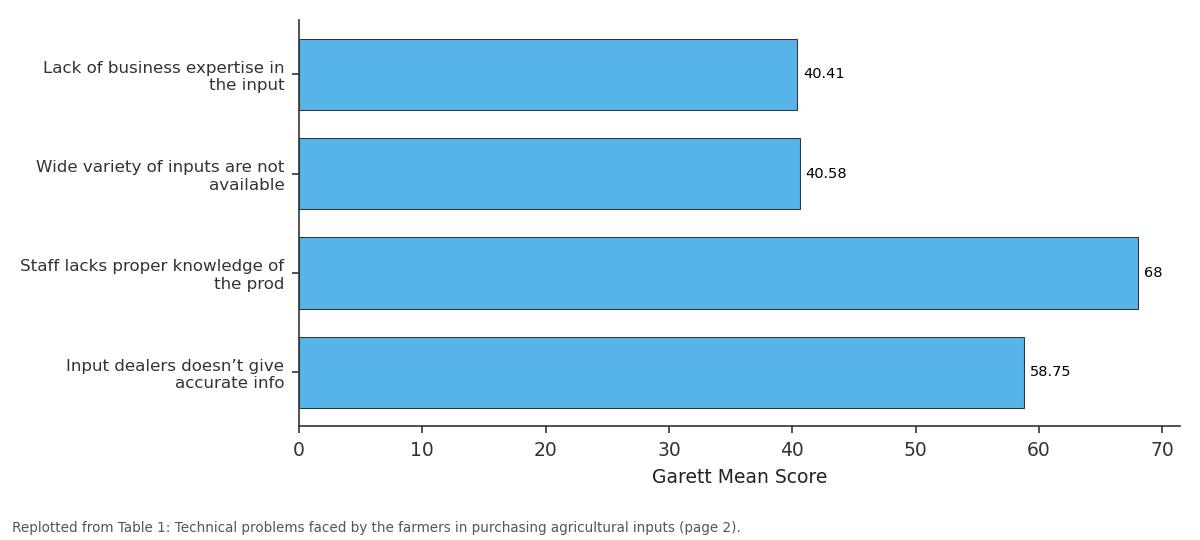
Garett Mean Score: Lack of business... vs Wide variety of inputs... vs Staff lacks proper... vs Input dealers doesn’t...
Replotted from Table 1 (page 2) of the original paper. Every bar is the paper's own table value.
View source evidence ↗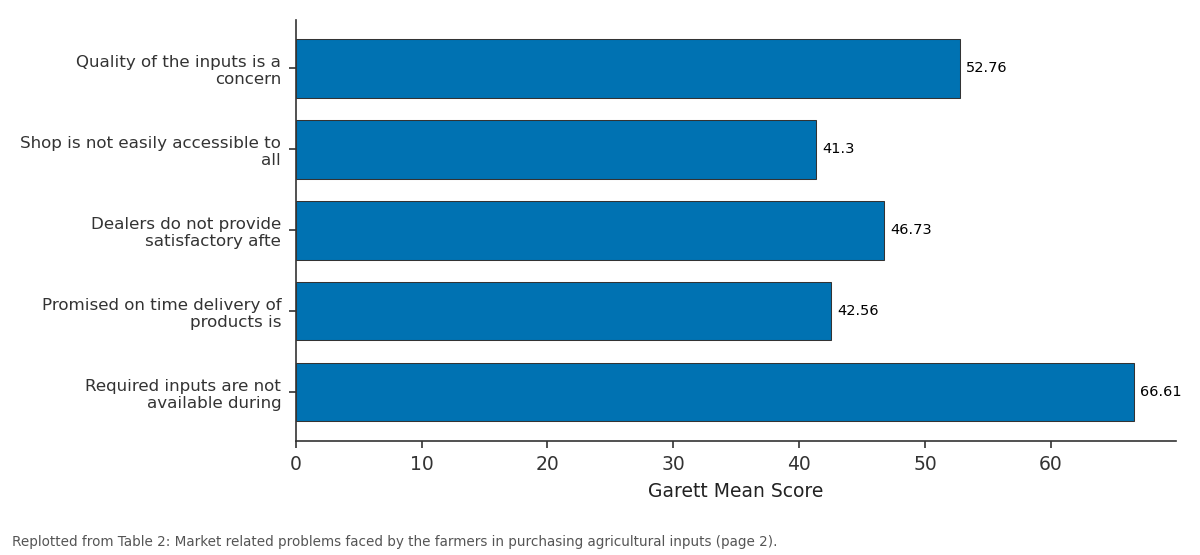
Garett Mean Score: Quality of the inputs... vs Shop is not easily... vs Dealers do not provide... vs Promised on time... vs Required inputs are not...
Replotted from Table 2 (page 2) of the original paper. Every bar is the paper's own table value.
View source evidence ↗Figures & tables
From the original paper Table 1
 Table 2
 Table 3
 Table 4
Introduction
Dominance of agriculture and allied sectors in Indian economy since ages needs no special mention (Kumar et al., 2024; Chauhan et al., 2022) [10,5] . From traditional subsistence-oriented agriculture to a commercial one, Indian agriculture has gone through many gradual changes. In the rapidly evolving landscape of agriculture, the role of agroadvisory services has become increasingly vital. These services provide farmers with essential information and guidance on various aspects of farming, including crop management, pest control, irrigation, and market trends. According to Christoplos (2010) [6] agricultural extension is a system that facilitate the access of farmers, their organizations and other market actors to knowledge, information and technologies; facilitate their interaction with partner in research, education, agri-business and other relevant institution; and assist them to develop their own technical, organizational and management skills and practices". Agricultural extension service role in India is being played by several actors like public and private extension systems. Public extension services are managed by state agricultural departments and the Directorate of Extension at the national level. The Indian Council of Agricultural Research (ICAR) and its institutes, along with Krishi Vigyan Kendra's (KVKs), as well as State Agricultural Universities (SAUs) through their research stations and KVKs, facilitate frontline extension at the district level. On the other hand, private extension services are primarily provided by companies that market agricultural inputs such as seeds, fertilizers, pesticides, and farm machinery, often delivered through their dealers, marketing personnel, and contact farmers. Among private extension sources, input dealers play a crucial role in terms of credibility among farmers (Babu et al., 2012; Khose, 2004) [3,9] . The success of farming activities largely depends on the timely and efficient delivery of agro services, particularly those provided by input dealers (Manasa et al., 2023) [11] . These services include the supply of seeds, fertilizers, pesticides, and other essential inputs that are crucial for crop production. Despite the importance of these services, farmers often encounter various challenges when dealing with input dealers, which can negatively impact their productivity and overall well-being. Input dealers serve as the primary link between farmers and the agricultural input market, making their role crucial in ensuring that farmers have access to quality products and relevant advice. However, several issues, such as lack of transparency, misinformation, high costs, and limited access to credit, have been reported by farmers, leading to dissatisfaction and reduced trust in the services provided by these dealers. These challenges not only hinder the adoption of modern farming practices but also exacerbate the difficulties faced by farmers in sustaining their agricultural activities. This study aims to explore the specific problems that farmers encounter when receiving agro services from input dealers.
Methodology
The Present study was conducted using Ex-Post facto research design during 2023 in Nagar Kurnool and Wanaparthy districts of Telangana state which were www.extensionjournal.com randomly selected for the purpose of the study. Under Nagar Kurnool district, Nagar Kurnool, Achampet and Kalwakurthy were randomly selected with 20 farmers from each mandal making a total of 60 farmers from the district. Similarly, under Wanaparthy district, Wanaparthy, Gopalpet and Pebbair were selected randomly with 20 farmers from each mandal making a total of 60 farmers again. Thus, the total sample size equals to 120. Data was collected with a specially designed interview schedule through personal interview method. The data collected was tabulated and analysed using Garrett ranking method.
Results and Discussion
Results and Discussion
Problems faced by the farmers in receiving Agro Services from Input dealers
The problems faced by the farmers in receiving agro services from the input dealers were studied under different heads like technical problems, market related problems, financial problems, social problems
Technical problems
The findings from Table 1 reveal that, staff working in the input shops do not have proper knowledge of the products being sold ranked first among various technical problems faced by the farmers while purchasing the inputs. It might be due to the reason that these workers end up working for low wages in these shops usually comes from low education background. Second most expressed problem was that input dealers doesn't give accurate information on crop queries followed by the third problem wide variety of inputs are not available in the shop. This emphasizes the need for training the input dealers in various crop related aspects to help update them with necessary information and upgrade their skills. Similar findings were given by Agashe et al., 2023 [1] ; Bamigboye, & Adeniji, 2022 [2] . Least complained problem was that the business dealers do not have enough business expertise. This is in agreement with the findings of Agashe et al., 2023 [1] that the input dealers had a medium level of business expertise
| S. No. | Technical related problems | Total Garett | Garett Mean Score | Rank |
|---|---|---|---|---|
| 1. | Lack of business expertise in the input dealer | 2425 | 40.41 | IV |
| 2. | Wide variety of inputs are not available in the shop | 2435 | 40.58 | III |
| 3. | Staff lacks proper knowledge of the products | 4080 | 68 | I |
| 4. | Input dealers doesn’t give accurate information on crop queries | 3525 | 58.75 | II |
Table text extracted from the original PDF; superscript letters are shown inline. The original table image is below.
View original table image
Market related problems
An analysis of Table 2 unfolds that unavailability of the required inputs during offseason was the first and foremost problem faced by farmers while purchasing inputs from the input dealers. This might be because during off season, farmers might be engaged in non-agricultural activities and there won't be enough business activity for the dealers.
| S. No. | Market related problems | Total Garett | Garett Mean Score | Rank |
|---|---|---|---|---|
| 1. | Quality of the inputs is a concern | 3216 | 52.76 | IV |
| 2. | Shop is not easily accessible to all | 2438 | 41.30 | V |
| 3. | Dealers do not provide satisfactory after support to the farmers | 2664 | 46.73 | III |
| 4. | Promised on time delivery of products is lacking | 2570 | 42.56 | II |
| 5. | Required inputs are not available during offseason | 4001 | 66.61 | I |
Table text extracted from the original PDF; superscript letters are shown inline. The original table image is below.
View original table image
Lack of promised on time delivery of inputs and dealers do not provide satisfactory after support to the farmers were ranked 2 nd and 3 rd . The concern for quality inputs was ranked 4 th and that shop is not easily accessible to all ranked 5 th among other market related problems. Similar findings were reported by Deepa et al., 2021 [7] .
Financial problems
The results obtained from Table 3 depicts that obtaining crop loans from banks as a tiresome process was ranked as the first problem concerning the farmers. Second most problem expressed was that heavy prices are charged for the inputs and third was that input dealers don't sell products on credit. Input dealers expressed that they get a very low margin for the agricultural inputs and hence they can't give sell them at heavy discounts to the farmers. They also mentioned that late repayment by the farmers is a very serious problem being faced by them and hence they discontinued selling the inputs on credit basis (Reddy et al., 2020) [12] . Lastly, input dealers not hiring machinery/ implements was complained as the 4 th problem of all. The possible reason for this might be that there were custom hiring centres in the state that offer farm implements on hire at nominal costs to the farmers. So, the input dealers might not be renting the implements because of low demand from the farmers (Kadaraiah et al., 2022) [8] .
| S. No. | Financial problems | Total Garett | Garett Mean Score | Rank |
|---|---|---|---|---|
| 1. | Input dealers don’t sell products on credit. | 2852 | 47.53 | III |
| 2. | Obtaining crop loans from banks is a tiresome process | 3702 | 61.7 | I |
| 3. | Heavy prices are charged for the inputs | 3293 | 54.88 | II |
| 4. | Input dealers don’t hire machinery/ implements | 2153 | 35.88 | IV |
Table text extracted from the original PDF; superscript letters are shown inline. The original table image is below.
View original table image
Conclusion
The study provides a comprehensive analysis of the various challenges faced by farmers in receiving agro services from input dealers, categorized under technical, market-related, financial, and social problems. The most significant technical issue identified is the lack of proper knowledge among the staff working in input shops along with farmers concern over the inaccuracy of information provided by input dealers. Market-related challenges are led by the unavailability of required inputs during the offseason, indicating a gap in the supply chain during critical periods.
Concerns over the quality of inputs and the accessibility of shops to all farmers were also highlighted, underscoring the need for improvements in market dynamics and infrastructure. The financial hurdles encountered by farmers are dominated by the cumbersome process of obtaining crop loans from banks. High input prices and the reluctance of input dealers to sell products on credit further strain the financial resources of farmers. Social challenges reveal a troubling bias among input dealers towards large farmers, with caste-based discrimination also being a significant issue. The lack of empathy and friendliness from input dealers towards farmers further exacerbates the social divide, creating an environment of distrust and inequality in the provision of agro services. Addressing these technical, market, financial, and social issues, is very important to make the agricultural input delivery system more efficient, equitable, and farmer-friendly which ultimately leads to better agricultural outcomes and improved livelihoods for farmers. Hence, an attempt was made to provide some suggestions based on the study which were mentioned below.
Capacity building for input dealers:
Training programs should be developed to enhance the knowledge and technical skills of input dealers and their staff. These programs should cover crop-related aspects, product knowledge, and customer service skills to ensure that farmers receive accurate and helpful advice.
Supply chain improvements:
To address the unavailability of inputs during the offseason, efforts should be made to strengthen supply chain management. Input dealers could be encouraged to maintain a more consistent stock of inputs throughout the year, possibly through incentives or support from the government or agricultural organizations.
Financial support reforms:
Simplifying the process of obtaining crop loans and offering more flexible financial products could alleviate the financial strain on farmers. Additionally, input dealers could be encouraged or incentivized to offer credit options to farmers, especially small-scale ones, to ensure they can access necessary inputs without immediate financial pressure.
References
10 in the original paper- Agashe R, Agashe DR, Dhuware SR, Waskel SL. Training need of agricultural input dealers in transfer of agricultural technology. J Krishi Vigyan. 2023;11(2):361-366.
- Bamigboye OT, Adeniji OB. Effectiveness of agrodealers services on farmers' access to agricultural inputs in South-West Nigeria. Socio Econ Policy Stud. 2022;2(2):63-69.
- Chandhana B, Kumar GDS, Sengar RS. Development of scale to measure sunflower farmers' perception on public and private extension systems. Indian J Ext Educ. 2022;58(3):197-200.
- Chauhan JK, Meena BS, Meena HR, Bhakat C, Upadhyay AD, Lahiri B, et al. Assessment of livelihood security and diversification of tribal dairy farmers in NEH region of India. Indian Res J Ext Educ. www.extensionjournal.com 2022;22(3):182-187.
- Deepa C, Sathyagopal PV, Lakshmi T, Hemalatha S. Constraints faced by the rice farmers in input utilization and suggestions to overcome them. Int J Farm Sci. 2021;11(1, 2):80-83.
- Kadaraiah A, Jirli B, Yarazari SP, Nandini HM, Chaubey PN. Perception of farmers towards custom hiring service centres in Tumakuru district of Karnataka. Indian J Ext Educ. 2022;58(2):209-212.
- Khose. Exploratory assessment of the Macao casino dealers job perceptions. Zonal conference, RABI-200405. Fertilizer Marketing News. 2004;35(1):7-8.
- Kumar V, Chauhan JK, Upadhayay AD, Pal P, Lahiri B, Ghosh A, Chandegara AK. Assessment of training effectiveness for fish farmers of Tripura. Indian Res J Ext Educ. 2024;24(2):10-18.
- Manasa K, Jirli B, Srishailam B, Ravi G. A critical study on availability of agricultural inputs with the agri input dealers of Nagarkarnool and Wanaparthy districts of Telangana State, India. Asian J Agric. Ext Econ Sociol. 2023;41(3):61-68.
- Reddy UKK, Gopal PS, Sailaja V, Prasad SV. Constraints faced by agri-input dealers and their suggestions. Andhra Agric J. 2020;67(2):113-115.
Social problems
Table 4 gives a glimpse of the social problems faced by the farmers while purchasing the agricultural inputs. Among all input dealers are biased towards large farmers received the first rank with highest Total Garett score (3781) and the highest Garett Mean Score (63.02), which suggests that farmers perceive bias towards large farmers as the most severe or important social problem.
Table text extracted from the original PDF; superscript letters are shown inline. The original table image is below.
View original table image
Second most complained was that Input dealers discriminate farmers based on caste which indicates prevalence of castebased discrimination in the study area. Input dealers are not empathetic towards the farmers ranked III and Input dealers are not friendly with the farmers is ranked IV indicating that while this issue is still important, it was perceived as less severe compared to the others.