Scinovex

Research article · 2024 · Full text

International Journal of Agriculture Extension and Social Development

Understanding the trends of agricultural extension research in India through bibliometric analysis

Keesam ManasaSidharth SenB. Srishailam

Volume 7(8) · Pages 459–464 · DOI: 10.33545/26180723.2024.v7.i8g.969 ↗

Research areasAgricultural Economics and PracticesAgricultural Innovations and PracticesAgricultural Systems and Practices

↓ Read full-text PDF0 citations

Abstract

Author-written

This study conducts a bibliometric analysis of agricultural extension research from January 2015 to August 2024, aiming to map the evolution, key contributors, and emerging trends within the field. Utilizing data from the dimension.ai database, the analysis covers publication counts, citation metrics, keyword co-occurrence, and journal contributions. Results show a notable increase in research output, peaking in 2022, with a subsequent decline in 2023 and 2024. The Asian Journal of Agricultural Extension Economics & Sociology leads in publication volume, while Sustainability stands out for its high citation count, reflecting its significant influence. Key research domains include Human Society and Agricultural Sciences, with high-impact keywords such as Knowledge and Food Security. The study identifies influential publications and trends, providing insights into the field's growth and areas needing further exploration. The findings underscore the importance of continuing to align research with the evolving needs of the agricultural sector and highlight the value of bibliometric analysis in shaping future research directions.

Summary

Source-checked

Plain-language reading of the full paper, prepared with AI and checked against the text. Each point links to the authors' own words.

  1. Why it matters

    • Agricultural extension research is essential for improving sustainability and productivity in farming, particularly within the diverse agricultural landscape of India. View evidence ↗

      Why it matters

      Agricultural extension research is essential for improving sustainability and productivity in farming, particularly within the diverse agricultural landscape of India.

      In the paper's own words

      “Agricultural extension research is pivotal in advancing agricultural productivity and sustainability, especially in diverse agrarian contexts such as India.”

      Page 1

      Found in: Introduction

      Read it in the full textOpen PDF at page 1 ↗
    • The core purpose of agricultural extension is to provide farmers with the knowledge, technologies, and best practices needed to improve their livelihoods and productivity. View evidence ↗

      Why it matters

      The core purpose of agricultural extension is to provide farmers with the knowledge, technologies, and best practices needed to improve their livelihoods and productivity.

      In the paper's own words

      “Agricultural extension involves disseminating knowledge, technologies, and best practices to farmers to enhance their skills, productivity, and livelihoods”

      Page 1

      Found in: Introduction

      Read it in the full textOpen PDF at page 1 ↗
    • Bibliometric analysis is used as a quantitative method to identify patterns, trends, and gaps in academic literature within a specific field. View evidence ↗

      Why it matters

      Bibliometric analysis is used as a quantitative method to identify patterns, trends, and gaps in academic literature within a specific field.

      In the paper's own words

      “Bibliometric analysis serves as a valuable tool for this purpose, offering a quantitative approach to examining academic literature and uncovering patterns, trends, and insights within a specific research domain”

      Page 1

      Found in: Introduction

      Read it in the full textOpen PDF at page 1 ↗
  2. The question

    • The study aims to provide a detailed overview of agricultural extension research from January 2015 to June 2024 by analyzing publication trends, journals, research domains, and keywords. View evidence ↗

      The question

      The study aims to provide a detailed overview of agricultural extension research from January 2015 to June 2024 by analyzing publication trends, journals, research domains, and keywords.

      In the paper's own words

      “This study employs bibliometric methods to analyze agricultural extension research from January 2015 to June 2024, examining publication trends, author networks, research domains, leading journals, and frequently used keywords to provide a detailed overview of the field’s current state and future directions.”

      Page 1

      Found in: Introduction

      Read it in the full textOpen PDF at page 1 ↗
  3. What they did

    • The researchers retrieved data from the dimension.ai database for the period between January 2015 and August 2024 using the search term 'Agricultural extension'. View evidence ↗

      What they did

      The researchers retrieved data from the dimension.ai database for the period between January 2015 and August 2024 using the search term 'Agricultural extension'.

      In the paper's own words

      “All research output was retrieved from the dimension.ai database between January 2015 and August 2024 by searching for Agricultural extension.”

      Page 1

      Found in: Materials and Methods

      Read it in the full textOpen PDF at page 1 ↗
    • Data analysis was performed using MS Excel, a Word Cloud generator, and VOS viewer. View evidence ↗

      What they did

      Data analysis was performed using MS Excel, a Word Cloud generator, and VOS viewer.

      In the paper's own words

      “The data were analysed using MS Excel, Word Cloud generator, and VOS viewer.”

      Page 1

      Found in: Materials and Methods

      Read it in the full textOpen PDF at page 1 ↗
    • The final analysis was based on a total of 50,619 articles identified through the systematic search. View evidence ↗

      What they did

      The final analysis was based on a total of 50,619 articles identified through the systematic search.

      In the paper's own words

      “The analysis included 50,619 articles discovered through a systematic search on Agricultural Extension Research.”

      Page 1

      Found in: Materials and Methods

      Read it in the full textOpen PDF at page 1 ↗
  4. What they found

    • Research output grew steadily from 2,735 publications in 2015 to a peak of 7,185 publications in 2022. View evidence ↗

      What they found

      Research output grew steadily from 2,735 publications in 2015 to a peak of 7,185 publications in 2022.

      In the paper's own words

      “Starting with 2,735 publications in 2015, the field saw steady growth, peaking at 7,185 publications in 2022.”

      Page 2

      Found in: Results and Discussion Distribution of agricultural extension research publications by year

      Read it in the full textOpen PDF at page 2 ↗
    • Following the peak, publication counts declined to 6,882 in 2023 and further to 3,720 in 2024. View evidence ↗

      What they found

      Following the peak, publication counts declined to 6,882 in 2023 and further to 3,720 in 2024.

      In the paper's own words

      “The slight decline to 6,882 publications in 2023 and the more noticeable drop to 3,720 in 2024 may indicate a shift in research priorities”

      Page 2

      Found in: Results and Discussion Distribution of agricultural extension research publications by year

      Read it in the full textOpen PDF at page 2 ↗
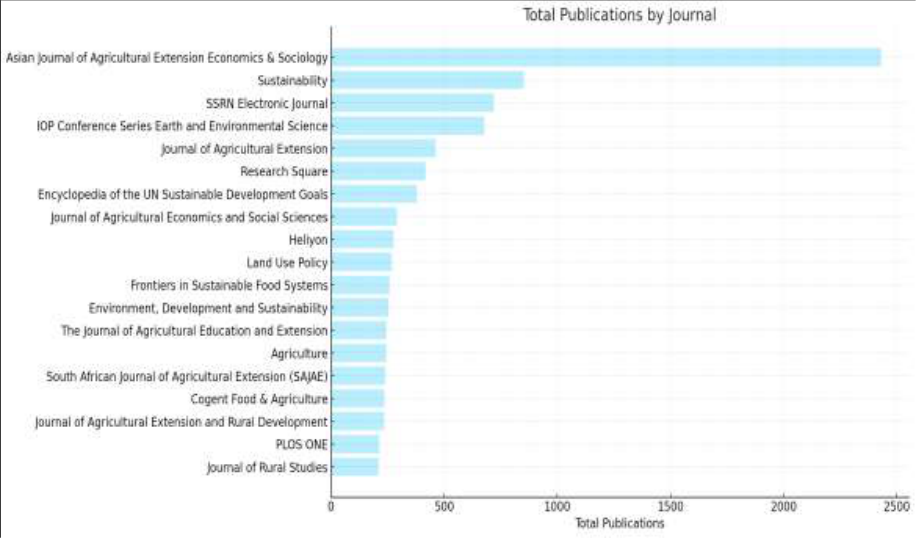
    • The Asian Journal of Agricultural Extension Economics & Sociology is the most prolific journal in the field, with 2,431 publications. View evidence ↗

      What they found

      The Asian Journal of Agricultural Extension Economics & Sociology is the most prolific journal in the field, with 2,431 publications.

      In the paper's own words

      “The Asian Journal of Agricultural Extension Economics & Sociology leads significantly with 2,431 publications”

      Page 2

      Found in: Top Journals on Agricultural Extension Research

      Read it in the full textOpen PDF at page 2 ↗
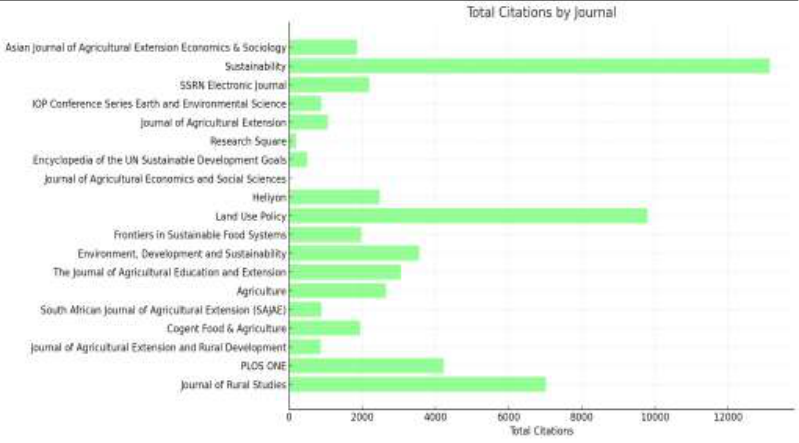
    • The journal Sustainability is the most influential in terms of total citations, recording 13,135 citations. View evidence ↗

      What they found

      The journal Sustainability is the most influential in terms of total citations, recording 13,135 citations.

      In the paper's own words

      “Sustainability emerges as a leader with 13,135 citations, underscoring the broad influence of research published in this journal.”

      Page 3

      Found in: Top Journals on Agricultural Extension Research

      Read it in the full textOpen PDF at page 3 ↗
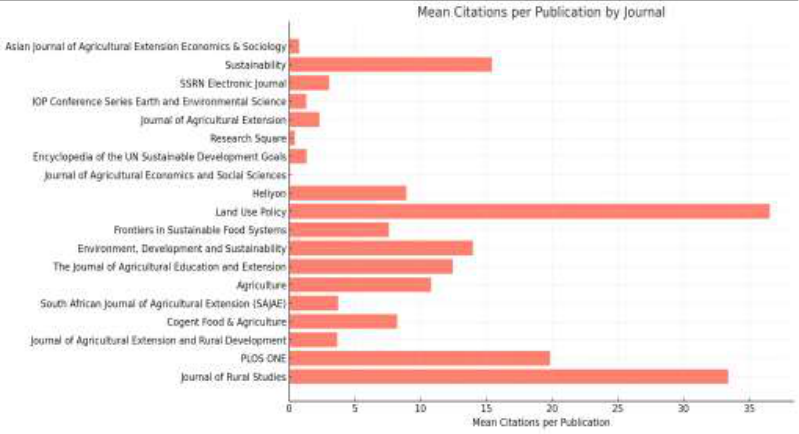
    • Land Use Policy (36.56) and the Journal of Rural Studies (33.40) have the highest mean citations per publication, indicating high individual article influence. View evidence ↗

      What they found

      Land Use Policy (36.56) and the Journal of Rural Studies (33.40) have the highest mean citations per publication, indicating high individual article influence.

      In the paper's own words

      “Land Use Policy and Journal of Rural Studies lead with mean citations per publication of 36.56 and 33.40 respectively”

      Page 3

      Found in: Top Journals on Agricultural Extension Research

      Read it in the full textOpen PDF at page 3 ↗
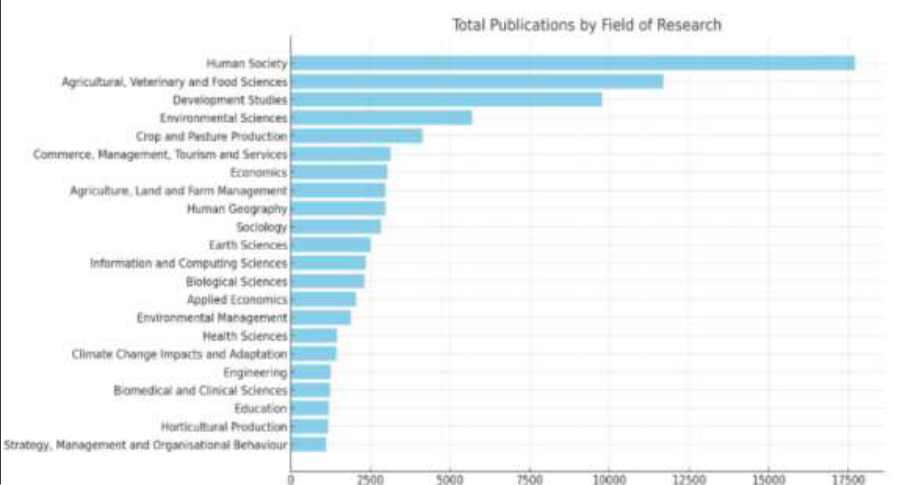
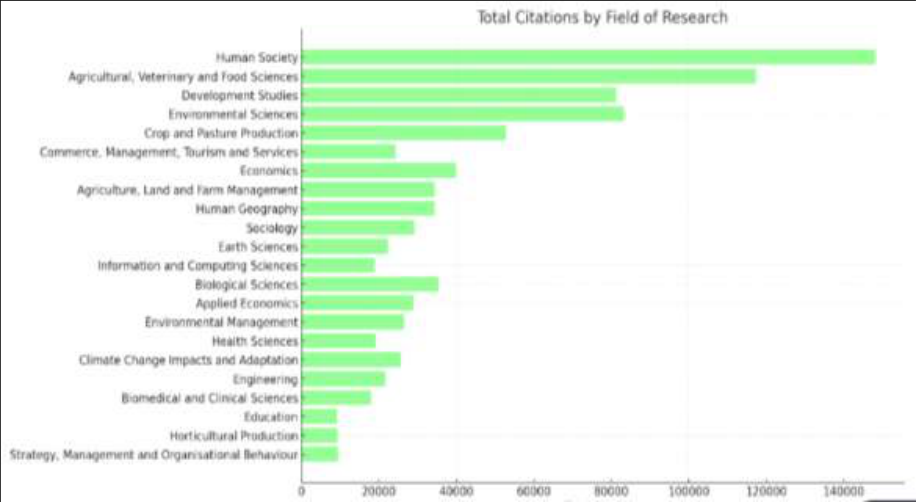
    • The most active research domains by publication volume are Human Society and Agricultural, Veterinary, and Food Sciences. View evidence ↗

      What they found

      The most active research domains by publication volume are Human Society and Agricultural, Veterinary, and Food Sciences.

      In the paper's own words

      “Fields such as Human Society and Agricultural, Veterinary, and Food Sciences lead with the highest number of publications”

      Page 4

      Found in: Top Journals on Agricultural Extension Research

      Read it in the full textOpen PDF at page 4 ↗
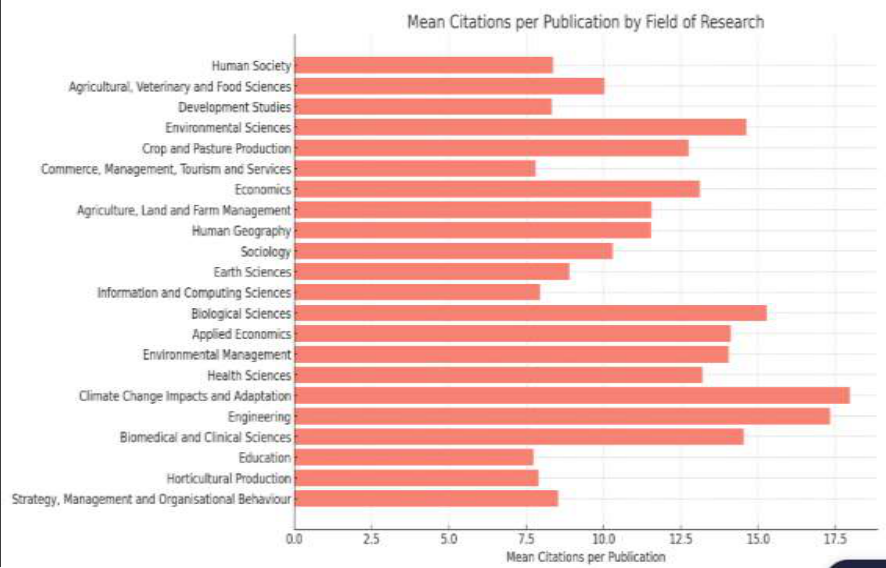
    • Research in Engineering and Climate Change Impacts and Adaptation is particularly impactful, showing the highest mean citations per publication. View evidence ↗

      What they found

      Research in Engineering and Climate Change Impacts and Adaptation is particularly impactful, showing the highest mean citations per publication.

      In the paper's own words

      “Notably, fields such as Climate Change Impacts and Adaptation and Engineering have the highest mean citations per publication”

      Page 5

      Found in: Top Journals on Agricultural Extension Research

      Read it in the full textOpen PDF at page 5 ↗
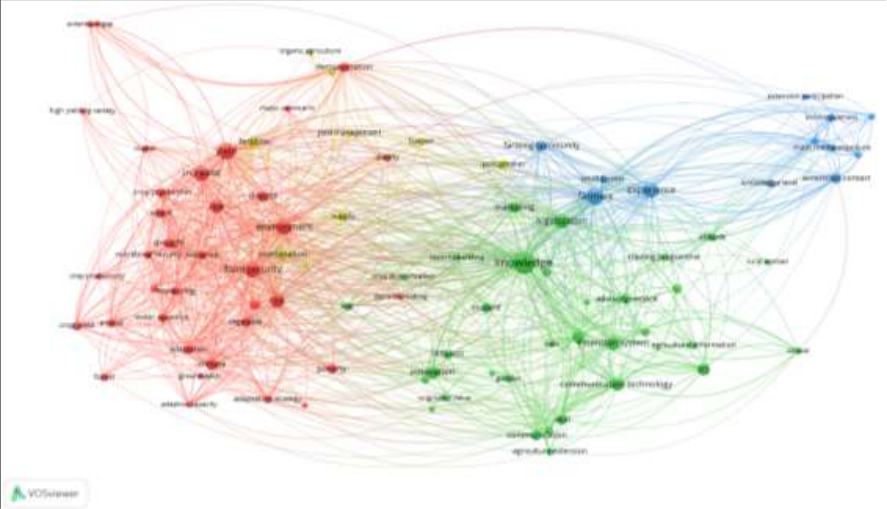
    • The most frequently used and strongest author keywords include Knowledge, Communication, Food security, Environment, and Innovation. View evidence ↗

      What they found

      The most frequently used and strongest author keywords include Knowledge, Communication, Food security, Environment, and Innovation.

      In the paper's own words

      “Keywords such as Knowledge, Communication, Food security, Environment, and Innovation are the most used author keywords with high strengths.”

      Page 5

      Found in: Introduction

      Read it in the full textOpen PDF at page 5 ↗
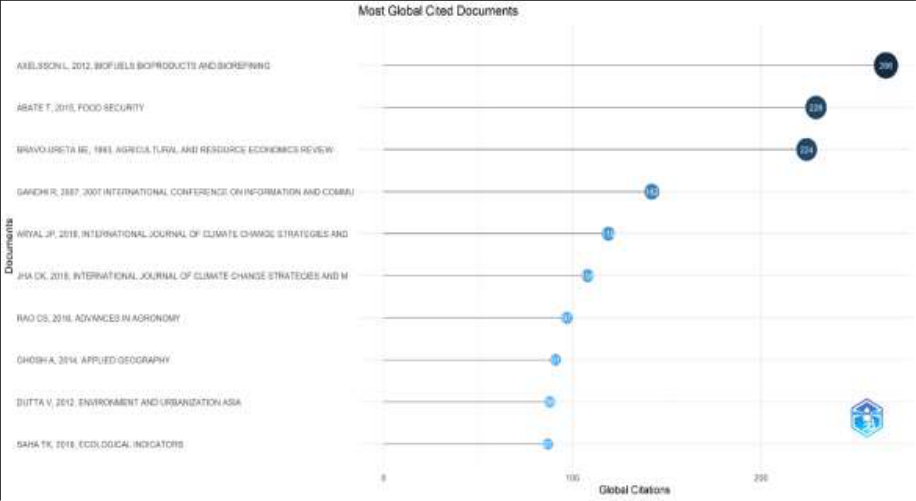
    • A 2015 study on Jatropha cultivation in southern India is among the top-cited works, with nearly 266 citations. View evidence ↗

      What they found

      A 2015 study on Jatropha cultivation in southern India is among the top-cited works, with nearly 266 citations.

      In the paper's own words

      “The article entitled “Jatropha cultivation in southern India: assessing farmers' experiences,” published in 2015, has nearly 266 citations.”

      Page 6

      Found in: Materials and Methods

      Read it in the full textOpen PDF at page 6 ↗
  5. What it means

    • The authors recommend the continued use of bibliometric tools to monitor trends and guide the strategic direction of agricultural extension research. View evidence ↗

      What it means

      The authors recommend the continued use of bibliometric tools to monitor trends and guide the strategic direction of agricultural extension research.

      In the paper's own words

      “Future research should continue to leverage bibliometric tools to monitor trends, assess research impact, and guide strategic directions in agricultural extension.”

      Page 6

      Found in: Introduction

      Read it in the full textOpen PDF at page 6 ↗

Visual summary

1 visuals

Illustrations explain the paper; they do not show study data.
AI-generated illustration
AI-generated conceptual illustration (printed academic journals and citation symbols). It explains the idea and does not show study data.↗ Enlarge
Journal Impact vs Volume
AI-generated conceptual illustration (printed academic journals and citation symbols). It explains the idea and does not show study data.

AI-generated conceptual illustration (printed academic journals and citation symbols). It explains the idea and does not show study data.

Open full-size image ↗

Journal Impact vs Volume

AI-generated conceptual illustration (printed academic journals and citation symbols). It explains the idea and does not show study data.

View source evidence ↗

Figures & tables

From the original paper
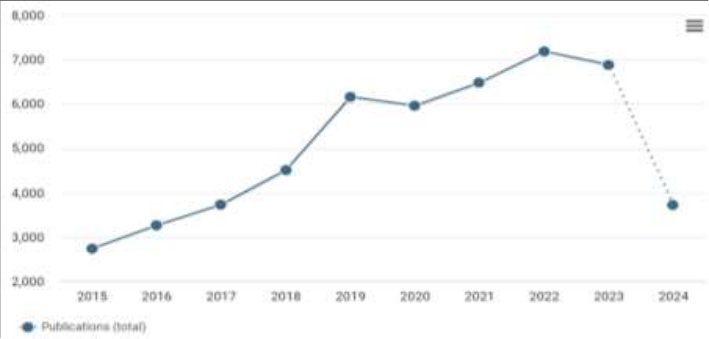
Year wise distribution of extension research publications, 2015-2024.Figure 1Page 2Total publications by JournalFigure 2Page 2Total citations by JournalFigure 3Page 3Mean citations per publication by field of researchFigure 4Page 3Total publications by field of researchFigure 5Page 4Total citations by field of researchFigure 6Page 4Total citations by field of researchFigure 7Page 5The networks between the two bubbles represent their co‑occurrence of all keywords and the size of the bubble relates to the numberFigure 8Page 5Top 10 articles on agricultural extension with their total citationsFigure 9Page 6
FULL TEXT Original article · reflowed for reading

Introduction

Agricultural extension research is pivotal in advancing agricultural productivity and sustainability, especially in diverse agrarian contexts such as India. Agricultural extension involves disseminating knowledge, technologies, and best practices to farmers to enhance their skills, productivity, and livelihoods (Jamilah et al., 2010; Swanson, 2008) [3,8] . Over time, numerous efforts have been directed towards improving agricultural extension methods, yet a systematic analysis of research trends is necessary to understand the field's evolution, identify gaps, and guide future research effectively. Bibliometric analysis serves as a valuable tool for this purpose, offering a quantitative approach to examining academic literature and uncovering patterns, trends, and insights within a specific research domain (de Bellis, 2009; Moed, 2005) [2,6] . By analyzing bibliometric indicators such as publication counts, citation metrics, keyword co-occurrence, and author collaborations, researchers can gain a comprehensive understanding of the research landscape (Martinez-Lopez et al., 2018; Bornmann & Leydesdorff, 2014) [5,1] . This method helps identify influential publications, prolific authors, key research themes, and emerging areas of interest. In agricultural extension research, bibliometric analysis can elucidate the field's development over the past decade, highlighting growth in research output, leading journals, and prominent research topics. It can also pinpoint research gaps by revealing underexplored areas that require further investigation. Understanding these gaps is crucial for directing future research efforts to better address the needs of farmers and the broader agricultural sector (Kumar et al., 2020; Sheehan et al., 2021) [4,7] . This study employs bibliometric methods to analyze agricultural extension research from January 2015 to June 2024, examining publication trends, author networks, research domains, leading journals, and frequently used keywords to provide a detailed overview of the field's current state and future directions.

Materials and Methods

All research output was retrieved from the dimension.ai database between January 2015 and August 2024 by searching for Agricultural extension. The number of publications by year, the network analysis between author linkage, research domain, articles from leading journals with high citations, and commonly used keywords was all used to evaluate articles. The data were analysed using MS Excel, Word Cloud generator, and VOS viewer. Keywords were searched in the title, abstract, and keywords. Papers were first evaluated for eligibility for inclusion as titles, and abstracts and full texts were also reviewed in case of ambiguity. Articles with their primary focus on agricultural extension or those related to agricultural extension in India are included. Studies published only in English are included. The analysis included 50,619 articles discovered through a systematic search on Agricultural Extension Research. www.extensionjournal.com

Results and Discussion Distribution of agricultural extension research publications by year

The data represents the total number of publications related to agricultural extension research from 2015 to 2024, reflecting trends in research activity over the past decade. Starting with 2,735 publications in 2015, the field saw steady growth, peaking at 7,185 publications in 2022. This increase highlights a rising focus on agricultural extension, likely driven by the growing need for improved agricultural practices and the dissemination of knowledge to farmers and stakeholders. The slight decline to 6,882 publications in 2023 and the more noticeable drop to 3,720 in 2024 may indicate a shift in research priorities or a reallocation of resources to other emerging areas within agricultural sciences. Overall, the data underscores the significant expansion and dynamic nature of agricultural extension research over the years.

Top Journals on Agricultural Extension Research

Total Publications by Journal, provides a comprehensive view of the research output across various journals within the field of agricultural extension and related disciplines. The Asian Journal of Agricultural Extension Economics & Sociology leads significantly with 2,431 publications, indicating its prominent role as a platform for disseminating research in this area. This journal's large volume of publications suggests that it is a go-to source for researchers, possibly due to its wide scope or the accessibility of its publication process. Other journals like Sustainability and SSRN Electronic Journal also show considerable publication activity with 852 and 720 publications respectively, reflecting their importance in the broader context of sustainability and social sciences research as it intersects with agriculture. The diversity in publication counts among the journals illustrates the varying levels of focus and specialization, with some journals catering to broader audiences and others targeting niche aspects of agricultural research. Engineering have the highest mean citations per publication, suggesting that research in these areas tends to be highly influential, even if the total number of publications is lower. This metric highlights fields where individual research outputs are particularly impactful, contrasting with fields that may produce a larger volume of work with less frequent citations. Together, these charts offer a comprehensive overview of both the quantity and quality of research across different disciplines.

Co-occurrence of author keywords

Co-occurrence of author keywords

Figures and tables from the paper

Figure 1. Year wise distribution of extension research publications, 2015-2024.
Year wise distribution of extension research publications, 2015-2024.↗ Enlarge
Figure 1
Year wise distribution of extension research publications, 2015-2024.

Year wise distribution of extension research publications, 2015-2024.

Open full-size image ↗
Original paper figureSource PDF · page 2 ↗
Figure 2. Total publications by Journal
Total publications by Journal↗ Enlarge
Figure 2
Total publications by Journal

Total publications by Journal

Open full-size image ↗
Original paper figureSource PDF · page 2 ↗
Figure 3. Total citations by Journal
Total citations by Journal↗ Enlarge
Figure 3
Total citations by Journal

Total citations by Journal

Open full-size image ↗
Original paper figureSource PDF · page 3 ↗
Figure 4. Mean citations per publication by field of research
Mean citations per publication by field of research↗ Enlarge
Figure 4
Mean citations per publication by field of research

Mean citations per publication by field of research

Open full-size image ↗
Original paper figureSource PDF · page 3 ↗
Figure 5. Total publications by field of research
Total publications by field of research↗ Enlarge
Figure 5
Total publications by field of research

Total publications by field of research

Open full-size image ↗
Original paper figureSource PDF · page 4 ↗
Figure 6. Total citations by field of research
Total citations by field of research↗ Enlarge
Figure 6
Total citations by field of research

Total citations by field of research

Open full-size image ↗
Original paper figureSource PDF · page 4 ↗
Figure 7. Total citations by field of research
Total citations by field of research↗ Enlarge
Figure 7
Total citations by field of research

Total citations by field of research

Open full-size image ↗
Original paper figureSource PDF · page 5 ↗
Figure 8. The networks between the two bubbles represent their co‑occurrence of all keywords and the size of the bubble relates to the number
The networks between the two bubbles represent their co‑occurrence of all keywords and the size of the bubble relates to the number↗ Enlarge
Figure 8
The networks between the two bubbles represent their co‑occurrence of all keywords and the size of the bubble relates to the number

The networks between the two bubbles represent their co‑occurrence of all keywords and the size of the bubble relates to the number

Open full-size image ↗
Original paper figureSource PDF · page 5 ↗
Figure 9. Top 10 articles on agricultural extension with their total citations
Top 10 articles on agricultural extension with their total citations↗ Enlarge
Figure 9
Top 10 articles on agricultural extension with their total citations

Top 10 articles on agricultural extension with their total citations

Open full-size image ↗
Original paper figureSource PDF · page 6 ↗

References

4 in the original paper
  1. Jamilah N, Nor NM, A R AK. Agricultural extension in Malaysia: A review of research and practice. Int. J Agric. Ext Rural Dev. 2010;3(1):45-58.
  2. Kumar P, Mahajan P. Trends in agricultural extension research: A bibliometric analysis. J Agric. Sci. Technol. 2020;22(5):123-136.
  3. Martinez-Lopez B, Zhai M. Analyzing the evolution of agricultural research through bibliometric indicators. J Agric. Econ. 2018;35(2):205-220.
  4. Sheehan P, Moffitt R. Identifying research gaps in agricultural extension: A systematic review. Agric. Syst. 2021;191:103-115.