
Research article · 2024 · Full text
International Journal of Agriculture Extension and Social DevelopmentImpact of sustainable development policy for orange tree on land use efficiency in Bac Quang district, Ha Giang province
Volume 7(8) · Pages 07–14 · DOI: 10.33545/26180723.2024.v7.i8a.871 ↗
Research areasSoil and Land Suitability AnalysisLand Use and Ecosystem Services
Abstract
Author-writtenThis study was conducted to assess the impact of sustainable development policies for orange trees on the efficiency of land use in three aspects: economic, social, and environmental, thereby proposing some solutions for sustainable orange development in Bac Quang district, Ha Giang province. The research results show that sustainable development policies for orange trees have a positive impact on economic, social, and environmental efficiency indicators with indexes ranging from 3.59 to 4.3 (impact levels 1 and 2). However, orange cultivation in Bac Quang district still faces some difficulties in consumption and capital shortage. In addition, many of the King orange gardens also have yellow leaves, dry branch tips, degeneration; unplanned expansion of orange acreage; and fake and poor-quality fertilizers. To sustainably develop orange trees, it is necessary to implement the following solutions: apply appropriate cultivation measures to overcome yellow leaves, dry branch tips, and degradation; review and orient the development of orange acreage according to the planning; manage fertilizers and pesticides; promote production and consumption of oranges according to the linkage chain and value chain applying 4.0 technology; support organizations, households and individuals to borrow capital; replicate the model of orange gardens associated with digital transformation.
Summary
Source-checkedPlain-language reading of the full paper, prepared with AI and checked against the text. Each point links to the authors' own words.
Why it matters
- Bac Quang district is the largest orange-growing region in Ha Giang province, with a total area of 3,893.01 hectares as of 2023. View evidence ↗
- King orange cultivation has declined significantly due to degradation caused by inappropriate production processes, poor nutrition, and susceptibility to yellow leaves and dry branch tips. View evidence ↗
- The orange market has been unstable because of a lack of policies to encourage business investment in processing and preservation. View evidence ↗
What they did
- The researchers used SPSS 20.0 software to synthesize and analyze the primary data. View evidence ↗
What they found
- Economic efficiency indicators showed positive impacts, with production value (4.38), added value (4.17), and capital efficiency (3.93) rated as higher or much higher. View evidence ↗
- Access to finance was rated as 'much easier' with an assessment index of 4.28. View evidence ↗
- Land use right assurance was rated at level 1, indicating it is 'Very good'. View evidence ↗
- Environmental efficiency criteria, including pesticide limitation and soil degradation limitation, all reached level 2 (good), with indexes between 3.59 and 4.17. View evidence ↗
- Following capital investment support, orange producers' income increased by nearly 30 million VND, which is 1.5 to 2 times higher than previous levels. View evidence ↗
- Despite policies, 2,091.28 hectares of oranges remain degraded, with 40.56% at level II and 34.14% at level III degradation. View evidence ↗
- The use of fake and poor-quality fertilizers and pesticides by some households has caused financial loss and environmental damage. View evidence ↗
What it means
- The authors recommend sustainable growth through appropriate cultivation to fix degradation, planned acreage expansion, strict fertilizer management, and the use of 4.0 technology and digital transformation in value chains. View evidence ↗
- The study notes that the consumption market remains a challenge due to low pricing during peak seasons and a total lack of an export market. View evidence ↗
Figures & tables
From the original paper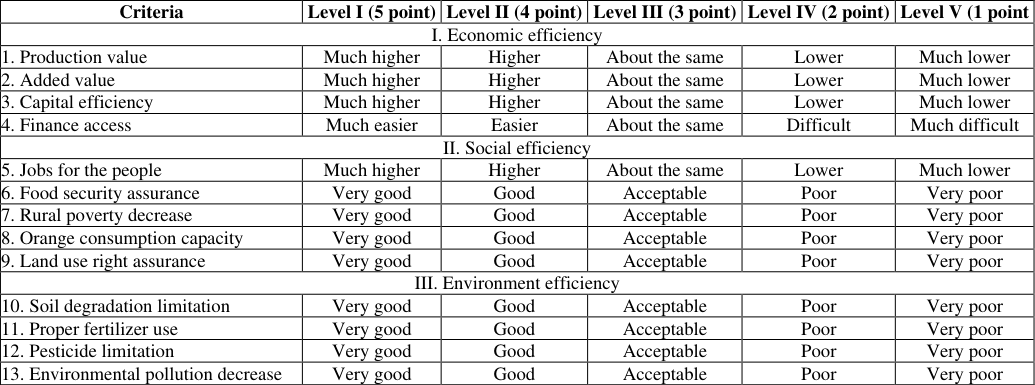 Table 1
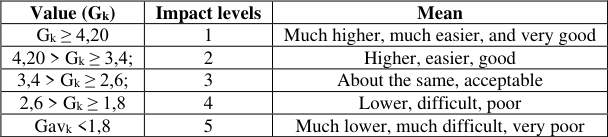 Table 2
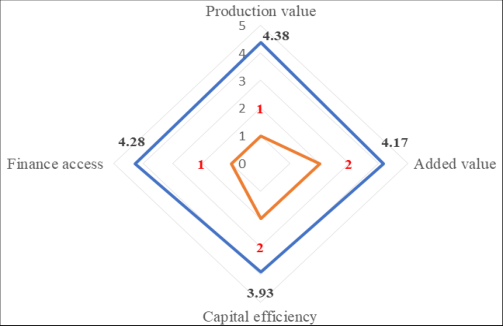 Figure 1
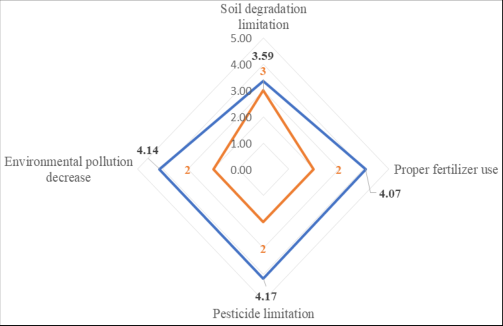 Figure 3
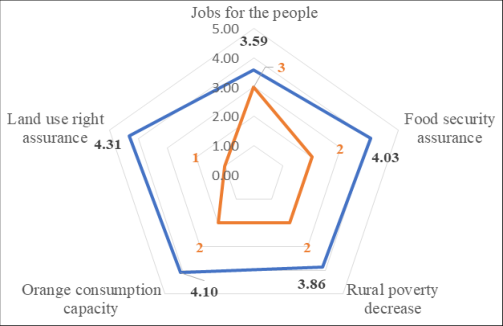 Figure 2
Introduction
Bac Quang is the district with the largest orange area in Ha Giang province. According to Department of Agriculture and Rural Development of Bac Quang district (2023), the orange area of the whole district is 3,893.01 hectares, of which the largest area is the King orange variety with 2,144.06 hectares (accounting for 55.07%), followed by the Vinh orange variety with an area of 1,507.70 (accounting for 38.73%) and finally the V2 orange variety with the smallest area of 241.25 (accounting for 6.20%). The orange area for harvest is 3,469.20 hectares (the King orange variety is 2,030.70 hectares), the average yield is 10.5 tons/ha (the King orange variety is 11 tons/ha) and the total output is over 36,426 tons. Identifying orange trees, especially the King orange tree, as a key commodity in the economic development strategy and one of the key products of Ha Giang province in general and Bac Quang district in particular, however, in recent years, the area of the King orange tree in the whole Ha Giang province as well as Bac Quang district has decreased significantly due to degradation. The main reason is that gardeners apply inappropriate production processes and do not ensure nutritional factors and the King orange tree is susceptible to yellow leaves and dry branch tips. In Bac Quang district, the area of the King orange trees decreased by 922 hectares in the period 2021 -2023. In addition, the development of the King orange tree has not been planned or oriented; there is little investment in intensive farming, and care has not been applied according to genetic conservation techniques, resulting in poor fruit appearance, unevenness, acidic fruit quality, and numerous seeds. Furthermore, the product consumption market is unstable as a result of the absence of policies and mechanisms, which have not encouraged businesses to invest in product preservation and processing. In response to this circumstance, Ha Giang province and Bac Quang district have implemented numerous policies to promote and mobilize resources for the sustainable development of orange trees. These policies are intended to enhance land use efficiency, generate income, and ensure the livelihoods of rural residents. Land use efficiency is the benefit that is derived from a specific area of land (Zhu et al., 2019; Xie et al., 2021) [1,2] . It is crucial to evaluate the comprehensive development of land, ecological, social, and economic factors, or sustainable development, through the use of land use efficiency (Ma et al., 2023) [3] . Many academicians have been interested in researching the impact of policies on the efficiency of land use (Ayouba et al., [4][5][6][7][8] . Nevertheless, there has been no research conducted to date on the effect of the policy on the efficacy of land use for orange cultivation. This study was conducted to evaluate the impact of the sustainable development policies of orange trees on the efficiency of orange www.extensionjournal.com cultivation in three dimensions: economic, social, and environmental, thereby proposing some solutions for the sustainable development of orange trees in Bac Quang district, Ha Giang province.
Methods
Methods
Data collection
Secondary data on orange cultivation was collected from the Statistics sub-office of Bac Quang district and the Department of Agriculture and Rural Development of Bac Quang district. Primary data was collected from a survey of 30 orange-growing households in the three communes with the largest orange-growing areas in the district, including Vinh Hao, Tien Kieu, and Vinh Phuc. Research criteria to assess orange tree land efficiency based on three categories: economic (production value; added value; capital efficiency; access to credit), social (employment for people; food insecurity; rural poverty; orange consumption capacity; land use rights assurance) and environmental (soil degradation; fertilizer use; pesticide use; environmental pollution). The criteria are evaluated on a 5-level Likert scale with each level specified in Table 1. The evaluation score for each corresponding level is from 5 points to 1 point (Likert, 1932) [9] . Economic efficiency The primary data sources were synthesized, processed, and analyzed using SPSS 20.0 software. The Likert scale was used to classify the weighted average value of the interview results and determine the impact level of the sustainable development policy on economic, social, and environmental efficiency indicators of orange trees (Table 2).
| Value (Gk) | Impact levels | Mean |
|---|---|---|
| Gk ≥ 4,20 | 1 | Much higher, much easier, and very good |
| 4,20 > Gk ≥ 3,4; | 2 | Higher, easier, good |
| 3,4 > Gk ≥ 2,6; | 3 | About the same, acceptable |
| 2,6 > Gk ≥ 1,8 | 4 | Lower, difficult, poor |
| Gavk <1,8 | 5 | Much lower, much difficult, very poor |
Table text extracted from the original PDF; superscript letters are shown inline. The original table image is below.
View original table image
| Criteria | Level I (5 point) | Level II (4 point) | Level III (3 point) | Level IV (2 point) | Level V (1 point |
|---|---|---|---|---|---|
| I. Economic efficiency | |||||
| 1. Production value | Much higher | Higher | About the same | Lower | Much lower |
| 2. Added value | Much higher | Higher | About the same | Lower | Much lower |
| 3. Capital efficiency | Much higher | Higher | About the same | Lower | Much lower |
| 4. Finance access | Much easier | Easier | About the same | Difficult | Much difficult |
| II. Social efficiency | |||||
| 5. Jobs for the people | Much higher | Higher | About the same | Lower | Much lower |
| 6. Food security assurance | Very good | Good | Acceptable | Poor | Very poor |
| 7. Rural poverty decrease | Very good | Good | Acceptable | Poor | Very poor |
| 8. Orange consumption capacity | Very good | Good | Acceptable | Poor | Very poor |
| 9. Land use right assurance | Very good | Good | Acceptable | Poor | Very poor |
| III. Environment efficiency | |||||
| 10. Soil degradation limitation | Very good | Good | Acceptable | Poor | Very poor |
| 11. Proper fertilizer use | Very good | Good | Acceptable | Poor | Very poor |
| 12. Pesticide limitation | Very good | Good | Acceptable | Poor | Very poor |
| 13. Environmental pollution decrease | Very good | Good | Acceptable | Poor | Very poor |
Table text extracted from the original PDF; superscript letters are shown inline. The original table image is below.
View original table image
Results and Discussion
Overview of some policies for sustainable development of orange trees Many policies have been implemented by the Ha Giang Provincial People's Council between 2015 and 2020 to promote the growth of commodity agriculture, which includes orange trees (Ha Giang Provincial People's Council, 2015, 2017, 2018) [10][11][12] . Specifically, on December 1, 2020, the Standing Committee of Ha Giang Provincial People's Council issued Resolution No. 04 on the sustainable development of the King orange trees in the province for the period of 2021-2025, with a vision to 2030. The objective of this resolution is to enhance the quality of the King orange products, shift the economic structure in agriculture, and develop the King orange trees in conjunction with the development of typical commodity agriculture to enhance the lives, income, and employment of the populace. By 2025, the objective is to preserve a consistent 5,000 ha orange acreage throughout the province in 38 communes of the three districts of Bac Quang, Quang Binh, and Vi Xuyen that have been certified for geographical indications. The focus will be on renovation, with an emphasis on the application of intensive investment to enhance productivity and quality, as well as the establishment of a value chain that connects the production, processing, and consumption of products, with a total area of 2,000 hectares. By 2030, renovate and implement an intensive investment strategy to enhance productivity and quality, as well as establish a value chain that connects the production, processing, and consumption of products for the remaining 3,000 hectares. This will guarantee that all 5,000 hectares of pomelos meet the standard quality standard (Ha Giang Provincial Party Committee, 2020) [13] .
Resolution No. 17-NQ/TU, dated October 10, 2021, of the www.extensionjournal.com Provincial Party Committee, which is concerned with the development of high-quality agricultural products by the value chain associated with product brand establishment. The Resolution has advocated for the promotion of agricultural development that is based on the promotion of advantages in terms of climate, soil conditions, and seedlings with specific strengths that are suitable for market signals. It also promotes the application of science and technology in the development of typical agricultural products; the application of digital transformation and ecommerce in the management of growing areas and product consumption; the strict control of the production process according to the value chain, from gene conservation and seed sources to seed production, the selection of production areas, the harvesting, processing, and consumption of products; and the focus on the mobilization of resources, the strengthening of production linkages, and the support of tourism development to create sustainable livelihoods and improve the lives of people. The Resolution underscored the importance of e-commerce and digital transformation in the administration of agricultural production areas and the consumption of traditional agricultural products in Ha Giang province (Ha Giang Provincial Party Committee, 2021) [14] . Furthermore, the People's Council of Ha Giang province issued Resolution No. 58/2020/NQ-HDND on December 9, 2020, to further enhance the quality of pomelo products. This resolution outlines specific policies to promote the sustainable development of pomelo trees and the development of household garden economies in the province from 2021 to 2025 (Ha Giang Provincial People's Council, 2020) [15] . Under Resolution No. 58/2020/NQ-HDND, organizations and individuals may receive loans to enhance the quality of the King orange trees. The maximum loan amount is 60 million VND/ha, and the loan term is 36 months from the date of disbursement with an interest rate is 0%. In addition, the Resolution establishes policies for the promotion and consumption of King orange products, as well as for the conservation of genes, the transfer of technology, and the promotion of sound breeding. We will provide direct support of 500,000 VND per original tree per year to organizations and individuals who preserve existing original King orange trees and apply scientific and technological advances to seed production to create a source of quality, disease-free seeds to supply new planting areas to replace old areas (if any). Support for transportation costs of VietGAP and organic orange products when there is a contract to consume products in markets outside the province with a direct support level of 100,000 VND/ton of fresh fruit, and at the same time, participate in the trade promotion program according to the province's annual plan. Furthermore, orange producers are provided with assistance in the form of technology transfer, product promotion, and the development of high-quality varieties. Organizations and individuals who invest in the construction of citrus fruit processing factories are provided with 100% of the compensation costs, ground clearance by the specific project, and support for the construction of infrastructure outside the project (such as electricity, water, roads, and wastewater treatment). The level of support is contingent upon the specific circumstances of each project and is not to exceed 2 billion VND per project (Ha Giang Provincial People's Council, 2020) [15] . On January [16] . Furthermore, Bac Quang district has implemented numerous policies to promote the development of commodity www.extensionjournal.com production, thereby encouraging the production of oranges by VietGAP and organic standards, as well as value chains and linkage chains, to further enhance the quality of orange products. Furthermore, the Bac Quang district People's Committee has collaborated with relevant agencies and units to establish a model orange garden that is linked to digital transformation. This garden is intended to assist individuals in the intensive cultivation and growth of orange trees by VietGAP and organic processes, while also enhancing the quality of the product through the application of science and technology in the production process. The digital transformation strategy is particularly relevant in the production and consumption of orange products, as it aims to increase the value of the product.
Assessing the impact of sustainable development policy for orange trees on land use efficiency Economic efficiency:
The economic efficiency is positively influenced by the sustainable development policy for orange trees. The data in Figure 1 indicates that the three economic efficiency indicators (added value, capital efficiency, and production value) have been evaluated at levels of higher and much higher, with indexes of 4.17, 3.93, and 4.38, respectively. To accomplish this objective, the Bac Quang district has implemented numerous strategies to enhance the productivity, quality, and income of orange growers. These strategies include the encouragement and support of new planting in the old and degraded orange areas, the renovation of old gardens, the application of advanced technology in production, the promotion of brands and trade, the establishment of geographical indications, and the recognition of VietGAP production processes. Digital transformation and 4.0 technology have been utilized to promote orange consumption through various methods, including propaganda and electronic applications. These efforts have yielded favorable outcomes. Furthermore, the district has fostered partnerships with supermarket systems such as Vinmart and Vinmart+, Big C, Saigon Coop, and Coop. mart, clean produce stores, wholesale markets, and traders to guarantee a consistent quantity of orange products during the harvest. According to Phuong Duyen & Hai Tu (2023) [17] , implementing Resolution No. 58/2020/NQ-HDND, the Transaction Office of the Social Policy Bank of Bac Quang district has disbursed over 14 billion VND to 157 households with 0% interest rate loans to develop Sanh orange trees. In addition, over 2,800 tons of oranges were supported with transportation costs for consumption outside the province with a total budget of 289.5 million VND (Thu Phuong, 2023) [18] . The income of orange producers has increased by nearly 30 million VND, an average of 1.5 to 2 times compared to the period before receiving capital investment support. The value of the King orange trees has been elevated as a result of the rapid disbursement of preferential capital (Phuong Duyen & Hai Tu, 2023; Thu Phuong (2022) [16,17] . . According to orange producers, the loan enabled the investment in intensive orange cultivation to be made by the VietGAP process, with the products being labeled with traceability labels and internal garden traffic being invested. Consequently, the orange garden grew and developed well, the fruit was uniform, beautiful in appearance, and of superior quality, and the rate of fruit damage due to harvesting was reduced, thereby contributing to increased economic efficiency. This was the assessment of the people. Numerous studies have demonstrated that the implementation of sophisticated technology in agricultural production enhances the efficiency of land use (Jin et al., 2019; Sui et al., 2022) [19,20] . The utilization of digital technology in agriculture enhances and optimizes agricultural systems, thereby increasing crop productivity and quality, reducing costs, and managing pests and diseases, thereby increasing land use efficiency (Scholz et al., 2018) [21] . Figure 1 indicates that the finance access criterion is evaluated at a level of much easier, with an assessment index of 4.28. Social efficiency: One of the five criteria for social efficiency is land use right assurance, which is rated at level 1 (Very good). Sustainable development policies for orange trees motivate farmers to be more committed to their fields and gardens. Through the implementation of policies, farmers can incorporate scientific advancements into their production processes, which are bolstered by capital and product consumption. This process contributes to the growth of income, the establishment of sustainable livelihoods for rural families, and the restriction of the transfer of land use rights. From that point forward, their agricultural land use rights are ensured. According to Nguyen et al. (2016) [22] , land tenure security in Thailand is positively impacted by increased investment in agriculture. Agricultural land tenure that is secure will motivate households to invest in agricultural land, particularly continuous investment in agricultural land (Jacoby et al., 2002; Deininger et al., 2003) [23, 24] . In addition to reducing poverty and ensuring food security in rural areas, the sustainable development policies www.extensionjournal.com of orange trees in Ha Giang also generate numerous new employment opportunities for workers, while also supporting the expansion of superior orange consumption markets. The corresponding assessment indexes range from 3.59 to 4.10. In Bac Quang district, the policies for sustainable development of orange trees have generated capital that has enabled individuals to invest in intensive cultivation, expand consumption markets, and develop production. This has resulted in an increase in income, an improvement in the quality of life, and the creation of numerous new jobs for workers. Additionally, the economic efficiency per unit of cultivated area has been enhanced. According to Thu Phuong (2023) [18] , Bac Quang district has implemented six chains of linkage and is intensively cultivating the King orange trees by VietGAP and organic standards on 215.5 hectares of land owned by 121 households in three communes of Vinh Hao, Vinh Phuc, and Dong Thanh. Furthermore, the People's Committee of Bac Quang district collaborated with pertinent agencies and units to establish a model orange garden that is linked to digital transformation. This garden is intended to assist farmers in the cultivation and growth of orange trees following VietGAP and organic processes, while also enhancing the quality of the product through the application of science and technology in the production process. [25] , 979.69 ha/1,146 households in 20 communes and towns are the area of orange trees in Bac Quang district with yellow leaves, dry branch tips, poor growth and development, and mortality, as per. In addition, the orange area that has been degraded is also substantial. According to the Department of Agriculture and Rural Development of Bac Quang district (2023), there are currently 2,091.28 ha of degraded oranges in the district. Of this total, 531.17 ha are classified as level I degradation, accounting for 25.40%, 714.05 ha as level II degradation (40.56%), and 714.05 ha as level III degradation (34.14%). Orange tree development is still haphazard and unplanned in certain villages and regions. According to both the Project on citrus tree planning of Bac Quang district until 2025, with a vision to 2030, and the Planning for developing commodity production for key www.extensionjournal.com products in Bac Quang district from 2017 to 2020, with a vision to 2025, the orange production area of Bac Quang District focuses on communes and towns with many advantages in developing citrus fruit trees, such as Dong Thanh, Dong Yen, Tien Kieu, Vinh Phuc, Vinh Hao, Tan Thanh, Dong Tien, Viet Hong, Vinh Tuy, and Viet Quang. Currently, however, orange trees are planted in all 22 communes and cities within the district; some of these communes, such as Dong Tien, Thuong Binh, Huu San, and Lien Hiep, have extremely tiny areas, less than 10 hectares. Pesticides and fertilizers are essential supplies for agricultural production. These are significant factors that impact user health, quality, and productivity of orange trees. However, some orange-growing households in the Bac Quang district have been buying fake and poor-quality pesticides and fertilizers in recent years, which has negatively impacted the environment and cost orange growers money. The orange consumption market continues to face challenges, with low pricing, particularly during the ripe season. Nowadays, the Bac Quang Orange Association and cooperatives handle the majority of the district's orange product consumption on a domestic level. There is now no export market, and businesses only buy, preserve, and process a small amount of orange produce for juice. Every season, depending on the state of production, cooperatives and the Bac Quang Orange Association actively look for markets to enter into contracts to purchase oranges in supermarkets and wholesale markets in Gia Lam, Ha Dong (Hanoi); Hai Phong, Bac Ninh; Vinh (Nghe An). Furthermore, the government of Bac Quang district also gives special attention to trade promotion, market research, and promotional activities. These take many different forms, such as the organization of King Orange Week, the competition of King Orange Products, the participation in fairs in Quang Ninh, Ha Noi, etc. In some crop years, the orange consumption market still faces challenges despite the efforts of the government, cooperatives, and the Bac Quang Orange Association to promote, find markets, and find ways to increase trade.
Figures and tables from the paper
References
20 in the original paper- Zhu X, Zhang P, Wei Y, Li Y, Zhao H. Measuring the efficiency and driving factors of urban land use based on the DEA method and the PLS-SEM model -A case study of 35 large and medium-sized cities in China. Sustainable Cities and Society. 2019 Oct;50:101646.
- Xie X, Fang B, Xu H, He S, Li X. Study on the coordinated relationship between Urban Land use efficiency and ecosystem health in China. Land Use Policy. 2021 Mar;102:105235.
- Ma Y, Zheng M, Zheng X, Huang Y, Xu F, Wang X, et al. Land Use Efficiency Assessment under Sustainable Development Goals: A Systematic Review. Land. 2023 Apr;12(4):894.
- Ayouba K, Boussemart JP, Vigeant S. The impact of single farm payments on technical inefficiency of French crop farms. Rev Agric Food Environ Stud. 2017 Jul;98(1):1-23.
- Brady M, Sahrbacher C, Kellermann K, Happe K. An agent-based approach to modeling impacts of agricultural policy on land use, biodiversity and ecosystem services. Landscape Ecol. 2012 Nov;27(9):1363-1381.
- Minviel JJ, Latruffe L. Effect of public subsidies on farm technical efficiency: a meta-analysis of empirical results. Applied Economics. 2017 Jan;49(2):213-226.
- Eagle AJ, Rude J, Boxall PC. Agricultural support policy in Canada: What are the environmental consequences? Environ Rev. 2016 Mar;24(1):13-24.
- Likert R. A technique for the measurement of attitudes. Archives of Psychology. 1932;22(140)(140):5-55.
- Ha Giang Provincial People's Council. Resolution No. 209/2015/NQ-HDND dated December 10, 2015 on promulgating policies to encourage the development of agricultural commodity production in Ha Giang province; c2015.
- Ha Giang Provincial People's Council. Resolution No. 86/2017/NQ-HDND dated July 14, 2017 on amending and supplementing several contents of Article 1 in Resolution No. 209/2015/NQ-HDND dated December 10, 2015 of the Provincial People's Council promulgating policies to encourage the development of agricultural commodity production in Ha Giang province; c2017.
- Ha Giang Provincial People's Council. Resolution No. 29/2018/NQ-HDND dated December 7, 2018 on promulgating policies to encourage the development of commodity agricultural production in Ha Giang province; c2018.
- Ha Giang Provincial Party Committee. Resolution No. 04-NQ/TU dated December 1, 2020 of the Provincial Party Committee Standing Committee on the development of pomelo trees in Ha Giang province for the period 2021-2025, with a vision to 2025; c2020.
- Ha Giang Provincial Party Committee. Resolution No. 17-NQ/TU dated October 10, 2021 of the Provincial Party Executive Committee on developing high-quality commodity agriculture according to the value chain in the province for the period 2021-2025; c2021.
- Ha Giang Provincial People's Council. Resolution 58/2020/NQ-HDND dated December 9, 2020 of the People's Council of Ha Giang on specific policies to support the development of household gardens and sustainable development of orange trees in the province for the period 2021-2025; c2020.
- Jin G, Li Z, Deng X, Yang J, Chen D, Li W. An analysis of spatiotemporal patterns in Chinese agricultural productivity between 2004 and 2014. Ecological Indicators. 2019 Oct;105:591-600.
- Sui F, Yang Y, Zhao S. Labor Structure, Land Fragmentation, and Land-Use Efficiency from the Perspective of Mediation Effect: Based on a Survey of Garlic Growers in Lanling, China. Land. 2022 Jun;11(6):952.
- Scholz RW, Bartelsman EJ, Diefenbach S, Franke L, Grunwald A, Helbing D, et al. Unintended Side Effects of the Digital Transition: European Scientists' Messages from a Proposition-Based Expert Round Table. Sustainability. 2018 Jun;10(6):2001.
- Nguyen TT, Bauer S, Grote U. Does Land Tenure Security Promote Manure Use by Farm Households in Vietnam? Sustainability. 2016 Feb;8(2):178.
- Jacoby HG, Li G, Rozelle S. Hazards of Expropriation: Tenure Insecurity and Investment in Rural China. American Economic Review. 2002 Dec;92(5):14201447.
- Deininger K, Jin S, Adenew B, Gebre-Selassie S, Nega B. Tenure Security and Land-Related Investment: Evidence from Ethiopia. The World Bank; c2003. DOI: 10.1596/1813-9450-2991