
Research article · 2024 · Full text
International Journal of Agriculture Extension and Social DevelopmentMeasuring knowledge level of value chain partners on value chain management
Volume 7(8S) · Pages 196–199 · DOI: 10.33545/26180723.2024.v7.i8sd.959 ↗
Research areasGlobal Trade and Competitiveness
Abstract
Author-writtenThe current investigation was carried out in four major maize growing districts of Telangana with a sample of 160 maize growers and 80 stakeholders. Value chain management is both theory and practice involving actors and activities along a value chain. The term knowledge in current investigation was confined to unearth how far the farmers and other stakeholders were familiar to apply value chain management aspects in their existing situations for obtaining better value to their product. It was observed that less than half percent of the maize growers had medium level of knowledge followed by high and low levels. With regard to the other stakeholder’s majority had high level of knowledge followed by medium and low level.
Summary
Source-checkedPlain-language reading of the full paper, prepared with AI and checked against the text. Each point links to the authors' own words.
Why it matters
- A value chain consists of a series of activities performed by a company to generate value for its customers. View evidence ↗
- In India, approximately 60% of maize consumption is dedicated to animal feed. View evidence ↗
- Value chain management integrates both theoretical and practical applications involving various actors and activities throughout the chain. View evidence ↗
The question
- The study aimed to determine the extent to which maize farmers and other stakeholders were familiar with applying value chain management to obtain better value for their products. View evidence ↗
What they did
- Because no standardized test existed, the authors developed a questionnaire by screening 60 initial items down to 35, and finally selecting 24 items based on an item analysis of 30 non-sample respondents. View evidence ↗
What they found
- Among maize growers, 46.25% possessed a medium level of knowledge, 38.13% had a high level, and 15.63% had a low level. View evidence ↗
- A majority of other stakeholders (62.50%) demonstrated a high level of knowledge, compared to 33.75% with medium and 3.75% with low levels. View evidence ↗
- There is a lack of cost transparency in the chain: 66.88% of growers and 61.25% of other stakeholders were unaware of the costs incurred by their partners. View evidence ↗
- Approximately 36.87% of farmers did not view buyer complaints as an opportunity to improve value chain activities. View evidence ↗
- The vast majority of maize growers (85.88%) are unaware of the specific costs incurred during each of their own operations. View evidence ↗
- 98% of maize growers identified moisture content and the absence of impurities or diseased seeds as the primary buyer preferences. View evidence ↗
What it means
- The authors conclude that this study contributes to the limited existing research on measuring the knowledge levels of actors within a value chain. View evidence ↗
Figures & tables
From the original paper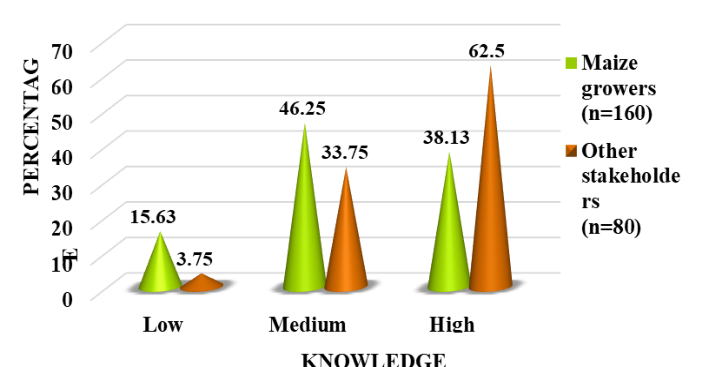 Figure 1
Introduction
A value chain is a collection of activities that are performed by a company to create value for its customers (Porter, 1985) [4] . A value chain refers to "the full range of activities which are required to bring a product or service from conception, through the intermediary phases of production, delivery to final consumers, and disposal after use" (Kaplinsky and Morris, 2002) [2] . A value chain can be a vertical linking or a network between various independent business organizations and can involve processing, packaging, storage, transportation and distribution (FAO, 2005) [1] . Value chain management involves various actors and their activities right from the raw material until the product reaches to the final consumer. This can be represented as primary activities and support activities. The primary activities are such activities which are directly involved in production, the supporting activities include facilitating activities such that the primary activities are carried out at ease (Porter, 1985) [4] . Maize consumption in India can be broadly seen in three important categories i.e., feed, food and industrial. Feed accounts for about 60 percent of the maize consumption in India (Maize Vision, 2022) [3] . The important actors in maize value chain in India are farmers, aggregators/traders, processors (Feed industry/ Starch industry), consumers (Poultry industry/Food or feed industry). The current investigation studied knowledge level of maize value chain partners on the components of value chain management.
Methodology
Exploratory research design was followed in the current investigation. The investigation was confined to four dominant maize growing districts of Telangana. The sample included 160 maize growers and 80 other stakeholders comprising various agencies involved in handling, storage and distribution of maize, industry firms, large scale processors, poultry farmers, few food manufacturers and traders. Value chain management was operationally defined as process of organizing primary value chain activities and supporting activities by various stakeholders involved in a maize value chain. The primary value chain activities include inbound logistics, operations, outbound logistics, marketing and sales. The supporting activities include procurement, technology development, human resource management and firm infrastructure. (Porter's value chain concept, 1985) [4] . Knowledge was operationalized as extent of understanding a value chain partner has in the aspects of value chain management in maize which was acquired either through experience or education. Since there are no pre-existing standardized tests on measuring knowledge level of farmers and other stakeholders on the aspects of value chain management, the present investigation, after thorough review of available literature considered 60 knowledge items initially. After screening, fine tuning and editing, 35 items had remained. These 35 items were subjected to item analysis to screen some more items based on the responses of 30 respondents from non-sample area. From the item analysis, 24 items out of 35 were selected for inclusion in the final questionnaire.
Results and Discussion
As evident from figure 1, less than half (46.25%) of the maize growers had medium level of knowledge followed by high (38.13%) and low (15.63%). With regard to the other stakeholder's majority (62.50%) had high level of knowledge followed by medium (33.75%) and low (3.75%) level. High level of knowledge with respect to other stakeholders could be due to their higher inclination to obtain better price and profits, higher exposure to the information sources and better managerial abilities as compared to maize growers. www.extensionjournal.com To the first item on "value adding activities in the farm operations" 55 percent of the farmers/maize growers stated that "optimum time of sowing is essential for obtaining healthy maize cobs because if the flowering happens during excess rains, it leads to damaged cobs that may fetch less price" and "harvested cobs must be spread evenly and not in heaps because humidity may increase if kept as heaps and seeds may get damaged". With regard to other stakeholders in the value chain most (72.5%) responded as "moisture content of maize is an important quality check" besides "seed conforming to the FAQ norms shall only be taken from farmers". Most (61.25%) of the maize growers stated that "occurrence of weeds/other plants doesn't add any value to the standing crop but incurs additional costs for managing them" as response to the non-value adding operations. Other stakeholders (75%) stated, "improper stitching of the gunny bags containing maize seed leads to the loss of produce during transportation, the losses for which must be incurred by that agency/corporation itself". Most poultry farmers also stated, "excess moisture retards the quality of poultry feed besides reducing storage time". Cent percent of the maize growers and other stakeholders knew that better prices will be realised if the procurement agency/buyer states prices in advance. In the present investigation, TS MARKFED was a nodal agency to procure maize under MSP and hence maize growers had sold the maize at a uniform price (MSP) with immediate returns from MARKFED. Most (66.88%) of the maize growers had no idea of the costs incurred by other chain partners in the value chain neither other stakeholders (61.25%) knew about the costs incurred by their immediate chain partners. As far as the item "risk sharing improves trust" is concerned, most (73.75%) farmers had given a "yes" response. Though government stated not to grow maize, since there is a surplus, farmers in the sample districts have grown maize. When the government stated that it will not procure maize from farmers, they were in a distress situation especially during the Covid lockdown periods when the movements were restricted. But the government later altered its decision to procure maize through MARKFED under MSP. With this decision, maize growers were relieved that they will be able to sell their produce and accordingly TS MARKFED procured maize with immediate returns to the farmers. When asked about the trust levels with this type of regulation by the government, most said that since they are assured of returns, they can develop trust on such regulations. All these might be the reason that influenced farmers to believe that risk sharing may definitely improve trust levels. Other stakeholders in the value chain, especially managers of PACS/DCMS and poultry farmers also believed risk sharing improves trust. Cent percent of maize growers stated a "yes" response to the item on training labour to manage quality. This referred to the farm operations that require quality considerations such as not heaping the cobs, removing the foreign grains and other particulate matter, detasseling at right time etc. Training here in farmer's perception was to enable the labour to get the desired work done. Other stakeholders too know that training the labour is the most important factor in maintaining quality. Processing firms and poultry farmers in the present investigation had given informal trainings to the new labour from the pre-existing experienced labour. With regard to the knowledge item "are the buyer complaints viewed as an opportunity to improve value chain activities" 36.87 percent of the farmers partially given a "no" response. It was observed that farmers are more concerned with disposing of their produce and hardly concerned about the corrective measures/feedback from their immediate buyers. This may be an important factor for consideration in effective value chain developmental projects. Other stakeholders viz., managers in MARKFED/PACS/ too had cared least on the feedback from the immediate buyers but processing firms/poultry farmers have given a "yes" response indicating they take into consideration on the corrections/feedback obtained in their processed maize. Majority (76.97%) of the farmers knew the standards to be maintained in maize to get fair price. These are stated as FAQ (Fair Average Quality) norms provided by the government. Of all the specifications stated, farmers focus was more on the moisture content. Agricultural Extension Officer was an important person in routing the harvested maize to the next chain partners. He/ She enabled farmers to know about these specifications and also aided in sale. Other stakeholders such as poultry farmers and processing firms follow the standards in maintaining the quality of www.extensionjournal.com poultry feed and poultry units respectively. Fifty percent of the maize growers stated it is correct to involve other stakeholders in planning and goal setting activities. Many of them consider farming operations as a natural way of work and hence do not specifically involve in planning and goal setting. They just know about the buyers and are least considered about involving other stakeholders in planning. This aspect may be given emphasis in value chain developmental projects where participation and common goal setting among chain partners can be enabled through extension interventions. With regard to other stakeholders of the chain, most (86.35%) of them responded as "correct". Especially due to the covid pandemic regulations where informal markets were restricted and closed, it was mandatory for the nodal agencies in procurement and distribution to have an appropriate planning and mode of action. T S MARKFED has given guidelines concerning the procurement of maize during market seasons of 2019-2020. The guidelines clearly comprised of activities in specific to be undertaken right from the procurement of maize from farmers at village level, to the weighing and bagging by PACS/DCMS, distribution by transport agencies until the produce reached warehouses. Such planning involving various stakeholders definitely clears the roles and duties of each chain partner which further strengthens the entire value chain system. Though most (89.38%) of the maize growers stated correct to the item "stronger is the market for maize products, greater is the stability for sustaining in the value chain", in present investigation maize was in surplus, hence there was less demand, but still farmers have grown it because it incurs lesser costs. In these situations, as an extension intervention it may become a necessity to persuade farmers in cultivating those crops which are having more demand and give higher returns with the same cost of cultivation. With regard to other stakeholders in the value chain, most of the feed processors have given a "correct" response to this knowledge item indicating that for processors too, a stronger market for maize products enables better profitability and sustainability in the chain. Most (86.88%) of the maize growers in the sampled districts have stated a "correct" response to the knowledge item "associations/group formations help in better management of operations" indicating that farmers knew that through formation of groups, it will be easier to take decisions and sell their produce especially during covid pandemic periods. It can be emphasized here that groups were stronger at a village level, but a relatively weak association was seen in between farmers from two different mandals. Buyers/processing firms have also given a "correct" response to this knowledge item. They opined that by maintaining relations amongst their immediate buyers it was easy for them to deal with price related matters. With regard to knowledge item about other actors in maize value chain, most (76.90%) of the farmers have listed out their buyers and the small-scale poultry feed manufacturers located nearby. Some maize growers also knew about the popular poultry feed manufactures located in Telangana such as Sneha farms, Suguna firms, Venkateshwara hatcheries etc. They knew about the probable link through which maize is being channelized. But few farmers are not aware of some of the middle nodal agencies involved in maize procurement, distribution and storage like MARKFED, NACOF, SWC etc. Other chain partners knew about other immediate stakeholders in the maize value chain. But are unaware of the origin of their product i.e, they hardly knew and cared who were the actual maize growers of the produce they bought from MARKFED. To the knowledge item on "buyer preferences" most (98%) maize growers stated, "moisture content" and "lack of impurities and diseased seeds" as the dominant response. As far as other stakeholders are concerned, "color of the grain", "size of the grain", "vital grain" and "moisture percentage" were most prominent responses. Time and distance of transportation will definitely have an effect on getting a good price according to most (89.37%) of the maize growers and cent percent of the other stakeholders. Maize growers opined that since both these parameters influence moisture content, it does have an impact on quality. TS MARFED has given certain regulations with regard to the transportation of maize stocks i.e., district managers shall shift maize stocks within 70 kms radiance from purchase centre to the godown point, and if the godown is located above 70 kms then necessary approval shall be obtained from the head office. If the distance of transportation is more, it may not only deteriorate the stocks but also incur additional transportation costs. Most (85.88%) of the maize growers do not know the costs incurred at each activity in their operations. They do not maintain cost analysis documents/ bills to analyse how much cost is involved in maize production. When enquired about the costs, most farmers provided approximate total costs. They do not maintain any records which may help them in understanding cost to return ratios. Other stakeholders do maintain all records of costs right from procurement to warehouse. It is mandatory for at all agencies/societies/corporations to document price and quantity related information. Processing firms too maintain records of prices and sale data. Information on incentives/schemes from government at village level is provided by Agricultural Extension Officers. Government of Telangana has laid more emphasis on village level agricultural extension officers as an important mediator in getting the information from farmers and providing information to the farmers. Many of the maize growers from sample villages do know about certain schemes viz., Rythu Bandhu, Mission Kakatiya etc. With regard to other stakeholders especially processing firms, most of them knew about the initiatives by the central (NABARD) and state government. The two important distribution channels amongst maize growers were PACS/DCMS under MARKFED and traders/commission agents (mostly prior to covid) in lorries. From MARKFED, the produce was distributed to processing firms such as V care seeds, Vimala feeds, Kohinoor hatcheries etc and also to the NACOF. Cent percent of the maize growers stated "feed" as an alternate consumption form of maize followed by "seed" and "food products". Same was the response from procurement and distribution agencies. Processing firms stated maize is predominantly used in feed industry followed by seed, food, starch etc. If the quality of the maize gets decreased, i.e., in case if the www.extensionjournal.com grains are deformed or shrivelled, farmers use it for feed requirements for home poultry or treat it as a wastage if found with fungal contamination. In most of the cases, farmers generally take utmost care in maintaining appropriate moisture content. It was reported that quality of maize was not very adversely damaged at godowns. TS MARKFED ensured all the godowns in perfect condition before transport of maize. Most used information sources to access market related information by maize growers were neighbour farmers and television. Whereas other stakeholders used most mass media sources like television, social media and newspapers.
Conclusion
The current study unearthed understanding level of maize stakeholders on the aspects of value chain management. The various items included in knowledge test elaborated to what extent stakeholders (value chain actors) are aware of and apply (value chain activities) the same in their situation. Since not much of the studies were conducted on measuring knowledge level in relation to value chain, this study can add to the already existing research on value chain management.
References
4 in the original paper- FAO. Addressing marketing and processing constraints that inhibit agrifood exports. A guide for policy analysts and planners. FAO Agric Serv Bull. 2005;60: Rome.
- Kaplinsky R, Morris M. A handbook for value chain research. IDRC; 2002.
- FICCI. Maize Vision 2022: A knowledge report. India Maize Summit. Available from: http://ficci.in/spdocument/22966/India-MaizeSummit.pdf.
- Roper S, Du J, Love JH. Modelling the innovation value chain. Research policy. 2008 Jul 1;37(6-7):961977.