
Research article · 2024 · Full text
International Journal of Agriculture Extension and Social DevelopmentStudy on relationship between smartphone addiction and behavior problems among upper primary school children
Volume 7(8) · Pages 415–418 · DOI: 10.33545/26180723.2024.v7.i8f.963 ↗
Research areasImpact of Technology on AdolescentsPsychosocial Factors Impacting Youth
Abstract
Author-writtenThe study aimed to assess the relationship between smartphone addiction and behavior problems among upper primary school children. A total of 352 upper primary school children (176 boys and 176 girls) in the age group of 11-14 years from 8 private schools located under six zones in Hyderabad city of Telangana state were selected as sample through random sampling method. Out of 352 sample, 240 (120 boys and 120 girls) were selected for the study who had scored average to high on smartphone addiction scale. The data was collected by using smartphone addiction scale developed by Dr. Vijayshri and Dr. Masaud Ansari (2020) and revised behavioral problem scale by Quay and Peterson (1986). An exploratory research design was adopted for the study. The Smartphone addiction scale asses the children’s level of compulsion, forgetfulness, lack of attention, depression and anxiety, disturbed hunger and sleep, social withdrawal. Revised Behavioral problem scale assess conduct disorder, socialized aggression, attention problem, anxiety withdrawal and psychotic behavior. The SPSS 16.0 package program was used to analyze the data. After conducting correlational analysis using Karl pearson’s product-moment correlation between smartphone addiction and behavior problems, a significant and strong positive correlation (r=0.615**) was observed, which was found to be significant at 0.01 level of probability. It means that as smartphone addiction increased, the behavior problems among upper primary school children also increased. This implies that children who were overly reliant on their phones, missed their hobbies, sports, and social connections, and felt pressured to reply to messages, were more likely to exhibit aggressive, bullying, and distracted behaviors. Surprisingly, our findings support previous studies in the same area. The assumption that smartphone addiction plays a critical role in establishing behavior problems among upper primary school children is supported by the consistency of our findings across research.
Summary
Source-checkedPlain-language reading of the full paper, prepared with AI and checked against the text. Each point links to the authors' own words.
Why it matters
- Smartphone addiction has become a growing social concern among children and teenagers, particularly following the COVID-19 pandemic. View evidence ↗
- Upper primary school children are especially susceptible to smartphone addiction because of their increased access to devices for entertainment and education. View evidence ↗
- Behavior problems are characterized as abnormal conduct that violates social standards and creates difficulties for the individual and their community. View evidence ↗
The question
- The research aimed to evaluate the relationship between smartphone addiction and behavior problems in children attending upper primary school. View evidence ↗
What they did
- The study used a random sample of 352 children (176 boys and 176 girls) aged 11-14 from eight private schools across six zones in Hyderabad, Telangana. View evidence ↗
- From the initial sample, 240 children (120 boys and 120 girls) who scored average to high on the smartphone addiction scale were selected for analysis. View evidence ↗
- Data collection utilized a smartphone addiction scale (Vijayshri and Ansari, 2020) and a revised behavioral problem scale (Quay and Peterson, 1986). View evidence ↗
- The relationship between the variables was measured using Karl Pearson's product-moment correlation. View evidence ↗
What they found
- A strong and significant positive correlation (r=0.615, p<0.01) was found between overall smartphone addiction and behavior problems. View evidence ↗
- The 'disturbed hunger and sleep' component showed a strong positive association (r=0.374, p<0.01) with behavior problems. View evidence ↗
What it means
- The authors conclude that smartphone addiction has a significant positive relationship with behavior problems in upper primary school children. View evidence ↗
- The authors recommend that parents and educators limit screen time, encourage physical exercise and social engagement, and teach ethical technology use. View evidence ↗
Visual summary
1 visualsIllustrations explain the paper; charts are replotted from the paper's own table values.
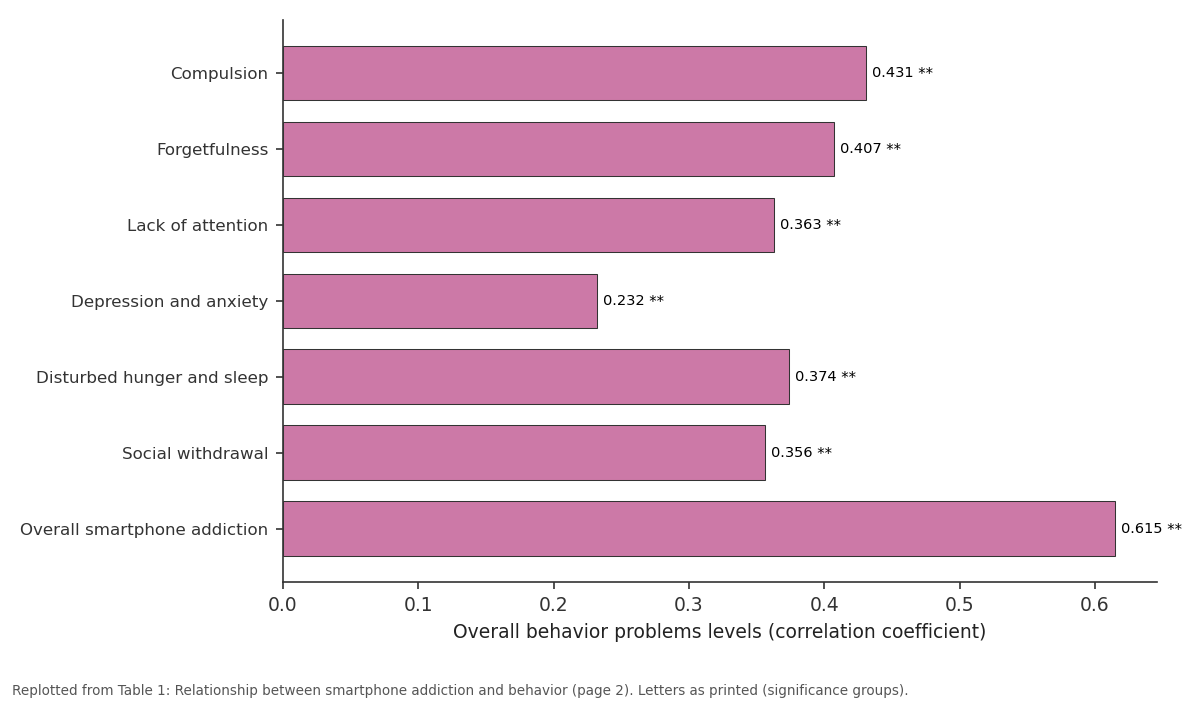
Overall behavior problems levels: Compulsion vs Forgetfulness vs Lack of attention vs Depression and anxiety vs Disturbed hunger and...
Replotted from Table 1 (page 2) of the original paper. Every bar is the paper's own table value.
View source evidence ↗Figures & tables
From the original paper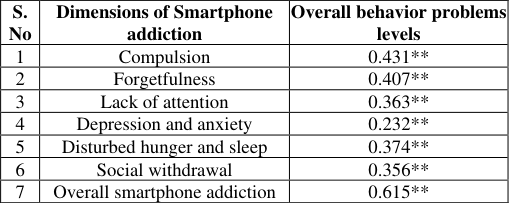 Table 1
Introduction
Smartphone use has grown dramatically, particularly in the time of the worldwide pandemic induced by SARS-CoV2 coronavirus (COVID-19). During this time, a growing social issue among children and teenagers is smartphone addiction. Prevalence rates of smartphone addiction in children and adolescents is reported from 5% to 50% pre-pandemic. Anecdotally, smartphone dependency has increased within the short time frame of the pandemic when compared to pre-COVID (Mokhtarinia et al. 2022) [1] because majority of the children used smartphones for academic purpose (Vyas et al. 2021) [3] . Smartphone addiction can be defined as the excessive usage of a mobile that interferes with day-to-day activities and interpersonal relationships (Sharon Levy, 2021) [2] . Globally, among teenagers and school-going children, the prevalence of mobile phone addiction ranges from 2.4% to as high as 60.3% (Gangadharan et al. 2022) [7] . Upper primary school children, in particular, are vulnerable to smartphone addiction due to their increasing access to digital devices and growing reliance on technology for various activities, including education and entertainment. Behavior problems are defined as abnormal conduct that goes against the social standards of a certain culture and creates issues for the person as well as other members of the community. The prolonged occurrence of these issues consider them as abnormal. However, when it comes to behavior problems in children, they can be defined as www.extensionjournal.com responses or behavioral patterns that fall short of what parents, relatives, or the community anticipate of their children might be considered behavior issues. This behavior is often referred to as deviant and disturbed. An increasing body of evidence suggests that excessive smartphone use may contribute to behavior problems among children such as depression, bullying, sleep quality (Saied et al.2022) [8] , anxiety (Aflahudin et al. 2022) [4] etc. Behavior problems are quite common among school children be identified and solved. The school-age children demonstrate a variety of behavioral issues, including being late or absent, lying, complaining about other students, chatting during class, displaying excessive compliance, pinching, beating, fighting, squabbling over seats, shyness, fear, and anxiety related to exams. The socioeconomic background, television, movies, poor parenting techniques, smartphone addiction, and television are the influencing variables for these behavioral issues in school-age children. The behaviors associated with the behavior problems can range from abrupt withdrawal to severe violent conduct. These children will struggle with social interactions and their issues may get worse as they get older if they are not recognized and helped while they are in school. Children require a variety of things in order to grow and develop, including physical, psychological, and intellectual requirements. (Babu et al. 2007) [5] . However, the specific mechanisms and underlying factors linking smartphone addiction to behavior problems in upper primary school children remain inadequately explored. Research has shown that smartphone addiction can lead to a range of behavior problems in this age group.
Materials and Methods
Materials and Methods
Location of the study
The present study was aimed to study the relationship between smartphone addiction and behavior problems among upper primary school children. The study was carried out in Hyderabad city of Telangana state because the city culture boasts up a diverse demographic population including children, students, professionals extensively use smartphone. Hyderabad city was divided into six zones, and eight private schools were randomly selected from these zones.
Sample Size
The sample size comprised of 352 members with 176 boys and 176 girls. Out of 352 sample, 240 upper primary school children with 120 boys and 120 girls were selected for the study who had scored average to high on smartphone addiction scale.
Tools used for the study
Smartphone addiction scale was used. The scale has six dimensions and 23 items, the dimensions were compulsion, forgetfulness, lack of attention, depression and anxiety, disturbed hunger and sleep, social withdrawal. Revised behavior problem scale under 5 components such as conduct disorder, socialized aggression, attention problem, anxiety withdrawal and psychotic behavior was used.
Statistical Analysis
The SPSS 16.0 package program was used to analyze the data. Karl pearson's product-moment correlation was used to measure the relationship. The component "compulsion" of smartphone addiction exhibited a highly significant positive relationship (r = .431**) with the overall behavior problems of upper primary school children at a 0.01 level of probability. This significant positive correlation suggested that a higher level of compulsion was associated with increased behavior problems among upper primary school children. This association could have been attributed to the fact that excessive gaming, frequent phone checks, and prolonged phone use were linked to increased behavioral problems such as disobedience, hostility, and in-attention. These findings were consistent with a study by Ambiha et al. (2023) [9] found that children who had an obsession with cell phones also had an unfavorable behavioral change as a result of using their phones excessively. The analysis of the smartphone addiction component "forgetfulness" revealed a significant and positive relationship (r = .407**) with the overall behavior problems of upper primary school children at a 0.01 level of probability. This indicates that as forgetfulness increased, behavioral problems among children also increased. This includes frequently forgetting chores or responsibilities like homework. This might be because upper primary school children struggled to remember important tasks and responsibilities because of distractions from their smartphones, which lead to frustration and acting out, which may then result in behavior issues. The above findings align with a study conducted by Hamvai et al. (2023) [10] described that excessive smartphone use, academic procrastination, and bedtime procrastination all had an impact on the relationship between poor sleep outcomes and the inability to maintain focus and effectively www.extensionjournal.com plan tasks (both directly and indirectly). The component "lack of attention" displayed a significant and positive relationship (r = .363**) with the overall behavior problems of upper primary school children at a 0.01 level of probability. This indicated that as lack of attention increased, there was a corresponding increase in behavior problems. It means the children who had more difficulty in paying attention were more likely to exhibit behavior problems. This finding suggests that upper primary school children who struggled to focus on academic-related tasks because of phone notifications or appealing content can become more likely to develop behavioral issues. These findings were consistent with a study conducted by Dontre (2020) [12] found that using laptops, cellphones, and social media, especially Facebook decreased grades. Multimedia tasking was also linked to decreased levels of self-efficacy, which in turn caused behavioral issues. The analysis from the table above revealed that, depression and anxiety were positively correlated (r = .232**) with overall behavior problems of upper primary school children at a 0.01 level of probability. This indicated that as depression and anxiety increased, behavior problems also increased. It means, children who exhibit higher levels of depression and anxiety were more likely to experience behavior problems. This positive relationship suggested that depression and anxiety could play a key role in the development of these problems, with feelings of worry, loneliness, and depression in the absence of a phone enhances behavior issues. Present findings were on par with a study conducted by Baek et al. (2014) [11] who found statistically significant variations in behavior issues linked to ownership, gender, and the amount of time spent on smartphones, as well as internalization symptoms such as somatization, withdrawal, anxiety, and depression. Additionally, it showed that phone addiction was positively related to internalizing symptoms such as anxiety and depression among school-age children. The study found that the smartphone addiction component "disturbed hunger and sleep" exhibited a strong positive association (r=0.374**) with the overall behavior problems of upper primary school children at a 0.01 level of probability. This suggests that, as irregular eating habits and disrupted sleep patterns due to smartphone addiction increased, there was a consistent increase in behavior problems. These findings were supported by a study conducted by Sahu et al. (2019) [13] who revealed that excessive or overuse of mobile phones was linked to behavioral issues like staying up late, feeling insecure and poor parent-child and school interactions. The table indicated that the aspect of "social withdrawal," a component of smartphone addiction, was found to be significantly and positively related to the overall behavior problems of upper primary school children at a 0.01 level of probability (r=.356**). This finding suggested that a gradual increase in social withdrawal was associated with an increase in behavior problems among upper primary school children. This positive correlation implied that spending more time on social media than with family, opting for virtual friends over in-person contacts and using phones excessively could contribute to behavioral issues among these children.
Results and Discussion
These findings align closely with a study conducted by Christensen (2018) [14] who revealed that the more time spent on social media, the more the individual suffered from a decline in the quality of their relationships and an adverse effect on their general emotional well-being. From the above table, it was noticed that the overall smartphone addiction was found to be highly, positive and significantly related with the behavior problems of upper primary school children, with a correlation coefficient of (r=.615**) at a 0.01 level of probability. This strong positive correlation indicated that higher levels of smartphone addiction were associated with increased behavior problems in children. Smartphone addiction encompassed various aspects such as compulsive phone checking, forgetting things easily, difficulty focusing on schoolwork and other activities, anxiety, depression, irregular eating and sleeping patterns, and a preference for the virtual world over the real one. These behaviors were often associated with increased behavioral issues in upper primary school children. These findings were consistent with a study conducted by Sharma and Singh (2023) [15] , which revealed a substantial positive correlation between mobile phone dependence and disruptive conduct among children.
Conclusion
The study can be concluded that smartphone addiction had a significant positive relationship with behavior problems among upper primary school children. This suggests that children who were more dependent on their phones were more prone to engage in a variety of harmful behaviors such as increased hostility, difficulty focusing, social disengagement, anxiousness, and even disobedience. Addiction to smartphones may interfere with social, emotional and cognitive developmental processes, resulting in unfavorable effects inside and outside of the classroom.
Future scope
This study highlights how critical it is for parents, educators, and policy makers to be aware of the possible risks associated with unrestrained smartphone usage and the need to take measures including limiting screen time, supporting substitutes that foster social engagement and physical exercise, and teaching children about ethical technology usage.
Acknowledgement
AcknowledgementThe authors thank Honourable Vice Chancellor of Professor Jayashankar Telangana State Agricultural University, Rajendranagar for his encouragement.
Figures and tables from the paper
References
14 in the original paper- Mokhtarinia HR, Torkamani MH, Farmani O, Biglarian A, Gabel CP. Smartphone addiction in children: Patterns of use and musculoskeletal discomfort during the COVID-19 pandemic in Iran. BMC Pediatr. 2022;22(1):1-8.
- Levy S. Phone addiction: Effects, signs, risk factors, and treatment. Available from: www.extensionjournal.com https://addictionresource.com/addiction/smartphone/. 2021.
- Vyas D, Patel B, Janki D, Rathod D, Mansuri F, Parmar H, Vishwa S. Effect of smartphone addiction among school-going children (8-12 years) during COVID-19 pandemic. J Emerg Technol Innov Res. 2021;8(10):6171.
- Aflahudin MAN, Febriyana N, Djuari L, Rizal. Correlation between smartphone addiction risk with anxiety level of elementary schoolers in Surabaya. Jurnal Psikiatri Surabaya. 2022;11(1):25-31.
- Chiang JT, Chang FC, Lee KW, Hsu SY. Transitions in smartphone addiction proneness among children: The effect of gender and use patterns. PLoS ONE. 2019;14(5):1-12.
- Gangadharan N, Borle AL, Basu S. Mobile phone addiction as an emerging behavioural form of addiction among adolescents in India. Cureus. 2022;14(4):1-9.
- Saied H, Mohamed NB, Elrazek FAA. Smartphone addiction and its relation with bullying, sleep quality, and depression among children. Int J Health Sci. 2022;6(S9):4568-4583.
- Ambiha R, Sathyapriya J, Akila N, Vanitha R, Muniyammal K. Smartphone obsession linked behavioural changes among Indian adolescents. Bioinformation. 2023;19(10):1025-1028.
- Hamvai C, Kiss H, Voros H, Fitzpatrick KM, Vargha A, Piko BF. Association between impulsivity and cognitive capacity decrease is mediated by smartphone addiction, academic procrastination, bedtime procrastination, sleep insufficiency, and daytime fatigue among medical students: A path analysis. BMC Med Educ. 2023;23(1):1-12.
- Baek HW, Shin Y, Shin KM. Emotional and behavioral problems related to smartphone overuse in elementary school children. J Korean Neuropsychiatr Assoc. 2014;53(5):320-326.
- Dontre AJ. The influence of technology on academic distraction: A review. Hum Behav Emerg Technol. 2021;3(3):379-390.
- Sahu M, Gandhi S, Sharma MK. Mobile phone addiction among children and adolescents: A systematic review. J Addict Nurs. 2019;30(4):261-268.
- Sharma M, Singh B. Human behaviour in the digital bubble: Relationship between mobile phone dependency and disruptive behaviour among teens. Indian J Health Wellbeing. 2023;14(2):248-251.
- Lee J, Sung MJ, Song SH, Lee YM, Lee JJ, Cho SM, Park MK, Shin YM. Psychological factors associated with smartphone addiction in South Korean adolescents. J Early Adolesc. 2016;38(3):288-302.
Cited by 2
From OpenAlex, OpenCitations and reference lists read by Scinovex
- Influencing factors of smartphone addiction among adolescent students of West Bengal. ↗
Mamtaz Begum, Blessy Peter · International Journal of Nursing and Health Sciences · 2024
Background: Children are great imitator, they learn smartphone use in very early childhood by observing parents and other members of society. They develop addiction to smartphone and the rising rate of addiction and its health effects during COVID pandemic is a major concern for health care provider. The study aimed to find the prevalence of smartphone addiction and its influencing
❝ 1PDF - THE IMPACT OF SMARTPHONE ON BREACHING THE ETHICS OF HUMAN COMMUNICATION ↗
Manv Sharma, Sarika Takhar · ShodhKosh Journal of Visual and Performing Arts · 2024
The rise of smartphones has transformed the landscape of human communication, bringing forth significant ethical concerns. This research is focused on examining the effects of smartphones on ethical decision-making in communication, exploring the relationship between smartphone addiction and the quality of ethical communication. The purpose of this paper is to thoroughly review how smartphones affect ethical norms in communication by…
❝ 0PDF