
Research article · 2024 · Full text
International Journal of Agriculture Extension and Social DevelopmentA hermeneutic phenomenological exploration of the cultural components of the bio-cultural landscape of the Wayanad dwarf cattle
Volume 7(8S) · Pages 166–172 · DOI: 10.33545/26180723.2024.v7.i8sc.957 ↗
Research areasRangeland Management and Livestock Ecology
Abstract
Author-writtenThe focus of the present study was the cultural components of the bio-cultural landscape of the life word of the Wayanad Dwarf cattle keepers of Wayanad district of Kerala state. The resilience of these socio ecological systems depends to a great extent on the tangible outcomes through which communities interact with their landscapes that include the cultural components of the bio cultural system. The present study was undertaken with the aim of studying the cultural components of the bio-cultural landscape of this system. A hermeneutic phenomenological stance with thematic analysis of narrative experiences of the respondents was used to study the lived experience of the Kuruma cattle keepers who are involved in Wayanad dwarf cattle keeping. The study was conducted among eight information rich respondents from Noolpuzha, Amabalavayal, Thirunelly and Thavinhal panchayats of Wayanad district of Kerala state. Thematic analysis of the interview transcripts revealed five major themes that centred around smaller subthemes, related to the cultural components of the bio-cultural landscape of Wayanad dwarf cattle keeping. these included the role of the Wayanad dwarf cattle on the traditional rice fields of Wayanad, the role of the Kuruma tribespeople as custodians of the Wayanad dwarf and traditional rice varieties, the Wayanad dwarf as a means of subsistence and livelihood, the perceived cultural attributes of the Wayanad dwarf cow and the cultural role of Wayanad dwarf cows and its products in the life world of the keepers of the Wayanad dwarf cattle. An understanding of the bio-cultural landscape of the Wayanad Dwarf cattle is crucial to sustain efforts directed at the conservation of these animals.
Summary
Source-checkedPlain-language reading of the full paper, prepared with AI and checked against the text. Each point links to the authors' own words.
Why it matters
- The resilience of socio-ecological systems is heavily dependent on the tangible ways communities interact with their landscapes, including the cultural components of the bio-cultural system. View evidence ↗
- A bio-cultural landscape is made up of biological, physical, and cultural processes unique to an area, with indigenous knowledge systems serving as a crucial component. View evidence ↗
- Indigenous people and their essential role in shaping and maintaining landscapes have frequently been underrepresented in global conservation discussions. View evidence ↗
The question
- The study aimed to investigate the cultural components of the bio-cultural landscape associated with Wayanad dwarf cattle keeping. View evidence ↗
What they did
- The researchers used theoretical sampling to select 12 Wayanad Dwarf cattle keepers for repeated in-depth interviews until saturation was reached. View evidence ↗
- The study employed a research method of hermeneutic phenomenology combined with thematic analysis. View evidence ↗
- An interview guide was developed and pre-piloted with eight non-sample respondents from the Noolpuzha, Amabalavayal, Thirunelly, and Thavinhal panchayats. View evidence ↗
What they found
- The cultural world of the Kuruma people is centered on traditional rice farming festivals, specifically Thulapathu, Puthari, and Uchal. View evidence ↗
- Kuruma cattle keepers generally avoid crossbred cows because they have a strong dislike for the milk produced by them. View evidence ↗
- Selling the dung of Wayanad dwarf cattle once or twice a year serves as a major source of income for the keepers. View evidence ↗
- Cultural norms forbid the sale of female animals (heifers, calves, or cows), which are kept as prized possessions until death. View evidence ↗
- In Kuruma culture, the wealth of a family or hamlet is measured by the number of Wayanad dwarf cows they own. View evidence ↗
- Milk and dairy products from native cows are used as offerings in the Daivappura (place of worship) during festivals such as Uchchal and Thulapathu. View evidence ↗
- Fresh dung from Wayanad dwarf cattle is viewed as auspicious and is spread on home and shrine floors twice a year to ensure purity and cleanliness. View evidence ↗
- Ghee from Wayanad dwarf cow milk is used to make a special dosa for 'dosa kalyanam', a critical exchange in Kuruma marriage rituals. View evidence ↗
What it means
- The authors conclude that the cultural roles and attributes of the Wayanad dwarf cattle justify classifying the breed as cultural property of the State. View evidence ↗
- The authors recommend implementing participatory, community-based conservation projects to preserve the native cattle. View evidence ↗
Visual summary
1 visualsIllustrations explain the paper; they do not show study data.
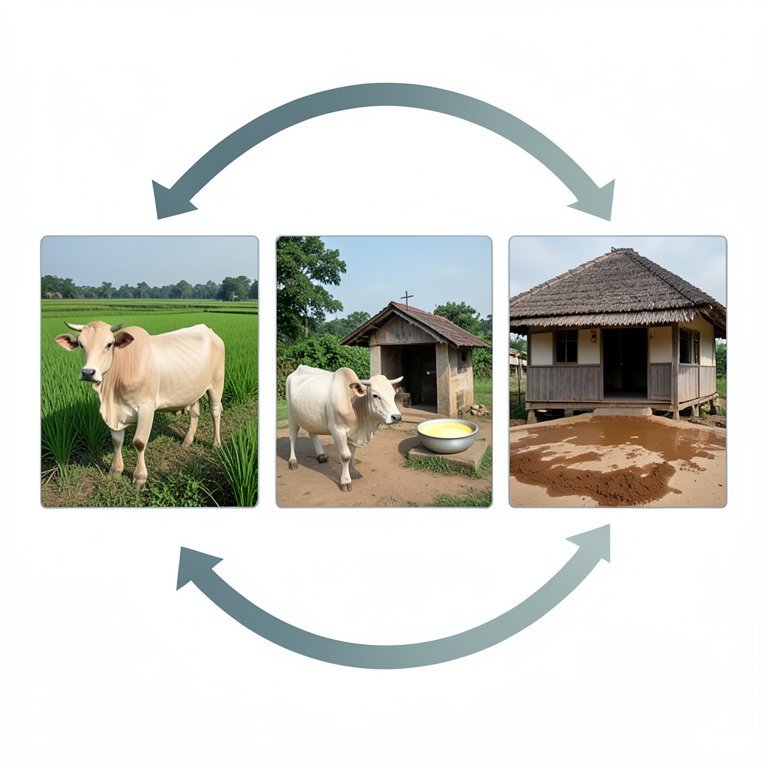
The Cycle of Bio-Cultural Integration
AI-generated conceptual illustration (Wayanad dwarf cattle and traditional Kuruma village elements). It explains the idea and does not show study data.
View source evidence ↗Introduction
Cultural heritage does not merely refer to tangible structures like monuments, but also encompasses the broad range of intangible elements such as the traditions or living expressions inherited from one's ancestors. The bio-cultural landscape comprises the biological, physical and cultural process that are unique to an area of which indigenous knowledge system is crucial part. Traditional knowledge is embedded in complex cultural systems. The focus of this study was the cultural components of the bio-cultural landscape of the life world of the Wayanad Dwarf cattle keepers as constructed by them using their contextual and personal frames of reference in their daily life as they engaged in the stewardship of this animal in a cultural landscape created through time. Thematic analysis of the interview narrations of the respondent farmers revealed the recurring theme to the traditional festivals that revolve around rice farming and harvest being central to the life world of the Kurumas. Cultural heritage does not merely refer to tangible structures like monuments, but also encompasses the broad range of intangible elements such as the traditions or living expressions inherited from one's ancestors. Living expressions Bridgewater and Rotherham (2019) [7] also observed that the creation and maintenance of traditional landscapes and their self-contained ecological systems are also crucial components (Agnoletti and Rotherham, 2015) [1] of cultural heritage. These encompass oral traditions, performing arts, rituals, festivals and the vast array of knowledge and practices about nature and the universe (Bridgewater and Rotherham, 2019) [7] . In addition to these range of components that encompass cultural heritage as mentioned above, Cultural landscapes that are unique to a particular region of the world are the combined effect of nature and humans and they signify the deep and intricate relationship between people and their natural environment (UNESCO, 1972) [28] . The dynamics of cultural landscapes according to Nassauer (1995) [20] is based on the four principles that view human landscape perceptions, cognitions and values as directly affecting landscapes and being affected by landscapes; landscape patterns as being shaped by cultural conventions; differing concepts of nature and ecological functions held by communities and that of the scientific community and the role of cultural values in shaping the aesthetic appearance of landscapes. It was these four principles of Nassauer (1995) [20] that gave rise to the use of the term bio-cultural while referring to the use of the term landscapes byBridgewater and Walton (1996) [8] as being shaped by the blending of www.extensionjournal.com human activity and the expression of biodiversity, thus giving rise to what they referred to as bio cultural landscapes. Poe et al. (2014) [23] also observed that bio cultural landscapes were the products of the joint production process of biophysical process and customary landscape management practices. The bio-cultural landscape comprises the biological, physical and cultural process that are unique to an area of which indigenous knowledge system is crucial part. Traditional knowledge is embedded in complex cultural systems (Berkes et al., 2000) [4] . Indigenous Technical knowledge has been described as specialized information specific to a certain culture or community (Sauvrav et. al., 2023) [25] . The interaction between communities and their natural, historical and social environments overtime gives rise to their unique culture. Their environments are important because they satisfy material needs of the community for food and water as well as fodder for their animal and medicine. In addition to material aspects, these environments are important in providing people with a basis for ethical values that they espouse as well as their concept of sacred spaces, aesthetic experiences and personal as well as group identification (Kassam, 2009) [16] . The voice of the indigenous people has often been underrepresented in global conservation discourse and their crucial role in giving form to and maintaining landscape has also had the same reception (DeGorger and Reilly, 2009) [10] . The concept of cultural landscape captures the entire expanse of human-environment interactions including associated uses and beliefs as well as practices and traditions. Previous approaches to conservation especially those centred upon the management of protected areas have their foundations rooted on ordered ecological systems that were undisturbed by humans (Wu and Loucks, 1995) [30] . These views have now been replaced with approaches that see ecosystem and the current global context -for that matter-as the result of a complex interplay between activities of economic and political origin and changes in the environment and climate and transformation on the social and cultural plane. This new understanding has rephrased the current practice of conservation to account for anticipated future threats besides providing sufficient room to accommodate various genetic and ecological processes that result from communities responding to change. The resilience of these socio ecological systems depends to a great extent on the tangible outcomes through which communities interact with their landscapes such as folklore, agro biodiversity and food sovereignty. Indigenous communities in their traditional or ancestral environments are intrinsic elements of these social ecological environment that have been shaped by very long process of interdependency co-evolution. Tribal communities all over India have their own preferences for rearing native breeds of cattle and poultry. Yadav and Bhimawat (2020) [31] reported that the tribal farmers of Bhilwara district of Rajasthan had a strong preferences for Kadakanath, a native poultry. Wayanad dwarf cattle have been reported from the Kuruma tribal settlements of the Kurichiat Range of the Wayanad Wildlife and Muthanga Wildlife sanctuaries as well as from the Periya area of Manathavady block in Wayanad district and from the catchment areas of the Karapuzha Dam (Kerala Biodiversity Board, 2016) [17] . There is of date, however no study on the cultural components of the biocultural landscape of this system. It is important that dairy farming systems are studied so as to ensure that strategic planning and government intervention can be forthcoming (Barman, et.al., 2024; Prashanthi and Reddy, 2022) [3,21] . It was in this context that the present study was undertaken.
Methodology
The focus of this study was the cultural components of the bio-cultural landscape of the life world of the Wayanad Dwarf cattle keepers as constructed by them using their contextual and personal frames of reference in their daily life as they engaged in the stewardship of this animal in a cultural landscape created through time. Life world here referred to the original ground of all theoretical and practical life of the keepers of the Wayanad Dwarf cattle (Zelic, 2007) [33] . Keeping in mind the objective of this study to gain an understanding of the experiences of the respondents and the role of the Wayanad Dwarf cattle in shaping these bio-cultural landscapes an interpretative/constructivist research design was used for the study. The interpretative/constructivist paradigm based on the epistemology of idealism and exploration of the social world of individuals was used for this study. Keeping in mind the objective of the study to generate information rich cases consistent with the interpretive research paradigm, theoretical sampling was used to select 12 Wayanad Dwarf cattle keepers for data collection through in depth repeated interviews till thematic and theoretical saturation was achieved (Ajjawi and Higgs, 2007; Guest et al., 2006) [2,14] . Hermeneutic phenomenology with thematic analysis was the research method used for the second phase of this study. This approach to research attempts to decipher the experience of the individual assuming that the reality of the individual is socially constructed. The importance of this research paradigm lies in its emphasis of the view of the participant in the situation under study. This research paradigm also provides a framework for making the background and the experiences of the participant or respondent a part of the research outcome. In contrast of the positivist paradigm, the constructivist paradigm does not begin with theory; it generates theory, or a pattern of meaning, inductively. Wayanad district of Kerala state was selected purposively for this study since the Wayanad Dwarf cattle are reported from this district. Data for the study was collected using an interview guide that had been prepared through a pre pilot test and tested among eight non-sample respondents from Noolpuzha, Amabalavayal, Thirunelly and Thavinhal panchayats. This pretested interview guide was then used to collect data from 12 respondents identified for the second part of the study through unstructured personal interviews followed by thematic analysis of the interviews. Thematic analysis of the interviews for was undertaken as per the procedure of Braun and Clarke (2006) [6] as follows:
Step 1: Familiarisation with the data by transcribing, reading and re reading the transcribed interview extracts and noting down initial ideas generated through discussion with the respondents
Step 2: Generation of initial codes and systematically coding important features of the data across the entire data set and collating the data relevant to each code www.extensionjournal.com
Step 3: Collating codes into potential themes and gathering data relevant to each theme Step 4: Reviewing themes at two levels; first level check if the theme matches with the coded extracts and second levelchecking if the theme s matches with the entire data set
Step 5: The themes were then reanalysed again and again to arrive at a clear idea of theme Step 6: Producing the text of the final scholarly report by combining various themes that emerged from the above process.
Results
Theme 1 -The traditional rice fields Thematic analysis of the interview narrations of the respondent farmers revealed the recurring theme to the traditional festivals that revolve around rice farming and harvest being central to the life world of the Kurumas. The main festivals that recurred through the data sets as comprising the cultural world of the Kurumas included the Thulapathu, Puthari, and Uchal that celebrate the planting of paddy saplings and the harvesting of rice. Paddy cultivation has also been reported among the tribal community of Assam (Bora et. al., 2023) [5] . Among the Kuruma, traditionally, planting the sapling is a ritual and is celebrated with festivities. community. The head of each hamlet, the eldest male member, performs poojas in the Daivappura (a place of worship) and his lighting of the nilavilakku (traditional lamp), marks this day as an important one for the community. The celebration Thulampathu or Putthari (meaning 'new rice') is significant for this paddy farming culture. This was followed by a hunting expedition, referred to as Uchal, in the evening, in former days but now this is not practiced due to the restrictions imposed by the Wildlife Protection Act, 1972.
Theme 2 -Custodians of the Wayanad dwarf and traditional rice varieties
Thematic analysis of the narratives of respondent farmers indicated the recurrent themes that centred on the fact that the Wayanad dwarf cows were treated as common property of the hamlet and were reared in large stables for all such cows in the hamlet. Over the data set another theme that was repeatedly encountered was the fact that the Kurumas generally tend to avoid rearing crossbred cows, despite their stated advantages, in view of their strong dislike for the milk of crossbred cows. Data from the transcribed interview transcripts indicated the recurring theme that highlighted the belief of the Kuruma tribesfolk that they were the custodians and stewards of the Wayanad dwarf cattle and the firm assertion that the protection of native cows was synonymous with protecting their culture and heritages. Cultural beliefs about organically grown agricultural produce and milk and dairy products made from milk of the Wayanad dwarf cattle being the secret to the health of the Kuruma community and the consequent need to sustain the ecosystem within these natural resources thrive also emerged as a recurring theme while analysing the transcripts of the interviews with the respondents of the study. In addition to these beliefs, the basic view of the Kuruma farmers that their mental happiness and source of entertainment lay in rearing the native Wayanad cow was also an important factor that kept them engaged in this vocation. The surprising revelation was that contrary to popular thought, this feeling was elicited by all the respondents irrespective of age and the cultural attributes of this animal was appreciated even among the younger members of this community as well. Abandonment of indigenous cows was cited as a very painful situation with significant psychological stress by the keepers of this animal. A life without the Wayanad dwarf was something unthinkable for the Kuruma farmers, as revealed by the theme that emerged wherein farmers repeatedly mentioned that they did not want a life where the Wayanad cows were excluded from their bio cultural landscapes.
Theme 3 -Wayanad dwarf as a means of subsistence and livelihood
Analysis of the interview transcripts revealed that secondary underlying reasons for rearing the Wayanad dwarf cattle were for subsistence and as a source of livelihood. Among the respondents studied, the sale of the dung of these animals -which was sold once or twice an year-was a major source of income and it was not uncommon for farmers from other parts of Wayanad to visit the Kurumas for the purchase of this valuable source of income. The urine of the Wayanad dwarf was also collected separately and sold to customers who specifically came to purchase the same. The other source of income from this system was through the sale of one-or two-year-old bull calves and aged bulls as well. These were sold to butchers and middle men for meat. Cultural norms however prohibited the Kurumas from selling any female animals, whether heifers, calves or cows. These were never sold; rather they were reared as priced possessions till death of the animal on the hamlet itself. Analysis of the data transcripts indicated the recurring theme that though the female Wayanad dwarf cow in all its stages was given a special position on their hamlets, the practice of attributing any divine character or nature to the female Wayanad dwarf cow was not practiced by the Kurumas.
Theme 4 -Cultural attributes of the Wayanad dwarf cow
Recurring themes that emerged during the analysis of the transcripts of interviews with the respondents indicated that the Wayanad dwarf cow was equated with the heritage and culture of the Kuruma tribe folk; protection and preservation of this animal, to the Kurumas meant the protection and cultivation of their heritage and culture. Important cultural concepts of wealth in terms of the perception of the Kuruma tribe people also emerged from the information generated through the analysis of the transcribed interviews that shed light on the important symbolic meaning of wealth that was ascribed to the Wayanad dwarf cow so that the wealth of a Kuruma family or hamlet was calculated in terms of its population of the Wayanad dwarf cow which was in line with the findings of Dash and Sethi (2007) [9] who observed that the Koya tribesmen also equated prestige and social standing with the number of native Motu cows on a household. Indigenous cows are maintained as an additional source of income along with farming. Wayanad dwarf cow rearing is a very cost-effective method of rearing. A good amount of income per year is obtained from native cows without any www.extensionjournal.com cost like feed, treatment and medicine. Indigenous Wayanad cows are cared for to obtain milk for domestic use and to produce various dairy products. Farmers believed that the milk quality and medicinal value of Wayanad cows is high.
Theme 5 -Cultural role of Wayanad dwarf cows and its products
Thematic analysis of the interview transcripts of the narrations of the respondent farmers indicated the recurring theme that the native cows were associated with the rituals and festivals of the Kuruma community. The important cultural role of the milk of the native cow in the ceremonies in the traditional family temples also referred to as the Daivappura was a repeated theme across the data sets. Milk and milk products of native cows are offered in the Daivappura during traditional festivals like Uchchal and Thulapathu. The importance of the milk of the Wayanad Dwarf cattle in the preparation of traditional and culturally priced food delicacies of the Kuruma community like Mulayaripayasam, and others that are used during special occasions and distributed among members of the community are prepared by the Kuruma, using native cow milk was another recurring theme that emerged highlighting the cultural role of the Wayanad Dwarf cattle in the life of the local community. These foods are used during the traditional events of Kuruma community such as the wedding ceremonies, death ceremonies and ceremonies related to the coming of age ceremonies of young girls (menarche). The Kuruma repeatedly articulated the theme that only the milk of the Wayanad cow could be used to prepare these culturally important food items that complete the life cycle of the Kuruma tribes people. Importantly significant was their views of the use of the milk of the crossbred cow. The closest translation of the vernacular word that was used to describe their feeling on why they do not prefer to use the milk the cross bred cow was that they abhorred the milk of the cross bred cow and hence would not use it. Though the Kuruma tribesmen sold their male animals for meat purposes they themselves would never and do not slaughter their animals for meat purposes or use the meat of their animals for ceremonial purposes Dung is an important product of the Wayanad dwarf cattle keeping system. Fresh dung from these animals is considered auspicious and it spread on the floors of their home and shrine twice in a year to instil cleanliness and purity to their residences. Brooms made of sticks of the dry Sida plant locally known as Alutha, and a wild variety of the common Sida rhombifolia plant also known as Kattu kurunthotti in vernacular is used by the Kurumas for spreading the fresh dung on the floors of their homes and shrines. The Kuruma community believe in after death ceremony and upon the demise of a community member, the practice of serving food items (sadhya) with all traditional delicacies to appease the member who has passed away is practiced. Milk of the Wayanad dwarf cow is used to prepare a wide range of dishes for this purpose. Young girls on their first attaining menarche is one of celebration and on a specified date family and relatives are invited for an auspicious gathering wherein the young girl is fed sweet dishes brought by relatives after which she is also fed rice mixed with ghee made from the milk of the Wayanad dwarf cow.
Analysis of the interviews of the respondents shed light on the theme that centred on the belief of the Kuruma tribesmen that any shortcuts in preparing delicacies for this purpose would not be appreciated by the deceased and hence the use of culturally prescribed ingredients is strictly adhered to. Analysis of the transcribed interview transcripts revealed recurring themes highlighting the sacredness of wedding rituals among the Kuruma tribesmen. Among the various traditions followed, that of providing meals to the groom's relatives on the third day of marriage is more important. On this day, the families of both the bride as well as the groom exchange several delicacies made from the milk of the Wayanad dwarf cow and its products. This exchange is referred to as Pittuvirunnu and the Thalaputtu and Madipputtu are the components of the same. A special item made on for this exchange is a type of ghee flat dosa known as Kellaputtu (a special type of dosa made from rice batter) and the ghee used is that obtained from the milk of the Wayanad dwarf cow milk. This exchange of the ghee dosa is called 'dosa kalyanam' and is a very important part of the marriage rituals of the Kuruma tribal people. The culturally important position assigned to the Wayanad dwarf as a sign of prosperity and auspiciousness was reflected in the theme that were recurrent on analysis of the transcribed interview transcripts that centred on the believe that a family that owned a dwarf cow would never be plagued by hunger and families with more animals were richer. This belief is the result of the inextricable role that this animal plays in both the social, cultural, physical and economic life of the Kuruma tribesmen. The entire life world of this community is touched by some aspect of this small animal that is indispensable to their life world. During the division of their ancestral properties to the next generation, animals are also treated as valuable property and are divided as per their customary law, The Kuruma community is rich in terms of its cultural forms and practices. The art forms they practice include kolkali, and vattakali. Narikuthu was another important art form practiced by them. It is not a festival, but a celebration of victory after a rather adventurous hunting. This practice of Narikuthu is related to cattle and the livelihood of the Kurumas since wild animals are a significant threat to cattle. Narikuthu used to be celebrated after capturing the problematic wild animal using a net at night after which and the community gathered around the captured animal singing and dancing. The song that they used to sing on such occasions is commonly referred to as the narikuthu/ anchadi pattu and this was sung through the night. All Kuruma communities do not practice narikuthu. This custom is prevalent in areas where wild animal attacks are prevalent. But today this ritual hunting is not practiced due to restrictions under the Wildlife Protection Act, 1972.
Discussion
The inextricable link of the Wayanad Dwarf cattle with the cultural way of life that revolved around the traditional rice cultivation cycle was also a recurring theme high lighting the links between the Wayanad dwarf cow and the practices associated with the preservation of the traditional rice fields. Apart from paddy, other traditionally cultivated crops such as ginger, turmeric, coffee and pepper also required the dung and urine of the Wayanad dwarf cow as important www.extensionjournal.com sources of manure. A better understanding of these systems could help in equipping farmers with appropriate tools to cope with the challenges posed by changing climatic conditions, making their farming practices more resilient and sustainable in the face of these adversities (Jyothi and Vijayabhinandana, 2024) [15] . Analysis of the interview transcripts revealed that secondary underlying reasons for rearing the Wayanad dwarf cattle were for subsistence and as a source of livelihood. Similar findings were made by Mitu et. al. (2023) [18] who observed that livestock are importance for resource poor rural households in that they provide a variety of functions that include power for cropping, transport, threshing, and oilseed crushing, manure as a source of fertilizer and fuel, a ready source of cash, and milk and meat for consumption. So also, Pravallika and Mazhar (2021) [22] , also reported that people in rural areas depend heavily on natural resources such as local water supplies and agricultural land. Similarly, Goswami and Biswas (2021) [13] also reported that livestock farming played a significant role in supplementing family income and gainful employment in rural sector, particularly, among poor farmers. Analysis of the data transcripts indicated the recurring theme that though the female Wayanad dwarf cow in all its stages was given a special position on their hamlets, the practice of attributing any divine character or nature to the female Wayanad dwarf cow was not practiced by the Kurumas. Similar findings were made by previous Somagond et al. (2020) [27] among the Soliga tribesmen of the outer parts of the hilly forest areas of Bili Giri Rangana Hills and Mahadeshwara Hills of Chamarajanagar district of Karnataka and by Dash and Sethi (2007) [9] who reported the use of dung on the agricultural field of the tribal communities engaged in rearing these animals as well as the sale of male animals and dung as a source of income. The findings of the present study were also corroborated with those of Chakrabarti et al. (2020) [31] among tribal farmers of Saraitoli village of Ranchi district of Jharkhand state where farmers reportedly reared cows for draft purposes as well as for valuable cow dung and they also sold calves for their livelihood. Recurring themes that emerged during the analysis of the transcripts of interviews with the respondents indicated that the Wayanad dwarf cow was equated with the heritage and culture of the Kuruma tribe folk; protection and preservation of this animal, to the Kurumas meant the protection and cultivation of their heritage and culture. Important cultural concepts of wealth in terms of the perception of the Kuruma tribe people also emerged from the information generated through the analysis of the transcribed interviews that shed light on the important symbolic meaning of wealth that was ascribed to the Wayanad dwarf cow so that the wealth of a Kuruma family or hamlet was calculated in terms of its population of the Wayanad dwarf cow which was in line with the findings of Dash and Sethi (2007) [9] who observed that the Koya tribesmen also equated prestige and social standing with the number of native Motu cows on a household. Saikia and Chauhan (2021) [24] observed that the tribal population of India was an important part of her social fabric. The Kuruma community is no exception, being rich in terms of its cultural forms and practices. The art forms they practice include kolkali, and vattakali. Narikuthu was another important art form practiced by them. Though the Kuruma tribesmen sold their male animals for meat purposes they themselves would never and do not slaughter their animals for meat purposes or use the meat of their animals for ceremonial purposes. This was in contrast to the findings of Somagond et al. (2020) [27] who observed that the Soliga tribesmen of the forests of Karnataka resorted to slaughter of their live animals and sale of meat within the community during Soliga festivals such as Mari habba, Kulemari, birthday and obituary ceremonies and on Sundays with an arrangement of assembly of 8-10 people as well as the findings of Dash and Sethi (2007) [9] who observed that the Koya tribesmen slaughtered and consumed the meat of the Motu cows that they reared and they even had the practice of consuming the dead animal. The importance of local breeds in the promotion sustainable models of development founded on tradition was highlighted by Gandini and Vila (2003) [12] who observed that despite the fact that a few breeds were promoted in Europe in the early 20 th century, the old local breeds of Europe continue to be farmed in certain areas because of the significant contribution of these breeds, in various environments, to humans in the form of work, food, raw materials for textiles and artisan crafts and fertilizers. The cultural value of local breeds is important as these values are linked to the need to preserve such breeds because they reflect the long history of symbiosis with humankind. The results of this study shed light on the cultural functions of the Wayanad dwarf native cows and their association with aspects of the culture of the Kurumas such as the the rituals and festivals of the Kuruma community where in the milk of the native cow played a crucial role in the ceremonies of the traditional family temples, the Daivappura during traditional festivals like Uchchal and Thulampathu; the gastronomical cultural significance of the food delicacies prepared from the milk of this animal such as Mulayaripayasam, traditionally made dosa for use during ceremonies relating to wedding, death and the coming of age ceremonies of young girls (menarche) as well as the use of dung of these animals to signal purity and auspiciousness by using it for the floors of homes all highlight the inextricable role of this animal in preserving the cultural heritage of these indigenous people. Fraoua (1986) [11] observed that cultural property could be defined as the property held by a state that was important for the archaeology, prehistory, history of art or science. This concept of cultural property is very significant in the world scene today especially against the backdrop of the 'accepted and pushed' models of development that link privileges to technology and economy thus fostering the rapid disappearance of entire cultural facies (faces, forms, appearances) that have been present for centuries. This disappearance of entire cultural faces of communities and landscapes was described as cultural impoverishment by Yudhishthir (1986) [32] . Gandini and Villa (2003) [12] observed thus proposed that a local livestock breed could, in principle, be considered as cultural property on account of the fact that this breed was, even today, a point of reference in ancient local traditions, and thus a 'custodian of local traditions'. The authors further argued that this is because the central role that local breeds have played in the agricultural system of an area as well as the social life of www.extensionjournal.com rural populations makes them valuable evidence of the history of the farming of such areas. Other important factors that make a local breed considered as the cultural property is on account of the cultural value of typical products of animal origin that have originated from a specific local breed, farming method or area and have over time become part of the way of life and the gastronomic traditions, the religious and civic festivals of the area or the people (Morand-Fehr et al., 1998) [19] . Thus, the results of the present study highlighting the cultural attributes and roles of the Wayanad dwarf cattle stress upon the grounds for considering the Wayanad Dwarf cattle as a cultural property of the State.
Conclusion
The aforementioned results and discussion point to the crucial position that the Wayanad Dwarf cattle play in the life world of the Kurumas of Wayanad. These results point to the need for participatory community-based conservation projects that would involve the community in the preservation of this native cattle.
References
29 in the original paper- Agnoletti M, Rotherham ID. Landscape and biocultural diversity. Biodivers Conserv. 2015;24:3155-3165.
- Ajjawi R, Higgs J. Using Hermeneutic Phenomenology to Investigate How Experienced Practitioners Learn to Communicate Clinical Reasoning. Qual Rep. 2007;12:612-638.
- Barman BB, Mohammad A, Kisku U, Lepcha CY. Exploring dairy farming practices and perceived constraints: A study of Rajbanshi farmers in Coochbehar. Indian Res J Ext Edu. 2024;24:44-52.
- Berkes F, Colding J, Folke C. Rediscovery of traditional ecological knowledge as adaptive management. Ecol Appl. 2000;10:1251-1262.
- Bora P, Mishra P, Das P. Production decision making pattern of gender in tribal farming community of Assam. Indian Res J Ext Edu. 2023;23:125-130.
- Braun V, Clarke V. Using thematic analysis in psychology. Qual Res Psychol. 2006;3:77-101.
- Bridgewater P, Rotherham ID. A critical perspective on the concept of biocultural diversity and its emerging role in nature and heritage conservation. People Nat. 2019;1:291-304.
- DeGeorges PA, Reilly BK. The realities of community based natural resource management and biodiversity conservation in Sub-Saharan Africa. Sustainability. 2009;1(3):734-788.
- Fraoua R. Convention on the Means of Prohibiting and Preventing the Illicit Import, Export and Transfer of Ownership of Cultural Property (Paris, 1970). UNESCO Doc CC-86/WS/40; c1986.
- Gandini GC, Villa E. Analysis of the cultural value of local livestock breeds: A methodology. J Anim Breed Genet. 2003;120(1):1-11.
- Goswami A, Biswas S. Study on knowledge, communication & adoption practices in livelihood generation of livestock owners in coastal agro-climatic zone of West Bengal, India. Indian Res J Ext Edu. 2021;21:1-7.
- Guest G, Bunce A, Johnson L. How many interviews are enough?-an experiment with data saturation and variability. Field Methods. 2006;18:59-62.
- Jyothi V, Vijayabhinandana B. Farmers information landscape: Trends and transformation. Indian Res J Ext Edu. 2024;24:12-18.
- Kassam KA. Viewing change through the prism of indigenous human ecology: Findings from the Afghan and Tajik Pamirs. Hum Ecol. 2009;37(6):677-690.
- Mitu SA, Mondal T, Kabir MH, Nurani N. Exploring the determinants of milk production among smallholder dairy farming: A case of Pirojpur district, Bangladesh. Indian Res J Ext Edu. 2023;23:1-5.
- Nassauer JI. Culture and changing landscape structure. Landscape Ecol. 1995;10:229-238.
- Prashanthi A, Reddy RG. Livelihood security of an isolated Gothi Koya tribe in Telangana State. Indian Res J Ext Edu. 2022;22:1-7.
- Pravallika GJ, Mazhar SH. Knowledge of farmers on climate change in Rangareddy district, Telangana. Indian Res J Ext Edu. 2021;21:91-95.
- Poe MR, Norman KC, Levin PS. Cultural dimensions of socioecological systems: Key connections and guiding principles for conservation in coastal environments. Conserv Lett. 2014;7:166-175.
- Saikia P, Chauhan JK. Eminence of tribal women entrepreneurs in Lakhimpur district of Assam. Indian Res J Ext Edu. 2021;21:135-139.
- Saurav SK, Chakravarty R, Chandran V, Meena BS. Utilization pattern and validation of indigenous technical knowledge (ITK) prevailing among the dairy farmers of Northern Bihar. Indian Res J Ext Edu. 2023;23:31-38.
- Savalia K, Ahlawat A, Gamit V, Parikh G, Verma A. www.extensionjournal.com Recently recognized indigenous cattle breeds of India: A review. Int J Curr Microbiol Appl Sci. 2019;8:161168.
- Somagond A, Patel B, Jose B, Kumar K, Yadav S, Soni P. Role of livestock in sustainable living for Soliga tribe in B R Hills of Karnataka. Int J Livest Res. 2020;10(6):11-23.
- UNESCO. World Heritage Convention. Convention concerning the protection of the world cultural and natural heritage adopted by the General Conference at its seventeenth session Paris, 16th November 1972. United Nations Educational, Scientific and Cultural Organisation, Paris; c1972.
- UNESCO. What is Intangible cultural Heritage? Available from: https://ich.unesco.org/en/what-isintangible-heritage-00003. [Accessed 20 Nov 2020].
- Wu JG, Loucks OL. From balance of nature to hierarchical patch dynamics: A paradigm shift in ecology. Q Rev Biol. 1995;70(4):439-466.
- Yadav CM, Bhimawat BS. Growth performance of Kadaknath poultry of tribal farmers in Bhilwara district of Rajasthan. Indian Res J Ext Edu. 2020;20:1-3.
- Yudhishthir RI. Heritage preservation versus the demands of modernisation. In: Proceedings of a Conference on Cultural Preservation; 8-10 Apr 1986; Washington. Paris: UNESCO and Smithsonian Institution; c1986. p. 108-114.
- Zelic T. On the phenomenology of the life-world. Synth Philos. 2007;46:413-426.