
Research article · 2024 · Full text
International Journal of Agriculture Extension and Social DevelopmentAssessing climate change effect on ginger crop in Bishnupur district of Manipur: Farmers’ perception
Volume 7(8) · Pages 403–407 · DOI: 10.33545/26180723.2024.v7.i8f.960 ↗
Research areasAgricultural Economics and PracticesEntomological Studies and EcologyHumic Substances and Bio-Organic Studies
Abstract
Author-writtenGinger is an important cash crop which is native to Asia belonging to Zingiberaceae family. It is used as spice, medicines, condiments and flavoring drinks. India is the largest producer of ginger and grown all over the North-eastern states of India. In Manipur, the production of ginger in 2020-2021 was estimated 66939MT in area of 4801ha as against 72336MT in area of 4988ha in 2019-2020. Over the years there is increasing trend in temperature and erratic rainfall in the whole world. The climate change mostly affects the agricultural sector. The study was proposed with objectives to study the socio-economic profile of the ginger farmers and the perception of the ginger farmers’ to climate change. The sample size was collected by simple random techniques. Primary data was collected through personal interview using pretested interview schedule. In order to achieve the framed objectives, we have used statistical tools like mean, frequency, percentage, standard deviation, correlation and ordinal logistic regression. The farmers in the study area had perceived an increase in summer temperature, minimum average temperature, drought like situation and decrease in annual rainfall quantity, flood like situation and frost intensity. The outcomes of ordinal logistic regression portray that age, mass media exposure and extension agent contact have most significant influence on perception of climate change while annual income have negative significant influence.
Summary
Source-checkedPlain-language reading of the full paper, prepared with AI and checked against the text. Each point links to the authors' own words.
Why it matters
- Ginger is a significant cash crop native to Asia, utilized for its properties as a spice, medicine, condiment, and flavoring agent. View evidence ↗
- Global trends of increasing temperatures and erratic rainfall associated with climate change primarily impact the agricultural sector. View evidence ↗
- Farmers' perception and knowledge of climate change are critical because they influence the adaptation strategies used to mitigate adverse effects. View evidence ↗
The question
- The study aimed to analyze the socio-economic profiles of ginger farmers and their perceptions regarding climate change. View evidence ↗
What they did
- The research was conducted across three blocks (Bishnupur, Nambol, and Moirang) in the Bishnupur district of Manipur. View evidence ↗
- Primary data were gathered via personal interviews using a pre-tested schedule and analyzed using mean, standard deviation, percentage, Spearman's correlation, and ordinal logistic regression. View evidence ↗
What they found
- A vast majority of respondents (98.00%) perceived a decrease in the quantity of rainfall. View evidence ↗
- 84.00% of the farmers perceived an increase in drought-like situations. View evidence ↗
- 60% of respondents observed a decrease in the leaf-bearing characteristics of the ginger plants. View evidence ↗
- The majority of farmers (73.00%) observed that leaf growth occurred later than usual. View evidence ↗
- Farmers reported increased problems with weeds (73.00%), pest infestation (64.00%), and diseases (62.00%) in ginger cultivation. View evidence ↗
- 89.00% of the respondents believed that the increase in pests, diseases, and weeds was linked to climate change. View evidence ↗
- Regarding their overall perception level of climate change, 50% of respondents were categorized as medium, 30% as high, and 20% as low. View evidence ↗
- Ordinal logistic regression showed that higher age (3.30x odds), mass media exposure (6.13x odds), and extension agent contact (3.62x odds) significantly increased the likelihood of a farmer having a higher perception of climate change. View evidence ↗
- Higher annual income had a negative influence, decreasing the odds of being in a higher perception category by 0.32 times. View evidence ↗
What it means
- The authors recommend that the government improve irrigation facilities and implement precision farming to sustain agriculture against decreasing rainfall and increasing drought. View evidence ↗
Visual summary
2 visualsIllustrations explain the paper; charts are replotted from the paper's own table values.
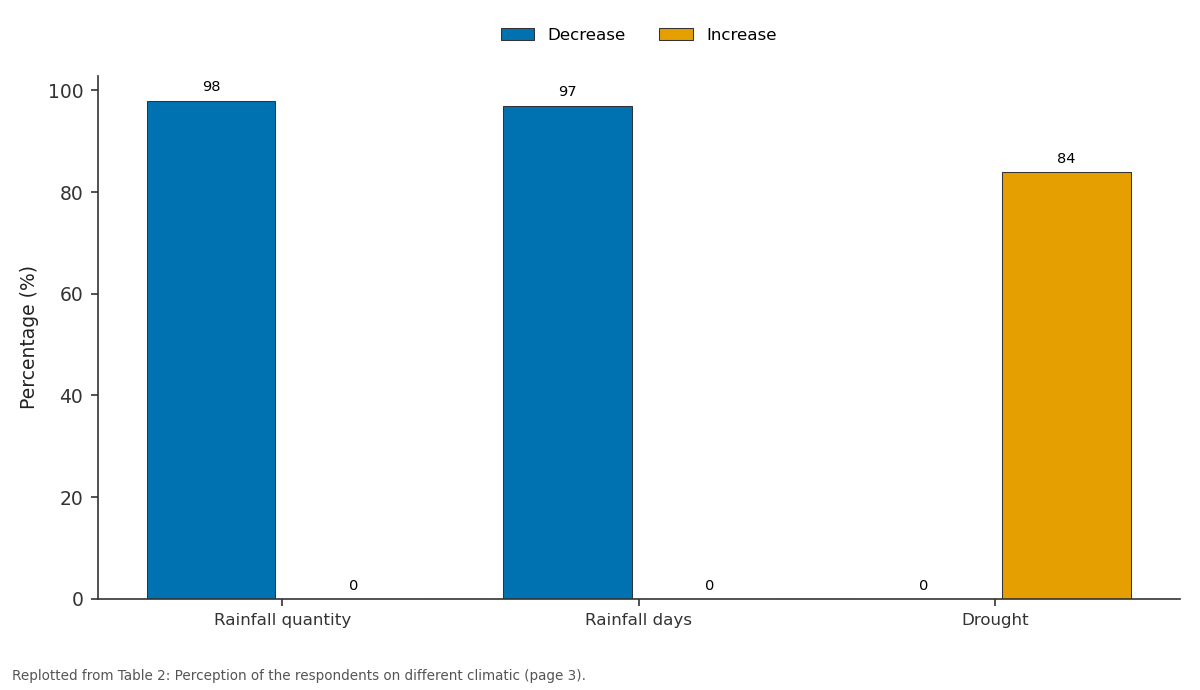
Decrease and Increase: Rainfall quantity vs Rainfall days vs Drought
Replotted from Table 2 (page 3) of the original paper. Every bar is the paper's own table value.
View source evidence ↗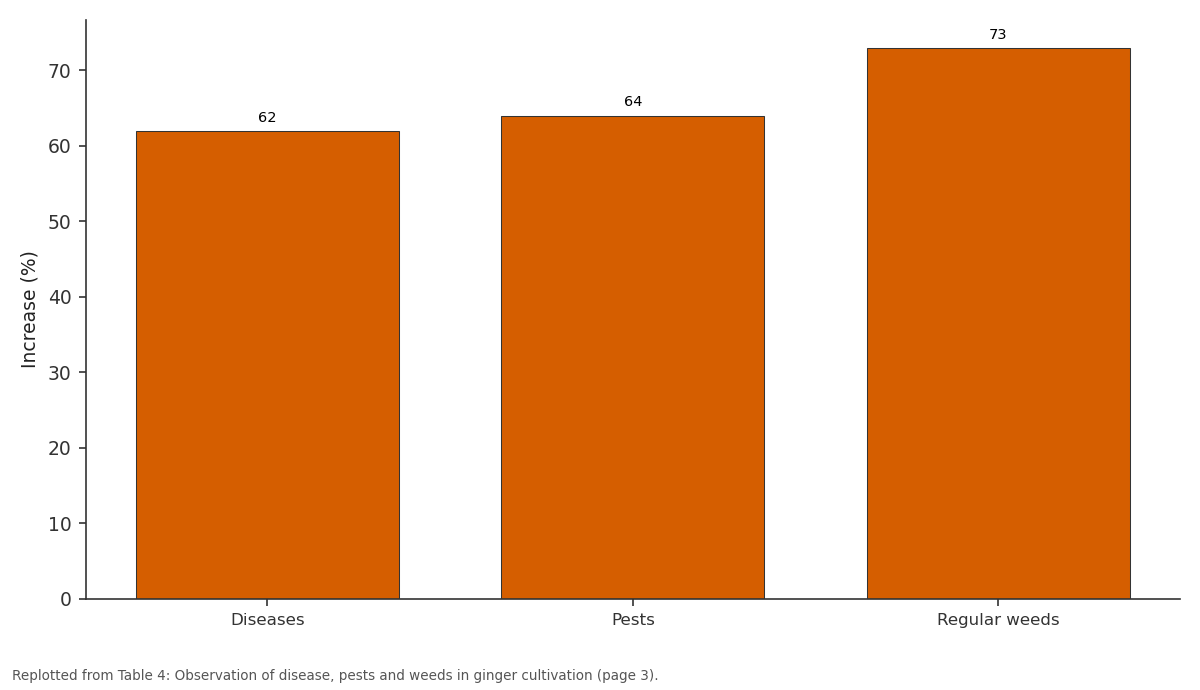
Increase (%): Diseases vs Pests vs Regular weeds
Replotted from Table 4 (page 3) of the original paper. Every bar is the paper's own table value.
View source evidence ↗Figures & tables
From the original paper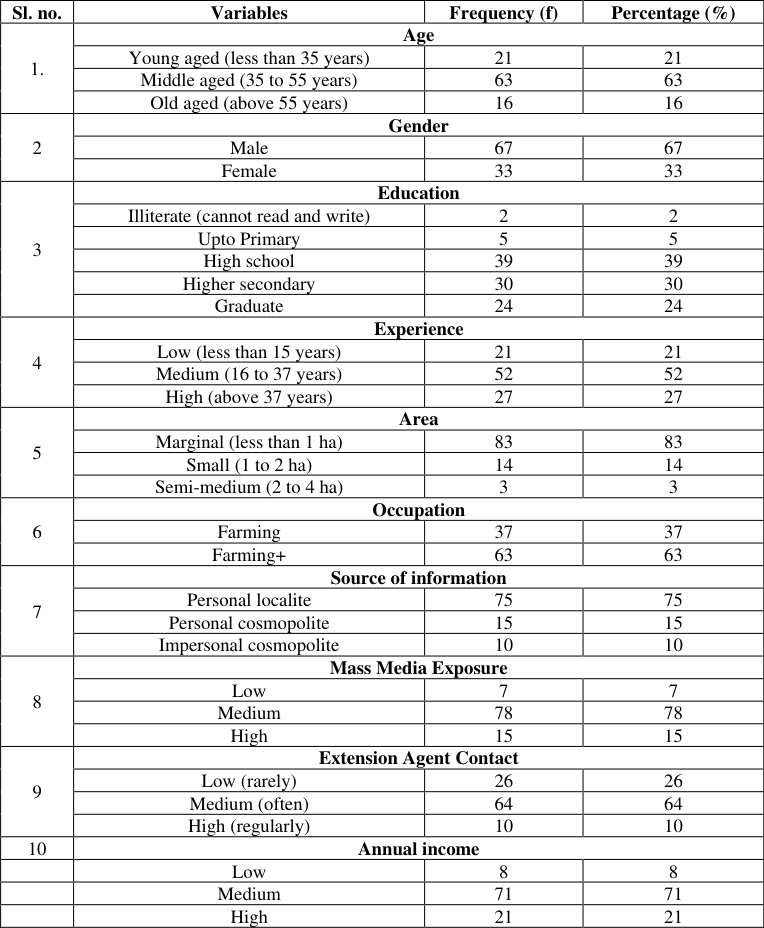 Table 1
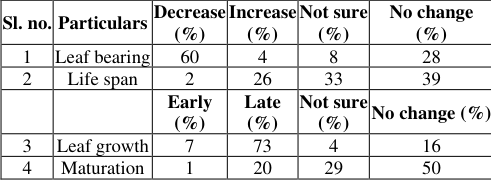 Table 3
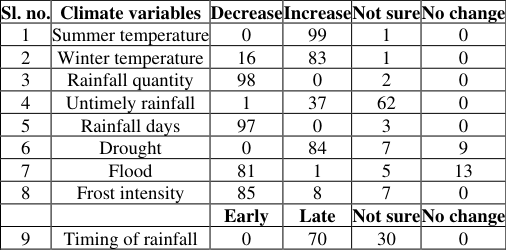 Table 2
 Table 4
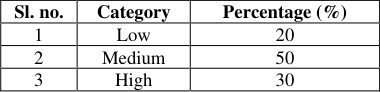 Table 5
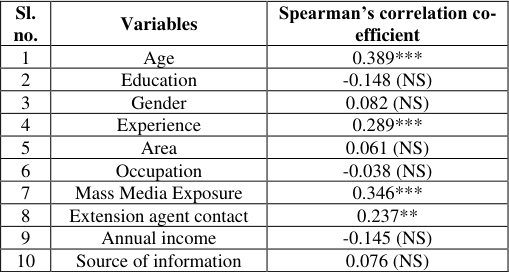 Table 6
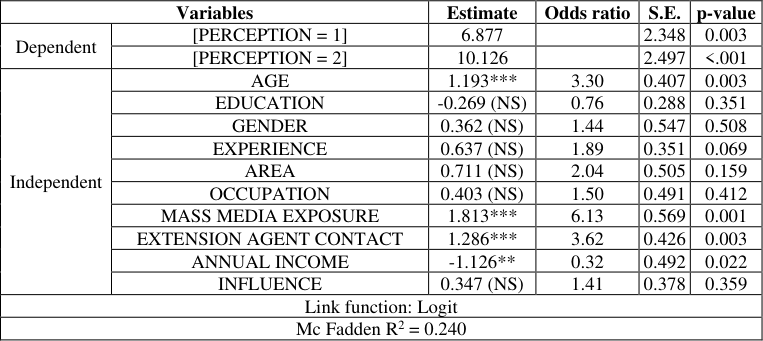 Table 7
Introduction
Ginger is an important cash crop and planted all over the North-Eastern India. India is the largest ginger producer in the world in which Madhya Pradesh rank first. M.P, Karnataka, Orissa, Assam, Meghalaya, Arunachal Pradesh and Gujarat together contributes 65% to the country's total production. In NER, Assam has the highest area as well as production but Mizoram has the higher productivity. In Manipur, Churachandpur district has the highest area and production followed by Bishnupur district (GoM, 2021) [4] . Ginger (Zingiber officinale) belongs to Zingiberaceae family and native probably from South-Eastern Asia. It is used as spice, condiment, confectionary and as flavoring in alcoholic and non-alcoholic beverages, medicines etc. Over the years, there has been an increasing trend in temperature and erratic rainfall (IPCC, 2007) [2] . In the past years, there were occurrence of severe drought and flood. There has been many cases of drought, even though the North Eastern Region belong to high rainfall region. In 2005, Mizoram state had prolong dry period and the wetlands in many parts of the North-East were shrinking. In 1999-2000, there was drought in Eastern India which led to starvation of millions and poor crop yield (Das et al., 2009) [1] . Yohannes (2016) [8] stated that change in the climatic factors has a potential threat to the agricultural activities and thus a threat to the country. The agricultural activities are highly dependent to the climatic factors like temperature, rainfall etc. The changing climate has posed great threat to the people's livelihood that is depending directly on agriculture. Also, climate change has a great impact in the ginger cultivation. The perception about climate change and the farmers' understanding and knowledge of the climate change affects how they deal with the climate change and the different adaptation strategies taken up by the farmers. Mundhe (2019) [6] stated that farmers' perception is the key to mitigate the adverse effect of climate change on agriculture. Thus, perception and understanding of the climate change is important in adaptation decision and policy making by the government. Niles et. al., (2016) [3] stated that perception of the farmers' to climate change was influenced by their personal and environmental factors including infrastructure which alter their adaptation decision. The present study was taken to study "Ginger farmers' perception about climate change" in Bishnupur district of Manipur. The main objectives include to study the sociowww.extensionjournal.com economic profile of the ginger farmers and to study the perception of climate change and its' effect on ginger crops.
Methodology
The present study was conducted in Bishnupur district of Manipur. In Bishnupur district there are three blocks viz. Bishnupur block, Nambol block and Moirang block. All the three blocks were selected. One village each were selected from Bishnupur and Nambol block while four villages were selected from Moirang block. Selection of the respondents was done by random sampling method and a total of 100 respondents were selected. Ex-post facto research design was used for the study. Primary and secondary data were collected. Primary data were collected through personal interview with the respondents by pre-tested interview schedule. For the data analysis mean, standard deviation, percentage, Spearman's correlation and ordered logistic regression analysis were employed. According to educational level, 39.00 per cent of the respondent had educational level up-to high school, 30.00 per cent of them were higher secondary level, 24.00 per cent of them were college graduates, 5.00 per cent of them had education level up-to primary and 2.00 per cent of them were illiterate. Farming experience wise 52.00 per cent of the respondent had medium farming experience, 27.00 per cent of them had high experience level while 21% of them had low experience level. As regard to area or landholding of the respondents, majority (83.00%) of them was marginal farmers, 14.00 per cent of them were small farmers and 3.00 per cent of them were semi-medium farmers. In regard to occupation wise of www.extensionjournal.com the respondents, 63.00 per cent of the respondents had nonfarming activities along with farming while 37.00 per cent of the respondents had farming as their primary occupation.
Results and Discussion
Results and Discussion
Socio-economic profile of the respondents
As for the source of information, 75.00 per cent of the respondents got their farming and agriculture related information from personal localite, 15.00 per cent of them from personal cosmopolite and the remaining 10.00 per cent from impersonal cosmopolite. As for the mass media exposure, majority (78.00%) of the respondents had medium level of exposure to mass media while 15.00 per cent of them had high exposure to mass media and the rest 7.00 per cent had low level of mass media exposure. Also for the extension agent contact, 64.00 per cent of the respondent had medium level of contact with the extension agent while 26.00 per cent of the respondent had low contact with the extension agent and 10.00 per cent of them had high contact with extension agent. As for the annual income of the respondent, 71.00 per cent of the respondent had medium annual income while 21.00 per cent of them had high annual income and the rest 8.00 per cent had low annual income.
Perception of ginger farmers' about the climate change
Perception is the understanding and interpretation of changes in climate by farmer based on their prior experiences (Mundhe, 2019) [6] . From table 2, it is evident that (99.00%) of the respondents in the study area perceived that the summer temperature had increased while the rest 1.00 per cent were not sure about the change in summer temperature. Also, 83.00 per cent of the respondents in the area perceived that the winter temperature had increase and 16.00 per cent of them perceived winter temperature had increase and the rest 1.00 per cent were not sure. 98.00 per cent of the respondents perceived that the rainfall quantity had decrease while the rest 2.00 per cent were not sure about the change in rainfall quantity. About the rainfall, 97.00 per cent of the respondents perceived that there was decrease in rainfall while the rest 3.00 per cent were not sure about the change. 84.00 per cent of the respondents perceived that the drought like situation in the study area had increase, 9.00 per cent of them perceived that there were no change and the rest 7.00 per cent of them stated that there were no change. 81.00 per cent of the respondents perceived that the flood had decrease while 13.00 per cent of them stated that there were no changed, 5.00 per cent of them were not sure about the change and the rest 1.00 per cent perceived that flood had increase. In case of frost intensity, 85.00 per cent of the respondents perceived that the frost intensity had decrease and 8.00 per cent of them stated that the frost intensity had increase and the remaining 7.00 per cent were not sure about the change in frost intensity. 70.00 per cent of the respondents perceived late rainfall while 30.00 per cent of the respondents were not sure about the change. Table 3, it was found that 60 per cent of the respondents observed that there was decrease in leaf bearing characteristic of ginger. However, 28.00 per cent of the respondents observed that there were no change in the leaf bearing characteristic, while 8.00 per cent of them were not sure of the change and 4.00 per cent of them observed that there were increase in the leaf bearing in ginger. Also, in case of life span of ginger 39.00 per cent of the respondent observed that there were no change in the life span. However, 33.00 per cent of them were not sure about the change, 26.00 per cent of them observed increased in the life span and 2.00 per cent of them observed that life span decrease.
| Sl. no. | Climate variables | Decrease | Increase | Not sure | No change |
|---|---|---|---|---|---|
| 1 | Summer temperature | 0 | 99 | 1 | 0 |
| 2 | Winter temperature | 16 | 83 | 1 | 0 |
| 3 | Rainfall quantity | 98 | 0 | 2 | 0 |
| 4 | Untimely rainfall | 1 | 37 | 62 | 0 |
| 5 | Rainfall days | 97 | 0 | 3 | 0 |
| 6 | Drought | 0 | 84 | 7 | 9 |
| 7 | Flood | 81 | 1 | 5 | 13 |
| 8 | Frost intensity | 85 | 8 | 7 | 0 |
| Early | Late | Not sure | No change | ||
| 9 | Timing of rainfall | 0 | 70 | 30 | 0 |
Table text extracted from the original PDF; superscript letters are shown inline. The original table image is below.
View original table image
| Sl. no. | Particulars | Decrease (%) | Increase (%) | Not sure (%) | No change (%) |
|---|---|---|---|---|---|
| 1 | Leaf bearing | 60 | 4 | 8 | 28 |
| 2 | Life span | 2 | 26 | 33 | 39 |
| Early (%) | Late (%) | Not sure (%) | No change (%) | ||
| 3 | Leaf growth | 7 | 73 | 4 | 16 |
| 4 | Maturation | 1 | 20 | 29 | 50 |
Table text extracted from the original PDF; superscript letters are shown inline. The original table image is below.
View original table image
In case of leaf growth, majority (73.00%) of the respondent observed that the leaf growth was late while 16.00 per cent of them observed no change, 7.00 per cent of them observed early leaf growth and 4.00 per cent of them were not sure about the change. In case of maturation of the ginger, 50.00 per cent of the respondents stated that there was no change in the maturation period of the ginger while 29.00 per cent of them were not sure about the change. However, 20.00 per cent of them observed late maturation of the ginger and the remaining 1.00 per cent of the observed early maturation. Majority of the respondents in the study area observed increase problem due to disease (62.00%), pest infestation (64.00%) and weeds occurrence (73.00%) in the ginger cultivation. Also from the table 4, it is evident that the majority (89.00%) believed that the increase in the diseases, pests and weeds were linked to climate change. Similar findings reported by Roy et. al., (2020) [7] . Table 5, show that the respondents were categorized according to their perception level. It shows that 50% of the respondents had medium level of perception while 30% of the respondents had high perception level and the remaining 20% had low perception level. Similar findings were reported by Mundhe (2019) [6] . Table 6, it was found that the variable age, experience, mass media exposure and extension agent contact was positively significant. This means that these variables were correlated with the perception on climate change. Age, experience in farming and mass media exposure were significant at 0.01 level of significance while extension agent contact was significant at 0.05 level of significance. Similar findings reported by Meinam (2022) [5] . 7, shows the regression analysis of the dependent variable, perception on climate change and independent variable, socio-economic profile of the ginger farmers. Out of the 10 independent variables, three variables viz., age, mass media exposure and extension agent contact had positive influence on the respondents' perception on climate change. This means that with increase in age of the respondent, the odds of being in the higher perception category is 3.30 times greater. Similarly, with higher exposure to mass media, the odds of being in higher perception category are increase by 6.13 times. Also, with higher contact with the extension agents, the odds of the respondent to be in higher perception category are increase by 3.62 times. However, annual income had negative influence on the perception on climate change. It is interpreted as, with higher annual income, the odds of respondent to be in higher perception category are decrease by 0.32 times.
| Sl. no. | Variables | Spearman’s correlation co- efficient |
|---|---|---|
| 1 | Age | 0.389*** |
| 2 | Education | -0.148 (NS) |
| 3 | Gender | 0.082 (NS) |
| 4 | Experience | 0.289*** |
| 5 | Area | 0.061 (NS) |
| 6 | Occupation | -0.038 (NS) |
| 7 | Mass Media Exposure | 0.346*** |
| 8 | Extension agent contact | 0.237** |
| 9 | Annual income | -0.145 (NS) |
| 10 | Source of information | 0.076 (NS) |
Table text extracted from the original PDF; superscript letters are shown inline. The original table image is below.
View original table image
| Sl. no. | Category | Percentage (%) |
|---|---|---|
| 1 | Low | 20 |
| 2 | Medium | 50 |
| 3 | High | 30 |
Table text extracted from the original PDF; superscript letters are shown inline. The original table image is below.
View original table image
| Category | Observation | — | — | — | Do you think it is due to climate change? | — | — |
|---|---|---|---|---|---|---|---|
| Decrease (%) | Increase (%) | Not sure (%) | No change (%) | No (%) | Yes (%) | Not sure (%) | |
| Diseases | 0 | 62 | 19 | 19 | 4 | 89 | 7 |
| Pests | 0 | 64 | 18 | 18 | |||
| Regular weeds | 11 | 73 | 6 | 10 |
Table text extracted from the original PDF; superscript letters are shown inline. The original table image is below.
View original table image
Conclusion and recommendations
Farmers perceived increase in maximum temperature, increase in minimum average temperature, decrease in rainfall quantity and decrease in frost intensity. Perception on climate change shows that 50% of the respondent had medium perception, 30% had high perception and 20% had low perception level. Age, experience, mass media exposure and extension agent contact are correlated with perception to climate change. Out come from Ordinal Logistic Regression portray that age, mass media exposure, extension agent contact have positive influence with perception to climate change. With decrease of rainfall quantity and increase drought like situation, Government and concern departments should take up initiatives to improve irrigation facilities. The Government should take initiatives to implement effective precision farming to sustain agriculture from climate change. Insurance coverage and financial aids to the farmers have to be guaranteed by government.
Acknowledgement
AcknowledgementAbove all, I would like to thank the co-authors for their kind support and valuable guidance, while conducting the www.extensionjournal.com research and revision of this paper. The authors also would like to thank the respondent farmers for sharing their valuable perception and knowledge
Figures and tables from the paper
| Sl. no. | Variables | Frequency (f) | Percentage (%) |
|---|---|---|---|
| 1. | Age | ||
| Young aged (less than 35 years) | 21 | 21 | |
| Middle aged (35 to 55 years) | 63 | 63 | |
| Old aged (above 55 years) | 16 | 16 | |
| 2 | Gender | ||
| Male | 67 | 67 | |
| Female | 33 | 33 | |
| 3 | Education | ||
| Illiterate (cannot read and write) | 2 | 2 | |
| Upto Primary | 5 | 5 | |
| High school | 39 | 39 | |
| Higher secondary | 30 | 30 | |
| Graduate | 24 | 24 | |
| 4 | Experience | ||
| Low (less than 15 years) | 21 | 21 | |
| Medium (16 to 37 years) | 52 | 52 | |
| High (above 37 years) | 27 | 27 | |
| 5 | Area | ||
| Marginal (less than 1 ha) | 83 | 83 | |
| Small (1 to 2 ha) | 14 | 14 | |
| Semi-medium (2 to 4 ha) | 3 | 3 | |
| 6 | Occupation | ||
| Farming | 37 | 37 | |
| Farming+ | 63 | 63 | |
| 7 | Source of information | ||
| Personal localite | 75 | 75 | |
| Personal cosmopolite | 15 | 15 | |
| Impersonal cosmopolite | 10 | 10 | |
| 8 | Mass Media Exposure | ||
| Low | 7 | 7 | |
| Medium | 78 | 78 | |
| High | 15 | 15 | |
| 9 | Extension Agent Contact | ||
| Low (rarely) | 26 | 26 | |
| Medium (often) | 64 | 64 | |
| High (regularly) | 10 | 10 | |
| 10 | Annual income | ||
| Low | 8 | 8 | |
| Medium | 71 | 71 | |
| High | 21 | 21 |
Table text extracted from the original PDF; superscript letters are shown inline. The original table image is below.
View original table image
| Variables | — | Estimate | Odds ratio | S.E. | p-value |
|---|---|---|---|---|---|
| Dependent | [PERCEPTION = 1] | 6.877 | 2.348 | 0.003 | |
| [PERCEPTION = 2] | 10.126 | 2.497 | <.001 | ||
| Independent | AGE | 1.193*** | 3.30 | 0.407 | 0.003 |
| EDUCATION | -0.269 (NS) | 0.76 | 0.288 | 0.351 | |
| GENDER | 0.362 (NS) | 1.44 | 0.547 | 0.508 | |
| EXPERIENCE | 0.637 (NS) | 1.89 | 0.351 | 0.069 | |
| AREA | 0.711 (NS) | 2.04 | 0.505 | 0.159 | |
| OCCUPATION | 0.403 (NS) | 1.50 | 0.491 | 0.412 | |
| MASS MEDIA EXPOSURE | 1.813*** | 6.13 | 0.569 | 0.001 | |
| EXTENSION AGENT CONTACT | 1.286*** | 3.62 | 0.426 | 0.003 | |
| ANNUAL INCOME | -1.126** | 0.32 | 0.492 | 0.022 | |
| INFLUENCE | 0.347 (NS) | 1.41 | 0.378 | 0.359 | |
| Link function: Logit | |||||
| Mc Fadden R2 = 0.240 |
Table text extracted from the original PDF; superscript letters are shown inline. The original table image is below.
View original table image
References
5 in the original paper- Intergovernmental Panel on Climate Change (IPCC). Climate change 2007: The physical science basis. Contribution of Working Group I to the Fourth Assessment Report of the Intergovernmental Panel on Climate Change; c2007.
- Niles MT, Mueller ND. Farmer perception of climate change: Associations with observed temperature and precipitation trends, irrigation, and climate beliefs. Glob Environ Change. 2016;39:133-142.
- Mundhe SD, Suradkar DD, Dhugand VG. Farmers' perception about climate change in Latur and Beed districts of Maharashtra state, India. Int J Curr Microbiol Appl Sci. 2019;8(6):2754-2761.
- Roy S, Barooah AK, Ahmed KZ, Baruah RD, Prasad AK, Mukhopadhyay A. Impact of climate change on tea pest status in northeast India and effective plans for mitigation. Acta Ecologica Sinica. 2020;40(6):432-442.
- Yohannes H. A review on the relationship between climate change and agriculture. J Earth Sci Clim Change. 2016;7(2):1000335.