
Research article · 2019 · Full text
International Journal of Advanced Chemistry ResearchInvestigate the concept of keystone species and their critical role in maintaining the structure and stability of ecosystems
Volume 1(2) · Pages 52–55 · DOI: 10.33545/26646781.2019.v1.i2a.223 ↗
Research areasAnimal Ecology and Behavior Studies
Abstract
Author-writtenIn essence, it refers to individual species in the ecosystem that influence it enormously and out of proportion to their prevalence. Besides, these species are very central in dictating the structure and stability of their settings and the kinds and quantities of other species present. It was named by the ecologist Robert Paine in 1969 and explicated that the extinction of the keystone species topples chain of events that distort community structure, and, in some cases, diminish the total number of species in that specific ecosystem. Keystone species may also be these species that prey on other species such as sea otters which act as predators of sea urchins or these species that alter the structure of their environment for instance beavers that build dams. They can also be mutual species for example, some animals that depend on flowering plants for pollination can be good examples. Exemplified by the role of wolves on moose population, mice, and plants, loss of keystone species will lead to the overexploitation of resources, overwhelming of a species, and future crashes in ecosystem effects. Thus, keystone species play the vital role in conservation of ecological balance, and they should be protected at all costs. Preserving keystone species is important to the stability and overall health of the world’s ecosystems because species help manage resources in the ecosystems.
Summary
Source-checkedPlain-language reading of the full paper, prepared with AI and checked against the text. Each point links to the authors' own words.
Why it matters
- Keystone species are organisms that have a disproportionately large impact on their ecosystem relative to their abundance. View evidence ↗
- These species are critical because they dictate the overall structure, stability, and the diversity of other species within their environment. View evidence ↗
- Protecting keystone species is essential for global ecosystem health as they play a key role in resource management. View evidence ↗
The question
- The study aims to describe keystone species, explain their importance, and analyze the effects of their removal using various examples. View evidence ↗
What they did
- The quantitative component of the research involved a literature review of manuscripts and reports from databases including PubMed, Scopus, Web of Science, and Google Scholar. View evidence ↗
- The study also used a qualitative approach consisting of survey questionnaires and structured interviews with experts in ecology, conservation biology, and environmental sciences. View evidence ↗
- The researchers used triangulation to merge statistical trends from the literature with themes and narratives from the expert interviews. View evidence ↗
What they found
- In marine intertidal zones, the removal of the starfish Pisaster ochraceous led to a decrease in species diversity because mussels, their prey, became dominant. View evidence ↗
- Beavers serve as ecosystem engineers by building dams that create new habitats, manage water movement, and improve water quality. View evidence ↗
- Bees are identified as keystone species across many ecosystems due to their critical role in plant reproduction, which supports the entire food chain. View evidence ↗
- Fig trees (Ficus spp.) act as keystone mutualists by providing a primary food source for many fruit-eating animals during periods of fruit scarcity. View evidence ↗
- The introduction of the invasive Argentine ant in California displaced native ants, which subsequently altered plant community composition and reduced plant diversity. View evidence ↗
- Sea otters protect kelp forests by regulating sea urchin populations; without otters, urchins overgraze the kelp, destroying habitats and reducing carbon moderation. View evidence ↗
What it means
- The authors conclude that preserving keystone species is vital for maintaining species diversity and the overall sustainability of ecosystems. View evidence ↗
- The authors recommend that future global conservation efforts focus on the understanding and effective management of keystone species to ensure environmental stability. View evidence ↗
Visual summary
1 visualsIllustrations explain the paper; they do not show study data.
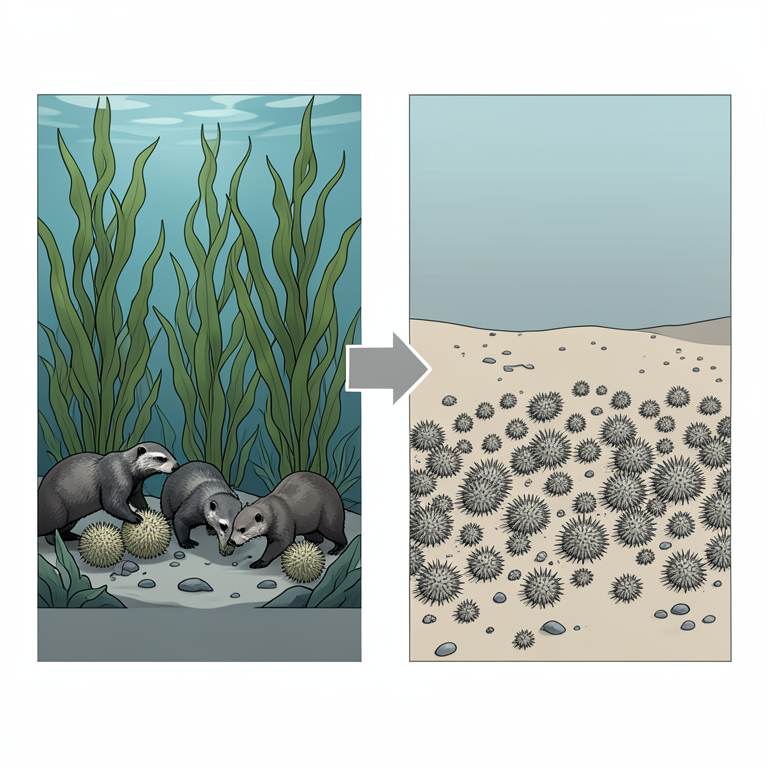
Study overview
AI-generated conceptual illustration (Sea otters, sea urchins, and kelp forests). It explains the idea and does not show study data.
View source evidence ↗Introduction
Keystone species remain an important theoretical concept in ecology; it underlines the significant impact of species on the surroundings. The concept of keystone species has been coined by Robert Paine in 1969 and represents organisms that have an important impact on the organization of the environment, although they are not numerous. These individuals are keystone species within the networks of species because they regulate the dynamics of the species abundance and their distribution, in addition to altering the species composition as well as resource supply and demand. Thus, keystone species can act as predators, ecosystem engineers and mutualist species. Aptly known as 'predator species,' namely the wolves and sea otters, control the number of preys to avoid overproduction that could lead to destruction of their habitats and depletion of species' biodiversity. Producers alter the physical environment by "building dams, felling trees, digging burrows, making trails, and watering channels; they also alter water, soil and vegetation characteristics". Specialist species that share positive interactions or dependency on one another for reproductive success are exceptional key-stone species, for instance, pollinators and seed dispersers that influence plant reproductive volume hence supporting the food chain. If a keystone species is taken out or fades away, then it can lead to deterioration of that ecosystem and loss of species' diversity. For example, when wolves were eradicated from Yellowstone "National Park", unnecessary consumption of vegetative and riparian areas to elks resulted to most of vegetation depletion. On the other hand, the introduction of wolves brought back the order in the ecosystem and made it healthy again. Keystone species' concept plays an important role in dissecting the conservation problem, so its understanding is critical. That is why protection of such species is important to maintain the stability of ecosystems and show people that all living creatures affect each other and are all interconnected on this planet. Consequently, keystone species act as signals of an ecosystem's health and as its protectors thereby reinforcing their significance in the management of the environment and the conservation of the biotic community.
Keystone Species in Marine Ecosystems
Paine's keystone volume collected and presented the keystone species concept, while his research on the roles of the starfish Pisaster ochraceous on the bottom of the intertidal zones at Friday Harbour, Washington provided the first empirical evidence of how a single predator could control species evenness. Paine (1969) illustrated that the exclusion of Pisaster aggravated the reduction of species diversity due to the increase in the density of mussel, which is their food source that tends to dominate the areas where the starfish's feed on them. This essential research pointed out that keystone predators may ensure the proper competitive exclusion of prey species.
Terrestrial Ecosystem Dynamics
In terrestrial ecosystems it was also found out that large herbivores and apex predators carry out the role of keystone species. According to Ripple and Beschta, wolf reintroduction has created a range of off target effects in Yellowstone National Park. According to their study, elk populations were controlled by wolves and in this way willow and aspen young growth, which was overgrazed, could regenerate again. This trophic cascade enhanced the riparian habitats' general health and the trophic cascade re-established engagement which clearly showed the role of apex predators in maintaining the ecosystem' stability.
Ecosystem Engineers
Probably the most well-known example of keystone ecosystem engineers is beavers. Concrete structures like dams built by the beaver's lead to the formation of new habitats for several species, overlooking of the water movement, and water quality enhancement. Other findings of Naiman et al. (1988) [3] include the demonstrated fact that beaver's engineering results in improvements in ecological factors such as gene pool heterogeneity and nutrient regime of wetland ecosystems. The study also pointed out that the consequences of beaver removal involve deterioration of wetland environment, and thus the reduction of species variety.
Pollinators as Keystone Species
For instance, bees are a keystone dominant species in most me size ecosystems found on the earth. It is crucial in the scheme of plant reproduction in helping to support the structural framework of entire food chain pyramids. Klein et al described investment on pollination by both the agricultural and the natural environment stressing that pollinator loss results in loss of crop production and plant pollination mutualism. In conclusion, this study stresses the importance of pollinators in the provision of ecosystem services and biodiversity.
Mutualistic Keystone Species
Some of the mutualistic relations also involve keystone species the keystone species that corresponds to the definition supplied refers to organisms that entrust a certain level of security of their own survival to species other than themselves. For instance, the trees of the Ficus spp. and their pollinators, the wasps belonging to the family Agaonidae, are considered typical obligate mutualisms in the tropical forests. Janzen (1979) [5] investigated these complex dynamics and pointed out that fig trees constitute a primary source of food for numerous frugivores during the months with little fruits. Such mutualism benefits not only two figured species but also many other animals, illustrating required contribution of keystone mutualists to the stability of animals' communities.
Invasive Species and Keystone Dynamics: Invasive Species and Keystone Dynamics
Keystone species in the ecosystems can include plants and animals and changes such as introduction or removal of these species can cause significant effects in the ecosystem especially when it comes to effects of invasive species. Sandars et al. (2003) [6] investigates how the exotic Argentine ant (Linepithema humile) impacts the native ants in California. Their results showed that local plant species' ignition vectors, which comprise native ants, disappeared due to the competition from the Argentine ants, therefore leading to changes in the plant community composition and reduced plant species heterogeneity. Through this evaluation, invasives and keystone species proved to be susceptible to the different reactions explaining why management to counteract favouring invasives must be very sensitive.
Conservation Implications
The cases that relate to conservation of keystone species are important for the preservation of stability as well as the diversity of a certain ecosystem. Soule et al. (2003) [7] supported the view that large predators should be saved to avoid trophic cascades which in turn ruin the ecosystem. They argue that they tried to show that protection of keystone species would be the appropriate way of preserving the biological systems and the intactness of those systems.
Broader Ecological Impacts
Extending the concept of keystone species Estes et al., (2011) [8] focused on the multi-taxon roles of keystone species in various habitats across the world. In their study, they were able to provide a range of keystone species in different ecosystems thus proving the versatility of keystone species. The study recommended that multiple species should be protected through the synthesis of conservation measures with an understanding that species themselves are connected and keystone species are particularly crucial for ecosystem functionality. To sum it up, the keystone species concept plays an important role in the studies of the ecological processes and the practice of the conservation. Thus, the complex of works reviewed here testifies to essential functions of these species in ensuring the structural integrity of the biosphere. It is fundamental to learn about those species that are essential in the maintain of ecosystems, it's the keystone species, to develop better strategies for the conservation of ecosystems.
Materials and Methods
Materials and Methods
Quantitative Analysis
This research's quantitative aspect uses the literature review by analyzing data from manuscripts, reports, and legal records from reliable databases like PubMed, Scopus, Web of Science, and Google Scholar. In order to eliminate irrelevant sources of information, keywords such as `keystone species,' `ecosystem stability,' and `biodiversity conservation' are utilized in the search. Consequently, content analysis is completed to identify relevant information, trends, facts, and results pointing to keystone species' influence on ecosystem structure and stability. To this end, contents of literature are sorted by themes and the synthesized data is used to establish patterns between keystone species and ecological consequences. Particular attention is paid to identify samples that contain quantitative and qualitative data and hypotheses or present the case that would show the link between keystone species and ecosystem properties. Also, quantitative data analysis entails assessing the statistical trends and measures according to the research and report discoveries. Information regarding each species' number, species richness and evenness, and other indicators of ecosystem health, will be measured in order to assess the extent of keystone species' impact. Relative comparison is used in order to determine variations in regards to geographical location, the type of ecosystems, or specialization on a species level.
Qualitative Investigation
Besides the quantitative analysis, the study incorporates a qualitative assessment which is survey questionnaires and the structured interviews of the professionals in the field of ecology, conservation biology, and environmental sciences. Due to the specific nature of the topic, purposive sampling is employed since the respondents are experts in keystone species and ecosystem management, such as university researchers, conservation practitioners, and employees of relevant environmental organizations. A self-designed interview schedule is prepared to minimize variations in the questions that are asked and to maintain equal levels of probing among the participants. The interview questions cover areas such as participant's awareness, encounter, or disdain, perception on keystone species and their roles in the ecosystems. In the interviews conducted, issues raised are on keystone species, their roles, the problems faced in their conservation, and the consequences on ecosystem management. Common procedures of survey data collection are live, video, face-to-face, and by phone interviews are used based on the participant's preference. Face-to-face interviews are also conducted and then note, or tape recorded for analysis at a later time. Views of various subjects are compared and analyzed to look for the main ideas and distinctions which help to enrich the information concerning the connection between keystone species and stability of the ecosystems in the framework of the qualitative analysis. Mapping our quantitative and qualitative findings in order to show how both components complement each other when used in research. At this level, triangulation is used to merge quantitative and statistical results with the qualitative qualifiable data by comparing trends in scores with themes, and participants' narratives [7] . In essence, the application of this approach ensures the development of a holistic and complex understanding of the research phenomenon, thus improving the general credibility of the results.
Data Validation and Trustworthiness
In order to validate and confirm the reliability of the study's findings several measures are put in place and include member checking, peer debriefing and reflexivity. Member checking ensures that participants verify the information collected on the part of the study focusing on the data generated as to their contributions which makes the results credible. Peer debriefing is such a technique that enables the investigators to share the interpretation of findings with other professionals with intent of ascertaining criticism and enhancing the analytical processes. Reflexivity means that the researcher constantly evaluates him or herself to reduce bias and thus increase the credibility of the study.
Data Management and Ethical Issues
Some of the ethical issues that must be considered while managing data are anonymity of the participants and their consent. Security procedures are in place to ensure the organization meets data protection laws if applied to the business. Extra care is also taken to ensure that during the interviews the participants do not disclose their identity and that all the tapes recorded and reports generated are de-identified to minimize the risk of identification. For the purpose of this study, participants' informed consent is provided and participants are enlightened on the purpose of the study and potential hazards and advantages of the process involved, their autonomy.
Experiment
Considering the keystone concept, it is possible to define such species as the components of ecosystems that are unique and important in comparison with their numbers. The idea was coined by ecologist "Robert Paine in the year 1969" and points to the importance of these species in the processes of regulating the balance of populations and interactions with the environment. Several of them either positively or negatively affect the structure, the levels of diversity and of stability of their ecosystems. This paper focuses on the description of keystone species, their importance, and effects of their elimination using examples. In the ecosystems, keystone species have critical roles that they fulfil in the coordination of their respective ecosystems. Population Control, Keystone species may well occupy a position of being apex predators that control the numbers of the prey. This is helpful as it avoids several species to grow exponentially to the extent they will compromise on other species and disturb the natural balance of ecosystems. For example, the extermination of wolves in the Yellowstone National Park to protect livestock caused the elk population to increase and strip the park's vegetation resource that is critical for many other species. "Habitat Formation and Modification", There are also keystone species that are physically involved in the modification of structures of their habitat which in one way or the other provides a new structure or changes the available structures. One excellent example is beavers, even though they are listed as pests due to their construction of dams forming wetland habitats, wetlands are significant habitats with many diverse species and have the function of water purification and flood control. Nutrient Cycling and "Energy Flow Every organis" affects nutrient cycling and energy flow in an ecosystem, keystone species play an important role in this. For example in marine ecosystems it is the sea otters who regulate the reproductory behavior of sea urchins. But very important and related with sea otters, the sea urchins can overgraze the kelp forests causing their reduction. The kelp forests remain important as they are the home to several marine plants and animals as well as plays a role in moderation of carbon in the atmosphere. Pollination and Seed Dispersal, Some of those species are critical to pollination of plant species or seed dispersal thus play crucial roles in plant breeding as well as genetic stock. Honeybees for example are considered keystone pollinators, and once they disappear plant species that they pollinate also disappear, hence the food chain is affected.
Effect of the Eradication of the Keystone Species
The process called 'trophic cascades' reveals that the elimination or decrease of a keystone species has drastic, and in most cases, unpredictable effects. This is described as a trophic cascade which has the potential of causing some shifts in the characteristics and processes of ecosystems. For instance, the removal of a keystone species will see the following trophic levels alter and this is evidenced by loss in bio-diversity and ecosystem productivity. For instance, the experiment involved the removal of sea stars (Pisaster ochraceus) from intertidal zones which are among Paine's study areas. Mussels are food to sea stars and absence of the stars had created a problem of too much of everything to the mussels. This led to pushing out of other species and thus exerted a tremendous impact on the overall levels of species diversity in the zones under consideration. This specific example brings out the interdependency of the species in any ecosystem and the importance of keystone species.
Case Studies
"Wolves in Yellowstone National Park", An example of keystone species version being used to bring balance is the wolf which was introduced in the Yellowstone in mid 1990s. Elks were pursued by Wolves to an extent that their population was effectively controlled so that overly grazed vegetation could regrow again. This is good for habitat in general, for birds, for beavers, anything that can take advantage of the recovery of this ecosystem. Sea Otters and Kelp Forests, Appreciation of sea otters is that they play a central role in the protection of kelp forest in the region of Pacific Northwest. In this way, otters keep sea urchins from being eaten by the latter marine inhabitants, and thus, control the instances of overgrazing of kelp. Mature kelp bed ecosystems are made of a complex of species, and they provide numerous and valuable ecosystem services, including the carbon sink. "Beavers as Ecosystem Engineers", Wetlands are habitats that are created by beavers with their dam building and the supports a variety of plant and animals. These wetlands also play the role of water purification as well as flood control. Thus, beavers can turn a plain stream into a rather complex and rich in species environment.
Conclusion
The concept we are going to discuss is called keystone species; these species are very significant for the stability of ecosystems. Some of the functions attributed to them include; Regulation of population density, the alteration of the habitat, cycling of nutrients as well as pollination all highlight the significance of these organisms. They have high envisaged value and are useful in deciphering the interactions of ecosystems by illustrating the consequences of keystone species removal. Preservation of keystone species is, therefore, very important for the sustainability of ecosystems and species diversities. In the course of expanding future studies and global conservation, comprehending and effective management of these crucial species will always be a focus in the endeavors of maintaining the earth's environmental stability.
References
8 in the original paper- Paine RT. A note on trophic complexity and community stability. The American Naturalist. 1969;103(929):91-93.
- Ripple WJ, Beschta RL. Wolves and the ecology of fear: Can predation risk structure ecosystems? Bioscience. 2004;54(8):755-766.
- Naiman RJ, Johnston CA, Kelley JC. Alteration of North American streams by beaver. Bioscience. 1988;38(11):753762.
- Klein AM, Vaissière BE, Cane JH, Steffan-Dewenter I, Cunningham SA, Kremen C, et al. Importance of pollinators in changing landscapes for world crops. Proceedings of the Royal Society B: Biological Sciences. 2007;274(1608):303-313.
- Janzen DH. How to be a fig. Annual Review of Ecology and Systematics. 1979;10:13-51.
- Sanders NJ, Barton KE, Gordon DM. Long-term dynamics of the distribution of the invasive Argentine ant, Linepithema humile, and native ant taxa in northern California. Oecologia. 2003;135(4):667-677.
- Soule ME, Estes JA, Miller B, Honnold DL. Strongly interacting species: Conservation policy, management, and ethics. Bioscience. 2003;53(2):168-176.
- Estes JA, Terborgh J, Brashares JS, Power ME, Berger J, Bond WJ, et al. Trophic downgrading of planet Earth. Science. 2011;333(6040):301-306.