
Research article · 2024 · Full text
International Journal of Veterinary Sciences and Animal HusbandryEffect of feeding different levels of protein of total mixed ration containing Maize (Zea mays) Cob on the performance of growing crossbred calves
Volume 9(4) · Pages 615–619 · DOI: 10.22271/veterinary.2024.v9.i4j.1616 ↗
Research areasPlant Growth and Agriculture TechniquesCrop Yield and Soil Fertility
Abstract
Author-writtenThe present study was conducted to assess the effect of varying level of protein present in the Total Mixed Ration (TMR) containing maize (Zea mays) cob as roughage source to replace the paddy straw. Eighteen cross bred calves of about 6 to 8 months of age with body weight ranging from 58 to 62 kg were divided into three groups of six each in completely randomized design. Two level of Crude protein (12% and 15%) and 60% TDN of ten diets were prepared using maize cobs at the level of 0%, 25%, 50%, 75% and 100% replacement of paddy straw. In vitro rumen fermentation study showed significantly (p
Summary
Source-checkedPlain-language reading of the full paper, prepared with AI and checked against the text. Each point links to the authors' own words.
Why it matters
- India faces significant shortages of livestock feed, including concentrate ingredients, dry fodder, and green fodder. View evidence ↗
- Maize cobs are an abundant agricultural byproduct, with 170 to 190 kg produced for every 1000 kg of shelled maize. View evidence ↗
- Due to their high cellulose and hemicellulose content, maize cobs are considered a potential alternative roughage source for ruminants. View evidence ↗
The question
- The study aimed to evaluate how different crude protein levels in maize cob-based diets, used to replace paddy straw, affect nutrient digestibility and growth in growing calves. View evidence ↗
What they did
- Nutrient digestibility was determined via a 7-day digestion trial conducted at the start of the experiment. View evidence ↗
- In vitro fermentation was measured using 100 ml glass syringes to determine gas production and the degradability of dry and organic matter. View evidence ↗
What they found
- The 15% crude protein diet showed significantly higher in vitro total gas (50.66 ml), dry matter degradability (52.93%), and organic matter degradability (55.27%) compared to other rations. View evidence ↗
- The digestibility of dry matter, organic matter, crude protein, ether extract, crude fiber, and nitrogen-free extract was significantly higher in the 15% CP diet than in the control or 12% CP diets. View evidence ↗
- Calves on the 15% CP diet achieved a significantly higher average daily weight gain (498 g/d) and a better feed conversion ratio (7.19 kg DMI/kg gain) than other groups. View evidence ↗
- There was no significant difference in dry matter intake between the control group and the treatment groups. View evidence ↗
What it means
- The authors conclude that maize cobs can fully replace paddy straw in total mixed rations at 12% and 15% crude protein levels without negatively impacting intake or digestibility, while increasing weight gain. View evidence ↗
- The authors recommend using maize cob-based rations to improve the growth performance of growing calves. View evidence ↗
Visual summary
1 visualsIllustrations explain the paper; they do not show study data.
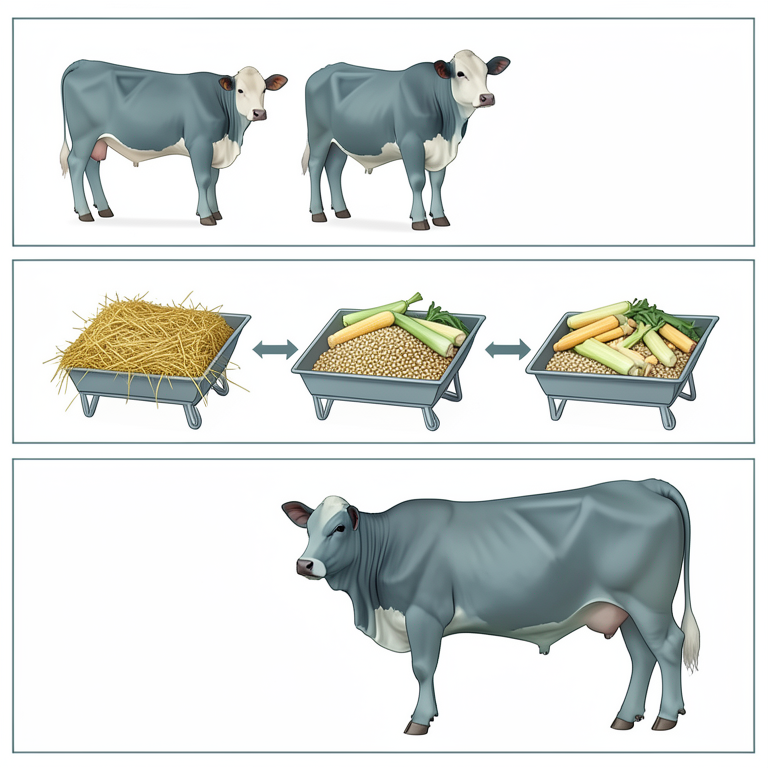
Dietary Comparison Flow
AI-generated conceptual illustration (crossbred calves and maize cobs). It explains the idea and does not show study data.
View source evidence ↗Figures & tables
From the original paper Table 1
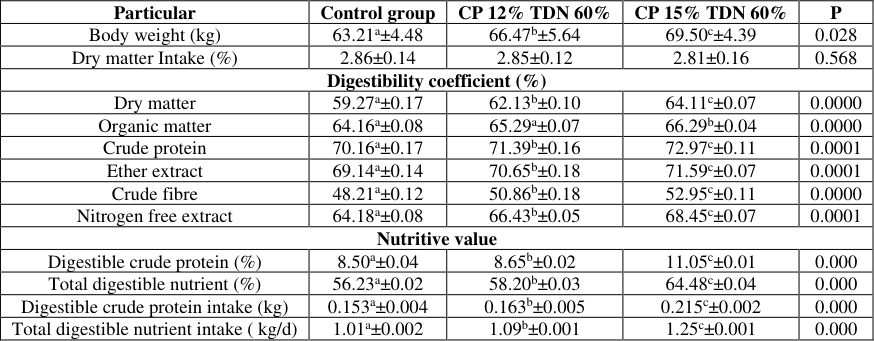 Table 2
 Table 3
Introduction
India is the largest milk producing country and also leading in the meat and egg production among other countries. Total animal population is 535.82 million in which around 302.82 million are bovines which reflects a 4.6% increase in population compared to the 2012 census (20 th Livestock census, 2019) [1] . India is home to a significant portion of the global bovine population, with 14.7% and 57.3% of the world's cattle and buffaloes, respectively. Most of the livestock in India are fed with dry roughages with shortage of 44% concentrate feed ingredients, 10.95% dry fodder, and 35.6% green fodder in the nation (IGFRI Vision, 2050) [9] .The lack of fodder is mainly due to the lack of high quality fodder seed, changing land use patterns, urbanization, diminishing pasture productivity, and diverting land for commercial crops among other factors. There are plenty of unconventional feed resources available throughout the country and it should be judiciously utilized to improve production performances of livestock. Maize cobs (Zea mays) are byproduct of maize crop after removing the grains from the Maize ear. About 170 to 190 kg of cobs are obtained from the 1000 kg of maize shelled (Singh et al., 2018) [21] . Several states have emerged as leading contributors to the country's overall maize production. Hence, there is a scope of production of 4.68 million tonnes of maize cob in India with present production of maize. Maize cobs, which are abundant in fibrous content, have a wide range of agricultural and industrial uses. In the agricultural sector, they serve as fuel, bedding material for poultry and other animals, and even as feed for ruminants, despite their limited nutritional value.
These cobs are notably high in hemicellulose and cellulose but contain relatively low levels of crude protein, making them a potential alternative feed source for ruminants (Shashikumar et al., 2017) [20] . This substantial quantity of maize cobs has the potential to serve as alternative roughage source for ruminants and also cost-effective feeding options. Protein is the most expensive nutrients and it should be judiciously used while formulating the diets. Excess supply of nitrogen will cause environmental pollution as well as detrimental to the livestock health (Lohakare et al., 2006) [12] . Keeping these facts in view, present study was planned to assess level of crude protein of the diets containing maize cob to replace paddy straw in total mixed ration using in vitro experiment and to evaluate the digestibility of nutrients and growth performances in growing calves.
Materials and Methods
This study was conducted at Veterinary College and Research Institute, Orathanadu, Thanjavur district. Concentrate feed ingredients, maize cob and paddy straw were collected from the feed mill and nearby village of Orathanadu. Samples were dried and ground to pass through 1mm sieve and stored in air tight bottles for further analysis. Total mixed ration containing 0% (MC0), 25% (MC25), 50% (MC50), 75% (MC75) and 100% (MC100) maize cobs replacing paddy straw with two level of crude protein (12 and 15%) and 60% TDN were prepared. The feed samples and diets (TMR) were analyzed for different proximate constituents as per the methods described in AOAC (1999) [3] and fiber components as per the method given by Van Soest et al. (1991) [23] . In vitro gas production, dry matter degradability (IVDMD) and organic matter degradability (IVOMD) of diets were carried out in 100 ml calibrated glass syringes as described by Menke and Steingass (1988) [13] . Feed samples (200 mg) were taken in triplicate in the glass syringes and strained rumen liquor (30 ml) collected from the cattle using stomach tube and mixed with rumen buffer medium (1:3) were infused into syringes under anaerobic conditions. The syringes were kept in an automatic water bath cum shaker incubator at 39±0.5°C for 48 hourincubation. Total gas production and dry matter degradability were measured after 48 hour fermentation. For the determination of apparent dry matter and organic matter degradability, the contents of each syringe were transferred quantitatively into centrifuge tube and centrifuged at 12000 g for 20 minutes at 4 °C. The supernatant was carefully separated using pipette without disturbing the pellet. The pellet was transferred quantitatively to a pre-weighed silica crucible and dried in the hot air oven till constant weight and the dry weight of residue was calculated. Dry weight of blank was subtracted from those recorded for the test samples. The residue in each crucible was ashed in muffle furnace at 550°C for 2 hours to determine the organic matter (OM) content. Eighteen crossbred Jersey female calves, 6-8 months of age, selected from the cattle yard of Veterinary College Research Institute, Orathanadu, Thanjavur and distributed randomly into three groups according to their body weight. The average body weight of calves fed with paddy straw based diet (Control), CP 12% maize cob based diet (T 1 ) and CP 15% maize cob based diet (T 2 ) were 60.03, 60.65 and 60.11 kg, respectively. The calves were housed in well-ventilated stall having facilities for individual feeding. Calves were dewormed using albendazole @ 10 mg/kg body weight before starting the experimental feeding. Growth trial was conducted for the period of 60 days. Drinking water was offered free choice throughout the day.The animals were weighed before feeding and watering in the morning on three consecutive days at the start of experimental feeding and thereafter at fortnightly intervals during the experimental period of 60 days. Dry matter intake was recorded twice a week by subtracting the residual dry matter from the quantity of dry matter offered. Growth rate was calculated on the basis of increase in body weight at fortnightly intervals and feed conversion efficiency was also calculated from dry matter intake to live weight gain. A digestion trial was conducted during the initial period of experiment with 7 days of collection period to determine the nutrient digestibility. Animals were weighed before and after the trial consecutively for three days. Fresh drinking water provided free choice throughout the day. Feed and their respective residues were collected in separate polythene bags daily for dry matter estimation. Faeces voided during 24 hours was collected and weighed at 8.00 AM daily. After through mixing, an aliquot was taken in duplicate for dry matter estimation. Dried dung samples were ground to pass through 1 mm sieve size and analyzed for proximate principles as per standard procedure AOAC (1999) [3] . Digestibility of nutrients was calculated for the diets provided to the growing calves.
Statistical analysis
As per the method of the statistical analysis system (SPSS, version 17 windows) [22] , the data gathered on various parameters in vitro and growth parameters were aggregated and subjected to analysis of variances and means were compared, and significance was determined based on suitability at p<0.05 and p<0.01.
Results and Discussion
Results and Discussion
Chemical composition of feed ingredients and diets
The Crude Protein (CP) content of Paddy Straw (PS) and Maize Cob (MC) were 4.08% and 4.11% respectively. The crude fiber (CF) content was more in paddy straw (31.10%) than maize cob (30.23%). Total ash (TA) and acid insoluble ash (AIA) content were higher in paddy straw (18.94%, 16.53%) than maize cob (2.85%, 0.43%). The Nitrogen free extract (NFE) was higher in maize cob (61.86%) than paddy straw (44.89%). The Neutral Detergent Fiber (NDF%) content was higher (78.33%) in maize cob than paddy straw (67.64%). The Acid Detergent Fiber (ADF%) content was lower in the maize cob (47.82%) than paddy straw (53.36%). Hemi cellulose and cellulose (%) content were higher in maize cob (30.51%, 42.77%) than paddy straw (39.14%, 14.28%). The lignin (%) content of paddy straw was higher (14.28%) than the maize cob (5.05%). Chemical composition of paddy straw was in accordance with findings of Singh et al. (2018) [21] and Ayyappan and Tomar (2006) [4] . The proximate and fiber fractions of maize cob was comparable with finding of Wachirapakorn et al. (2016) [24] ; Anjum and Afzal, (2015) [2] and Nagalakshmi and Reddy, (2008) [14] . The Average crude protein content of control, T 1 and T 2 diets were 12.11%, 12.15% and 15.32% respectively. As the inclusion level of maize cob increased, OM, NFE, NDF and hemicellulose contents were significantly (p<0.01) increased while TA, AIA, ADF, ADL percent level ware decreased. These findings are related with the report of Wachirapakorn et al. (2016) [24] , Shasikumar et al. (2017) [20] and Anjum and Afzal (2015) [2] . The complete diets were formulated for the two level of crude protein (12% and 15%) using maize cob replacing paddy straw (Elanchezhiyan et al., 2024) [6] and rations were tested for total gas production, IVDMD and IVOMD and values are given in Table 1. Total gas production (ml) in CP 12% diet ranged from 31.3 to 45.50, IVDMD (%) ranged from 41.70 to 49.14 and IVOMD (%) ranged from 43.99 to 51.69. The diet of 15% crude protein showed total gas production (ml), IVDMD (%) and IVOMD (%) of 35.16 to 50.66, 45.87 to 52.93 and 48.23 to 55.27 respectively. There was a linear increase in total gas production, percent IVDMD and IVOMD with increase in replacement level of maize cob in the two level of crude protein and the difference was significant (p<0.01). Highest gas production, IVDMD and IVOMD were observed at 100% replacement of paddy straw with maize cob in complete diets. These findings were in agreement with results reported by Farooq et al. (2015) [7] . The results revealed better utilization of maize cob during in vitro fermentation as compared to paddy straw. All the digestible parameters were improved by increasing inclusion level of maize cob. As there was no negative impact of paddy straw replacement with maize cob was observed and the use of as sole source of roughage appears to be feasible alternative. Total gas production from maize cob based rations showed significantly (p<0.01) higher than paddy straw based rations. These results were comparable with finding of Farooq et al. (2015) [7] who reported 29.50 ml of gas production from 200 mg substrate containing maize cobs incubated for 24 hours only. The more gas production may be due to high hemicellulose, cellulose and NFE contents of maize cobs attributed to higher fermentation and gas production. The negative relationship between lignifications and digestibility are found in this study reveals poor quality roughages mainly available as feed resources for the ruminants should get priority for processing methods to improve their nutritive values. Effect of protein levels in maize cob based ration on feed intake, digestibility in growing calves are given in the Table 2. Nutrient digestibility of dry matter, organic matter, crude protein, crude fiber, ether extract, NFE and dry matter were significantly (p<0.01) higher in CP 15% diet and CP 12% diet than paddy straw contained ration. The digestibility of nutrients have been increased linearly with increasing dietary CP level was corroborated with findings of Promkot and Wanapat (2005) [16] , Lohakare et al. (2006) [12] and Sharma et al. (2020) [19] . The higher digestibility of maize cob based rations may be due to high hemicellulose, cellulose and low lignin content and these were similar to results of Anjum and Afzal (2015) [2] and Azim et al. (2000) [5] who reported higher nutrient digestibility in the maize cob based diets in growing calves. Effect of protein levels of the diets on body weight gain and feed conversion efficiency in calves are given in the Table 3. The average body weight of growing calves at the start of experiment was 60.032.56 kg in group fed with paddy straw based control diet and 60.652.75 kg in group fed with maize cob based diet with CP 12% and 60.112.54 kg in CP 15% there was no significant (P>0.05) difference observed. The average dry matter intake of calves fed on control and treatments diets were not significant (P<0.05). The level of dry matter intake was quite adequate in both the groups to meet the requirement of growing calves (ICAR 2013) [8] . The present study findings are corroborated with report of Anjum and Afzal (2015) [2] and Azim et al. (2000) [5] who reported no significant (P>0.05) differences in dry matter intake but found significant (p<0.05) differences in body weight gain and FCR in buffalo heifer. Similar results were documented previously by Kerley et al. (1985) [11] who reported that diets containing maize cob had no negative effect on growth performances in growing lambs. Similarly, Sachin et al. (2023) [17] , Kavya et al. (2018) [10] , Pradeep (2015) [15] and Senani et al. (2013) [18] also reported positive effect on growth performances in lambs fed on maize cob based diets and the finding of the current study was in accordance with those reports. Live body weight gain after sixty days growth trial of CP 15% diet (29.87 kg) was higher than the control (20.18 kg) and CP 12% diets (24.49 kg). There was increase in body weight gain by feeding CP 15% diet (48.11%) and CP 12% diet (21.35%) when compared to feeding of paddy straw based control ration. The body weight gain and feed conversion ratio for the high protein diet was similar to the finding of Sharma et al.(2020) [19] and also in accordance with report of Anjum and Afzal (2015) [2] , who observed increased body weight gain on growing buffalo calves from maize cob based rations. However, Senani et al. (2013) [18] reported no significant effect on body weight gain but maize cob could replace ragi straw in the ration fed to Bandur lambs without any adverse effect.
| Particular | Control group | CP 12% TDN 60% | CP 15% TDN 60% | Sig |
|---|---|---|---|---|
| Initial body weight (kg) | 60.03±2.56 | 60.65±2.75 | 60.11±2.54 | NS |
| Final body weight (kg) | 80.21c±1.72 | 85.14b±1.43 | 89.99a±1.55 | ** |
| Body weight gain (kg) | 20.18c±1.20 | 24.49b±1.56 | 29.87a±1.27 | ** |
| Average daily gain (g/d) | 336.3c±0.01 | 408.2b±0.02 | 498.0a±0.01 | ** |
| Total dry matter intake (kg) | 215±0.89 | 216±0.94 | 215±1.37 | NS |
| Feed conversion ratio (kg DMI/kg gain) | 10.65a±0.10 | 8.83b±0.19 | 7.19c±0.06 | ** |
| Feed conversion efficiency (kg gain/kg DMI) | 0.094c±0.001 | 0.113b±0.002 | 0.139a±0.001 | ** |
Table text extracted from the original PDF; superscript letters are shown inline. The original table image is below.
View original table image
| Particular | Control group | CP 12% TDN 60% | CP 15% TDN 60% | P |
|---|---|---|---|---|
| Body weight (kg) | 63.21a±4.48 | 66.47b±5.64 | 69.50c±4.39 | 0.028 |
| Dry matter Intake (%) | 2.86±0.14 | 2.85±0.12 | 2.81±0.16 | 0.568 |
| Digestibility coefficient (%) | ||||
| Dry matter | 59.27a±0.17 | 62.13b±0.10 | 64.11c±0.07 | 0.0000 |
| Organic matter | 64.16a±0.08 | 65.29a±0.07 | 66.29b±0.04 | 0.0000 |
| Crude protein | 70.16a±0.17 | 71.39b±0.16 | 72.97c±0.11 | 0.0001 |
| Ether extract | 69.14a±0.14 | 70.65b±0.18 | 71.59c±0.07 | 0.0001 |
| Crude fibre | 48.21a±0.12 | 50.86b±0.18 | 52.95c±0.11 | 0.0000 |
| Nitrogen free extract | 64.18a±0.08 | 66.43b±0.05 | 68.45c±0.07 | 0.0001 |
| Nutritive value | ||||
| Digestible crude protein (%) | 8.50a±0.04 | 8.65b±0.02 | 11.05c±0.01 | 0.000 |
| Total digestible nutrient (%) | 56.23a±0.02 | 58.20b±0.03 | 64.48c±0.04 | 0.000 |
| Digestible crude protein intake (kg) | 0.153a±0.004 | 0.163b±0.005 | 0.215c±0.002 | 0.000 |
| Total digestible nutrient intake ( kg/d) | 1.01a±0.002 | 1.09b±0.001 | 1.25c±0.001 | 0.000 |
Table text extracted from the original PDF; superscript letters are shown inline. The original table image is below.
View original table image
| Total mixed ration | IVGP (ml/48 hrs) | — | IVDMD (%) | — | IVOMD (%) | — |
|---|---|---|---|---|---|---|
| CP 15% | CP 12% | CP 15% | CP 12% | CP 15% | CP 12% | |
| MC 0 | 35.16xe±0.79 | 31.33ye±0.33 | 45.87xe±0.05 | 41.70yye±0.04 | 48.23xe±0.14 | 43.99ye±0.11 |
| MC 25 | 40.16xd±0.54 | 37.00yd±0.51 | 47.85xd±0.06 | 43.91yd±0.04 | 50.31xd±0.14 | 45.92yd±0.57 |
| MC 50 | 41.83xc±0.30 | 39.00yc±0.57 | 49.72xc±0.04 | 45.69yc±0.05 | 52.27xc±0.26 | 48.02yc±0.13 |
| MC 75 | 49.16xb±0.42 | 44.83yb±0.74 | 51.50xb±0.04 | 47.19yb±0.05 | 53.89xb±0.12 | 49.67yb±0.12 |
| MC 100 | 50.66xa±0.47 | 45.50ya±1.17 | 52.93xa±0.06 | 49.14ya±0.03 | 55.27xa±0.12 | 51.69ya±0.13 |
Table text extracted from the original PDF; superscript letters are shown inline. The original table image is below.
View original table image
Conclusion
It can be concluded that the crude protein level of 15% and 12% diets containing maize cob as roughage source can replace paddy straw at 100 percent level in total mixed rations without affecting dry matter intake and digestibility of nutrients and increased body weight gain in growing calves. Thus maize cob based ration can be used for growing calves without affecting nutrient digestibility to improve growth performance
References
17 in the original paper- Anjum MI, Afzal M. Influence of substituting wheat straw with corncobs in fattening rations for growth rate and nutrient digestibility in buffalo calves. JAPS: J. Anim. Plant Sci. 2015;25(5):1216-1221.
- Ayyappan K, Tomar SK. Evaluation of faecal inoculum for estimating digestibility of feedstuffs. Indian J Anim. Nutr. 2006;23(1):59-62.
- Azim A, Khan AG, Nadeem MA, Mirza MA. Substitution of wheat straw with corn cobs in total mixed diets for buffalo heifers. Buffalo J. 2000;3:251-257.
- Elanchezhiyan M, Ayyappan K, Ramachandran M, Thomas SK, Saravanan KP, Srinivasan G. Effect of maize (Zea mays) cob as roughage source in total mixed ration on in vitro fermentation and nutrient digestibility. Int. J Vet. Sci. Anim. Husb. 2024;9(4):78-83.
- Farooq J, Sharma RK, Rastogi A, Barman K. Effect of replacement of wheat straw with maize cobs with or without physico-chemical treatment on degradation of dry matter, truly digestible organic matter and production of microbial biomass of composite ration in vitro using goat rumen liquor. J Anim. Res. 2015;5(3):501-510.
- Kavya PS, Prabhu TM, Pradeep RR, Gloridoss G, Singh KC, Suresh BN, et al. Nutritional evaluation of spent maize (Zea mays) cobs as roughage source in sheep feeding. Indian J. Small Rumin. 2018;24(1):57-61.
- Kerley MS, Kinser AR, Firkins JL, Fahey Jr GC, Berger LL. Effects of roughage particle size on site of nutrient digestion and digesta flow through the gastrointestinal tract of sheep fed corncob-concentrate diets. J Anim. Sci. 1985;61(2):504-513.
- Lohakare JD, Pattanaik AK, Khan SA. Effect of dietary protein levels on the performance, nutrient balances, metabolic profile and thyroid hormones of crossbred calves. Asian-Aust. J Anim. Sci. 2006;19(11):1588-1596.
- Menke KH, Steingass H. Estimation of the energetic feed value obtained from chemical analysi and in vitro gas production using rumen fluid. Anim. Res. Dev. 1988;28:7-55.
- Nagalakshmi D, Reddy DN. On farm evaluation of expander-extruder processed complete diet containing maize cobs in Murrah buffaloes. Indian J Vet. Res. 2008;17(1):37-43.
- Promkot C, Wanapat M. Effect of level of crude protein and use of cottonseed meal in diet containing cassava chips and rice straw for lactating dairy cows. Asian-Aust. J Anim. Sci. 2005;18:502-511.
- Senani S, Sharath BS, Elangovan AV, Samanta AK, Kolte AP. Use of spent maize cobs as source of roughage in the ration of Bandur lambs. Indian J Anim. Sci. 2013;83(11):1207-1209.
- Sharma B, Nimje P, Tomar SK, Dey D, Mondal S, Kundu SS. Effect of different fat and protein levels in calf ration on performance of Sahiwal calves. AsianAust. J Anim. Sci. 2020;33(1):53-60.
- Shashikumar MG, Prabhu TM, Gloridoss RG, Singh KC, Suresh BN, Siddalingamurthy HK, et al. Effect of feeding maize (Zea mays) husk and cob based complete feed block on feed intake, nutrient utilization and growth in Mandya sheep. Indian J Anim. Nutr. 2017;34(2):135139.
- Singh K, Singh J, Kumar S. A sustainable environmental study on corn cob ash subjected to elevated temperature. Curr. World Environ. 2018;13(1):144.
- Van Soest PV, Robertson JB, Lewis BA. Methods for dietary fibre, neutral detergent fibre, and nonstarch polysaccharides in relation to animal nutrition. J Dairy sci. 1991;74(10):3583-3597.
- Wachirapakorn C, Pilachai KM, Wanapat P, Pakdee, Cherdthong A. Effect of ground corn cobs as a fibre source in total mixed ration on feed intake, milk yield and milk composition in tropical lactating crossbred Holstein cows. Anim. Nutr. 2016;2(4):334-338.