
Research article · 2024 · Full text
International Journal of Agriculture Extension and Social DevelopmentInfluence of different sowing dates on seasonal incidence of pod fly, Melanagromyza obtusa in pigeonpea
Volume 7(8S) · Pages 163–165 · DOI: 10.33545/26180723.2024.v7.i8sc.956 ↗
Research areasAgricultural pest management studiesGenetic and Environmental Crop StudiesAgricultural Research and Practices
Abstract
Author-writtenA field study carried out during kharif 2019-20 at Zonal Agricultural Research Station, Kalaburagi, University of Agricultural Sciences, Raichur, Karnataka on seasonal incidence of pod fly, M. obtusa in long duration pigeonpea variety BSMR 736 sown across different dates viz., 20-07-2019, 05-08-2019 and 20-08-2019 revealed that, the activity of pod fly commenced from 49th SMW (7.20 percent pod damage and 3.69 percent seed damage), which continued till 6th SMW across different sowing dates indicating its peak activity with pod damage of 52.80 percent and seed damage of 46.31 percent in late sown sown crop.
Summary
Source-checkedPlain-language reading of the full paper, prepared with AI and checked against the text. Each point links to the authors' own words.
Why it matters
- Pigeonpea is a globally significant pulse crop grown in about 50 countries, with India producing approximately 75% of the world's supply. View evidence ↗
- The pod fly is a significant pest for long-duration pigeonpea varieties, with some reports indicating yield losses between 60% and 80%. View evidence ↗
- The timing of sowing can significantly influence pest incidence due to varying weather conditions. View evidence ↗
The question
- The study aimed to investigate how different sowing dates affect the seasonal occurrence of the pod fly in pigeonpea. View evidence ↗
What they did
- The research was a field experiment conducted during the kharif 2019-20 season in Kalaburagi, Karnataka, India. View evidence ↗
- The long-duration pigeonpea variety BSMR 736 was planted on three specific dates: July 20, August 5, and August 20, 2019. View evidence ↗
What they found
- Pod fly activity began in the second week of December (49th Standard Meteorological Week), with initial pod damage at 7.20% and seed damage at 3.69%. View evidence ↗
- The peak infestation occurred in the second week of February (6th SMW), reaching a maximum of 52.80% pod damage and 46.31% seed damage. View evidence ↗
- During January, damage levels rose, with pod damage ranging from 16.80% to 39.20% and seed damage from 15.49% to 34.28%. View evidence ↗
- Crops sown earlier (July 20 and August 5) experienced lower pod and seed damage compared to those sown on August 20. View evidence ↗
What it means
- The authors concluded that for variety BSMR 736, pod fly infestation begins at the 49th SMW and peaks at the 6th SMW. View evidence ↗
- The study concludes that earlier sowing dates (specifically July 20) result in lower pod and seed damage from pod fly. View evidence ↗
Visual summary
3 visualsIllustrations explain the paper; charts are replotted from the paper's own table values.
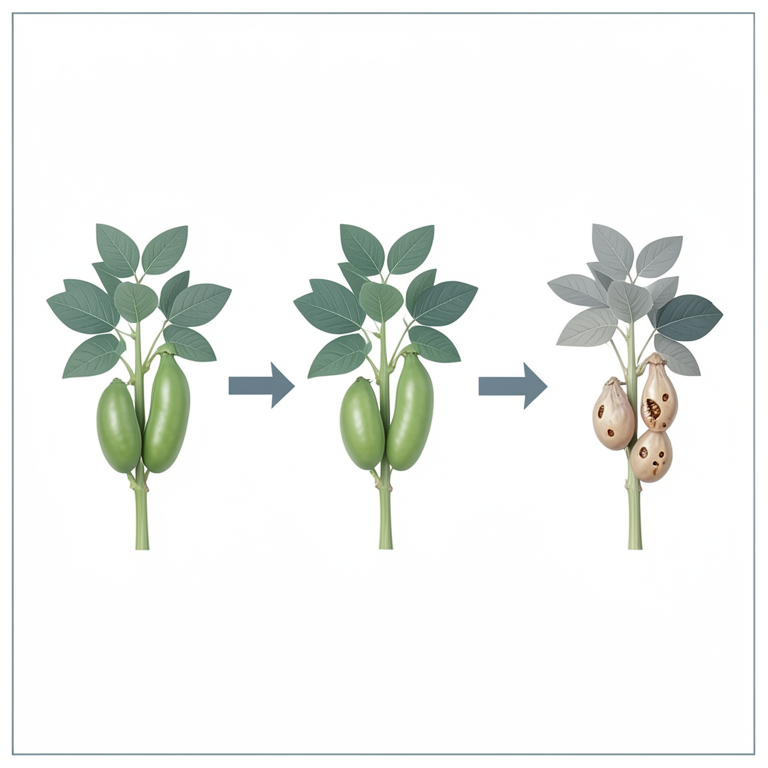
Sowing Date vs Pest Damage
AI-generated conceptual illustration (pigeonpea plants). It explains the idea and does not show study data.
View source evidence ↗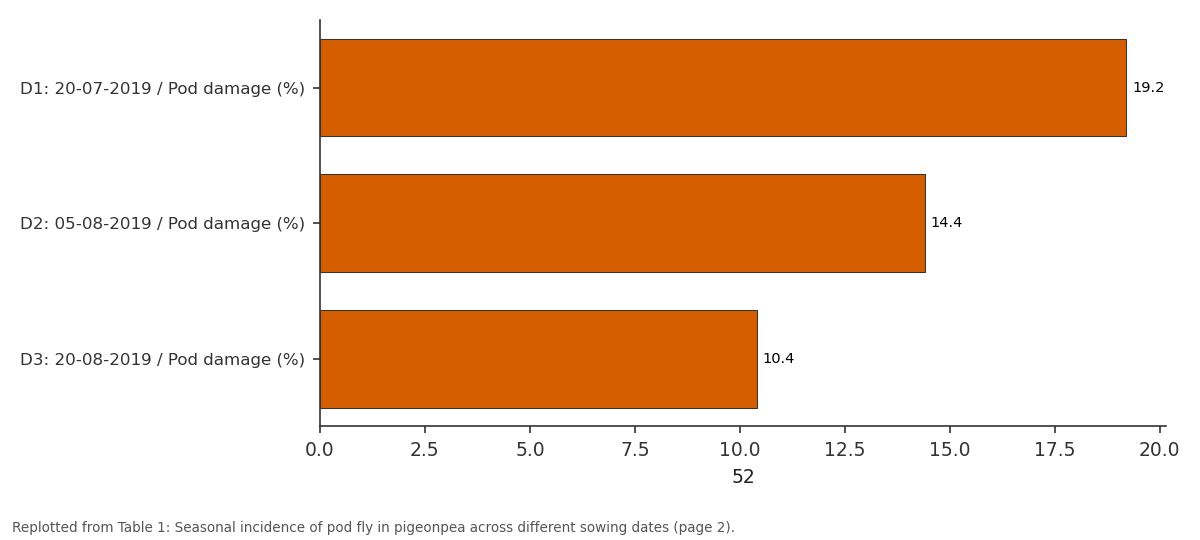
52: D1: 20-07-2019 / Pod... vs D2: 05-08-2019 / Pod... vs D3: 20-08-2019 / Pod...
Replotted from Table 1 (page 2) of the original paper. Every bar is the paper's own table value.
View source evidence ↗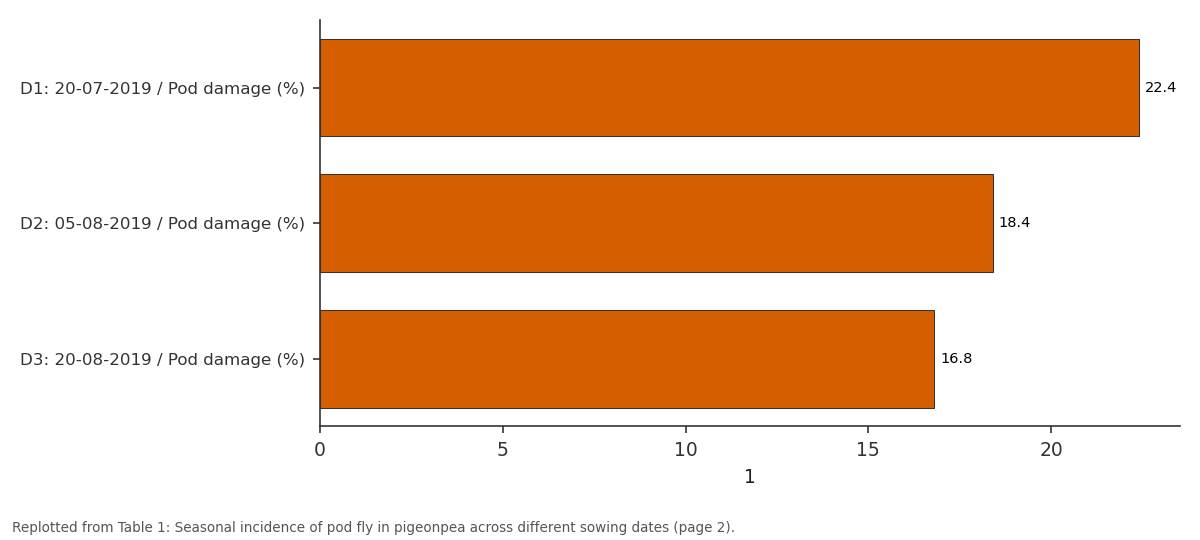
1: D1: 20-07-2019 / Pod... vs D2: 05-08-2019 / Pod... vs D3: 20-08-2019 / Pod...
Replotted from Table 1 (page 2) of the original paper. Every bar is the paper's own table value.
View source evidence ↗Figures & tables
From the original paper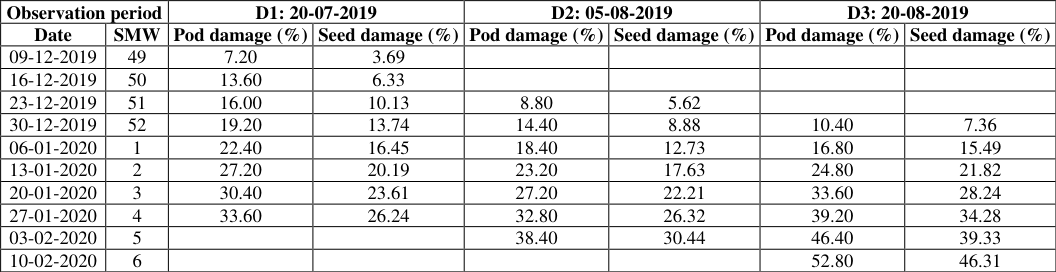 Table 1
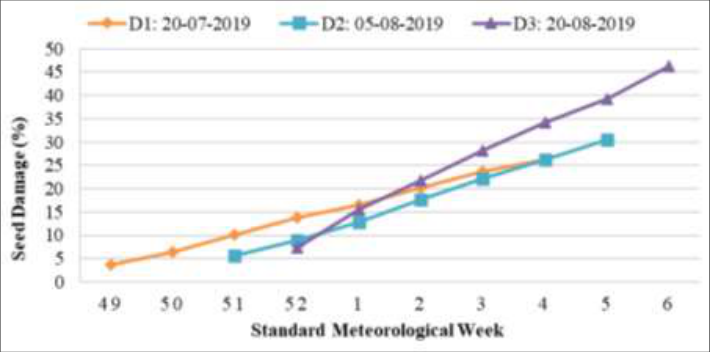 Figure 2
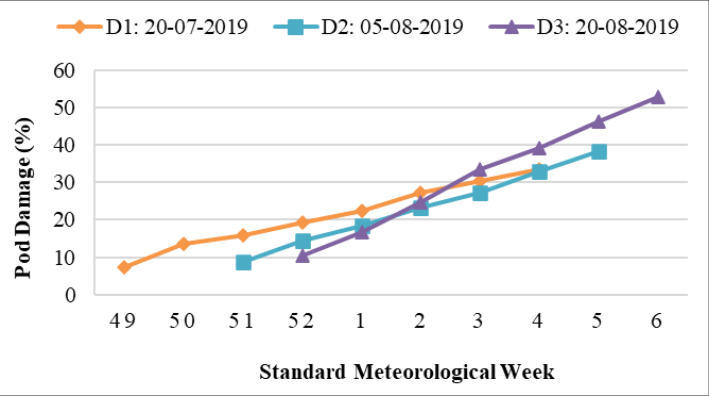 Figure 1
Introduction
Pigeonpea (Cajanus cajan L. Millsp.) is a major pulse crop cultivated in the tropics and subtropics, grown in around 50 countries across Asia, Africa and America. Among the Kharif pulses, pigeonpea holds considerable importance in Indian agriculture due to its diverse uses, including as food, feed, fodder and fuel, as well as its role in maintaining agricultural productivity. India contributes to approximately 75 percent of the global production of pigeonpea. Economically, it is the second most important pulse crop after chickpea, accounting for about 20 percent of the total pulse production (Sharma et al., 2010) [14] . Major constraint in the production of pigeonpea is the damage caused by insect pests. Maximum economic damage is caused by pests feeding upon flowers and seeds. It is attacked by over 300 species of insect pests, of which 17 are considered major (Lal and Singh, 1998) [10] . The most significant yield losses are caused by the pod borer complex, which regularly infests pigeonpea and cause extensive damage. Among these pod borers, pod fly has emerged as a potential pest in key pulse growing areas causing yield losses especially in long duration varieties (Gopali et al., 2010, 2013; Sharma et al., 2011) [8,7,13] . It has inflicted 21.00 to 38.50 percent pod damage, 12.29 to 19.87 percent grain damage (Khan et al., 2014) [9] and 31.35 percent mean pod damage (Patra et al., 2016) [12] . However, the yield loss of 60 to 80 percent was recorded due to the pod fly infestation in pigeonpea (Durairaj, 2006) [5] . Till date, chemicals are the only available efficient strategy against pod fly yet it involves several limitations like no promising management of the pest even after two or three applications of insecticides, the crop still undergo considerable losses and also the insecticides are mostly unsafe to natural enemies and also cause hazards to mankind (Chiranjeevi and Sarnaik, 2017) [2] . Date of sowing has a great impact on the incidence of the pests which may be attributed to the difference in weather conditions. Gaining insights into the seasonal occurrence can provide crucial information for developing effective management strategies. Therefore, the current study aims to investigate the seasonal incidence of pod fly in pigeonpea across different sowing dates.
Materials and Methods
The field experiment was conducted at Zonal Agricultural Research Station, Kalaburagi, University of Agricultural Sciences, Raichur, Karnataka, India during kharif 2019-20. Kalaburagi is situated in North eastern dry zone of Karnataka between 16º 16' latitude and 77º 20' longitudes and at 389 meters above mean sea level. Long duration Pigeonpea variety BSMR 736 was sown in plots of 5.4 m × 4.8 m on three dates viz., 20-07-2019, 05-08-2019 and 20-08-2019. The recommended spacing of 90 cm between rows and 20 cm between plants was maintained. The crop was raised by following the standard agronomic practices as per the package of practices of UAS Raichur (Anonymous, 2017) [1] except for insect pest management. In the current season, Helicoverpa armigera and pod fly were the major pests. The H. armigera was managed by spraying HaNPV @ 250 LE/ha at weekly interval starting from flower initiation stage of the crop. Observation was initiated at pod formation stage by collecting fifty pods randomly from each www.extensionjournal.com plot at weekly intervals and seeds were separated. These seeds were examined for healthy and infested one and accordingly, the pod and seed damage caused by pod fly was calculated (Pathade et al. 2015) [11] .
Results and Discussion
The pod fly incidence in pigeonpea variety BSMR 736 started from December second week (49 th SMW) with 7.20 percent pod damage and 3.69 percent seed damage and it increased to 19.20 and 13.74 percent of pod and seed damage, respectively by the end of December (52 nd SMW). Further, in January month the damage increased and pod damage ranged from 16.80 to 39.20 percent with 15.49 to 34.28 percent seed damage. February second week (6 th SMW) recorded peak activity of pod fly with maximum pod damage (52.80%) and seed damage (46.31%) (Table 1). From the results, it can be inferred that the pod fly infestation in BSMR 736 was noticed from December second week (49 th SMW). Damage increased gradually during January month and maximum infestation was noticed in the month of February (Fig. 1 and2). The long duration varieties have got higher incidence of pod fly when compared to early and medium maturing varieties as their flowering and pod formation was coincided with winter and post winter season which is congenial for the pest to multiply and develop. The present findings are in agreement with Gogi (2003) [6] who found that the infestation of pod fly started from November month in variety ICPL-87119 (long duration) with minimum pod damage (12.50%) and seed damage (2.50%). However, highest pod damage of 23.50 percent and grain damage of 10.50 percent was recorded during February month. Increasing trend in pod fly damage from January onwards was reported by Durairaj (1995) [4] from Tamil Nadu. Sunilkumar (2015) [16] also observed pod fly incidence in BSMR 736 started from 46 th SMW with minimum pod and grain damage of 5.50 and 2.10 percent, respectively during October 2012-13 and damage was peak in February month of 2013-14 which recorded maximum pod damage of 62.58 percent with 26.75 percent grain damage. Subharani and Singh (2007) [15] during 2002-04 noticed maximum infestation (15.56%) of pod fly in third week of February during 2002-03, whereas in 2003-04, maximum infestation was observed during February second week (13.72%). Das and Katyar (1998) [3] recorded pod fly infestation from 43 rd SMW and maximum pod infestation (16.00%) was noticed during February first week (5 th SMW).
| Observation period | — | D1: 20-07-2019 | — | D2: 05-08-2019 | — | D3: 20-08-2019 | — |
|---|---|---|---|---|---|---|---|
| Date | SMW | Pod damage (%) | Seed damage (%) | Pod damage (%) | Seed damage (%) | Pod damage (%) | Seed damage (%) |
| 09-12-2019 | 49 | 7.20 | 3.69 | ||||
| 16-12-2019 | 50 | 13.60 | 6.33 | ||||
| 23-12-2019 | 51 | 16.00 | 10.13 | 8.80 | 5.62 | ||
| 30-12-2019 | 52 | 19.20 | 13.74 | 14.40 | 8.88 | 10.40 | 7.36 |
| 06-01-2020 | 1 | 22.40 | 16.45 | 18.40 | 12.73 | 16.80 | 15.49 |
| 13-01-2020 | 2 | 27.20 | 20.19 | 23.20 | 17.63 | 24.80 | 21.82 |
| 20-01-2020 | 3 | 30.40 | 23.61 | 27.20 | 22.21 | 33.60 | 28.24 |
| 27-01-2020 | 4 | 33.60 | 26.24 | 32.80 | 26.32 | 39.20 | 34.28 |
| 03-02-2020 | 5 | 38.40 | 30.44 | 46.40 | 39.33 | ||
| 10-02-2020 | 6 | 52.80 | 46.31 |
Table text extracted from the original PDF; superscript letters are shown inline. The original table image is below.
View original table image
Conclusion
It can be concluded that the infestation of pod fly started from 49 th SMW in long duration pigeonpea variety BSMR 736. Peak activity was observed during 6 th SMW. The crop sown on 20 th July recorded lower pod damage and seed damage followed by 5 th August sown crop as compared to the crop sown on 20 th August.
Figures and tables from the paper
References
12 in the original paper- Chiranjeevi B, Sarnaik SV. Bio efficacy of promising insecticides against maggot population of pigeonpea pod fly, Melanagromyza obtusa (Malloch). J Entomol Zool Stud. 2017;5(3):159-162.
- Das SB, Katyar NP. Population dynamics and distribution pattern of pod fly, Melanagromyza obtusa and its parasites in medium maturing pigeonpea. Indian J Plant Prot. 1998;26(1):30-40.
- Durairaj C. Evaluation of certain neem formulations and insecticides against pigeonpea pod fly. Indian J Pulses Res. 2006;19(2):269-270.
- Gopali JB, Sharma OP, Yelshetty S, Rachappa V. Effect of insecticides and biorationals against pod bug, Clavigralla gibbosa in pigeonpea. Indian J Agric Sci. 2013;83(5):582-585.
- Gopali JB, Teggelli R, Mannur DM, Yelshetty S. Webforming lepidopteran, Maruca vitrata (Geyer): An emerging and destructive pest in pigeonpea. Karnataka J Agric Sci. 2010;23(1):35-38.
- Khan M, Srivastava CP, Sitanshu. Screening of some promising pigeonpea genotypes against major pests. Ecoscan. 2014;6:313-316.
- Lal SS, Singh NB. Proceedings of national symposium on management of biotic and abiotic stresses in pulse crops. Kanpur (India): Indian Institute of Pulse Research; 1998. p. 65-80.
- Pathade PM, Salunke PB, Borkar SL. Evaluation of some insecticides against pigeonpea pod fly, Melanagromyza obtusa Mall. Indian J Agric Res. 2015;49(5):460-463.
- Patra S, Firake DM, Thakur NSA, Roy A. Insect pest complex and crop losses in pigeonpea in medium altitude hill of Meghalaya. The Ecoscan. 2016;11(1):297-300.
- Sharma OP, Bhosle BB, Kamble KR, Bhede BV, Seeras NR. Management of pigeonpea pod borers with special reference to pod fly (Melanagromyza obtusa). Indian J Agric Sci. 2011;81(6):539-543.
- Sharma OP, Gopali JB, Yelshetty S, Bambawale OM, Garg DK, Bhosle BB. Pests of pigeonpea and their management. New Delhi (India): NCIPM, IARI; 2010. p. 4.
- Subharani S, Singh TK. Influence of meteorological factors on population dynamics of pod fly, Melanagromyza obtusa Malloch (Diptera: Agromyzidae) in pigeonpea under agro-climatic conditions of Manipur. Indian J Entomol. 2007;69(1):78-80.