
Research article · 2024 · Full text
International Journal of Agriculture Extension and Social DevelopmentConstraints and suggestions of the students undergoing agricultural diploma programme
Volume 7(8) · Pages 397–402 · DOI: 10.33545/26180723.2024.v7.i8f.955 ↗
Research areasEducation Systems and PolicyDiverse Educational Innovations Studies
Abstract
Author-writtenAgricultural diploma is the programme that deals with the study of farming methodologies and the use of farming machinery. The study was conducted in three constituent agricultural diploma colleges of Acharya N.G. Agricultural University during 2021-22 to understand the constraints of the students undergoing agricultural diploma programme. The data was collected from a total of 90 respondents (30 from each agricultural diploma college) using structured interview schedule. The findings revealed key challenges in three main areas: administrative, facilities, and academic aspects. The top-ranked administrative constraint was the limited number of seats available for progression to B.Sc (Agri), identified by 90.00 percent of students. In the category of library, laboratory, and classroom facilities, inadequate study halls emerged as the primary concern, affecting 61.11 percent of respondents. Academically, the most significant issue was the low level of practical knowledge, highlighted by 80.00 percent of the students. To address these challenges, students suggested increasing the number of seats for B.Sc (Agri) as the most critical administrative improvement, with 85.56 percent support. For facilities, improving classroom amenities, including projectors and whiteboards, was the top recommendation, cited by 73.33 percent of students. Academically, the need for more experienced and trained teaching staff was emphasized by 81.11 percent of the respondents as the most important enhancement. These findings underscore the need for targeted interventions in all aspects to improve the overall educational experience for agricultural diploma students.
Summary
Source-checkedPlain-language reading of the full paper, prepared with AI and checked against the text. Each point links to the authors' own words.
Why it matters
- Agriculture is a critical sector for food security, employment, and rural development, especially in developing regions. View evidence ↗
- Agricultural diploma programs are intended to provide the practical, hands-on training necessary for students to enter the agricultural workforce immediately. View evidence ↗
- The effectiveness of these diploma programs is frequently limited by various constraints that negatively impact student learning and outcomes. View evidence ↗
The question
- The study aimed to analyze the constraints faced by students in agricultural diploma programs and collect their suggestions for improvement. View evidence ↗
What they did
- The study sampled 90 students in total, with 30 participants selected from each of the three colleges. View evidence ↗
- Data collection was performed using a structured personal interview schedule tailored to the study's objectives. View evidence ↗
- The analysis involved calculating frequencies and percentages, and assigning ranks to the constraints and suggestions identified. View evidence ↗
What they found
- The most significant administrative constraint was the limited number of seats for progression to B.Sc (Agri), reported by 90.00% of the pooled student sample. View evidence ↗
- Regarding facilities, inadequate study halls were the primary concern, affecting 61.11% of the pooled respondents. View evidence ↗
- The top academic constraint was a low level of practical knowledge, highlighted by 80.00% of the pooled students. View evidence ↗
- To improve administration, 85.56% of students suggested increasing the number of seats available for B.Sc (Agri). View evidence ↗
- The top recommendation for facility improvement was enhancing classroom amenities, such as projectors and whiteboards, cited by 73.33% of students. View evidence ↗
- For academic enhancement, 81.11% of respondents emphasized the need to recruit more experienced and trained teaching staff. View evidence ↗
What it means
- The authors conclude that critical needs include increasing B.Sc (Agri) seats, enhancing practical training, and improving teaching staff quality. View evidence ↗
- Addressing these identified constraints is expected to improve the educational experience for students and benefit the broader agricultural sector. View evidence ↗
Visual summary
3 visualsIllustrations explain the paper; charts are replotted from the paper's own table values.
Key Constraints Framework
AI-generated conceptual illustration (Agricultural diploma students in a campus setting). It explains the idea and does not show study data.
View source evidence ↗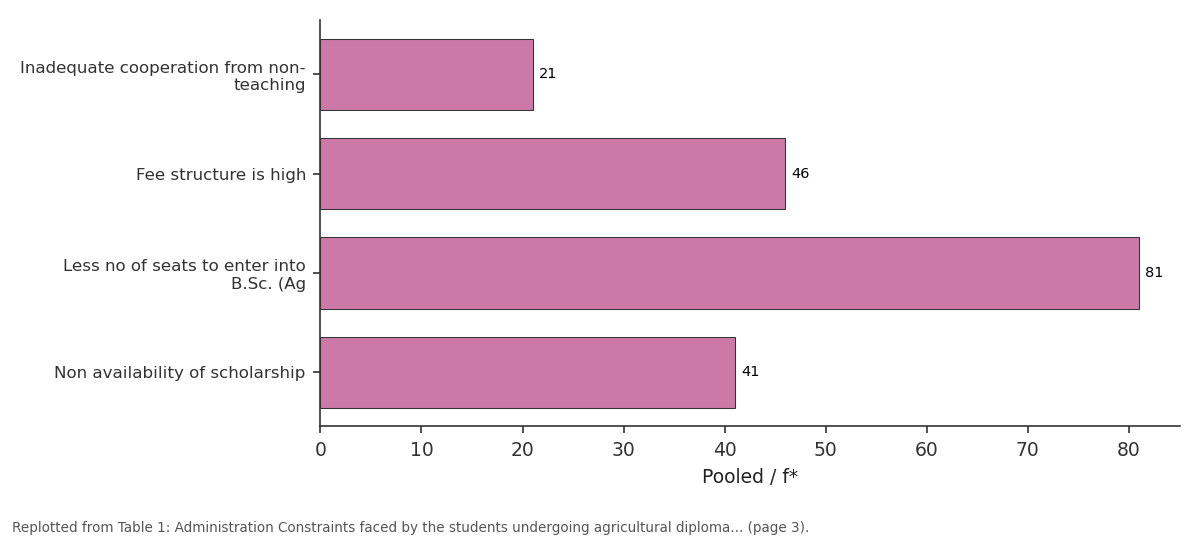
Pooled / f*: Inadequate cooperation... vs Fee structure is high vs Less no of seats to... vs Non availability of...
Replotted from Table 1 (page 3) of the original paper. Every bar is the paper's own table value.
View source evidence ↗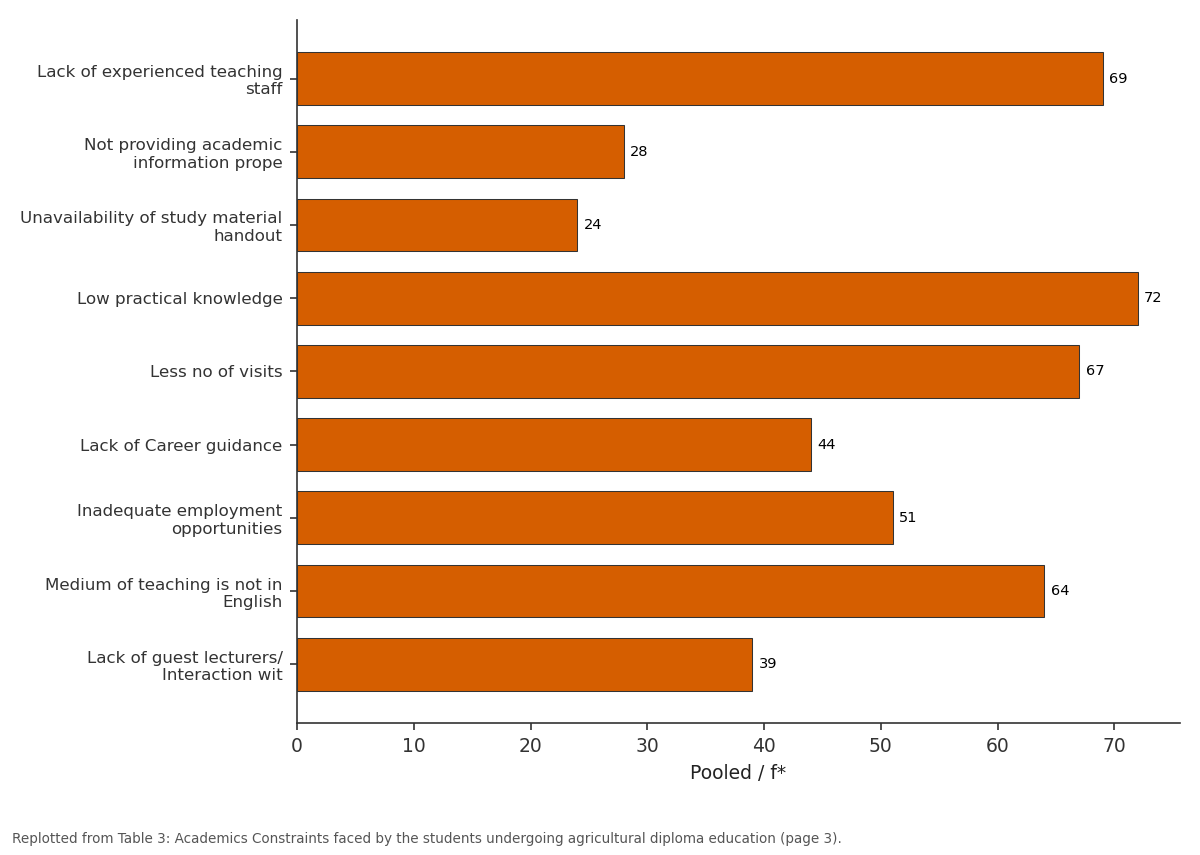
Pooled / f*: Lack of experienced... vs Not providing academic... vs Unavailability of study... vs Low practical knowledge vs Less no of visits
Replotted from Table 3 (page 3) of the original paper. Every bar is the paper's own table value.
View source evidence ↗Figures & tables
From the original paper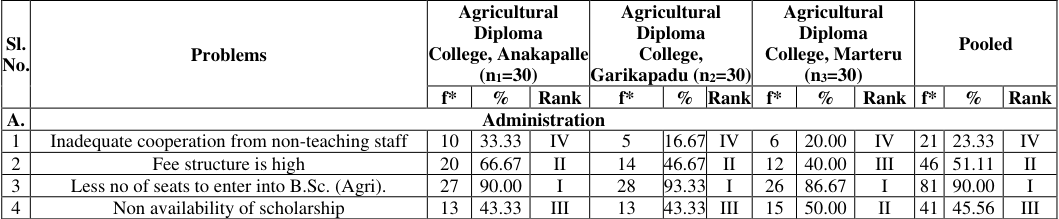 Table 1
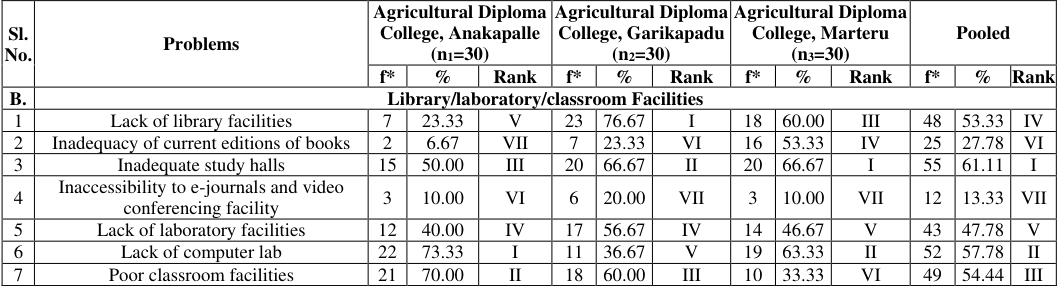 Table 2
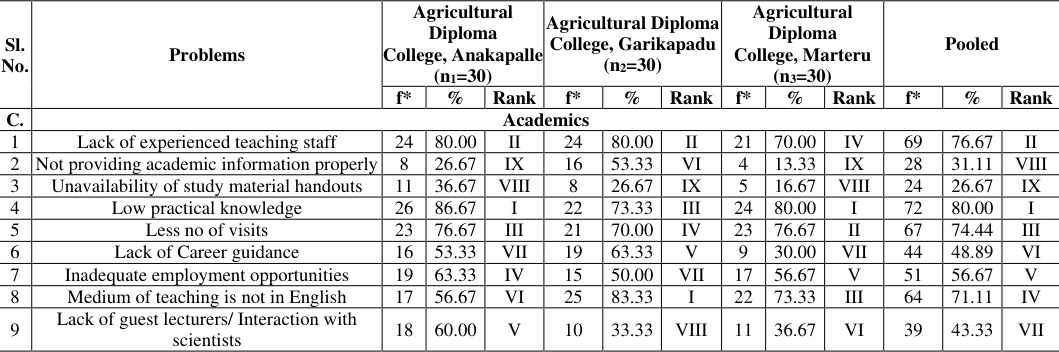 Table 3
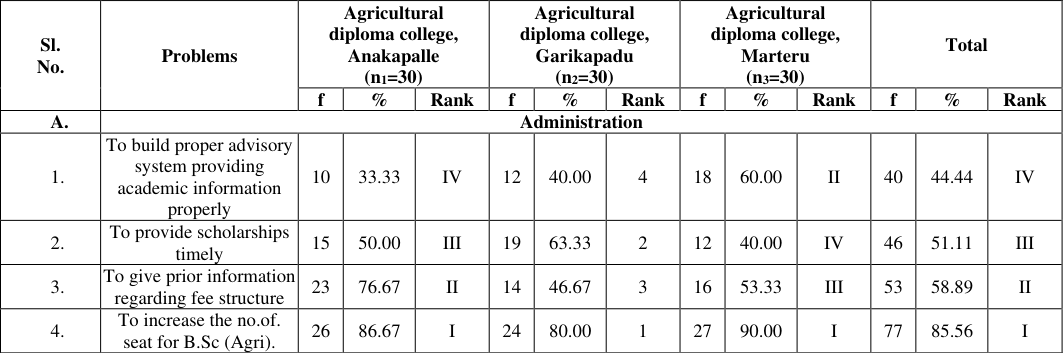 Table 4
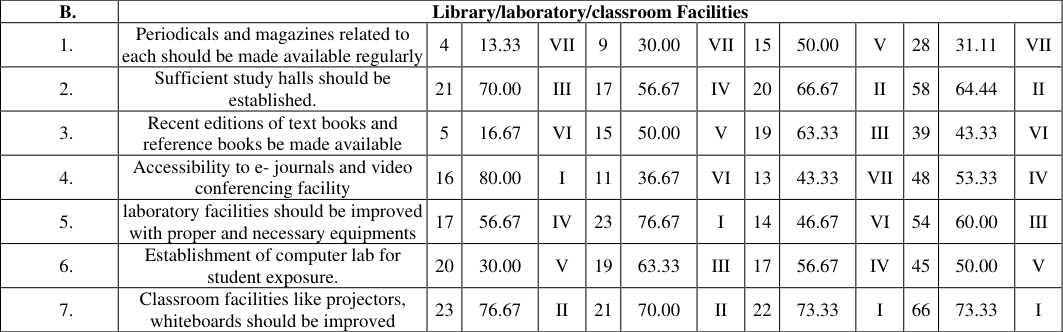 Table 5
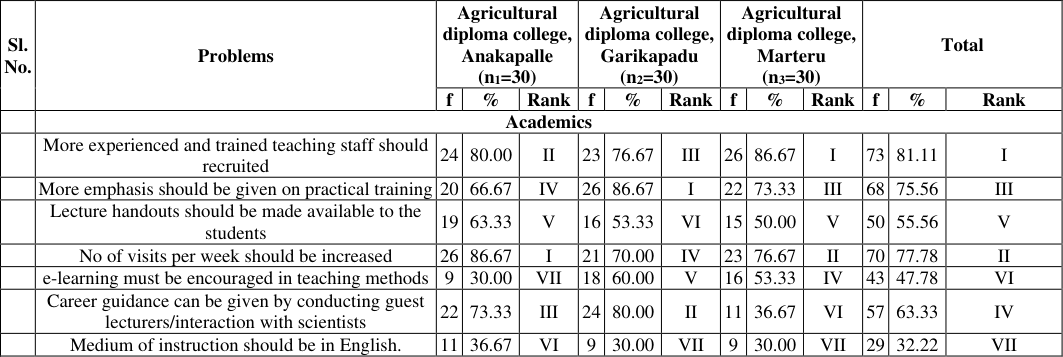 Table 6
Introduction
Agriculture remains the backbone of many economies, particularly in developing regions where it is essential for food security, employment, and rural development. The role of agricultural education in equipping the next generation with the necessary skills and knowledge to sustain and advance this critical sector cannot be overstated. Agricultural diploma programs, in particular, are designed to offer practical, hands-on training that prepares students for immediate entry into the agricultural workforce. However, the effectiveness of these programs is often hindered by a range of constraints that affect the students' learning experiences and outcomes. Agricultural diploma is the programme that deals with the study of farming methodologies and the use of farming machinery. The polytechnic in agriculture is the one of the basic and first step in agriculture education which aimed to provide enrolled collegians with knowledge, skill and experience, which are required to be assets in agriculture (James and Denis, 2015) [2] . In recent days many challenges faced by students in agricultural diploma programs, including outdated curricula, limited access to modern technology, inadequate practical training opportunities, and financial constraints. These challenges are compounded by socio-economic factors such as rural backgrounds, which often limit students' exposure to advanced agricultural practices and technologies. This study aims to get deeper understanding of students enrolled in agricultural diploma programs, with a particular focus on identifying the key constraints they face and exploring potential pathways for improvement. Understanding the constraints faced by students in agricultural diploma programs is crucial for improving the quality of education and ensuring that these programs effectively prepare students for future careers in agriculture. By identifying and addressing these challenges, educational institutions can enhance the overall learning experience, making it more relevant and supportive for students' academic and professional development. Hence, the study was undertaken with the objective to analyze the constraints and gather suggestions from students to improve the agricultural diploma programs.
Methodology
The present study was conducted in three constituent agricultural diploma colleges of Acharya N.G. Ranga www.extensionjournal.com Agricultural University using an ex post facto research design. A proportional sample of 90 respondents was selected, with 30 students from each of the three diploma colleges. Data were collected through a structured personal interview schedule, which included items specifically designed to meet the study's objectives. The collected data were analyzed using frequency and percentage calculations, and ranks were assigned to the identified constraints and suggestions to draw meaningful conclusions.
Results and Discussions
Constraints faced by the students undergoing agricultural diploma education A thorough analysis of data carried out to know administrative, library/laboratory/classroom facilities constraints, academic constrains faced by students of agricultural diploma college and results are presented in respective tables. With respect to Agriculture diploma college Anakapalle, under administrative constrains, less no of seats to enter into B.Sc (Agri) (90.00%) as major constraint faced by students undergoing agricultural diploma programme. This was Ranked first among the four administrative constrains. Followed by high fee structure (66.67%) (RANK II), lack of non-availability of scholarship (43.33%) (RANK III), inadequate co-operation from non-teaching staff (33.33%) (RANK IV). Under library/laboratory/classroom facilities constraints, less than three fourth (73.33%) of students undergoing agricultural diploma programme perceived that lack of computer as major constraint. This was ranked first among the seven of library/laboratory/classroom facilities constrains. Followed by Lack of classroom facilities (70.00%) (RANK II), inadequate study halls (50.00%) (RANK III), lack of laboratory facilities (40.00 %) (RANK IV), lack of library facilities (23.33%) (RANK V), inaccessibility to e-journals and video conferencing facility (10.00%) (RANK VI), inadequacy of current editions of books (6.67%) (RANK VII). Under academic constraints, majority (86.67%) of students undergoing agricultural diploma programme perceived that low practical knowledge as major constraint. This was ranked first among the nine academic constrains. Followed by lack of experienced teaching staff (80.00%) (RANK II), less no of visits (76.67%) (RANK III), inadequate employment opportunities (63.33%) (RANK IV), lack of guest lecturers/ interaction with scientists (60.00%) (RANKV), medium of teaching is not in English (56.67%) (RANKVI), lack of career guidance (53.33%) (RANKVII), unavailability of study material handouts (36.67%) (RANKVIII), not providing academic information properly (26.67%) (RANK IX). In case of agricultural diploma college, Garikapadu, under administrative constrains, less no of seats to enter into B.Sc (Agri) as major constraint faced by agricultural diploma students undergoing diploma programme (93.33%).This was ranked first among the four of administrative constrains. Followed by high fee structure (46.67%) (RANK II), lack of non-availability of scholarship felt (43.33%) (RANK III), inadequate co-operation from non-teaching staff (16.67%) (RANK IV). Under library/laboratory/classroom facilities constraints, more than half (76.67%) of students undergoing agricultural diploma programme perceived that lack of library facilities as major constraint. This was ranked first among the seven of library/laboratory/classroom facilities constrains. Followed by inadequate study halls (66.67%) (RANK II), lack of classroom facilities (60.00%) (RANK III), lack of laboratory facilities (56.67%) (RANK IV), lack of computer lab (36.67%) (RANK V), inadequacy of current editions of books (23.33%) (RANK VI), inaccessibility to ejournals and video conferencing facility (20.00%) (RANK VII). Under academic constraints, majority (83.33%) of students undergoing agricultural diploma perceived that medium of teaching is not in English as major constraint. This was ranked first among the nine academic constrains. Followed by lack of experienced teaching staff (80.00%) (RANK II), low practical knowledge (73.33%) (RANK III), less no of visits (70.00%) (RANK IV), lack of career guidance (63.33%) (RANK V), not providing academic information properly (53.33%) (RANK VI), inadequate employment opportunities (50.00%) (RANK VII), lack of guest lecturers/ interaction with scientists (33.33%) (RANK VIII), unavailability of study material handouts (26.67%) (RANK IX). Whereas, Agricultural diploma college, Maruteru under administrative constrains, less no of seats to enter into B.Sc (Agri) as major constraint faced by students undergoing agricultural diploma programme (86.67%). This was ranked first among the four administrative constrains. Followed by lack of non-availability of scholarship (50.00%) (RANK II), high fee structure (40.00%) (RANK III), inadequate cooperation from non-teaching staff (20.00%) (RANK IV). Under library/laboratory/classroom facilities, more than half (66.67%) of agricultural diploma students perceived that inadequate study halls as major constraint. this was ranked first among the seven library/laboratory/classroom facilities constrains. Followed by lack of computer lab (63.33%) (RANK II), lack of library facilities (60.00%) (RANK III), inadequacy of current editions of books (56.67%) (RANK IV), lack of laboratory facilities (46.67%) (RANK V), lack of classroom facilities (23.33%) (RANK VI), inaccessibility to e-journals and video conferencing facility (20.00%) (RANK VII). Under academic constraints, majority (80.00%) of agricultural diploma students perceived that low practical knowledge as major constraint. This was ranked first among the nine academic constrains, less no of visits (80.00%) (RANK II), followed by medium of teaching is not in English (73.33%) (RANK III), less of experienced teaching staff (70.00%) (RANK IV), inadequate employment opportunities (56.67%) (RANK V), lack of guest lecturers/ interaction with scientists (36.67%) (RANK VI), lack of career guidance (30.00%) (RANK VII), unavailability of study material handouts (33.33%) (RANK VIII), not providing academic information properly (26.67%) (RANK IX). The total suggestions from all three colleges were pooled together and ranked. The results were then analyzed and explained based on the overall ranking. Table 1 showing administrative constrains, the results revealed that less no of seats to enter into B.Sc (Agri) was major constraint faced by students undergoing agricultural diploma programme (90.00), followed by high fee structure (51.11 %) (RANK II), lack of non-availability of scholarship (45.56 %) (RANK III), inadequate co-operation from non-teaching staff (23.33%) (RANK IV). The findings of the study are similar to the findings of Srivani, G. and Yadav, J. P. (2021) [3] . www.extensionjournal.com 3 indicated academic constraints, the results explained that majority (80.00%) of students undergoing agricultural diploma programme perceived low practical knowledge as major constraint followed by lack of experienced teaching staff (76.67%) (RANK II), less no of visits (74.44%) (RANK III), medium of teaching is not in English (71.11%) (RANK IV), inadequate employment opportunities (56.67%) (RANK V), lack of career guidance (48.89%) (RANK VI), lack of guest lecturers/ interaction with scientists (43.33%) (RANK VII), not providing academic information properly (31.11%) (RANK VIII), unavailability of study material handouts (26.67%) (RANK IX). These results are in conformity with results of Dahake (2009) [1] and findings of Darko et al. (2016) [4] . periodicals and magazines related to each should be made available regularly (30.33%) (RANK VII). Under academic suggestions, more emphasis should be given on practical was ranked first among seven suggestion given by students undergoing agricultural diploma programme (86.67%) (RANK I) followed by career guidance can be given by conducting guest lecturers/interaction with scientists (80.00%) (RANK II), more experienced and trained teaching staff should recruited (76.67%) (RANK III), no of visits per week should be increased (70.00%) (RANK IV), e-learning must be encouraged in teaching methods (60.00%) (RANK V), lecture handouts should be made available to the student (53.33%) (RANK VI), medium of instruction should be in English (30.00%) (RANK VII). Whereas, agricultural diploma college, Maruteru it was evident that under administration to increase the number of seats for B.Sc (Agri.) was considered as most important suggestion by majority (90.00%) of students undergoing agricultural diploma programme. This suggestion ranked first among the four suggestions. Followed by suggestion to build proper advisory system for providing academic information properly (60.00%) (RANK II), to give prior information regarding fee structure (53.33%) (RANK III), to provide scholarships timely (40.00%) (RANK IV). For Library/laboratory/classroom facilities constraints, the suggestion ranked first among the seven suggestions was classroom facilities like projectors, whiteboards should be (73.33%) (RANK I) followed by Sufficient study halls should be established (66.67%) (RANK II), recent editions of text books and reference books be made available (63.33%) (RANK III), establishment of computer lab for student exposure (56.67%) (RANK IV), periodicals and magazines related to each should be made available regularly (50.00%) (RANK), laboratory facilities should be improved with proper and necessary equipments (46.67%) (RANKVI), accessibility to e-journals and video conferencing facility (43.33%) (RANK VII). Table 6 explained the academic suggestions, more experienced and trained teaching staff should recruited was ranked first among seven suggestion given by students undergoing agricultural diploma programme (86.67%) (RANK I) followed by number of visits per week should be increased (76.67%) (RANK II), more emphasis should be given on practical (53.33%) (RANK III), e-learning must be encouraged in teaching methods (53.33%) (RANK IV), lecture hangouts should be made available to the students (50.00%) (RANK V), career guidance can be given by conducting guest lecturers/interaction with scientists (36.67%) (RANK VI), medium of instruction should be in English (30.00%) (RANK VII). The total suggestions among all the three colleges were pooled and ranked. The results explained accordingly. From administration point of view table 4 depicts that, students suggested to increase the number of seats for B.Sc (Agri) which was expressed by more than four-fifth (85.56 %) of students followed by giving prior information regarding fee structure (58.89%) (RANK II), release of scholarships timely (51.11%) (RANK III), to build proper advisory system for providing academic information (44.44%) (RANK IV). The findings of the study are similar to the findings of Shireesha, K. and Tarde, V. J. (2011) [6] . www.extensionjournal.com [7] . [5] . www.extensionjournal.com
| Sl. No. | Problems | Agricultural diploma college, Anakapalle (n1=30) | — | — | Agricultural diploma college, Garikapadu (n2=30) | — | — | Agricultural diploma college, Marteru (n3=30) | — | — | Total | — | — |
|---|---|---|---|---|---|---|---|---|---|---|---|---|---|
| f | % | Rank | f | % | Rank | f | % | Rank | f | % | Rank | ||
| Academics | |||||||||||||
| More experienced and trained teaching staff should recruited | 24 | 80.00 | II | 23 | 76.67 | III | 26 | 86.67 | I | 73 | 81.11 | I | |
| More emphasis should be given on practical training | 20 | 66.67 | IV | 26 | 86.67 | I | 22 | 73.33 | III | 68 | 75.56 | III | |
| Lecture handouts should be made available to the students | 19 | 63.33 | V | 16 | 53.33 | VI | 15 | 50.00 | V | 50 | 55.56 | V | |
| No of visits per week should be increased | 26 | 86.67 | I | 21 | 70.00 | IV | 23 | 76.67 | II | 70 | 77.78 | II | |
| e-learning must be encouraged in teaching methods | 9 | 30.00 | VII | 18 | 60.00 | V | 16 | 53.33 | IV | 43 | 47.78 | VI | |
| Career guidance can be given by conducting guest lecturers/interaction with scientists | 22 | 73.33 | III | 24 | 80.00 | II | 11 | 36.67 | VI | 57 | 63.33 | IV | |
| Medium of instruction should be in English. | 11 | 36.67 | VI | 9 | 30.00 | VII | 9 | 30.00 | VII | 29 | 32.22 | VII |
Table text extracted from the original PDF; superscript letters are shown inline. The original table image is below.
View original table image
| Sl. No. | Problems | Agricultural Diploma College, Anakapalle (n1=30) | — | — | Agricultural Diploma College, Garikapadu (n2=30) | — | — | Agricultural Diploma College, Marteru (n3=30) | — | — | Pooled | — | — |
|---|---|---|---|---|---|---|---|---|---|---|---|---|---|
| f* | % | Rank | f* | % | Rank | f* | % | Rank | f* | % | Rank | ||
| A. | Administration | ||||||||||||
| 1 | Inadequate cooperation from non-teaching staff | 10 | 33.33 | IV | 5 | 16.67 | IV | 6 | 20.00 | IV | 21 | 23.33 | IV |
| 2 | Fee structure is high | 20 | 66.67 | II | 14 | 46.67 | II | 12 | 40.00 | III | 46 | 51.11 | II |
| 3 | Less no of seats to enter into B.Sc. (Agri). | 27 | 90.00 | I | 28 | 93.33 | I | 26 | 86.67 | I | 81 | 90.00 | I |
| 4 | Non availability of scholarship | 13 | 43.33 | III | 13 | 43.33 | III | 15 | 50.00 | II | 41 | 45.56 | III |
Table text extracted from the original PDF; superscript letters are shown inline. The original table image is below.
View original table image
Conclusion
The study highlights the critical areas of improvement needed in the agricultural diploma programs to enhance students' learning experiences and better prepare them for careers in agriculture. This study identifies key constraints and primary constraints include limited access to B.Sc (Agri) seats, inadequate practical training, and insufficient library, laboratory, and classroom facilities. The study reveals that increasing the number of available seats for B.Sc (Agri) programs, enhancing practical training opportunities, and improving the quality of teaching staff are critical needs. Additionally, the provision of better library resources, updated equipment, and improved classroom facilities are necessary to create a more conducive learning environment. Addressing these issues will not only enhance the educational experience for students but also aid in significant improvement of agricultural diploma programs, ultimately benefiting both students and the broader agricultural sector.
Figures and tables from the paper
| Sl. No. | Problems | Agricultural Diploma College, Anakapalle (n1=30) | — | — | Agricultural Diploma College, Garikapadu (n2=30) | — | — | Agricultural Diploma College, Marteru (n3=30) | — | — | Pooled | — | — |
|---|---|---|---|---|---|---|---|---|---|---|---|---|---|
| f* | % | Rank | f* | % | Rank | f* | % | Rank | f* | % | Rank | ||
| B. | Library/laboratory/classroom Facilities | ||||||||||||
| 1 | Lack of library facilities | 7 | 23.33 | V | 23 | 76.67 | I | 18 | 60.00 | III | 48 | 53.33 | IV |
| 2 | Inadequacy of current editions of books | 2 | 6.67 | VII | 7 | 23.33 | VI | 16 | 53.33 | IV | 25 | 27.78 | VI |
| 3 | Inadequate study halls | 15 | 50.00 | III | 20 | 66.67 | II | 20 | 66.67 | I | 55 | 61.11 | I |
| 4 | Inaccessibility to e-journals and video conferencing facility | 3 | 10.00 | VI | 6 | 20.00 | VII | 3 | 10.00 | VII | 12 | 13.33 | VII |
| 5 | Lack of laboratory facilities | 12 | 40.00 | IV | 17 | 56.67 | IV | 14 | 46.67 | V | 43 | 47.78 | V |
| 6 | Lack of computer lab | 22 | 73.33 | I | 11 | 36.67 | V | 19 | 63.33 | II | 52 | 57.78 | II |
| 7 | Poor classroom facilities | 21 | 70.00 | II | 18 | 60.00 | III | 10 | 33.33 | VI | 49 | 54.44 | III |
Table text extracted from the original PDF; superscript letters are shown inline. The original table image is below.
View original table image
| Sl. No. | Problems | Agricultural Diploma College, Anakapalle (n1=30) | — | — | Agricultural Diploma College, Garikapadu (n2=30) | — | — | Agricultural Diploma College, Marteru (n3=30) | — | — | Pooled | — | — |
|---|---|---|---|---|---|---|---|---|---|---|---|---|---|
| f* | % | Rank | f* | % | Rank | f* | % | Rank | f* | % | Rank | ||
| C. | Academics | ||||||||||||
| 1 | Lack of experienced teaching staff | 24 | 80.00 | II | 24 | 80.00 | II | 21 | 70.00 | IV | 69 | 76.67 | II |
| 2 | Not providing academic information properly | 8 | 26.67 | IX | 16 | 53.33 | VI | 4 | 13.33 | IX | 28 | 31.11 | VIII |
| 3 | Unavailability of study material handouts | 11 | 36.67 | VIII | 8 | 26.67 | IX | 5 | 16.67 | VIII | 24 | 26.67 | IX |
| 4 | Low practical knowledge | 26 | 86.67 | I | 22 | 73.33 | III | 24 | 80.00 | I | 72 | 80.00 | I |
| 5 | Less no of visits | 23 | 76.67 | III | 21 | 70.00 | IV | 23 | 76.67 | II | 67 | 74.44 | III |
| 6 | Lack of Career guidance | 16 | 53.33 | VII | 19 | 63.33 | V | 9 | 30.00 | VII | 44 | 48.89 | VI |
| 7 | Inadequate employment opportunities | 19 | 63.33 | IV | 15 | 50.00 | VII | 17 | 56.67 | V | 51 | 56.67 | V |
| 8 | Medium of teaching is not in English | 17 | 56.67 | VI | 25 | 83.33 | I | 22 | 73.33 | III | 64 | 71.11 | IV |
| 9 | Lack of guest lecturers/ Interaction with scientists | 18 | 60.00 | V | 10 | 33.33 | VIII | 11 | 36.67 | VI | 39 | 43.33 | VII |
Table text extracted from the original PDF; superscript letters are shown inline. The original table image is below.
View original table image
| B. | Library/laboratory/classroom Facilities | — | — | — | — | — | — | — | — | — | — | — | — |
|---|---|---|---|---|---|---|---|---|---|---|---|---|---|
| 1. | Periodicals and magazines related to each should be made available regularly | 4 | 13.33 | VII | 9 | 30.00 | VII | 15 | 50.00 | V | 28 | 31.11 | VII |
| 2. | Sufficient study halls should be established. | 21 | 70.00 | III | 17 | 56.67 | IV | 20 | 66.67 | II | 58 | 64.44 | II |
| 3. | Recent editions of text books and reference books be made available | 5 | 16.67 | VI | 15 | 50.00 | V | 19 | 63.33 | III | 39 | 43.33 | VI |
| 4. | Accessibility to e- journals and video conferencing facility | 16 | 80.00 | I | 11 | 36.67 | VI | 13 | 43.33 | VII | 48 | 53.33 | IV |
| 5. | laboratory facilities should be improved with proper and necessary equipments | 17 | 56.67 | IV | 23 | 76.67 | I | 14 | 46.67 | VI | 54 | 60.00 | III |
| 6. | Establishment of computer lab for student exposure. | 20 | 30.00 | V | 19 | 63.33 | III | 17 | 56.67 | IV | 45 | 50.00 | V |
| 7. | Classroom facilities like projectors, whiteboards should be improved | 23 | 76.67 | II | 21 | 70.00 | II | 22 | 73.33 | I | 66 | 73.33 | I |
Table text extracted from the original PDF; superscript letters are shown inline. The original table image is below.
View original table image
References
6 in the original paper- James OJ, Denis O. Factors influencing career choice among undergraduate students in an African university context: The case of agriculture students at Makerere University, Uganda. J Dyn Agric Res. 2015;2(2):12-20.
- Srivani G, Yadav JP. Constraints faced by undergraduate students of Sri Karan Narendra Agriculture University, Jobner-Jaipur (Rajasthan). Indian J Ext Educ. 2021;57(3):150-154.
- Darko RO, Yuan S, Simmons K, Abbey A, Liu J, Kumi F. Constraints encountered in teaching practical agriculture in selected senior high schools in the Sekondi-Takoradi Metropolis. Int J Inf Res Rev. 2016;3(7):2604-2611.
- Parmar H, Chauhan NM. Constraints faced and suggestions offered by students of N.M. College of Agriculture, NAU, Navsari for their betterment. Guj J Ext Edu. 2018;29(2):190-196.
- Shireesha K, Tarde VJ. Constraints faced by the postgraduate students and suggestions given by them in Post Graduate Institute, Rahuri and College of Agriculture, Pune. Res J Agric Sci. 2011;6:1498-1500.
- Bruening TH, Shao X. What should be included in an international agriculture undergraduate course. J Int Agric Ext Educ. 2005;12(1):47-54.
Cited by 1
From OpenAlex, OpenCitations and reference lists read by Scinovex
- A scale to measure the entrepreneurial capacities of turmeric growers in farmer producer organisations
BVSGS Deepika, T Gopikrishna, V Jyothi, A. V. Nagavani, Shaik Nafeez Umar · International Journal of Agriculture Extension and Social Development · 2026
Farmer Producer Organisations provide smallholders with access to inputs, markets, and collective bargaining; however, the advantages rely on the ability of individual members to operate as entrepreneurs on their farms. There is a lack of crop-specific tools that reflect this ability among turmeric farmers. This research created and standardized a tool to assess the entrepreneurial capacities of turmeric producers linked to FPOs in Andhra Pradesh. Entrepreneurial capacity was defined through nine dimensions: achievement motivation, risk-taking ability, innovativeness, decision-making ability,