
Research article · 2024 · Full text
International Journal of Agriculture Extension and Social DevelopmentKnowledge of FLDs farmers and fellow farmers about groundnut production technology
Volume 7(8S) · Pages 154–156 · DOI: 10.33545/26180723.2024.v7.i8sc.948 ↗
Research areasAgricultural Economics and PracticesAgricultural pest management studiesPeanut Plant Research Studies
Abstract
Author-writtenKnowledge of the recommended technologies is a prerequisite to adoption process. The adoption of any technology depends on the individual development and acceptance of modern agricultural technology is the foremost important for increasing crop production. This is possible through the demonstration as it is an important and appropriate extension method, which make it possible to disseminate technology to user farmers and field day played important role for horizontal spread of technology. The study was conducted in Saurashtra region with groundnut growers 60 FLDs farmers and 120 fellow farmers. Multistage and purposive random sampling techniques were used. The study revealed that 66.67 per cent of the FLDs farmers had medium level of knowledge about groundnut production technology, while 21.66 per cent and 11.67 per cent of the FLDs farmers had high and low level of knowledge about groundnut production technology, respectively. While in case of fellow farmers, 58.33 per cent of the fellow farmers had medium level of knowledge about groundnut production technology, while 25.00 per cent and 16.67 per cent of the fellow farmers had low and high level of knowledge about groundnut production technology, respectively. The several profile characteristics of FLDs farmers education, training received, size of land holding, social participation, annual income, source of information, extension participation, innovativeness, scientific orientation and yield index had positive and significant relationship with their level of knowledge about groundnut production technology. While in case of fellow farmers education, training received, social participation, annual income, source of information, extension participation, innovativeness and yield index had positive and significant relationship with their level of knowledge about groundnut production technology.
Summary
Source-checkedPlain-language reading of the full paper, prepared with AI and checked against the text. Each point links to the authors' own words.
Why it matters
- Groundnut is recognized globally and is referred to as the 'king of oilseed' crops. View evidence ↗
- Increasing crop production depends on the acceptance and adoption of modern agricultural technology, for which knowledge of recommended technologies is a necessary prerequisite. View evidence ↗
- Front line demonstrations (FLDs) serve as a critical method for transferring the latest agricultural practices to farmers by allowing them to learn in real farming situations. View evidence ↗
The question
- The study aimed to determine the level of knowledge regarding groundnut production technology among both FLD farmers and fellow farmers. View evidence ↗
What they did
- The study was conducted in the Saurashtra region of Gujarat state, specifically within the operational areas of three Krishi Vigyan Kendras (KVKs): Taraghadia, Pipalia, and Kodinar. View evidence ↗
- Data was collected using a pretested, structured interview schedule and specific scales and indices to measure dependent and independent variables. View evidence ↗
- A correlation coefficient was used to analyze the association between the respondents' profiles and their knowledge levels. View evidence ↗
What they found
- Among FLD farmers, 66.67% had a medium level of knowledge, 21.66% had a high level, and 11.67% had a low level of knowledge about groundnut production technology. View evidence ↗
- Among fellow farmers, 58.33% possessed a medium level of knowledge, 25.00% a low level, and 16.67% a high level of knowledge. View evidence ↗
- While FLD farmers showed slightly more knowledge than fellow farmers, the difference was not statistically significant (Z = 1.737). View evidence ↗
- Age was significantly and negatively associated with knowledge levels for both groups, indicating that younger farmers possessed more knowledge than older farmers. View evidence ↗
- For FLD farmers, knowledge levels were positively and significantly related to education, training, land holding size, social participation, income, information sources, extension participation, innovativeness, scientific orientation, and yield index. View evidence ↗
- For fellow farmers, knowledge levels were positively and significantly related to education, training, social participation, income, information sources, extension participation, innovativeness, and yield index. View evidence ↗
What it means
- The authors conclude that extension strategies focusing on training and extension participation are vital for updating farmers' knowledge levels. View evidence ↗
- Extension agencies are recommended to prioritize and enhance characteristics positively linked to knowledge, such as education, training, and social participation, to improve overall technology knowledge. View evidence ↗
Visual summary
3 visualsIllustrations explain the paper; charts are replotted from the paper's own table values.
Factors Influencing Farmer Knowledge
AI-generated conceptual illustration (Groundnut plants and rural farming tools). It explains the idea and does not show study data.
View source evidence ↗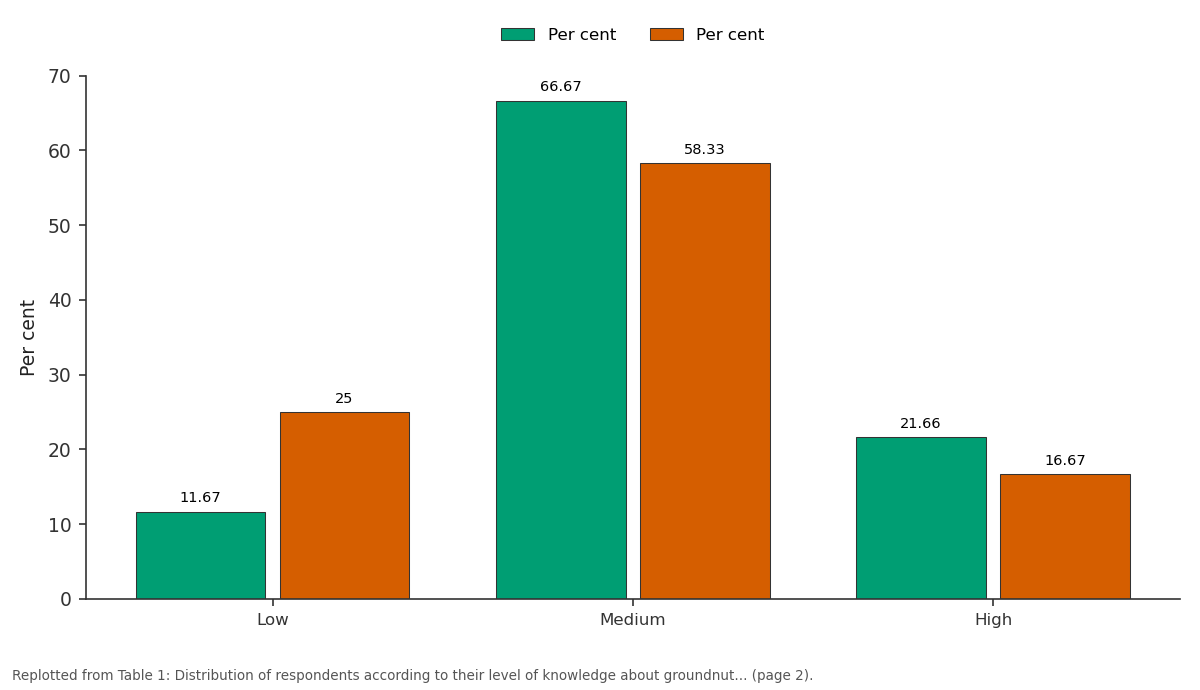
Per cent and Per cent: Low vs Medium vs High
Replotted from Table 1 (page 2) of the original paper. Every bar is the paper's own table value.
View source evidence ↗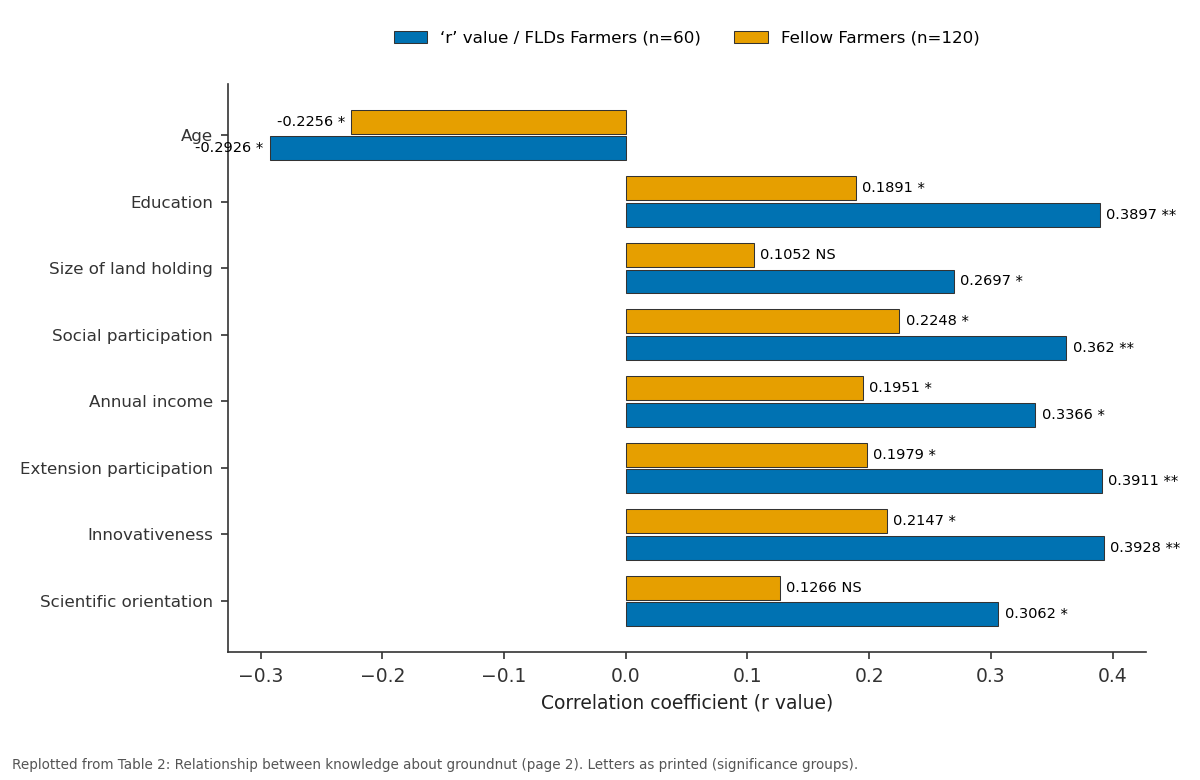
‘r’ value / FLDs Farmers (n=60) and Fellow Farmers (n=120): Age vs Education vs Size of land holding vs Social participation vs Annual income
Replotted from Table 2 (page 2) of the original paper. Every bar is the paper's own table value.
View source evidence ↗Figures & tables
From the original paper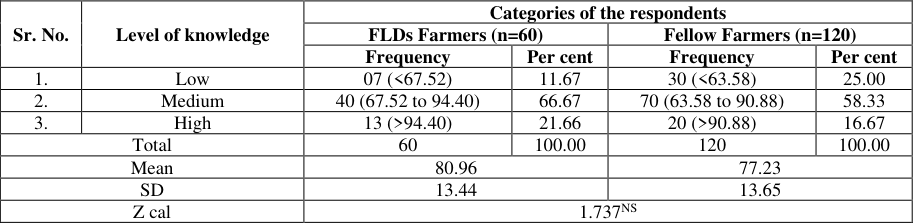 Table 1
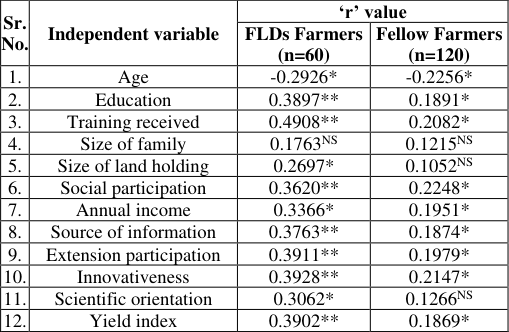 Table 2
Introduction
The groundnut (Arachis hypogea L.) has been recognized around the world by an assortment of colourful names. In India it is known as Mungfali (Hindi), Magfali (Gujrati), Cheenabadam (Bengali, Oriya and Assamese), Phuimug (Marathi), Nilakadalia (Tamil) and Nilashanaga / Verushanaga (Telugu). It is known as the 'king of oilseed' crops. Groundnuts have become a substitutes for costly nuts such as cashews and even they are widely regarded as poor man's cashews, while in Saurashtra it is popularly known as Kathiyawadi Kaju. The front line demonstration is an important method of transfer of latest package of practices in totality to farmers. Through it, farmers learn latest technologies of crops production under real farming situations at their own fields. The main objective of front line demonstration is to demonstrate newly released crop production and protection technologies and management practices at the farmers' fields under different agro-climatic regions and farming situations. While demonstrating the technologies in the farmers' fields, the scientists are required to study the factors contributing to higher crop production, field constraints of production and thereby generating production factors and feedback by them. Front line demonstrations are conducted in a block of two to four hectares of land in order to have better impact of the demonstrated technology on the farmers' fields. The technology of growing crops is complex and sophisticated. It required through understanding and repeated practice of different skills on the part of farmers to get rich harvest. Therefore, farmers should be trained in specific operational and technical know-how and skills embracing all phases of production for maximizing their economic returns. That could be done through demonstration technology. Hence, it is quite essential to study the level of knowledge of FLDs farmers and fellow farmers about groundnut production technology. By considering this fact the current study was determined with following objectives. Objectives 1. To find out the knowledge level of FLDs farmers and fellow farmers about groundnut production technology 2. To explore relationship between knowledge about www.extensionjournal.com groundnut production technology with their profile of respondents
Methodology
The present study was conducted in three KVKs (Taraghadia, Pipalia and Kodinar) operational area of Saurashtra region of Gujarat state, where frontline demonstrations under NMOOP are being conducted by Krishi Vigyan Kendras and the study was confined to "expost facto" research design. The multistage random and purposive random sampling technique was used for the selection of district, talukas, villages and respondents. The total numbers of groundnut growers 60 FLDs farmers and 120 fellow farmers were selected from two district and three KVKs by purposive and random sampling method. For the selection of independent variables, which were found most relevant were finally selected for the study. The tools and techniques used in the present study was interview schedule along with the suitable scales and indices for measurement of dependent and independent variables. For the data collection, pretested and structured interview schedule was prepared after discussing with a group of expert and necessary modifications were made. To know the association between selected profile of the respondents and knowledge about groundnut production technology, a correlation coefficient was applied.
Results and Discussion
Results and Discussion
Knowledge level of FLDs farmers and fellow farmers about groundnut production technology
In the present study knowledge refers to know-how about different groundnut production practices possessed by respondents. Adequate knowledge is essential for respondents in successful and profitable production. It was therefore thought necessary to obtain information from the groundnut respondents about groundnut production technology. The data regarding the knowledge level of the respondents about groundnut production technology were collected. As discussed in the methodology, a pretested and well-structured knowledge index was developed and used to measure the knowledge level of the respondents about groundnut production technology. These data regarding the knowledge level of the respondents groundnut production technology are presented in Table 1. The data given in Table 1 revealed that majority (66.67 per cent) of the FLDs farmers had medium level of knowledge about groundnut production technology, followed by 21.66 per cent and 11.67 per cent of the FLDs farmers had high and low level of knowledge about groundnut production technology, respectively. In terms of fellow farmers more than half (58.33 per cent) of the fellow farmers had medium level of knowledge about groundnut production technology, followed by 25.00 per cent and 16.67 per cent of the fellow farmers had low and high level of knowledge about groundnut production technology, respectively. As evident from table 15 'Z' value (1.737) was found to be non-significant, which indicates that FLDs farmers had slightly more knowledge regarding groundnut production technology than fellow farmers, this might be due to FLDs farmers gain knowledge from the direct contact with scientist and fellow farmers gain knowledge from the FLDs farmers seen by mean difference. The probable reason for having non-significant difference may be that the respondents had medium social participation, medium extension participation and source of information. These factors might have favourably helped the respondents in getting more knowledge about groundnut production technology.
| Sr. No. | Level of knowledge | Categories of the respondents | — | — | — |
|---|---|---|---|---|---|
| FLDs Farmers (n=60) | Fellow Farmers (n=120) | ||||
| Frequency | Per cent | Frequency | Per cent | ||
| 1. | Low | 07 (<67.52) | 11.67 | 30 (<63.58) | 25.00 |
| 2. | Medium | 40 (67.52 to 94.40) | 66.67 | 70 (63.58 to 90.88) | 58.33 |
| 3. | High | 13 (>94.40) | 21.66 | 20 (>90.88) | 16.67 |
| Total | 60 | 100.00 | 120 | 100.00 | |
| Mean | 80.96 | 77.23 | |||
| SD | 13.44 | 13.65 | |||
| Z cal | 1.737NS |
Table text extracted from the original PDF; superscript letters are shown inline. The original table image is below.
View original table image
Relationship between profile characteristics and knowledge level
The variables of FLDs farmers and fellow farmers played a vital role in determining their knowledge level about groundnut production technology. further the young farmers might be progressive in nature and always eager to take risk. This finding was in line with the finding of Humbal (2012) [2] and Hadiya (2013) [1] . The several profile characteristics of FLDs farmers education, training received, size of land holding, social participation, annual income, source of information, extension participation, innovativeness, scientific orientation and yield index had positive and significant relationship with their level of knowledge about groundnut production technology. Another variable size of family had positive and nonsignificant relationship with their level of knowledge and adoption about groundnut production technology; it means size of family was irrespective correlated with knowledge level of FLDs farmers. While in case of fellow farmers education, training received, social participation, annual income, source of information, extension participation, innovativeness and yield index had positive and significant relationship with their level of knowledge about groundnut production technology. Another variable size of family, size of land holding and scientific orientation had positive and non-significant relationship with their level of knowledge about groundnut production technology; it means size of family, size of land holding and scientific orientation were irrespective correlated with knowledge level of fellow farmers.
Conclusion
FLDs farmers and fellow farmers knowledge level about groundnut production technology was found maximum under the medium level of knowledge category as revealed by the 66.67 per cent and 58.33 per cent of the FLDs farmers and fellow farmers, respectively. The proper extension strategy like training received and extension participation may be found more important in updating the knowledge level of farmers. In case of FLDs farmers, among the independent variables the education, size of land holding, social participation, annual income, source of information, innovativeness, scientific orientation and yield index had positive and significant relationship with knowledge about groundnut production technology. While in case of fellow farmers education, social participation, annual income, source of information, innovativeness and yield index had positive and significant relationship with knowledge about groundnut production technology. To improve the knowledge of respondents about groundnut production technology, the extension agencies should make more efforts to bring up the positively related characteristics such as education, training received, social participation, source of information, annual income, extension participation, innovativeness, scientific orientation and yield index in order of its priority.
Figures and tables from the paper
| Sr. No. | Independent variable | ‘r’ value | — |
|---|---|---|---|
| FLDs Farmers (n=60) | Fellow Farmers (n=120) | ||
| 1. | Age | -0.2926* | -0.2256* |
| 2. | Education | 0.3897** | 0.1891* |
| 3. | Training received | 0.4908** | 0.2082* |
| 4. | Size of family | 0.1763NS | 0.1215NS |
| 5. | Size of land holding | 0.2697* | 0.1052NS |
| 6. | Social participation | 0.3620** | 0.2248* |
| 7. | Annual income | 0.3366* | 0.1951* |
| 8. | Source of information | 0.3763** | 0.1874* |
| 9. | Extension participation | 0.3911** | 0.1979* |
| 10. | Innovativeness | 0.3928** | 0.2147* |
| 11. | Scientific orientation | 0.3062* | 0.1266NS |
| 12. | Yield index | 0.3902** | 0.1869* |
Table text extracted from the original PDF; superscript letters are shown inline. The original table image is below.
View original table image
References
3 in the original paper- Subbaiah PV, Jyothi V, Rajasri M. Cluster front line demonstrations in summer sesamum-Impact on livelihood outcome. Seed. 1975;1450(1825).
- Raghav DK, Kumar U, Kumar A, Singh AK. Impact of Cluster Frontline Demonstration on Pigeon Pea for Increasing Production in Rain Fed Area of District Ramgarh (Jharkhand) towards Self-Sufficiency of Pulses. J of Ext. Edu. 2020;20(4):34-39.
- Veni CP, Rajkumar BV, Lakshmi DV, Swetha M, Kumar PV, Manjari MB, et al. Food Security by Promotion of Pulses through KVK Methodology-A Way of Doubling the Farmers Income. Int. J Curr. Microbiol. App. Sci. 2018;7(10):2585-2596.