
Research article · 2024 · Full text
International Journal of Agriculture Extension and Social DevelopmentKnowledge of agro input dealers about certificate course on pesticide management
Volume 7(8S) · Pages 151–153 · DOI: 10.33545/26180723.2024.v7.i8sc.947 ↗
Research areasAgricultural Economics and Practices
Abstract
Author-writtenAgro input dealers serves as an important link between the manufactures and the farmers and he has the responsibility to disseminate latest farm technology up to the field level. So, knowledge about pesticides is crucial for the agro input dealers. The farmers have more trust on the agro input dealers as they are more localize. There is a high need that proper recommendations should be communicated for sustainable usage of inputs and for proper understanding by the farmers about the product and process. The present study was conducted across the districts of Junagadh, Rajkot, Porbandar and Amreli in the Gujarat state. Data was collected from 160 agro input dealers who had completed a certificate course on pesticide management. Both purposive and random sampling techniques were employed. The study results revealed that just under three-fifths (58.13 per cent) of the agro input dealers possessed a moderate level of knowledge regarding the certificate course on pesticide management. Several profile characteristics including education, social participation, experience as a dealer, information sources, exposure to mass media, received training, extension contacts, economic motivation, management orientation, innovativeness, achievement motivation, and scientific orientation, exhibited positive and significant associations with knowledge about the certificate course on pesticide management. Conversely, age showed a negative and significant correlation with knowledge about the certificate course on pesticide management.
Summary
Source-checkedPlain-language reading of the full paper, prepared with AI and checked against the text. Each point links to the authors' own words.
Why it matters
- Agro input dealers act as a critical link between manufacturers and farmers, responsible for spreading the latest farming technologies to the field. View evidence ↗
- Farmers tend to trust agro input dealers more because they are local. View evidence ↗
- Since most pesticide dealers lack formal agricultural education, it is essential to provide them with technical knowledge on pest management and scientific advisory services. View evidence ↗
The question
- The study aimed to evaluate the level of knowledge agro input dealers possess regarding a certificate course on pesticide management. View evidence ↗
What they did
- The study was conducted across four districts in Gujarat state: Junagadh, Rajkot, Amreli, and Porbandar. View evidence ↗
- A total of 160 input dealers were selected from these districts using random sampling. View evidence ↗
- Data was collected using a pretested, structured interview schedule and specific scales to measure variables. View evidence ↗
- A correlation coefficient was used to analyze the association between the dealers' profiles and their knowledge levels. View evidence ↗
What they found
- The majority of dealers (58.13%) possessed a medium level of knowledge about the pesticide management certificate course. View evidence ↗
- Other knowledge levels were distributed as high (18.11%), very high (11.87%), and low (11.11%). View evidence ↗
- A very small minority of dealers (1.87%) had a very low level of knowledge. View evidence ↗
- Age had a significant negative correlation with knowledge, meaning younger dealers generally had higher knowledge levels than older dealers. View evidence ↗
- Factors such as education, experience, training, extension contact, and various psychological orientations (economic, management, achievement, and scientific) were positively and significantly associated with knowledge. View evidence ↗
- Annual income and risk orientation showed no significant association with the dealers' knowledge levels. View evidence ↗
What it means
- The authors conclude that training and extension contacts are the most important strategies for updating the knowledge of agro input dealers. View evidence ↗
- The authors recommend that training programs prioritize younger dealers and focus on psychological variables like economic and scientific orientation to increase effectiveness. View evidence ↗
Visual summary
1 visualsIllustrations explain the paper; charts are replotted from the paper's own table values.
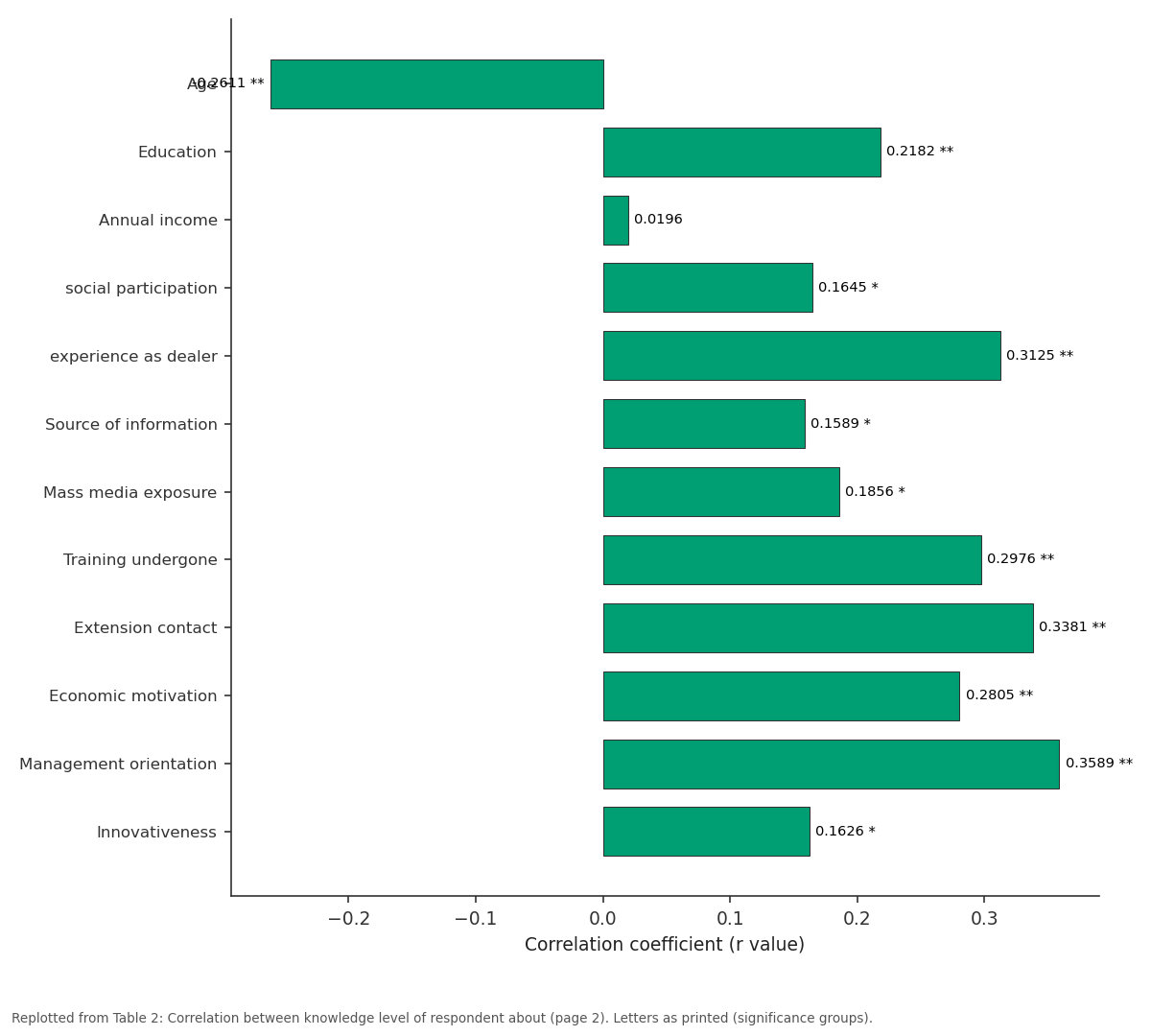
‘r’ value: Age vs Education vs Annual income vs social participation vs experience as dealer
Replotted from Table 2 (page 2) of the original paper. Every bar is the paper's own table value.
View source evidence ↗Figures & tables
From the original paper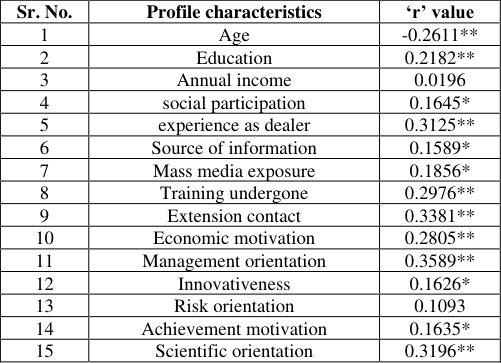 Table 2
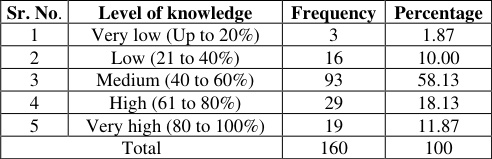 Table 1
Introduction
Agro input dealers are businesspersons with or without a technically qualification and a service provider. In order to overcome the possible negative effects, it is necessary to make technical qualification in agriculture as mandatory for issuing retailer ship license to provide agro advisory services besides selling agricultural inputs. The input dealer has no specifically for qualification to get license from the government and has inadequate knowledge about agricultural technology. So, training has to be provided to get better knowledge and skill to act as an extension service provider by competent institutes (Sharma, 2017) [9] . Agro input dealers serves as an important link between the manufactures and the farmers and he has the responsibility to disseminate latest farm technology up to the field level. Pesticide is one of the important agri inputs in agriculture. The pesticides is mostly marketed by dealers, distributors and retailers. Most of the farmers are dependent on pesticides dealers/retailers for information related to insecticides and pest management. However, majority of the pesticides dealers do not have formal education in agriculture. It is essential therefore to impart technical knowledge on pesticides, pest management and advisory based on scientific recommendations. In this context, the National Institute of Plant Health Management (NIPHM) has been entrusted the role of coordinator for the 72 hours certificate course for pesticides dealers and distributors and to equip them to acquire professional competency on pesticides and pest management and advisory services thereof. The main objective of this course is to impart the basic technical knowledge on pesticides and pest management to the pesticides dealers and distributors and to provide knowledge about the rules and laws governing the insecticides. If the agro input dealers have proper knowledge about pesticides, they can transfer that to the farmers for improving farming by boost up production which ultimately resulting in increasing living standard of farmers. Hence, it is quite essential to study the level of knowledge of input dealers about certificate course on pesticide management. By considering this fact the current study was determined with following objectives. Objectives 1. To find out the level of knowledge of agro input dealers about certificate course on pesticide management 2. To ascertain the relationship between knowledge of agro input dealers with their profile www.extensionjournal.com
Methodology
The present study was conducted in Junagadh, Rajkot, Amreli and Porbandar district of Gujarat state, where there are more number of input dealers with completion of certificate course on pesticide management and the study was confined to "ex-post facto" research design. The purposive and random sampling technique was used for the selection of district and respondents. The total numbers of 160 input dealers were selected from four district by random sampling method. For the selection of independent variables, which were found most relevant were finally selected for the study. The tools and techniques used in the present study was interview schedule along with the suitable scales and indices for measurement of dependent and independent variables. For the data collection, pretested and structured interview schedule was prepared after discussing with a group of expert and necessary modifications were made. To know the association between selected profile of the input dealers and knowledge about certificate course on pesticide management, a correlation coefficient was applied.
Results and Discussion
Results and Discussion
Knowledge level of agro input dealers about certificate course on pesticide management
Knowledge is the body of understood information possessed by an individual input dealer regarding certificate course on pesticide management. The data regarding the knowledge level of the agro input dealers about certificate course on pesticide management were collected. As discussed in the methodology, a pretested and well-structured knowledge scale was developed and used to measure the knowledge level of the agro input dealers about certificate course on pesticide management. These data regarding the knowledge level of the respondents about certificate course on pesticide management are presented in Table 1. The data given in Table 1 revealed that slightly less than three-fifth (58.13 per cent) of agro input dealers had medium level of knowledge after completion of certificate course on pesticide management, followed by 18.11 per cent, 11.87 per cent and 11.11 per cent of the agro input dealers had high, very high and low level of knowledge after completion of certificate course on pesticide management, respectively. Only few (1.87 per cent) of them was with very low level of knowledge after completion of certificate course on pesticide management. The finding was more or less similar to result of Kale et al. (2020) [3] , Khambhala (2020) [4] , Handa (2021) [2] , Latha et al. (2021) [6] and Mayekar (2022) [7] . It can be seen that 76.26 per cent of agro input dealers demonstrated a high to medium level of knowledge regarding the certificate course on pesticide management. This indicates that a significant majority of the respondents possessed a moderate level of knowledge on the subject matter. Several factors may contribute to this finding. Firstly, it can be attributed to the fact that a considerable number of the respondents had completed their education up to the middle school level, which may have provided them with a certain baseline of knowledge. Additionally, their experience as dealers, utilization of information sources, exposure to mass media and extension contact were also found to be at a moderate level. These factors collectively contribute to the medium level of knowledge observed among the respondents.
| Sr. No. | Level of knowledge | Frequency | Percentage |
|---|---|---|---|
| 1 | Very low (Up to 20%) | 3 | 1.87 |
| 2 | Low (21 to 40%) | 16 | 10.00 |
| 3 | Medium (40 to 60%) | 93 | 58.13 |
| 4 | High (61 to 80%) | 29 | 18.13 |
| 5 | Very high (80 to 100%) | 19 | 11.87 |
| Total | 160 | 100 |
Table text extracted from the original PDF; superscript letters are shown inline. The original table image is below.
View original table image
Relationship between profile characteristics and knowledge level
The variables of agro input dealers played a vital role in determining their knowledge level about certificate course on pesticide management. The probable reason might be due to that young agro input dealers were more interested and had better understanding of pesticides. This finding was in line with the finding of Kumar et al. (2020) [5] . The other profile characteristics education, social participation, experience as a dealer, source of information, mass media exposure, training undergone, extension contact, economic motivation, management orientation, innovativeness, achievement motivation and scientific orientation had a significant and positive relationship with knowledge level. Another characteristic i.e., annual income and risk orientation was non-significant association with their knowledge level about certificate course on pesticide management; it means annual income and risk orientation were irrespective correlated with knowledge level of agro input dealers. Similar finding had been reported by Nagesh www.extensionjournal.com et al. (2015) [8] and Chaudhari et al. (2015) [1] .
Conclusion
Agro input dealers knowledge level about certificate course on pesticide management was found maximum under the medium level of knowledge category as revealed by the 58.13 per cent of the input dealers. The proper extension strategy like training undergone and extension contact may be found more important in updating the knowledge level of agro input dealers. The characteristics like education, social participation, experience as a dealer, source of information, mass media exposure, economic motivation, management orientation, innovativeness, achievement motivation and scientific orientation were positive and significant with knowledge level of agro input dealers except annual income and risk orientation which and non-significant relationship with knowledge level. Therefore, During the training programme more attention should be given on psychological variable viz., economic motivation, management orientation, achievement motivation, scientific orientation etc. for better effectiveness of the training programme and give more priority to young agro input dealers in training programme.
Figures and tables from the paper
| Sr. No. | Profile characteristics | ‘r’ value |
|---|---|---|
| 1 | Age | -0.2611** |
| 2 | Education | 0.2182** |
| 3 | Annual income | 0.0196 |
| 4 | social participation | 0.1645* |
| 5 | experience as dealer | 0.3125** |
| 6 | Source of information | 0.1589* |
| 7 | Mass media exposure | 0.1856* |
| 8 | Training undergone | 0.2976** |
| 9 | Extension contact | 0.3381** |
| 10 | Economic motivation | 0.2805** |
| 11 | Management orientation | 0.3589** |
| 12 | Innovativeness | 0.1626* |
| 13 | Risk orientation | 0.1093 |
| 14 | Achievement motivation | 0.1635* |
| 15 | Scientific orientation | 0.3196** |
Table text extracted from the original PDF; superscript letters are shown inline. The original table image is below.
View original table image
References
6 in the original paper- Chaudhari JK, Patel BS, Parikh AH. Impact of Krishi Vigyan Kendra (KVK) on knowledge of farmers about improved agricultural technologies of wheat crop. Gujarat J Ext Educ. 2015;26(1):30-35.
- Kale KV, Hingne BN, Raut MA, Mankar DM. To ascertain the knowledge level of farm input dealers about the use of farm input they deal and to determine the training needs and decide the areas of training. Int J Commun Syst. 2020;8(1):1185-1188.
- Kumar S, Roy S, Atal R, Panda CK, Sohane RK. Knowledge gap of agri input dealers in farm production. Curr J Appl Sci Technol. 2020;39(4):92101.
- Latha MC, Kadian KS, Meena BS, Behera J. Impact of DAESI program on knowledge levels of input dealers in Andhra Pradesh, India. Indian J Ext Educ. 2021;57(2):82-86.
- Mayekar SK, Sawant PA, Gavali VP, Aher SS, Pol SS. Knowledge of farm input dealers about selected major crops grown in the South Konkan. Pharm Innov J. 2022;11(1):617-618.
- Nagesh B, Moulasab M, Kushal H. Analysis of knowledge status of improved technologies by groundnut farmers. Int J Trop Agric. 2015;33(4):35113514.