
Research article · 2024 · Full text
International Journal of Agriculture Extension and Social DevelopmentAgricultural stagnation and migration in Tamil Nadu: Challenges and policy implications
Volume 7(8) · Pages 379–382 · DOI: 10.33545/26180723.2024.v7.i8f.951 ↗
Research areasAgricultural Economics and PracticesSocial and Economic Development in IndiaIndian Economic and Social Development
Abstract
Author-writtenAgricultural stagnation and migration are critical issues in Tamil Nadu, a state renowned for its agricultural heritage. Over the past few decades, Tamil Nadu’s agricultural sector has grappled with challenges such as erratic rainfall, depleting groundwater levels, soil degradation, and limited access to modern technologies, leading to significant declines in productivity and growth. This stagnation has adversely affected the livelihoods of farmers, catalyzing a substantial migration of rural populations to urban areas in search of better opportunities. This study aims to elucidate the dynamics of agricultural stagnation and migration, providing insights into their socio-economic implications and proposing sustainable policy interventions. This research, conducted across four villages in Thanjavur and Thiruvarur districts, employs a mixed-method approach, combining survey data collected from January to June 2023 with qualitative insights from farmers and local experts. Findings indicate that increased cultivation costs, market volatility, and water scarcity have pushed rural households to explore non-farm employment opportunities. Education has emerged as a critical factor, with higher educational attainment motivating migration both domestically and abroad. This study advocates for comprehensive rural development programs that promote education, skill development, and non-farm employment to mitigate migration pressures and enhance rural livelihoods, aiming for a balanced socio-economic development in Tamil Nadu.
Summary
Source-checkedPlain-language reading of the full paper, prepared with AI and checked against the text. Each point links to the authors' own words.
Why it matters
- Tamil Nadu's agricultural sector has experienced a decline in productivity and growth due to soil degradation, limited technology access, depleting groundwater, and erratic rainfall. View evidence ↗
- Agricultural stagnation has negatively impacted farmer livelihoods, driving rural populations to migrate to urban areas for better opportunities. View evidence ↗
- The combination of environmental and technological challenges has increased rural poverty and reduced incomes for small and marginal farmers. View evidence ↗
The question
- The study aims to analyze the dynamics of agricultural stagnation and migration in Tamil Nadu to understand their socio-economic effects and suggest sustainable policy interventions. View evidence ↗
What they did
- The research used a mixed-method approach, combining qualitative insights and survey data collected from January to June 2023 across four villages in the Thiruvarur and Thanjavur districts. View evidence ↗
What they found
- Approximately 25.4% of households in the study villages have at least one member who has migrated domestically or overseas. View evidence ↗
- Domestic migrants are typically between 25 and 30 years old, suggesting that youth are choosing to leave rural agricultural life. View evidence ↗
- All migrants in the study had a minimum of 10 years of education, highlighting the role of educational attainment in the decision to migrate. View evidence ↗
- Villages at the tail end of the command area produced 73% of total overseas migrants, compared to those in the upper command area. View evidence ↗
- Migrants earned an average salary of around Rs.190,000 and sent back 75-80% of their earnings as remittances, regardless of their community. View evidence ↗
- Funding for migration differed by caste: BC households used savings, while MBC and SC households relied on borrowing, land mortgages, and jewel mortgages. View evidence ↗
What it means
- The authors suggest that ensuring consistent, timely water distribution and developing non-farm employment in the Cauvery Delta are viable ways to support farmers and landless households. View evidence ↗
- The study recommends comprehensive rural development programs focusing on skill development, education, and non-farm employment to reduce migration pressure. View evidence ↗
Visual summary
3 visualsIllustrations explain the paper; charts are replotted from the paper's own table values.
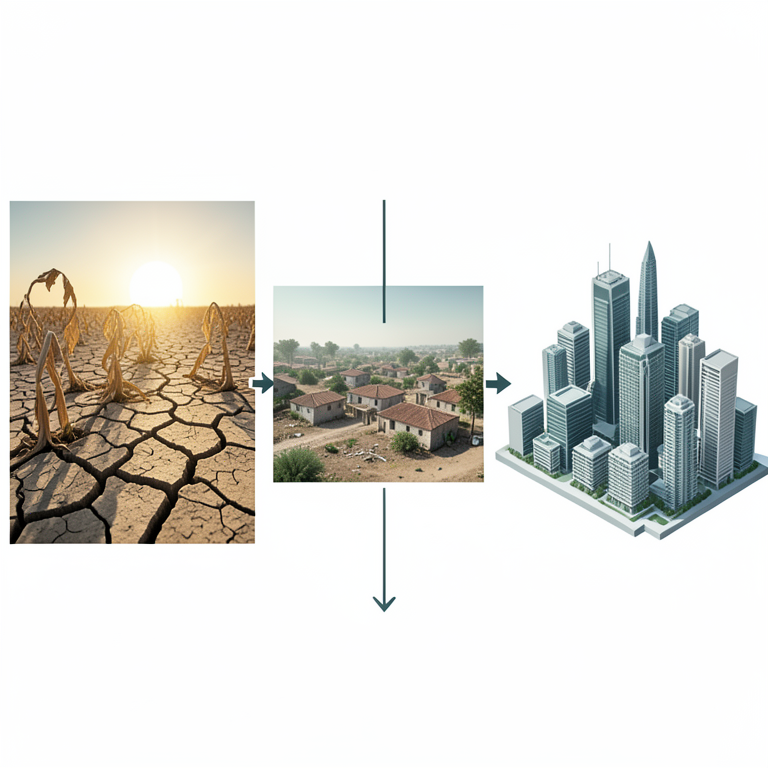
Cycle of Agricultural Stagnation and Migration
AI-generated conceptual illustration (Rural farmland and an urban city skyline in Tamil Nadu, India). It explains the idea and does not show study data.
View source evidence ↗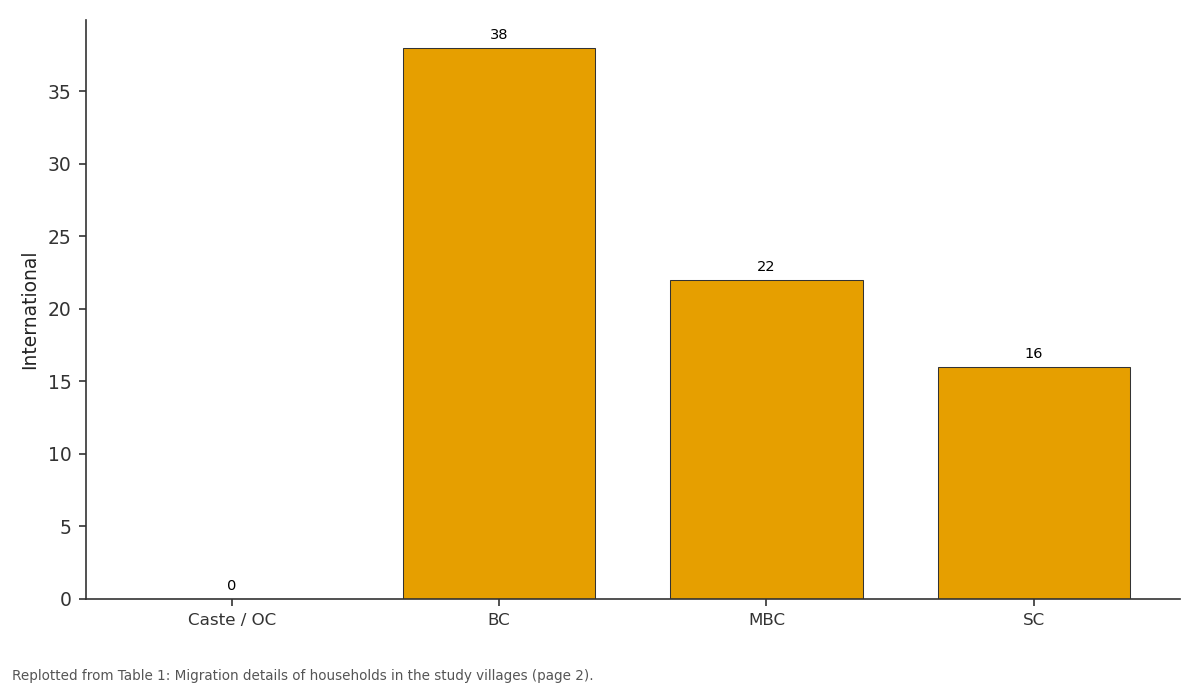
International: Caste / OC vs BC vs MBC vs SC
Replotted from Table 1 (page 2) of the original paper. Every bar is the paper's own table value.
View source evidence ↗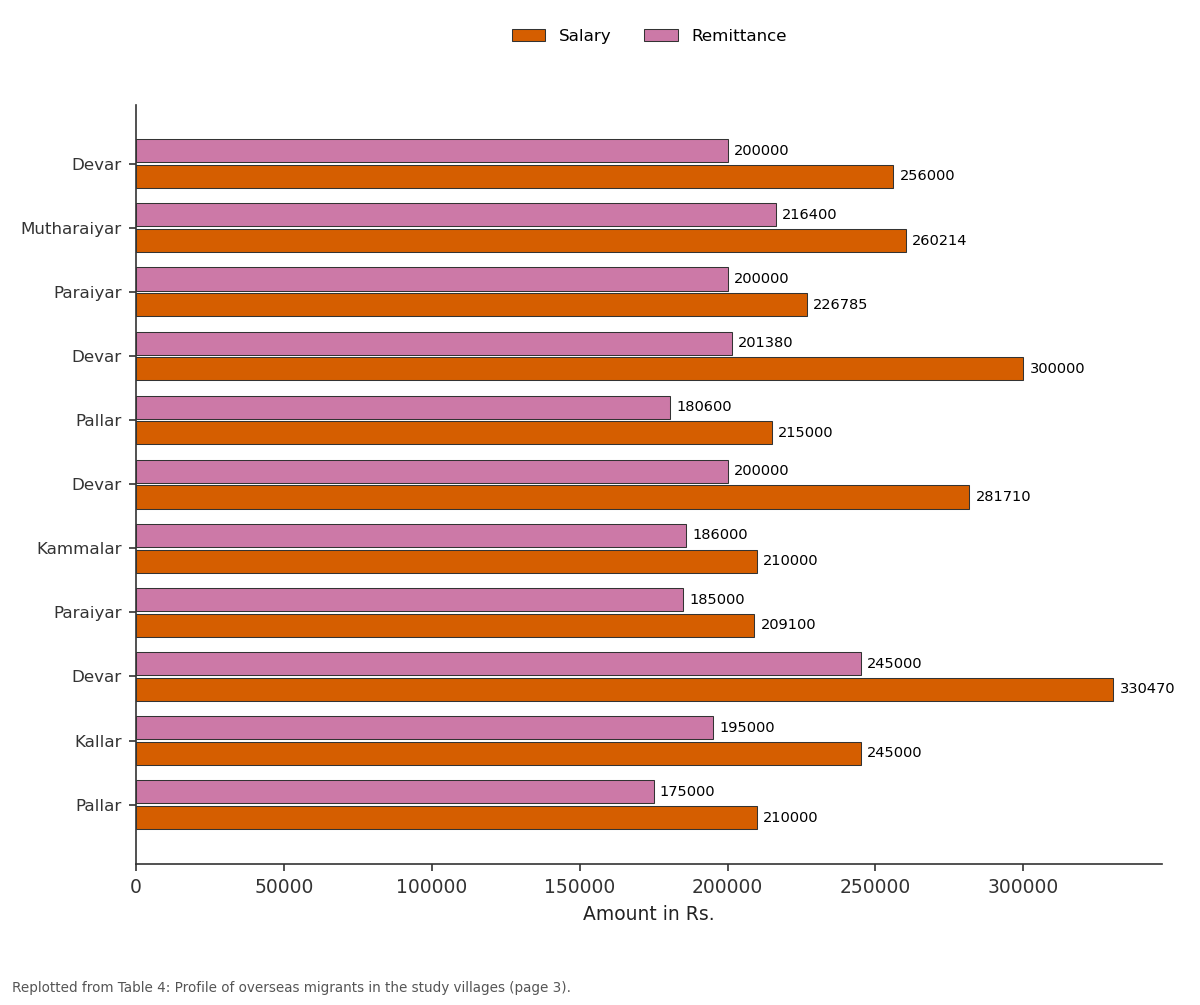
Salary and Remittance: Devar vs Mutharaiyar vs Paraiyar vs Devar vs Pallar
Replotted from Table 4 (page 3) of the original paper. Every bar is the paper's own table value.
View source evidence ↗Figures & tables
From the original paper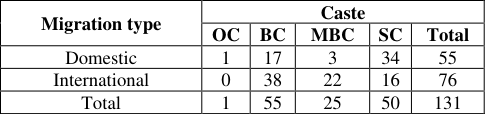 Table 1
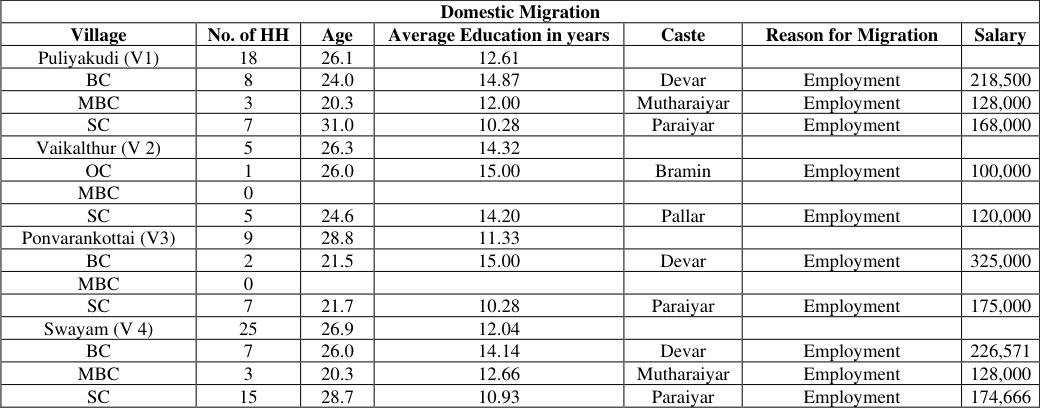 Table 2
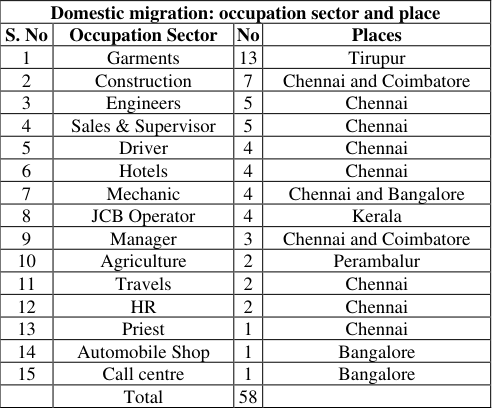 Table 3
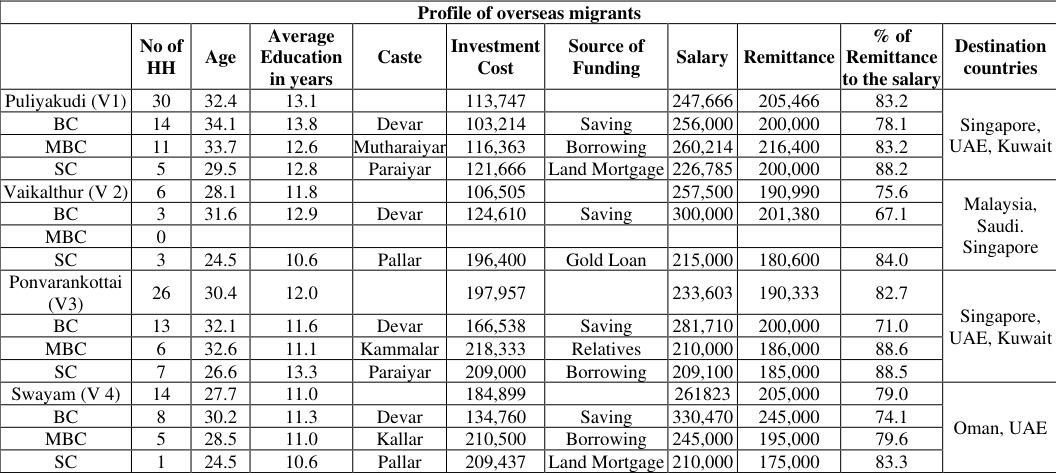 Table 4
Introduction
Agricultural stagnation and migration are critical issues in Tamil Nadu, a state with a significant agricultural heritage. Over recent decades, the agricultural sector has faced numerous challenges, leading to a slowdown in productivity and growth. This stagnation has profound implications, affecting the livelihoods of farmers and prompting substantial migration from rural areas to urban centers. Understanding these dynamics is essential for addressing the socio-economic challenges faced by the region. Tamil Nadu's economy has traditionally been anchored in agriculture, which provides employment and sustenance to a large portion of its population. However, the sector has been beset by problems such as erratic rainfall, depleting groundwater levels, soil degradation, and limited access to modern agricultural technologies. These issues have compounded the economic vulnerability of small and marginal farmers, resulting in declining agricultural incomes and increasing rural poverty. Recent studies have highlighted the complexities of these issues. For instance, Chand, R. et al. (2020) [1] discuss how climate change has adversely affected agricultural productivity in Tamil Nadu, citing increased frequency of droughts and unpredictable weather patterns as significant factors. Similarly, Venkatesh, K. and Srinivasan, S. (2021) [2] examine the socio-economic impacts of rural-urban migration, illustrating how the movement of rural populations to cities has reshaped labor markets and urban demographics. The migration of rural inhabitants to urban areas is both a consequence of and a response to agricultural stagnation. As rural residents move to cities in search of better employment opportunities and living conditions, the agricultural workforce dwindles. This migration alleviates some pressure on rural economies but strains urban infrastructure and services. Furthermore, the exodus of agricultural laborers and knowledge exacerbates the stagnation in rural areas. The intricacies of agricultural stagnation and migration in Tamil Nadu have been explored in several recent studies. For example, the Tamil Nadu State Action Plan on Climate Change (2022) [3] outlines strategies to enhance agricultural resilience through improved water management, adoption of climate-smart agricultural practices, and support for smallholder farmers. This plan underscores the importance of sustainable practices to combat the adverse effects of climate change on agriculture. A comprehensive report by the Indian Council of Agricultural Research (ICAR, 2021) [4] delves into the technological and infrastructural deficits in Tamil Nadu's agricultural sector. It highlights the need for improved irrigation systems, soil health management, and access to www.extensionjournal.com modern agricultural equipment to boost productivity. These measures are crucial for reversing the trend of stagnation and ensuring the sustainability of the agricultural sector. Another significant study by the National Institute of Rural Development and Panchayati Raj (NIRDPR, 2020) [5] focuses on the patterns and impacts of rural-urban migration in Tamil Nadu. The study reveals that migration is often driven by distress and lack of opportunities in rural areas, leading to a concentration of labor in urban informal sectors. This shift has implications for urban planning and the provision of services in cities, necessitating policies that address both rural development and urban management.
Significance of the Study
Addressing agricultural stagnation and migration in Tamil Nadu is essential for sustainable socio-economic development. Effective policy interventions must tackle the root causes of stagnation, such as water scarcity, soil degradation, and limited access to technology. By revitalizing the agricultural sector, policymakers can improve the livelihoods of rural populations and reduce the economic disparities between rural and urban areas. Moreover, comprehensive rural development programs are needed to create sustainable livelihood opportunities that can mitigate the pressure of migration on urban areas. Initiatives that promote education, skill development, and non-farm employment in rural regions can help achieve a more balanced regional development. This research aims to provide an in-depth analysis of the factors contributing to agricultural stagnation and migration in Tamil Nadu. By drawing on recent literature and empirical data, the study seeks to offer insights that can inform policy decisions and foster sustainable agricultural growth and equitable socio-economic development in the region.
Methodology
Study villages were selected based on the following criteria. 1. Two villages from old delta and two villages from new delta. 2. Villages which have Scheduled Caste (SC) population of about 20 per cent. 3. Villages which has 100-200 households with multiple castes. Based on these criteria villages were short listed. We visited many villages in the list to pre-test our hypothesis and had group discussion with farmers and local experts and collected basic information on various aspects of local livelihood. Finally, four villages were selected, two from upper command (old delta) and two from lower command area (new delta). Administratively, one each village was selected from Thiruvaiyaru Block and Pattukottai Block (from Thanjavur Distict), and from Needamangalam Block and Kottur Block (from Thiruvarur Distict). Data were collected through survey questionnaires, following extensive preliminary qualitative inquiries. Survey conducted from period of January to June 2023.
Story of Migrant Households
The livelihoods of farmers in Tamil Nadu have been significantly impacted by various factors, including increased cultivation costs, greater reliance on machinery, market fluctuations, yield stabilization issues, and water scarcity, as highlighted in the Farmer Status Report (2023). These challenges have made it difficult for farmers to sustain their families solely through agriculture. Household expenditures are on an upward trend, exacerbating financial pressures on rural households (Report 12). In response to these pressures, rural households have increasingly sought employment opportunities outside of agriculture. Most villages, with the exception of Vaikalathur (V2), have invested heavily in education. This has led to a notable increase in the average educational years among the working population (Ref). Higher education levels have motivated many to seek non-farm employment opportunities, both domestically and internationally, due to the limited availability of such opportunities locally In the study villages it is also observed that households also moved of the country in searching for jobs. Data related to overseas migration were also collected and presented in Table 4.
| Profile of overseas migrants | — | — | — | — | — | — | — | — | — | — |
|---|---|---|---|---|---|---|---|---|---|---|
| No of HH | Age | Average Education in years | Caste | Investment Cost | Source of Funding | Salary | Remittance | % of Remittance to the salary | Destination countries | |
| Puliyakudi (V1) | 30 | 32.4 | 13.1 | 113,747 | 247,666 | 205,466 | 83.2 | Singapore, UAE, Kuwait | ||
| BC | 14 | 34.1 | 13.8 | Devar | 103,214 | Saving | 256,000 | 200,000 | 78.1 | |
| MBC | 11 | 33.7 | 12.6 | Mutharaiyar | 116,363 | Borrowing | 260,214 | 216,400 | 83.2 | |
| SC | 5 | 29.5 | 12.8 | Paraiyar | 121,666 | Land Mortgage | 226,785 | 200,000 | 88.2 | |
| Vaikalthur (V 2) | 6 | 28.1 | 11.8 | 106,505 | 257,500 | 190,990 | 75.6 | Malaysia, Saudi. Singapore | ||
| BC | 3 | 31.6 | 12.9 | Devar | 124,610 | Saving | 300,000 | 201,380 | 67.1 | |
| MBC | 0 | |||||||||
| SC | 3 | 24.5 | 10.6 | Pallar | 196,400 | Gold Loan | 215,000 | 180,600 | 84.0 | |
| Ponvarankottai (V3) | 26 | 30.4 | 12.0 | 197,957 | 233,603 | 190,333 | 82.7 | Singapore, UAE, Kuwait | ||
| BC | 13 | 32.1 | 11.6 | Devar | 166,538 | Saving | 281,710 | 200,000 | 71.0 | |
| MBC | 6 | 32.6 | 11.1 | Kammalar | 218,333 | Relatives | 210,000 | 186,000 | 88.6 | |
| SC | 7 | 26.6 | 13.3 | Paraiyar | 209,000 | Borrowing | 209,100 | 185,000 | 88.5 | |
| Swayam (V 4) | 14 | 27.7 | 11.0 | 184,899 | 261823 | 205,000 | 79.0 | Oman, UAE | ||
| BC | 8 | 30.2 | 11.3 | Devar | 134,760 | Saving | 330,470 | 245,000 | 74.1 | |
| MBC | 5 | 28.5 | 11.0 | Kallar | 210,500 | Borrowing | 245,000 | 195,000 | 79.6 | |
| SC | 1 | 24.5 | 10.6 | Pallar | 209,437 | Land Mortgage | 210,000 | 175,000 | 83.3 |
Table text extracted from the original PDF; superscript letters are shown inline. The original table image is below.
View original table image
Profile of overseas migrants
Migration studies revealed that the ability to migrate is not only dependent on network and economic capability but also on the socio-ecological context of the place in which the people live. Villages located in the tail end of the command area (V1 and V3) produced larger number of overseas migrants (73 per cent of total migrant) when compare to villages located in the upper command area. Lower command area, locally called new canal area were provided with canal water later than upper command area. Last twenty years, amount and timing of water available for cultivation from Canal is drastically reduced. Initially households in this villages were changed their area from three to two times paddy and now forced to one-time paddy cultivation. It increased the uncertainties among the rural households both farmers and landless laborers. Paddy cultivation, labor intensive crop, when losing it charm due www.extensionjournal.com to lack of water, farmers slowly changed to coconut plantation. Coconut cultivation does not require as much as labor as paddy cultivation, labor were ended with jobless. So, they forced to migrate. It is the neighboring districts like Pudukkottai and Ramanathapuram already had traditions of overseas migration. In following their path, study villages also started to move out of the country for employment.
Education and age of migrants
Tamil Nadu has long history overseas migration since colonial period. British mobilised Tamil laborers for tea plantation and sugarcane plantation in their colonies. Following the tradition, earlier, households in the study villages went for low profile labor work in Southeast Asian countries and the Middle East countries. Experiences accrued through their work, they learn that skilled labor is better paid than non-skilled labor. In that experience, households in the study area invested in children education in line with demand of international work. Youth from the study villages went after completing 10 years of schooling, they joined with technical institutes which provided them with diploma in electrical. Plumber, fitter and construction. That is reason in the sample most of the respondents had education over 12 years. Immediately after getting diploma or degree, they went for local job to train and upskill themselves. In the mean time they kept their eye open in the opportunities abroad. They maintained close contact with earlier migrants and also watch the newspaper advertisement for employment opportunity abroad. And also they had used this earning to save for meet migration expenses. In that process, households in the study villages depending up on their education and family commitment spend two to five years. Hence, the average age of overseas migrants are around 30 in the study villages.
Source of funding, salary and remittance
It is important to note that while all the BC households used their savings to meet migration expenses, MBC and SC households were not in the position to use their savings. They borrowed money with interest and mortgaging land and jewels to mobilise needed money for migration. All the migrants have their own family commitment back home. Average salary for migrants were around Rs.190,000. All the migrants irrespective of their community, send remittance about 75-80 per cent of their earning. Living expenses and others managed through opting for over time.
As mentioned earlier, the villages prefer to migrate to Southeast Asian countries and Gulf countries.
Conclusion
The interplay between agricultural stagnation and migration in Tamil Nadu presents a complex challenge that requires a multifaceted approach. All the households invested in their children education and with support of government policy like free access school education, access to 20kg of rice and subsidised access to other food items they started move out from the agriculture. Unfortunately, excess labor pulled out from agriculture were not absorbed locally due to inadequate industrial development in the Cauvery Delta. So, both farm households and landless households migrated to the cities like a Chennai, Bangalore, Tirupur, Coimbatore and Kerala. An extension of domestic migration, rural households in the study villages started overseas migration.
To diversify their livelihood and chosen migration path, rural households needed credit support. But access to the credit is unequal among the respondents, it is skewed based on their caste status. Based on our field work and interaction with local experts, there was an ample evidence to say that Cauvery Delta farmers were in distress situation. Possible intervention to save the farmers and landless households in the Cauvery Delta were provide an assurance over consistency in the distribution of water on time and development nonfarm employment in the Cauvery Delta districts considered as viable options. Understanding the underlying causes and effects of these phenomena is crucial for developing effective solutions. Through this research, we hope to contribute to the ongoing discourse and support efforts to create a more resilient and prosperous future for Tamil Nadu's agricultural sector and its people.
Figures and tables from the paper
| Migration type | Caste | — | — | — | — |
|---|---|---|---|---|---|
| OC | BC | MBC | SC | Total | |
| Domestic | 1 | 17 | 3 | 34 | 55 |
| International | 0 | 38 | 22 | 16 | 76 |
| Total | 1 | 55 | 25 | 50 | 131 |
Table text extracted from the original PDF; superscript letters are shown inline. The original table image is below.
View original table image
| Domestic Migration | — | — | — | — | — | — |
|---|---|---|---|---|---|---|
| Village | No. of HH | Age | Average Education in years | Caste | Reason for Migration | Salary |
| Puliyakudi (V1) | 18 | 26.1 | 12.61 | |||
| BC | 8 | 24.0 | 14.87 | Devar | Employment | 218,500 |
| MBC | 3 | 20.3 | 12.00 | Mutharaiyar | Employment | 128,000 |
| SC | 7 | 31.0 | 10.28 | Paraiyar | Employment | 168,000 |
| Vaikalthur (V 2) | 5 | 26.3 | 14.32 | |||
| OC | 1 | 26.0 | 15.00 | Bramin | Employment | 100,000 |
| MBC | 0 | |||||
| SC | 5 | 24.6 | 14.20 | Pallar | Employment | 120,000 |
| Ponvarankottai (V3) | 9 | 28.8 | 11.33 | |||
| BC | 2 | 21.5 | 15.00 | Devar | Employment | 325,000 |
| MBC | 0 | |||||
| SC | 7 | 21.7 | 10.28 | Paraiyar | Employment | 175,000 |
| Swayam (V 4) | 25 | 26.9 | 12.04 | |||
| BC | 7 | 26.0 | 14.14 | Devar | Employment | 226,571 |
| MBC | 3 | 20.3 | 12.66 | Mutharaiyar | Employment | 128,000 |
| SC | 15 | 28.7 | 10.93 | Paraiyar | Employment | 174,666 |
Table text extracted from the original PDF; superscript letters are shown inline. The original table image is below.
View original table image
| Domestic migration: occupation sector and place | — | — | — |
|---|---|---|---|
| S. No | Occupation Sector | No | Places |
| 1 | Garments | 13 | Tirupur |
| 2 | Construction | 7 | Chennai and Coimbatore |
| 3 | Engineers | 5 | Chennai |
| 4 | Sales & Supervisor | 5 | Chennai |
| 5 | Driver | 4 | Chennai |
| 6 | Hotels | 4 | Chennai |
| 7 | Mechanic | 4 | Chennai and Bangalore |
| 8 | JCB Operator | 4 | Kerala |
| 9 | Manager | 3 | Chennai and Coimbatore |
| 10 | Agriculture | 2 | Perambalur |
| 11 | Travels | 2 | Chennai |
| 12 | HR | 2 | Chennai |
| 13 | Priest | 1 | Chennai |
| 14 | Automobile Shop | 1 | Bangalore |
| 15 | Call centre | 1 | Bangalore |
| Total | 58 |
Table text extracted from the original PDF; superscript letters are shown inline. The original table image is below.
View original table image
References
4 in the original paper- Chand R, Gupta S, Kumar S, et al. Impact of climate change on agricultural productivity in Tamil Nadu. J Clim Stud. 2020;15(3):45-60.
- Venkatesh K, Srinivasan S. Socio-economic impacts of rural-urban migration in Tamil Nadu. Econ Polit Weekly. 2021;56(21):78-85.
- Indian Council of Agricultural Research (ICAR). Technological and infrastructural deficits in Tamil Nadu's agricultural sector. ICAR Res J. 2021;32(4):120-135.
- National Institute of Rural Development and Panchayati Raj (NIRDPR). Patterns and impacts of rural-urban migration in Tamil Nadu. NIRDPR Working Paper Series. 2020;10(2):200-215.