
Research article · 2024 · Full text
International Journal of Agriculture Extension and Social DevelopmentQuality content in digital apps: Assessing infant development, parenting, and child care aspects
Volume 7(8) · Pages 278–280 · DOI: 10.33545/26180723.2024.v7.i8d.926 ↗
Research areasChild Development and Digital TechnologyTechnology Adoption and User Behaviour
Abstract
Author-writtenParent's use of apps to support their parenting is on the rise.New parents have unique challenges since they might feel unprepared to raise their children.They might rely on mobile programs, or "apps," and the Internet to help them deal with the challenges of daily parenthood.In the past, extended families provided support to young parents in raising children, but with the shift towards nuclear families, traditional parenting assistance is often unavailable.Consequently, there is a lack of spontaneous teaching and learning processes, leaving parents with insufficient knowledge of common childcare practices.The main objective of this study was to conduct a systematic analysis of infant parenting apps regarding available information about infant development, infant parenting and child care aspects.For analyzing various infant parenting apps, 40 apps were downloaded and installed on an Android phone available for free download on the Google Play Store.Each app was used and then individually assessed by the researcher for its content and quality on the various criteria using a self-structured schedule.The majority of the apps did not have information on infant development, parenting and child care.These apps provide information that is insufficient and not easy to understand.The information is in English language only.The findings of this unique analysis highlight that the information provided in the app is insufficient and lacks credibility.
Summary
Source-checkedPlain-language reading of the full paper, prepared with AI and checked against the text. Each point links to the authors' own words.
Why it matters
- The shift from extended to nuclear families has reduced traditional support for new parents, often leaving them with insufficient knowledge of childcare practices. View evidence ↗
- The abundance of subpar apps can lead parents to use unreliable resources created by businesses, which may promote poor parenting techniques. View evidence ↗
The question
- The study aimed to systematically analyze the content and quality of infant parenting apps specifically regarding child care, parenting, and infant development. View evidence ↗
What they did
- The researchers analyzed a sample of 40 free infant parenting apps downloaded from the Google Play Store. View evidence ↗
- A researcher individually assessed each app's content and quality using a self-structured schedule. View evidence ↗
- The study used frequency and percentage as descriptive statistics to interpret the results. View evidence ↗
What they found
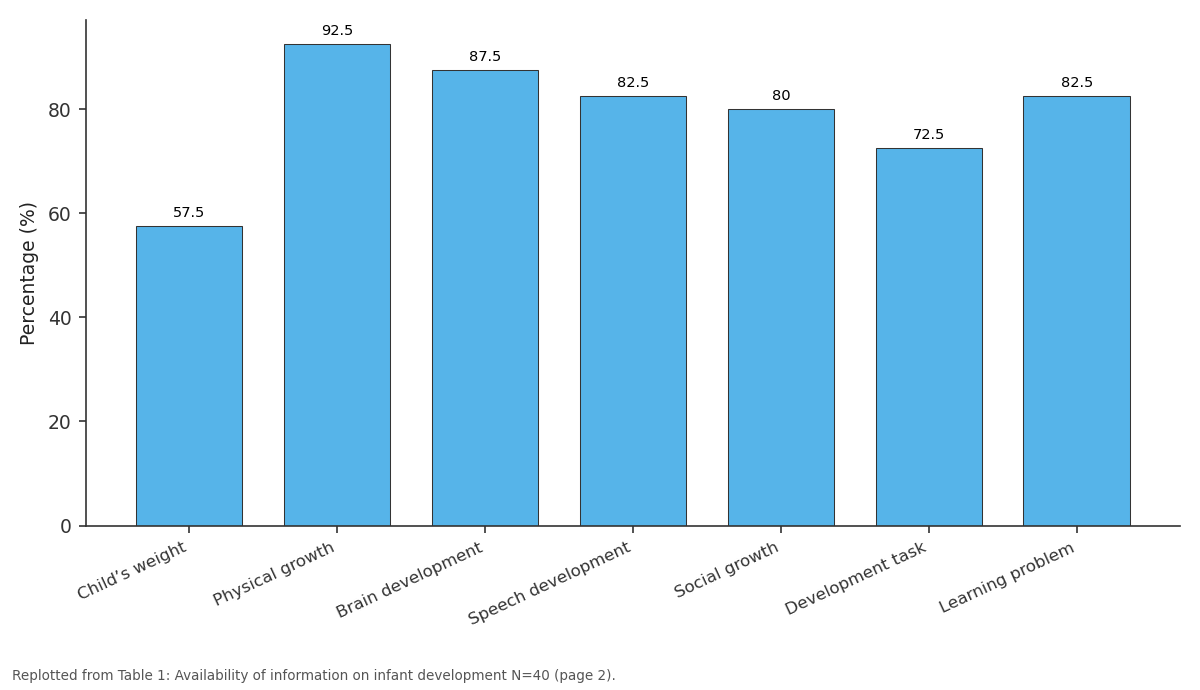
- Most apps provided information on physical growth (92.5%), brain development (87.5%), speech development (82.5%), learning problems (82.5%), social growth (80%), and developmental tasks (72.5%). View evidence ↗
- Only 57.5% of the analyzed apps provided information regarding a child's weight. View evidence ↗
- While 87.5% of apps covered parenting styles, 92.5% failed to provide information on Indian myths. View evidence ↗
- Information on 'good parent' aspects was provided by only 42.5% of apps, and 77.5% lacked information on 'moms' daily classrooms,' though 65.0% provided school tips. View evidence ↗
- A majority of apps lacked content on child eating habits (82.5%), child behavior (65.0%), and child daily care (60.0%). View evidence ↗
- Roughly half of the apps provided information on child crying (50.0%), child safety (52.5%), and daily activities and routines (57.5%). View evidence ↗
- The analyzed apps provided information only in English, which was found to be insufficient and lacking in credibility. View evidence ↗
What it means
- The authors conclude that current parenting apps provide insufficient guidance, leaving parents without the resources needed to make informed decisions about child care and development. View evidence ↗
- The study emphasizes a strong need to improve the quality and trustworthiness of parenting apps to meet the demand for reliable information on infant growth and care. View evidence ↗
Visual summary
2 visualsIllustrations explain the paper; charts are replotted from the paper's own table values.
%: Child’s weight vs Physical growth vs Brain development vs Speech development vs Social growth
Replotted from Table 1 (page 2) of the original paper. Every bar is the paper's own table value.
View source evidence ↗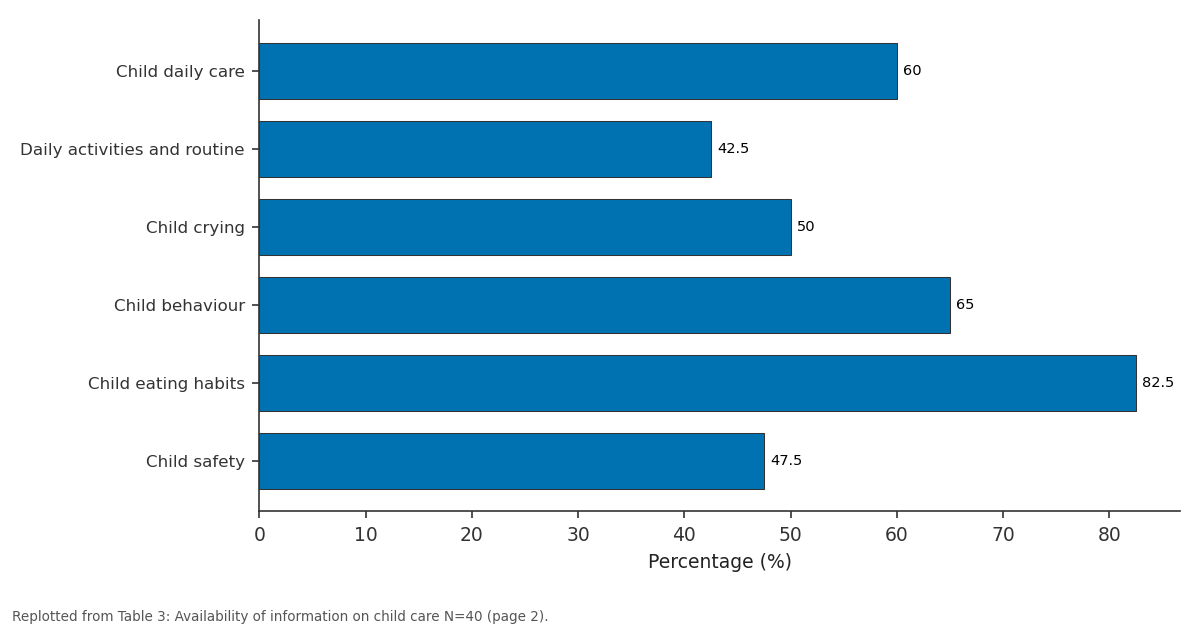
%: Child daily care vs Daily activities and... vs Child crying vs Child behaviour vs Child eating habits
Replotted from Table 3 (page 2) of the original paper. Every bar is the paper's own table value.
View source evidence ↗Figures & tables
From the original paper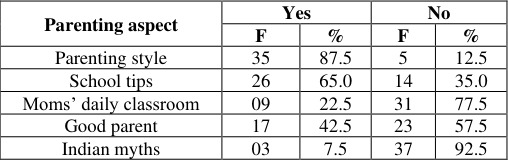 Table 2
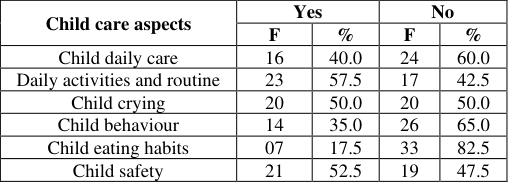 Table 3
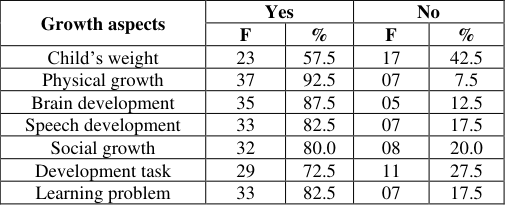 Table 1
Introduction
Parents have the greatest and most enduring impact on their children's lives, and research on how to promote their development demonstrates the critical role that early-life cognitive and social support from parents has in fostering infant development (Güven et al. 2023) [4] . Parenthood involves significant physical, social, and psychological changes, marked by both happiness and anxiety for numerous parents. New parents experiencing parenthood for the first time often feel unprepared to navigate the daily challenges of caring for their infants. Rehman et al. (2016) [9] assessed mothers' knowledge about child development and their sources of knowledge. They found that mothers have inadequate knowledge about child development. Aldayel et al. (2020) [2] identified the parents' levels of awareness regarding the developmental milestones of their children and the sources of information they use to stay informed. In all four domains, their expertise was found to be inadequate. Parents were shown to be the most knowledgeable about physical development out of the four areas of development; cognitive, social, and emotional development came next. Few parents stated that they always trusted the advice of their medical providers. They discovered that parents lacked the necessary understanding of developmental stages. Karuppannan et al. (2020) [5] evaluated the mother's parenting abilities and understanding of her child's developmental stages. They discovered that mothers in Kanchipuram have very less understanding of the developmental stages of their children. In the past, extended families provided support to young parents in raising children, but with the shift towards nuclear families, traditional parenting assistance is often unavailable. Consequently, there is a lack of spontaneous teaching and learning processes, leaving parents with insufficient knowledge of common childcare practices. They may turn to the Internet and mobile applications, commonly known as "apps," seeking guidance and assistance in managing various parenting scenarios. Several parents use mobile applications (apps) to record and track their infants' growth and development, learn about parenting techniques, and calm their babies by playing white noise and lullabies. 'How to' video-sharing apps assist parents in learning about practical aspects of baby care, such as putting together and operating baby equipment. (Lupton & Pedersen 2016) [7] . Lupton (2016) [6] assessed the use and value of digital media for information about pregnancy and early motherhood. Results of the study showed that women tend to value multifunctional apps and digital platforms related to early motherhood. His study revealed the importance of using www.extensionjournal.com digital platforms for making mothers socially active and maintaining relationships with other mothers. However, women also valued experts' advice and showed more desire for highly ready to access information and suggestions by medical professionals. Numerous apps have been released by app developers and health care providers to assist with parenting. However, the abundance of pointless and subpar apps means that parents still have trouble finding those that suit their needs. (Virani et al. 2019) [11] . Researchers globally have developed various apps to aid parents during the initial year of their infant's life (Franciscovich et al. 2015 and Morse et al. 2018) [3,8] . Nonetheless, parents still have trouble locating reliable apps that live up to their high standards for functionality and usability. Because of this, parents use unreliable and unsafe apps, the majority of which are created by businesses, which may encourage bad parenting techniques (Virani et al. 2020) [12] .
Methods
Methods
Sample selection
The digital sample of the study comprised of 40 infant parenting apps available for free download on the Google Play Store which were analyzed for their content and quality.
Data collection
A total number of 40 apps were downloaded and installed on an Android phone which were available free of cost on Google Play Store.
Data analysis
Each app was used and individually assessed by the researcher for its content and quality on the various criteria by using a self-structured schedule. The collected data were classified and tabulated to draw meaningful inferences as per the objectives of the study. For interpretation of results, the following descriptive statistics were used: Frequency and percentage. Results of the information on infant parenting have been shown in Table 2. The majority of the apps provided information on parenting style (87.5%) but at the same time they did not provide any information on Indian myths (92.5%). Nearly three-fourth of the apps did not provide information on moms' daily classrooms (77.5%). More than half of the apps provided information on school tips (65.0%). Only 42.5 percent of apps provided information on good parent aspect. The rest of the apps did not provide content on above given aspects. Results of information on child care have been displayed in Table 3. The majority of the apps did not have content on child eating habits (82.5%) while the remaining of the apps provided such information. More than half of the apps did not provide information on child daily care (60.0%), or child behaviour (65.0%). Around half of the apps provided information on child crying (50.0%). More than half of the apps provided information on daily activities and routines (57.5%) and child safety (52.5%).whereas the remaining apps did not contain information on these aspects.
| Child care aspects | Yes | — | No | — |
|---|---|---|---|---|
| F | % | F | % | |
| Child daily care | 16 | 40.0 | 24 | 60.0 |
| Daily activities and routine | 23 | 57.5 | 17 | 42.5 |
| Child crying | 20 | 50.0 | 20 | 50.0 |
| Child behaviour | 14 | 35.0 | 26 | 65.0 |
| Child eating habits | 07 | 17.5 | 33 | 82.5 |
| Child safety | 21 | 52.5 | 19 | 47.5 |
Table text extracted from the original PDF; superscript letters are shown inline. The original table image is below.
View original table image
| Parenting aspect | Yes | — | No | — |
|---|---|---|---|---|
| F | % | F | % | |
| Parenting style | 35 | 87.5 | 5 | 12.5 |
| School tips | 26 | 65.0 | 14 | 35.0 |
| Moms’ daily classroom | 09 | 22.5 | 31 | 77.5 |
| Good parent | 17 | 42.5 | 23 | 57.5 |
| Indian myths | 03 | 7.5 | 37 | 92.5 |
Table text extracted from the original PDF; superscript letters are shown inline. The original table image is below.
View original table image
Research Findings
Research Findings
Discussion
Discussion
A. Infant development
The findings of the present study underscore a critical gap in the existing landscape of mobile applications designed for mothers in India. The majority of the apps analyzed provided content on essential aspects such as a child's weight, physical growth, brain development, speech development, social growth, developmental tasks, and learning problems. However, it was observed that the depth and breadth of this content were insufficient to meet the needs of Indian mothers effectively. This observation resonates with previous research conducted by Samanta et al. (2021), which highlighted a significant demand among mothers for comprehensive information on the physical, motor, cognitive, social, and emotional development of infants. The study reinforces the notion that while some information is available through existing apps, it often falls short in terms of depth and specificity required by mothers in India. This finding aligns with previous research by Aldayel et al. (2020) [2] and Karuppannan et al. (2020) [5] to further corroborate these findings. They have identified www.extensionjournal.com persistent knowledge gaps among mothers regarding various aspects of infant growth and development. Specifically, mothers lack sufficient knowledge about the nuances of physical, motor, cognitive, social, and emotional development, as well as developmental milestones.
B. Child care and Infant parenting
The current study reveals a notable deficiency in existing mobile applications concerning essential care aspects of infant parenting. Specifically, it was observed that a significant number of apps lacked information on crucial topics such as child daily care, child crying, daily activities and routine, child behaviour, and child eating habits. This inadequacy indicates that the current digital resources may not fully meet the informational needs of mothers in India. [1] .
Conclusion
The findings of this unique analysis highlight significant gaps in the information provided by parenting apps for parents of infants. Specifically, these apps often lack relevant and comprehensive information on key aspects such as infant growth, effective parenting strategies, and child care practices. The analysis reveals that the available apps offer insufficient guidance and support in these crucial areas, leaving parents without the necessary resources to make informed decisions about their child's development and care. Additionally, the credibility of these apps is often questionable, further undermining their usefulness. This research underscores a strong demand among mothers for more reliable and thorough information on infant growth, parenting techniques, and child care, emphasizing the need for improvements in the quality and trustworthiness of parenting apps.
Figures and tables from the paper
| Growth aspects | Yes | — | No | — |
|---|---|---|---|---|
| F | % | F | % | |
| Child’s weight | 23 | 57.5 | 17 | 42.5 |
| Physical growth | 37 | 92.5 | 07 | 7.5 |
| Brain development | 35 | 87.5 | 05 | 12.5 |
| Speech development | 33 | 82.5 | 07 | 17.5 |
| Social growth | 32 | 80.0 | 08 | 20.0 |
| Development task | 29 | 72.5 | 11 | 27.5 |
| Learning problem | 33 | 82.5 | 07 | 17.5 |
Table text extracted from the original PDF; superscript letters are shown inline. The original table image is below.
View original table image
References
12 in the original paper- Agarwal S, Srivastava K, Sethi V. Maternal and newborn care practices among the urban poor in Indore, India, reasons and potential program options. IndiaGaps, Reasons and Potential Program Option. 2007;11(4):111-123.
- Aldayel AS, Aldayel AA, Almutairi AM, Alhussain HA, Alwehaibi SA, Almutairi TA, et al. Parental knowledge of children's developmental milestones in Riyadh, Saudi Arabia. Int. J Pediatr. 2020;9:24-32.
- Franciscovich A, Vaidya D, Doyle J, Bolinger J, Capdevila M, Rice M, et al. PoopMD, a mobile health application, accurately identifies infant alcoholic stools. PLoS One. 2015;10(7):e0132270.
- Güven Baysal Ş, Gümüş Doğan D, Kortay S, Arslan FN, Demirkıran Öztürk Y, Yağın FH, et al. Parenting knowledge of child development in Turkish mothers and fathers. Trends Pediatr. 2023;4(2):109-119.
- Karuppannan A, Ramamoorthy T, Rammamoorthi A, Ravichandran L. Mother's knowledge on child's developmental milestones and parenting skills in Kanchipuram District, Tamilnadu -A descriptive cross sectional study. Int. J Health Sci. Res. 2020;10:242247.
- Lupton D. The use and value of digital media for information about pregnancy and early motherhood: A focus group study. BMC Pregnancy Childbirth. 2016;16(1):1-10.
- Lupton D, Pedersen S, Thomas GM. Parenting and digital media: from the early web to contemporary digital society. Sociol Compass. 2016;10(8):730-743.
- Morse SS, Murugiah MK, Soh YC, Wong TW, Ming LC. Mobile health applications for pediatric care: review and comparison. Ther Innov. Regul. Sci. 2018;52(3):383-391.
- Rehman AU, Kazmi FS, Munir F. Mothers' knowledge about child development. Pak Pediatr J. 2016;40(3):176-181.
- Samanta Malik P, Dahiya M, Yadav P. Need analysis of parents regarding knowledge of aspects of infant parenting. Int J Educ Manag Stud. 2023;13(3):315-319.
- Virani A, Duffett-Leger L, Letourneau N. Parenting apps review: in search of good quality apps. Mhealth, 2019, 5.
- Virani A, Duffett-Leger L, Letourneau N. Parents' perspectives of parenting app use. J Informatics Nurs. 2020;5(1):8-18.