
Research article · 2024 · Full text
International Journal of Agriculture Extension and Social DevelopmentConstraints and suggestions of agro input dealers in providing agro advisory services in Gaya district of Bihar: Garret ranking approach
Volume 7(8) · Pages 346–349 · DOI: 10.33545/26180723.2024.v7.i8e.940 ↗
Research areasAgricultural Economics and PracticesLivestock Management and Performance ImprovementAgricultural risk and resilience
Abstract
Author-writtenAgri input dealers have played a key stakeholder role in agricultural development due to the resource intensive nature and demand of agricultural production. The present study was conducted in Gaya district of Bihar, India which aimed to identify key constraints faced by agri input dealers and their suggestions in providing agro advisory services. The blocks selected purposively for the study were Gaya, Manpur and Tekari due to large number of dealers present in area due to agricultural land. Data were collected from 320 respondents using pre-tested schedule and analyzed using appropriate statistical tests followed by Garrett ranking. The study inferred that major constraints notified among personal problems were inadequate technical qualification of input dealers in agro-advisory services (GMS-52.07), among socio economic problems lack of belief in agro-advisory services given by input dealers among farmers was ranked highest (GMS-55.26), among technical constraints lack of feasibility and simple recommended technologies was observed highest (GMS-52.10),among Supply, Communication and marketing problems lack of market intelligence at various levels in providing market information to the farmers was noted (GMS-53.54), among situational constraints lack of information on climate change /variability before advising farmers was observed (GMS-54.58), considering infrastructural constraints transportation problem (cost and vehicle availability) while giving field visit to the farmers field was highest (GMS-51.59). Identifying major constraints directs focus areas for training need assessment. The prime suggestion by the respondents was incorporation of need based training.
Summary
Source-checkedPlain-language reading of the full paper, prepared with AI and checked against the text. Each point links to the authors' own words.
Why it matters
- Agricultural input dealers in India serve as essential intermediaries, connecting input manufacturers with farmers. View evidence ↗
- These dealers provide agro-advisory services that are critical for smallholder farmers who lack direct access to modern agricultural knowledge, helping improve yields and sustainability. View evidence ↗
The question
- The study aimed to identify the primary constraints faced by agri-input dealers when providing advisory services and to collect their suggestions for improvement. View evidence ↗
What they did
- The research was conducted in the Gaya, Manpur, and Tekari blocks of the Gaya district in Bihar, India. View evidence ↗
- A sample of 320 respondents was selected using a proportionate random sampling method. View evidence ↗
What they found
- Among personal constraints, inadequate technical qualification was ranked highest with a Garrett mean score (GMS) of 52.07. View evidence ↗
- The primary socio-economic problem identified was the farmers' lack of belief in the advisory services provided by dealers (GMS 55.26). View evidence ↗
- The top technological constraint was the lack of simple and feasible recommended technologies (GMS 52.1). View evidence ↗
- Regarding supply, communication, and marketing, the lack of market intelligence for providing information to farmers was the top constraint (GMS 53.54). View evidence ↗
- The most significant situational problem was the lack of information on climate change and variability prior to advising farmers (GMS 54.58). View evidence ↗
- The leading infrastructural constraint was transportation issues, specifically cost and vehicle availability for field visits (GMS 51.59). View evidence ↗
- The top suggestion for the government and SAUs was the implementation of specific need-based training programs (GMS 57.62). View evidence ↗
- The primary suggestion for manufacturers was to strengthen the linkage between private research, input dealers, and farmers (GMS 56.50). View evidence ↗
What it means
- The authors conclude that improving agro-advisory services requires specific training programs and stronger linkages between research, dealers, and farmers. View evidence ↗
Visual summary
2 visualsIllustrations explain the paper; charts are replotted from the paper's own table values.
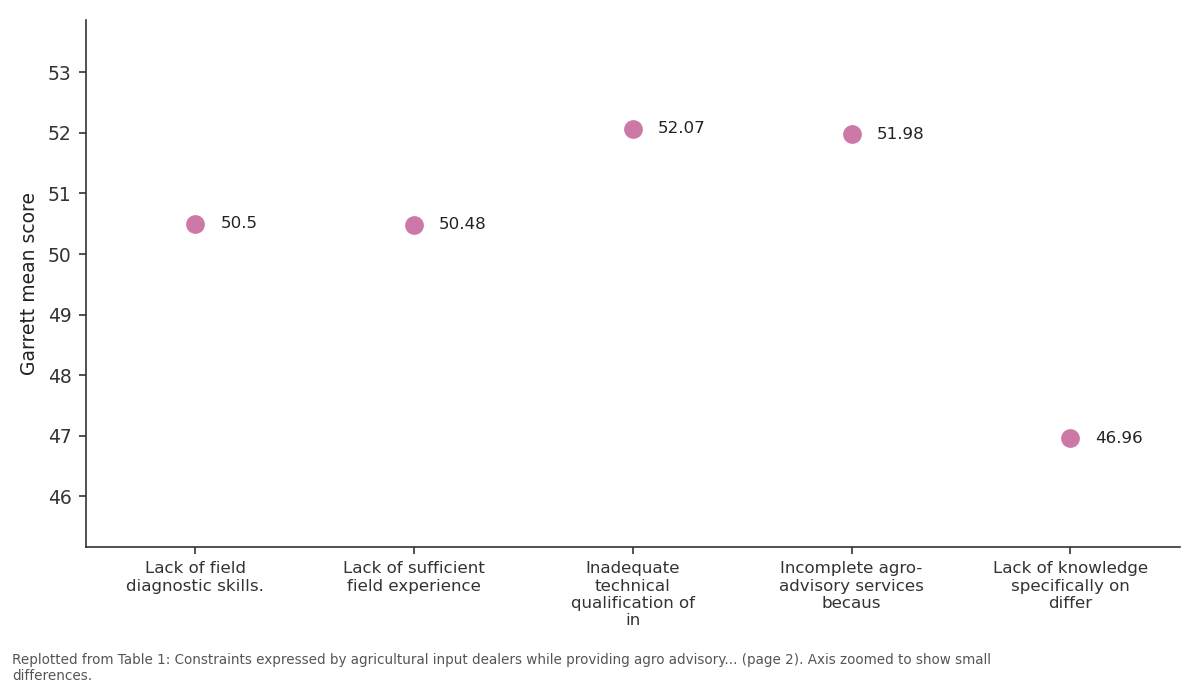
Garrett mean score: Lack of field... vs Lack of sufficient... vs Inadequate technical... vs Incomplete... vs Lack of knowledge...
Replotted from Table 1 (page 2) of the original paper. Every bar is the paper's own table value.
View source evidence ↗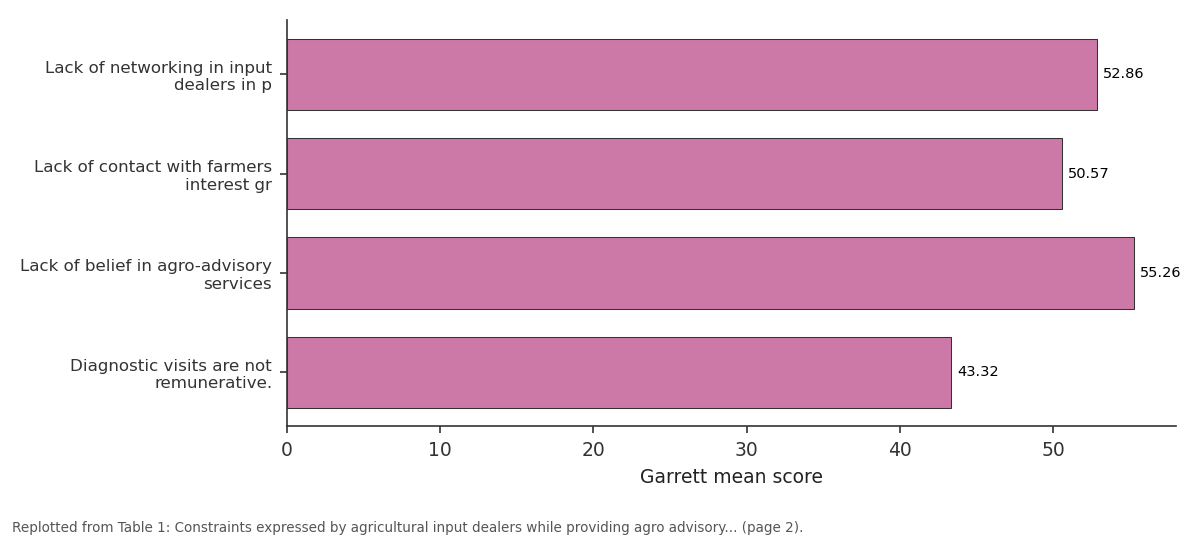
Garrett mean score: Lack of networking in... vs Lack of contact with... vs Lack of belief in... vs Diagnostic visits are...
Replotted from Table 1 (page 2) of the original paper. Every bar is the paper's own table value.
View source evidence ↗Figures & tables
From the original paper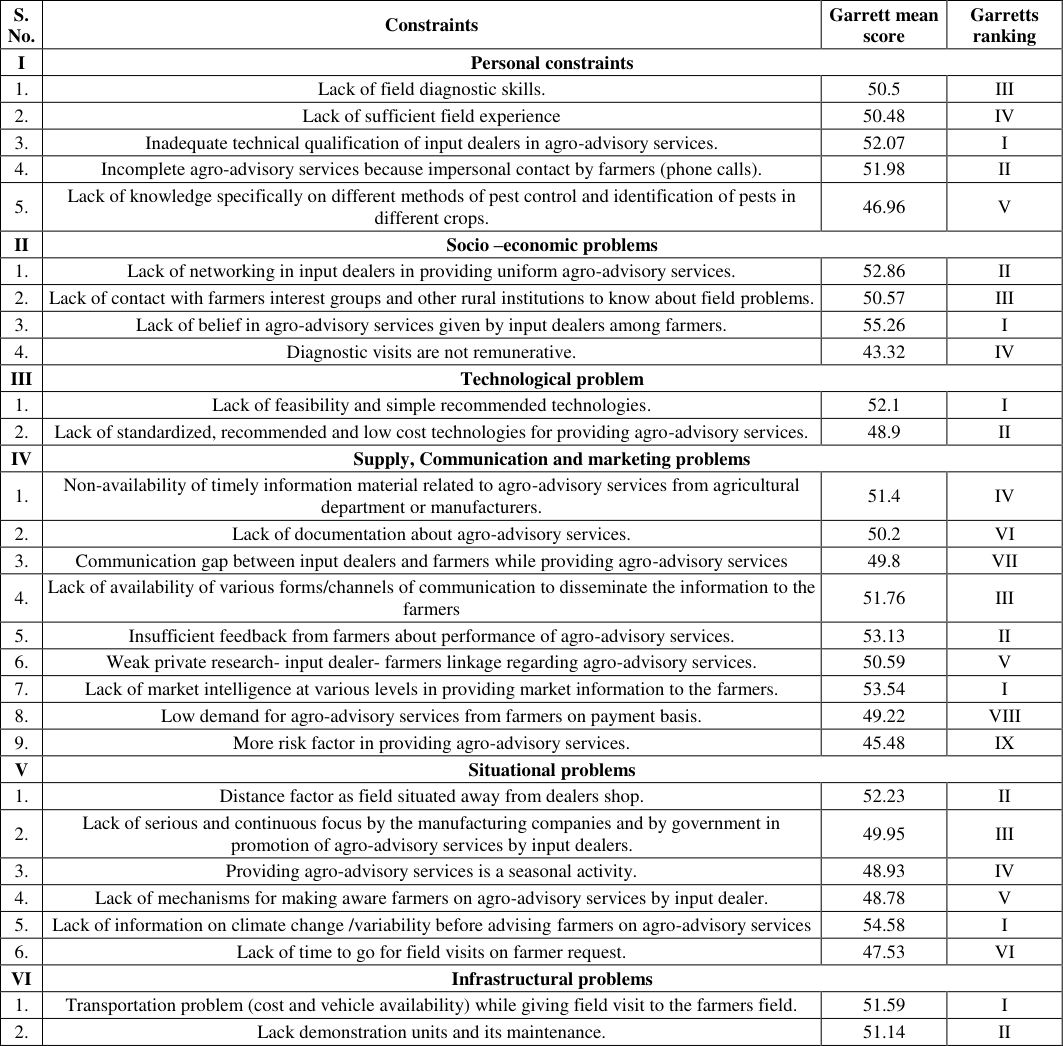 Table 1
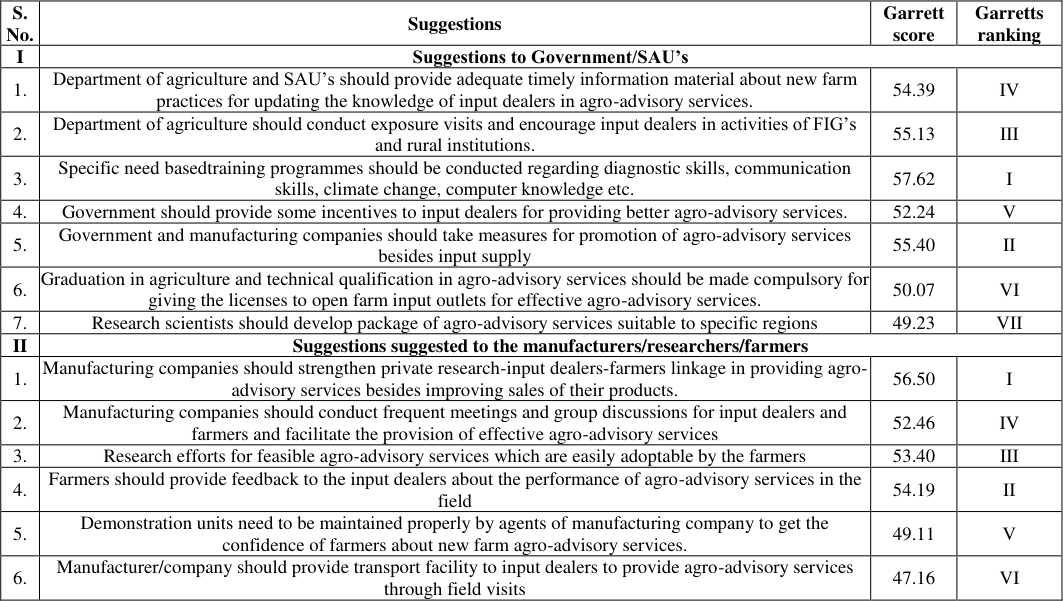 Table 2
Introduction
Agri input dealers in India play a crucial role in the agricultural ecosystem, acting as vital intermediaries between manufacturers of agricultural inputs (such as seeds, fertilizers, pesticides, and machinery) and the farmers who use them. These dealers not only supply essential products but also provide critical agro advisory services, leveraging their extensive knowledge of local agricultural practices, crop requirements, and pest management. Their advisory services help farmers make informed decisions, leading to better crop yields and sustainable farming practices. This role is particularly important in India, where smallholder farmers often lack direct access to modern agricultural knowledge and technologies. By offering guidance on optimal input usage, soil health, weather patterns, and disease control, agri input dealers contribute significantly to enhancing agricultural productivity and farmers' livelihoods. Progressive farmers are the most trusted source of farm information followed by agri input dealers in rural areas. (Adhiguru et al., 2009) [7] . Their importance is underscored by their ability to bridge the gap between traditional farming methods and modern agricultural advancements, thereby driving rural development and food security in the country. The objectives of this study was to identify the major constraints prevalent in providing agro advisory services and suggestions by the agri input dealers. By examining these aspects, this research aims to provide valuable insights into the core areas of concern and its implications for providing effective delivery service for agricultural development. The findings of this study are expected to contribute to the existing literature on agro advisory services in agriculture and inform policy interventions aimed at promoting sustainable agricultural practices. By highlighting the constraints and suggestions faced by input dealers in providing agro advisory services key areas for suitable intervention are identified and suitable strategies can be devised to mitigate them.
Research methodology
The research was carried out in Gaya district of Bihar state, India. Gaya, Manpur and Tekari blocks were selected purposively for the study. The proportionate random sampling method was used and a sample size of 320 respondents were selected for the study. Garrett ranking www.extensionjournal.com method was used for analysis. The study had the respondents rank different constraints and outcome based on their impact thereby converting into score value and rank with the help of the following formula: Percent position = 100(Rij-0.5)/Nj Where Rij = Rank given for the i th variable by j th respondents Nj = Number of variable ranked by j th respondents With the help of Garrett's Table, the percent position estimated is converted into scores by referring to the table given by Garret and Woodworth (1969) [3] . Then for each factor, the scores of each individual are added and then total value of scores and mean values of score is calculated. The factors having highest mean value is considered to be the most important factor. Interview schedules were developed with the guidance of field experts, incorporating standard indices and scales. The collected data were organized, summarized, and analysed using appropriate statistical methods.
Results and Discussion
This section presents the results of the study undertaken and the relevant interpretation and discussion in the light of the objectives of the study.
Supply, communication, and marketing constraints
Lack of market intelligence at various levels in providing market information to the farmers (Garrett mean score: 53.54, Garrett's ranking: 1). Access to market intelligence is essential for farmers to make informed decisions about crop selection, production practices, and marketing strategies. Without timely and accurate market information, farmers may face challenges in optimizing their production and maximizing returns. Insufficient feedback from farmers about performance of agro-advisory services (Garrett mean score: 53.13, Garrett's ranking: 2). Feedback mechanisms are essential for evaluating the effectiveness and impact of agro-advisory services and for continuous improvement. Establishing structured feedback mechanisms enables input dealers and service providers to identify strengths, address weaknesses, and better align services with farmers' needs and priorities.
Situational constraints
Lack of information on climate change/variability before advising farmers on agro-advisory services (Garrett mean score: 54.58, Garrett's ranking: 1). Climate change and variability pose significant challenges for agriculture. Integrating climate-smart approaches into agro-advisory services is crucial for enhancing the resilience and sustainability of agricultural systems in the face of changing climatic conditions. Distance factor as the fields situated away from the dealer's shop (Garrett mean score: 52.23, Garrett's ranking: 2). The geographical distance between farmers' fields and input dealers' shops can pose logistical challenges in providing timely and personalized agroadvisory services.
Infrastructural constraints
Transportation problem (cost and vehicle availability) while giving field visits to the farmer's field (Garrett mean score: 51.59, Garrett's ranking: 1). Transportation constraints, including high costs and limited vehicle availability, can impede input dealers' ability to conduct field visits to farmers' fields. Without reliable transportation, dealers may struggle to reach remote or inaccessible areas, hindering their capacity to provide on-site advice and support. Addressing transportation challenges is essential for ensuring equitable access to agro-advisory services, particularly for farmers in rural or marginalized communities.Lack of demonstration units and its maintenance (Garrett mean score: 51.14, Garrett's ranking: 2). Demonstration units serve as valuable platforms for showcasing best practices, innovative technologies, and agronomic techniques to farmers. However, the absence of demonstration units, or their inadequate maintenance, can limit opportunities for hands-on learning and skill development among farmers. Investing in the establishment and upkeep of demonstration units is essential for promoting technology adoption, building farmers' capacities, and disseminating knowledge effectively. The results are in line with the findings of Sharma et al. (2017) [7] , Patel et al. (2019) [5] and Srisailam et al. (2021) [2] . www.extensionjournal.com 2). For farmers/researchers/manufacturers the prime suggestion noted was Manufacturing companies should strengthen private research-input dealers-farmers linkage in providing agro-advisory services (Garrett mean score: 56.50, Garrett's ranking: 1) followed by Farmers should provide feedback to the input dealers about the performance of agro-advisory services in the field (Garrett mean score: 54.19, Garrett's ranking: 2). The results are in line with the findings of Patel et al. (2019) [5] .
Conclusion
It was concluded that major constraint identified was inadequate technical knowledge about agro advisory services, lack of self belief which hampers credibility, followed by lack of feasibility and simple recommended technologies, Lack of market intelligence at various levels in providing market information to the farmers, Lack of information on climate change /variability before advising farmers on agro-advisory services ,Transportation problem (cost and vehicle availability) while giving field visit to the farmers field. The suggestions include Specific training programmes and Manufacturing companies should strengthen private research-input dealers-farmers linkage in providing agro-advisory services besides improving sales of their products.
Figures and tables from the paper
| S. No. | Constraints | Garrett mean score | Garretts ranking |
|---|---|---|---|
| I | Personal constraints | ||
| 1. | Lack of field diagnostic skills. | 50.5 | III |
| 2. | Lack of sufficient field experience | 50.48 | IV |
| 3. | Inadequate technical qualification of input dealers in agro-advisory services. | 52.07 | I |
| 4. | Incomplete agro-advisory services because impersonal contact by farmers (phone calls). | 51.98 | II |
| 5. | Lack of knowledge specifically on different methods of pest control and identification of pests in different crops. | 46.96 | V |
| II | Socio –economic problems | ||
| 1. | Lack of networking in input dealers in providing uniform agro-advisory services. | 52.86 | II |
| 2. | Lack of contact with farmers interest groups and other rural institutions to know about field problems. | 50.57 | III |
| 3. | Lack of belief in agro-advisory services given by input dealers among farmers. | 55.26 | I |
| 4. | Diagnostic visits are not remunerative. | 43.32 | IV |
| III | Technological problem | ||
| 1. | Lack of feasibility and simple recommended technologies. | 52.1 | I |
| 2. | Lack of standardized, recommended and low cost technologies for providing agro-advisory services. | 48.9 | II |
| IV | Supply, Communication and marketing problems | ||
| 1. | Non-availability of timely information material related to agro-advisory services from agricultural department or manufacturers. | 51.4 | IV |
| 2. | Lack of documentation about agro-advisory services. | 50.2 | VI |
| 3. | Communication gap between input dealers and farmers while providing agro-advisory services | 49.8 | VII |
| 4. | Lack of availability of various forms/channels of communication to disseminate the information to the farmers | 51.76 | III |
| 5. | Insufficient feedback from farmers about performance of agro-advisory services. | 53.13 | II |
| 6. | Weak private research- input dealer- farmers linkage regarding agro-advisory services. | 50.59 | V |
| 7. | Lack of market intelligence at various levels in providing market information to the farmers. | 53.54 | I |
| 8. | Low demand for agro-advisory services from farmers on payment basis. | 49.22 | VIII |
| 9. | More risk factor in providing agro-advisory services. | 45.48 | IX |
| V | Situational problems | ||
| 1. | Distance factor as field situated away from dealers shop. | 52.23 | II |
| 2. | Lack of serious and continuous focus by the manufacturing companies and by government in promotion of agro-advisory services by input dealers. | 49.95 | III |
| 3. | Providing agro-advisory services is a seasonal activity. | 48.93 | IV |
| 4. | Lack of mechanisms for making aware farmers on agro-advisory services by input dealer. | 48.78 | V |
| 5. | Lack of information on climate change /variability before advising farmers on agro-advisory services | 54.58 | I |
| 6. | Lack of time to go for field visits on farmer request. | 47.53 | VI |
| VI | Infrastructural problems | ||
| 1. | Transportation problem (cost and vehicle availability) while giving field visit to the farmers field. | 51.59 | I |
| 2. | Lack demonstration units and its maintenance. | 51.14 | II |
Table text extracted from the original PDF; superscript letters are shown inline. The original table image is below.
View original table image
| S. No. | Suggestions | Garrett score | Garretts ranking |
|---|---|---|---|
| I | Suggestions to Government/SAU’s | ||
| 1. | Department of agriculture and SAU’s should provide adequate timely information material about new farm practices for updating the knowledge of input dealers in agro-advisory services. | 54.39 | IV |
| 2. | Department of agriculture should conduct exposure visits and encourage input dealers in activities of FIG’s and rural institutions. | 55.13 | III |
| 3. | Specific need basedtraining programmes should be conducted regarding diagnostic skills, communication skills, climate change, computer knowledge etc. | 57.62 | I |
| 4. | Government should provide some incentives to input dealers for providing better agro-advisory services. | 52.24 | V |
| 5. | Government and manufacturing companies should take measures for promotion of agro-advisory services besides input supply | 55.40 | II |
| 6. | Graduation in agriculture and technical qualification in agro-advisory services should be made compulsory for giving the licenses to open farm input outlets for effective agro-advisory services. | 50.07 | VI |
| 7. | Research scientists should develop package of agro-advisory services suitable to specific regions | 49.23 | VII |
| II | Suggestions suggested to the manufacturers/researchers/farmers | ||
| 1. | Manufacturing companies should strengthen private research-input dealers-farmers linkage in providing agro- advisory services besides improving sales of their products. | 56.50 | I |
| 2. | Manufacturing companies should conduct frequent meetings and group discussions for input dealers and farmers and facilitate the provision of effective agro-advisory services | 52.46 | IV |
| 3. | Research efforts for feasible agro-advisory services which are easily adoptable by the farmers | 53.40 | III |
| 4. | Farmers should provide feedback to the input dealers about the performance of agro-advisory services in the field | 54.19 | II |
| 5. | Demonstration units need to be maintained properly by agents of manufacturing company to get the confidence of farmers about new farm agro-advisory services. | 49.11 | V |
| 6. | Manufacturer/company should provide transport facility to input dealers to provide agro-advisory services through field visits | 47.16 | VI |
Table text extracted from the original PDF; superscript letters are shown inline. The original table image is below.
View original table image
References
3 in the original paper- Adhiguru P, Birthal PS, Kumar BG. Strengthening pluralistic agricultural information delivery systems in India. Agric Econ Res Rev. 2009;22(1):71-79.
- Srishailam B, Jirli B, Manasa K. Constraints Faced by the Farm Based Agri-Input Entrepreneurs in Central Telangana Region. Asian J Agric. Ext. Econ. Sociol. 2021;39(12):118-125.
- Kumar S, Kumar S. Constraints faced by Agri-input Dealers in Dissemination of Information to Farmers. Biol Forum Int J. 2021;13(3a):643-648.