
Research article · 2024 · Full text
International Journal of Agriculture Extension and Social DevelopmentPerception of stakeholders towards agricultural skill development training programme
Volume 7(8) · Pages 342–345 · DOI: 10.33545/26180723.2024.v7.i8e.935 ↗
Research areasAgricultural Innovations and PracticesAgricultural Systems and PracticesLivestock Management and Performance Improvement
Abstract
Author-writtenIn India various training programmes are conducted especially for rural people, farmers and weaker section for knowledge and skill development. Training is a process of acquisition of new skills, attitude and knowledge in the context of preparing for entry into a vocation or improving productivity in an organization or enterprise. Training is essential for human resource development. In first stage, out of seven FTCs of Saurashtra, four FTCs will be selected for the study on the basis of maximum number of farmers were got training under Farmer Training Centre (FTC). A tentative list of 28 statements was drafted keeping in view the applicability of statements suited to the area of study. The collected statements were edited in the light of the suggested criteria. The result showed that nearly half of trained (48.75 percent) and untrained (43.75 percent) farmers belonged to medium level of perception, while 23.12 percent trained and 35.62 percent untrained farmers belonged to low level of perception. Only 28.13 percent of trained and 20.63 percent of untrained farmers belong to high level of perception. It can be concluded that the majority of the respondents were in medium level perception of Agricultural Skill Development Training Programme.
Summary
Source-checkedPlain-language reading of the full paper, prepared with AI and checked against the text. Each point links to the authors' own words.
Why it matters
- Training is viewed as the primary method for transferring new agricultural technologies to farmers. View evidence ↗
- After eight years of implementation, there is a need to evaluate the program's impact on farmers' perceptions. View evidence ↗
The question
- The study aims to analyze the perceptions of stakeholders regarding the agricultural skill development training program. View evidence ↗
What they did
- The research was carried out in the Saurashtra region of Gujarat during the 2021-22 period. View evidence ↗
- The study sampled 160 trained farmers and 160 randomly selected untrained farmers from the same villages. View evidence ↗
- Data was collected using a structured interview schedule consisting of 29 statements to measure farmer perception. View evidence ↗
- A five-point Likert scale was used, with scores ranging from 5 (strongly agree) to 1 (strongly disagree). View evidence ↗
What they found
- The majority of both groups held a medium level of perception: 48.75% of trained and 43.75% of untrained farmers. View evidence ↗
- A higher percentage of untrained farmers (35.62%) had a low level of perception compared to trained farmers (23.12%). View evidence ↗
- Trained farmers were more likely to have a high level of perception (28.13%) than untrained farmers (20.63%). View evidence ↗
- The Z-calculated value of 8.493 exceeded the Z-tabulated value of 1.96 at a 95% significance level. View evidence ↗
- Trained stakeholders demonstrated a statistically significant higher perception level than untrained stakeholders. View evidence ↗
What it means
- The authors conclude that training provided by Farmer Training Centres (FTCs) significantly improved the perception levels of stakeholders. View evidence ↗
- The authors state that training makes farmers more capable of adopting modern techniques, leading to higher yields and resource efficiency. View evidence ↗
Figures & tables
From the original paper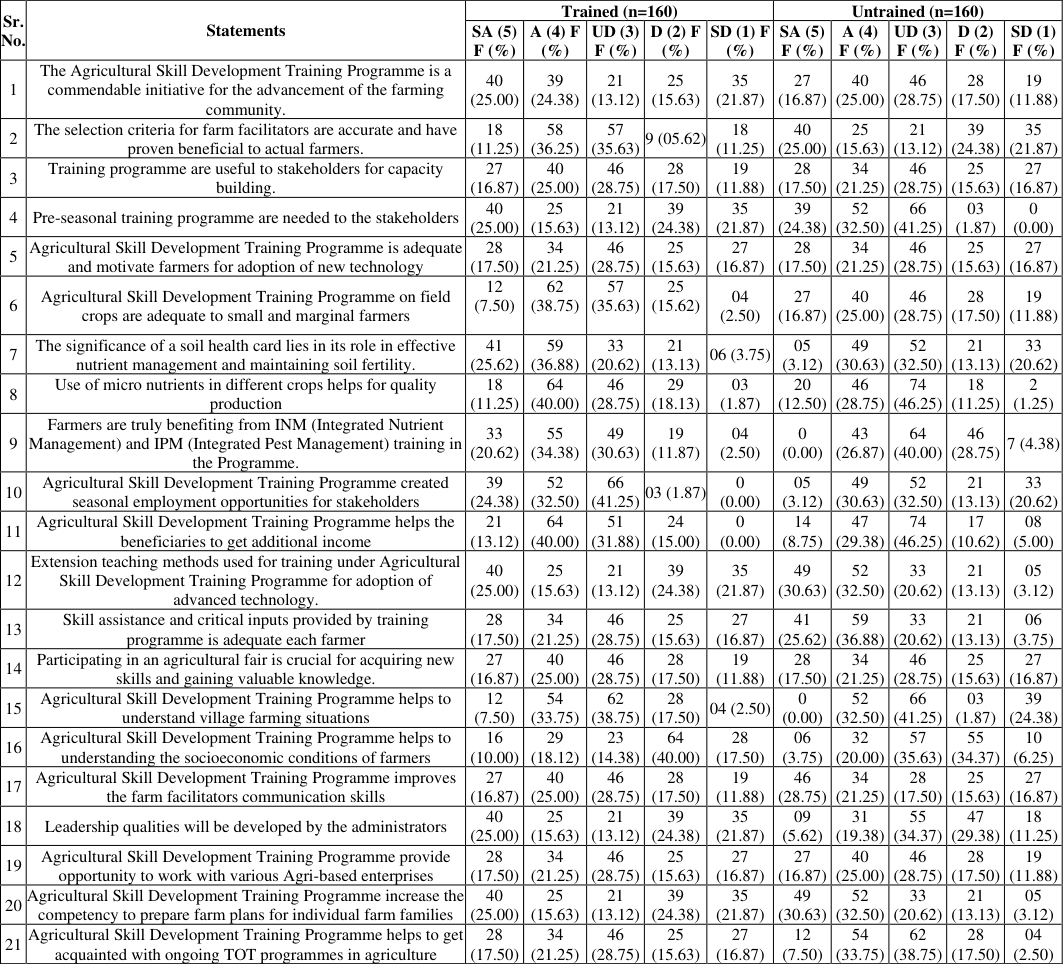 Table 1
 Table 2
 Table 3
Introduction
Training is considered the most important activity for transferring agricultural technologies to farmers. Hence, it is crucial to analyse the institutional training imparted to the farmers at Farmer Training Centre. The history of the wellorganized farmers training programme in India can be traced back to 1948 with the inception of Etawah pilot project.
Training, an age-old concept, serves the therapeutic function of shaping individuals' knowledge, skills and attitudes necessary for effective performance in their roles. Programs aimed at agricultural and community development seek to impart information, knowledge and skills, fostering the exchange of experiences and opinions while addressing doubts and challenges. Training ensures individuals possess the specific knowledge, skills and attitudes required to meet established standards. It typically involves four fundamental components: acquiring knowledge of the skill, observing skilled models, practicing the skill and reinforcing newly acquired behaviors. Lynton and Pareek (1990) [3] said that "Training is a process by which the desire, knowledge, attitude, skill and ideas are inculcated, fostered and reinforced in an organism". A systematically arranged training programme aids in the production of desirable changes in the behavior of people. In India various training programmes are conducted especially for rural people, farmers and weaker section for knowledge and skill development. Training is a process of acquisition of new skills, attitude and knowledge in the context of preparing for entry into a vocation or improving productivity in an organization or enterprise. Agricultural skill development training programme sanctioned under gender audit programme for more productive varieties and training and education programme for farmers. Government of Gujarat sanctioned a programme of "Agricultural Skill Development Training Programme for Women Farmers" in the year 2012-13. Afterwords in the year of 2013-14, government have sanctioned this programme jointly. Under this programme, selected women farmers, male farmers and youth have trained and guided in agricultural and allied aspects in scientific method. The programme has completed eight years. Now, it is necessary to study how the Agricultural Skill Development Training Programme has made an impact on perception of farmers.
Objective
To study the perception of stakeholders towards agricultural skill development training programme.
Methodology
The present study was conducted in Saurashtra region of Gujarat state during 2021-22. Ex-post facto research design was followed for carrying out the study. In first stage, out of seven FTCs of Saurashtra, four FTCs will be selected for the www.extensionjournal.com study on the basis of maximum number of farmers were got training under Farmers Training Centre (FTC). Two villages from each FTC will be selected, thus forty farmers selected from each village. The villages from FTCs will be selected on the basis of information given by Farmers Training Centre. At the second stage, twenty trained farmers will be selected by multistage purposive sampling method from each selected village. Thus, total 160 trained farmers will be selected as sample for the study. The equal number of untrained farmers also will be randomly selected from the same villages. An interview schedule was developed in accordance with the objectives of the study and it was pretested. The data of this study were collected with the help of structured interview schedule. The collected data was interpreted in order to make the finding meaningful. The scale comprised 29 statements that designed to elicit the perception of farmers towards the impact of agricultural skill development training programme. The five-point continuum of strongly agree, agree, undecided, disagree, and strongly disagree carried scores of 5, 4, 3, 2, and 1, respectively. The respondents' perception scores were calculated based on their answers to the statements, and they were then grouped into three categories using the mean plus standard deviation method. Thus, the study aimed to investigate the impact of agricultural skill development training programme.
Results and Discussion
Perception is a critical aspect of the study of human behaviour, as it involves the interpretation of sensations that are dependent on past experiences. This mental phenomenon is characterized by the association of various types of sensation and ideals to form a cohesive whole. Although perception cannot be directly observed in behaviour, it can be inferred from performance, particularly changes in performance or behaviour. The responses of respondents regarding the agricultural skill development training programme are presented in Table 1. From the Table 3, it can be observed that the Z calculated is less than Z tab. Therefore, it is inferred that there was significant difference in perception level of trained and untrained stakeholders. The study of Table inferred that the significance level of t test calculated is less than "t" tabulated at 95 percent level of significance. Thus, it can be said that there was significant difference among the perception level of stakeholders. Thus, from Table 3 it can be concluded that the trained stakeholders had statistically significant higher perception level than untrained stakeholders. Therefore, it can be concluded that training conducted by FTCs were able to create a significant advantage to perception level of stakeholders. This finding was in fully conformity with findings of Satishkumar (2006) [6] , Oladeji (2011) [4] , Gorfad (2012) [1] , Singh and George (2012) [7] , Sarada and Kumar (2018) [5] and Jadhav (2020) [2] .
| — | Perception level of trained stakeholders | Perception level of untrained stakeholders |
|---|---|---|
| Mean | 119.71 | 113.51 |
| Standard Deviation | 12.42 | 10.56 |
| Sample Size | 160 | 160 |
| Z cal | 8.493 | |
| Z tab at 95% los | 1.96 |
Table text extracted from the original PDF; superscript letters are shown inline. The original table image is below.
View original table image
| Sr. No. | Statements | Trained (n=160) | — | — | — | — | Untrained (n=160) | — | — | — | — |
|---|---|---|---|---|---|---|---|---|---|---|---|
| SA (5) F (%) | A (4) F (%) | UD (3) F (%) | D (2) F (%) | SD (1) F (%) | SA (5) F (%) | A (4) F (%) | UD (3) F (%) | D (2) F (%) | SD (1) F (%) | ||
| 1 | The Agricultural Skill Development Training Programme is a commendable initiative for the advancement of the farming community. | 40 (25.00) | 39 (24.38) | 21 (13.12) | 25 (15.63) | 35 (21.87) | 27 (16.87) | 40 (25.00) | 46 (28.75) | 28 (17.50) | 19 (11.88) |
| 2 | The selection criteria for farm facilitators are accurate and have proven beneficial to actual farmers. | 18 (11.25) | 58 (36.25) | 57 (35.63) | 9 (05.62) | 18 (11.25) | 40 (25.00) | 25 (15.63) | 21 (13.12) | 39 (24.38) | 35 (21.87) |
| 3 | Training programme are useful to stakeholders for capacity building. | 27 (16.87) | 40 (25.00) | 46 (28.75) | 28 (17.50) | 19 (11.88) | 28 (17.50) | 34 (21.25) | 46 (28.75) | 25 (15.63) | 27 (16.87) |
| 4 | Pre-seasonal training programme are needed to the stakeholders | 40 (25.00) | 25 (15.63) | 21 (13.12) | 39 (24.38) | 35 (21.87) | 39 (24.38) | 52 (32.50) | 66 (41.25) | 03 (1.87) | 0 (0.00) |
| 5 | Agricultural Skill Development Training Programme is adequate and motivate farmers for adoption of new technology | 28 (17.50) | 34 (21.25) | 46 (28.75) | 25 (15.63) | 27 (16.87) | 28 (17.50) | 34 (21.25) | 46 (28.75) | 25 (15.63) | 27 (16.87) |
| 6 | Agricultural Skill Development Training Programme on field crops are adequate to small and marginal farmers | 12 (7.50) | 62 (38.75) | 57 (35.63) | 25 (15.62) | 04 (2.50) | 27 (16.87) | 40 (25.00) | 46 (28.75) | 28 (17.50) | 19 (11.88) |
| 7 | The significance of a soil health card lies in its role in effective nutrient management and maintaining soil fertility. | 41 (25.62) | 59 (36.88) | 33 (20.62) | 21 (13.13) | 06 (3.75) | 05 (3.12) | 49 (30.63) | 52 (32.50) | 21 (13.13) | 33 (20.62) |
| 8 | Use of micro nutrients in different crops helps for quality production | 18 (11.25) | 64 (40.00) | 46 (28.75) | 29 (18.13) | 03 (1.87) | 20 (12.50) | 46 (28.75) | 74 (46.25) | 18 (11.25) | 2 (1.25) |
| 9 | Farmers are truly benefiting from INM (Integrated Nutrient Management) and IPM (Integrated Pest Management) training in the Programme. | 33 (20.62) | 55 (34.38) | 49 (30.63) | 19 (11.87) | 04 (2.50) | 0 (0.00) | 43 (26.87) | 64 (40.00) | 46 (28.75) | 7 (4.38) |
| 10 | Agricultural Skill Development Training Programme created seasonal employment opportunities for stakeholders | 39 (24.38) | 52 (32.50) | 66 (41.25) | 03 (1.87) | 0 (0.00) | 05 (3.12) | 49 (30.63) | 52 (32.50) | 21 (13.13) | 33 (20.62) |
| 11 | Agricultural Skill Development Training Programme helps the beneficiaries to get additional income | 21 (13.12) | 64 (40.00) | 51 (31.88) | 24 (15.00) | 0 (0.00) | 14 (8.75) | 47 (29.38) | 74 (46.25) | 17 (10.62) | 08 (5.00) |
| 12 | Extension teaching methods used for training under Agricultural Skill Development Training Programme for adoption of advanced technology. | 40 (25.00) | 25 (15.63) | 21 (13.12) | 39 (24.38) | 35 (21.87) | 49 (30.63) | 52 (32.50) | 33 (20.62) | 21 (13.13) | 05 (3.12) |
| 13 | Skill assistance and critical inputs provided by training programme is adequate each farmer | 28 (17.50) | 34 (21.25) | 46 (28.75) | 25 (15.63) | 27 (16.87) | 41 (25.62) | 59 (36.88) | 33 (20.62) | 21 (13.13) | 06 (3.75) |
| 14 | Participating in an agricultural fair is crucial for acquiring new skills and gaining valuable knowledge. | 27 (16.87) | 40 (25.00) | 46 (28.75) | 28 (17.50) | 19 (11.88) | 28 (17.50) | 34 (21.25) | 46 (28.75) | 25 (15.63) | 27 (16.87) |
| 15 | Agricultural Skill Development Training Programme helps to understand village farming situations | 12 (7.50) | 54 (33.75) | 62 (38.75) | 28 (17.50) | 04 (2.50) | 0 (0.00) | 52 (32.50) | 66 (41.25) | 03 (1.87) | 39 (24.38) |
| 16 | Agricultural Skill Development Training Programme helps to understanding the socioeconomic conditions of farmers | 16 (10.00) | 29 (18.12) | 23 (14.38) | 64 (40.00) | 28 (17.50) | 06 (3.75) | 32 (20.00) | 57 (35.63) | 55 (34.37) | 10 (6.25) |
| 17 | Agricultural Skill Development Training Programme improves the farm facilitators communication skills | 27 (16.87) | 40 (25.00) | 46 (28.75) | 28 (17.50) | 19 (11.88) | 46 (28.75) | 34 (21.25) | 28 (17.50) | 25 (15.63) | 27 (16.87) |
| 18 | Leadership qualities will be developed by the administrators | 40 (25.00) | 25 (15.63) | 21 (13.12) | 39 (24.38) | 35 (21.87) | 09 (5.62) | 31 (19.38) | 55 (34.37) | 47 (29.38) | 18 (11.25) |
| 19 | Agricultural Skill Development Training Programme provide opportunity to work with various Agri-based enterprises | 28 (17.50) | 34 (21.25) | 46 (28.75) | 25 (15.63) | 27 (16.87) | 27 (16.87) | 40 (25.00) | 46 (28.75) | 28 (17.50) | 19 (11.88) |
| 20 | Agricultural Skill Development Training Programme increase the competency to prepare farm plans for individual farm families | 40 (25.00) | 25 (15.63) | 21 (13.12) | 39 (24.38) | 35 (21.87) | 49 (30.63) | 52 (32.50) | 33 (20.62) | 21 (13.13) | 05 (3.12) |
| 21 | Agricultural Skill Development Training Programme helps to get acquainted with ongoing TOT programmes in agriculture | 28 (17.50) | 34 (21.25) | 46 (28.75) | 25 (15.63) | 27 (16.87) | 12 (7.50) | 54 (33.75) | 62 (38.75) | 28 (17.50) | 04 (2.50) |
Table text extracted from the original PDF; superscript letters are shown inline. The original table image is below.
View original table image
Conclusion
The data presented in Table 2 reveals that approximately www.extensionjournal.com half of both trained (48.75%) and untrained (41.25%) farmers exhibited a medium level of perception. Furthermore, 23.12% of trained farmers and 37.50% of untrained farmers had a low level of perception, whereas only 28.13% of trained farmers and 21.25% of untrained farmers demonstrated a high level of perception. In summary, it can be deduced that a significant portion of the respondents held a medium-level perception regarding the Agricultural Skill Development Training Programme. This tendency could be attributed to the fact that a majority of the respondents possessed a moderate level of education, social participation, extension contact, innovativeness, scientific orientation, risk orientation, achievement motivation, and economic motivation.
| Sr. No. | Perception | Trained (n=160) | — | Untrained (n=160) | — |
|---|---|---|---|---|---|
| Frequency | Percentage | Frequency | Percentage | ||
| 1 | Low level of perception (< Mean – S D.) | 37 (<107.29) | 23.12 | 57 (<102.95) | 35.62 |
| 2 | Medium level of perception (Mean ± S.D.) | 78 (107.29 to 132.13) | 48.75 | 70 (102.95 to 124.07) | 43.75 |
| 3 | High level of perception (>Mean + S.D.) | 45 (>132.13) | 28.13 | 33 (>124.07) | 20.63 |
| Total | 160 | 100.00 | 160 | 100.00 | |
| Mean | 119.71 | 113.51 | |||
| Standard deviation | 12.42 | 10.56 |
Table text extracted from the original PDF; superscript letters are shown inline. The original table image is below.
View original table image
References
3 in the original paper- Oladeji JO. Farmers perception of agricultural advertisements in Nigerian newspapers Ibadan municipality, Oyo State, Nigeria. J Media Commun Stud. 2011;3(3):97-101.
- Sarada O, Kumar GV. Perception of the farmers on zero budget natural farming in Prakasam district of Andhra Pradesh. J Res Prof Jayashankar Telangana State Agric Univ. 2018;46(1):34-38.
- Singh S, George R. Organic farming: awareness and beliefs of farmers in Uttarakhand, India. J Hum Ecol. 2012;37(2):139-149.