
Research article · 2024 · Full text
International Journal of Agriculture Extension and Social DevelopmentExtent of adoption of improved pineapple cultivation practices by farmers in Thoubal District of Manipur
Volume 7(8) · Pages 315–317 · DOI: 10.33545/26180723.2024.v7.i8e.929 ↗
Research areasAgricultural Economics and PracticesPineapple and bromelain studiesAgricultural Science and Fertilization
Abstract
Author-writtenThe study was on Extent of adoption of improved Pineapple cultivation practices by farmers in Thoubal District of Manipur conducted in the session 2023-2024. During the study, a total numbers of 120 respondents were taken randomly from Saram Village under Thoubal Block. Pre-structured interview schedule was used for collecting primary data and appropriate statistical analysis to obtain the results. The detailed analysis of the study shows that 35.83 percent of the respondents were middle age (35-55 years) and 39.17 percent of the respondents were educated up to high school. It was revealed that 49.17 percent are engaged in agriculture only with 43.33 percent of the respondents’ income is below 80,000 rupees. It was found that 46.67 percent of the respondents land holding are less than 1 acre. It was also revealed that 36.67 percent of the respondents have <10 years of farming experience. It shows that (60.83%) of the respondents had medium level category adoption level towards improved pineapple cultivation practices. It revealed that all ten independent variables i.e., age, education, occupation, annual income, land holding, farming experience, extension contact, mass media exposure, risk bearing capacity and scientific orientation are positively and significantly correlated with knowledge and adoption of farmers towards improved pineapple cultivation practices.
Summary
Source-checkedPlain-language reading of the full paper, prepared with AI and checked against the text. Each point links to the authors' own words.
Why it matters
- Pineapple is a significant fruit crop for both India and the state of Manipur. View evidence ↗
- In the Thoubal district of Manipur, farmers primarily rely on traditional cultivation methods. View evidence ↗
- Traditional practices in the region are characterized by a total dependence on rainfall for irrigation and a lack of chemical fertilizers or insecticides. View evidence ↗
The question
- The study aimed to assess the socio-economic profiles of farmers and analyze how much they have adopted improved pineapple cultivation practices. View evidence ↗
What they did
- The researchers employed a descriptive research design to observe and describe the population's characteristics. View evidence ↗
- The study sample consisted of 120 randomly selected pineapple farmers. View evidence ↗
- Primary data was collected using a pre-structured interview schedule. View evidence ↗
What they found
- The largest groups of respondents were middle-aged (35.83% aged 36-55) and educated up to high school (39.17%). View evidence ↗
- Nearly half of the respondents (49.17%) were engaged only in agriculture, and 43.33% had an annual income below 80,000 rupees. View evidence ↗
- A plurality of farmers (46.67%) held less than 1 acre of land, and 36.67% had 10 years or less of farming experience. View evidence ↗
- The majority of farmers (60.83%) showed a medium level of adoption for improved practices, while 26.67% were low and 12.5% were high. View evidence ↗
- None of the 120 respondents (100%) adopted irrigation, chemical fertilizers/pesticides, or post-harvest technologies. View evidence ↗
- All ten studied independent variables, including education, income, and mass media exposure, were positively and significantly correlated with the adoption of improved practices. View evidence ↗
What it means
- The authors concluded that most farmers in the study area have a medium level of adoption of recommended pineapple cultivation practices. View evidence ↗
- The authors recommend that the Department of Agriculture provide training on plant protection and farm management to improve productivity. View evidence ↗
Visual summary
3 visualsIllustrations explain the paper; charts are replotted from the paper's own table values.
Distribution of Adoption Levels
AI-generated conceptual illustration (pineapple plants in a field). It explains the idea and does not show study data.
View source evidence ↗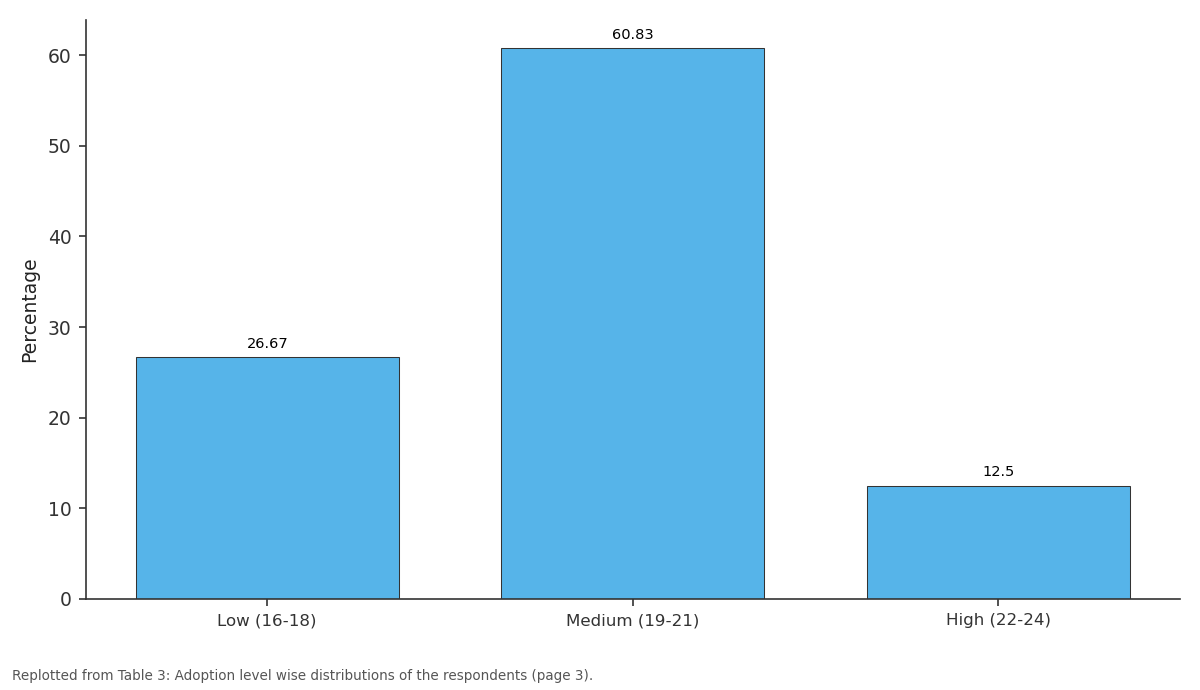
Percentage: Low (16-18) vs Medium (19-21) vs High (22-24)
Replotted from Table 3 (page 3) of the original paper. Every bar is the paper's own table value.
View source evidence ↗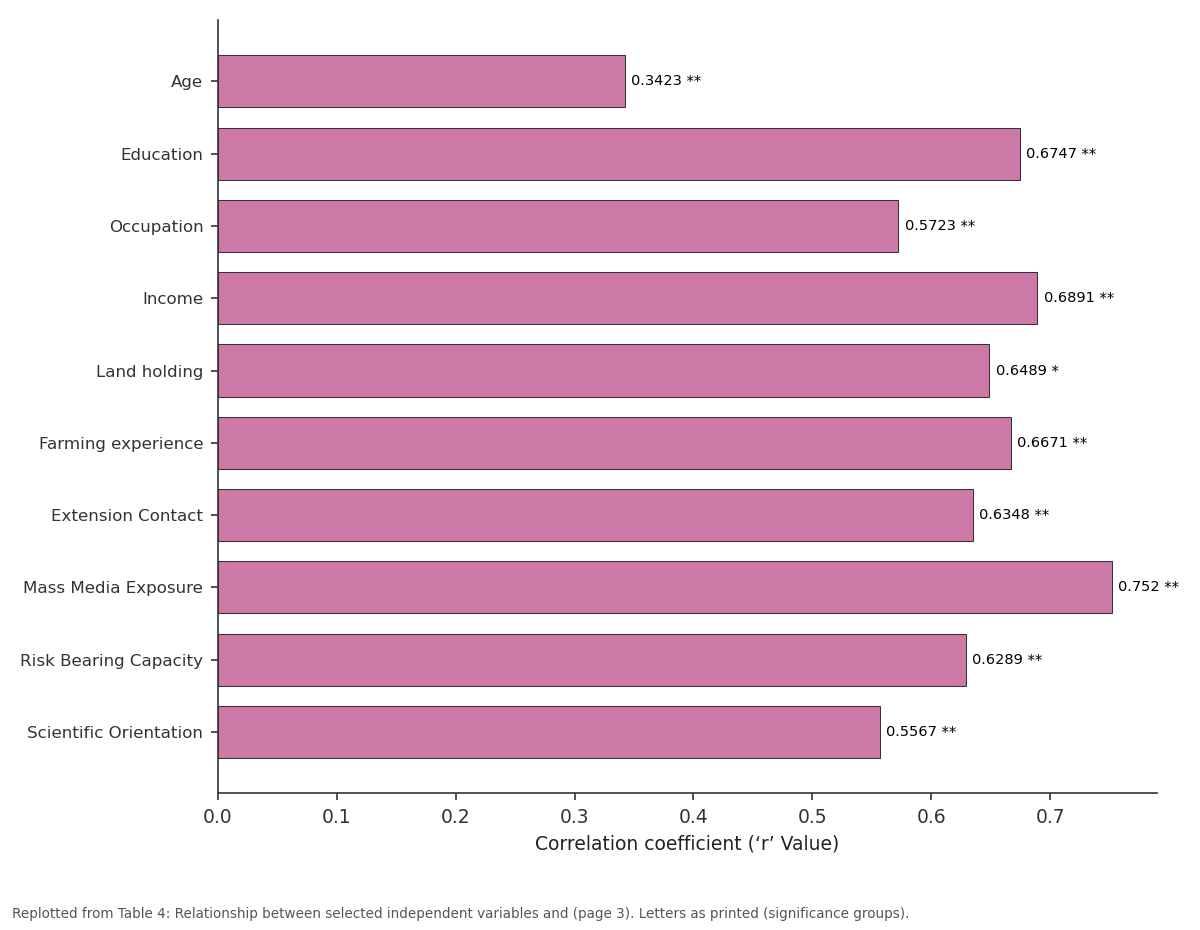
Correlation coefficient (‘r’ Value): Age vs Education vs Occupation vs Income vs Land holding
Replotted from Table 4 (page 3) of the original paper. Every bar is the paper's own table value.
View source evidence ↗Figures & tables
From the original paper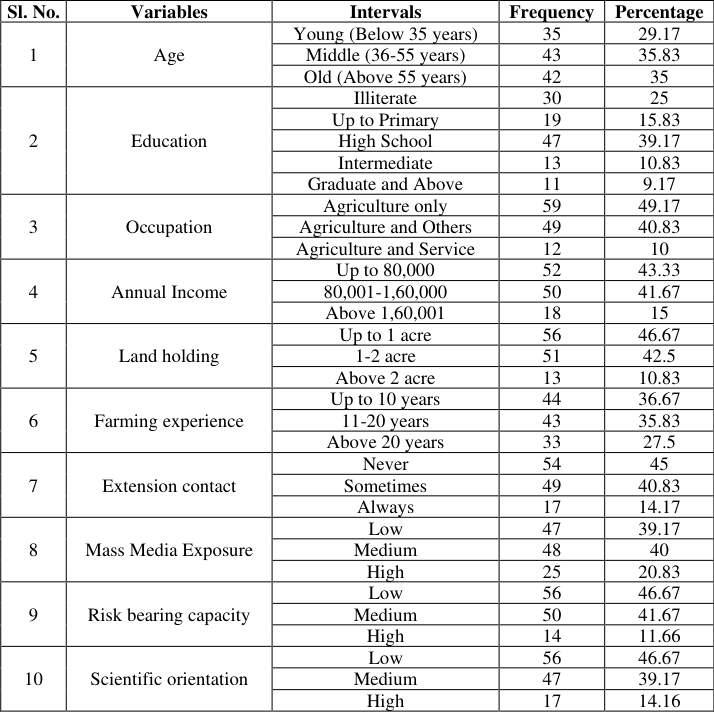 Table 1
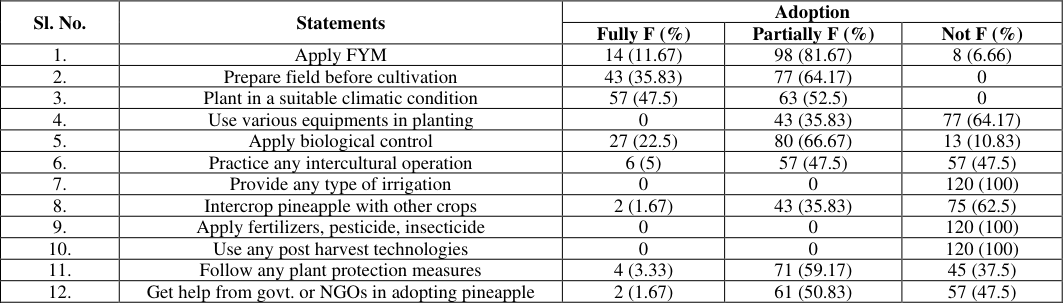 Table 2
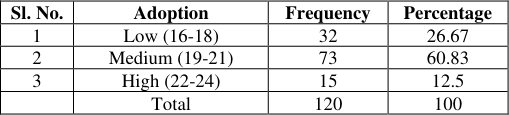 Table 3
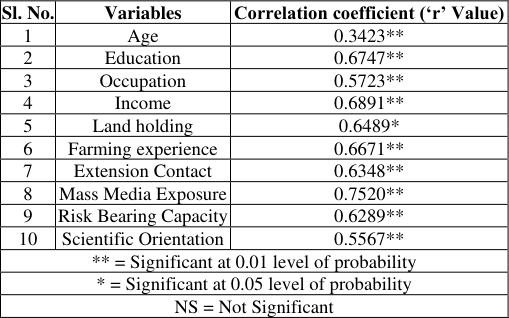 Table 4
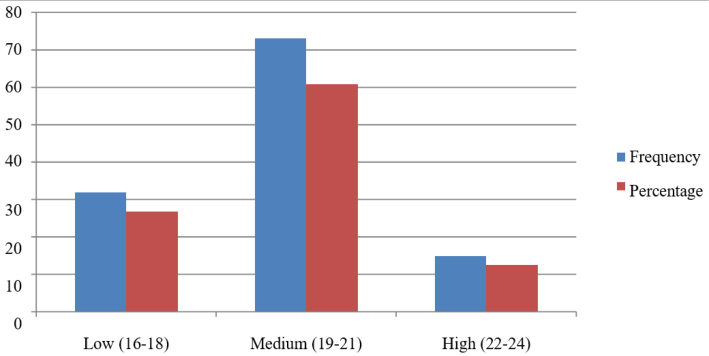 Figure 1
Introduction
Pineapple (Ananas comosus) is an important fruit crop in India as well as in Manipur state. It is known as ‘kihom’ in Manipur. Pineapple crop is cultivated widely in the adjoining areas of hills and valley in Manipur. The main pineapple cultivated districts in Manipur include Imphal East, Imphal west, Thoubal, Churachandpur, Chandel and Senapati district.
The pineapple fruits weighing nearly 1.2-1.7 kg with the TSS of 14-180 brix and acidity 0.9 to 1.2% and total sugar 0.7 to 1.75% depending on the stage of maturity and season. In the district pineapple are grown in hillocks with a slope of 30-40% as beyond that soil erosion is very high during rainy season and experienced moisture scarcity during winter (T. Chanu, 2014) [2]. Farmers in the Thoubal district of Manipur practice pineapple cultivation mainly by traditional method of cultivation.
During the cultivation process, farmers didn’t provide any type of irrigation instead they totally depend on rainfall for their pineapple crops to be irrigated. Also there is no application of any chemical fertilizers, insecticide, etc to the crop. Mostly they used only biological control
Methods
to protect their crops from diseases that are associated with fungi, bacteria, nematodes and viruses. 315 https://www.extensionjournal.com
Results And Discussion
Socio Economic Profile of the respondents Table 1: Profile characteristics of the respondents Sl. No. Variables Intervals Frequency Percentage 1 Age Young (Below 35 years) 35 29.17 Middle (36-55 years) 43 35.83 Old (Above 55 years) 42 35 2 Education Illiterate 30 25 Up to Primary 19 15.83 High School 47 39.17 Intermediate 13 10.83 Graduate and Above 11 9.17 3 Occupation Agriculture only 59 49.17 Agriculture and Others 49 40.83 Agriculture and Service 12 10 4 Annual Income Up to 80,000 52 43.33 80,001-1,60,000 50 41.67 Above 1,60,001 18 15 5 Land holding Up to 1 acre 56 46.67 1-2 acre 51 42.5 Above 2 acre 13 10.83 6 Farming experience Up to 10 years 44 36.67 11-20 years 43 35.83 Above 20 years 33 27.5 7 Extension contact Never 54 45 Sometimes 49 40.83 Always 17 14.17 8 Mass Media Exposure Low 47 39.17 Medium 48 40 High 25 20.83 9 Risk bearing capacity Low 56 46.67 Medium 50 41.67 High 14 11.66 10 Scientific orientation and also 40 percent of the respondents have medium level category towards mass media exposure. It was revealed that 46.67 percent of the respondents have low level category towards risk bearing capacity and again 46.67 percent of the respondents have low level category towards scientific orientation.
| Sl. No. | Variables | Intervals | Frequency | Percentage |
|---|---|---|---|---|
| 1 | Age | Young (Below 35 years) | 35 | 29.17 |
| Middle (36-55 years) | 43 | 35.83 | ||
| Old (Above 55 years) | 42 | 35 | ||
| 2 | Education | Illiterate | 30 | 25 |
| Up to Primary | 19 | 15.83 | ||
| High School | 47 | 39.17 | ||
| Intermediate | 13 | 10.83 | ||
| Graduate and Above | 11 | 9.17 | ||
| 3 | Occupation | Agriculture only | 59 | 49.17 |
| Agriculture and Others | 49 | 40.83 | ||
| Agriculture and Service | 12 | 10 | ||
| 4 | Annual Income | Up to 80,000 | 52 | 43.33 |
| 80,001-1,60,000 | 50 | 41.67 | ||
| Above 1,60,001 | 18 | 15 | ||
| 5 | Land holding | Up to 1 acre | 56 | 46.67 |
| 1-2 acre | 51 | 42.5 | ||
| Above 2 acre | 13 | 10.83 | ||
| 6 | Farming experience | Up to 10 years | 44 | 36.67 |
| 11-20 years | 43 | 35.83 | ||
| Above 20 years | 33 | 27.5 | ||
| 7 | Extension contact | Never | 54 | 45 |
| Sometimes | 49 | 40.83 | ||
| Always | 17 | 14.17 | ||
| 8 | Mass Media Exposure | Low | 47 | 39.17 |
| Medium | 48 | 40 | ||
| High | 25 | 20.83 | ||
| 9 | Risk bearing capacity | Low | 56 | 46.67 |
| Medium | 50 | 41.67 | ||
| High | 14 | 11.66 | ||
| 10 | Scientific orientation | Low | 56 | 46.67 |
| Medium | 47 | 39.17 | ||
| High | 17 | 14.16 |
Table text extracted from the original PDF; superscript letters are shown inline. The original table image is below.
View original table image
Adoption level of respondents on improved pineapple cultivation practices Low 56 46.67 Medium 47 39.17 High 17 14.16 From the above table 1, it was revealed that 35.83 percent of the respondents were middle age (35-55 years) and 39.17 percent of the respondents were educated up to high school. It was revealed that 49.17 percent are engaged in agriculture only with 43.33 percent of the respondents’ income is below 80,000 rupees. It was found that 46.67 percent of the respondents land holding are less than 1 acre. It was also revealed that 36.67 percent of the respondents have <10 years of farming experience.
It found that 40.83 percent of the respondents contact with extension agents sometimes Table 2: Adoption level of the respondents towards improved pineapple cultivation practices Sl. No. Statements Adoption Fully F (%) Partially F (%) Not F (%) 1. Apply FYM 14 (11.67) 98 (81.67) 8 (6.66) 2.
| Sl. No. | Statements | Adoption | — | — |
|---|---|---|---|---|
| Fully F (%) | Partially F (%) | Not F (%) | ||
| 1. | Apply FYM | 14 (11.67) | 98 (81.67) | 8 (6.66) |
| 2. | Prepare field before cultivation | 43 (35.83) | 77 (64.17) | 0 |
| 3. | Plant in a suitable climatic condition | 57 (47.5) | 63 (52.5) | 0 |
| 4. | Use various equipments in planting | 0 | 43 (35.83) | 77 (64.17) |
| 5. | Apply biological control | 27 (22.5) | 80 (66.67) | 13 (10.83) |
| 6. | Practice any intercultural operation | 6 (5) | 57 (47.5) | 57 (47.5) |
| 7. | Provide any type of irrigation | 0 | 0 | 120 (100) |
| 8. | Intercrop pineapple with other crops | 2 (1.67) | 43 (35.83) | 75 (62.5) |
| 9. | Apply fertilizers, pesticide, insecticide | 0 | 0 | 120 (100) |
| 10. | Use any post harvest technologies | 0 | 0 | 120 (100) |
| 11. | Follow any plant protection measures | 4 (3.33) | 71 (59.17) | 45 (37.5) |
| 12. | Get help from govt. or NGOs in adopting pineapple | 2 (1.67) | 61 (50.83) | 57 (47.5) |
Table text extracted from the original PDF; superscript letters are shown inline. The original table image is below.
View original table image
Prepare field before cultivation 43 (35.83) 77 (64.17) 0 3. Plant in a suitable climatic condition 57 (47.5) 63 (52.5) 0 4. Use various equipments in planting 0 43 (35.83) 77 (64.17) 5. Apply biological control 27 (22.5) 80 (66.67) 13 (10.83) 6.
Practice any intercultural operation 6 (5) 57 (47.5) 57 (47.5) 7. Provide any type of irrigation 0 0 120 (100) 8. Intercrop pineapple with other crops 2 (1.67) 43 (35.83) 75 (62.5) 9. Apply fertilizers, pesticide, insecticide 0 0 120 (100) 10.
Use any post harvest technologies 0 0 120 (100) 11. Follow any plant protection measures 4 (3.33) 71 (59.17) 45 (37.5) 12. Get help from govt. or NGOs in adopting pineapple 2 (1.67) 61 (50.83) 57 (47.5) F= Frequency, %= Percentage 316 https://www.extensionjournal.com Table 3: Adoption level wise distributions of the respondents Sl. No.
| Sl. No. | Adoption | Frequency | Percentage |
|---|---|---|---|
| 1 | Low (16-18) | 32 | 26.67 |
| 2 | Medium (19-21) | 73 | 60.83 |
| 3 | High (22-24) | 15 | 12.5 |
| Total | 120 | 100 |
Table text extracted from the original PDF; superscript letters are shown inline. The original table image is below.
View original table image
Adoption Frequency Percentage 1 Low (16-18) 32 26.67 2 Medium (19-21) 73 60.83 3 High (22-24) 15 12.5 Total 120 100 From the above table 3, it was revealed that majority (60.83%) of the respondents have medium level adoption level followed by 26.67 percent of the respondents have low level adoption level and 12.5 percent of the respondents have high level adoption level. Similar result was also reported by Mondal et. al., (2023) [4]. Fig 1: Adoption level wise distributions of the respondents Relationship between Selected Independent Variables with the Adoption of the respondents towards improved pineapple cultivation practices Table 4: Relationship between selected independent variables and adoption Farmers should be trained for better productivity, proper education on plant protection measure, and farm management practices should be ensure by Department of Agriculture.
| Sl. No. | Variables | Correlation coefficient (‘r’ Value) |
|---|---|---|
| 1 | Age | 0.3423** |
| 2 | Education | 0.6747** |
| 3 | Occupation | 0.5723** |
| 4 | Income | 0.6891** |
| 5 | Land holding | 0.6489* |
| 6 | Farming experience | 0.6671** |
| 7 | Extension Contact | 0.6348** |
| 8 | Mass Media Exposure | 0.7520** |
| 9 | Risk Bearing Capacity | 0.6289** |
| 10 | Scientific Orientation | 0.5567** |
| ** = Significant at 0.01 level of probability | ||
| * = Significant at 0.05 level of probability | ||
| NS = Not Significant |
Table text extracted from the original PDF; superscript letters are shown inline. The original table image is below.
View original table image
Conclusion
It was concluded that majority of the respondents had medium level of adoption followed by low and high level in respective to the recommended practices. The factors influencing the adoption towards improved pineapple cultivation practices were age, education, occupation, annual income, land holding, farming experience, extension contact, mass media exposure, risk bearing capacity and scientific orientation which were directly co-related with adoption towards improved pineapple cultivation practices. 317
References
5 in the original paper- Achouba N, Devi MD. Origin of pineapple cultivation in Manipur. Int. J Creative Res. Thoughts. 2021;9(9):34-38.
- Chanu TM, Baite DJ, Singh MK. Adoption of pineapple cultivation practices by farmers in Manipur state. Indian Res. J Ext. Edu. 2014;14(1):17-20.
- Marak BR, Bandyopadhyay AK, Lahiri B. Adoption of pineapple production technology in West Garo Hills District of Meghalaya. Indian Res. J Ext. Edu. 2015;15(3):56-59.
- Mondal S, Mazhar SH. Adoption behavior of farmers towards improved pineapple production practices in Uttar Dinajpur District of West Bengal, India. Asian J Agric Ext Econ Sociol. 2023;41(8):251-258.
- Ningombam S, Singh NGJ, Singh V. The socioeconomic status of pineapple growers in Manipur. Pharma Innov. J. 2023;12(4):2681-2685. Sl. No. Variables Correlation coefficient (‘r’ Value) 1 Age 0.3423** 2 Education 0.6747** 3 Occupation 0.5723** 4 Income 0.6891** 5 Land holding 0.6489* 6 Farming experience 0.6671** 7 Extension Contact 0.6348** 8 Mass Media Exposure 0.7520** 9 Risk Bearing Capacity 0.6289** 10 Scientific Orientation 0.5567** ** = Significant at 0.01 level of probability * = Significant at 0.05 level of probability NS = Not Significant The data presented in table 4 reveals that all the independent variables i.e. age, education, occupation, income, land holding, farming experience, extension contact, mass media exposure, risk bearing capacity and scientific orientation are positively and significantly correlated with adoption towards improved pineapple cultivation practices.