
Research article · 2024 · Full text
International Journal of Agriculture and Food ScienceConstraints faced by load carrying workers of grain market in Haryana state
Volume 6(2) · Pages 16–20 · DOI: 10.33545/2664844x.2024.v6.i2a.196 ↗
Research areasAgricultural Economics and PracticesLivestock Management and Performance Improvement
Abstract
Author-writtenMandi labour, like agricultural labour in fields, plays an important and intensive role in agricultural regulated markets. Mandi labour is defined as labour that works in regulated agriculture markets or mandis during the mandi season, i.e. when crops arrive. These workers may experience work related constraints due to the work environmental. Therefore, present study was planned on load carrying workers of grain market in the four cities of Haryana State. Study was conducted on 160 workers (40 from each city) to assess the constraints faced by the workers at grain market. Results show that occupational constraints was the highly faced constraints as it scored high WMS (8.51) and Rank I, second most faced constraints was behavioral constrains with WMS of 7.21 and injuries/MSD got rank III with WMS 6.96 due to the high temperature 35.4 + 2.27 degree celcious, high umidy 58.6 + 9.22% and heat index 86.7 + 1.53 from the recommended value. It is concluded that there was a need to some input which is helpful in maintaning the environmental parameters according to the workers comfortable level.
Summary
Source-checkedPlain-language reading of the full paper, prepared with AI and checked against the text. Each point links to the authors' own words.
Why it matters
- Mandi labour is essential for the operation of regulated agricultural markets in India. View evidence ↗
- Grain handlers perform physically demanding work, such as lifting and transporting loads, which can lead to health issues. View evidence ↗
- Repetitive work with heavy loads and awkward postures often results in musculoskeletal disorders for grain handlers. View evidence ↗
The question
- The study aimed to assess the working environment and the constraints perceived by load-carrying workers in various grain markets. View evidence ↗
What they did
- The research was conducted in four randomly selected cities (Hisar, Fatehabad, Ratia, and Hansi) within the Hisar and Fatehabad districts of Haryana state. View evidence ↗
- The sample consisted of 160 purposively selected physically fit workers, with 40 participants from each of the four cities. View evidence ↗
- Data were collected using a pre-tested personal interview schedule and an observation sheet, with analysis based on frequency, percentage, Weighted Mean Score (WMS), and ranking. View evidence ↗
- Environmental parameters were measured using thermometers for temperature, hygrometers for humidity, air quality monitors for suspended particulate matter, and the NOAA heat index for heat stress. View evidence ↗
What they found
- Occupational problems were the most significant constraint faced by workers, ranking first with a Weighted Mean Score (WMS) of 2.13. View evidence ↗
- Behavioral factors were the second most common constraint, ranking second with a WMS of 1.80. View evidence ↗
- Injuries and musculoskeletal disorders (MSD) ranked third among constraints with a WMS of 1.74. View evidence ↗
- Among the occupational problems, the most common issue reported by workers was the delay in wage payments. View evidence ↗
- Most workers (75.6%) experienced body discomfort during activity, with the shoulder (24.8%) and neck (21.5%) being the most affected areas. View evidence ↗
- The majority of workers experienced temporary pain that required more than 15 minutes for recovery. View evidence ↗
What it means
- The authors conclude that interventions are needed to maintain environmental parameters at levels that are comfortable for the workers. View evidence ↗
Visual summary
1 visualsIllustrations explain the paper; they do not show study data.
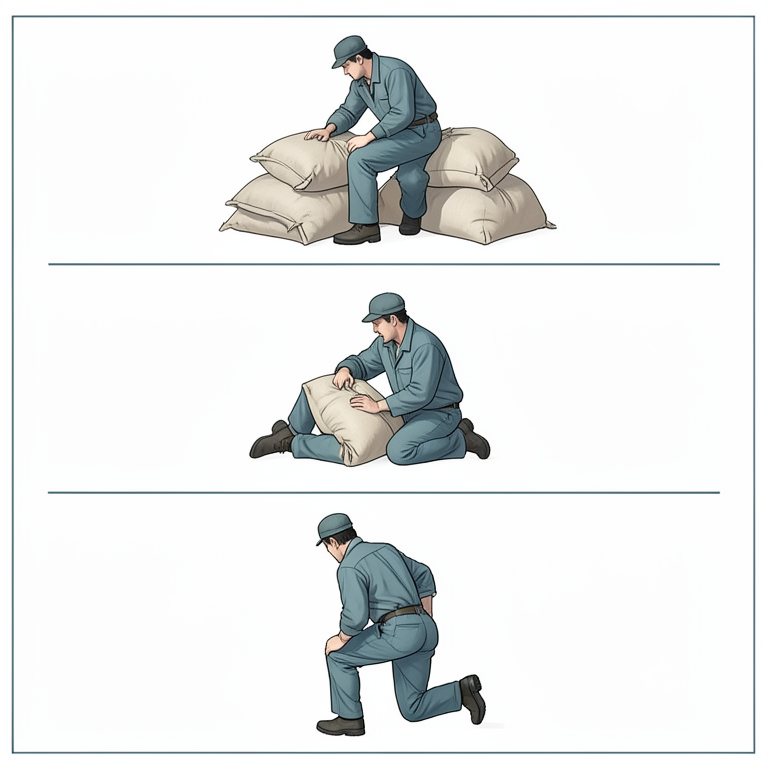
Hierarchy of Worker Constraints
AI-generated conceptual illustration (load carrying workers in a grain market). It explains the idea and does not show study data.
View source evidence ↗Figures & tables
From the original paper Table 1
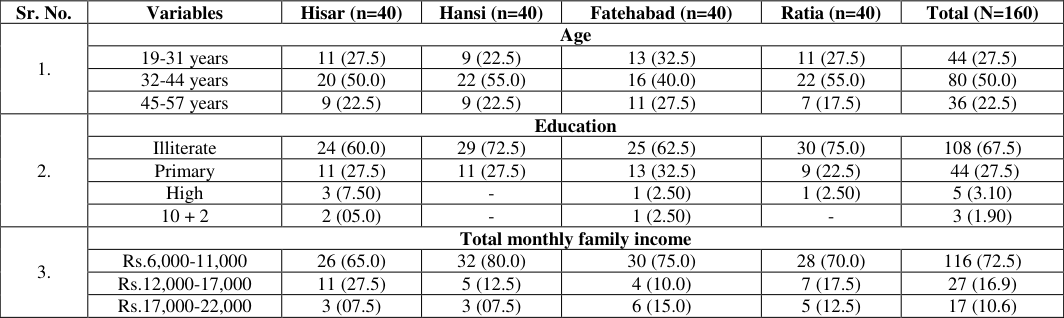 Table 1
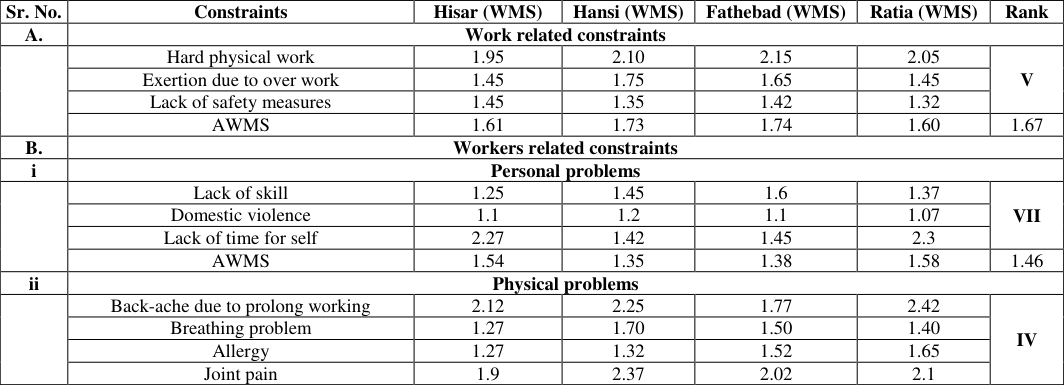 Table 2
 Table 3
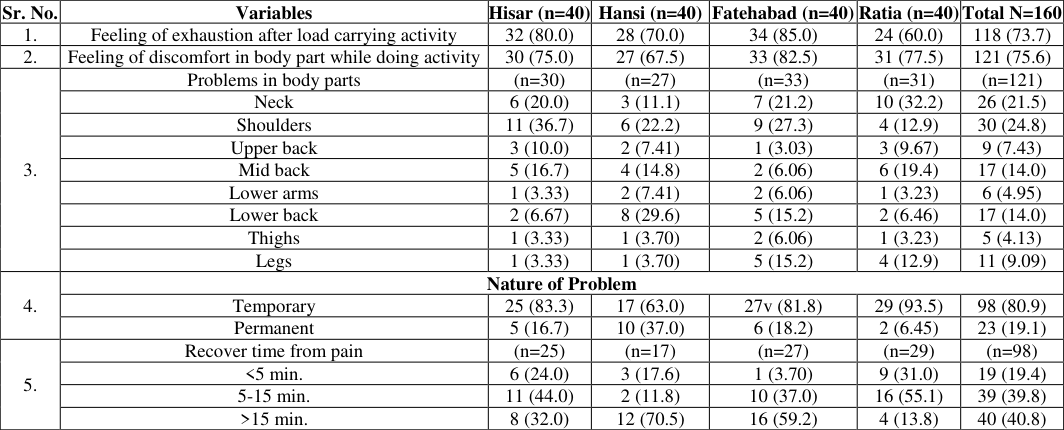 Table 4
Introduction
India's labour force consists of 466 million workers (2015-16); 4.75 million people are added to the labour force in India each year. Agriculture employs 233.1 million people, the majority of whom work as cultivators and labourers (Anonymous 2018a). Mandi labour, like agricultural labour in fields, plays an important and intensive role in agricultural regulated markets. Mandi labour is defined as labour that works in regulated agriculture markets or mandis during the mandi season, i.e. when crops arrive. The mandi labour performs a variety of tasks in a regulated agricultural market for various crop arrivals. In both the rabi and kharif seasons, various activities such as unloading, packing, cleaning, stitching, loading, and so on are carried out for various crops. Labor in mandi is only available during the marketing seasons of various crops, such as market arrivals of paddy and cotton in kharif and wheat crop in Rabi. The majority of agricultural operations are completed manually. Workers in agriculture are often divided into cultivators and labourers. Workers that handle grain engage in a variety of physically demanding tasks, including cleaning, collection, lifting, transporting, and loading. In many poor nations, carrying a load on the head is a widespread habit instead of carrying it on the back and shoulders. They have numerous health issues during these activities, including headaches, respiratory issues, itchy or irritated skin, and musculoskeletal disorders (MSDs). Work method rationalization can improve worker health and safety (Bhatt and Sharma, 2014) [2] . Grain handlers suffer from musculoskeletal disorders as a result of working in an awkward posture with heavy loads and repetitive work at various locations throughout the workplace. The primary job component of mandi workers is load handling, which entails lifting and carrying heavy loads of grain-filled sacs. Load carrying workers in grain markets work long hours, often starting early in the morning and working until late in the evening. They may work in all weather conditions, including extreme heat, cold, or rain. The work is physically demanding and can lead to injuries or health problems if appropriate safety measures are not in place. These workers may experience physical strain and fatigue as they carry heavy loads, which can contribute to occupational stress. It is a strenuous muscular activity that involves muscle flexion, resulting in both tangible and intangible injuries to workers' musculoskeletal systems.
So, the current study was planned to assess the working environment and constraints perceived by the different grain markets in load carrying activity in different areas.
Methodology
To achieve the planned objectives study was conducted on load carrying activity workers of grain market in two district of Haryana state. Hisar and Fatehabad district which were randomly selected. Four cities i.e. Hisar, Fatehabad, Ratia and Hansi were also selected randomly. Sample was comprised of workers, who were involved in load carrying activity in the grain market. A total of 160 workers (40 from each city) were selected purposively who were physically fit and willing to cooperate in the study. A schedule was developed and tested on 30 respondents before conducting the actual study to collect the data. An observation sheet was prepared to assess the environmental parameters in the different grain markets. Measurements of different
Environmental parameters
Environmental parameters
Environmental variables
Measuring tools Temperature Thermometer Heat stress Heat index, NOAA (2001-02) (National Oceanic and Atmospheric Administration) Humidity Hygrometer Suspended particulate matter Air quality monitor
Personal interview schedule was used to collect the data and frequency, percentage, WMS and rank were calculated to analysis the data. Problem in bending/straightening was the main constraints faced by most of the workers among all city grain markets. In occupational problems, delay in payment of wages was the most common problem among all workers. Occupation problems were the most prominent among the workers of Fatehabad city (2.18) followed by Hansi workers (2.15) and Hisar (2.06). Work related constraints included behavioral factor and environment factors. In behavioral factors, Rude behavior of contractor was the most commonly faced problem in all the grain markets i.e. Hansi (1.95), Hisar (1.85), Fatehabad (1.80) and Ratia (1.77). In environmental factors, workers from the Ratia grain market were faced the more problems (11.75), followed by Hisar (1.72) and Fatehabad (1.70).
Results and Discussion
Results and Discussion
Conclusion
It is concluded that overall occupational problems of workers got I st rank with 2.13 WMS, behavioral factor got rank II nd (WMS 1.80), injuries/MSD got rank III rd (WMS 1.74), physical problems and environmental factor IV th rank each (WMS 1.70), work related constraints got V th rank and least problems was personal problems rank VII th . It is also concluded that environmental parameters i.e. temperature, humidity and heat stress were not as per the recommendation and were creating the health issues among the grain workers. Majority of respondents (75.6%) felt the discomfort in body part while doing activity. Among them 24.8 percent respondents faced the shoulder [pain followed by neck pain (21.5%). Most of the respondents faced temporary pain and take more than 15 minutes to recover.
Figures and tables from the paper
| Environmental variables | Measuring tools |
|---|---|
| Temperature | Thermometer |
| Heat stress | Heat index, NOAA (2001-02) (National Oceanic and Atmospheric Administration) |
| Humidity | Hygrometer |
| Suspended particulate matter | Air quality monitor |
Table text extracted from the original PDF; superscript letters are shown inline. The original table image is below.
View original table image
| Sr. No. | Variables | Hisar (n=40) | Hansi (n=40) | Fatehabad (n=40) | Ratia (n=40) | Total (N=160) |
|---|---|---|---|---|---|---|
| 1. | Age | |||||
| 19-31 years | 11 (27.5) | 9 (22.5) | 13 (32.5) | 11 (27.5) | 44 (27.5) | |
| 32-44 years | 20 (50.0) | 22 (55.0) | 16 (40.0) | 22 (55.0) | 80 (50.0) | |
| 45-57 years | 9 (22.5) | 9 (22.5) | 11 (27.5) | 7 (17.5) | 36 (22.5) | |
| 2. | Education | |||||
| Illiterate | 24 (60.0) | 29 (72.5) | 25 (62.5) | 30 (75.0) | 108 (67.5) | |
| Primary | 11 (27.5) | 11 (27.5) | 13 (32.5) | 9 (22.5) | 44 (27.5) | |
| High | 3 (7.50) | - | 1 (2.50) | 1 (2.50) | 5 (3.10) | |
| 10 + 2 | 2 (05.0) | - | 1 (2.50) | - | 3 (1.90) | |
| 3. | Total monthly family income | |||||
| Rs.6,000-11,000 | 26 (65.0) | 32 (80.0) | 30 (75.0) | 28 (70.0) | 116 (72.5) | |
| Rs.12,000-17,000 | 11 (27.5) | 5 (12.5) | 4 (10.0) | 7 (17.5) | 27 (16.9) | |
| Rs.17,000-22,000 | 3 (07.5) | 3 (07.5) | 6 (15.0) | 5 (12.5) | 17 (10.6) |
Table text extracted from the original PDF; superscript letters are shown inline. The original table image is below.
View original table image
| Sr. No. | Constraints | Hisar (WMS) | Hansi (WMS) | Fathebad (WMS) | Ratia (WMS) | Rank |
|---|---|---|---|---|---|---|
| A. | Work related constraints | |||||
| Hard physical work | 1.95 | 2.10 | 2.15 | 2.05 | V | |
| Exertion due to over work | 1.45 | 1.75 | 1.65 | 1.45 | ||
| Lack of safety measures | 1.45 | 1.35 | 1.42 | 1.32 | ||
| AWMS | 1.61 | 1.73 | 1.74 | 1.60 | 1.67 | |
| B. | Workers related constraints | |||||
| i | Personal problems | |||||
| Lack of skill | 1.25 | 1.45 | 1.6 | 1.37 | VII | |
| Domestic violence | 1.1 | 1.2 | 1.1 | 1.07 | ||
| Lack of time for self | 2.27 | 1.42 | 1.45 | 2.3 | ||
| AWMS | 1.54 | 1.35 | 1.38 | 1.58 | 1.46 | |
| ii | Physical problems | |||||
| Back-ache due to prolong working | 2.12 | 2.25 | 1.77 | 2.42 | IV | |
| Breathing problem | 1.27 | 1.70 | 1.50 | 1.40 | ||
| Allergy | 1.27 | 1.32 | 1.52 | 1.65 | ||
| Joint pain | 1.9 | 2.37 | 2.02 | 2.1 |
Table text extracted from the original PDF; superscript letters are shown inline. The original table image is below.
View original table image
| Environmental parameters | Working condition (Mean + SD) | — | — | — | Total (Average) | % difference | Recommended value* |
|---|---|---|---|---|---|---|---|
| Hisar | Hansi | Fatehabad | Ratia | ||||
| Temperature (°C) | 35.2 + 2.5 | 35.8 + 2.0 | 34.8 + 2.3 | 35.9 + 2.3 | 35.4 + 2.27 | 53.9% | 20-24 (0C) |
| Humidity (%) | 59.3 + 8.5 | 59.0 + 8.9 | 60.7 + 10.1 | 55.5 + 9.4 | 58.6 + 9.22 | 17.2% | 40-60% |
| Heat stress (°F) | 81.6 + 1.6 | 83.8 + 1.42 | 89.9 + 1.57 | 91.5 + 1.62 | 86.7 + 1.53 | 2.0% | 800F-900F |
| Suspended particulate matter (um) | 74.2 + 11.9 | 72.0 + 14.3 | 69.9 + 14.5 | 77.1 + 13.6 | 73.3 + 13.5 | 47.6% | 140ug/m3 |
Table text extracted from the original PDF; superscript letters are shown inline. The original table image is below.
View original table image
| Sr. No. | Variables | Hisar (n=40) | Hansi (n=40) | Fatehabad (n=40) | Ratia (n=40) | Total N=160 |
|---|---|---|---|---|---|---|
| 1. | Feeling of exhaustion after load carrying activity | 32 (80.0) | 28 (70.0) | 34 (85.0) | 24 (60.0) | 118 (73.7) |
| 2. | Feeling of discomfort in body part while doing activity | 30 (75.0) | 27 (67.5) | 33 (82.5) | 31 (77.5) | 121 (75.6) |
| 3. | Problems in body parts | (n=30) | (n=27) | (n=33) | (n=31) | (n=121) |
| Neck | 6 (20.0) | 3 (11.1) | 7 (21.2) | 10 (32.2) | 26 (21.5) | |
| Shoulders | 11 (36.7) | 6 (22.2) | 9 (27.3) | 4 (12.9) | 30 (24.8) | |
| Upper back | 3 (10.0) | 2 (7.41) | 1 (3.03) | 3 (9.67) | 9 (7.43) | |
| Mid back | 5 (16.7) | 4 (14.8) | 2 (6.06) | 6 (19.4) | 17 (14.0) | |
| Lower arms | 1 (3.33) | 2 (7.41) | 2 (6.06) | 1 (3.23) | 6 (4.95) | |
| Lower back | 2 (6.67) | 8 (29.6) | 5 (15.2) | 2 (6.46) | 17 (14.0) | |
| Thighs | 1 (3.33) | 1 (3.70) | 2 (6.06) | 1 (3.23) | 5 (4.13) | |
| Legs | 1 (3.33) | 1 (3.70) | 5 (15.2) | 4 (12.9) | 11 (9.09) | |
| 4. | Nature of Problem | |||||
| Temporary | 25 (83.3) | 17 (63.0) | 27v (81.8) | 29 (93.5) | 98 (80.9) | |
| Permanent | 5 (16.7) | 10 (37.0) | 6 (18.2) | 2 (6.45) | 23 (19.1) | |
| 5. | Recover time from pain | (n=25) | (n=17) | (n=27) | (n=29) | (n=98) |
| <5 min. | 6 (24.0) | 3 (17.6) | 1 (3.70) | 9 (31.0) | 19 (19.4) | |
| 5-15 min. | 11 (44.0) | 2 (11.8) | 10 (37.0) | 16 (55.1) | 39 (39.8) | |
| >15 min. | 8 (32.0) | 12 (70.5) | 16 (59.2) | 4 (13.8) | 40 (40.8) |
Table text extracted from the original PDF; superscript letters are shown inline. The original table image is below.
View original table image
References
4 in the original paper- Anonymous. FICCI Agri Report; c2018 [cited 2021 May 4]. Available from: https://ficci.in/spdocument/20550/FICCI-agriReport%2009-03-2015.pdf
- Bhatt H, Sharma P. An ergonomic assessment: Occupational health and safety risk factors of commercial cafeteria workers. Occup. Environ Med. 2014;71(1):93-A98.
- Rawal V. The labour process in rural Haryana (India): A field-report from two villages. Journal of Agrarian Change. 2006 Oct;6(4):538-583.
- Mehta CR, Chandel NS, Senthilkumar T. Status, challenges and strategies for farm mechanization in India. Agricultural Mechanization in Asia, Africa and Latin America. 2014 Sep 1;45(4):43-50.