
Research article · 2024 · Full text
International Journal of Agriculture Extension and Social DevelopmentAdoption of improved French bean cultivation practices by the farmers of Bishnupur district of Manipur
Volume 7(8) · Pages 254–258 · DOI: 10.33545/26180723.2024.v7.i8d.921 ↗
Research areasAgricultural Economics and PracticesAgricultural Science and FertilizationAgricultural pest management studies
Abstract
Author-writtenThe main purpose of the study was to ascertain the extent of adoption of improved French bean cultivation practices by the farmers of Bishnupur District of Manipur. The research took place in Bishnupur block of Bishnupur District during the period 2023-2024. This study utilized a descriptive research design. The main information was gathered from 120 participants through face-to-face interviews utilizing a predetermined interview schedule. Farmer adoption was assessed through a series of 16 questions related to the cultivation of French beans. The results indicated that 40.00 percent of the participants exhibit a low level of adopting French bean cultivation, with 39.17 percent displaying a medium level of adoption and 20.83 percent showing a high level of adoption in French bean cultivation. All eleven independent variables, such as age, education, occupation, annual income, land holding, farming experience, mass media exposure, source of agriculture information, risk bearing capacity, economic motivation, and innovativeness, were found to have a positive and significant correlation with farmers' adoption of improved French bean cultivation practices.
Summary
Source-checkedPlain-language reading of the full paper, prepared with AI and checked against the text. Each point links to the authors' own words.
Why it matters
- French bean is a traditional and profitable vegetable crop in the North-Eastern region of India. View evidence ↗
- The crop is advantageous because it is relatively less susceptible to diseases and pests. View evidence ↗
- French bean cultivation is considered a climate-smart practice due to its water efficiency and ability to improve soil productivity and health. View evidence ↗
The question
- The study aimed to determine how much farmers in the Bishnupur District of Manipur have adopted improved French bean cultivation practices. View evidence ↗
What they did
- The researchers used a descriptive research design for the study conducted in the Bishnupur block of Bishnupur District between 2023 and 2024. View evidence ↗
- Data was collected from 120 participants using face-to-face interviews and a predetermined schedule. View evidence ↗
- The level of adoption was measured using a set of 16 questions focused on French bean cultivation. View evidence ↗
- Analysis involved transforming data into a three-point Likert scale and using mean, frequency, percentage, and correlation to evaluate variables. View evidence ↗
What they found
- The majority of farmers showed low (40.00%) or medium (39.17%) adoption levels, while only 20.83% showed a high level of adoption. View evidence ↗
- Seed treatment before sowing had very low adoption, with 62.59% of respondents not adopting the practice and only 8.33% fully adopting it. View evidence ↗
- Post-harvest management was largely ignored, with 65.83% of farmers not adopting it and only 11.67% fully adopting it. View evidence ↗
- The use of suitable soil was one of the more adopted practices, with 42.50% of respondents fully adopting it. View evidence ↗
- Eleven factors, including education, income, and innovativeness, were all positively and significantly correlated with the adoption of improved practices. View evidence ↗
What it means
- The authors recommend implementing extension strategies and awareness programs focused on pest and disease control to increase the adoption of improved practices. View evidence ↗
Visual summary
3 visualsIllustrations explain the paper; charts are replotted from the paper's own table values.
Factors Influencing Adoption
AI-generated conceptual illustration (French bean plants in a field). It explains the idea and does not show study data.
View source evidence ↗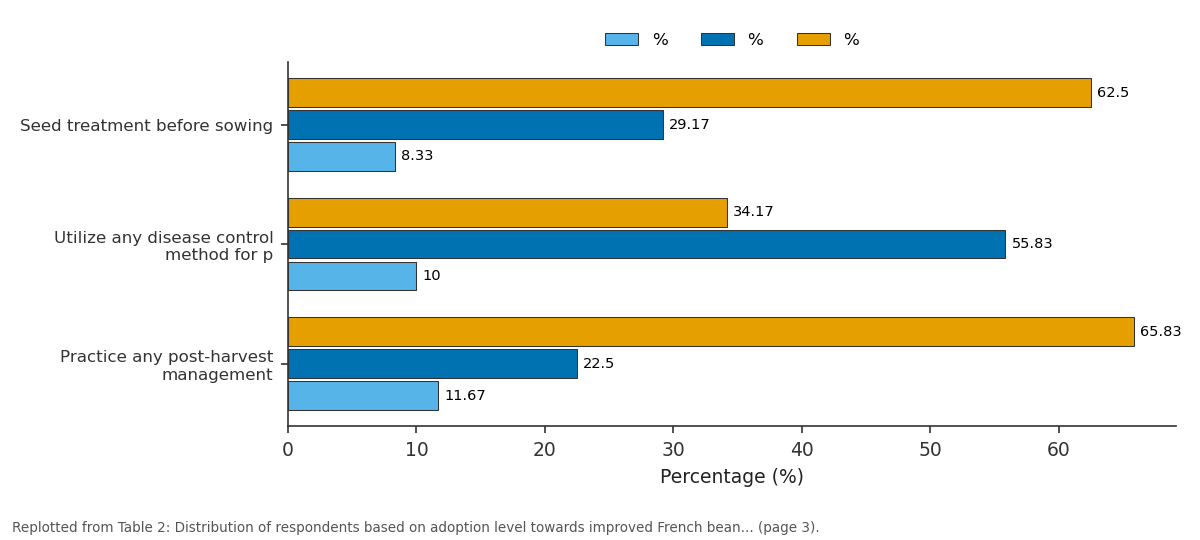
% and % and more: Seed treatment before... vs Utilize any disease... vs Practice any...
Replotted from Table 2 (page 3) of the original paper. Every bar is the paper's own table value.
View source evidence ↗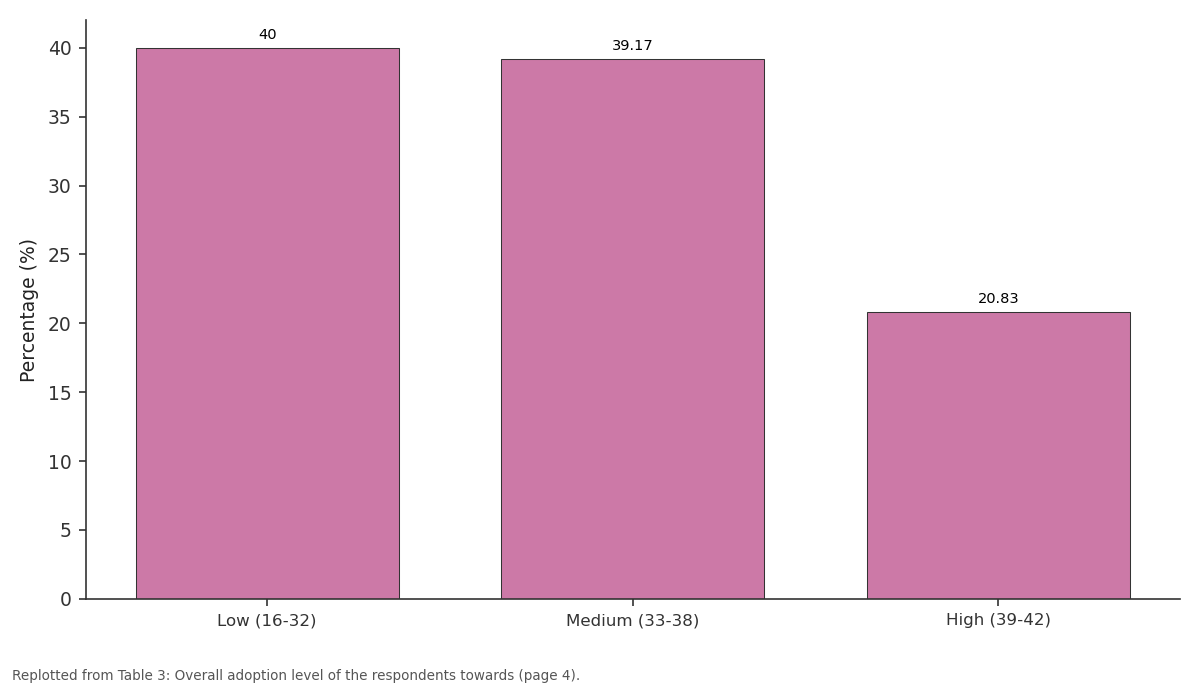
Percentage: Low (16-32) vs Medium (33-38) vs High (39-42)
Replotted from Table 3 (page 4) of the original paper. Every bar is the paper's own table value.
View source evidence ↗Figures & tables
From the original paper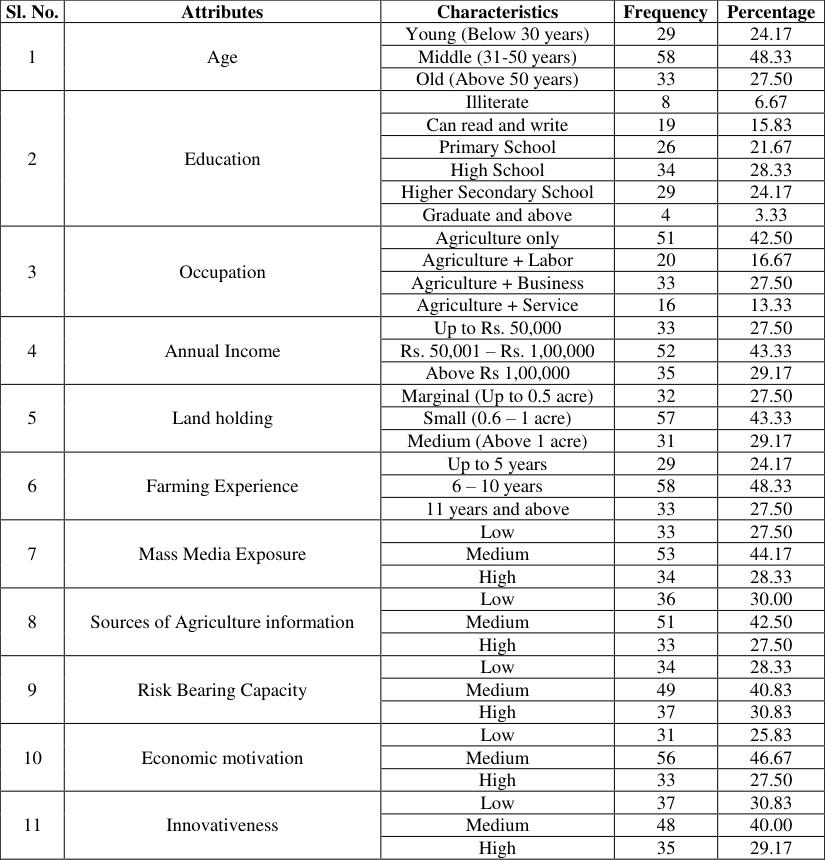 Table 1
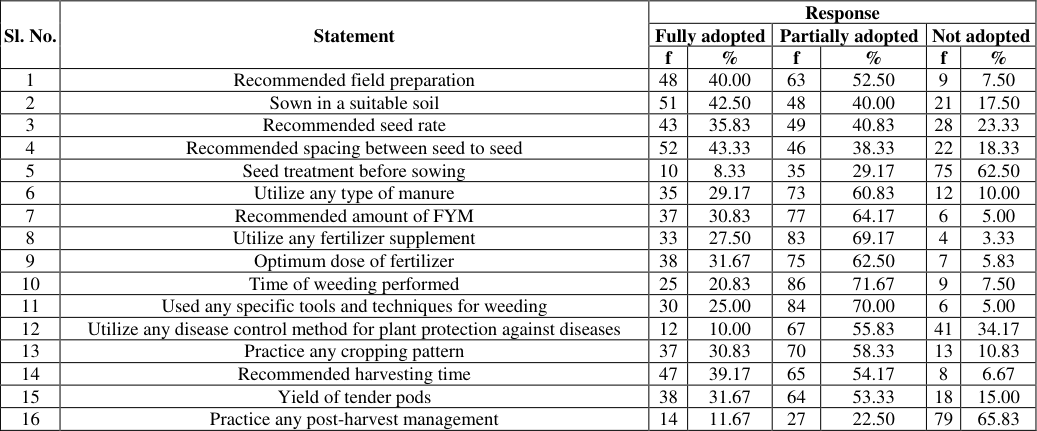 Table 2
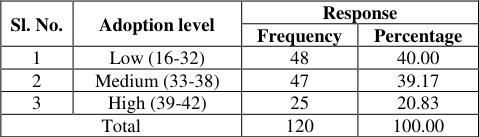 Table 3
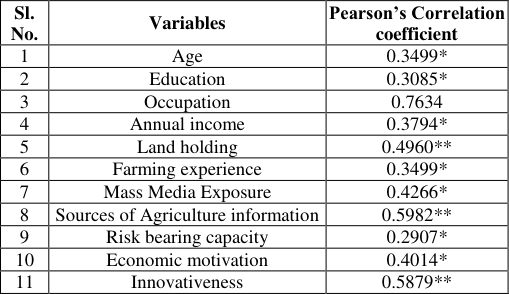 Table 4
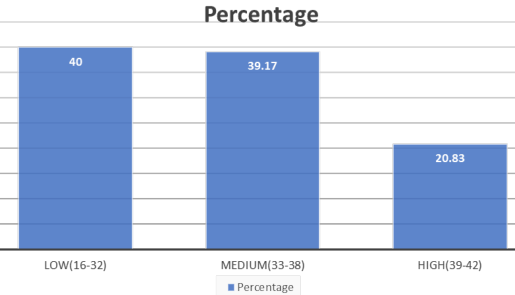 Figure 1
Introduction
The French bean (Phaseolus vulgaris L.) is one of the most popular and widely cultivated vegetables in India and belongs to the family Leguminosae. It is also referred to as the common bean, green bean, dry bean, kidney bean, and navy bean (Singh et al., 2021) [4] . Globally, French beans are cultivated primarily in American and European countries, including the United States, England, Poland, Brazil, Mexico, Myanmar, China, and India. In 2016, global production of green beans reached 23.6 million tons, with China accounting for 79% of the total output. In 2016, the global production of dried beans was 26.8 million tons, with Myanmar, India, and Brazil accounting for the majority of this output. In India, over 90% of the total pulse production has been contributed by 10 states: Madhya Pradesh, Maharashtra, Rajasthan, Uttar Pradesh, Karnataka, Andhra Pradesh, Gujarat, Jharkhand, Tamil Nadu and Telangana (Singh et al., 2021) [4] . French bean is a significant pulse crop, exhibiting a high degree of productivity in comparison to gram and pea. In the hilly region, French bean is cultivated during the Kharif season (June to October), while in the lower hills it is sown as a spring crop (March). In the northeast regions, it is cultivated during the rabi season, which spans from November to May. French bean is a traditional vegetable crop of the North-Eastern region, and its cultivation is profitable in crop farming. Additionally, this crop is relatively less prone to pest and disease problems, which is an added advantage. As a self-pollinated crop, French bean seed production and maintenance of its purity is much easier than that of other vegetable crops. The tender pods are used as a vegetable, while the mature seeds are consumed as dal (Tongbram et al., 2021) [5] . In India, fresh pods utilised as a vegetable are termed 'faras', whereas dried pods are known as 'rajmash'. The dried seeds of rajma have been found to contain 60.6% carbohydrates, 22.9% protein and 1.3% fat. Additionally, 100 g of seeds contains minerals, including calcium (260 mg), phosphorus (410 mg) and iron (5.8 mg) (Vidyakar et al., 2017) [6] . French beans are a highly popular foodstuff due to their favourable quality, nutritional balance and higher biological efficiency. This vegetable plays a pivotal role in the sustenance of the global population (Panchbhaiya et al., 2017) [3] . The green pods are a rich source of thiamine (vitamin B1), which is essential for the optimal functioning of brain cells (Singh et al., 2021) [4] . French beans are a water-efficient crop that enhances soil health and productivity, thereby constituting a climate-smart practice (Nasar et al., 2023) [2] .
Justification of the study
The results of the present study will assist farmers in the Bishnupur district of Manipur in the adoption of improved French bean cultivation practices. This will facilitate an investigation into the most appropriate methodology for identifying the constraints in the utilisation of recommended safe plant protection measures and knowledge for more effective crop management and enhanced productivity with www.extensionjournal.com regard to improved French bean cultivation. Objectives 1. To assess the socio-economic profile of the respondents. 2. To find the adoption level of improved French bean cultivation practices by the respondents. 3. To establish the relationship between the selected independent variables with adoption of improved French bean cultivation practices.
Research Methodology
The study was conducted in Bishnupur District, Manipur.
The present study employed a descriptive research design, which is appropriate for studies that aim to describe the characteristics of a phenomenon. A multi-stage sampling methodology was employed in order to select the requisite samples for the present study. Manipur is comprised of 16 districts, of which Bishnupur was selected for inclusion in the study. Bishnupur district is subdivided into three blocks: Bishnupur, Nambol and Moirang. Bishnupur block was selected purposively based on the rationale that it encompasses the greatest area under French bean cultivation. Toubul and Khoijuman Khullen were selected from Bishnupur block, and a total of 120 respondents were randomly selected on a proportional basis, in accordance with the extent of French bean cultivation in each area.
Methods used for Data Collection
A pre-tested structured interview schedule, designed to collect data aligned with the objectives of the study, was developed. A survey method of data collection was employed, utilising a pre-structured interview schedule. The data were then classified, tabulated and subjected to analysis in order to ascertain their relevance to the stated objectives.
Statistical Analysis of Data
The data obtained from the respondents was transformed into a three-point Likert scale and subsequently tabulated.
The data was evaluated and the relationship between the independent and dependent variables was determined using mean, frequency, percentage and correlation. The data presented in Table 2 indicated that majority (52.50%) of the respondents partially adopted the recommended field preparation for French bean cultivation, 40.00 per cent of the respondents fully adopt and only 7.50 per cent of the respondents did not adopt. It was observed that majority (42.50%) of the respondents fully adopt suitable soil for French bean cultivation, 40.00 per cent of the respondents partially adopt and 17.50 per cent of the respondents did not adopt. It shows that majority (40.83%) of the respondents partially adopt the recommended seed rate of French bean, 35.83 per cent of the respondents fully adopt and 23.33 per cent of the respondents did not adopt the seed rate of French bean cultivation. It recorded that majority (43.33%) of the respondents fully adopt the spacing between seed to seed of French bean, 38.33 per cent partially adopt and 18.33 per cent of the respondents did not adopt. It indicated that majority (62.59%) of the respondents did not adopt treatment of French bean seeds before sowing, 29.17 per cent partially adopt and only 8.33 per cent of the respondents fully adopt. It was found that majority (60.83%) of the respondents partially adopt the use of manure in French bean cultivation, 29.17 per cent of the respondents fully adopt and 10.00 per cent of the respondents did not adopt. It was observed that majority (64.17%) of the respondents partially adopted the amount of FYM used, 30.83 per cent of the respondents fully adopted and 5.00 per www.extensionjournal.com cent of the respondents did not adopt. It indicated that majority (69.17%) of the respondents partially adopted the fertilizer supplement used, 27.50 per cent of the respondents fully adopted and only 3.33 per cent did not adopt the fertilizer supplement used. It reveals that majority (62.50%) of the respondents partially adopt the dose of fertilizer for French bean cultivation, 31.67 per cent fully adopt and 5.83 per cent of the respondents did not adopt the dose of fertilizer for French bean cultivation. It showed that majority (71.67%) of the respondents partially adopt the stage when weeding for French bean cultivation is done, 20.83 per cent of the respondents fully adopt and 7.50 per cent of the respondents did not adopt. It reported that majority (70.00%) of the respondents partially adopt weeding method, 25.00 per cent fully adopt and 5.00 per cent of the respondents did not adopt weeding method. It was observed that majority (55.83%) of the respondents partially adopt disease control for French bean, 34.17 per cent did not adopt and 10.00 per cent of the respondents fully adopt disease control for French bean. It was found that majority (58.33%) of the respondents partially adopt cropping pattern, 30.83 per cent fully adopt and 10.83 per cent of the respondents did not adopt cropping pattern. It recorded that majority (54.17%) of the respondents partially adopt the harvesting time for French bean, 39.17 per cent fully adopt and 6.67 per cent of the respondents did not adopt the harvesting time for French bean. It showed that majority (53.33%) of the respondents partially adopt the recommended yield of tender pods of French bean, 31.67 per cent fully adopt and 15.00 per cent of the respondents did not adopt the recommended yield of tender pods of French bean. It also recorded that majority (65.83%) of the respondents did not adopt post-harvest management, 22.50 per cent of the respondents partially adopted and 11.67 per cent of the respondents fully adopted the post-harvest management of French bean. [1] .
| Sl. No. | Statement | Response | — | — | — | — | — |
|---|---|---|---|---|---|---|---|
| Fully adopted | Partially adopted | Not adopted | |||||
| f | % | f | % | f | % | ||
| 1 | Recommended field preparation | 48 | 40.00 | 63 | 52.50 | 9 | 7.50 |
| 2 | Sown in a suitable soil | 51 | 42.50 | 48 | 40.00 | 21 | 17.50 |
| 3 | Recommended seed rate | 43 | 35.83 | 49 | 40.83 | 28 | 23.33 |
| 4 | Recommended spacing between seed to seed | 52 | 43.33 | 46 | 38.33 | 22 | 18.33 |
| 5 | Seed treatment before sowing | 10 | 8.33 | 35 | 29.17 | 75 | 62.50 |
| 6 | Utilize any type of manure | 35 | 29.17 | 73 | 60.83 | 12 | 10.00 |
| 7 | Recommended amount of FYM | 37 | 30.83 | 77 | 64.17 | 6 | 5.00 |
| 8 | Utilize any fertilizer supplement | 33 | 27.50 | 83 | 69.17 | 4 | 3.33 |
| 9 | Optimum dose of fertilizer | 38 | 31.67 | 75 | 62.50 | 7 | 5.83 |
| 10 | Time of weeding performed | 25 | 20.83 | 86 | 71.67 | 9 | 7.50 |
| 11 | Used any specific tools and techniques for weeding | 30 | 25.00 | 84 | 70.00 | 6 | 5.00 |
| 12 | Utilize any disease control method for plant protection against diseases | 12 | 10.00 | 67 | 55.83 | 41 | 34.17 |
| 13 | Practice any cropping pattern | 37 | 30.83 | 70 | 58.33 | 13 | 10.83 |
| 14 | Recommended harvesting time | 47 | 39.17 | 65 | 54.17 | 8 | 6.67 |
| 15 | Yield of tender pods | 38 | 31.67 | 64 | 53.33 | 18 | 15.00 |
| 16 | Practice any post-harvest management | 14 | 11.67 | 27 | 22.50 | 79 | 65.83 |
Table text extracted from the original PDF; superscript letters are shown inline. The original table image is below.
View original table image
Results and Discussion Socio Economic Characteristics of the Respondents
Results and Discussion Socio Economic Characteristics of the Respondents
Fig 1:
Overall distribution of respondents based on the adoption level of improved French bean cultivation practices. The data presented in Table 4 revealed that all of the eleven independent variables, i.e. age, education, occupation, annual income, land holding, farming experience, mass media exposure, sources of agriculture information, risk bearing capacity, economic motivation and innovativeness are positively and significantly correlated with adoption of farmers towards improved French bean cultivation practices.
| Sl. No. | Variables | Pearson’s Correlation coefficient |
|---|---|---|
| 1 | Age | 0.3499* |
| 2 | Education | 0.3085* |
| 3 | Occupation | 0.7634 |
| 4 | Annual income | 0.3794* |
| 5 | Land holding | 0.4960** |
| 6 | Farming experience | 0.3499* |
| 7 | Mass Media Exposure | 0.4266* |
| 8 | Sources of Agriculture information | 0.5982** |
| 9 | Risk bearing capacity | 0.2907* |
| 10 | Economic motivation | 0.4014* |
| 11 | Innovativeness | 0.5879** |
Table text extracted from the original PDF; superscript letters are shown inline. The original table image is below.
View original table image
Association between Selected Independent Variables with the Adoption of the Respondents towards Improved French bean Cultivation Practices
Association between Selected Independent Variables with the Adoption of the Respondents towards Improved French bean Cultivation Practices
Conclusion
It was concluded that majority of the respondents were of middle age (31-50 years), most of the respondents had attained High School, majority of the respondents were engaged in agriculture + caste business, majority of the respondents' income were 50,001 -1 lakh rupees, majority of the respondents had 0.5-1 acres of land with 6 -10 years of farming experience and majority of the respondents have medium level of mass media exposure. Majority (40.00%) of the respondents have low adoption level, followed by 39.17% of the respondents having medium level of adoption and 20.83% of the respondents with high adoption level.
Figures and tables from the paper
| Sl. No. | Attributes | Characteristics | Frequency | Percentage |
|---|---|---|---|---|
| 1 | Age | Young (Below 30 years) | 29 | 24.17 |
| Middle (31-50 years) | 58 | 48.33 | ||
| Old (Above 50 years) | 33 | 27.50 | ||
| 2 | Education | Illiterate | 8 | 6.67 |
| Can read and write | 19 | 15.83 | ||
| Primary School | 26 | 21.67 | ||
| High School | 34 | 28.33 | ||
| Higher Secondary School | 29 | 24.17 | ||
| Graduate and above | 4 | 3.33 | ||
| 3 | Occupation | Agriculture only | 51 | 42.50 |
| Agriculture + Labor | 20 | 16.67 | ||
| Agriculture + Business | 33 | 27.50 | ||
| Agriculture + Service | 16 | 13.33 | ||
| 4 | Annual Income | Up to Rs. 50,000 | 33 | 27.50 |
| Rs. 50,001 – Rs. 1,00,000 | 52 | 43.33 | ||
| Above Rs 1,00,000 | 35 | 29.17 | ||
| 5 | Land holding | Marginal (Up to 0.5 acre) | 32 | 27.50 |
| Small (0.6 – 1 acre) | 57 | 43.33 | ||
| Medium (Above 1 acre) | 31 | 29.17 | ||
| 6 | Farming Experience | Up to 5 years | 29 | 24.17 |
| 6 – 10 years | 58 | 48.33 | ||
| 11 years and above | 33 | 27.50 | ||
| 7 | Mass Media Exposure | Low | 33 | 27.50 |
| Medium | 53 | 44.17 | ||
| High | 34 | 28.33 | ||
| 8 | Sources of Agriculture information | Low | 36 | 30.00 |
| Medium | 51 | 42.50 | ||
| High | 33 | 27.50 | ||
| 9 | Risk Bearing Capacity | Low | 34 | 28.33 |
| Medium | 49 | 40.83 | ||
| High | 37 | 30.83 | ||
| 10 | Economic motivation | Low | 31 | 25.83 |
| Medium | 56 | 46.67 | ||
| High | 33 | 27.50 | ||
| 11 | Innovativeness | Low | 37 | 30.83 |
| Medium | 48 | 40.00 | ||
| High | 35 | 29.17 |
Table text extracted from the original PDF; superscript letters are shown inline. The original table image is below.
View original table image
| Sl. No. | Adoption level | Response | — |
|---|---|---|---|
| Frequency | Percentage | ||
| 1 | Low (16-32) | 48 | 40.00 |
| 2 | Medium (33-38) | 47 | 39.17 |
| 3 | High (39-42) | 25 | 20.83 |
| Total | 120 | 100.00 |
Table text extracted from the original PDF; superscript letters are shown inline. The original table image is below.
View original table image
References
6 in the original paper- Kumbhani SR, Kavad SD, Patel GR. Adoption of improved Indian bean production technology. Young. 2017;9:15-00.
- Nasar S, Shaheen H, Murtaza G, Tinghong T, Arfan M, Idrees M. Socioeconomic evaluation of common bean (Phaseolus vulgaris L.) cultivation in providing sustainable livelihood to the mountain populations of Kashmir Himalayas. Plants. 2023;12(1):213.
- Panchbhaiya A, Singh DK, Jatav V, Mallesh S, Verma P. Studies on variability, heritability and genetic advance for yield and yield contributing characters in French bean (Phaseolus vulgaris L.) germplasm under tarai region of Uttarakhand. J Appl Nat Sci. 2017;9(4):1926-1930.
- Singh OK, Singh KR, Singh NG, Ram D, Singh YC, Tongbram K. An economic analysis of French bean (Phaseolus vulgaris L.) production in Bishnupur district of Manipur. Asian J Agric Ext Econ Sociol. 2021;39(8):33-39.
- Tongbram K, Singh YC, Singh OK. A study on production and marketing constraints of French bean (Phaseolus vulgaris L.) growers in Bishnupur district of Manipur. Asian J Agric Ext Econ Sociol. 2021;39(9):37-41.
- Vidyakar V, Lal GM, Singh MK, Kumar A. Study on genetic diversity in French bean (Phaseolus vulgaris L.). J Pharmacogn Phytochem. 2017;6(6S):184-187.