
Research article · 2024 · Full text
International Journal of Agriculture Extension and Social DevelopmentStudy on natural drying techniques of papaya leaves
Volume 7(8S) · Pages 70–72 · DOI: 10.33545/26180723.2024.v7.i8sb.914 ↗
Research areasFood Science and Nutritional StudiesPapaya Research and Applications
Abstract
Author-writtenThis research examines natural drying techniques for papaya leaves, emphasizing the assessment of moisture content and drying efficiency. To analyze moisture content, a sample was subjected to oven drying at 110°C for one hour, followed by a drying phase at 100 ± 5°C for approximately four hours, with weight measurements taken until a stable weight was achieved. Weights were recorded at 15-minute intervals for samples weighing 100 grams. The greenhouse drying method utilized a structure made of polypropylene plastic sheeting, equipped with an exhaust fan operating at a speed of 1 m/s. The drying process occurred between 10 AM and 4 PM, resulting in a moisture content of 4-6% on a dry basis. Additionally, the study explores the initial moisture content and drying kinetics of both blanched and unblanched papaya leaves under solar and greenhouse drying conditions. Freshly harvested papaya leaves from cultivated plants displayed an average moisture content of 74.56% (wet basis), with individual samples ranging from 73.00% to 76.00%. This elevated moisture content categorizes the leaves as highly perishable. The study highlights the notable influence of blanching on the drying kinetics of papaya leaves, revealing that blanched samples experienced a more significant reduction in drying rate during solar drying, whereas unblanched samples demonstrated a quicker decline in drying rate under greenhouse drying conditions.
Summary
Source-checkedPlain-language reading of the full paper, prepared with AI and checked against the text. Each point links to the authors' own words.
Why it matters
- Papaya leaves, which were previously often seen as waste, are now recognized for providing various health benefits. View evidence ↗
- The leaves of the papaya plant are considered valuable for treating conditions such as fever, syphilis, diabetes, and for healing wounds. View evidence ↗
- Drying is a necessary process for food preservation to ensure it remains safe for consumption and stays fresh. View evidence ↗
The question
- The study aims to evaluate natural drying techniques for papaya leaves, specifically focusing on their drying efficiency and moisture content. View evidence ↗
What they did
- The experiment used Mandhubindu cultivar papaya plants grown at the College of Horticulture, Agricultural University, Anand. View evidence ↗
- Samples were pre-treated using a hot water blanching method based on Ranganna (1886). View evidence ↗
- Solar drying was performed using a commercial solar dryer with a modular size of 1000 mm x 2000 mm. View evidence ↗
What they found
- Freshly harvested papaya leaves (16 samples) had an average moisture content of 74.56% (wet basis), ranging from 73.00% to 76.00%, indicating they are highly perishable. View evidence ↗
- During solar drying at 42-65 °C, the average drying rate for unblanched leaves decreased from 11.28% to 0.07% dry basis per minute. View evidence ↗
- In solar drying, blanched leaves showed an average drying rate reduction from 11.89% to 0.15% dry basis per minute. View evidence ↗
- Blanched samples experienced a more rapid decline in drying rate during solar drying, with an arithmetic decrement of 11.74% d.b./min compared to 11.21% for unblanched leaves. View evidence ↗
- Under greenhouse drying at 40-60 °C, the average drying rate for unblanched leaves decreased from 12.33% to 0.07% dry basis per minute. View evidence ↗
- In greenhouse drying, blanched leaves saw their average drying rate reduce from 11.63% to 0.43% dry basis per minute. View evidence ↗
Visual summary
1 visualsIllustrations explain the paper; they do not show study data.
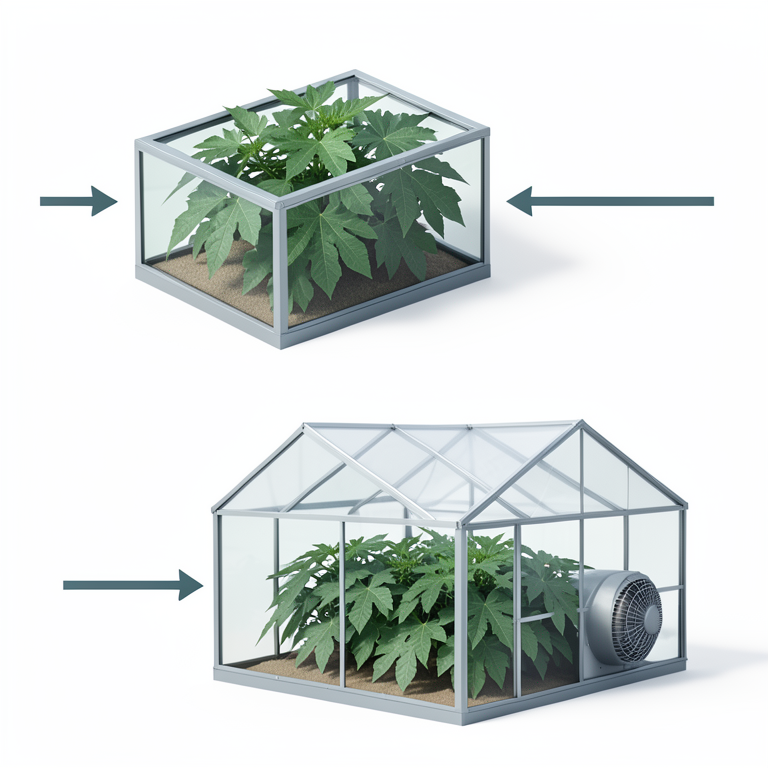
Comparison of Drying Methods
AI-generated conceptual illustration (papaya leaves). It explains the idea and does not show study data.
View source evidence ↗Figures & tables
From the original paper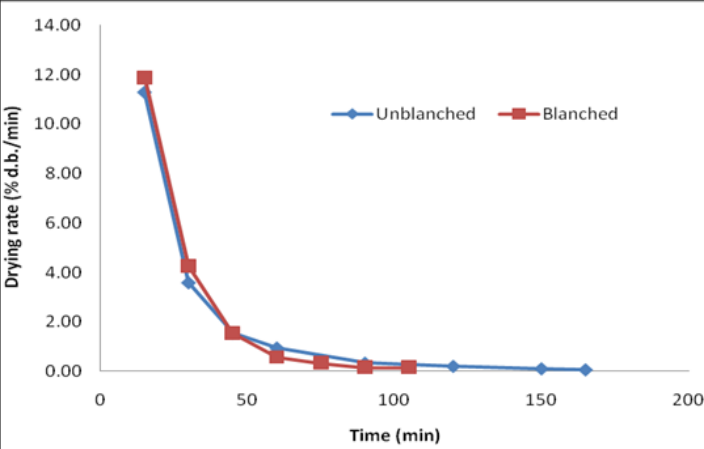 Figure 1
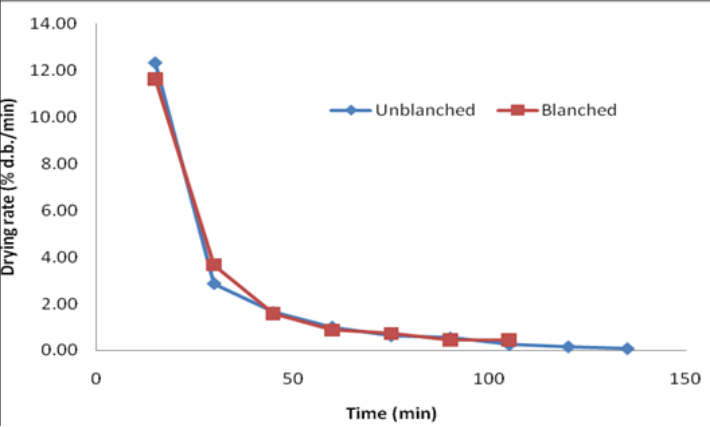 Figure 2
Introduction
The papaya (Carica papaya Linn.) is indigenous to the Americas and thrives in tropical climates. It is a sizable plant resembling a tree, yet it is classified as a herbaceous plant due to its soft, green, and minimally woody stem that remains pliable until it dies. The solitary stem can reach heights of 5 to 10 meters, with all the foliage concentrated at the top. The leaves are large, deeply lobed, and palmate, measuring 50-70 cm in width and supported by long petioles. Optimal growth conditions for papaya include well-drained, well-aerated soil rich in organic matter, with a pH range of 5.5 to 6.7; however, waterlogged conditions can lead to tree mortality within 3 to 4 days. In India, papaya is widely cultivated, with Andhra Pradesh leading in both area and production, followed by Gujarat. In the 2019-20 period, the total area dedicated to papaya cultivation in India was 149 thousand hectares, yielding 6050 thousand metric tonnes. In Gujarat, the area under papaya cultivation for 2020-2021 was estimated at 18.189 thousand hectares, with a production of 1107.880 thousand metric tonnes (Anonymous, 2021) [1] . The leaves of Carica papaya, often regarded as waste, are now recognized for their health benefits. Recent studies have investigated the effects of pretreatment and various drying methods to better understand the physicochemical properties of leaf powder. Papaya is a significant source of the digestive enzyme papain, which finds applications in cosmetics, the brewing industry, meat tenderization, and pharmaceuticals. The raw fruit of papaya possesses laxative properties, while the leaves are valuable for managing diabetes, fever, syphilis, and wound healing (Sudhakar et al., 2014) [7] . Both leaf and fruit extracts of papaya demonstrate antimicrobial and antioxidant properties, attributed to their content of phenols, vitamins, and enzymes (Zuhair et al., 2013) [8] . Drying food is essential for keeping it fresh and safe to consume Sardar et al., 2024 [5] .
Materials and Methods
Mandhubindu cv. of papaya plants were grown in the Horticulture Farm of College of Horticulture, Agricultural University, Anand. The seedlings variety were procured from the local nursery and grown in the month of November. The plant leaves were manually handpicked from the papaya plant for experiments.
Pre-treatment of Sample (Blanching)
Hot water blanching was carried out using the method described by Ranganna (1886) [3] .
Moisture Content
The method described in AOAC (1990) was used to determine the moisture content. A metallic dish was dried in oven at 110 °C for a period of one hour. It was quickly covered, cooled in desiccator and weighed. A 5 g sample was kept in thin layer on the metallic dish and weighed as quickly as possible to avoid loss of moisture. The sample was kept in hot air oven maintained at 100 + 5 °C. The sample was dried for about 4 h until two to three remained www.extensionjournal.com consecutive weights constant and final weight was recorded.
Solar drying
The solar drying studies of papaya leaves was carried out in the commercial solar dryer (Plate 3.16) available at the College of Food Processing Technology & Bio-Energy. The modular size of the solar dryer was 1000 mm x 2000 mm. Total modules were two having loading capacity upto 10 kg per batch. The tray size and numbers were 400 mm x 424 mm x 24 mm and 8 numbers respectively. The trays were made of stainless steel with SS wire mesh. Inlet, outlet and ambient temperatures were recorded. Each 100 g blanched and unblanched samples were uniformly spread in single layer on a perforated stainless steel wire mess tray and dried at the desired temperature. The moisture loss was recorded at every 15 min interval using top pan digital balance.
Greenhouse Drying
Greenhouse drying is a type of low cost and energy efficient drying which uses solar energy as its medium of drying. The green house dryer is made of poly propylene plastic sheets and fitted with an exhaust fan at the top front side of the dryer. The exhaust fan helps in removing moisture from inside the drying chamber. The plastic sheets were washed thoroughly so as to remove dust and dirt from the surface. The exhaust fan was set at 1 m/s velocity. The drying experiment was conducted during the day time from 10 AM to 4 PM. The sample weight was recorded before loading them on the perforated trays. The trays were then loaded in the dryer and the weight loss of the sample was recorded after every fixed interval until the loss in weight was found to be constant, having moisture content of 4-6% on dry basis. The dried samples were made powder then packed in aluminium laminated pouches.
Results and Discussion
Results and Discussion
Initial Moisture Content
The papaya leaves were collected from the plants grown in the farm. Average moisture content of 16 samples of the fresh papaya leaves was 74.56% (w. b.) at the time of harvest. The range of moisture content varied from 73.00 -76.00% (w. b.), which shows that the papaya leaves can be considered under highly perishable group.
Solar Drying
In the solar drying of papaya leaves, (temperature ranging from 42-65 °C), average drying rate decreased from 11.28 to 0.07% d. b./min for the drying of unblanched papaya leaves. Sayyad et al., 2015 [6] described solar drying trends. For the blanched leaves average drying rate was reduced from 11.89 to 0.15% d.b./min in the solar drying. The arithmetic decrement in drying rate was 11.21 for the unblanched leaves, while it was 11.74% d.b./min for blanched sample. This showed that the drying rate was rapidly decreasing in the blanched sample than the unblanched sample respectively. The trend of variation of drying rate with time is shown in Figs. 1, for blanched and unblanched drying respectively.
Green Housing Drying
In the green house drying of papaya leaves (temperature ranging from 40-60 °C), average drying rate decreased from 12.33 to 0.07% d. b./min for the drying of unblanched papaya leaves. For the blanched leaves average drying rate was reduced from 11.63 to 0.43% d.b./ min in the green house drying. The arithmetic decrement in drying rate was 12.26 for the unblanched leaves, while it was 11.20% d.b./min for blanched sample. Sardar, 2022 [4] studied on greenhouse drying of jamun. This showed that the drying rate was rapidly decreasing in the unblanched sample than the blanched sample respectively. The trend of variation of drying rate with time is shown in Figs. 2, for blanched and unblanched drying respectively. www.extensionjournal.com
Figures and tables from the paper
References
3 in the original paper- Sayyad FG, Sardar NR, Rathod JP, Baria UA, Yaduvanshi BK, Solanki BP, et al. Design and development of solar cooker cum dryer. Curr World Environ. 2015;10(3):985-993.
- Sudhakar A, Sudhakar T, Vidhya RM. Medicinal properties of Carica papaya Linn: A mini review. Int J Pharm Pharm Sci. 2014;6(2).
- Zuhair A, Aminah A, Iqbal D. Antioxidant activity and physiochemical properties changes of papaya (Carica papaya) during different ripening stages. Int Food Res J. 2013;20(4).
Cited by 1
From OpenAlex, OpenCitations and reference lists read by Scinovex
- Solar Drying of Moringa oleifera Leaves: A Comprehensive Review on Nutrient Retention and Process Optimization ↗
Narendra Dudhmal, Nilesh Diwakar · International Journal of experimental research and review · 2026
Solar drying can be a good and sustainable technique of drying nutrient-rich medicinal plants like Moringa oleifera leaves, which are commonly known to contain high levels of vitamins, minerals, antioxidants and bioactive compounds. The moringa leaves, however, are very perishable due to their high moisture content and thus require effective drying methods to preserve their nutritional value. The current review…
❝ 0PDF