
Research article · 2024 · Full text
International Journal of Agriculture Extension and Social DevelopmentA study on decision-making behaviour of ‘Meitei women’ in agriculture in Thoubal district of Manipur
Volume 7(8S) · Pages 78–82 · DOI: 10.33545/26180723.2024.v7.i8sb.916 ↗
Research areasAgricultural Economics and PracticesLivestock Management and Performance ImprovementAgricultural risk and resilience
Abstract
Author-writtenThe main purpose of the study was to ascertain the decision-making behaviour of Meitei women in agriculture in Thoubal district of Manipur. The study was conducted in Khangabok block of Thoubal district in the year 2023-2024. Descriptive research designed was applied for this study. The primary data was collected from 120 respondents by personal interview method using pre-structure interview schedule. Participation of the women was measured by asking 14 questions in respect of decision-making. Finding showed that 58.34 per cent of the respondents have medium participation level in decision-making, followed by 20.83 per cent of the respondents having medium participation level in decision-making and 24.17 per cent of the respondents having low medium participation level in decision-making respectively. It was revealed that out of nine independent variables, i.e. age, education, occupation, annual income, land holding, farming, mass media exposure, risk bearing capacity, extension contacts and social participation are positively and significantly correlate with participation of women towards decision-making behaviour.
Summary
Source-checkedPlain-language reading of the full paper, prepared with AI and checked against the text. Each point links to the authors' own words.
Why it matters
- Rural women in India are essential partners in maintaining the sustainability of the agricultural sector. View evidence ↗
- In Manipur, women manage household maintenance, childcare, meal preparation, home gardens, and assist in animal and crop production. View evidence ↗
- Despite their involvement, women's suggestions are often not given sufficient consideration in farming and important family decisions. View evidence ↗
The question
- The study aimed to analyze the relationship between the decision-making behavior of Meitei women in agriculture and their psychological and socio-economic characteristics. View evidence ↗
What they did
- The researchers used a descriptive research design to conduct the study in the Thoubal district of Manipur. View evidence ↗
- A total of 120 respondents were randomly and proportionately selected from Khangabok village in the Thoubal block. View evidence ↗
- Data was collected using a survey method with a pre-tested, structured interview schedule. View evidence ↗
- The analysis involved converting data to a 3-point Likert Scale and using mean, frequency, percentage, and correlation to evaluate variables. View evidence ↗
What they found
- The majority of respondents (58.34%) exhibited a medium level of participation in agricultural decision-making, while 20.83% showed high and 20.83% showed low participation. View evidence ↗
- A high percentage of women (77.50%) fully participate in programs designed to enhance their agricultural decision-making. View evidence ↗
- Most respondents (90.83%) do not participate in decisions regarding pricing, market access, or the agricultural value chain. View evidence ↗
- The vast majority (89.17%) of women do not participate in budgeting decisions for agricultural expenses and inputs. View evidence ↗
- All nine studied independent variables, including age, education, income, and social participation, showed a positive and significant correlation with the women's participation in agriculture. View evidence ↗
What it means
- The authors conclude that Meitei women in the studied area generally have a medium level of participation in agricultural decision-making. View evidence ↗
Visual summary
2 visualsIllustrations explain the paper; charts are replotted from the paper's own table values.
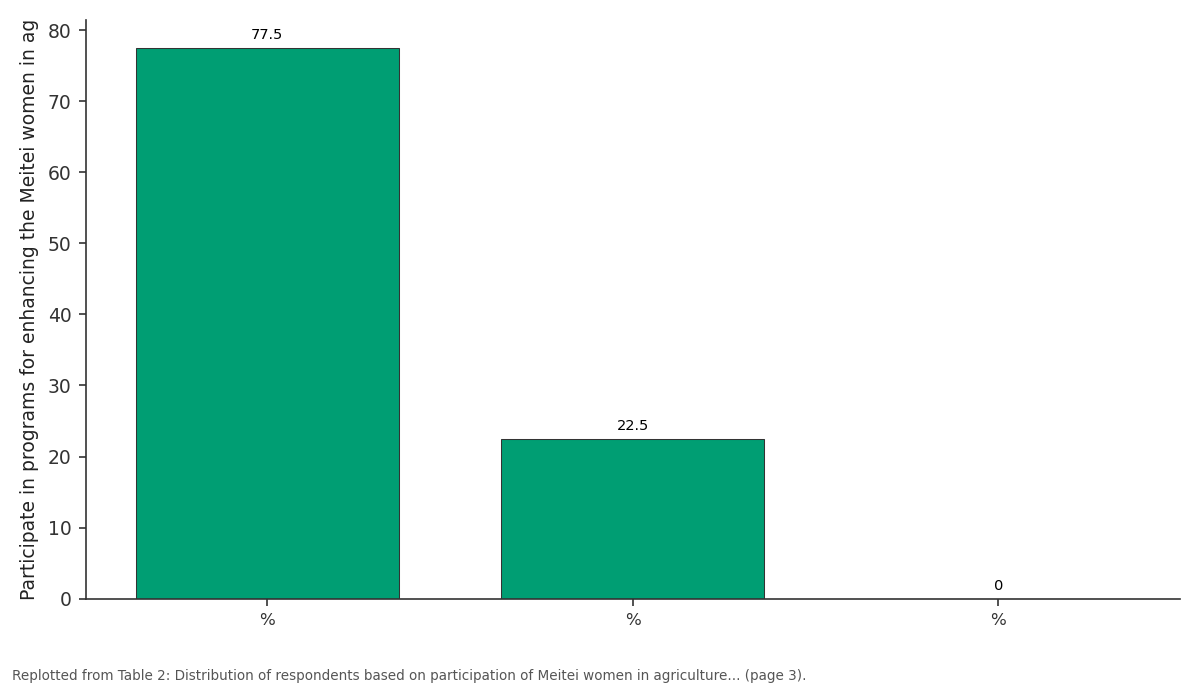
Participate in programs for enhancing the...: % vs % vs %
Replotted from Table 2 (page 3) of the original paper. Every bar is the paper's own table value.
View source evidence ↗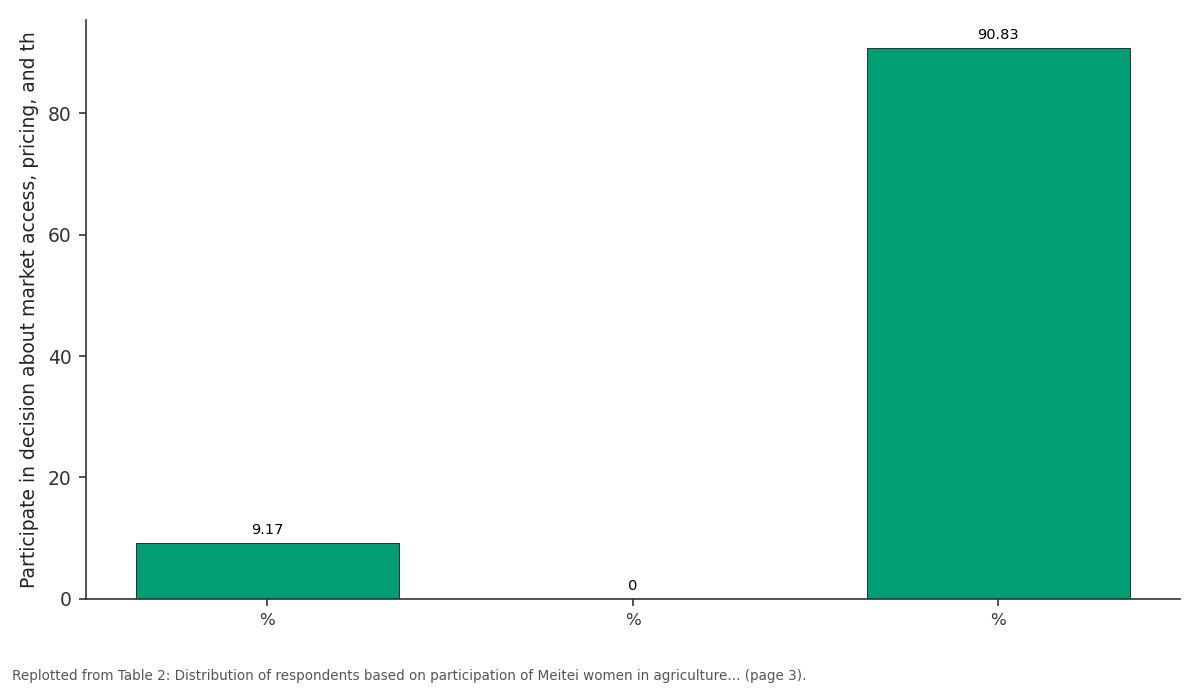
Participate in decision about market access...: % vs % vs %
Replotted from Table 2 (page 3) of the original paper. Every bar is the paper's own table value.
View source evidence ↗Figures & tables
From the original paper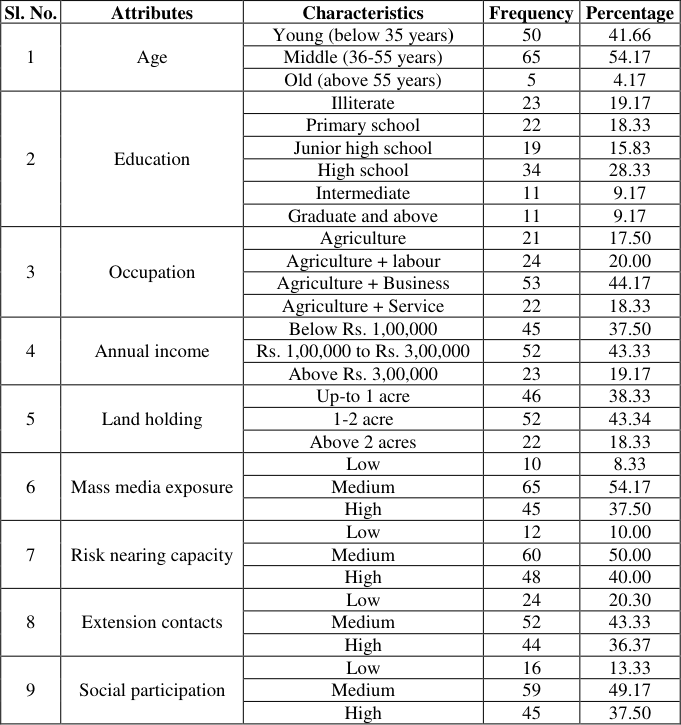 Table 1
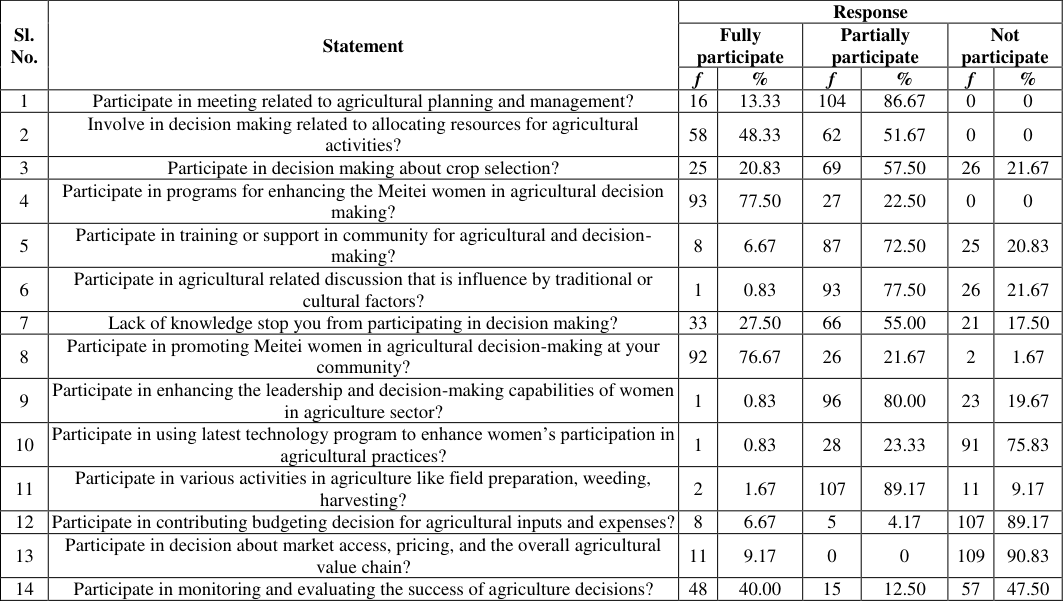 Table 2
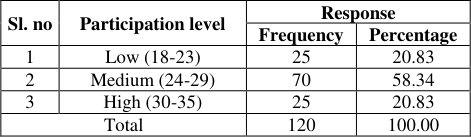 Table 3
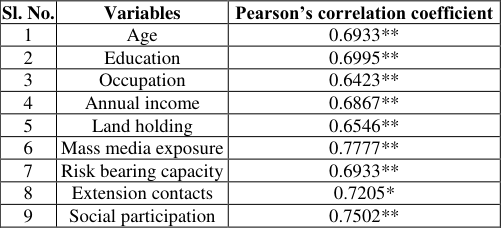 Table 4
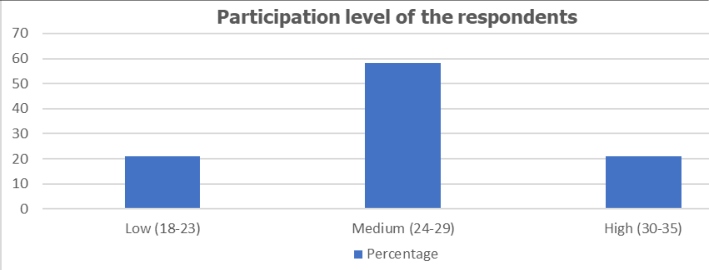 Figure 1
Introduction
In psychology, decision making is regarded as the cognitive process resulting in the selection of a belief or a course of action among several possible alternative options. The decision-making process is a reasoning process based on assumptions of values, preferences and beliefs of decision maker. Decision making is simply the process of making a choice. Indian rural women have always been an important and prominent partner in sustainability of agriculture sector. Agriculture and allied sectors are unique because of their diversity and location specific requirement, decussating of technologies to a range of agro-ecological conditions. Women contribute almost half of our country's population and have been the major components of the working force since from the beginning of agriculture. Their contribution to the economic growth has been quite substantial. Farm women play many roles inside as well as outside their home. She spends about 304 days of her life span only in the kitchen annually, which remains unaccounted in the national income estimates. Farm women have always worked along with men infields and have helped them in other vocation such as handicrafts, small scall cottage industries etc. Sunil B. (2021) [3] . The participation of farm women in decision making was worked out based on the member of women who have taken part in particular aspect of decision under the major heads of organizational, production and marketing decisions. Women took some decision in the farm solely or independently while some other decisions were taken jointly with their male counterparts. In the case of those respondents who did not take part in decision making, their male counter parts were the major decision makers. Goswami et al., (2010) [1] . In a small state like Manipur, women contribute productive work force in the economy of the state. In Manipur, women are moral responsible to all maintenance of household. Besides from caring and brought up of children, women are indulging to preparation daily meals, maintain the home garden, and assisting in crop and animal production. Women are involved in all aspects of agricultural operations, from crop selection to land preparation, to seed selection planting, weeding, pest control, harvesting, crop storage, handling, marketing, and processing. In rural areas both the husband and wives join the decision making on the matters like family obligation related aspect. However, women suggestion is not given due consideration in decision partnering to farming and important family matter. Thus, the identification of role of women in decision making process of various farm and non-farm activities is very important in view of above facts and notions the present study will be carried out with the specific objectives viz., to analyse relationship between decision making behaviour of the Meitei women in agriculture and their socio-economic and psychological characteristics.
Justification of the study
The findings of the present study will help the participation of Meitei women in decision-making that is existing among the women in Thoubal district, Manipur. It will enable to www.extensionjournal.com investigate its appropriate approach to trace out the constraints due to lack of agricultural education and training, adequate working conditions, wage gaps, market place discrimination and land-owning rights.
Objectives
To assess the socio-economic profile of the respondents. To determine the participation of Meitei women in agriculture related activities. To establish the relationship between the selected independent variables with participation.
Research Methodology
The study was conducted in Thoubal district of Manipur. Descriptive research design was followed for the present study as it describes the characteristics or phenomenon that is being studied. Multi stages sampling was followed for the present study for the selection of samples required. Manipur has 16 districts and out of which Thoubal district was selected. There are three blocks in Thoubal district, out of which Thoubal block was selected purposively based on maximum area of women participation. Khangabok village was selected from Thoubal block and a total number of 120 respondents were randomly selected proportionately on the basis of women participation.
Methods used for data collection
A pre-tested structured interview schedule focused towards the objectives of the study was developed for data collection. Survey method of data collection with the help of a pre-structured interview schedule was used. The collected data were classified, tabulated and analyzed in light of the objectives.
Data statistical analysis
The data collected from the respondents was converted to 3 point score (Likert Scale) and tabulated. The evaluation of the data and the relationship between the independent and dependent variables was done using Mean, Frequency, Percentage and Correlation. [2] . Social participation 0.7502** * = Significant at p = 0.05%, **= Significant at p = 0.01%, NS= Non-significant The data presented in Table 4 revealed that out of nine independent variables, i.e. age, education, occupation, annual income, land holding, mass media exposure, risk bearing capacity, extension contacts and social participation are positively and significantly correlated with participation of Meitei women in agriculture related activities.
| Sl. No. | Variables | Pearson’s correlation coefficient |
|---|---|---|
| 1 | Age | 0.6933** |
| 2 | Education | 0.6995** |
| 3 | Occupation | 0.6423** |
| 4 | Annual income | 0.6867** |
| 5 | Land holding | 0.6546** |
| 6 | Mass media exposure | 0.7777** |
| 7 | Risk bearing capacity | 0.6933** |
| 8 | Extension contacts | 0.7205* |
| 9 | Social participation | 0.7502** |
Table text extracted from the original PDF; superscript letters are shown inline. The original table image is below.
View original table image
Results and Discussion Socio Economic Characteristics of the Respondents
Results and Discussion Socio Economic Characteristics of the Respondents
Conclusion
It is concluded that most of the respondents are middle age (36-55 years), majority of the respondents were educated up-to High school level of education, majority of the respondents were engaged in agriculture business only, majority of the respondent income is between 1 to 3 lakhs rupees, majority of the respondent land holdings are between 1-2 acres, majority of the respondents have medium level of mass media exposure, majority of the respondents have medium level of risk bearing capacity, majority of the respondents have medium level of extension contacts and majority of the respondents have medium level of social participation. Majority of the respondents had medium level of participation towards decision making behaviour of Meitei women, followed by high and low level of participation towards decision-making behaviour of Meitei women. Subsequently, all of the selected independent variables, i.e. age, education, occupation, annual income, land holding, mass media exposure, risk bearing capacity, extension contacts and social participation were positively significant with participation towards decision making behaviour of Meitei women.
Figures and tables from the paper
| Sl. No. | Attributes | Characteristics | Frequency | Percentage |
|---|---|---|---|---|
| 1 | Age | Young (below 35 years) | 50 | 41.66 |
| Middle (36-55 years) | 65 | 54.17 | ||
| Old (above 55 years) | 5 | 4.17 | ||
| 2 | Education | Illiterate | 23 | 19.17 |
| Primary school | 22 | 18.33 | ||
| Junior high school | 19 | 15.83 | ||
| High school | 34 | 28.33 | ||
| Intermediate | 11 | 9.17 | ||
| Graduate and above | 11 | 9.17 | ||
| 3 | Occupation | Agriculture | 21 | 17.50 |
| Agriculture + labour | 24 | 20.00 | ||
| Agriculture + Business | 53 | 44.17 | ||
| Agriculture + Service | 22 | 18.33 | ||
| 4 | Annual income | Below Rs. 1,00,000 | 45 | 37.50 |
| Rs. 1,00,000 to Rs. 3,00,000 | 52 | 43.33 | ||
| Above Rs. 3,00,000 | 23 | 19.17 | ||
| 5 | Land holding | Up-to 1 acre | 46 | 38.33 |
| 1-2 acre | 52 | 43.34 | ||
| Above 2 acres | 22 | 18.33 | ||
| 6 | Mass media exposure | Low | 10 | 8.33 |
| Medium | 65 | 54.17 | ||
| High | 45 | 37.50 | ||
| 7 | Risk nearing capacity | Low | 12 | 10.00 |
| Medium | 60 | 50.00 | ||
| High | 48 | 40.00 | ||
| 8 | Extension contacts | Low | 24 | 20.30 |
| Medium | 52 | 43.33 | ||
| High | 44 | 36.37 | ||
| 9 | Social participation | Low | 16 | 13.33 |
| Medium | 59 | 49.17 | ||
| High | 45 | 37.50 |
Table text extracted from the original PDF; superscript letters are shown inline. The original table image is below.
View original table image
| Sl. No. | Statement | Response | — | — | — | — | — |
|---|---|---|---|---|---|---|---|
| Fully participate | Partially participate | Not participate | |||||
| f | % | f | % | f | % | ||
| 1 | Participate in meeting related to agricultural planning and management? | 16 | 13.33 | 104 | 86.67 | 0 | 0 |
| 2 | Involve in decision making related to allocating resources for agricultural activities? | 58 | 48.33 | 62 | 51.67 | 0 | 0 |
| 3 | Participate in decision making about crop selection? | 25 | 20.83 | 69 | 57.50 | 26 | 21.67 |
| 4 | Participate in programs for enhancing the Meitei women in agricultural decision making? | 93 | 77.50 | 27 | 22.50 | 0 | 0 |
| 5 | Participate in training or support in community for agricultural and decision- making? | 8 | 6.67 | 87 | 72.50 | 25 | 20.83 |
| 6 | Participate in agricultural related discussion that is influence by traditional or cultural factors? | 1 | 0.83 | 93 | 77.50 | 26 | 21.67 |
| 7 | Lack of knowledge stop you from participating in decision making? | 33 | 27.50 | 66 | 55.00 | 21 | 17.50 |
| 8 | Participate in promoting Meitei women in agricultural decision-making at your community? | 92 | 76.67 | 26 | 21.67 | 2 | 1.67 |
| 9 | Participate in enhancing the leadership and decision-making capabilities of women in agriculture sector? | 1 | 0.83 | 96 | 80.00 | 23 | 19.67 |
| 10 | Participate in using latest technology program to enhance women’s participation in agricultural practices? | 1 | 0.83 | 28 | 23.33 | 91 | 75.83 |
| 11 | Participate in various activities in agriculture like field preparation, weeding, harvesting? | 2 | 1.67 | 107 | 89.17 | 11 | 9.17 |
| 12 | Participate in contributing budgeting decision for agricultural inputs and expenses? | 8 | 6.67 | 5 | 4.17 | 107 | 89.17 |
| 13 | Participate in decision about market access, pricing, and the overall agricultural value chain? | 11 | 9.17 | 0 | 0 | 109 | 90.83 |
| 14 | Participate in monitoring and evaluating the success of agriculture decisions? | 48 | 40.00 | 15 | 12.50 | 57 | 47.50 |
Table text extracted from the original PDF; superscript letters are shown inline. The original table image is below.
View original table image
| Sl. no | Participation level | Response | — |
|---|---|---|---|
| Frequency | Percentage | ||
| 1 | Low (18-23) | 25 | 20.83 |
| 2 | Medium (24-29) | 70 | 58.34 |
| 3 | High (30-35) | 25 | 20.83 |
| Total | 120 | 100.00 |
Table text extracted from the original PDF; superscript letters are shown inline. The original table image is below.
View original table image
References
3 in the original paper- Goswami NS, Venugopalam VM, Ramamurthy V, Gawande SR, Patil PV, Chaturvedi A. Participation of farm women in land use decision making process -A case study in Panubali watershed of Nagpur district, Maharashtra. Indian J Ext Educ. 2010;46(1&2):97-100.
- Ram D, Singh MK, Chaudhary KP, Jayarani L. Entrepreneurship behaviour of women entrepreneurs in www.extensionjournal.com Imphal of Manipur. Indian Res J Ext Educ. 2013;13(2):31-5.
- Sunil B. A study on decision making ability and participation in various agriculture activities performed by farm women in Khargone district of M.P. Rajmata Vijayaraje Scindia Krishi Vishwa Vidyalaya, Gwalior (M.P.). 2020;101.