
Research article · 2024 · Full text
International Journal of Agriculture Extension and Social DevelopmentA study on knowledge and adoption of improved potato cultivation practices in Thoubal district of Manipur
Volume 7(8S) · Pages 83–88 · DOI: 10.33545/26180723.2024.v7.i8sb.917 ↗
Research areasAgricultural Economics and Practices
Abstract
Author-writtenThe main purpose of the study was to ascertain the knowledge and adoption behavior towards improved potato cultivation practices in Thoubal district of Manipur. The study was conducted in Thoubal block of Thoubal district in the year 2023-2024. Descriptive research designed was applied for this study. The primary data was collected from 120 respondents by personal interview method using pre-structure. Knowledge of farmers was measured my asking 24 questions in respect of potato cultivation and adoption of the farmers was measured by asking 14 questions in respect of potato cultivation. Finding showed that majority (54.17%) of the respondents have medium knowledge level category, 29.16 per cent respondents were observed in the high knowledge level category and remaining 16.67 per cent respondents formed low knowledge level category towards potato cultivation practices and majority (50%) of the respondents have medium level adoption level, 34 per cent of the respondents have high adoption level and 15 per cent of the respondents have low adoption level towards improved potato cultivation respectively. It was revealed that out of ten independent variables, i.e., age, education, annual income, occupation, land holding, farming experience, risk bearing capacity, mass media exposure, scientific orientation and progressiveness are positively and significantly correlate with knowledge and adoption of farmers towards improved potato cultivation practices.
Summary
Source-checkedPlain-language reading of the full paper, prepared with AI and checked against the text. Each point links to the authors' own words.
Why it matters
- Potato productivity in Manipur is significantly lower than the national average, potentially due to high cultivation costs, expensive inputs, and the use of low-yielding varieties. View evidence ↗
- Late blight disease is identified as the primary factor contributing to low potato yields in the Manipur region. View evidence ↗
- Potatoes are a valuable nutritional source, providing carbohydrates, essential proteins, vitamin C, and minerals such as potassium, phosphorus, and magnesium. View evidence ↗
The question
- The study aimed to determine the level of knowledge and the adoption behavior of farmers regarding improved potato cultivation practices in the Thoubal district of Manipur. View evidence ↗
What they did
- A descriptive research design was used for the study, which took place in the Thoubal block of the Thoubal district during 2023-2024. View evidence ↗
- Primary data was gathered from 120 respondents through personal interviews using a pre-structured schedule. View evidence ↗
- Farmer knowledge was assessed using 24 specific questions, while adoption levels were measured using 14 questions related to potato cultivation. View evidence ↗
- Data was analyzed using a 3-point Likert scale and evaluated through mean, frequency, percentage, and correlation analysis to determine relationships between variables. View evidence ↗
What they found
- The majority of respondents (54.17%) possessed a medium level of knowledge, while 29.16% had high knowledge and 16.67% had low knowledge regarding improved practices. View evidence ↗
- Regarding the adoption of improved practices, 50% of respondents showed a medium level of adoption, 34% showed high adoption, and 15% showed low adoption. View evidence ↗
- The use of improved cultivars for plantation was the most widely adopted practice, with 96.67% of respondents fully adopting it. View evidence ↗
- Harvest and post-harvest management was the least adopted practice, with 63.33% of respondents not adopting it at all. View evidence ↗
- Ten independent variables, including age, education, income, and mass media exposure, were found to be positively and significantly correlated with the farmers' knowledge of improved practices. View evidence ↗
- The same ten independent variables were also found to be positively and significantly correlated with the actual adoption of improved potato cultivation practices. View evidence ↗
What it means
- The authors conclude that the majority of potato growers in the studied area possess a medium level of both knowledge and adoption of improved cultivation practices. View evidence ↗
Visual summary
3 visualsIllustrations explain the paper; charts are replotted from the paper's own table values.
Correlation of Socio-Economic Factors
AI-generated conceptual illustration (potato plants in a field). It explains the idea and does not show study data.
View source evidence ↗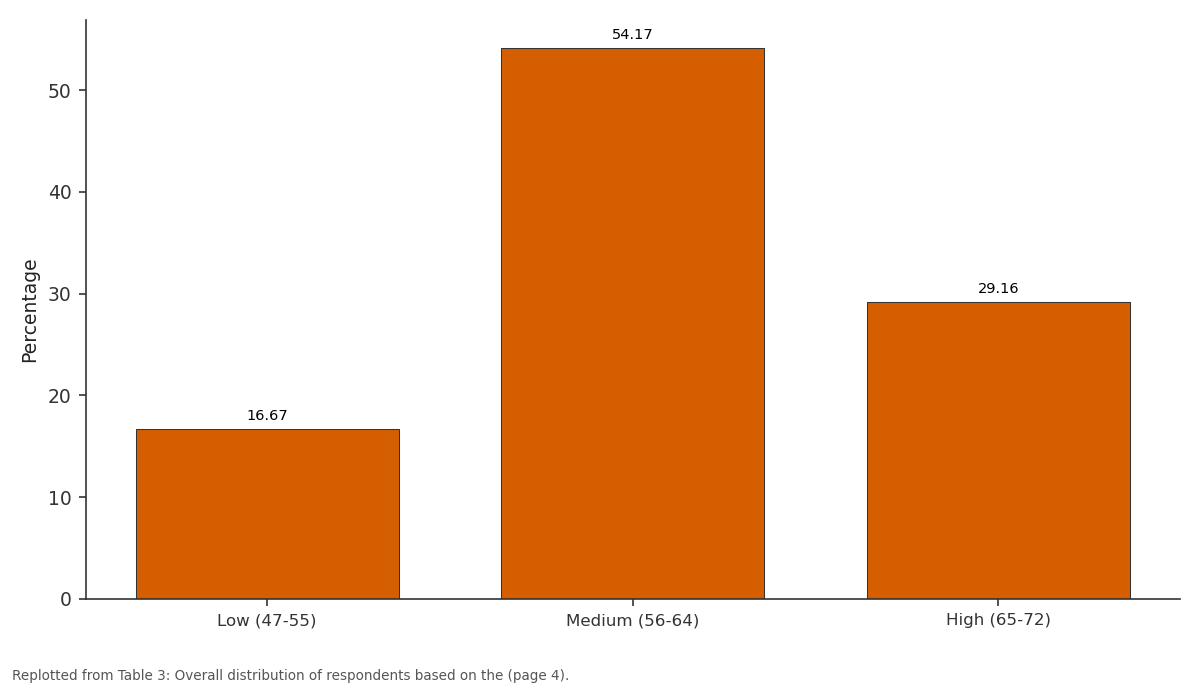
Percentage: Low (47-55) vs Medium (56-64) vs High (65-72)
Replotted from Table 3 (page 4) of the original paper. Every bar is the paper's own table value.
View source evidence ↗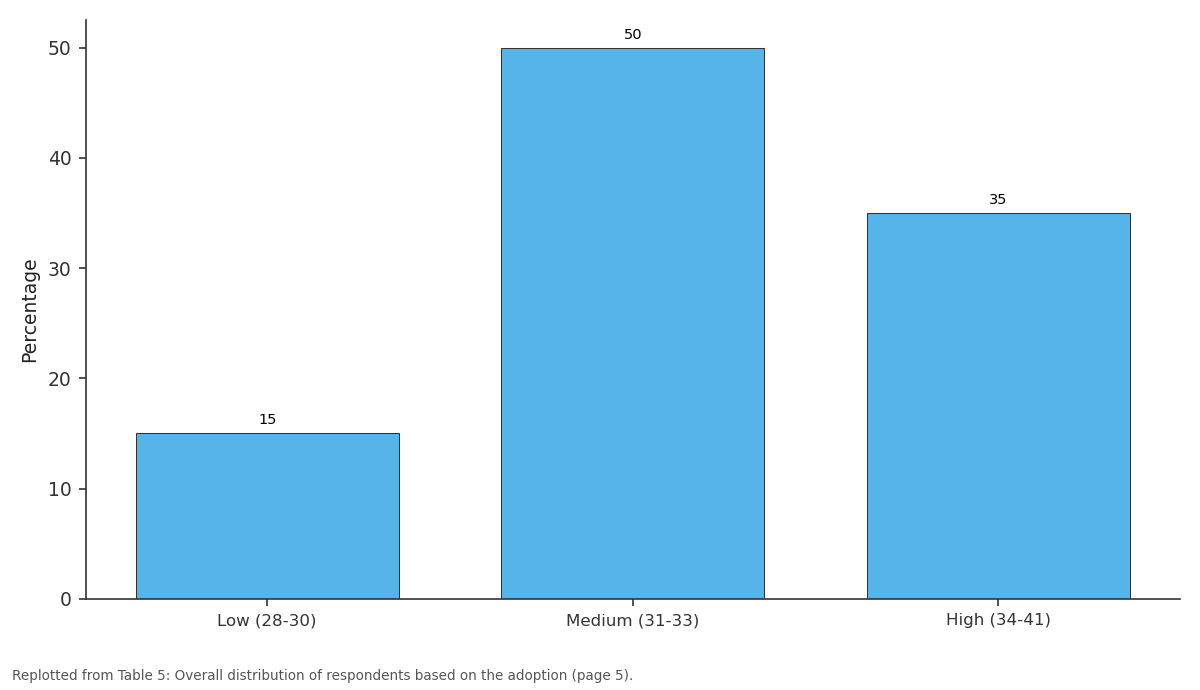
Percentage: Low (28-30) vs Medium (31-33) vs High (34-41)
Replotted from Table 5 (page 5) of the original paper. Every bar is the paper's own table value.
View source evidence ↗Figures & tables
From the original paper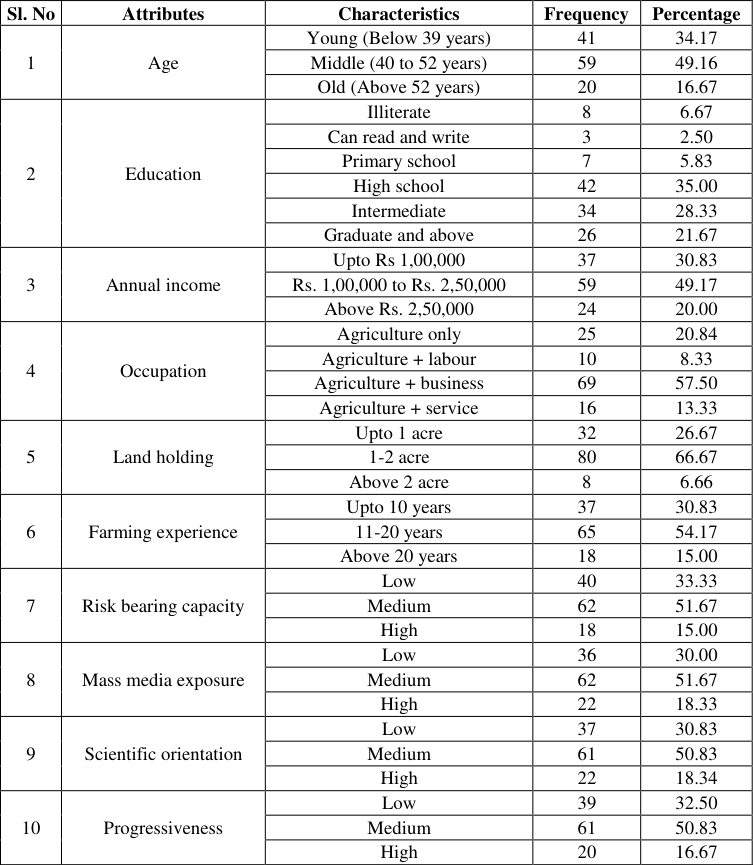 Table 1
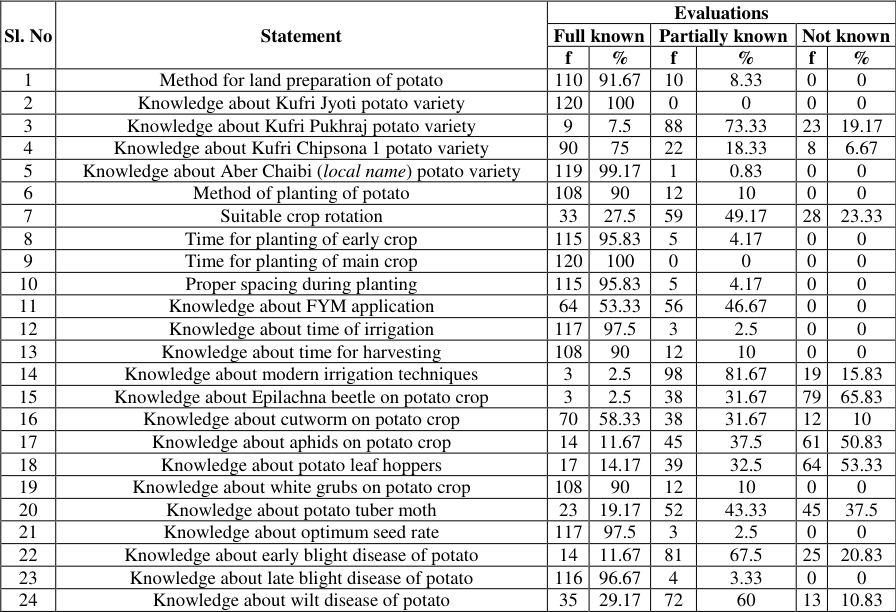 Table 2
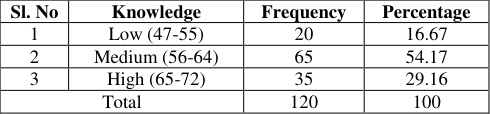 Table 3
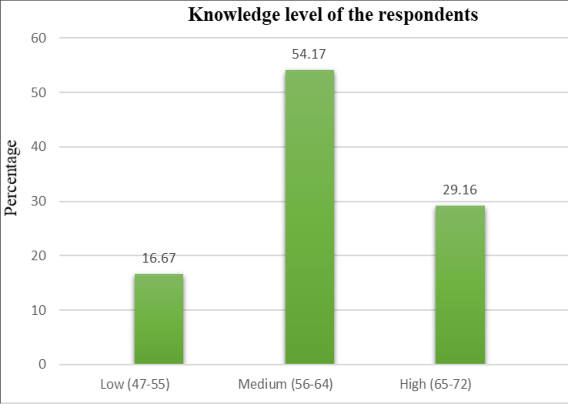 Figure 1
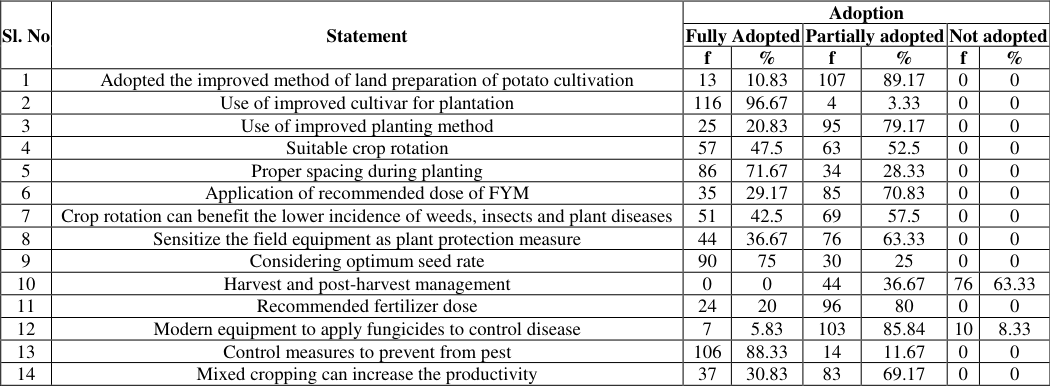 Table 4
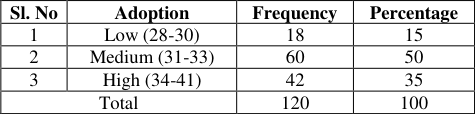 Table 5
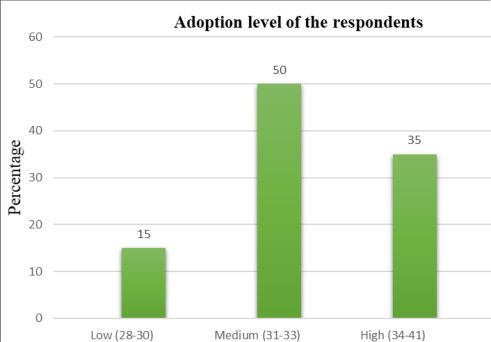 Figure 2
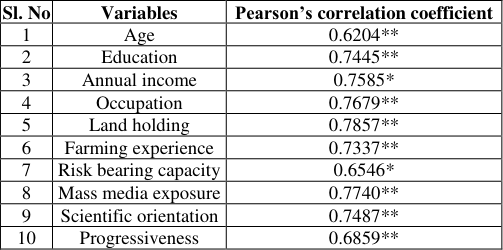 Table 6
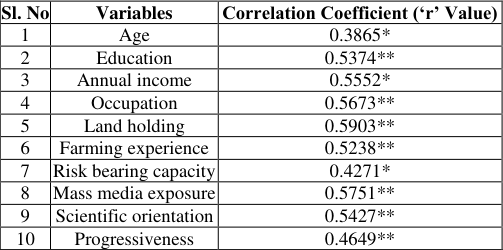 Table 7
Introduction
The potato (commonly known as Solanum tuberosum) belongs to the nightshade family called Solanaceae and is a part of the genus Solanum. This genus includes a variety of plants, some of which are edible like the potato, while others may be ornamental or toxic. The Solanaceae family also includes other important crops like tomatoes, eggplants, and peppers. In Manipur area, production and productivity of potato recorded 1.7 ha, 15.2 tonnes and 89.4 q/ha respectively (Anonymous, 2010). The productivity of potato in Manipur region is very low compared to national productivity of potato. This may be due to high cost of cultivation, high input of seeds and chemical fertilizers and use of less yielding variety etc. For reducing the costs of cultivation of many potato growers are using high yielding varieties. But no systemic work has been done to determine the suitable variety for a particular region which has a great impact on the yield of the crop. The most popular potato variety among the farmers in Manipur is Kufri Jyoti. The variety, which has a 25-30 t/ha production potential, was introduced in 1968. The variety is suited to plateaus, plains, and hills. It takes 110-130 days for this medium-maturing cultivar to mature. The late blight disease of potato is the most important factor for the low yield of potato in Manipur. To replace Kufri Jyoti with a better potato variety suited to Manipur and spread awareness among the farmers, Front Line demonstration of potato varieties Kufri Pukhraj and Kufri-Chipsona-1 in five different locations of Manipur viz. Haorong Sabal, Kwasiphai, Mayang Langjing, Mapao and Phumlou organized by ICAR-Central Potato Research Institute, Regional Station, Shillong, and ICAR RC for NEH Region, Manipur Centre, Lamphel-pat during rabi season of 2022 along with ICAR KVK-Imphal West. In Manipur, during the preparation of some common everyday dishes, especially "Eromba" and "Kangsoi", potato is used as a base. In the cooking of many different cultures, potatoes are crucial and have multiple uses. It forms the base for many diverse foods depending on the consumer's preference and offers a wide range of flavours and textures on the finished plate. While potato is a well-known source of carbohydrates, it is a good source of essential protein, vitamins, minerals, and biologically active compounds such as polyphenols, flavonoids, and fibre. Potatoes provide a moderate amount of iron while being rich in vitamin C, which helps the body absorb iron. It is a good source of minerals like potassium, phosphorus, magnesium, and vitamins B1, B3, and B6 (Ningombam et al., 2023) [2] .
Justification of the study
The findings of the present study will help the knowledge and adoption behaviour of the farmers that is existing among the Potato growers in Thoubal district, Manipur. It will enable to investigate its appropriate approach to trace www.extensionjournal.com out the constraints in utilization of improved cultivation practices and knowledge for better crop management and enhance productivity regarding improved potato cultivation.
Objectives
To assess the socio-economic profile of the respondents. To ascertain the knowledge and analyse adoption level of the respondents toward improved potato cultivation practices. To establish the relationship between selected independent variables with dependent variables.
Research Methodology
The study was conducted in Thoubal district of Manipur. Descriptive research design was followed for the present study as it describes the characteristics or phenomenon that is being studied. Multi stages sampling was followed for the present study for the selection of samples required. Manipur has 16 districts and out of which Thoubal district was selected. There are three blocks in Thoubal district, out of which Thoubal block was selected purposively based on maximum area cover under potato cultivation. Khangabok village was selected from Thoubal block and a total number of 120 respondents were randomly selected proportionately on the basis of maximum area covered under potato cultivation.
Methods used for data collection
A pre-tested structured interview schedule focused towards the objectives of the study was developed for data collection. Survey method of data collection with the help of a pre-structured interview schedule was used. The collected data were classified, tabulated and analyzed in light of the objectives.
Data statistical analysis
The data collected from the respondents was converted to 3 point score (Likert Scale) and tabulated. The evaluation of the data and the relationship between the independent and dependent variables was done using Mean, Frequency, Percentage and Correlation.
Results and Discussion
Socio-economic Characteristics of the Respondents: The data presented in Table 1 revealed that 49.16 per cent of the respondents are middle age (40-52 years) followed by 34.17 per cent young age (below 39) and 16.67 per cent of the respondents are of old age (above 52 years). It also indicated that 35 per cent of the respondents were educated upto high school level of education followed by 28.33 per cent of the respondents had intermediate education, 21.67 per cent of the respondents had graduate and above level of education, 6.67 per cent respondents were illiterate, 5.83 per cent of respondents had primary school level education and 2.5 per cent of the respondents can read and write. It was found that 49.17 per cent of the respondents had an income between Rs 1,00,000 and Rs 2,50,000 followed by 30.83 per cent of the respondents had an income upto Rs 1,00,000 and 20 per cent of the respondents had an income above Rs 2,50,000. It was revealed that 57.5 per cent of the respondents were engaged in business along with agriculture, 20.84 per cent of the respondents were engaged in agriculture only, 13.33 per cent of the respondents were engaged in service along with agriculture and 8.33 per cent of the respondents were engaged in agriculture and labour. It was found that (66.67%) of the respondents had a land holding of 1-2 acres, 26.67 per cent of the respondents had a land holding upto 1 acre and 6.66 per cent of the respondents had a land holding above 2 acres. It was revealed that (54.17%) of the respondents had farming experience between 11-20 years, 30.83 per cent of the respondents had farming experience upto 10 years and 15 per cent of the respondents had farming experience above 20 years. It was found that majority (51.67%) of the respondents had medium level of risk bearing capacity followed by 33.33 per cent of the respondents had low level and 15 per cent of the respondents had high level of risk bearing capacity. It was revealed that (51.67%) of the respondents had medium level of mass media exposure, 30 per cent of the respondents had low level and 18.33 per cent of the respondents had high level of mass media exposure. It was found that majority (50.83%) of the respondents had medium level of scientific orientation followed by 30.83 per cent of the respondents had low level and 18.34 per cent of the respondents had high level of scientific orientation. It was revealed that (50.83%) of the respondents had medium level of progressiveness followed by 32.5 per cent of the respondents had low level and 16.67 per cent of the respondents had high level of progressiveness. [3] . The above table 4. shows that majority (89.17%) of the respondents have partially adopted the improved method of land preparation for potato cultivation and 10.83 per cent of the respondents have fully adopted. It was observed that majority (96.67%) of the respondents have fully adopted the use of improved cultivar for plantation and 3.33 per cent have partially adopted. It shows that majority (79.17%) of the respondents have partially adopted the use of improved planting method and 20.83 per cent of the respondents have fully adopted. It reveals that majority (52.5%) of the respondents have partially adopted suitable crop rotation and 47.5 per cent of the respondents have fully adopted. It shows that majority (71.67%) of the respondents have fully adopted the proper spacing during planting of potato and 28.33 per cent of the respondents have partially adopted. It states that majority (70.83%) of the respondents have partially adopted the recommended dose of FYM and 29.17 per cent of the respondents have fully adopted. It states that majority (57.5%) of the respondents have partially adopted crop rotation that can benefit in lowering the incidence of weeds, insects and plant diseases and 42.5 per cent of the respondents have fully adopted. It shows that majority (63.33%) of the respondents have partially adopted the technique of sensitizing field equipment as plant control measures and 36.67 per cent of the respondents have fully adopted. It was revealed that majority (75%) of the respondents have fully adopted the optimum seed rate and 25 per cent of the respondents have partially adopted. It shows that majority (63.33%) of the respondents have not adopted the harvest and post-harvest management and 36.67 per cent of the respondents have partially adopted. It was revealed that majority (80%) of the respondents have partially adopted the use of recommended fertilizer dose and 20 per cent of the respondents have fully adopted. It shows that majority (85.84%) of the respondents have partially adopted the use of modern equipment to apply fungicides to control disease, 8.33 per cent of the respondents have partially adopted and 5.83 per cent of the respondents have fully adopted. It was revealed that majority (88.33%) of the respondents have fully adopted the control measures to prevent potatoes from pest and 11.67 per cent of the respondents have partially adopted. It states that majority (69.17%) of the respondents have partially adopted the use of mixed cropping to increased productivity and 30.83 per cent of the respondents have fully adopted. [1] . Progressiveness 0.4649** * = Significant at p = 0.5%, ** = Significant at p = 0.01%, NS = Non Significant
| Sl. No | Statement | Adoption | — | — | — | — | — |
|---|---|---|---|---|---|---|---|
| Fully Adopted | Partially adopted | Not adopted | |||||
| f | % | f | % | f | % | ||
| 1 | Adopted the improved method of land preparation of potato cultivation | 13 | 10.83 | 107 | 89.17 | 0 | 0 |
| 2 | Use of improved cultivar for plantation | 116 | 96.67 | 4 | 3.33 | 0 | 0 |
| 3 | Use of improved planting method | 25 | 20.83 | 95 | 79.17 | 0 | 0 |
| 4 | Suitable crop rotation | 57 | 47.5 | 63 | 52.5 | 0 | 0 |
| 5 | Proper spacing during planting | 86 | 71.67 | 34 | 28.33 | 0 | 0 |
| 6 | Application of recommended dose of FYM | 35 | 29.17 | 85 | 70.83 | 0 | 0 |
| 7 | Crop rotation can benefit the lower incidence of weeds, insects and plant diseases | 51 | 42.5 | 69 | 57.5 | 0 | 0 |
| 8 | Sensitize the field equipment as plant protection measure | 44 | 36.67 | 76 | 63.33 | 0 | 0 |
| 9 | Considering optimum seed rate | 90 | 75 | 30 | 25 | 0 | 0 |
| 10 | Harvest and post-harvest management | 0 | 0 | 44 | 36.67 | 76 | 63.33 |
| 11 | Recommended fertilizer dose | 24 | 20 | 96 | 80 | 0 | 0 |
| 12 | Modern equipment to apply fungicides to control disease | 7 | 5.83 | 103 | 85.84 | 10 | 8.33 |
| 13 | Control measures to prevent from pest | 106 | 88.33 | 14 | 11.67 | 0 | 0 |
| 14 | Mixed cropping can increase the productivity | 37 | 30.83 | 83 | 69.17 | 0 | 0 |
Table text extracted from the original PDF; superscript letters are shown inline. The original table image is below.
View original table image
| Sl. No | Attributes | Characteristics | Frequency | Percentage |
|---|---|---|---|---|
| 1 | Age | Young (Below 39 years) | 41 | 34.17 |
| Middle (40 to 52 years) | 59 | 49.16 | ||
| Old (Above 52 years) | 20 | 16.67 | ||
| 2 | Education | Illiterate | 8 | 6.67 |
| Can read and write | 3 | 2.50 | ||
| Primary school | 7 | 5.83 | ||
| High school | 42 | 35.00 | ||
| Intermediate | 34 | 28.33 | ||
| Graduate and above | 26 | 21.67 | ||
| 3 | Annual income | Upto Rs 1,00,000 | 37 | 30.83 |
| Rs. 1,00,000 to Rs. 2,50,000 | 59 | 49.17 | ||
| Above Rs. 2,50,000 | 24 | 20.00 | ||
| 4 | Occupation | Agriculture only | 25 | 20.84 |
| Agriculture + labour | 10 | 8.33 | ||
| Agriculture + business | 69 | 57.50 | ||
| Agriculture + service | 16 | 13.33 | ||
| 5 | Land holding | Upto 1 acre | 32 | 26.67 |
| 1-2 acre | 80 | 66.67 | ||
| Above 2 acre | 8 | 6.66 | ||
| 6 | Farming experience | Upto 10 years | 37 | 30.83 |
| 11-20 years | 65 | 54.17 | ||
| Above 20 years | 18 | 15.00 | ||
| 7 | Risk bearing capacity | Low | 40 | 33.33 |
| Medium | 62 | 51.67 | ||
| High | 18 | 15.00 | ||
| 8 | Mass media exposure | Low | 36 | 30.00 |
| Medium | 62 | 51.67 | ||
| High | 22 | 18.33 | ||
| 9 | Scientific orientation | Low | 37 | 30.83 |
| Medium | 61 | 50.83 | ||
| High | 22 | 18.34 | ||
| 10 | Progressiveness | Low | 39 | 32.50 |
| Medium | 61 | 50.83 | ||
| High | 20 | 16.67 |
Table text extracted from the original PDF; superscript letters are shown inline. The original table image is below.
View original table image
Knowledge of respondents towards improved potato cultivation practices
The above table 7. revealed that out of ten independent variables, i.e. age, education, annual income, occupation, land holding, farming experience, risk bearing capacity, mass media exposure, scientific orientation and progressiveness are positively and significantly correlated with adoption of farmers towards improved potato cultivation practices.
| Sl. No | Variables | Correlation Coefficient (‘r’ Value) |
|---|---|---|
| 1 | Age | 0.3865* |
| 2 | Education | 0.5374** |
| 3 | Annual income | 0.5552* |
| 4 | Occupation | 0.5673** |
| 5 | Land holding | 0.5903** |
| 6 | Farming experience | 0.5238** |
| 7 | Risk bearing capacity | 0.4271* |
| 8 | Mass media exposure | 0.5751** |
| 9 | Scientific orientation | 0.5427** |
| 10 | Progressiveness | 0.4649** |
Table text extracted from the original PDF; superscript letters are shown inline. The original table image is below.
View original table image
Conclusion
It is concluded from the present study that most of the respondents were middle age (40-52 years). Most of the respondents were educated upto high school level of education. Most of the respondents had an annual income between Rs 1,00,000 to Rs 2,50,000. Most of the respondents were engaged in business along with agriculture. Most of the respondents had land holdings between 1-2 acres. Most of the respondent had farming experience between 11-20 years. Majority of the respondents had medium level of risk bearing capacity.
Most of the respondents had medium level of mass media exposure. Majority of the respondent had medium level of scientific orientation. Most of the respondents had medium level of progressiveness. Majority of the respondents had medium level of knowledge. Majority of the respondents had medium level of adoption respectively. Subsequently, all of the selected independent variables, i.e., age, education, annual income, occupation, land holding, farming experience, risk bearing capacity, mass media exposure, scientific orientation and progressiveness are positively and significantly correlate with knowledge and adoption of farmers towards improved potato cultivation practices.
Figures and tables from the paper
| Sl. No | Statement | Evaluations | — | — | — | — | — |
|---|---|---|---|---|---|---|---|
| Full known | Partially known | Not known | |||||
| f | % | f | % | f | % | ||
| 1 | Method for land preparation of potato | 110 | 91.67 | 10 | 8.33 | 0 | 0 |
| 2 | Knowledge about Kufri Jyoti potato variety | 120 | 100 | 0 | 0 | 0 | 0 |
| 3 | Knowledge about Kufri Pukhraj potato variety | 9 | 7.5 | 88 | 73.33 | 23 | 19.17 |
| 4 | Knowledge about Kufri Chipsona 1 potato variety | 90 | 75 | 22 | 18.33 | 8 | 6.67 |
| 5 | Knowledge about Aber Chaibi (local name) potato variety | 119 | 99.17 | 1 | 0.83 | 0 | 0 |
| 6 | Method of planting of potato | 108 | 90 | 12 | 10 | 0 | 0 |
| 7 | Suitable crop rotation | 33 | 27.5 | 59 | 49.17 | 28 | 23.33 |
| 8 | Time for planting of early crop | 115 | 95.83 | 5 | 4.17 | 0 | 0 |
| 9 | Time for planting of main crop | 120 | 100 | 0 | 0 | 0 | 0 |
| 10 | Proper spacing during planting | 115 | 95.83 | 5 | 4.17 | 0 | 0 |
| 11 | Knowledge about FYM application | 64 | 53.33 | 56 | 46.67 | 0 | 0 |
| 12 | Knowledge about time of irrigation | 117 | 97.5 | 3 | 2.5 | 0 | 0 |
| 13 | Knowledge about time for harvesting | 108 | 90 | 12 | 10 | 0 | 0 |
| 14 | Knowledge about modern irrigation techniques | 3 | 2.5 | 98 | 81.67 | 19 | 15.83 |
| 15 | Knowledge about Epilachna beetle on potato crop | 3 | 2.5 | 38 | 31.67 | 79 | 65.83 |
| 16 | Knowledge about cutworm on potato crop | 70 | 58.33 | 38 | 31.67 | 12 | 10 |
| 17 | Knowledge about aphids on potato crop | 14 | 11.67 | 45 | 37.5 | 61 | 50.83 |
| 18 | Knowledge about potato leaf hoppers | 17 | 14.17 | 39 | 32.5 | 64 | 53.33 |
| 19 | Knowledge about white grubs on potato crop | 108 | 90 | 12 | 10 | 0 | 0 |
| 20 | Knowledge about potato tuber moth | 23 | 19.17 | 52 | 43.33 | 45 | 37.5 |
| 21 | Knowledge about optimum seed rate | 117 | 97.5 | 3 | 2.5 | 0 | 0 |
| 22 | Knowledge about early blight disease of potato | 14 | 11.67 | 81 | 67.5 | 25 | 20.83 |
| 23 | Knowledge about late blight disease of potato | 116 | 96.67 | 4 | 3.33 | 0 | 0 |
| 24 | Knowledge about wilt disease of potato | 35 | 29.17 | 72 | 60 | 13 | 10.83 |
Table text extracted from the original PDF; superscript letters are shown inline. The original table image is below.
View original table image
| Sl. No | Knowledge | Frequency | Percentage |
|---|---|---|---|
| 1 | Low (47-55) | 20 | 16.67 |
| 2 | Medium (56-64) | 65 | 54.17 |
| 3 | High (65-72) | 35 | 29.16 |
| Total | 120 | 100 |
Table text extracted from the original PDF; superscript letters are shown inline. The original table image is below.
View original table image
| Sl. No | Adoption | Frequency | Percentage |
|---|---|---|---|
| 1 | Low (28-30) | 18 | 15 |
| 2 | Medium (31-33) | 60 | 50 |
| 3 | High (34-41) | 42 | 35 |
| Total | 120 | 100 |
Table text extracted from the original PDF; superscript letters are shown inline. The original table image is below.
View original table image
| Sl. No | Variables | Pearson’s correlation coefficient |
|---|---|---|
| 1 | Age | 0.6204** |
| 2 | Education | 0.7445** |
| 3 | Annual income | 0.7585* |
| 4 | Occupation | 0.7679** |
| 5 | Land holding | 0.7857** |
| 6 | Farming experience | 0.7337** |
| 7 | Risk bearing capacity | 0.6546* |
| 8 | Mass media exposure | 0.7740** |
| 9 | Scientific orientation | 0.7487** |
| 10 | Progressiveness | 0.6859** |
Table text extracted from the original PDF; superscript letters are shown inline. The original table image is below.
View original table image
References
3 in the original paper- Desai HK, Thakkar KA, Desai JD. Adoption of potato cultivation technology by the potato growers under contract farming. Gujarat J Ext Educ. 2022;1(33):3132.
- Pottappa K, Krinamurthy B, Narayanagowda K. Knowledge level of potato growers in Chickballapur district. Mysore J Agric Sci. 2014;48(1):95-98.
- Singh TM, Sharma A. Cost and returns on various farm levels of selected major horticultural crops in the state of Nagaland and Manipur, India. Plant Archives. 2020;20(2):9095-9103.