
Research article · 2024 · Full text
International Journal of Agriculture Extension and Social DevelopmentImpact of agricultural broadcasting programme through air news on the farmers’ adoption of innovative agricultural practices in Bishnupur district of Manipur, India
Volume 7(8S) · Pages 73–77 · DOI: 10.33545/26180723.2024.v7.i8sb.915 ↗
Research areasAgricultural Economics and Practices
Abstract
Author-writtenThe main purpose of the study was to ascertain the adoption of innovative agricultural practices of AIR (All India Radio) News programme in Bishnupur district of Manipur. The study was conducted in Bishnupur Block of Bishnupur district in the year 2023-2024. Ex-post facto research designed was applied for this study. The primary data was collected from 120 respondents by personal interview method using pre-structure interview schedule. Adoption of the agricultural broadcasting programme was measured by asking 17 questions in respect of innovative agricultural practices. Finding showed that 49.16 per cent of the respondents have medium adoption level of innovative agricultural practices, followed by 34.17 per cent of the respondents having low adoption level of innovative agricultural practices and 16.67 per cent of the respondents having high adoption level of innovative agricultural practices respectively. It was revealed that out of ten independent variables, i.e. age, education, annual income, occupation, land holding, mass media exposure, scientific orientation, innovativeness, risk orientation and sources of agricultural information are positively and significantly correlate with adoption of farmers towards Agricultural Broadcasting Programme through AIR News.
Summary
Source-checkedPlain-language reading of the full paper, prepared with AI and checked against the text. Each point links to the authors' own words.
Why it matters
- Radio is viewed as a highly effective and powerful mass media tool for the rapid dissemination of agricultural information to farmers. View evidence ↗
- In the state of Manipur, AIR News agricultural broadcasting programs are significant for supporting the development activities of local farmers. View evidence ↗
- Understanding the impact of these programs can help farmers improve management activities such as sustainable agriculture, water conservation, and integrated pest management. View evidence ↗
The question
- The primary goal of the study was to determine the extent to which farmers in the Bishnupur district of Manipur adopted innovative agricultural practices promoted by AIR News. View evidence ↗
What they did
- The research used an ex-post facto design and was conducted in the Bishnupur Block of the Bishnupur district during 2023-2024. View evidence ↗
- Primary data was gathered from 120 respondents through personal interviews using a pre-structured interview schedule. View evidence ↗
- The adoption of the broadcasting program was measured using a set of 17 questions focused on innovative agricultural practices. View evidence ↗
- Data was analyzed using a 3-point Likert scale and evaluated through mean, frequency, percentage, and correlation analysis. View evidence ↗
What they found
- The majority of respondents (49.16%) showed a medium level of adoption, while 34.17% had a low level and 16.67% had a high level of adoption. View evidence ↗
- A vast majority of respondents (92.50%) fully adopted general knowledge about agricultural broadcasting programs through AIR. View evidence ↗
- Adoption of the Pradhan Mantri Fasal Bima Yojana was very low, with 89.16% of respondents not adopting it. View evidence ↗
- Recommended irrigation systems had low adoption, with 75% of respondents not adopting them. View evidence ↗
- Most respondents (77.50%) partially adopted the use of chemical fertilizers, pesticides, and insecticides based on the program. View evidence ↗
- Ten independent variables, including age, education, income, and risk orientation, were found to be positively and significantly correlated with the adoption of the program. View evidence ↗
What it means
- The authors conclude that while most farmers have a medium level of adoption, their adoption is significantly influenced by their socio-economic profile and psychological orientations. View evidence ↗
Visual summary
1 visualsIllustrations explain the paper; charts are replotted from the paper's own table values.
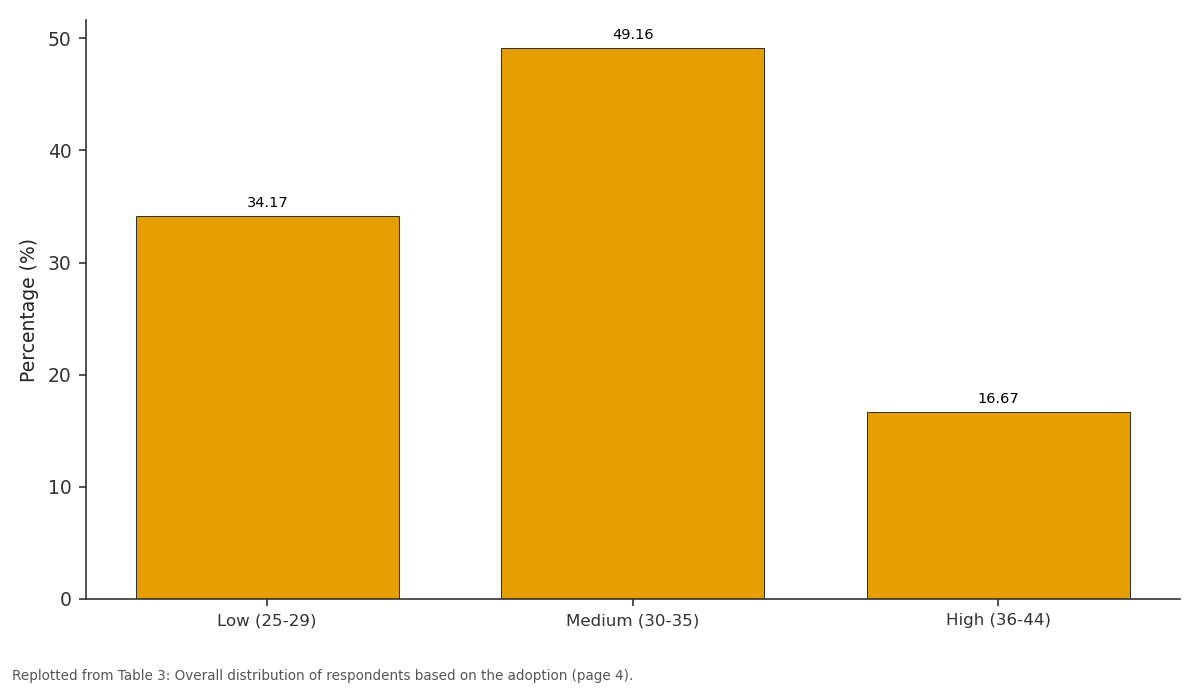
Percentage: Low (25-29) vs Medium (30-35) vs High (36-44)
Replotted from Table 3 (page 4) of the original paper. Every bar is the paper's own table value.
View source evidence ↗Figures & tables
From the original paper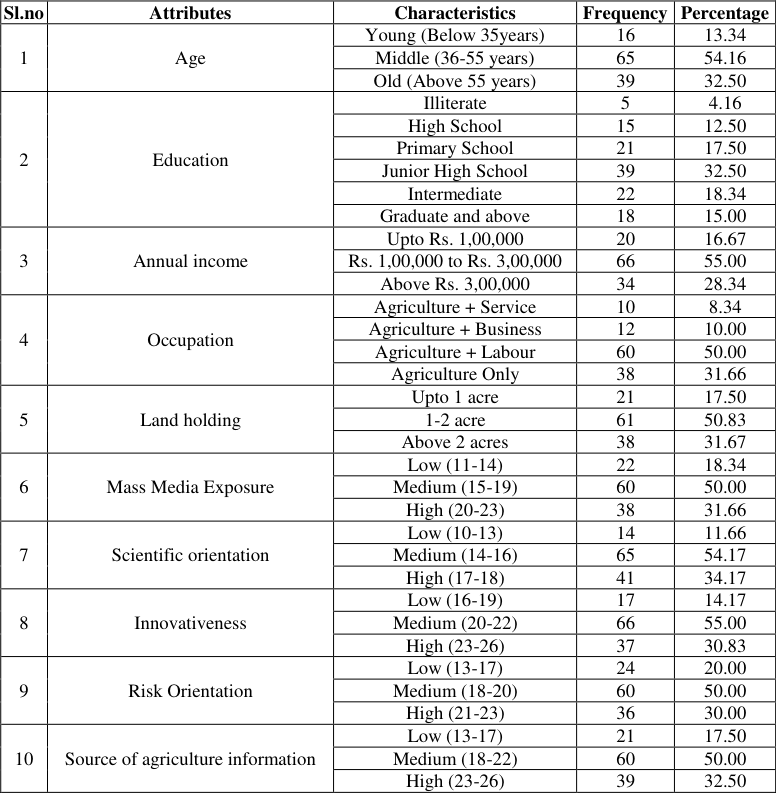 Table 1
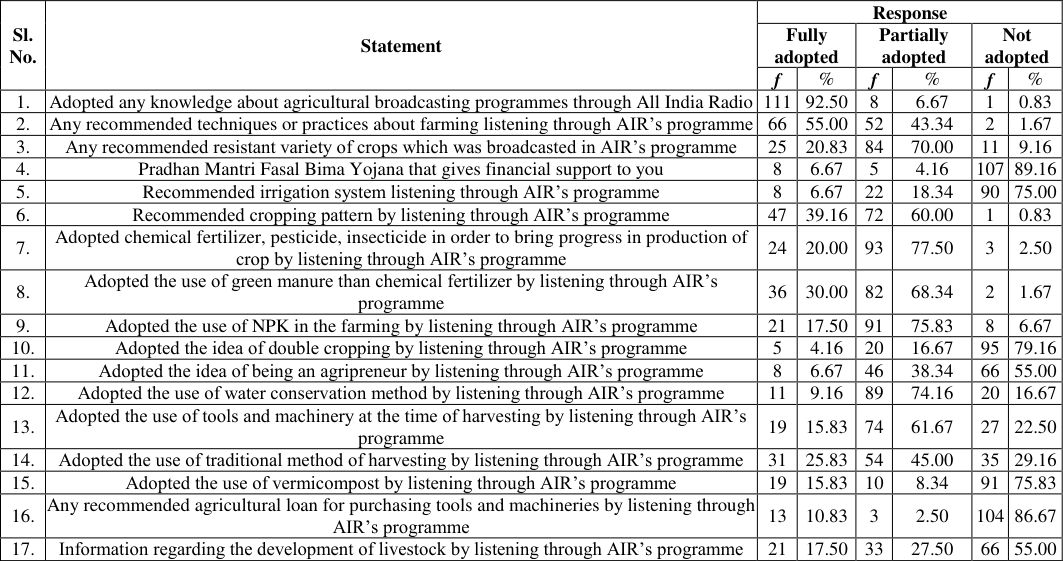 Table 2
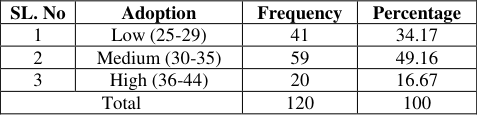 Table 3
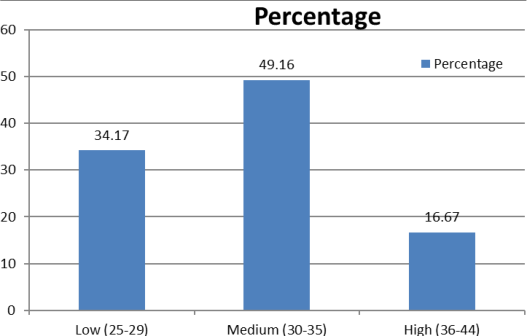 Figure 1
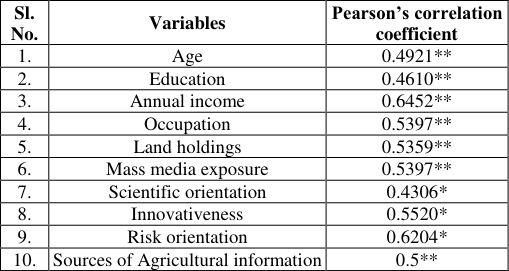 Table 4
Introduction
Akashvani formerly known as All India Radio (AIR), officially known since 1957 as Akashvani (literary meaning "Voice from the Sky"), is the national public radio broadcaster of India and is a division of Prasar Bharati. It was established in 1936. It is the sister service of Prasar Bharati's Doordarshan, an Indian television broadcaster. Headquartered in the Akashvani Bhavan building in New Delhi, it houses the Drama Section, the FM Section, and the National Service, and is also home to the Indian television station Doordarshan Kendra, (Delhi). Radio is considered as an effective tool to disseminate agricultural information among the farmers and it is the most powerful mass media for broadcasting Information quickly. A large percentage of farmers opined that the information broadcast through agricultural radio programmes as "practicable". A large percentage of farmers considered the style of presentation of programmes as "understandable" (Kakade et.al., 2013) [2] . All India Radio has been a witness to the course of development of India as an institution of communication given to catalyze the process of change on the one hand and as an upholder as well as preserver of a vibrant cultural heritage on the other. The socioeconomic development of agrarian sector is a vital factor in Indian agriculture. Keeping this in view All India Radio has been playing a vital role continuously by adopting innovative techniques. In keeping with the respective social objectives, the concern of All India Radio has been to aid the process of changing lives of those who exist on the margins of development. Differing perceptions of development potential at different times needed to be unbundled leading to devising of commensurate communication strategies within the typical development framework. The relevance of All India Radio in the process of social development and change has always been robust primarily because of its innate strength to be in tune with time. The crafts and techniques of information dissemination have meticulously addressed the social realities of respective time in its long course of public service and the impact has been discernible in different realms of life of the society in general and agrarian sector in particular (Sekhar et al., 2017) [3] . In Manipur, the agricultural broadcasting programme of AIR News plays an important role in the development activities of farmer. There are three agricultural programme in AIR News i.e. Khungangi Thouram, Lou-U-Singugi Wapham and Mai Paklaba Loumee. Khungangi Thouram is a composite programme of about one hour, which is broadcast everyday on both FM and MW channels from 6:25-7:25 pm. It consists of three parts first one is interview, second is music (mostly khunung eshei) and the third one is again interview. The interview topic is mainly on agriculture, but sometimes it covers other stuffs also. In this programme, it is mostly discuss on the relationship between the farmers and the rural life. Lou-U-Singugi Wapham is just of 5 minutes programme and it's about agricultural www.extensionjournal.com practices like how to cultivate rice, manure and fertilizer application, post harvest technique, etc. Mai Paklaba Loumee is about the interview of progressive farmers. It is of 30 minutes which is broadcast only on FM every Thursday. Radio is one of the most powerful mass media for the dissemination of agricultural information and its effectiveness has been well established by many researchers. Krishi Samriddhi radio programme is a farm radio programme which is being sponsored by ICAR-Vivekananda Parvatiya Krishi Anusandhan Sansthan, Almora and broadcasted through All India Radio, Akashvani, Almora since July 2009 with the prime objective to disseminate modern agricultural information amongst the local hill farmers as per their need. The present study was conducted to analyze the talks broadcasted in Krishi Samriddhi farm radio programme in a year and its effectiveness as perceived by the farmer listeners (Joshi et al., 2020) [1] .
Justification of the study
The finding of the impact (agricultural broadcasting programme through AIR News Manipur) will help the farmer in the improvement of the agricultural management activities like land and water conservation, sustainable agriculture, biotechnology, integrated pest management in crops, crop insurance schemes, environment protection, disaster management and role of panchayats in rural development etc. It will enable appropriate approach to trace out the constraints faced by the farmers. This study would help the researcher, extension worker, VDO, Government, Non-government Organisation, etc. to do the sincere efforts in promoting awareness on the production and productivity of agriculture.
Objectives
To access the socio-economic profile of the respondents. To identify the factor that affects the adoption of innovative agricultural practices by farmers. To establish the relationship between the selected independent variables with adoption.
Research Methodology
The study was conducted in Bishnupur district of Manipur. Ex-post facto research design was followed for the present study as it shows the characteristics or phenomenon that is being studied. Multi stages sampling was followed for the present study for the selection of samples required. Manipur has 16 districts and out of which Bishnupur district was selected. There are three blocks in Bishnupur district, out of which Bishnupur block was selected purposively based on maximum areas of farming. Three villages were selected from Bishnupur block and a total number of 120 respondents were randomly selected proportionately on the basis of maximum area of farming.
Methods used for data collection
A pre-tested structured interview schedule focused towards the objectives of the study was developed for data collection. Survey method of data collection with the help of a pre-structured interview schedule was used. The collected data were classified, tabulated and analyzed in light of the objectives.
Data statistical analysis
The data collected from the respondents was converted to 3 point score (Likert Scale) and tabulated. The evaluation of the data and the relationship between the independent and dependent variables was done using Mean, Frequency, Percentage and Correlation.
Results and Discussion Socio Economic Characteristics of the Respondents
The data presented in The above table reveals that majority (92.50%) of the respondents fully adopts any knowledge about agricultural broadcasting programmes through All India Radio, 6.67 per cent of the respondents partially adopt and 0.83 per cent of the respondents does not adopt. It was observed that majority (55%) of the respondents fully adopts any recommended techniques or practices about farming listening through AIR's programme, 43.34 per cent of the respondents partially adopt and 1.67 per cent of the respondents does not adopt. It states that majority (70%) of the respondents partially adopts any recommended resistant variety of crops which was broadcasted in AIR's programme, 20.83 per cent of the respondents fully adopt and 9.16 per cent of the respondents does not adopt. It revealed that majority (89.16%) of the respondents not adopts Pradhan Mantri Fasal Bima Yojana, 6.67 per cent of the respondents fully adopt and 4.16 per cent of the respondents does partially adopt. It revealed that majority (75%) of the respondents not adopts recommended irrigation system listening through AIR's programme, 18.34 per cent of the respondents partially adopt and 6.67 per cent of the respondents does fully adopt. It revealed that majority (60%) of the respondents partially adopts recommended cropping pattern by listening through AIR's programme, 39.16 per cent of the respondents fully adopt and 0.83 per cent of the respondents does not adopt. It revealed that majority (77.50%) of the respondents partially adopts chemical fertilizer, pesticide, insecticide in order to bring progress in production of crop by listening through AIR's programme, 20 per cent of the respondents fully adopt and 2.50 per cent of the respondents does not adopt. It revealed that majority (68.34%) of the respondents partially adopts the use of green manure than chemical fertilizer by listening through AIR's programme, 30 per cent of the respondents fully adopt and 1.67 per cent of the respondents does not adopt. It revealed that majority (75.83%) of the respondents partially adopts the use of NPK in the farming by listening through AIR's programme, 17.50 per cent of the respondents fully adopt and 6.67 per cent of the respondents does not adopt. It revealed that majority (79.16%) of the respondents not adopts the idea of double cropping by listening through AIR's programme, 16.67 per cent of the respondents partially adopt and [4] . Risk orientation 0.6204* 10. Sources of Agricultural information 0.5** * = Significant at p = 0.05%, **= Significant at p = 0.01%, NS=Non-Significant The data presented in Table 4 revealed that out of eleven independent variables, i.e. age, education, annual income, occupation, land holding, mass media exposure, scientific orientation, innovativeness, risk orientation and sources of agricultural information are positively and significantly correlated with adoption of farmers towards Agricultural Broadcasting Programme through AIR News.
| Sl. No. | Variables | Pearson’s correlation coefficient |
|---|---|---|
| 1. | Age | 0.4921** |
| 2. | Education | 0.4610** |
| 3. | Annual income | 0.6452** |
| 4. | Occupation | 0.5397** |
| 5. | Land holdings | 0.5359** |
| 6. | Mass media exposure | 0.5397** |
| 7. | Scientific orientation | 0.4306* |
| 8. | Innovativeness | 0.5520* |
| 9. | Risk orientation | 0.6204* |
| 10. | Sources of Agricultural information | 0.5** |
Table text extracted from the original PDF; superscript letters are shown inline. The original table image is below.
View original table image
Conclusion
It is concluded that the socio-economic profile of the respondents, majority of the respondents are middle age (36-55 years), majority of the respondents were educated up-to junior high school level of education, majority of the respondent income is Rs. 1,00,000 to Rs. 3,00,000 rupees, majority of the respondents were engaged in agriculture labour, majority of the respondent land holdings are above 1-2 acres, and majority of the respondents have medium level of mass media exposure, majority of the respondents have medium level of scientific orientation, majority of the respondents have medium level of innovativeness, majority of the respondents have medium level of risk orientation and majority of the respondents have medium level of source of agriculture information. Majority of the respondents had medium level of adoption, followed by low level of adoption and high level of adoption respectively. Subsequently, all of the eleven independent variables, i.e. age, education, annual income, occupation, land holding, mass media exposure, scientific orientation, innovativeness, risk orientation and sources of agricultural information were positively and significantly correlated with adoption of farmers towards Agricultural Broadcasting Programme through AIR News.
Figures and tables from the paper
| Sl.no | Attributes | Characteristics | Frequency | Percentage |
|---|---|---|---|---|
| 1 | Age | Young (Below 35years) | 16 | 13.34 |
| Middle (36-55 years) | 65 | 54.16 | ||
| Old (Above 55 years) | 39 | 32.50 | ||
| 2 | Education | Illiterate | 5 | 4.16 |
| High School | 15 | 12.50 | ||
| Primary School | 21 | 17.50 | ||
| Junior High School | 39 | 32.50 | ||
| Intermediate | 22 | 18.34 | ||
| Graduate and above | 18 | 15.00 | ||
| 3 | Annual income | Upto Rs. 1,00,000 | 20 | 16.67 |
| Rs. 1,00,000 to Rs. 3,00,000 | 66 | 55.00 | ||
| Above Rs. 3,00,000 | 34 | 28.34 | ||
| 4 | Occupation | Agriculture + Service | 10 | 8.34 |
| Agriculture + Business | 12 | 10.00 | ||
| Agriculture + Labour | 60 | 50.00 | ||
| Agriculture Only | 38 | 31.66 | ||
| 5 | Land holding | Upto 1 acre | 21 | 17.50 |
| 1-2 acre | 61 | 50.83 | ||
| Above 2 acres | 38 | 31.67 | ||
| 6 | Mass Media Exposure | Low (11-14) | 22 | 18.34 |
| Medium (15-19) | 60 | 50.00 | ||
| High (20-23) | 38 | 31.66 | ||
| 7 | Scientific orientation | Low (10-13) | 14 | 11.66 |
| Medium (14-16) | 65 | 54.17 | ||
| High (17-18) | 41 | 34.17 | ||
| 8 | Innovativeness | Low (16-19) | 17 | 14.17 |
| Medium (20-22) | 66 | 55.00 | ||
| High (23-26) | 37 | 30.83 | ||
| 9 | Risk Orientation | Low (13-17) | 24 | 20.00 |
| Medium (18-20) | 60 | 50.00 | ||
| High (21-23) | 36 | 30.00 | ||
| 10 | Source of agriculture information | Low (13-17) | 21 | 17.50 |
| Medium (18-22) | 60 | 50.00 | ||
| High (23-26) | 39 | 32.50 |
Table text extracted from the original PDF; superscript letters are shown inline. The original table image is below.
View original table image
| Sl. No. | Statement | Response | — | — | — | — | — |
|---|---|---|---|---|---|---|---|
| Fully adopted | Partially adopted | Not adopted | |||||
| f | % | f | % | f | % | ||
| 1. | Adopted any knowledge about agricultural broadcasting programmes through All India Radio | 111 | 92.50 | 8 | 6.67 | 1 | 0.83 |
| 2. | Any recommended techniques or practices about farming listening through AIR’s programme | 66 | 55.00 | 52 | 43.34 | 2 | 1.67 |
| 3. | Any recommended resistant variety of crops which was broadcasted in AIR’s programme | 25 | 20.83 | 84 | 70.00 | 11 | 9.16 |
| 4. | Pradhan Mantri Fasal Bima Yojana that gives financial support to you | 8 | 6.67 | 5 | 4.16 | 107 | 89.16 |
| 5. | Recommended irrigation system listening through AIR’s programme | 8 | 6.67 | 22 | 18.34 | 90 | 75.00 |
| 6. | Recommended cropping pattern by listening through AIR’s programme | 47 | 39.16 | 72 | 60.00 | 1 | 0.83 |
| 7. | Adopted chemical fertilizer, pesticide, insecticide in order to bring progress in production of crop by listening through AIR’s programme | 24 | 20.00 | 93 | 77.50 | 3 | 2.50 |
| 8. | Adopted the use of green manure than chemical fertilizer by listening through AIR’s programme | 36 | 30.00 | 82 | 68.34 | 2 | 1.67 |
| 9. | Adopted the use of NPK in the farming by listening through AIR’s programme | 21 | 17.50 | 91 | 75.83 | 8 | 6.67 |
| 10. | Adopted the idea of double cropping by listening through AIR’s programme | 5 | 4.16 | 20 | 16.67 | 95 | 79.16 |
| 11. | Adopted the idea of being an agripreneur by listening through AIR’s programme | 8 | 6.67 | 46 | 38.34 | 66 | 55.00 |
| 12. | Adopted the use of water conservation method by listening through AIR’s programme | 11 | 9.16 | 89 | 74.16 | 20 | 16.67 |
| 13. | Adopted the use of tools and machinery at the time of harvesting by listening through AIR’s programme | 19 | 15.83 | 74 | 61.67 | 27 | 22.50 |
| 14. | Adopted the use of traditional method of harvesting by listening through AIR’s programme | 31 | 25.83 | 54 | 45.00 | 35 | 29.16 |
| 15. | Adopted the use of vermicompost by listening through AIR’s programme | 19 | 15.83 | 10 | 8.34 | 91 | 75.83 |
| 16. | Any recommended agricultural loan for purchasing tools and machineries by listening through AIR’s programme | 13 | 10.83 | 3 | 2.50 | 104 | 86.67 |
| 17. | Information regarding the development of livestock by listening through AIR’s programme | 21 | 17.50 | 33 | 27.50 | 66 | 55.00 |
Table text extracted from the original PDF; superscript letters are shown inline. The original table image is below.
View original table image
| SL. No | Adoption | Frequency | Percentage |
|---|---|---|---|
| 1 | Low (25-29) | 41 | 34.17 |
| 2 | Medium (30-35) | 59 | 49.16 |
| 3 | High (36-44) | 20 | 16.67 |
| Total | 120 | 100 |
Table text extracted from the original PDF; superscript letters are shown inline. The original table image is below.
View original table image
References
3 in the original paper- Joshi P, Sanwal R, Chandra N, Roy LM, Mukherjee A, Jethi R, et al. A study on talks broadcasted in farm radio programme Krishi Samriddhi and its effectiveness as perceived by listener farmers. Indian J Ext Educ. 2020;56(4):91-96.
- Kakade O. Credibility of radio programmes in the dissemination of agricultural information: A case study of Air Dharwad, Karnataka. IOSR J Humanit Soc Sci. 2013;12(3):18-22.
- Zondo SNW, Ndoro TJ. Attributes of diffusion of innovation's influence on smallholder farmers' social media adoption in Mpumalanga Province, South Africa. Sustainability. 2023;15(5):4017.