
Research article · 2024 · Full text
International Journal of Agriculture Extension and Social DevelopmentConstraints faced by dairy farm women in managing their dairy enterprise in Uttarakhand
Volume 7(8) · Pages 38–40 · DOI: 10.33545/26180723.2024.v7.i8a.906 ↗
Research areasLivestock Management and Performance ImprovementAgricultural Economics and Practices
Abstract
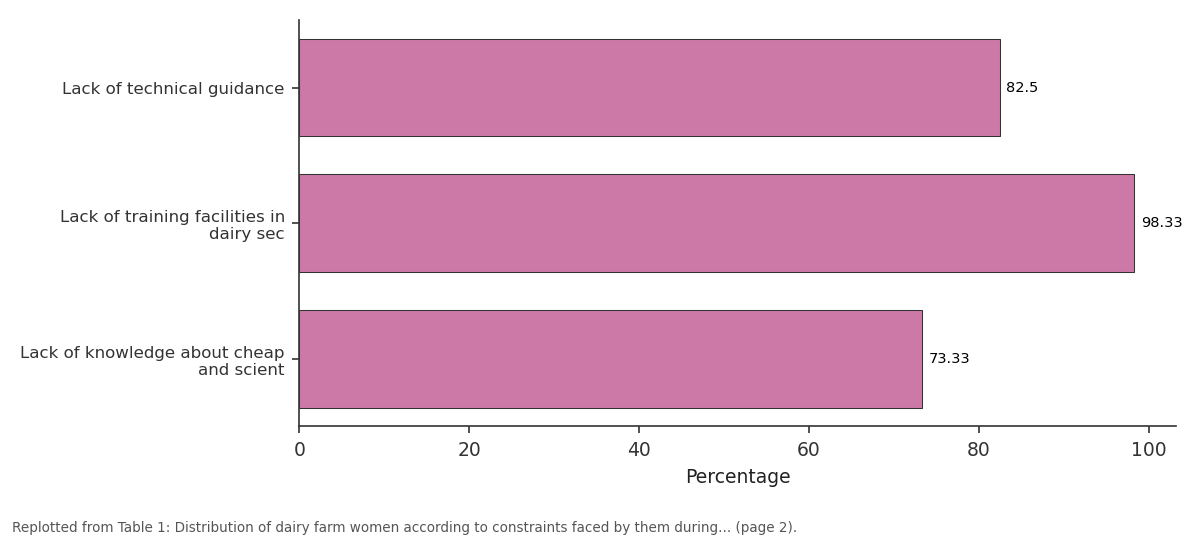
Author-writtenThe present study was conducted in Nainital district of Uttarakhand to analyze the constraints perceived by the dairy farm women while managing the dairy enterprise. Total 120 respondents were selected from five villages of Haldwani block that have maximum milk production. Regarding infrastructural constraints, 90 per cent farm women had lack of improved equipments and 72.5 per cent had low average milk yield of the milch animals. In economic constraints, nearly eighty per cent expressed low price of milk offered and 74 per cent faced high cost of cross-bred cow. As regards to marketing constraints, 65.83 per cent had irregular sale of milk and 70.83 per cent had less knowledge about marketing techniques. In technical constraints, majority i.e. 82.5 per cent farm women had lack of technical guidance and 98.33 per cent expressed lack of training facilities in dairy sector while 91.67 per cent farm women expressed inadequate information about government schemes related to dairy sector.
Summary
Source-checkedPlain-language reading of the full paper, prepared with AI and checked against the text. Each point links to the authors' own words.
Why it matters
- In rural India, dairy farming is closely linked with agriculture and serves as a viable way to create income and employment. View evidence ↗
- Rural women play a significant role in both domestic duties and agricultural activities. View evidence ↗
- In Uttarakhand, dairy farming is a primary activity and a key source of livelihood for communities dependent on livestock. View evidence ↗
The question
- The study aimed to analyze the specific constraints that women in the Nainital district of Uttarakhand face when managing dairy enterprises. View evidence ↗
What they did
- The researchers purposively selected the Nainital district and specifically the Haldwani block due to their high levels of milk production and presence of dairy entrepreneurs. View evidence ↗
- The sample consisted of 120 respondents from five villages, selected using a proportional allocation method, all of whom managed herds of more than five animals. View evidence ↗
What they found
- The primary infrastructural constraints were a lack of improved equipment (90%) and low average milk yield from animals (72.5%). View evidence ↗
- Economic challenges were led by the low price offered for milk (79.16%) and the high cost of cross-breed cows (74.16%). View evidence ↗
- Marketing constraints included a lack of knowledge regarding marketing techniques (70.83%) and the irregular sale of milk (65.83%). View evidence ↗
- Technical barriers were severe, with 98.33% reporting a lack of training facilities, 82.5% lacking technical guidance, and 73.33% lacking knowledge on scientific animal housing. View evidence ↗
- Miscellaneous constraints were dominated by inadequate information on government schemes (91.67%) and poor rapport with extension agencies (87.5%). View evidence ↗
What it means
- The authors recommend that extension workers educate women on government subsidies and schemes, and that women receive training in negotiation skills to improve profitability and efficiency. View evidence ↗
- The authors conclude that dairy farming can be a superior option for rural women provided they have access to proper organization, training, and improved technology. View evidence ↗
Visual summary
2 visualsIllustrations explain the paper; charts are replotted from the paper's own table values.
Percentage: Lack of technical... vs Lack of training... vs Lack of knowledge about...
Replotted from Table 1 (page 2) of the original paper. Every bar is the paper's own table value.
View source evidence ↗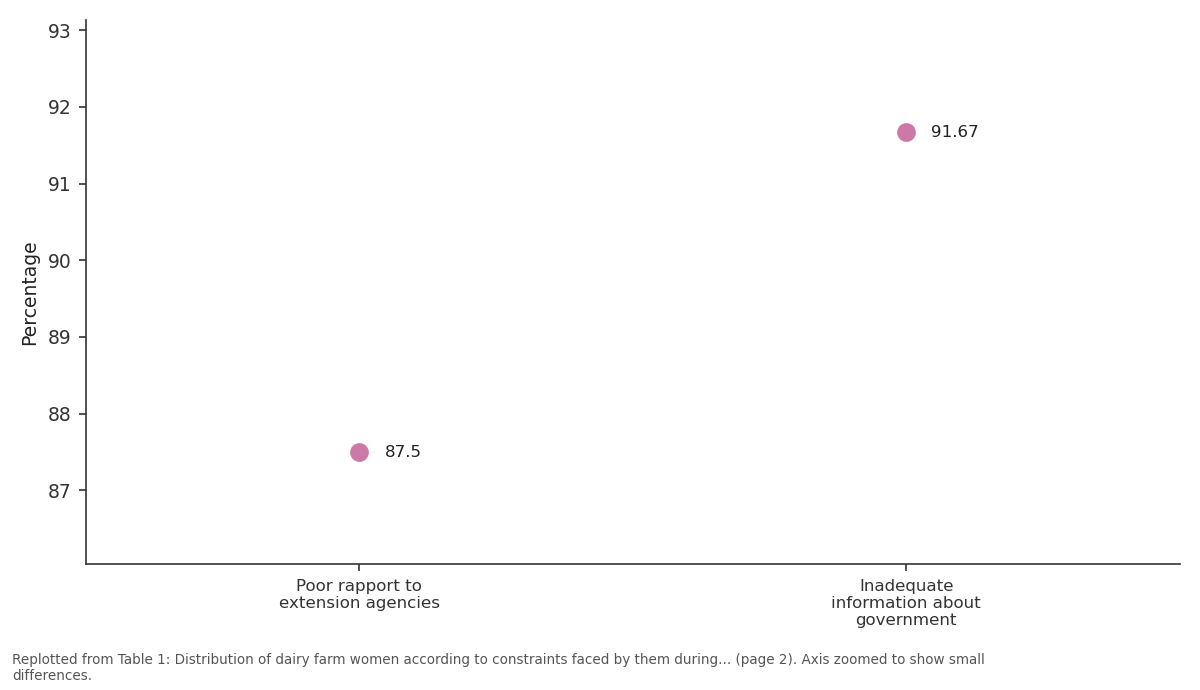
Percentage: Poor rapport to... vs Inadequate information...
Replotted from Table 1 (page 2) of the original paper. Every bar is the paper's own table value.
View source evidence ↗Figures & tables
From the original paper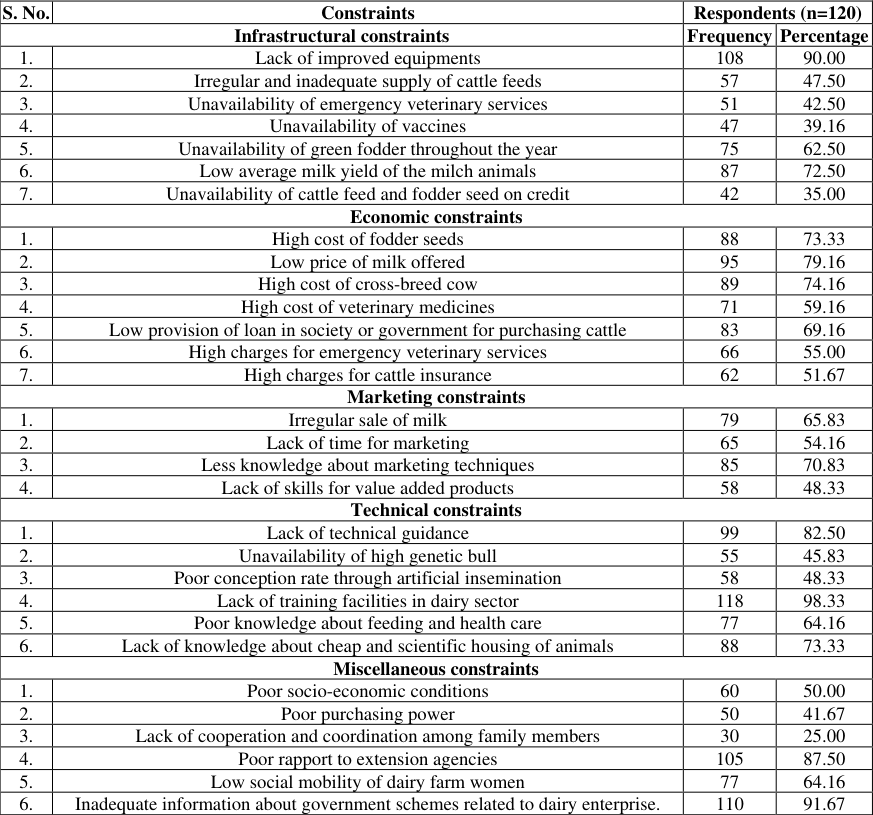 Table 1
Introduction
According to latest 20th Livestock Census 2019, conducted by Department of Animal Husbandry and Dairying, Ministry of Fisheries, Animal Husbandry and Dairying, Government of India, the total livestock population in the country is 536.76 million and total cattle population in the country is 193.46 million. In India, the major portion of livestock population belonged to rural areas with the percentage of 95.78% i.e. 514.11 million and remaining 22.65 million were present in urban areas which constitute only 4.22% of total livestock population. In rural India, dairy farming has been practiced along with agriculture as they both are intertwined with each other. Thus, dairy farming as an enterprise can be a better option for generating employment and income in rural areas. Giridhara (2013) [5] reported that every woman is an entrepreneur as she manages, organizes and assures responsibility for running her house. She is known as a person who accepts a social and family life and makes a balance between them by accepting various challenges for fulfilling their needs and requirements. Rural woman especially shoulders major responsibility not only on domestic front but her contribution in agriculture and allied activities cannot be denied. She has potential for economic transformation and social development of the Nation. According to Patel et al. (2019) [7] rural women perform numerous labour intensive jobs in relation to the livestock activities starting from caring of animals, bringing fodder from fields, chaffing the fodder, cleaning of animals and sheds, milking, making milk products to marketing the milk products. The process of dairy development would be incomplete and lopsided, unless farm women are fully involved in it. Sati (2016) [8] stated that dairy farming is main activity and source of livelihood of livestockdependent farming communities in Uttarakhand. It involves with natural resources base-forest/rangelands, croplands, livestock breeds, feeding, health management, marketing, and consumption of the product. Smallholder dairy farming has enormous potential. It can contribute to family income, generate gainful employment especially for women, elevate living standards of the producer, fight malnutrition especially amongst children and enhances sustainable agriculture. But dairy farm women face many difficulties while doing dairy farming. With the advancement of involving technology into agriculture and allied sectors, women face many constraints while managing their dairy enterprise.
Research Methodology
The present study was conducted in Nainital district of Uttarakhand. Nainital district was selected purposively because it has maximum milk production. Among eight blocks of Nainital district, Haldwani block was purposively selected because it has maximum milk production and dairy entrepreneurs. Total 120 respondents were selected from the five villages who have more than five number of herd size through proportional allocation method. The information regarding various constraints was measured by scale developed by Chaudhary et al. ( 2007) [3] with some modifications. The data were collected with the help of www.extensionjournal.com well-structured and pre-tested interview schedule. The data was analyzed through standard statistical methods such as frequency and percentage to draw the results.
Results and Discussion
Constraints imply the problems and difficulties faced by dairy farm women while doing day-to-day animal husbandry activities in their dairy enterprise. It is evident from Table 1 that 90 per cent respondents pointed out lack of improved equipments as the major infrastructural constraints, followed by low average milk yield of the milch animals by 72.50 per cent respondents. The other constraints reported were unavailability of green fodder throughout the year (62.50%), irregular and inadequate supply of cattle feeds (47.50%), unavailability of emergency veterinary services (42.50%) and only 39.16 per cent respondents expressed unavailability of vaccines as a constraint and 35 per cent had unavailability of cattle feed and fodder seed on credit. It was concluded that most of the dairy farm women had no new improved equipments because they were residing in rural areas. Some respondents had problem of green fodder throughout the year because of small and fragmented land holding.
| S. No. | Constraints | Respondents (n=120) | — |
|---|---|---|---|
| Infrastructural constraints | Frequency | Percentage | |
| 1. | Lack of improved equipments | 108 | 90.00 |
| 2. | Irregular and inadequate supply of cattle feeds | 57 | 47.50 |
| 3. | Unavailability of emergency veterinary services | 51 | 42.50 |
| 4. | Unavailability of vaccines | 47 | 39.16 |
| 5. | Unavailability of green fodder throughout the year | 75 | 62.50 |
| 6. | Low average milk yield of the milch animals | 87 | 72.50 |
| 7. | Unavailability of cattle feed and fodder seed on credit | 42 | 35.00 |
| Economic constraints | |||
| 1. | High cost of fodder seeds | 88 | 73.33 |
| 2. | Low price of milk offered | 95 | 79.16 |
| 3. | High cost of cross-breed cow | 89 | 74.16 |
| 4. | High cost of veterinary medicines | 71 | 59.16 |
| 5. | Low provision of loan in society or government for purchasing cattle | 83 | 69.16 |
| 6. | High charges for emergency veterinary services | 66 | 55.00 |
| 7. | High charges for cattle insurance | 62 | 51.67 |
| Marketing constraints | |||
| 1. | Irregular sale of milk | 79 | 65.83 |
| 2. | Lack of time for marketing | 65 | 54.16 |
| 3. | Less knowledge about marketing techniques | 85 | 70.83 |
| 4. | Lack of skills for value added products | 58 | 48.33 |
| Technical constraints | |||
| 1. | Lack of technical guidance | 99 | 82.50 |
| 2. | Unavailability of high genetic bull | 55 | 45.83 |
| 3. | Poor conception rate through artificial insemination | 58 | 48.33 |
| 4. | Lack of training facilities in dairy sector | 118 | 98.33 |
| 5. | Poor knowledge about feeding and health care | 77 | 64.16 |
| 6. | Lack of knowledge about cheap and scientific housing of animals | 88 | 73.33 |
| Miscellaneous constraints | |||
| 1. | Poor socio-economic conditions | 60 | 50.00 |
| 2. | Poor purchasing power | 50 | 41.67 |
| 3. | Lack of cooperation and coordination among family members | 30 | 25.00 |
| 4. | Poor rapport to extension agencies | 105 | 87.50 |
| 5. | Low social mobility of dairy farm women | 77 | 64.16 |
| 6. | Inadequate information about government schemes related to dairy enterprise. | 110 | 91.67 |
Table text extracted from the original PDF; superscript letters are shown inline. The original table image is below.
View original table image
Regarding economic constraints data in Table 1, nearly eighty per cent (79.16%) dairy farm women expressed low price of milk offered as the major constraint, followed by high cost of cross breed cow by 74.16 per cent respondents. The other constraints reported were high cost of fodder seeds (73.33%), low provision of loan in society (69.16%), high cost of veterinary medicines (59.16%), high charges for emergency services (55.00%) and high charges for cattle insurance (51.67%). It was concluded that maximum number of dairy farm women expressed low price of milk offered, high cost of cross breed cow and high cost of fodder seeds as major economic constraints. About 70.83 per cent dairy farm women possessed less knowledge about marketing techniques as the major marketing constraints. The other marketing constraints were irregular sale of milk (65.83%), lack of time for marketing the milk and milk products (54.16%) and only 48.33 per cent had shown lack of skills for value added products. It might be due to the reason that dairy farm women were less educated and involved much in household chores rather than marketing the milk products. Lack of knowledge of dairy farm women led to selling of dairy products in nearby areas only. [2] , Chaurasiya et al. (2017) [4] , Panchbhai et al. (2017) [6] and Adhikari (2018) [1] who also concluded that most of the dairy respondents expressed lack of improved equipments, unavailability of green fodder, high cost of cross breed cows, lack of technical guidance and marketing techniques, lack of training facilities and inadequate knowledge about government schemes related to dairy sector as major constraints faced by them in managing the dairy enterprise.
Conclusion
Dairy farming as an enterprise can be a better option for rural farm women if they are properly organized, trained and equipped with improved technology. The major constraints faced by dairy farm women were lack of improved equipments, low price of milk offered, less knowledge about marketing techniques, lack of training facilities and inadequate information about government schemes in dairy sector. The extension workers should make efforts to educate women about new subsidies and other government schemes so that they could earn sufficient profit to make dairy a profitable enterprise. Further, dairy farm women should be trained in negotiation skills and avail subsidies to strengthen and manage the dairy efficiently.
References
6 in the original paper- Biswas S, Goswami A, Mazumdar AK, Mazumdar D. Study on reason of employment and unemployment of farm women and constraints in dairy farming. Indian Res J Ext Edu. 2005;5(2&3):27-28.
- Chaudhary RR, Hirevenkanagoudar LV, Hanchinal SN, Mokashi AN. A scale for measurement of entrepreneurial behaviour of dairy farmers. Karnataka J Agric Sci. 2007;20:792-796.
- Chaurasiya KK, Maratha P, Badodiya SK. Factors affecting entrepreneurial behaviour of dairy farmers. Agric Update. 2017;12(1):23-30.
- Panchbhai GJ, Siddiqui MF, Sawant MN, Verma AP, Parmeswaranaik J. Constraints faced by co-operative dairy farmers in adoption of recommended dairy management practices. Int J Curr Microbiol Appl Sci. 2017;6(3):1962-1966.
- Patel S, Singh YK, Singh B. Factors affecting the role of women in farming and allied activities. Indian Res J Ext Edu. 2019;19(2&3):108-111.
- Sati VP. Livestock farming in the Uttarakhand Himalayas, India: use pattern and potentiality. Curr Sci. 2016;111(12):1955-1960.
Cited by 1
From OpenAlex, OpenCitations and reference lists read by Scinovex
- Perceived Constraints among Dairy Farmers in Eastern India Using Logistic Regression ↗
Bhartendu Yadav, Abhilash Singh Maurya, Ajay Kumar Srivastava, Bhavesh Bhavesh, Joginder Singh Malik · 2025
The dairy sector plays a crucial role in sustaining rural livelihoods, especially among the small and marginal farmers, by providing food security, nutrition, and a regular source of income. However, these farmers often face a variety of structural and operational constraints that hinder their growth and economic development. This study investigated the key perceived constraints experienced by selected 270 Marginal-Small…
❝ 0PDF