
Research article · 2024 · Full text
International Journal of Agriculture Extension and Social DevelopmentA study on the knowledge and attitude of the farmers about FPO in empowering the farmers through crop production
Volume 7(8) · Pages 50–53 · DOI: 10.33545/26180723.2024.v7.i8a.908 ↗
Research areasAgricultural Economics and PracticesLivestock Management and Performance Improvement
Abstract
Author-writtenA Farmers Producers Organization is defined as formal rural organization whose member organize themselves with the objective of improving farm income through improved production, marketing, and local processing activities. The present study was conducted in Nizamabad district of Telangana to assess farmer’s knowledge and attitude regarding Farmers producers Organization. The researcher purposively selected 120 respondents from 5 villages under Armoor and Dichipally block. The study findings revealed that the majority of respondents belong to various socio-economic profiles. Most of the respondents fall within age of 36-55 years (49.16%) belongs to OBC caste (43%), have family size upto 6 member (55%), having nuclear family type (77.50%%), have intermediate school (34.17%), lived in cemented house (68.33%), exclusively engaged in farming (50%), having income upto 2 lakhs (53.55%). Source of information, extension agent contact and mass media exposure were at a medium level for 56.44%, 73.33%, & 51.66% whereas scientific orientation were at a medium level for 55.45%.
Summary
Source-checkedPlain-language reading of the full paper, prepared with AI and checked against the text. Each point links to the authors' own words.
Why it matters
- Agriculture is a critical component of the Indian economy, contributing 15.87% of the GDP. View evidence ↗
- Farmer Producer Organizations (FPOs) are formal rural groups aimed at increasing farm income by improving production, marketing, and local processing. View evidence ↗
- FPOs typically provide essential services such as agricultural inputs, market linkages, training, and technical advice to farmers. View evidence ↗
The question
- The study aimed to evaluate the knowledge and attitudes of farmers regarding Farmer Producer Organizations. View evidence ↗
What they did
- The researchers used purposive and random sampling to select 120 respondents from five villages across the Armoor and Dichipally blocks in the Nizamabad district. View evidence ↗
- Data was collected via personal interviews using a pre-structured schedule, employing a 'before and after' research design. View evidence ↗
- The study analyzed data using frequency and percentage distributions. View evidence ↗
What they found
- The majority of respondents were aged 36-55 (49.16%), belonged to the OBC caste (43%), lived in nuclear families (77.50%), and had an annual income up to 2 lakhs (53.55%). View evidence ↗
- Following the intervention, the percentage of farmers with high knowledge of FPOs increased from 40% to 41.66%, while those with low knowledge decreased from 29.16% to 20.83%. View evidence ↗
- The proportion of farmers who understood the FPO concept increased from 76.67% before the intervention to 85% after. View evidence ↗
- Farmer attitudes shifted positively after the intervention, with the 'high' attitude category increasing from 33.33% to 39.16% and the 'low' category decreasing from 35% to 22.5%. View evidence ↗
- The percentage of farmers willing to recommend FPOs to others rose from 80% to 82.5% after the intervention. View evidence ↗
What it means
- The authors state that FPOs empower farmers by improving access to quality inputs and modern technology, which reduces costs and stabilizes income. View evidence ↗
Visual summary
2 visualsIllustrations explain the paper; charts are replotted from the paper's own table values.
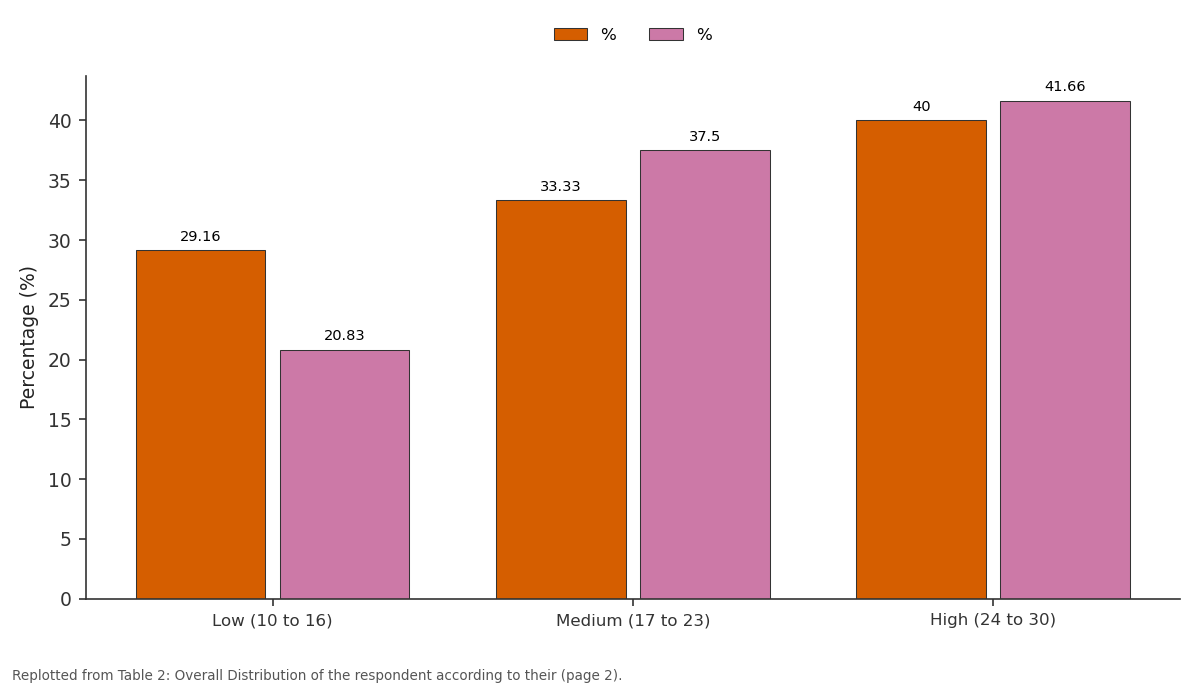
% and %: Low (10 to 16) vs Medium (17 to 23) vs High (24 to 30)
Replotted from Table 2 (page 2) of the original paper. Every bar is the paper's own table value.
View source evidence ↗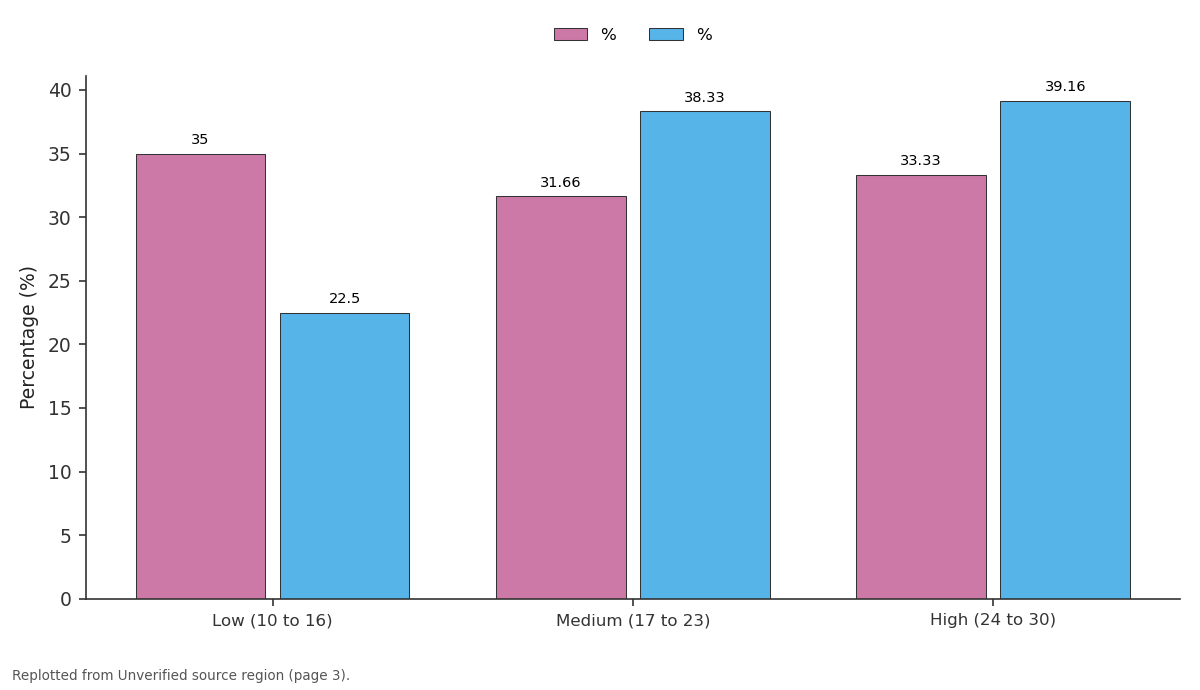
% and %: Low (10 to 16) vs Medium (17 to 23) vs High (24 to 30)
Replotted from a table (page 3) of the original paper. Every bar is the paper's own table value.
View source evidence ↗Figures & tables
From the original paper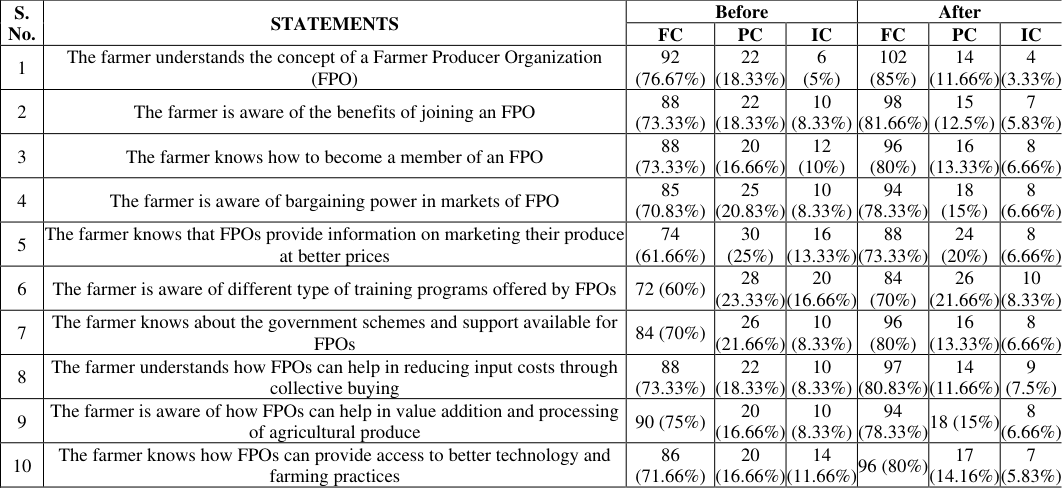 Table 1
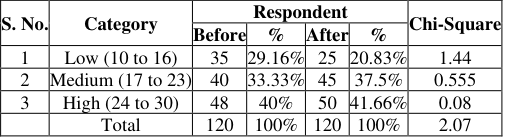 Table 2
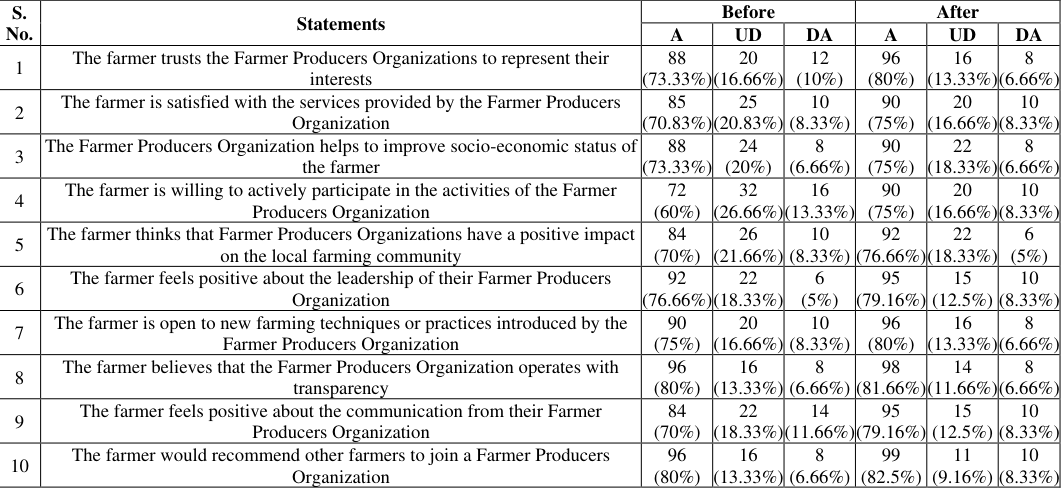 Table 3
Introduction
Agriculture in India is predominantly production oriented and plays a pivotal role in the Indian economy. Further, it is spread over a large number of small and fragmented holdings. Agriculture is often referred to as the backbone of Indian economy as it contributes 15.87 percent of the GDP. It provides employment to around 53 percent of the Indian work force, contributes to overall growth of the economy and reduces poverty by providing employment and food security to majority of the population. Agriculture in India is unique in its characteristics, where over 250 different crops are cultivated in varied agro-climatic regions, unlike 25 to 30 crops grown in many of the developed nations of the world target group. A Producer Organization is defined as formal rural Organization whose members organize themselves with the objective of improving farm income through improved production, marketing, and local processing activities. Producer Organisation (POs) strengthen economic position its members by providing agricultural inputs, credit, processing and marketing services. National Commission on Farmers (2004) stated that Farmers' Organizations should be promoted to combine the advantages of decentralized production and centralized services, post-harvest management, value addition and marketing. International Fund for Agricultural Development (2004) opined that "in rural areas, Farmers' Organisations (FOs) are the nearest and often the only institutions providing essential goods and services to the rural poor and helping them to break out of the poverty cycle. FOs reduce the risk that individual farmers face during seasonal shocks. FOs also mobilize capital and contribute to the growth of the local economy. Farmers Organizations (FOs) Are essentially institutions for the empowerment, poverty alleviation and advancement of farmers and the rural poor. It has been estimated that there are around 6000 FPOs across the country formed by different agencies under different arrangements. NABARD had been at the fore front of promoting a large number of FPOs within a short time span. The FPO's major operations will include the supply of seed, fertilizer and machinery, market linkages, training and networking and financial and technical advice. The Government of India has approved and launched the Central Sector Scheme of "Formation and Promotion of 10,000 Farmer Producer Organizations (FPOs)" to form and promote 10,000 new FPOs till 2027-28 with a total budgetary outlay of Rs.6865 Cr.
Objectives of the study
To study the knowledge and attitude of respondents towards Farmer Producer Organization.
Research methodology
The study used Purposive sampling to select samples for the study. The districts were chosen through purposive sampling, with Nizambad district being chosen due to FPO for farmers. The blocks were chosen are Armoor and Dichipally. From two block, five villages were randomly selected, and from each village, 24 respondents were selected, constituting 120 respondents. Personal interview method was utilized by the investigator himself, either at their home or at their field. Before and After research design has been used in the present study. The data collected from the respondents by using pre-structured interview schedule. Data analysis is done through frequency and percentage distribution using statistical tools. For calculating percentage, frequency was multiplied by 100 and divided by total number of respondents.
Results and Discussion
Objective 1: Knowledge level of respondents towards FPO This part of the chapter deals with impact of Farmers Producers organization on its respondent farmers in Nizamabad District District of Telangana. Knowledge as a body of understood information possessed by an individual is one of the important components of behavioural aspect. On this ground, it was realized imperative to examine the extent of knowledge of respondents about Farmers Producers Organiszation.
Distribution of respondent respondents according to their knowledge about Farmer Producer Organization in Nizamabad District, Telangana
The study categorized respondents into low, medium, and high knowledge levels about FPO, focusing on individual aspect-wise knowledge to identify areas of good knowledge and areas of lack, aiming to improve future focus. The data shows that farmers have a good understanding of the concept of Farmer Producer Organizations (FPOs) and are aware of the benefits of joining one. They also have knowledge about the various ways FPOs can support them in terms of market access, reducing input costs, value addition, and technology adoption. This understanding is crucial in helping farmers realize the potential of FPOs as a tool for improving their livelihoods and increasing their profitability. By pooling resources and expertise, farmers in FPOs can negotiate better prices for their produce, access credit and inputs at lower rates, and benefit from shared knowledge and best practices. Furthermore, the data also suggests that there is a strong interest among farmers in participating in FPOs and reaping the benefits that come with it. This eagerness to be part of FPOs indicates a willingness to collaborate and work collectively towards achieving common goals, thereby strengthening the agricultural community as a whole. Overall, the findings highlight the importance of fostering awareness and education around FPOs among farmers, as well as creating an enabling environment that supports the development and growth of these organizations. By doing so, we can empower farmers to take control of their own destinies and work towards a more sustainable and prosperous future for themselves and their communities. The data shows a shift towards higher levels of respondent categories after the intervention, with an increase in the percentage of respondents falling into the Medium and High categories and a decrease in the Low category. This shift suggests that the intervention had a positive impact on the respondents, leading to an overall improvement in their perceptions or behaviors related to the topic being studied. The increase in the Medium and High categories indicates that more respondents are now exhibiting positive attitudes or behaviors, while the decrease in the Low category suggests that fewer respondents are displaying negative attitudes or behaviors
Attitude of respondents towards farmer producer organization
This part of the chapter deals with Attitude towards Farmer Producer organization on its respondent farmers in Nizambad District of Nizambad. Attitude as a body of understood information possessed by an individual is one of the important components of behavioral aspect. On this ground, it was realized imperative to examine the extent of Attitude of respondents about FPO.
Distribution of respondent respondents according to their Attitude about FPO in Nizanbad District, Telangana
The study categorized respondents into low, medium, and high attitude levelsFarmer Producer organization focusing on individual aspect-wise attitudes to identify areas of improvement and prioritize areas with low attitudes for future planning. The data indicates that farmers have a high level of trust and satisfaction with Farmer Producers Organizations, believing that they positively impact their socio-economic status and local farming community. Farmers are willing to actively participate, open to new techniques, and would recommend joining such organizations to others in the farming community. The findings suggest that Farmer Producers Organizations play a crucial role in empowering farmers and improving their livelihoods. The sense of community and support provided by these organizations is highly valued by farmers, who see them as a valuable resource for knowledge sharing, market access, and collective bargaining power. This suggests that the intervention had a positive impact on the respondents, leading to an overall improvement in their levels of satisfaction or agreement with the subject matter. The decrease in the percentage of respondents in the high category could indicate that the intervention helped to address any issues or concerns that were previously present, leading to a more balanced distribution of responses across the different categories. Overall, the data supports the effectiveness of the intervention in bringing about positive changes in the attitudes or perceptions of the respondents.
Conclusion
It is concluded that majority of the respondents having middle-aged engaged in farming. Most of them were found to be literate, farming was the main occupation, earning an annual income of upto Rs. 2 lakhs. Majority of respondents belong to OBC caste with upto 6 members family type belongs to nuclear family type. The study reveals that after Impact of FPO the knowledge level of majority farmers changed to high level (41.66%) followed by medium (37.5) & low (20.83%). The study also reveals the attitude level was also changed to high (39.16%) followed by medium
Acknowledgement
www.extensionjournal.com (38.33%) and low (22.5%). FPOs have significantly enhanced farmers' access to critical resources such as quality seeds, fertilizers, and modern agricultural technologies. By collectively purchasing inputs and marketing their produce, farmers benefit from economies of scale, resulting in reduced costs and improved income stability. Additionally, FPOs facilitate knowledge dissemination through training programs, enabling farmers to adopt better farming practices, increase crop yields, and diversify their crop portfolios.
Figures and tables from the paper
| S. No. | STATEMENTS | Before | — | — | After | — | — |
|---|---|---|---|---|---|---|---|
| FC | PC | IC | FC | PC | IC | ||
| 1 | The farmer understands the concept of a Farmer Producer Organization (FPO) | 92 (76.67%) | 22 (18.33%) | 6 (5%) | 102 (85%) | 14 (11.66%) | 4 (3.33%) |
| 2 | The farmer is aware of the benefits of joining an FPO | 88 (73.33%) | 22 (18.33%) | 10 (8.33%) | 98 (81.66%) | 15 (12.5%) | 7 (5.83%) |
| 3 | The farmer knows how to become a member of an FPO | 88 (73.33%) | 20 (16.66%) | 12 (10%) | 96 (80%) | 16 (13.33%) | 8 (6.66%) |
| 4 | The farmer is aware of bargaining power in markets of FPO | 85 (70.83%) | 25 (20.83%) | 10 (8.33%) | 94 (78.33%) | 18 (15%) | 8 (6.66%) |
| 5 | The farmer knows that FPOs provide information on marketing their produce at better prices | 74 (61.66%) | 30 (25%) | 16 (13.33%) | 88 (73.33%) | 24 (20%) | 8 (6.66%) |
| 6 | The farmer is aware of different type of training programs offered by FPOs | 72 (60%) | 28 (23.33%) | 20 (16.66%) | 84 (70%) | 26 (21.66%) | 10 (8.33%) |
| 7 | The farmer knows about the government schemes and support available for FPOs | 84 (70%) | 26 (21.66%) | 10 (8.33%) | 96 (80%) | 16 (13.33%) | 8 (6.66%) |
| 8 | The farmer understands how FPOs can help in reducing input costs through collective buying | 88 (73.33%) | 22 (18.33%) | 10 (8.33%) | 97 (80.83%) | 14 (11.66%) | 9 (7.5%) |
| 9 | The farmer is aware of how FPOs can help in value addition and processing of agricultural produce | 90 (75%) | 20 (16.66%) | 10 (8.33%) | 94 (78.33%) | 18 (15%) | 8 (6.66%) |
| 10 | The farmer knows how FPOs can provide access to better technology and farming practices | 86 (71.66%) | 20 (16.66%) | 14 (11.66%) | 96 (80%) | 17 (14.16%) | 7 (5.83%) |
Table text extracted from the original PDF; superscript letters are shown inline. The original table image is below.
View original table image
| S. No. | Category | Respondent | — | — | — | Chi-Square |
|---|---|---|---|---|---|---|
| Before | % | After | % | |||
| 1 | Low (10 to 16) | 35 | 29.16% | 25 | 20.83% | 1.44 |
| 2 | Medium (17 to 23) | 40 | 33.33% | 45 | 37.5% | 0.555 |
| 3 | High (24 to 30) | 48 | 40% | 50 | 41.66% | 0.08 |
| Total | 120 | 100% | 120 | 100% | 2.07 |
Table text extracted from the original PDF; superscript letters are shown inline. The original table image is below.
View original table image
| S. No. | Statements | Before | — | — | After | — | — |
|---|---|---|---|---|---|---|---|
| A | UD | DA | A | UD | DA | ||
| 1 | The farmer trusts the Farmer Producers Organizations to represent their interests | 88 (73.33%) | 20 (16.66%) | 12 (10%) | 96 (80%) | 16 (13.33%) | 8 (6.66%) |
| 2 | The farmer is satisfied with the services provided by the Farmer Producers Organization | 85 (70.83%) | 25 (20.83%) | 10 (8.33%) | 90 (75%) | 20 (16.66%) | 10 (8.33%) |
| 3 | The Farmer Producers Organization helps to improve socio-economic status of the farmer | 88 (73.33%) | 24 (20%) | 8 (6.66%) | 90 (75%) | 22 (18.33%) | 8 (6.66%) |
| 4 | The farmer is willing to actively participate in the activities of the Farmer Producers Organization | 72 (60%) | 32 (26.66%) | 16 (13.33%) | 90 (75%) | 20 (16.66%) | 10 (8.33%) |
| 5 | The farmer thinks that Farmer Producers Organizations have a positive impact on the local farming community | 84 (70%) | 26 (21.66%) | 10 (8.33%) | 92 (76.66%) | 22 (18.33%) | 6 (5%) |
| 6 | The farmer feels positive about the leadership of their Farmer Producers Organization | 92 (76.66%) | 22 (18.33%) | 6 (5%) | 95 (79.16%) | 15 (12.5%) | 10 (8.33%) |
| 7 | The farmer is open to new farming techniques or practices introduced by the Farmer Producers Organization | 90 (75%) | 20 (16.66%) | 10 (8.33%) | 96 (80%) | 16 (13.33%) | 8 (6.66%) |
| 8 | The farmer believes that the Farmer Producers Organization operates with transparency | 96 (80%) | 16 (13.33%) | 8 (6.66%) | 98 (81.66%) | 14 (11.66%) | 8 (6.66%) |
| 9 | The farmer feels positive about the communication from their Farmer Producers Organization | 84 (70%) | 22 (18.33%) | 14 (11.66%) | 95 (79.16%) | 15 (12.5%) | 10 (8.33%) |
| 10 | The farmer would recommend other farmers to join a Farmer Producers Organization | 96 (80%) | 16 (13.33%) | 8 (6.66%) | 99 (82.5%) | 11 (9.16%) | 10 (8.33%) |
Table text extracted from the original PDF; superscript letters are shown inline. The original table image is below.
View original table image
References
6 in the original paper- Agarwal B. Rethinking agricultural production collectivities. Econ Polit Wkly. 2010;45(9):64-78.
- Ajmal MP, Mathur A. Farmer producer organisations (FPOs): An approach for doubling farmer income by 2022. J Pharmacogn Phytochem. 2018;7(6):1321-1325.
- Babu C, Patoju KS. Impact of Farmer Producer Companies on marginal and small farmers: A study in Osmanabad District of Maharashtra. Grassroot J Nat Resour. 2021;4(2):23-33.
- Bikkina N, Turaga RMR, Bhamoriya V. Farmer Producer Organizations. Dev Policy Rev. 2015;36:669687.
- Chandre GMJ, Sreenath DMH. Women's participation in Karnataka's FPOs. Econ Polit Wkly. 2018;53(45):21.
- Chauhan S. Producer companies in Madhya Pradesh: An evaluative study. Int J Recent Res Aspects. 2015;2(3):66-77.