
Research article · 2024 · Full text
International Journal of Veterinary Sciences and Animal HusbandryPerformance of Dorper sheep fed on range grass and legume diets in a feedlot system in Taita Taveta and Makueni counties of Kenya
Volume 9(4) · Pages 499–502 · DOI: 10.22271/veterinary.2024.v9.i4h.1589 ↗
Research areasRangeland Management and Livestock EcologyRuminant Nutrition and Digestive PhysiologyGenetic and phenotypic traits in livestock
Abstract
Author-writtenA feeding trial was conducted on-farm at Kasigau Ranch in Taita Taveta County and on-station at Kenya Agricultural and Livestock Research Organization (KALRO) Kiboko in Makueni County, Southern Kenya to determine the performance of Dorper sheep fed on different diets in a feedlot system. The trial animals at KALRO were ewes while those at Kasigau Ranch were rams, all aged between 10 to 12 months and weighing 22.7±2.4 kg. Two grasses i.e. African foxtail (Cenchrus ciliaris) and Bush rye (Enteropogon macrostachyus) and two legumes, that is, Dolichos lablab (Lablab purpureus) and Cowpea M66 (Vigna unguiculata) were used to formulate the diets. The six diets representing the treatments included; Diet 1; C. ciliaris + cowpea, Diet 2; C. ciliaris + Dolichos lablab, Diet 3; E. macrostachyus + cowpea, Diet 4; E macrostachyus + Dolichos Lablab, Diet 5; C. ciliaris and Diet 6; E. macrostachyus. The trial at Kasigau Ranch involved 18 rams while the KALRO Kiboko one involved 24 ewes with 3 and 4 animals assigned to each treatment at Kasigau and Kiboko, respectively, in a completely randomized block design. Nutritive analysis of the diets was performed using wet chemistry for dry matter (DM), crude protein (CP), acid-detergent fibre (ADF) and neutral-detergent fibre (NDF), crude fiber (CF), Nitrogen free extract (NFE) and acid detergent lignin (ADL). All the trial animals were weighed once a week for growth performance data collection. The data collected was analyzed using Genstat 14th Edition and the means separated using Turkey HSD at 5% significant level. Analysis of the Dry Matter Intake (DMI) and weight gain data showed significant differences (p
Summary
Source-checkedPlain-language reading of the full paper, prepared with AI and checked against the text. Each point links to the authors' own words.
Why it matters
- Kenya faces a significant beef supply deficit of approximately 300,000 MT, with demand estimated at 900,000 MT compared to a supply of 600,000 MT. View evidence ↗
- The beef supply gap is largely driven by shortages in the quantity and quality of feed available in Arid and Semi-Arid Lands (ASALs), which hinders livestock productivity. View evidence ↗
- Small ruminants in these regions are typically raised via open grazing on rangeland grasses that lack necessary protein or energy supplementation and have low nutritive value. View evidence ↗
The question
- The study aimed to evaluate the performance of Dorper sheep when fed various diets within a feedlot system. View evidence ↗
What they did
- The trial used Dorper sheep aged 10 to 12 months with an average weight of 22.7±2.4 kg, consisting of ewes at the KALRO site and rams at Kasigau Ranch. View evidence ↗
- The study involved 18 rams at Kasigau Ranch and 24 ewes at KALRO Kiboko, with animals assigned to treatments in a completely randomized block design. View evidence ↗
- The trial animals were provided their assigned diets ad-libitum over a period of 90 days. View evidence ↗
What they found
- The combination of C. ciliaris and cowpea resulted in the highest Average Daily Weight Gain (ADWG), reaching 245.0 g at Kasigau and 272.4 g/day at Kiboko. View evidence ↗
- The lowest weight gains were observed in control sheep fed a pure E. macrostachyus diet, with gains of 121.7 g/day at Kasigau and 89.4 g/day at Kiboko. View evidence ↗
- The C. ciliaris and Cowpea diet produced the highest Dry Matter Intake (DMI), recorded at 977.0 g/day at Kasigau and 1023.1 g/day at Kiboko. View evidence ↗
- Regression analysis showed that the feed ration influenced the Average Daily Weight Gain (ADWG) by 70.7%. View evidence ↗
- Control diets consisting of pure grass fell below the recommended quality thresholds of 7% crude protein (CP) and 8MJ metabolizable energy (ME) per kg of dry matter. View evidence ↗
What it means
- The authors concluded that including legumes in the diets enhances nutritive quality, dry matter intake, and average daily weight gain. View evidence ↗
- The authors recommend that farmers always include legumes in feed rations, either by growing them on-farm or using commercial high-protein concentrates, to improve livestock performance. View evidence ↗
Visual summary
3 visualsIllustrations explain the paper; charts are replotted from the paper's own table values.
Diet Composition Comparison
AI-generated conceptual illustration (Dorper sheep). It explains the idea and does not show study data.
View source evidence ↗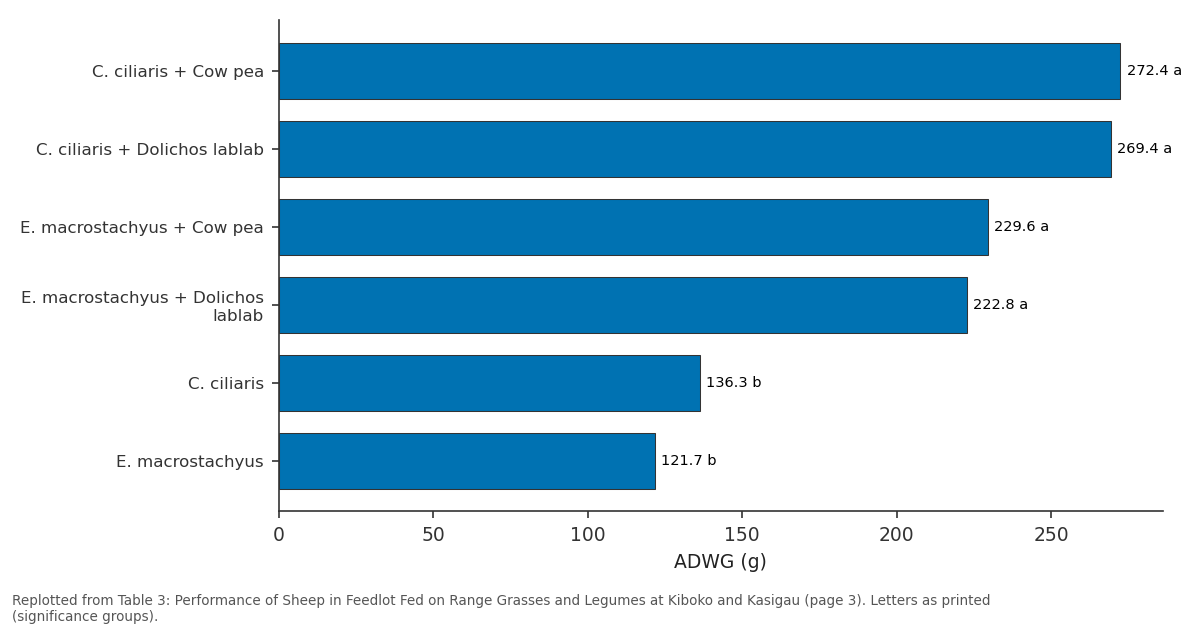
ADWG (g): C. ciliaris + Cow pea vs C. ciliaris + Dolichos... vs E. macrostachyus + Cow... vs E. macrostachyus +... vs C. ciliaris
Replotted from Table 3 (page 3) of the original paper. Every bar is the paper's own table value.
View source evidence ↗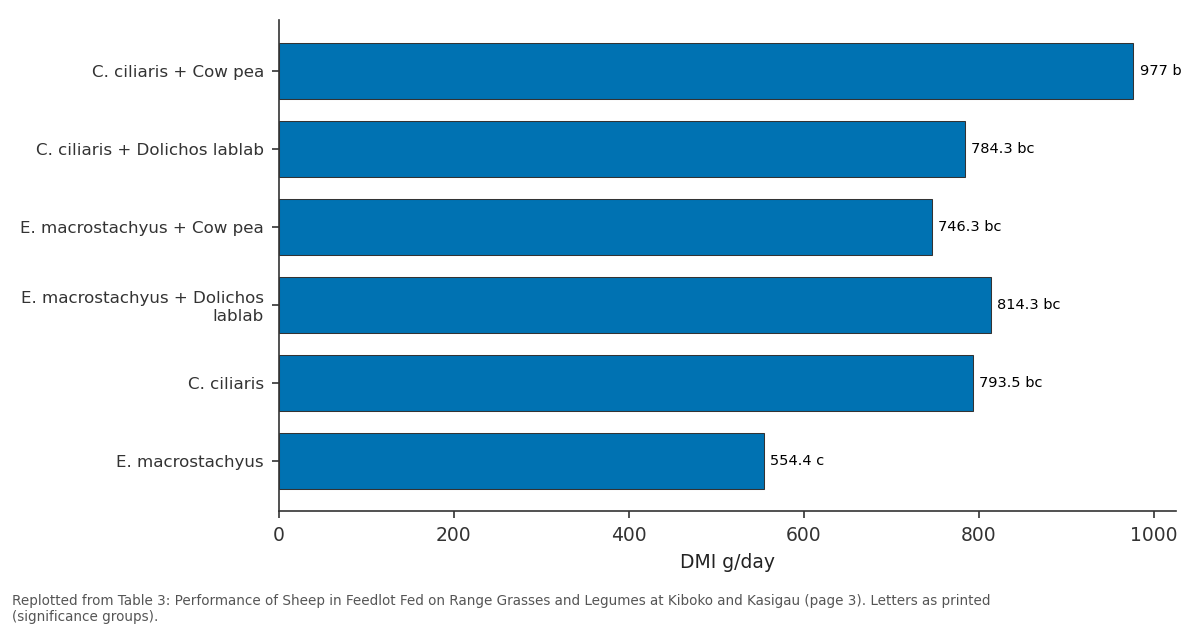
DMI g/day: C. ciliaris + Cow pea vs C. ciliaris + Dolichos... vs E. macrostachyus + Cow... vs E. macrostachyus +... vs C. ciliaris
Replotted from Table 3 (page 3) of the original paper. Every bar is the paper's own table value.
View source evidence ↗Figures & tables
From the original paper Table 1
 Table 2
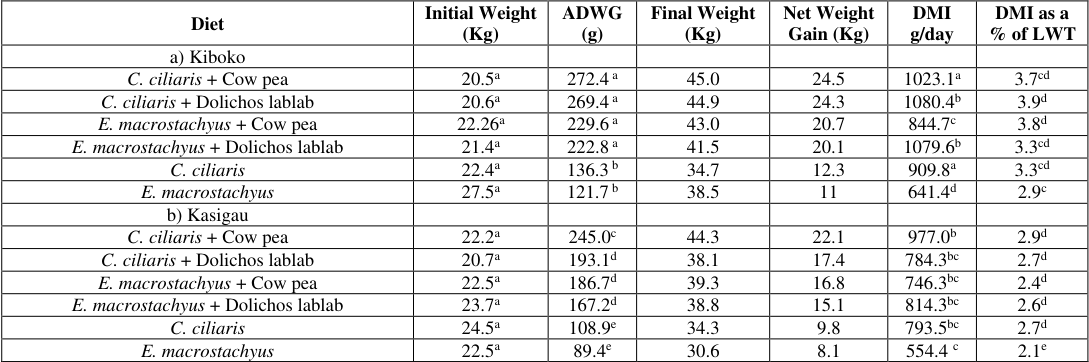 Table 3
Introduction
The estimated demand for beef in Kenya is about 900,000 against estimated supply of 600,000 suggesting a supply deficit of about 300,000 MT (Mwangi et al. 2020) [11] . Kenya has an estimated population of 14 -14.3 million beef cattle, 17 million sheep, 24 -26.7 million meat goats and 3 million camels (KNBS, 2010; Kilimo News, 2020) [5,6] about 70% of which are in the Arid and Semi-Arid lands It is important and imperative to close this supply gap. An important cause of this beef supply deficit is feed shortage in terms of quantity and quality, which limits livestock production and productivity in the Arid and semi-arid lands (ASALs). Small ruminants provide food and nutritional security to disadvantaged groups and smallholder farmers in ASAL rain-fed production systems (Juma et al., 2010) [4] . The small ruminants are reared under extensive open grazing system dominated by rangeland grasses that are generally of low nutritive value and without protein or energy supplementation (Sagala et al., 2021) [13] . Dorper sheep is across of Dorset and Black head Persian (Milne, 2000) [9] . The animals take up to 3 years to attain the market weight. There is need to improve the nutritional plane of the animals in order to fast-track the growth.
Practicing feedlot system of production in ASALs is one way of addressing the nutritional challenges faced by grazing ruminants. Excess forages could be harvested during the growing seasons and conserved. These can be fed to livestock for a short period of 90 to 120 days for purposes of finishing them for the market. To cover the protein deficit in the rangeland grasses, well adapted legumes can be planted and used to formulate quality feed rations to feed animals in the feedlot. Such animals would attain the market weights faster thus increasing the flow of economic benefits to the small scale livestock farmers and support the national effort to close the beef supply gap in the country.
Materials and Methods
Materials and Methods
Study sites
The study was carried out at both Kasigau Ranch in Taita [10] . An unreliable rainfall occurs in March, April and May while the reliable short rains occurs in October, November and December.
Preparation of the Trial Diets
The diet ingredients were grown in the respective sites, harvested, sun dried and stored as hay bales and in gunny bags for the grass and legumes, respectively. The grass and legume material were processed by chopping to 2cm size using motorized chopper. The diets were prepared by mixing the grass with the legume at the ratio of 3:1, respectively. A total of six diets representing the treatments were formulated, including; Diet 1; C. ciliaris + Cowpea, Diet 2; C. ciliaris + Dolichos lablab, Diet 3; E. macrostachyus + Cowpea, Diet 4; E. macrostachyus + Dolichos lablab, Diet 5; C. ciliaris and Diet 6; E. macrostachyus. The latter two diets represented the controls.
The Trial Animals, Design and Feeding
The trial animals at KALRO were ewes while those at Kasigau Ranch were rams, all aged between 10 to 12 months and weighing 22.7±2.4 kg. Four and three individually housed animals were randomly assigned to the trial diets/treatments at KALRO and Kasigau, respectively, in a completely randomized design where the individual animals were replicates for each diet. The initial live weight of all the animals was taken using a digital weighbridge for small stock. The Daily share of each diet was provided ad-libitum for a period of 90 days. The amount of feed offered to each animal daily was weighed using digital Kitchen balance of capacity 10kg, with accuracy of 1 gram. The daily amount was divided into two where, half portion was offered at 08.00 hrs and the other half at 14.00 hrs in the individual pens. The refusals were weighed the next morning as the first activity of the day. Water and mineral block (Afya Bora® stock lick; Unga Group PLC.) were offered ad-libitum to all the animals in the trial. Samples of each diet were taken every time new formulation was done, mixed at the end of the trial and triplicate composite samples taken for each diet for nutritive value analysis that was done using wet chemistry. After taking the initial weight, the animals were acclimatized for one week in the feedlot, before data collection commenced and thereafter weighed on weekly basis. At the end of the trial period, the final body weight of each animal was taken in order to determine the growth rate. Average Daily Weight Gain (ADWG, g/day) was obtained by calculating the difference between the final and the initial body weight (kg), divided by the number of days in feedlot and multiplied by 1,000 to obtain ADWG in grams.
Statistical Analysis
The data on daily dry matter intake, daily weight gain and the nutritive value were recorded in excel spreadsheet and analyzed using Genstat 14 th Edition. Where the analysis of variance was significant, the means were separated using Turkey's HSD at 5% significant level.
Results and Discussion
The regression analysis presented in Table 1 indicates that the variables used in the model were significant at p=0.000. The independent variable, 'feed ration' influenced the dependent variable, 'ADWG' by 70.7%. The ADWG performance of the animals was significantly influenced by the feed ration such that an increase in feed quality increased the animal performance and vice versa. The initial weights of the animals did not have a significant influence, (p=0.278) on the growth performance which is attributed to the homogeneity in sampling of the animals where the differences in animal weights were negligible. (Gohl, 1981; Machogu, 2013) [3,8] . The acid detergent fibre for all the diets was high, ranging between 42% and 52% compared to 30% to 41% reported by Machogu (2013) [8] for rangeland grasses and Brachiaria Mulato II. These diets also had marginal level of metabolizable energy. The low crude protein, high fiber and low ME suggested low quality of the grasses. The other diets combining grass and legume had slightly higher levels of CP and metabolizable energy compared with the recommended minimum for quality livestock feed, suggesting fair quality. The diet, E. macrostachyus + Dolichos lablab had exceptionally high level of CP in both sites. andE. macrostachyus + Dolichos lablab diets recorded similar and the highest DMI while sheep on pure E. macrostachyus control diet had the lowest DMI. The finding for the control sheep on E. macrostachyus diet is attributed to high acid detergent fiber of between 474 and 504 g/Kg DM and low crude protein of between 37 to 57 g/Kg DM.
| Source | Type III Sum of Squares | df | Mean Square | F | Sig. |
|---|---|---|---|---|---|
| Model | 904337.124a | 22 | 41106.233 | 5.717 | .000 |
| Initial weight | 195831.441 | 21 | 9325.307 | 1.297 | .278 |
| Ration | 112787.936 | 1 | 112787.936 | 15.686 | .001 |
| Dependent Variable: ADG a. R Squared = .857 (Adjusted R Squared = .707) |
Table text extracted from the original PDF; superscript letters are shown inline. The original table image is below.
View original table image
Generally, the DMI for all the trial animals at Kiboko and Kasigau including the controls was high, exceeding 2% of live weight possibly as the animals struggled to cover for the protein and energy shortfalls. On the performance, the results (Table 3) indicate that there was a significant difference (p<0.05) in ADWG between the treatment diets and controls, the latter being lower. The C. ciliaris + cowpea diet registered the highest ADWG of 245.0 g at Kasigau and 272.4 g/day at Kiboko, while the control sheep on the pure E. macrostachyus diet attained the lowest gains of 121.7 and 89.4 g/day at Kasigau and Kiboko, respectively. The explanation for this observation was poor quality of the grasses in terms of low energy and protein, high level of acid detergent fibre. Otherwise, all the sheep on the four diets combining grass and legume were gaining weight but the difference in ADWG between the diets within sites was not significant (p>0.05). The high fibre content coupled with low energy and crude protein in pure grasses compared with rest of the diets explains the poor performance of sheep on the control diets. The pure grass (control) diets had CP and energy contents below the critical levels recommended for quality livestock feed i.e. 7% CP and 8MJ ME/kg DM, respectively (NRC, 2000) [12] . The ADF level of the diets was also higher than 45% recommended for quality livestock feed. Generally, animal performance is determined by feed availability, feed nutrient content, intake, extent of digestion, and metabolism of the feed digested (Abebe and Tamir, 2016) [1] . Nutrient requirements of all livestock are based on the size of the animal, how active the animal is, the body growth rate, and/or the animal's level of milk production and fat content in milk produced (Simões, et al 2021) [14] .
| Diet | Initial Weight (Kg) | ADWG (g) | Final Weight (Kg) | Net Weight Gain (Kg) | DMI g/day | DMI as a % of LWT |
|---|---|---|---|---|---|---|
| a) Kiboko | ||||||
| C. ciliaris + Cow pea | 20.5a | 272.4 a | 45.0 | 24.5 | 1023.1a | 3.7cd |
| C. ciliaris + Dolichos lablab | 20.6a | 269.4 a | 44.9 | 24.3 | 1080.4b | 3.9d |
| E. macrostachyus + Cow pea | 22.26a | 229.6 a | 43.0 | 20.7 | 844.7c | 3.8d |
| E. macrostachyus + Dolichos lablab | 21.4a | 222.8 a | 41.5 | 20.1 | 1079.6b | 3.3cd |
| C. ciliaris | 22.4a | 136.3 b | 34.7 | 12.3 | 909.8a | 3.3cd |
| E. macrostachyus | 27.5a | 121.7 b | 38.5 | 11 | 641.4d | 2.9c |
| b) Kasigau | ||||||
| C. ciliaris + Cow pea | 22.2a | 245.0c | 44.3 | 22.1 | 977.0b | 2.9d |
| C. ciliaris + Dolichos lablab | 20.7a | 193.1d | 38.1 | 17.4 | 784.3bc | 2.7d |
| E. macrostachyus + Cow pea | 22.5a | 186.7d | 39.3 | 16.8 | 746.3bc | 2.4d |
| E. macrostachyus + Dolichos lablab | 23.7a | 167.2d | 38.8 | 15.1 | 814.3bc | 2.6d |
| C. ciliaris | 24.5a | 108.9e | 34.3 | 9.8 | 793.5bc | 2.7d |
| E. macrostachyus | 22.5a | 89.4e | 30.6 | 8.1 | 554.4 c | 2.1e |
Table text extracted from the original PDF; superscript letters are shown inline. The original table image is below.
View original table image
The amounts of digestible energy, protein, vitamins, and minerals needed for maintenance is low relative to other animal processes. Forages that contain less than 70% NDF and more than 8% crude protein will contain enough digestible energy and protein, to maintain older animals (Ball et al., 2001) [2] . Thus, even many low quality forages and crop residues can meet the maintenance needs of some classes of animals, if protein and minerals are adequate. The NDF values of both Kiboko and Kasigau diets were beyond the critical values recommended for efficient animal performance i.e. 600-650 g/Kg DM (van Soest et al., 1991) [15] . The ADWG values recorded in the trials were higher than what had been reported earlier by Lengarite et al. (2014) [7] , with indigenous goats.
Acknowledgement
AcknowledgementsThe authors acknowledge the funding from European Union and the Embassy of the Kingdom of Netherlands, the Netherlands Development Organization (SNV) for the overall management of the ICSIAPL project under which the trial was conducted; cooperation from County Governments of Taita Taveta and Management of Kasigau Ranch. Logistical support was provided by the Director General of KALRO, through the Director of Arid and Rangelands Research Institute (ARLRI), Kiboko.
Figures and tables from the paper
References
12 in the original paper- Abebe H, Tamir B. Effects of supplementation with pigeon pea (Cajanus cajun), cowpea (Vigna unguiculata) and lablab (Lablab purpureus) on feed intake, body weight gain and carcass characteristics in Wollo sheep fed grass hay. Int J Adv Res Biol Sci. 2016;3(2):280-295.
- Ball DM, Collins GD, Lacefield NP, Martin DA, Mertens KE, Olson DH, et al. Understanding the forage quality. American Farm Bureau Federation Publication 1-01; 2001. Park Ridge, IL.
- Gohl B. Tropical feeds: Feed information summaries and nutritive values. 1981. p. xviii + 529.
- Juma G, Ngigi M, Baltenweck I & Drucker A. Consumer demand for sheep and goat meat in Kenya. Small Ruminant Research. 2010;90(1):135-138.
- Kenya National Bureau of Statistics; c2010. ECONOMIC SURVEY 2010
- Kilimo News. Livestock Population In Kenya. 2010; https://kilimonews.co.ke
- Lengarite MI, Getachew G, Akudabweni L, Hoag D. Supplementary feeding of lactating goats with processed and unprocessed Acacia tortilis pods and local grass in the dry season in Northern Kenya. Agric Sci Res J. 2014;4(3):63-71.
- Mwangi V, Owuor S, Kiteme B, Giger M. Beef production in the rangelands: A comparative assessment between pastoralism and large-scale ranching in Laikipia County, Kenya. Agriculture. 2020;10(9):99. doi: 10.3390/agriculture10090399.
- Nutrient Research Council (2000): Nutrient Requirements of Domestic Animals, Nutrient Requirements of Beef Cattle. 7th ed. National Academy of Sciences. National Research Council, Washington, USA NRC. Nutrient Requirements of Dairy Cattle: Seventh Revised Edition; The National Academies Press: Washington, DC, USA; c2001. p. 405
- Sagala JI, Gachuiri CK, Kuria SG, Wanyoike MM. Effects of supplementing lactating camels with Acacia tortilis pods and 'Chalbi salt'on milk yield and calf growth in the peri-urban area of Marsabit town, Kenya. International Journal of Agricultural Research, Innovation and Technology, 2021;11(1):117-122. 1103, DOI:10.1080/1828051X.2022.2093657
- Simões J, Abecia JA, Cannas A, Delgadillo JA, Lacasta D, Voigt K, et al. Managing sheep and goats for sustainable high yield production. Animal. 2021;15:100293.
- Soest VPJ, Robertson JB, Lewis BA. Methods for dietary fibre, neutral detergent fibre, and non-starch polysaccharides in relation to animal nutrition. J Dairy Sci. 1991;74:3576-3583.