
Research article · 2024 · Full text
International Journal of Agriculture Extension and Social DevelopmentRole of public private panchayat raj bodies helping in developing skills of the farmers in Korba district of Chhattisgarh
Volume 7(8) · Pages 240–241 · DOI: 10.33545/26180723.2024.v7.i8d.910 ↗
Research areasAgricultural Economics and PracticesAgricultural Systems and PracticesLivestock Management and Performance Improvement
Abstract
Author-writtenThe study was conducted in Korba district of Chhattisgarh to ascertain the role of Public Private Panchayat Raj Bodies activities in skill development of the farmers. A total number of 130 respondents were selected purposively from 9 villages under Korba and Katghora block based on the availability of beneficiaries. The data were collected by interview method by using pre structured schedule and later appropriate statistical analysis was done to find out the meaningful results. The findings also revealed that majority (53.07%) of the respondents have medium skill level followed by 35.38 per cent of those having low and 11.55 per cent of those having high level of skill.
Summary
Source-checkedPlain-language reading of the full paper, prepared with AI and checked against the text. Each point links to the authors' own words.
Why it matters
- Panchayat Raj institutions (PRIs) serve as a system of local self-government in rural India designed to decentralize power and improve local development. View evidence ↗
- Public-private partnerships (PPPs) within these institutions aim to combine private sector efficiency and innovation with public administration to improve local services and infrastructure. View evidence ↗
The question
- The study aimed to understand the various activities performed by Public Private Panchayat Raj bodies. View evidence ↗
- The research sought to determine how Public Private Panchayat Raj Bodies contribute to the skill development of farmers. View evidence ↗
What they did
- The researchers used a descriptive research design to characterize the phenomena being studied. View evidence ↗
- The study was conducted in the Korba district of Chhattisgarh, purposively selecting 130 respondents from 9 villages across the Korba and Katghora blocks. View evidence ↗
- Data collection was performed via interviews using a pre-structured schedule, followed by statistical analysis. View evidence ↗
What they found
- The majority of farmers (53.07%) possessed a medium skill level, while 35.38% had a low skill level and 11.55% had a high skill level. View evidence ↗
- All 130 respondents (100%) agreed that the Panchayati Samiti played a role in constructing village roads. View evidence ↗
- A high percentage of farmers (80.8%) agreed that the Panchayati Samiti's role in the Soil Health Management (SHM) scheme was helpful. View evidence ↗
- The Panchayati Samiti was perceived as ineffective in transferring information on climate change and sustainable agriculture, with 84.6% of respondents disagreeing that this occurred. View evidence ↗
- Several factors, including education, annual income, and extension contact, showed a significant correlation with farmers' skill levels at the 0.01% probability level. View evidence ↗
- Age, type of house, and mass media exposure were positively and significantly correlated with skill levels at the 0.05% probability level. View evidence ↗
What it means
- The authors concluded that the role played by Public Private Panchayat Raj Bodies (PPPRB) in skill development was primarily at a medium level (53.07%). View evidence ↗
Visual summary
2 visualsIllustrations explain the paper; charts are replotted from the paper's own table values.
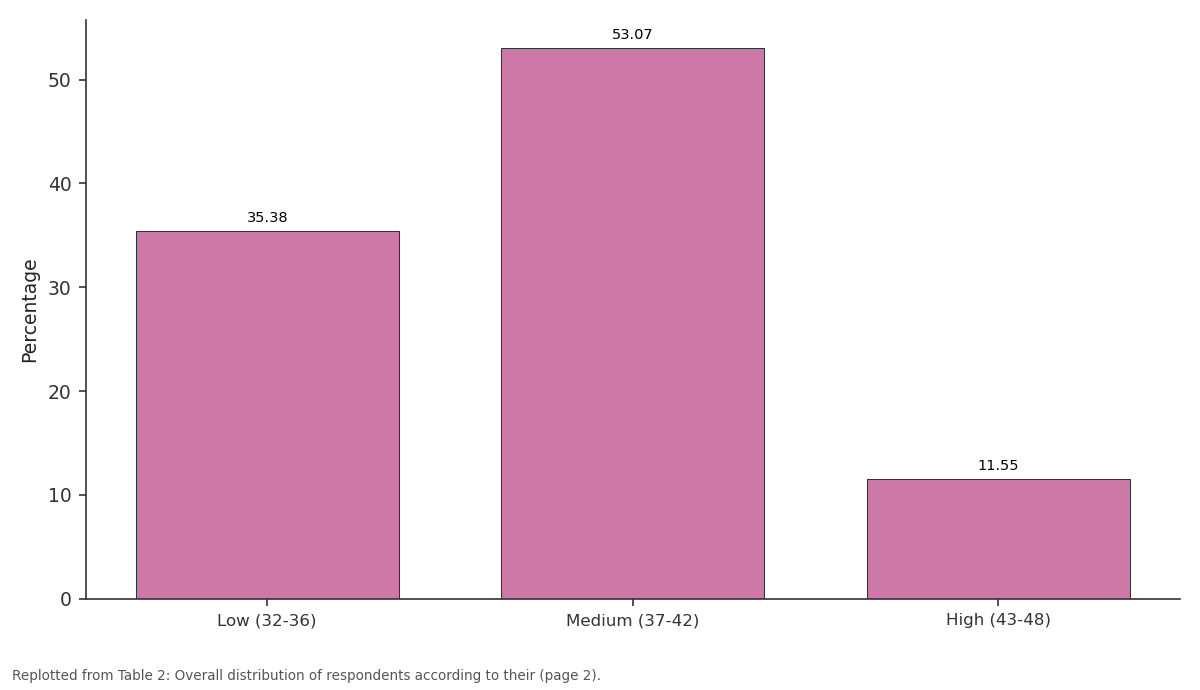
Percentage: Low (32-36) vs Medium (37-42) vs High (43-48)
Replotted from Table 2 (page 2) of the original paper. Every bar is the paper's own table value.
View source evidence ↗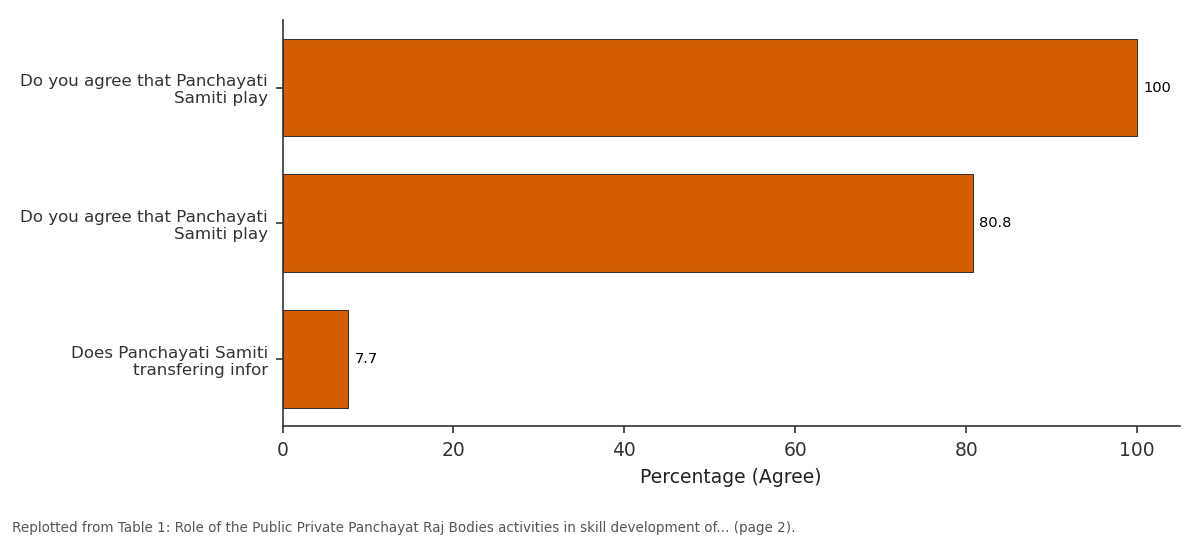
P: Do you agree that... vs Do you agree that... vs Does Panchayati Samiti...
Replotted from Table 1 (page 2) of the original paper. Every bar is the paper's own table value.
View source evidence ↗Figures & tables
From the original paper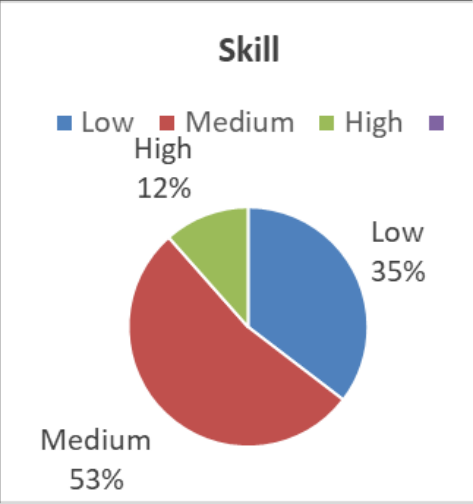 Figure 1
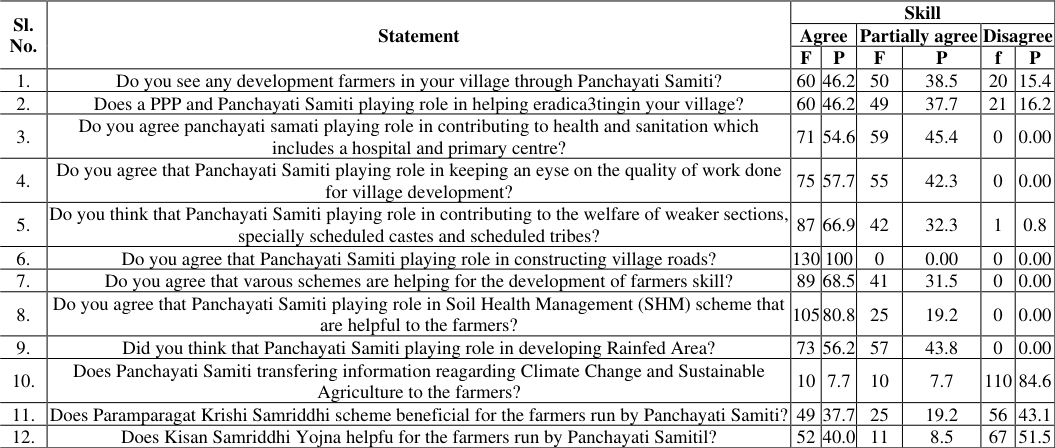 Table 1
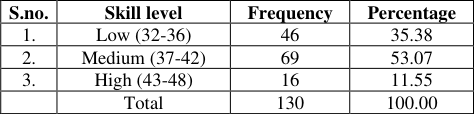 Table 2
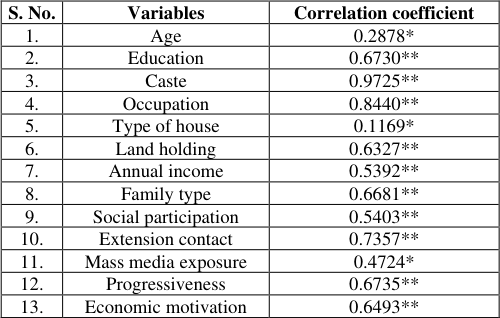 Table 3
Results And Discussion
Fig 1: Distribution of skill of farmers towards role of Public Private Panchayat Raj Bodies
Introduction
Public-private Panchayat Raj bodies represent a collaborative governance model in India, blending public administration with private sector engagement at the local level. Panchayat Raj institutions (PRIs) are a system of local self-government in rural areas, established to decentralize power and enhance local development. These bodies typically include elected representatives such as Sarpanches and Panchayat Members. The introduction of public-private partnerships (PPPs) in this context involves private entities collaborating with Panchayat Raj institutions to improve infrastructure, services, and governance.
This partnership aims to leverage private sector efficiency and innovation while ensuring that the benefits reach the local communities effectively. The synergy between public administration and private expertise helps address local needs more efficiently and fosters sustainable development. Objective • To understand the different activities of Public Private Panchayat Raj bodies. • To determine the role of Public Private Panchayat Raj Bodies in skill development in farmers Research Methodology Descriptive research design was adopted for the study as it describes the characteristics or phenomena that are being studied. The study is carried out in the Korba district of Chhattisgarh Out of 5 blocks, two block namely Korba and Katghora was selected purposively based on maximum n 240 https://www.extensionjournal.com Table 1: Role of the Public Private Panchayat Raj Bodies activities in skill development of the farmers.
| Sl. No. | Statement | Skill | — | — | — | — | — |
|---|---|---|---|---|---|---|---|
| Agree | Partially agree | Disagree | |||||
| F | P | F | P | f | P | ||
| 1. | Do you see any development farmers in your village through Panchayati Samiti? | 60 | 46.2 | 50 | 38.5 | 20 | 15.4 |
| 2. | Does a PPP and Panchayati Samiti playing role in helping eradica3tingin your village? | 60 | 46.2 | 49 | 37.7 | 21 | 16.2 |
| 3. | Do you agree panchayati samati playing role in contributing to health and sanitation which includes a hospital and primary centre? | 71 | 54.6 | 59 | 45.4 | 0 | 0.00 |
| 4. | Do you agree that Panchayati Samiti playing role in keeping an eyse on the quality of work done for village development? | 75 | 57.7 | 55 | 42.3 | 0 | 0.00 |
| 5. | Do you think that Panchayati Samiti playing role in contributing to the welfare of weaker sections, specially scheduled castes and scheduled tribes? | 87 | 66.9 | 42 | 32.3 | 1 | 0.8 |
| 6. | Do you agree that Panchayati Samiti playing role in constructing village roads? | 130 | 100 | 0 | 0.00 | 0 | 0.00 |
| 7. | Do you agree that varous schemes are helping for the development of farmers skill? | 89 | 68.5 | 41 | 31.5 | 0 | 0.00 |
| 8. | Do you agree that Panchayati Samiti playing role in Soil Health Management (SHM) scheme that are helpful to the farmers? | 105 | 80.8 | 25 | 19.2 | 0 | 0.00 |
| 9. | Did you think that Panchayati Samiti playing role in developing Rainfed Area? | 73 | 56.2 | 57 | 43.8 | 0 | 0.00 |
| 10. | Does Panchayati Samiti transfering information reagarding Climate Change and Sustainable Agriculture to the farmers? | 10 | 7.7 | 10 | 7.7 | 110 | 84.6 |
| 11. | Does Paramparagat Krishi Samriddhi scheme beneficial for the farmers run by Panchayati Samiti? | 49 | 37.7 | 25 | 19.2 | 56 | 43.1 |
| 12. | Does Kisan Samriddhi Yojna helpfu for the farmers run by Panchayati Samitil? | 52 | 40.0 | 11 | 8.5 | 67 | 51.5 |
Table text extracted from the original PDF; superscript letters are shown inline. The original table image is below.
View original table image
Sl. No. Statement Skill Agree Partially agree Disagree F P F P f P 1. Do you see any development farmers in your village through Panchayati Samiti? 60 46.2 50 38.5 20 15.4 2.
Does a PPP and Panchayati Samiti playing role in helping eradica3tingin your village? 60 46.2 49 37.7 21 16.2 3. Do you agree panchayati samati playing role in contributing to health and sanitation which includes a hospital and primary centre? 71 54.6 59 45.4 0 0.00 4. Do you agree that Panchayati Samiti playing role in keeping an eyse on the quality of work done for village development? 75 57.7 55 42.3 0 0.00 5. Do you think that Panchayati Samiti playing role in contributing to the welfare of weaker sections, specially scheduled castes and scheduled tribes? 87 66.9 42 32.3 1 0.8 6.
Do you agree that Panchayati Samiti playing role in constructing village roads? 130 100 0 0.00 0 0.00 7. Do you agree that varous schemes are helping for the development of farmers skill? 89 68.5 41 31.5 0 0.00 8. Do you agree that Panchayati Samiti playing role in Soil Health Management (SHM) scheme that are helpful to the farmers? 105 80.8 25 19.2 0 0.00 9. Did you think that Panchayati Samiti playing role in developing Rainfed Area? 73 56.2 57 43.8 0 0.00 10.
Does Panchayati Samiti transfering information reagarding Climate Change and Sustainable Agriculture to the farmers? 10 7.7 10 7.7 110 84.6 11. Does Paramparagat Krishi Samriddhi scheme beneficial for the farmers run by Panchayati Samiti? 49 37.7 25 19.2 56 43.1 12. Does Kisan Samriddhi Yojna helpfu for the farmers run by Panchayati Samitil? 52 40.0 11 8.5 67 51.5 F= Frequency, P=Percentage Table 2: Overall distribution of respondents according to their skill level S.no. Skill level Frequency Percentage 1.
| S.no. | Skill level | Frequency | Percentage |
|---|---|---|---|
| 1. | Low (32-36) | 46 | 35.38 |
| 2. | Medium (37-42) | 69 | 53.07 |
| 3. | High (43-48) | 16 | 11.55 |
| Total | 130 | 100.00 |
Table text extracted from the original PDF; superscript letters are shown inline. The original table image is below.
View original table image
Low (32-36) 46 35.38 2. Medium (37-42) 69 53.07 3. High (43-48) 16 11.55 Total 130 100.00 The data presented in the table 2 reveals that majority. It was found out that 53.07 per cent respondents had medium level of skill followed by 35.38 per cent respondents had low level of skill and 11.55 per cent had high level of skill.
Table 3: Correlation between selected independent variables with dependent variables i.e. socio economic profile and skill
| S. No. | Variables | Correlation coefficient |
|---|---|---|
| 1. | Age | 0.2878* |
| 2. | Education | 0.6730** |
| 3. | Caste | 0.9725** |
| 4. | Occupation | 0.8440** |
| 5. | Type of house | 0.1169* |
| 6. | Land holding | 0.6327** |
| 7. | Annual income | 0.5392** |
| 8. | Family type | 0.6681** |
| 9. | Social participation | 0.5403** |
| 10. | Extension contact | 0.7357** |
| 11. | Mass media exposure | 0.4724* |
| 12. | Progressiveness | 0.6735** |
| 13. | Economic motivation | 0.6493** |
Table text extracted from the original PDF; superscript letters are shown inline. The original table image is below.
View original table image
Conclusion
It was concluded that role played by PPPRB was medium 53.07 per cent followed by low level of skill 35.38 per cent and 11.55 per cent had high level of skill.
Acknowledgement
I express my deepest findings gratitude to my Advisor, Prof. Dr. Syed H. Mazhar, for their valuable guidance and support.
I also thank the faculty of Department of Agricultural Extension and Communication, NAI- SHUATS. Special thanks to the farmers who participated and for their insights, and to my family and friends for their unwavering support.
References
18 in the original paper- Hussain A. Role of Project for Creating Model Gram Panchayat Clusters (PCMGPCs) in Strengthening Panchayati Raj Institutions in Jammu & Kashmir. Indian J Soc Stud Humanities. 2023;1(15).
- Shukla S, Pankaj A. Potential of Gram Panchayat in the Transformation of Rural India: A Socio-Legal Analysis. Int J Law Soc Sci. 2022;8(1).
- Dar LH. Panchayati Raj Institutions: As an Instrument of Social and Economic Progress. Pramana Res J. 2020;10(6).
- Das B. Role of Panchayati Raj System in Transforming Rural India. Webology. 2021;18(6).
- Yuvaraj, Chakraborty S, Acharya SK. Role Performance of Panchayat Raj for Development of Farming and Rural Community in Puttaparthi Block of Anantapur District (A.P). Int J Res Humanit. 2018;6(6):341-346.
- Anupama. Role of Panchayat Raj in Women Empowerment: Regional Analysis of India. Int Peer Rev J. 2017;4(1):36-46.
- Ramya T. Role of Panchayati Raj Institutions in Rural Development: The Study of a Tribal Village in Arunachal Pradesh. Int J Humanit Soc Sci. 2014;1(3):503-521. . S. No. Variables Correlation coefficient
- Education 0.6730**
- Occupation 0.8440**
- Type of house 0.1169*
- Land holding 0.6327**
- Annual income 0.5392**
- Family type 0.6681**
- Social participation 0.5403**
- Extension contact 0.7357**
- Mass media exposure 0.4724*
- Progressiveness 0.6735**
- Economic motivation 0.6493** * = Correlation is significant at the 0.01 level of probability ** = Correlation is significant at the 0.05 level of probability It is observed from the table 4.3 that, age, type of house and mass media exposure were positively significantly correlated at 0.05 per cent level of probability and education, caste, occupation, holding, annual income, family type, social participation, extension contact, progressiveness and economic motivation were significantly correlated at 0.01per cent level of probability with skill of farmers. 241