
Research article · 2024 · Full text
International Journal of Agriculture Extension and Social DevelopmentKnowledge level of mango growers towards improved cultivation practices in Malda district, West Bengal
Volume 7(8S) · Pages 29–32 · DOI: 10.33545/26180723.2024.v7.i8sa.905 ↗
Research areasAgricultural Economics and PracticesSilkworms and Sericulture ResearchAgricultural Systems and Practices
Abstract
Author-writtenMango (Mangifera indica) is highly regarded in India, known as the "King of fruits" due to its adaptability, high nutritional value, taste, and popularity.West Bengal, particularly Malda district, is a leading region for mango cultivation.This region grows varieties like Langra, Himsagar, Amrapali, Laxmanbhog, Gopalbhog, and Fazli, with mangoes available from May to August.The study has been done in Malda district of West Bengal.The study has been conducted to measure the extent of knowledge of mango growers towards improved cultivation practices.Based on highest numbers of mango growers in the villages, a total 140 respondents were selected randomly chosen from seven villages within English Bazar block.The data is collected through pre developed scheduled and analysed with proper statistical tools and techniques.The study inferred that most respondents (55.00%) belong to middle age group.A significant number of the respondents have medium level of scientific orientation (45.71%), risk bearing capacity (48.57%) and progressiveness (43.57%).According to the study, the majority of the respondents (57.86%) had a medium level of knowledge about the improved mango cultivation practices.Independent Variables such as age, educational qualification, occupation, family size, social participation, mass media exposure, extension contact, scientific orientation, risk bearing capacity shows a positive and significant correlation with knowledge level.
Summary
Source-checkedPlain-language reading of the full paper, prepared with AI and checked against the text. Each point links to the authors' own words.
Why it matters
- Malda district is the leading region for mango cultivation in West Bengal in terms of crop area. View evidence ↗
- Mango quality has been declining due to the improper use of chemicals, including excessive fertilizers and ripening agents. View evidence ↗
The question
- The study aimed to measure how much knowledge mango growers in the Malda district have regarding improved cultivation practices. View evidence ↗
What they did
- The researchers used proportionate random sampling to select 140 respondents from seven villages within the English Bazar block of Malda district. View evidence ↗
- Data was gathered using pre-developed schedules and analyzed with statistical tools. View evidence ↗
What they found
- The majority of the respondents (55.00%) were in the middle age group. View evidence ↗
- A significant portion of growers showed a medium level of progressiveness (43.57%), risk-bearing capacity (48.57%), and scientific orientation (45.71%). View evidence ↗
- The majority of respondents (57.86%) possessed a medium level of knowledge regarding improved mango cultivation practices. View evidence ↗
- Regarding specific practices, 60% of respondents had full knowledge about improved mango varieties. View evidence ↗
- Knowledge gaps were identified in irrigation, with 45% of respondents lacking knowledge of improved techniques. View evidence ↗
- Over half of the respondents (52.14%) demonstrated proper knowledge regarding yield. View evidence ↗
- Factors such as age, income, family size, educational qualification, extension contact, and risk-bearing capacity were significantly positively correlated with knowledge levels (p < 0.01). View evidence ↗
- Land holding and social participation did not show a significant correlation with the growers' knowledge levels. View evidence ↗
What it means
- The authors conclude that most mango growers in the study area possess a medium level of knowledge about improved cultivation practices. View evidence ↗
Visual summary
2 visualsIllustrations explain the paper; charts are replotted from the paper's own table values.
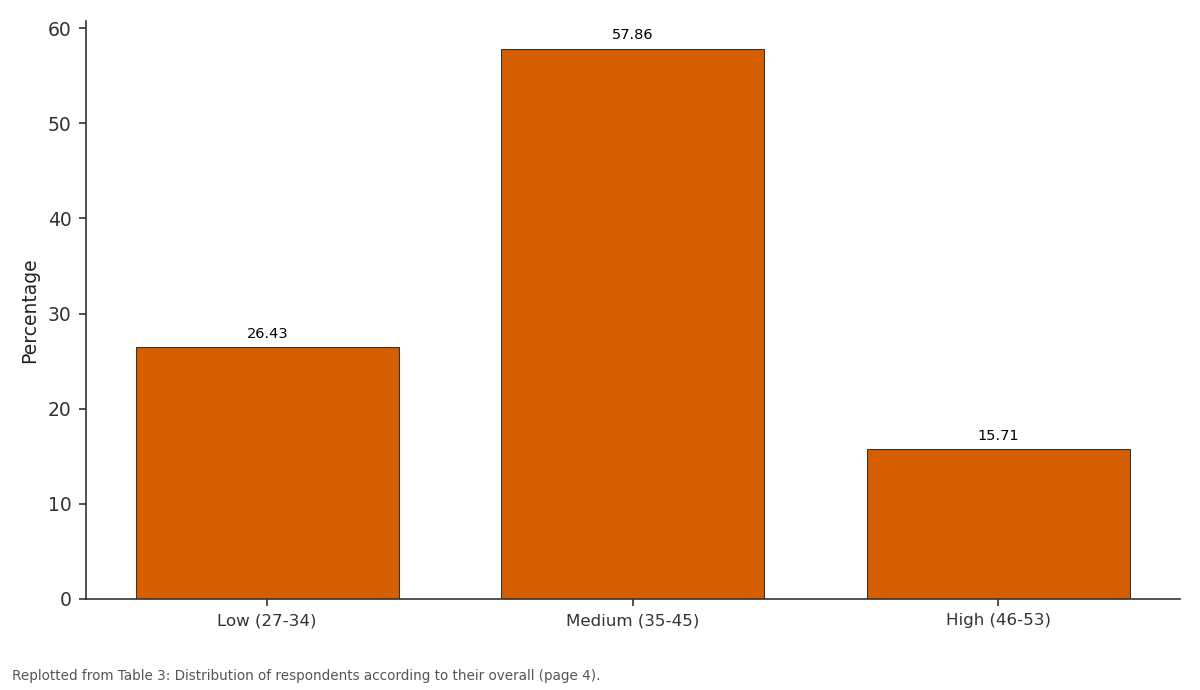
Percentage: Low (27-34) vs Medium (35-45) vs High (46-53)
Replotted from Table 3 (page 4) of the original paper. Every bar is the paper's own table value.
View source evidence ↗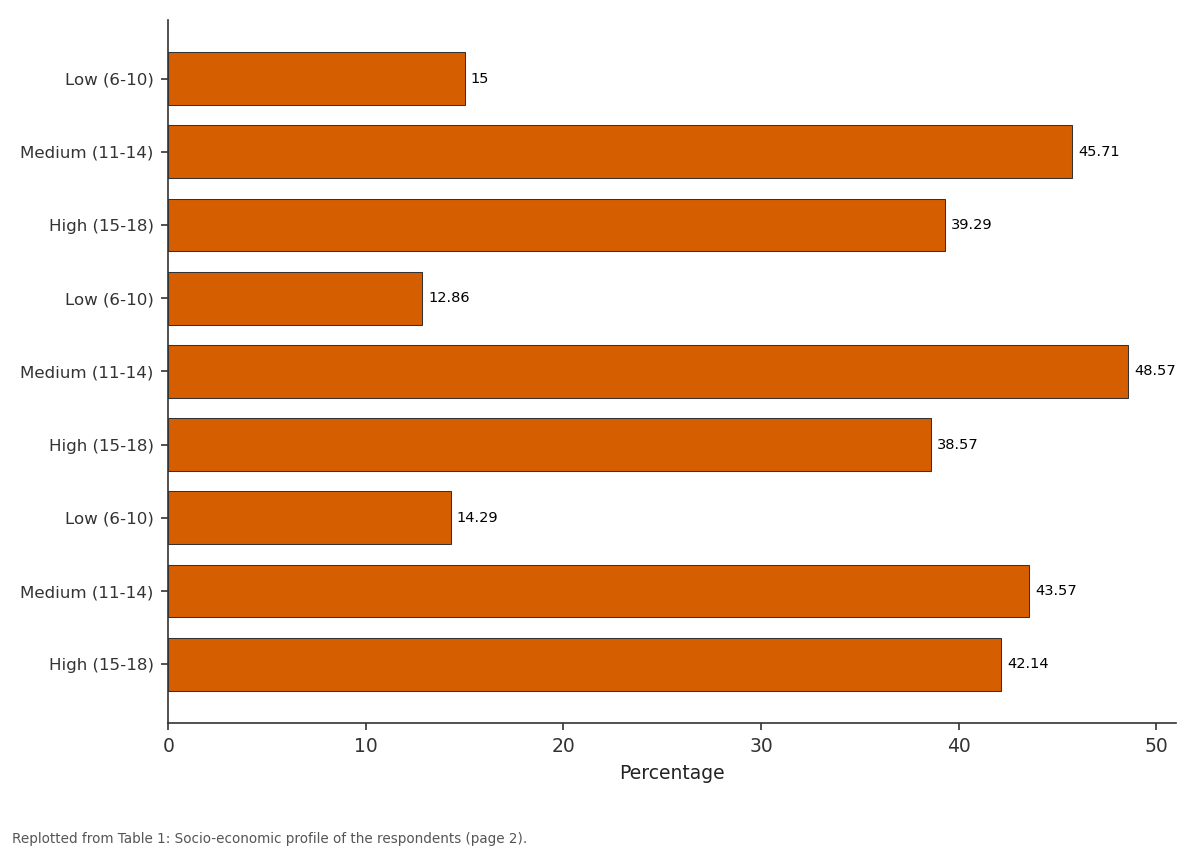
Percentage: Low (6-10) vs Medium (11-14) vs High (15-18) vs Low (6-10) vs Medium (11-14)
Replotted from Table 1 (page 2) of the original paper. Every bar is the paper's own table value.
View source evidence ↗Figures & tables
From the original paper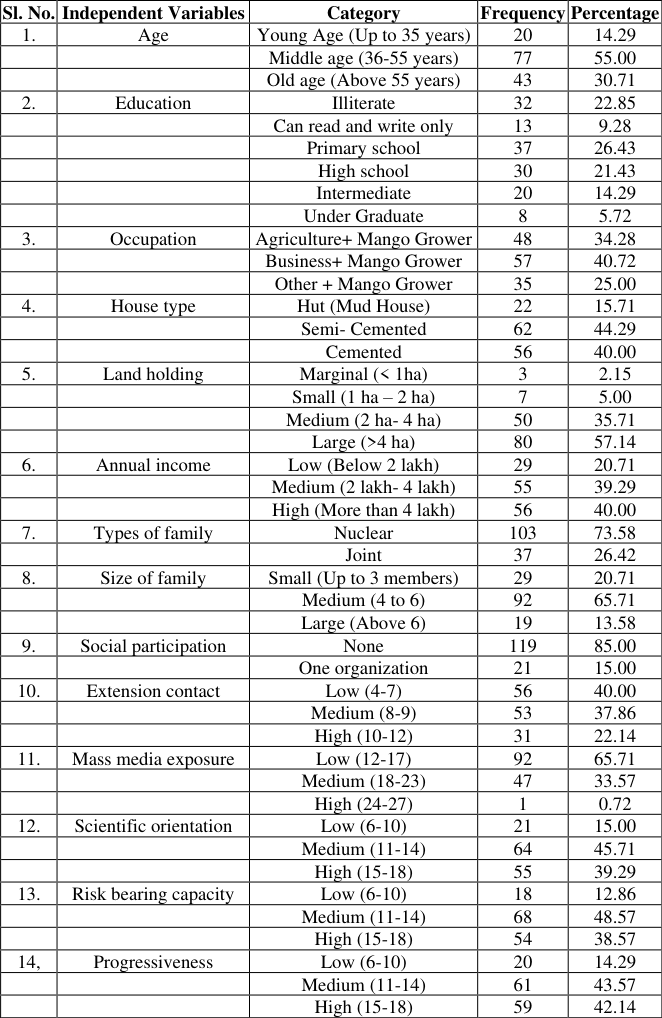 Table 1
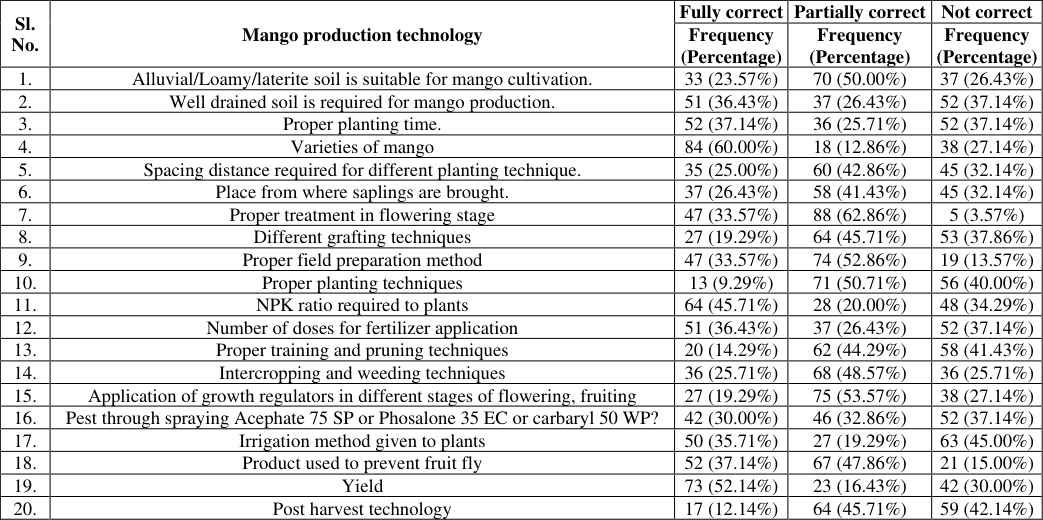 Table 2
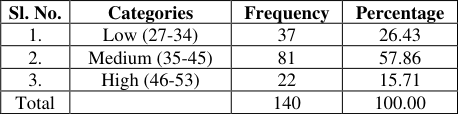 Table 3
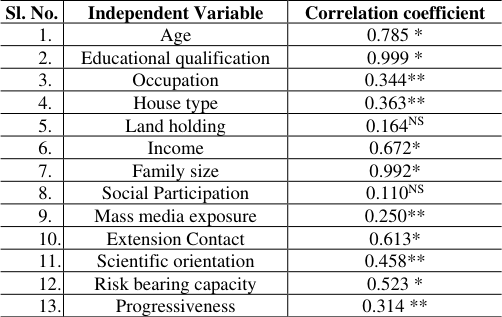 Table 4
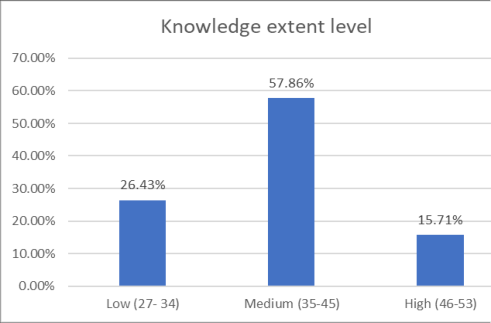 Figure 1
Introduction
Mango (Mangifera indica) is the most important fruit of India. The mango has become a most important fruit crop of the tropics and sub-tropics, particularly in Asia where it has considered the 'King of fruits' (Mukherjee and Litz, 2009) [7] due to its wide adaptability, high nutritive value, delicious taste, excellent flavour, attractive appearance, and popularity among masses (Kishun et al., 1998) [4] . West Bengal is a progressive state in the field of modern horticulture in the country. West Bengal is one of the leading state in respect of mango cultivation in India. In terms of area under the crop, the Malda district ranks first in the state followed by Murshidabad and North 24 Pargana. Mango is undoubtedly the best-known product of the district having national and international fame. In the year 2021-2022 the total area under mango production estimated was 32000 ha and the mango production estimated was 3.57 lakh metric ton. A range of delectable table fruit, ranging from the famous langra to the himasagar, amrapali, laxmanbhog, gopalbhog and fazli mango varieties grows in the mangoes grown in the district become available for processing between the months of May and August, starting from early varieties such as the himsagar and laxmanbhog to late varieties such as the gopalbhog. Thus, once an orchard has been planted and has matured, mango cultivation becomes a highly seasonal activity, with the activity period spanning just four months of the year. As the district's economy is largely dependent on production and trading of mango, storage and transportation facility has improved a lot. (District Census Handbook, 2011) [1] . The quality of mango is decreasing over the years due to use of excessive use of chemical fertilizers, treatment of plants with improper dose of chemicals, applying chemical ripening chemical etc. Hence it is imperative to analyse the actual status of mango in cropping system of Malda district. It was also felt necessary to critically analyse the extent of knowledge of improved mango cultivation practices. Knowledge of improved production practices is the key to higher production of fruits and higher incomes to farmers. The technical knowledge of growers appears to be the key link to higher level of adoption. The scientific research being done at the fruit research stations has to be transferred to orchardists through extension education processes including on-farm training, distributing extension literature and regular field visits and demonstrations. Once growers acquire knowledge, they begin to use and apply new techniques and improved practices in their orchards. Even among growers, there is a great variation in their levels of knowledge, as well as their readiness to accept, try new methods and improved production practices. Some need more time to grasp and get convinced and hence need longer sustained support from extension agencies including horticulture department staff. www.extensionjournal.com
Research methodology
Descriptive research design was followed for the study as it describes the characters that are being studied. The present study has been conducted in Malda district of West Bengal. Out of 16 blocks in Malda district, English Bazar has been chosen purposively based on the maximum number of mango growers among the all blocks of the district. From selected block, seven villages were selected randomly and from there a total number of 140 respondents were selected through proportionate random sampling method who were involved in mango cultivation.
Objectives of the study 1. To assess the socio-economic profile of the respondents. 2. To determine the extent of knowledge of the respondents towards improved mango cultivation practices [11] , Saryam & Jirli (2020) [10] and Kumar et al. (2022) [5] . The results from table 4, indicate that several independent variables, including age, educational qualification, occupation, house type, income, family size, social participation, mass media exposure, extension contact, scientific orientation, risk bearing capacity shows a positive and significant correlation with knowledge level. Among the independent variables age, educational qualification, income, family size, extension contact, risk bearing capacity shows positive correlation which is significant at 0.01 per cent probability. Occupation, house type, mass media exposure, scientific orientation, progressiveness shows positive correlation which is significant at 0.05 per cent probability. It shows that there is no significance with land holding and social participation.
| Sl. No. | Independent Variable | Correlation coefficient |
|---|---|---|
| 1. | Age | 0.785 * |
| 2. | Educational qualification | 0.999 * |
| 3. | Occupation | 0.344** |
| 4. | House type | 0.363** |
| 5. | Land holding | 0.164NS |
| 6. | Income | 0.672* |
| 7. | Family size | 0.992* |
| 8. | Social Participation | 0.110NS |
| 9. | Mass media exposure | 0.250** |
| 10. | Extension Contact | 0.613* |
| 11. | Scientific orientation | 0.458** |
| 12. | Risk bearing capacity | 0.523 * |
| 13. | Progressiveness | 0.314 ** |
Table text extracted from the original PDF; superscript letters are shown inline. The original table image is below.
View original table image
Results and Discussion
Results and Discussion
Conclusion
It is concluded that most respondents were middle aged group, possessed a higher level of literacy, belonged to nuclear families, resided in semi-cemented houses, significant source of income was mango cultivation along with business, possessed a higher level of literacy and had high level of annual income. A significant number of the respondents have medium level of scientific orientation, risk bearing capacity and progressiveness. The maximum numbers of the respondents have a medium level of knowledge regarding improved mango cultivation practices. Independent Variables such as age, educational qualification, occupation, family size, social participation, mass media exposure, extension contact, scientific orientation, risk bearing capacity shows a positive and significant correlation with knowledge level.
Competing Interest
Authors have declared that no competing interests exist.
Figures and tables from the paper
| Sl. No. | Independent Variables | Category | Frequency | Percentage |
|---|---|---|---|---|
| 1. | Age | Young Age (Up to 35 years) | 20 | 14.29 |
| Middle age (36-55 years) | 77 | 55.00 | ||
| Old age (Above 55 years) | 43 | 30.71 | ||
| 2. | Education | Illiterate | 32 | 22.85 |
| Can read and write only | 13 | 9.28 | ||
| Primary school | 37 | 26.43 | ||
| High school | 30 | 21.43 | ||
| Intermediate | 20 | 14.29 | ||
| Under Graduate | 8 | 5.72 | ||
| 3. | Occupation | Agriculture+ Mango Grower | 48 | 34.28 |
| Business+ Mango Grower | 57 | 40.72 | ||
| Other + Mango Grower | 35 | 25.00 | ||
| 4. | House type | Hut (Mud House) | 22 | 15.71 |
| Semi- Cemented | 62 | 44.29 | ||
| Cemented | 56 | 40.00 | ||
| 5. | Land holding | Marginal (< 1ha) | 3 | 2.15 |
| Small (1 ha – 2 ha) | 7 | 5.00 | ||
| Medium (2 ha- 4 ha) | 50 | 35.71 | ||
| Large (>4 ha) | 80 | 57.14 | ||
| 6. | Annual income | Low (Below 2 lakh) | 29 | 20.71 |
| Medium (2 lakh- 4 lakh) | 55 | 39.29 | ||
| High (More than 4 lakh) | 56 | 40.00 | ||
| 7. | Types of family | Nuclear | 103 | 73.58 |
| Joint | 37 | 26.42 | ||
| 8. | Size of family | Small (Up to 3 members) | 29 | 20.71 |
| Medium (4 to 6) | 92 | 65.71 | ||
| Large (Above 6) | 19 | 13.58 | ||
| 9. | Social participation | None | 119 | 85.00 |
| One organization | 21 | 15.00 | ||
| 10. | Extension contact | Low (4-7) | 56 | 40.00 |
| Medium (8-9) | 53 | 37.86 | ||
| High (10-12) | 31 | 22.14 | ||
| 11. | Mass media exposure | Low (12-17) | 92 | 65.71 |
| Medium (18-23) | 47 | 33.57 | ||
| High (24-27) | 1 | 0.72 | ||
| 12. | Scientific orientation | Low (6-10) | 21 | 15.00 |
| Medium (11-14) | 64 | 45.71 | ||
| High (15-18) | 55 | 39.29 | ||
| 13. | Risk bearing capacity | Low (6-10) | 18 | 12.86 |
| Medium (11-14) | 68 | 48.57 | ||
| High (15-18) | 54 | 38.57 | ||
| 14, | Progressiveness | Low (6-10) | 20 | 14.29 |
| Medium (11-14) | 61 | 43.57 | ||
| High (15-18) | 59 | 42.14 |
Table text extracted from the original PDF; superscript letters are shown inline. The original table image is below.
View original table image
| Sl. No. | Mango production technology | Fully correct | Partially correct | Not correct |
|---|---|---|---|---|
| Frequency (Percentage) | Frequency (Percentage) | Frequency (Percentage) | ||
| 1. | Alluvial/Loamy/laterite soil is suitable for mango cultivation. | 33 (23.57%) | 70 (50.00%) | 37 (26.43%) |
| 2. | Well drained soil is required for mango production. | 51 (36.43%) | 37 (26.43%) | 52 (37.14%) |
| 3. | Proper planting time. | 52 (37.14%) | 36 (25.71%) | 52 (37.14%) |
| 4. | Varieties of mango | 84 (60.00%) | 18 (12.86%) | 38 (27.14%) |
| 5. | Spacing distance required for different planting technique. | 35 (25.00%) | 60 (42.86%) | 45 (32.14%) |
| 6. | Place from where saplings are brought. | 37 (26.43%) | 58 (41.43%) | 45 (32.14%) |
| 7. | Proper treatment in flowering stage | 47 (33.57%) | 88 (62.86%) | 5 (3.57%) |
| 8. | Different grafting techniques | 27 (19.29%) | 64 (45.71%) | 53 (37.86%) |
| 9. | Proper field preparation method | 47 (33.57%) | 74 (52.86%) | 19 (13.57%) |
| 10. | Proper planting techniques | 13 (9.29%) | 71 (50.71%) | 56 (40.00%) |
| 11. | NPK ratio required to plants | 64 (45.71%) | 28 (20.00%) | 48 (34.29%) |
| 12. | Number of doses for fertilizer application | 51 (36.43%) | 37 (26.43%) | 52 (37.14%) |
| 13. | Proper training and pruning techniques | 20 (14.29%) | 62 (44.29%) | 58 (41.43%) |
| 14. | Intercropping and weeding techniques | 36 (25.71%) | 68 (48.57%) | 36 (25.71%) |
| 15. | Application of growth regulators in different stages of flowering, fruiting | 27 (19.29%) | 75 (53.57%) | 38 (27.14%) |
| 16. | Pest through spraying Acephate 75 SP or Phosalone 35 EC or carbaryl 50 WP? | 42 (30.00%) | 46 (32.86%) | 52 (37.14%) |
| 17. | Irrigation method given to plants | 50 (35.71%) | 27 (19.29%) | 63 (45.00%) |
| 18. | Product used to prevent fruit fly | 52 (37.14%) | 67 (47.86%) | 21 (15.00%) |
| 19. | Yield | 73 (52.14%) | 23 (16.43%) | 42 (30.00%) |
| 20. | Post harvest technology | 17 (12.14%) | 64 (45.71%) | 59 (42.14%) |
Table text extracted from the original PDF; superscript letters are shown inline. The original table image is below.
View original table image
| Sl. No. | Categories | Frequency | Percentage |
|---|---|---|---|
| 1. | Low (27-34) | 37 | 26.43 |
| 2. | Medium (35-45) | 81 | 57.86 |
| 3. | High (46-53) | 22 | 15.71 |
| Total | 140 | 100.00 |
Table text extracted from the original PDF; superscript letters are shown inline. The original table image is below.
View original table image
References
7 in the original paper- Haldar G. Economic significance behind of the mango cultivation of the Malda district in West Bengal: Case study in English Bazer block, Malda district. J Surv Fish Sci. 2022;9(1):940-947.
- Kumar M, Yadav VK, Doharey RK, Yadav RN, Kumar G. Knowledge level of mango orchardists in relation to different practices of mango in Meerut district, Uttar Pradesh, India. Asian J Agric Ext Econ Sociol. 2022;40(11):38-44.
- Lakshmi R, Singh AK, Shelar R. Knowledge and adoption of good management practices among litchi farmers in Muzaffarpur district of Bihar. Indian J Ext Educ. 2023;59(4):130-134.
- Saadat MN, Gupta K. Mango cultivation in Malda district, West Bengal: A historical perspective. Asian Agri Hist. 2017;21:309-318.
- Saadat MN, Gupta K. Trend and spatial pattern of area, production and productivity of mango crop in Malda district, West Bengal: A geographical analysis. Indian J Reg Sci. 2018;50(1):103-107.
- Saryam M, Jirli B. Socio-economic status of orange farmers in Chhindwara district of Madhya Pradesh. Int J Agric Sci Res. 2020;10(2):67-78.
- Singh SK, Singh S. Socio-economic relationship with knowledge of mango grower of Lucknow. Bull Environ Pharmacol Life Sci. 2017;6(1):244-248.
Cited by 1
From OpenAlex, OpenCitations and reference lists read by Scinovex
- Evaluating the Socioeconomic Outcomes of Agricultural Information Literacy among Mango Cultivators: Evidence from Malda District, India ↗
Md. Manirul Islam, Renu Bala · International Journal of Applied and Behavioral Sciences · 2026
Knowing how to find and use agricultural information is very important for farmers. It helps them make smart choices about growing crops, managing resources and dealing with the market. As digital tools and farming methods change in India, it’s becoming more and more important for farmers to be able to find, understand and use the right farming information. This study…
❝ 0PDF