
Research article · 2024 · Full text
International Journal of Veterinary Sciences and Animal HusbandryManagement of shell repair in Indian pond terrapin: Case study
Volume 9(4) · Pages 362–363 · DOI: 10.22271/veterinary.2024.v9.i4f.1578 ↗
Research areasFish Biology and Ecology StudiesMarine Biology and Environmental Chemistry
Abstract
Author-writtenAn Indian Pond terrapin was rescued with the history of vehicle run over after examination it was noticed that it had a shell fracture in the carapace. The Terrapin weighed 500 gms. Shell repair was performed under General anaesthesia using Ketamine and butorphanol and maintained under isoflurane. To bring the shell into opposition metal dress hooks were used and these hooks were anchored to the shell with epoxy putty, and Stainless-steel wires were placed in the cloth hook and tightened to bring the cloth hooks and the shell closure to each other and thus facilitating healing process.
Summary
Source-checkedPlain-language reading of the full paper, prepared with AI and checked against the text. Each point links to the authors' own words.
Why it matters
- The Indian Pond terrapin (Melanochelys trijuga) is a medium-sized still-water species found across several South and Southeast Asian countries. View evidence ↗
- Shell injuries are frequently seen in both wild and captive turtles, requiring immediate pain relief and supportive care, and potentially surgical fixation. View evidence ↗
- The choice of shell fracture fixation method depends on the fracture's characteristics, the veterinarian's experience, and available resources. View evidence ↗
The question
- The study aims to describe the management and repair of a carapace fracture in an Indian Pond terrapin using metal cloth hooks and wire. View evidence ↗
What they did
- A terrapin with a vehicle-induced carapace fracture was stabilized at the PfA wildlife rescue and conservation centre in Bangalore using subcutaneous fluids and Tramadol (5 mg/kg IM) for three days prior to surgery. View evidence ↗
- Surgery was performed under general anesthesia induced with Tramadol, Ketamine (10 mg/kg), and butorphanol (1 mg/kg IM), and maintained with isoflurane and oxygen at 2 l/min. View evidence ↗
- Metal cloth hooks were anchored to the shell using epoxy putty, which was allowed to dry overnight, and then secured with stainless steel wires. View evidence ↗
- The fractured shell was brought into opposition by wrapping precut stainless steel wires around the hooks in a figure-eight pattern, with the knot centered between the hooks. View evidence ↗
- Post-operative care included Enrofloxacin (5 mg/kg IM), Tramadol (5 mg/kg IM), and Meloxicam (0.1 mg/kg IM), with the wound flushed using a 2% chlorhexidine solution and normal saline. View evidence ↗
What they found
- The terrapin successfully recovered and was released back into the wild after an eight-month rehabilitation period. View evidence ↗
- The authors note that complete shell healing and rehabilitation for chelonians typically takes between eight and twenty months. View evidence ↗
What it means
- The use of metal cloth hooks and stainless steel wire in a figure-eight pattern is an effective method for repairing carapace fractures in the Indian Pond terrapin. View evidence ↗
Visual summary
1 visualsIllustrations explain the paper; they do not show study data.
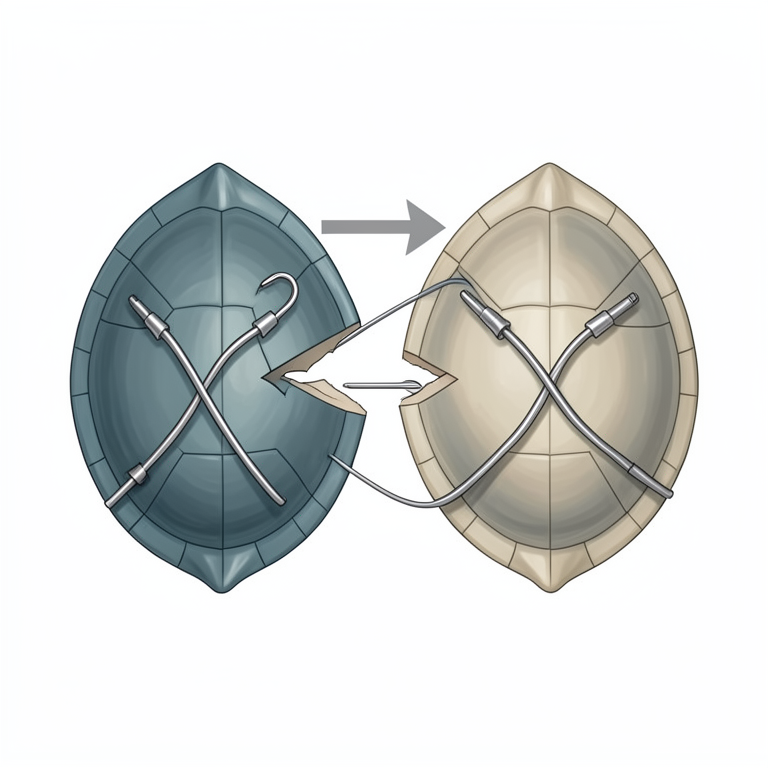
Figure-Eight Shell Fixation
AI-generated conceptual illustration (Indian pond terrapin shell). It explains the idea and does not show study data.
View source evidence ↗Figures & tables
From the original paper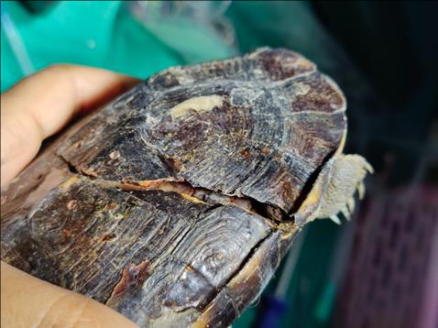 Figure 1
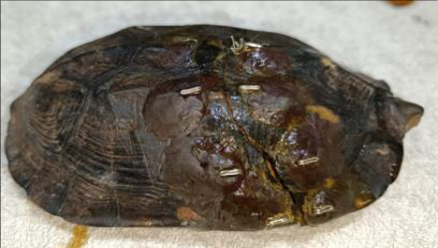 Figure 2
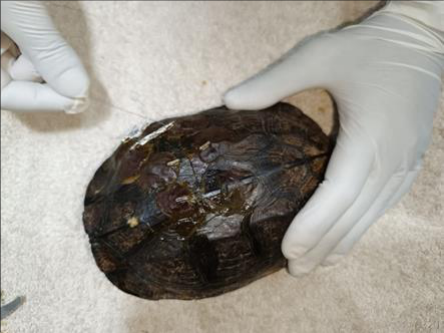 Figure 3
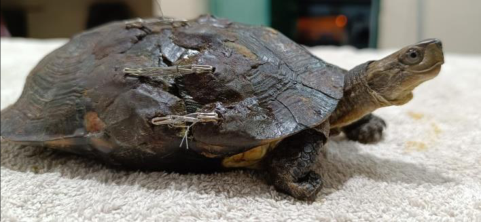 Figure 4
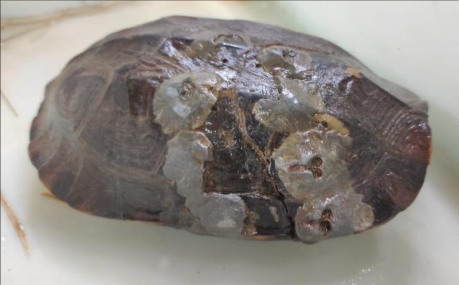 Figure 5
Introduction
The Indian Pond terrapin, Melanochelys trijuga (Family Geoemydidae), is a medium sized (carapace length to 38.3 cm), mainly still-water species from northern, northeastern, and peninsular India, Sri Lanka, Myanmar, Nepal, Bangladesh, Thailand, and possibly Pakistan. Six subspecies are currently recognized. The turtle has been introduced to some of the islands of the western Indian Ocean by seafarers. Omnivorous in dietary habits, the species takes aquatic plants in addition to invertebrates and carrion.
Two to 16 elongated, brittle-shelled eggs are laid, with eggs and hatchlings showing considerable size variation. The species, although in no immediate danger in India, is exploited in unknown numbers for food, and population declines have been reported from Sri Lanka (Indraneil Das). The carapace is elongated, relatively more elevated in adults and more depressed in juveniles and Tricarinate with feebly serrated marginal posteriorly. The nuchal scute is small and distinctly triangular (Indraneil Das), The plastron is about as long as the carapace, and truncated anteriorly (Indraneil Das) The head is moderate in size, with a short snout, which is shorter than the diameter of the eye (Indraneil Das).
Shell injuries are a common presentation in wild and captive turtles should be provided with immediate analgesia and supportive care followed by fracture fixation if required. There are many methods of fracture fixation and the decision for which method to use is based on the characteristics of the fracture, the veterinarian's familiarity with the method as well as the time and money available for the case. Epoxies and adhesives are suitable for some fractures. Methods that bridge the fracture include cable ties, metal bridges, clothing hooks and the Top Closure method.
Orthopaedics fracture fixation
Methods
include metal sutures, screws with wire and metal plates (Jane Roffey, Sasha Miles), this case was presented with a carapace fracture and was fixed using metal cloth hook and a metal wire.
Materials And Methods
An Indian Pond terrapin was presented to PfA wildlife rescue and conservation centre, Bangalore with the history of vehicle run over. On examination it was noticed that it had fracture in the carapace (Fig.1), the animal was immediately treated with Tramadol @5 mg/kg IM (James W. Carpenter 2022) [⁴] for pain management, the animal was stabilised with subcutaneous fluids and tramadol for 3 days before the surgery. On the day of surgery tramadol followed by Ketamine @10 mg/kg (James W.
Carpenter 2022) [4] and butorphanol @1 mg/kg IM (James W. Carpenter 2022) [⁴]. VET 2024; 9(4): 362-363 Navaz Sheriff Chief Veterinarian and General Manager, PfA Wildlife Hospital, Bengaluru, Karnataka, India Madhav HV Senior Veterinarian, PfA Wildlife Hospital, Bengaluru, Karnataka, India Jayanth KV Associate Veterinarian, PfA Wildlife Hospital, Bengaluru, Karnataka, India Dhanush Y Associate Veterinarian, PfA Wildlife Hospital, Bengaluru, Karnataka, India Navaz Sheriff Chief Veterinarian and General Manager, PfA Wildlife Hospital, Bengaluru, Karnataka, India https://www.veterinarypaper.com After induction isoflurane was used for maintenance with oxygen at the level of 2 l/min. Cloths hooks were placed on the shell and were fixed with epoxy putty and let it dry overnight.
Stainless steel wires were used to anchor to the hook. Precut pieces of wire is wrapped around one hook and the passed to the other screw by bringing the fractured shell in opposition and closure, but by passing it in between the two screws which makes an eight pattern (Fig.3), this is repeated and made sure the knot is in the centre of both the hooks (Fig.4). Fig 4: Knot is made with the stainless wire to keep the fragments in position. Fig 1: An Indian Pond terrapin rescued with a fracture in Carapace Fig 2: Cloth hooks are placed on the shell using epoxy putty Fig 5: Healed Shell Fracture after Eight Months
Results And Discussion
Medical management and surgery of shell fracture in chelonians can be challenging and time consuming, it takes around eight to twenty months for the shell to completely heal and successfully rehabilitate it and release it to the wild.
Acknowledgments
The Authors Thank all the staff at PfA wildlife Hospital for their expertise in handling animals, Rahul J, Vasanth R And Srinivas M for rehabilitation.
References
5 in the original paper- Outerbridge ME, O'Riordan R, Fort DJ, Davenport J. Ecotoxicological assessment of diamondback terrapin (Malaclemys terrapin) pond habitat, prey and eggs in Bermuda. Marine Pollution Bulletin. 2016;102(1):36-43.
- Sayers I, Kubiak M. 20.1 Husbandry. Handbook of Exotic Pet Medicine; c2020.
- Murphy JB. Conservation Initiatives and Studies on Tortoises, Turtles, and Terrapins Mostly in Zoos and Aquariums. Part II Suborder Pleurodira, Suborder Cryptodira, Sea Turtles. Herpetological Review; c2016.
- Brennessel B. Diamonds in the marsh: a natural history of the diamondback terrapin. UPNE; c2006.
- Selman W. Life in skinny water: observations of juvenile diamondback terrapins (Malaclemys terrapin) utilizing shallow water habitats. Herpetological Conservation and Biology. 2018;13(2):399-407. Fig 3: Stainless steel wires are wrapped around the hook in a figure of 8 pattern. Post-operative antibiotics Enrofloxacin @5 mg/kg IM was given along with tramadol @ 5 mg/kg IM, Meloxicam @0.1 mg/kg IM and the wound was flushed with a 2% Solution of chlorhexidine followed by normal saline (MADER& DIVERS). The terrapin was released back to the wild after eight months of rehabilitation. How to Cite This Article Sheriff N, Madhav HV, Jayanth KV, Dhanush Y. Management of shell repair in Indian pond terrapin: Case study. International Journal of Veterinary Sciences and Animal Husbandry. 2024; 9(4): 362-363. Creative Commons (CC) License This is an open access journal, and articles are distributed under the terms of the Creative Commons Attribution-Non-Commercial-Share- Alike 4.0 International (CC BY-NC-SA 4.0) License, which allows others to remix, tweak, and build upon the work non-commercially, as long as appropriate credit is given and the new creations are licensed under the identical terms.